Factors That Affect Your BAC Level After Drinking
A clear look at what actually pushes your blood alcohol concentration up or down — body weight, sex, food, medications, and more — plus real BAC ranges so you know what different levels actually mean.
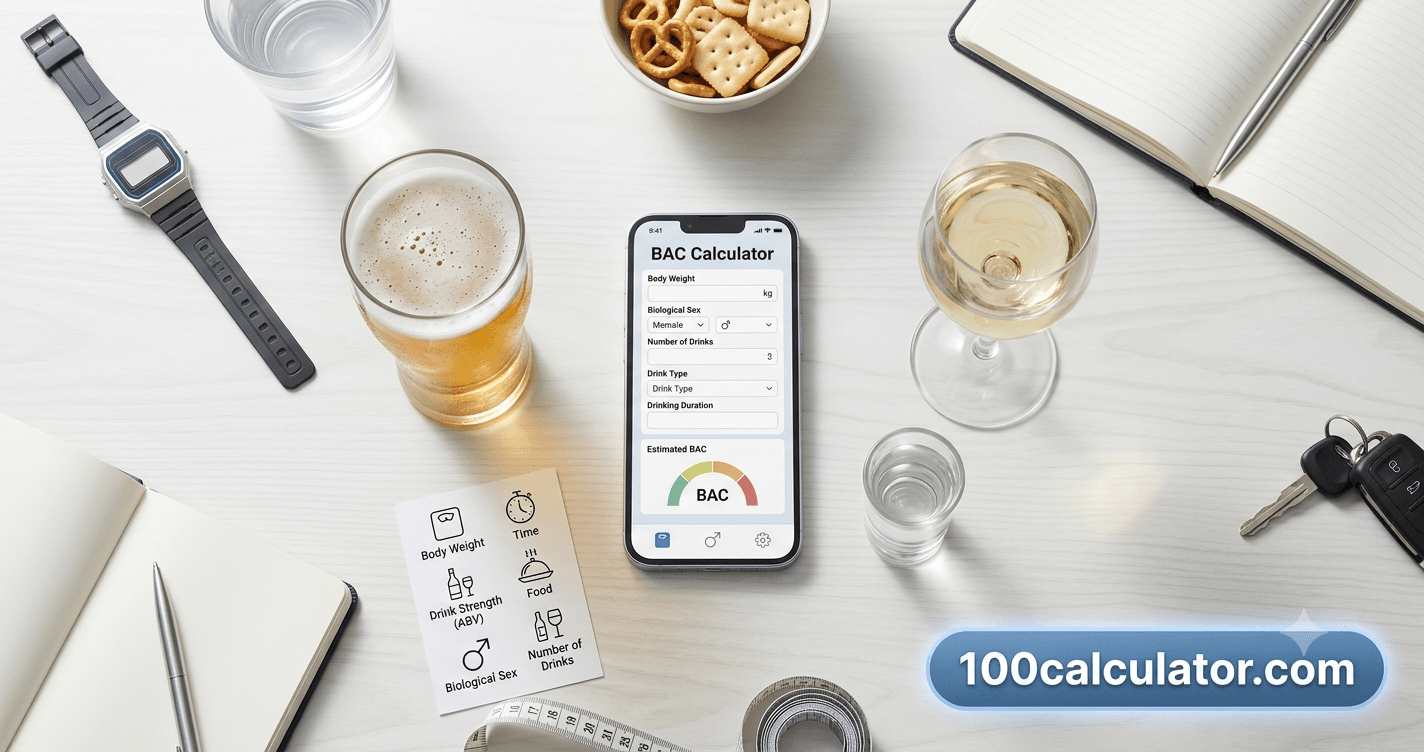
Two people can have the exact same number of drinks and end up in completely different places. One feels barely buzzed. The other is stumbling. That difference isn't random — it comes down to a specific set of factors that change how your body absorbs, spreads, and breaks down alcohol.
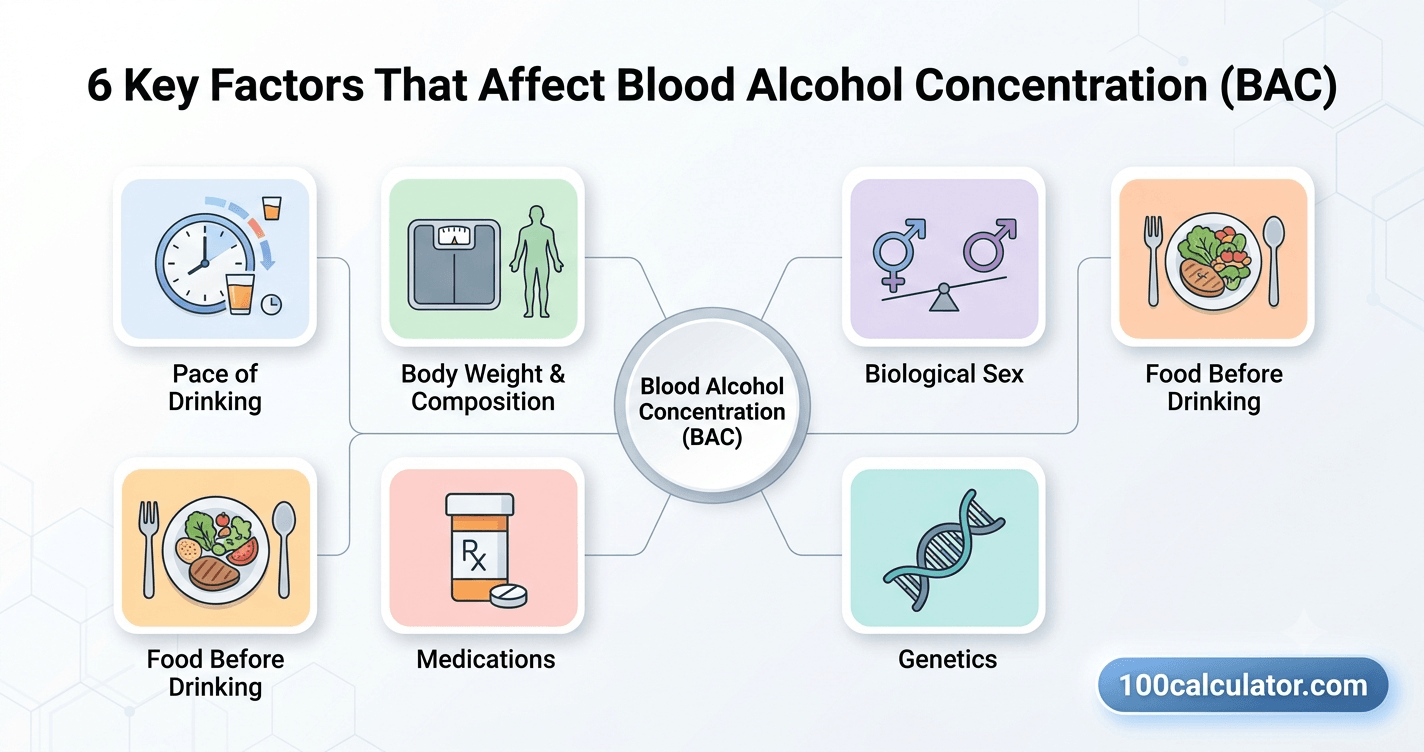
Your BAC, or blood alcohol concentration, depends mainly on six factors: how much and how fast you drink, your body weight and composition, your biological sex, whether you've eaten, any medications or other substances in your system, and your individual metabolism. Change any one of these, and your BAC at the end of the night can look very different, even with the exact same drinks.
Understanding these factors is useful for more than curiosity. It's the difference between guessing how you'll feel after a few drinks and actually knowing your risk. If you want a faster way to estimate where you stand, 100 Calculator's BAC Calculator (Blood Alcohol Concentration) does the math for you based on your weight, sex, and how much you've had to drink.
In this guide, we'll walk through each factor in detail, show you what different BAC levels actually feel like, explain how long alcohol really stays in your system, and clear up a few persistent myths about breathalyzers and "sobering up" fast. First, let's cover what BAC actually measures.
Understanding Blood Alcohol Concentration
Blood alcohol concentration is the amount of alcohol in your bloodstream, expressed as a percentage. A BAC of 0.08%, for example, means 0.08 grams of alcohol are present for every 100 milliliters of blood. You'll also see it written as milligrams per deciliter (mg/dL) or, in some countries, per mille (‰), but the underlying amount is the same either way.
Your BAC rises as you drink because alcohol passes from your stomach and small intestine into your bloodstream, then spreads throughout your body's water. It falls only once your liver has had time to break it down. Nothing else meaningfully speeds up that second part, which is a theme we'll come back to later in this guide.
How BAC Is Measured
BAC is typically measured one of three ways: a breath test, a blood test, or, less commonly, a urine test. Breathalyzers estimate BAC from the alcohol in your breath, while blood tests measure it directly. Blood tests are generally considered the most accurate of the three, since breath tests can be thrown off by a handful of outside factors we'll cover later in this guide.
What Counts as a Standard Drink
Not all drinks affect your BAC equally, because "one drink" isn't a fixed amount of alcohol — it depends entirely on the beverage. That's why health guidelines rely on the idea of a standard drink instead of just counting glasses. (NIAAA) In the United States, one standard drink contains about 14 grams, or 0.6 fluid ounces, of pure alcohol.
| Drink Type | Standard Serving Size | Typical Alcohol Content |
|---|---|---|
| Beer | 12 fl oz (355 mL) | About 5% ABV |
| Wine | 5 fl oz (148 mL) | About 12% ABV |
| Distilled spirits (a shot) | 1.5 fl oz (44 mL) | About 40% ABV |
A tall glass of wine, a strong craft beer, or a heavy-handed cocktail can easily add up to one and a half to three standard drinks, even though it looks like a single serving. That mismatch is one of the easiest ways people underestimate their own BAC.
The Six Main Factors That Affect Your BAC
Some of these factors are within your control on any given night. Others are simply part of your biology. Here's what actually moves the needle.
1. How Much and How Fast You Drink
This is the most obvious factor, but the "how fast" part matters just as much as the "how much" part. Your liver can only process about one standard drink per hour, no matter how much you've had. Drink faster than that, and alcohol builds up in your bloodstream quicker than your body can clear it, so your BAC keeps climbing. Spacing drinks out over a longer period gives your liver time to keep pace, which is why six drinks over six hours leaves you with a much lower peak BAC than six drinks in ninety minutes.
2. Body Weight and Body Composition
Alcohol distributes through the water in your body, not through fat. A larger body generally has more total water available to dilute the same amount of alcohol, so a heavier person will typically reach a lower BAC than a lighter person after drinking the same amount. Body composition matters just as much as the number on the scale, since muscle tissue holds far more water than fat tissue does. If you're curious how your own body composition breaks down beyond just weight, our guide on fat-free mass index is a useful next read.
3. Biological Sex
Women typically reach a higher BAC than men of the same weight after drinking the same amount of alcohol, for two separate reasons. First, women generally have a lower percentage of body water and a higher percentage of body fat than men, leaving less water available to dilute the alcohol. Second, women tend to produce less alcohol dehydrogenase, an enzyme that starts breaking down alcohol in the stomach before it even reaches the bloodstream. Together, these differences mean the same drink affects women more than men, even at an identical body weight.
4. Food in Your Stomach
Drinking on an empty stomach lets alcohol reach your small intestine, where most absorption happens, much faster than if food is slowing things down. Eating before or while you drink — especially something with fat, protein, or fiber — keeps your stomach's exit valve closed longer, delaying how quickly alcohol moves through. A full meal beforehand can meaningfully lower your peak BAC compared to drinking on an empty stomach, even with the identical number of drinks.
5. Medications and Other Substances
Alcohol interacts with a long list of common medications, including antihistamines, sleep aids, anti-anxiety medications, some antidepressants, and certain pain relievers. Some of these slow down how quickly your body processes alcohol, while others simply amplify its sedating effects, which can be risky even if your actual BAC number isn't unusually high. If you take a prescription medication and plan to drink, it's worth a quick check with a pharmacist or your doctor about how the two interact.
6. Genetics and Personal Metabolism
Your genes influence how much alcohol dehydrogenase and aldehyde dehydrogenase your body produces, both of which affect how quickly you break down alcohol. That's part of why some people seem to handle more alcohol without feeling the same effects as others, while some people — commonly people of East Asian descent with a specific enzyme variant — flush, feel nauseated, or feel the effects much faster after even small amounts. Age plays a role too: metabolism tends to slow down somewhat over time, which is part of why the same amount of alcohol can hit harder later in life than it did in your twenties.
Why Body Weight and Body Fat Change Your BAC So Much
Body composition comes up so often in BAC discussions that it's worth slowing down to explain exactly why it matters this much.
Why Water Matters More Than Weight
Alcohol is water-soluble, meaning it mixes into water rather than fat. Once alcohol enters your bloodstream, it spreads evenly across your body's water — inside your cells, in your blood plasma, all of it. A person with more total body water has a larger "container" for that same amount of alcohol to dilute into, which lowers the resulting concentration. That's the real reason body size affects BAC: it isn't about weight itself, it's about how much water that weight represents.
Muscle vs. Fat: What the Difference Comes Down To
Muscle tissue is made up mostly of water, while fat tissue holds much less. That's why two people of identical weight can reach different BAC levels after the same number of drinks if one carries noticeably more body fat than the other — the person with less body fat has more water-rich tissue available to dilute the alcohol. It's also part of why body composition, not just the number on a scale, is such a useful thing to understand about your own body. Our FFMI vs BMI comparison goes deeper into how these numbers relate to overall fitness, if you want to explore that further.
Why Men and Women Process Alcohol Differently
Body Water and Enzyme Differences
On average, a man's body is about 55% to 65% water, while a woman's body is closer to 45% to 50% water, even at the same body weight. That difference alone means the same amount of alcohol becomes more concentrated in a woman's bloodstream than in a man's. On top of that, women generally have lower levels of alcohol dehydrogenase in the stomach lining, the enzyme responsible for breaking down some alcohol before it's fully absorbed. With less of that first line of defense, a larger share of the alcohol a woman drinks reaches her bloodstream intact.
What This Means in Real Life
In practice, a man and a woman of the same weight who drink the same number of drinks over the same period will often land at different BAC levels, with the woman typically ending up higher. It's part of why standard drinking guidelines have historically suggested different daily limits for men and women — not because of any difference in willpower, but because of these underlying physiological differences. Hormonal shifts across the menstrual cycle may also play a modest role in how quickly some people absorb alcohol, though research on this is still developing, and the effect appears much smaller than the body water and enzyme differences described above.
How Food, Drink Type, and Pace Change Your BAC
Eating Before and During Drinking
We touched on this earlier, but it's worth expanding on. Food doesn't stop alcohol from being absorbed — it just slows the process by keeping alcohol in your stomach longer before it reaches your small intestine, where the bulk of absorption happens. The small intestine absorbs around 80% of the alcohol you drink, while the stomach absorbs roughly 20%, so anything that delays that handoff meaningfully lowers your peak BAC. Meals with fat and protein tend to slow this process more than a light snack does, which is why a full dinner before drinking makes a bigger difference than a handful of chips.
Why Carbonated and Stronger Drinks Hit Faster
Carbonated alcoholic drinks — champagne, beer, or a mixed drink topped with soda — tend to be absorbed somewhat faster than still drinks with the same amount of alcohol, since carbonation can speed up how quickly your stomach empties into your small intestine. Higher- proof drinks add another wrinkle: sipping a strong cocktail quickly delivers more alcohol per swallow than sipping a beer at the same pace, even though both might feel like "one drink" in the moment.
BAC Levels and What They Typically Feel Like
Numbers on their own don't mean much without context. Here's roughly what different BAC ranges tend to look like. (Cleveland Clinic) Keep in mind these are typical patterns, not guarantees — the same factors covered above mean two people at an identical BAC can look and feel noticeably different.
BAC Effects at a Glance
In the United States, 0.08% is the legal driving limit in every state except Utah, where it's 0.05%. (Utah Highway Safety Office) That legal line sits roughly in the middle of the effects most people notice.
| BAC Range | Typical Effects |
|---|---|
| 0.01% – 0.03% | Slight warmth or relaxation; little to no noticeable impairment |
| 0.04% – 0.06% | Lowered inhibitions, minor coordination changes, feeling more talkative or relaxed |
| 0.07% – 0.09% | Noticeably impaired coordination, judgment, and reaction time; crosses the legal driving limit in most states |
| 0.10% – 0.15% | Significant impairment, slurred speech, poor balance, slowed reaction time |
| 0.16% – 0.30% | Confusion, nausea, possible vomiting and blackouts; alcohol poisoning symptoms become more likely |
| 0.31% – 0.40% | High risk of loss of consciousness and alcohol poisoning |
| 0.40% and above | Potentially fatal; high risk of coma and respiratory failure |
When BAC Becomes a Medical Emergency
Once BAC climbs past about 0.30%, the risk of serious harm rises sharply. This is the range where alcohol starts to genuinely interfere with the basic functions your body needs to survive, not just your coordination or judgment.
How Long Alcohol Actually Stays in Your System
The Roughly One-Drink-Per-Hour Rule
Your liver metabolizes alcohol at a fairly fixed rate: roughly one standard drink per hour, which lowers BAC by about 0.015% each hour. That rate barely changes from person to person, which is why it's such a reliable rule of thumb. At that pace, someone who peaks at a BAC of 0.08% needs around five to six hours before it reaches zero, and someone who peaks much higher, say 0.20%, is looking at closer to thirteen hours. This is also why "how long will a few beers show up on a breathalyzer" doesn't have one universal answer — it depends heavily on your peak BAC, which loops back to all six factors covered earlier.
Why There's No Real Shortcut to Lowering BAC
Coffee, cold showers, exercise, greasy food, and sleep are all popular home remedies for feeling less drunk, and none of them speed up how quickly your liver breaks down alcohol. Coffee and cold water might make you feel more alert, but that's a separate thing from your actual BAC — you can be wide awake and still just as impaired. The only thing that reliably lowers BAC is time. If you've been drinking and have any doubts about whether you're safe to drive, the only genuinely safe move is to not drive at all, no matter how long it's been or how sober you feel.
Free Online Tool
Want to see where you'd land?
100 Calculator's BAC Calculator (Blood Alcohol Concentration) estimates your BAC based on your weight, sex, and drinks consumed, right in your browser, with no account required.
Breathalyzers, False Positives, and Common Myths
Breathalyzers are generally reliable, but they're not foolproof. They're designed to measure alcohol vapor from deep in your lungs, and a few unusual situations can throw that measurement off.
Medical Conditions That Can Skew a Breathalyzer
Gastroesophageal reflux disease (GERD) is one of the more well-documented causes of a falsely high breathalyzer reading. GERD can allow stomach contents, including any alcohol still being digested, to travel back up into the esophagus and mouth. Since a breathalyzer can't tell the difference between that "mouth alcohol" and alcohol from deep in your lungs, it can register a higher reading than your actual blood alcohol concentration. People with diabetes who are in ketoacidosis can also trigger false readings on some devices, since the ketones their body produces break down into a compound that certain breathalyzers mistake for alcohol.
Does Coffee, Mouthwash, or a Cold Shower Change Anything?
Plain coffee itself won't register on a breathalyzer, since caffeine isn't alcohol. The exception is anything that actually contains alcohol, like an Irish coffee, a coffee-based cocktail, or certain mouthwashes and breath sprays, which can cause a brief false reading right after use since the alcohol lingers in your mouth. That effect fades within a few minutes, well before it reflects your actual BAC. A cold shower, chewing gum, or a strong mint might change how you feel, but none of them change what a breathalyzer or blood test will show.
Current Guidelines for Alcohol Consumption
What "Moderate" Used to Mean
For years, U.S. dietary guidance defined moderate drinking in concrete terms: up to two drinks a day for men and up to one drink a day for women, with anything above that considered higher risk. Those numbers gave people something specific to measure their own drinking against, even if real-world pours often ran larger than a true standard drink.
What Changed in the Newest Guidelines
The (2025–2030 Dietary Guidelines for Americans), released in January 2026, moved away from those specific numbers. Instead of daily drink limits, the current guidance recommends consuming less alcohol for better health, without spelling out exactly what "less" means in practice. The change followed separate scientific reviews that reached somewhat different conclusions about alcohol's health effects, and it has drawn mixed reactions since being released — some public health and medical organizations have raised concerns that dropping specific numbers makes the guidance harder to act on day to day, while others see it as a more flexible approach.
Separately from the dietary guidelines, NIAAA still defines heavy drinking in concrete terms — 5 or more drinks in a day or 15 or more per week for men, and 4 or more in a day or 8 or more per week for women — which remains a commonly used reference point for identifying higher-risk drinking patterns, even without a single official daily number to compare against.
Related Calculators
Put what you just read into practice, try these free tools instantly, no sign-up required.
Fat Free Mass Index Calculator
Measure your lean muscle mass relative to height with FFMI.
Macro / Protein Calculator
Calculate your daily protein, carbs, and fat intake targets.
BAC Calculator (Blood Alcohol Concentration)
Estimate your blood alcohol concentration based on drinks consumed.
Free Bioavailable Testosterone Calculator Online
Calculate free and bioavailable testosterone levels from lab results.
Calorie Deficit Calculator for PCOS
Plan a sustainable calorie deficit tailored for managing PCOS.
Building Safer Drinking Habits
None of this is about telling you whether or how much to drink — that's a personal decision. It's about making sure that decision is an informed one.
Practical Ways to Pace Yourself
- Eat a real meal before drinking, not just a snack
- Alternate alcoholic drinks with a glass of water
- Aim for roughly one standard drink per hour as a pace
- Know the actual alcohol content of what you're drinking, not just how it's served
- Plan your ride home before you start drinking, not after
- Keep track of how many drinks you've actually had, not just how many rounds
When to Get Help
If you're finding it hard to stick to the limits you set for yourself, or if people around you have raised concerns about your drinking, that's worth taking seriously rather than brushing off. A primary care doctor is a reasonable place to start — they can point you toward local resources, and conversations about drinking habits are a routine, judgment-free part of general health checkups.
Medical disclaimer: This article is for general educational purposes only and isn't a substitute for professional medical advice, diagnosis, or treatment. Individual responses to alcohol vary widely, and BAC estimates — whether from a calculator, a chart, or a breathalyzer — should never be used to decide whether it's safe to drive. If you or someone else shows signs of alcohol poisoning, seek emergency medical care immediately. If you're concerned about your own or someone else's drinking, talk to a licensed healthcare provider.
More From Common Health Guides
Still curious about BAC, body composition, or how your body processes what you consume? These related guides dig deeper into the topics covered above.
Frequently Asked Questions
What are the six main factors that affect BAC?
The six biggest factors are how much and how fast you drink, your body weight and composition, your biological sex, whether you have food in your stomach, any medications or other substances in your system, and your genetics or personal metabolism. Together, these explain why two people can drink the same amount and end up with very different BAC levels.
What organ absorbs most of the alcohol you drink?
The small intestine absorbs about 80% of the alcohol you drink, while the stomach absorbs the remaining 20%. Because the small intestine has a much larger surface area, alcohol that reaches it gets into your bloodstream quickly, which is why an empty stomach lets alcohol hit your system faster.
Does body weight affect how high your BAC rises?
Yes. Alcohol distributes through your body's water, so a larger body generally has more fluid available to dilute the same amount of alcohol. A smaller or lighter person will typically reach a higher BAC than a larger person after drinking the exact same amount.
Does body fat percentage affect how fast you get drunk?
Yes. Fat tissue holds very little water, while muscle holds much more, so alcohol doesn't distribute into fat the way it does into water-rich tissue. Two people of the same weight but different body fat percentages can reach different BAC levels from the same number of drinks, since the person with more body fat has less water available to dilute the alcohol.
Who usually reaches a higher BAC after the same amount of alcohol — men or women?
Women typically reach a higher BAC than men of the same weight after drinking the same amount. This comes down to two things: women generally have a lower percentage of body water, and they produce less alcohol dehydrogenase, an enzyme that starts breaking down alcohol before it fully enters the bloodstream.
What blood alcohol level counts as legally drunk?
In the United States, a BAC of 0.08% is the legal limit for driving in every state except Utah, where the limit is 0.05%. Reaching or passing that number is enough for a DUI charge on its own, even if you don't feel especially impaired.
Is a BAC of 0.13% or 0.15% considered high?
Yes. A BAC of 0.13% to 0.15% is well above the 0.08% legal limit in most states and typically comes with noticeably slurred speech, poor coordination, and impaired judgment. At this range, many people also start to feel nauseated, and reaction time is significantly slower than at lower levels.
Is a blood alcohol level of 300 mg/dL dangerous?
Yes. A blood alcohol level of 300 mg/dL is the same as a BAC of 0.30%, which falls in the range where loss of consciousness and alcohol poisoning symptoms become a real risk. At this level, emergency medical attention may be needed, especially if the person is vomiting, unresponsive, or breathing slowly.
What blood alcohol level is considered fatal?
A BAC of 0.40% or higher is generally considered potentially fatal, since it can suppress the parts of the brain that control breathing and heart rate. Some people have died at somewhat lower levels, which is why any BAC above 0.30% should be treated as a medical emergency rather than something to sleep off.
How long does it take for alcohol to fully leave your system?
Your liver breaks down alcohol at a fairly fixed rate of about one standard drink per hour, lowering BAC by roughly 0.015% each hour. That means someone with a BAC of 0.08% needs around 5 to 6 hours before it reaches zero, and a heavier drinking session can take considerably longer.
Is there a way to quickly lower your BAC?
No. Coffee, cold showers, exercise, and drinking water can make you feel more alert, but none of them speed up how fast your liver breaks down alcohol. The only thing that actually lowers BAC is time, so the safest choice after drinking is to avoid driving and wait it out rather than relying on any shortcut.
Can certain foods or health conditions cause a false positive on a breathalyzer?
Yes. Certain metabolic conditions, like diabetic ketoacidosis, can produce compounds that some breathalyzers mistake for alcohol, and a handful of medical conditions can leave residual alcohol in the mouth or throat. These situations are uncommon, but they're a recognized reason breath test results can occasionally be challenged.
Can GERD or acid reflux affect a breathalyzer reading?
It can. GERD can allow stomach contents, including any alcohol still being digested, to travel back up into the mouth and throat. Since breathalyzers are designed to measure air from deep in the lungs, this "mouth alcohol" can produce an artificially high reading that doesn't reflect actual blood alcohol concentration.
Can coffee trigger a breathalyzer test?
Plain coffee itself won't register as alcohol on a breathalyzer, since caffeine isn't alcohol and doesn't affect BAC readings. The exception is coffee drinks that actually contain alcohol, like an Irish coffee or a coffee liqueur cocktail, which will show up just like any other alcoholic drink.
What are the current guidelines for alcohol consumption?
The 2025–2030 Dietary Guidelines for Americans moved away from specific numeric limits, replacing the older guidance of up to 2 drinks a day for men and 1 for women with a broader recommendation to consume less alcohol for better health. NIAAA's separate definitions of heavy and binge drinking are still commonly used as reference points for higher-risk drinking.
About 100 Calculator
100 Calculator is a free hub of online calculators and educational guides covering health, finance, trading, crypto, education, and more. Every tool is built to be fast, accurate, and genuinely free, with no account or signup required.
We built this guide, and the BAC Calculator (Blood Alcohol Concentration) referenced throughout it, to make everyday questions about alcohol and your body a little easier to answer. Head back to the 100 Calculator homepage to explore the full library of tools, or learn more about the team behind them on our About Us page.