Protein Intake Guide: How Much Do You Really Need?
A practical, judgment-free breakdown of how much protein you actually need each day based on your body weight, your goals, and your activity level, plus real food examples so you can hit your number without overthinking it.

If you've ever stared at a nutrition label wondering whether you're eating enough protein, you're not alone. It's one of the most common nutrition questions there is, and the honest answer is that it depends on your body weight, your activity level, and what you're actually trying to achieve.
As a general starting point, most healthy adults need somewhere between 0.8 grams of protein per kilogram of body weight (the baseline recommended intake) and up to 2.2 grams per kilogram if they train regularly and want to build muscle. For a 70 kilogram (about 154 lb) adult, that works out to roughly 56 grams at the low end and up to 154 grams at the high end, depending on the goal.
That's a wide range, and the right number for you depends on things like whether you're building muscle, losing fat, or just covering your basic nutritional needs. This guide walks through exactly how to work out your number, what that looks like in real food, and clears up a few persistent myths about protein, including its relationship with testosterone. If you'd rather skip the math altogether, 100 Calculator's Macro / Protein Calculator works out a personal daily target from your weight, goal, and activity level in a few seconds.
Understanding Protein and Why Your Needs Are Personal
Before getting into exact numbers, it helps to understand why "how much protein do you need" doesn't have one single answer that applies to everyone.
What Protein Actually Does in Your Body
Protein is one of three macronutrients, alongside carbs and fat, and it's built from smaller building blocks called amino acids. Your body uses twenty different amino acids, nine of which are considered "essential" because you can't make them yourself. You have to get them from food.
Protein is used to build and repair muscle tissue, make enzymes and hormones, support your immune system, and keep skin, hair, and nails healthy. Unlike carbs and fat, your body doesn't have a dedicated storage system for protein, which is one reason intake needs to be reasonably consistent day to day rather than something you can catch up on once a week.
RDA vs. Optimal Intake — They're Not the Same Number
The Recommended Dietary Allowance (RDA) for protein, 0.8 grams per kilogram of body weight per day, is the amount needed to prevent deficiency in the average, largely sedentary adult. (National Institutes of Health) It isn't necessarily the amount that helps you feel or perform your best. Sports nutrition organizations generally recommend meaningfully more than the RDA for people who exercise regularly, especially with resistance training, since physical activity increases how much protein your muscles need to repair and adapt.
That's the short version of why the "right" protein target genuinely depends on your goals and activity level, not your body weight alone. The rest of this guide breaks that down by specific goal, starting with the simplest way to calculate your own number.
How Much Protein Do You Need Per Day?
The most reliable way to estimate your protein needs is to base it on your body weight rather than a flat number that ignores how big you are. From there, you adjust based on your specific goal.
The Simple Per-Kilogram Formula
Multiply your body weight in kilograms by a target range depending on your goal:
- General health, sedentary: 0.8–1.0 grams per kilogram
- Weight loss, preserving muscle: 1.2–1.6 grams per kilogram
- Muscle building, active training: 1.6–2.2 grams per kilogram
If you think in pounds instead of kilograms, divide your weight by 2.2 first to convert, or skip the conversion entirely and let 100 Calculator's Macro / Protein Calculator do it for you. It's also worth pairing this with our guide to calculating your daily macro and protein needs if you want to see how protein fits alongside your carb and fat targets too.
Protein Needs by Body Weight (Quick Reference Table)
Here's what those percentages look like in actual grams, across a range of common body weights. This directly answers the two questions people ask most often: how much protein a 60 kg person needs, and how much a 70 kg person needs.
| Body Weight | General Health (0.8 g/kg) | Active / Muscle Building (1.6–2.2 g/kg) |
|---|---|---|
| 50 kg (110 lb) | 40 g | 80–110 g |
| 60 kg (132 lb) | 48 g | 96–132 g |
| 70 kg (154 lb) | 56 g | 112–154 g |
| 80 kg (176 lb) | 64 g | 128–176 g |
| 90 kg (198 lb) | 72 g | 144–198 g |
Is 100 Grams of Protein a Lot?
Not really, in context. For someone around 60–65 kg aiming to build muscle, 100 grams sits comfortably inside the recommended active range from the table above. For a smaller or more sedentary person, 100 grams might land above their baseline RDA but still well within commonly recommended, safe limits.
Whether 100 grams feels like "a lot" mostly comes down to how it's spread across your day. A 6-ounce chicken breast, a cup of Greek yogurt, and a couple of eggs adds up faster than most people expect, usually without a single meal feeling oversized.
How Much Protein Do You Need to Build Muscle?
Muscle building has the highest protein demands of any common goal. Resistance training creates small amounts of stress on your muscle fibers, and protein supplies the amino acids your body uses to repair and rebuild that tissue slightly stronger each time.
Protein Targets for Muscle Growth
Most sports nutrition research points to roughly 1.6 to 2.2 grams of protein per kilogram of body weight per day for people doing regular resistance training. Going meaningfully above that upper number doesn't appear to add extra muscle-building benefit for most people, so more isn't automatically better once you're already in range. If you're curious how your current muscle mass compares to your overall weight, it's worth reading about what fat free mass index actually measures, or trying 100 Calculator's Fat Free Mass Index Calculator directly.
The 3-3-3 Protein Rule Explained
You may have come across the "3-3-3 rule" while researching protein. It's a popular, informal rule of thumb rather than an official clinical guideline, and different fitness sources define it slightly differently. The version most relevant to protein intake means aiming for roughly 30 grams of protein at each of your three main meals.
Spreading protein out this way, rather than getting most of it in one large meal, appears to support muscle protein synthesis more evenly through the day. It's a simple mental model, not a rigid formula. Your total daily number from the table in the previous section still matters more than hitting exactly 30 grams three times.
Does Meal Timing Really Matter?
The idea of a strict post-workout "anabolic window" where you must eat protein within minutes of finishing a workout has been largely overstated in older bodybuilding advice. Current understanding treats that window as far more flexible than once believed. What matters most is your total daily protein intake, with eating a protein-containing meal within a few hours of training being genuinely helpful, just not a strict requirement.
How Much Protein Do You Need to Lose Weight?
Protein plays a different, but equally important, role when your goal is losing weight rather than building muscle.
Why Protein Matters More When You're Cutting Calories
When you eat fewer calories than you burn, higher protein intake helps preserve muscle mass instead of losing muscle along with fat, and it tends to keep you fuller for longer. Both of those effects make it easier to stick with a calorie deficit over the weeks it actually takes to see results.
Protein Targets for Weight Loss (Men and Women)
Most research suggests aiming toward the higher end of the general range, roughly 1.2 to 1.6 grams per kilogram, to help preserve muscle during weight loss, regardless of sex. The per-kilogram recommendation itself doesn't change based on sex. What usually differs is the absolute number in grams, since average body size and total calorie needs tend to be lower for women than for men.
If you're a woman working out your target alongside your other nutrition needs, 100 Calculator's Nutrition Calculator for Women can help you look at protein in the context of your full daily nutrition, not just in isolation.
Signs You're Not Getting Enough Protein
Because your body doesn't store protein the way it stores fat, running low for an extended stretch tends to show up in ways that are easy to write off as something else, like tiredness or a stubborn cold.
Early, Easy-to-Miss Signs
Common early signs include persistent fatigue, slower recovery after workouts, unusually brittle nails or thinning hair, slow-healing cuts or scrapes, and getting sick more often than usual, since protein supports antibody production. Noticeable loss of muscle mass or strength despite otherwise similar training is often the clearest red flag for someone who's active, since it suggests your intake hasn't kept pace with what your training demands.
What Long-Term Protein Deficiency Can Lead To
Severe, prolonged protein deficiency is a recognized medical condition called kwashiorkor, marked by swelling (edema), a distended abdomen, and impaired growth in children. (Cleveland Clinic) It's important to keep this in perspective: kwashiorkor is rare in adults with regular access to food, and it's mostly documented in settings of famine or severe malnutrition. For most people reading a guide like this one, mild insufficiency, simply not hitting an active target, is the realistic concern, not a clinical deficiency disease.
Protein, Mood, and Anxiety — What We Actually Know
Amino acids from protein, including tryptophan, are precursors for mood-related neurotransmitters like serotonin, so nutrition broadly does play some role in mental well-being. That said, the evidence linking protein intake specifically to anxiety is limited and shouldn't be overstated. If you're dealing with ongoing anxiety, that's worth discussing with a doctor or mental health professional rather than assuming diet alone explains it.
Can You Eat Too Much Protein?
For healthy adults, yes, there's a practical ceiling, but it's higher than most people assume, and the risks most often mentioned online aren't as clear-cut as they're made to sound.
What the Evidence Says About Kidney Health
In people with normal kidney function, current research doesn't show that higher protein intake causes kidney damage. (National Institutes of Health) Your kidneys temporarily filter more to process additional protein, which appears to be a normal adaptation rather than an injury. This is different for people who already have kidney disease, where a lower-protein diet is often specifically recommended, so that's a conversation to have directly with a doctor if it applies to you.
Signs You Might Be Overdoing It
For most people, the more realistic downside of very high protein intake isn't kidney harm, it's what gets crowded out. If protein takes up so much of your plate that carbs, healthy fats, and fiber-rich vegetables keep getting squeezed out, digestive discomfort like bloating or constipation is usually the first practical sign you've gone too far in one direction.
How to Actually Hit Your Protein Target Every Day
Knowing your number is one thing. Actually hitting it day after day is another. A little familiarity with what protein looks like in real food makes this much less of a guessing game.
What 30 Grams of Protein Looks Like
Roughly one of the following gets you to about 30 grams: a single chicken breast (3.5 oz, about 100 grams), four to five large eggs, about one and a half cups of plain Greek yogurt, or a generous cup of cottage cheese. Combining smaller amounts works just as well. Two eggs plus a cup of Greek yogurt gets you there just as easily as one large portion.
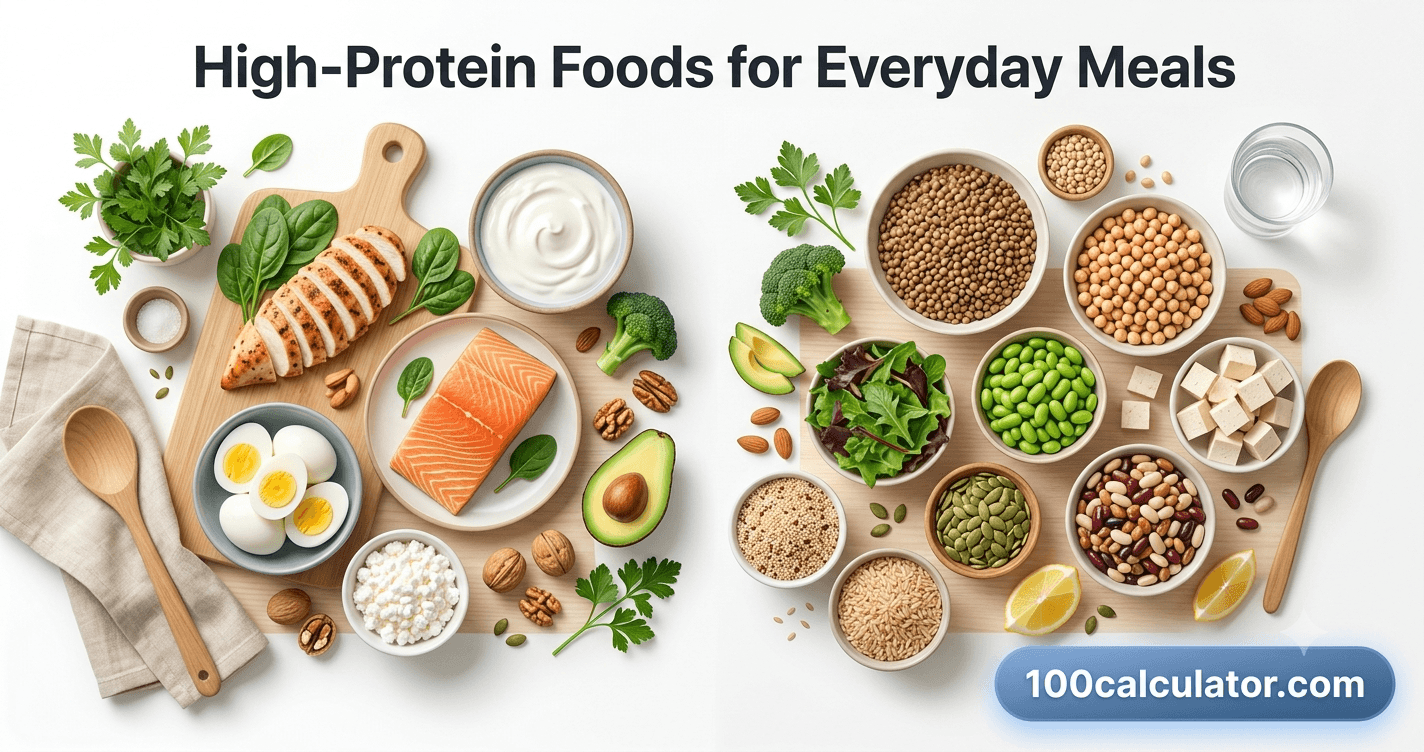
7 Foods That Are Genuinely Rich in Protein
| Food | Typical Serving | Protein |
|---|---|---|
| Chicken breast, cooked | 100 g (3.5 oz) | ~31 g |
| Eggs | 2 large eggs | ~13 g |
| Greek yogurt, plain nonfat | 170 g (6 oz) | ~17 g |
| Salmon or tuna, cooked | 100 g (3.5 oz) | ~24 g |
| Lentils, cooked | 1 cup (198 g) | ~18 g |
| Cottage cheese | 1 cup (226 g) | ~25 g |
| Tofu, firm | 100 g (3.5 oz) | ~8 g |
How to Realistically Eat 150 Grams of Protein a Day
Spreading intake across three or four meals is far more manageable than trying to hit a big number in one sitting. Here's what that could look like for someone targeting roughly 150 grams:
- Breakfast: 3 eggs plus 170 g of Greek yogurt (about 36 g)
- Lunch: a 150 g chicken breast (about 46 g)
- Snack: a cup of cottage cheese (about 25 g)
- Dinner: 100 g of salmon with a cup of lentils (about 42 g)
That adds up to roughly 149 grams across the day, without needing a single oversized meal or a specialty product. Exact numbers will vary slightly by brand and exact portion size, so treat this as a realistic template rather than an exact formula.
How Much Protein Is in One Egg?
One large egg has about 6.3 grams of protein, according to USDA nutrition data, split roughly between the white (about 3.6 grams) and the yolk (about 2.7 grams). Cooking method, whether boiled, fried, or scrambled, doesn't meaningfully change that number.
Protein, Eggs, and Testosterone: Sorting Myths From Facts
Protein and testosterone come up together a lot in fitness circles, so it's worth separating what's actually supported by evidence from what just gets repeated online.
Do Eggs (or 10 Eggs a Day) Raise Testosterone?
It's true that cholesterol is a biological building block your body uses to produce testosterone. But that doesn't mean eating more eggs, 10 a day or otherwise, meaningfully raises your testosterone level. How much your body produces is governed mainly by signaling between your brain and your testes, not by how much dietary cholesterol you happen to eat on a given day. Solid evidence for eggs specifically driving up testosterone is thin. Eggs remain a genuinely excellent source of complete protein and nutrients like choline, just not a testosterone shortcut.
Can Too Much Protein Raise Testosterone?
No good evidence supports this either. Protein intake, even at the higher end of the ranges covered earlier in this guide, hasn't been shown to push testosterone above your normal levels. What protein does do is support the muscle repair that resistance training depends on, and resistance training itself is genuinely linked to healthier testosterone levels over time, which is likely where this myth gets its staying power.
Why Some Bodybuilders Eat Egg Whites Only
Some bodybuilders stick to egg whites specifically during contest prep or very lean phases, because whites carry most of an egg's protein with almost none of the calories or fat found in the yolk. That's useful when trying to hit a very low calorie target while keeping protein high. Outside that narrow context, whole eggs are nutritionally excellent, and the yolk contributes nutrients beyond protein alone, so whites-only isn't automatically the better choice for most people.
Does Not Ejaculating for 7 Days Raise Testosterone?
A widely shared claim says abstaining for exactly 7 days boosts testosterone by 45 percent. That figure traces back to a small 2003 study of 28 men that has since been retracted and never independently replicated, and fact-checkers who've examined the specific claim rate it false. (Snopes) More carefully designed research generally suggests that short-term ejaculation frequency doesn't meaningfully change testosterone levels, though some studies on longer stretches of abstinence, several weeks rather than days, have shown small and inconsistent effects. It isn't a reliable lever for raising testosterone.
Testosterone Levels and TRT: What Protein Can (and Can't) Do
A number of readers land on a protein guide while actually researching testosterone, so it's worth addressing that connection directly, including where protein genuinely fits and where it doesn't.
Signs of Low Testosterone
Common signs include ongoing fatigue, reduced sex drive, difficulty building or maintaining muscle, mood changes, and in some cases reduced body or facial hair growth. None of these on their own confirms low testosterone. They overlap with plenty of other causes, including poor sleep, high stress, and thyroid issues. The only way to actually know is a morning blood test, ideally repeated on a separate day, interpreted by a doctor. 100 Calculator's Free Bioavailable Testosterone Calculator Online can help you make sense of a lab result you've already received, alongside our explainer on what bioavailable testosterone means and the difference between free, total, and bioavailable testosterone on a typical report.
For reference, normal total testosterone in adult men typically falls somewhere in the range of about 300 to 1,000 nanograms per deciliter, though exact reference ranges vary by lab and by age. A specific number like 1,000 ng/dL sits at the very top of that typical range. For most adult men, reaching a number that high isn't something lifestyle changes alone reliably produce, and it isn't a standard treatment goal. What actually matters clinically is being within a healthy range and free of symptoms, not chasing a specific ceiling figure.
What Really Raises or Lowers Testosterone Naturally
Factors commonly linked to lower testosterone include poor sleep, chronic stress, carrying excess body fat, heavy regular alcohol use, a sedentary lifestyle, and exposure to certain environmental chemicals such as BPA. (Harvard Health) On the other side, consistent resistance training, getting 7 to 9 hours of quality sleep, maintaining a healthy weight, and managing chronic stress are generally associated with healthier testosterone levels. It's worth being clear about what this does and doesn't mean: these habits help you sit at the healthy end of your own natural range. They won't push anyone to abnormally high levels, since normal physiology sets an upper limit that diet and lifestyle alone don't override.
Protein Needs While on TRT
Testosterone replacement therapy (TRT) can improve the body's ability to build and maintain muscle by supporting muscle protein synthesis, which is one reason many men on TRT also train more seriously. Because of that, the same activity-based protein targets covered earlier in this guide, roughly 1.6 to 2.2 grams per kilogram for people training regularly, generally apply whether or not someone is on TRT. TRT changes what your body can do with the protein you eat more than it changes how much protein you specifically need. If you're on TRT, it's worth raising your nutrition plan with the doctor managing your treatment, since they're also tracking things like blood counts and cardiovascular markers as part of your overall care.
Why We Won't Tell You a Specific Testosterone Dose "Builds Muscle"
You may have seen questions online asking whether a specific weekly dose, like 400 milligrams, is "enough" to build muscle on TRT. We're not going to answer that directly, and it's worth explaining why. Standard testosterone replacement therapy for men with medically diagnosed low testosterone is typically prescribed around 100 to 200 milligrams per week, individualized and adjusted based on bloodwork by a physician. A dose meaningfully above that range moves beyond replacing what your body is missing and into performance-enhancing territory, which carries real health risks, including cardiovascular strain and suppressed natural hormone production, and in most places requires a valid prescription to use legally.
The more useful question isn't whether a given dose "works" for building muscle. It's whether a treatment plan is medically appropriate for your specific health picture, which only a doctor can determine after reviewing your bloodwork and medical history.
Related Calculators
Put what you just read into practice, try these free tools instantly, no sign-up required.
Fat Free Mass Index Calculator
Measure your lean muscle mass relative to height with FFMI.
Macro / Protein Calculator
Calculate your daily protein, carbs, and fat intake targets.
BAC Calculator (Blood Alcohol Concentration)
Estimate your blood alcohol concentration based on drinks consumed.
Free Bioavailable Testosterone Calculator Online
Calculate free and bioavailable testosterone levels from lab results.
Calorie Deficit Calculator for PCOS
Plan a sustainable calorie deficit tailored for managing PCOS.
Building a Protein Routine That Actually Sticks
Knowing your target number matters less than actually hitting it most days. A few habits make that considerably easier.
- Anchor protein to meals you already eat rather than adding entirely new ones. Add eggs to whatever you already have for breakfast, or a scoop of Greek yogurt to a snack you already reach for.
- Front-load your first meal. Getting 25 to 35 grams at breakfast makes the rest of the day easier, since a typical breakfast of cereal, toast, or coffee is often protein-light by default.
- Keep two or three "reliable" protein foods on hand, like a rotisserie chicken, a tub of Greek yogurt, a few cans of tuna, or a bag of frozen edamame, so you're never stuck without an easy option.
- Recalculate as your weight or goal changes. The grams that made sense for weight loss won't be the same once you shift toward maintenance or serious muscle building.
- Use a tool to check your math instead of guessing. Plug your current weight and goal into 100 Calculator's Macro / Protein Calculator to get a specific daily target rather than relying on rough mental math.
Medical disclaimer: This article is for general educational purposes only and isn't a substitute for professional medical or nutritional advice, diagnosis, or treatment. Protein needs, hormone levels, and any therapy involving prescription medications such as testosterone vary significantly from person to person, so always talk to a licensed healthcare provider or registered dietitian about your specific needs, symptoms, or treatment options.
More From Our Common Health Guide
Still building out your understanding of nutrition, body composition, and hormone health? These related guides dig deeper into topics covered above.
Frequently Asked Questions
How much protein do I actually need per day?
Most healthy adults need somewhere between 0.8 grams per kilogram of body weight, the general RDA, and up to 2.2 grams per kilogram if they train regularly or want to build muscle. For a 70 kg person, that's roughly 56 to 154 grams a day depending on the goal. The Macro / Protein Calculator can give you a specific number based on your weight, sex, and activity level in a few seconds.
How much protein should someone who weighs 60 to 70 kg eat per day?
At the general health level (0.8 g/kg), that's about 48 grams for a 60 kg person and 56 grams for a 70 kg person. If you're active or building muscle, the range moves up to roughly 96 to 132 grams for 60 kg, or 112 to 154 grams for 70 kg, using the commonly recommended 1.6 to 2.2 g/kg range for people who train regularly.
How much protein do I need to build muscle?
Most sports nutrition research points to roughly 1.6 to 2.2 grams of protein per kilogram of body weight per day for people doing regular resistance training. Going meaningfully higher than this doesn't appear to add extra muscle-building benefit for most people. Consistent training and adequate calories matter just as much as a very high protein number.
How much protein should I eat to lose weight?
Aiming for roughly 1.2 to 1.6 grams per kilogram of body weight tends to work well during weight loss, since higher protein intake helps preserve muscle mass while you're in a calorie deficit and helps you feel fuller for longer. The exact number still depends on your starting weight and how much training you're doing.
Is 100 grams of protein a day a lot?
Not particularly. For someone in the 55 to 65 kg range aiming to build muscle, 100 grams sits comfortably within typical recommendations. For a smaller or more sedentary person, it may sit above their baseline RDA but still well within commonly recommended, safe ranges. It usually feels more manageable once spread across three or four meals instead of one.
What is the 3-3-3 protein rule?
It's a popular, informal rule of thumb rather than an official clinical guideline, and different sources define it slightly differently. The version most relevant to protein means aiming for about 30 grams of protein at each of your three main meals, which helps spread intake evenly through the day instead of loading it all into one sitting.
What happens if I don't eat enough protein?
In the short term, you may notice slower recovery from workouts, more frequent minor illnesses, or difficulty maintaining muscle even with consistent training. Prolonged, severe protein deficiency is a recognized medical condition, but it's rare in adults with regular access to food. Mild, everyday insufficiency is a far more common and manageable concern.
What are the signs of protein deficiency?
Common early signs include persistent fatigue, slower healing from cuts or scrapes, unusually brittle nails or thinning hair, getting sick more often than usual, and losing muscle mass or strength despite similar training. These signs overlap with several other causes, so it's worth checking with a doctor rather than assuming protein is the cause.
Can I eat too much protein? Is it safe?
For healthy adults with normal kidney function, current research doesn't show that higher protein intake causes kidney damage. The kidneys simply adapt by filtering more. People with existing kidney disease are usually advised to eat less protein, so that's a conversation to have with a doctor if it applies to you. Otherwise, the main downside of very high intake is usually just digestive discomfort.
What does 30 grams of protein look like?
Roughly one of the following: a single chicken breast, four to five large eggs, about one and a half cups of plain Greek yogurt, or a generous cup of cottage cheese. Combining smaller amounts, like two eggs plus a cup of Greek yogurt, gets you there just as easily.
What are some foods that are rich in protein?
Chicken breast, eggs, Greek yogurt, salmon or tuna, lentils, cottage cheese, and tofu are all reliable, easy-to-find sources. Each delivers somewhere between roughly 8 and 31 grams of protein per typical serving, which makes it fairly easy to reach your daily target using just a few of them.
How do I eat 150 grams of protein a day?
Spread it across three or four meals rather than trying to hit it in one sitting. As a rough example: eggs and Greek yogurt at breakfast (about 36 g), a chicken breast at lunch (about 46 g), a protein-rich snack like cottage cheese (about 25 g), and salmon with lentils at dinner (about 42 g) adds up to roughly 149 grams across the day.
How much protein is in one egg?
One large egg has about 6.3 grams of protein, split roughly between the white (about 3.6 grams) and the yolk (about 2.7 grams), according to USDA nutrition data. Cooking method, whether boiled, fried, or scrambled, doesn't meaningfully change that number.
Do eggs or high protein intake raise testosterone levels?
Not in any meaningful, reliable way. Dietary cholesterol is a building block for testosterone production, but eating more eggs doesn't translate into your body producing more of it, since production is mainly controlled by your testes and brain signaling, not by a specific food. The same applies to protein intake generally: there's no solid evidence that eating more protein raises testosterone above your normal levels.
How much protein do you need on TRT?
Testosterone replacement therapy doesn't come with a separate protein formula. If you're training regularly, the same activity-based range covered in this guide, roughly 1.6 to 2.2 g/kg, generally applies, since TRT mainly affects how well your body can use protein for muscle repair rather than how much you need. Your prescribing doctor can help tailor this alongside your overall treatment plan.
About 100 Calculator
100 Calculator is a free hub of online calculators and educational guides covering health, finance, trading, crypto, education, and more. Every tool is built to be fast, accurate, and genuinely free, with no account or signup required.
We built this guide, and tools like the Macro / Protein Calculator referenced throughout it, to make everyday nutrition questions easier to answer without needing a nutrition degree. Head back to the 100 Calculator homepage to explore the full library of tools, or learn more about the team behind them on our About Us page.