FFMI vs BMI: Which Metric Reflects Fitness Better?
A plain-English breakdown of what BMI and FFMI actually measure, how to calculate your own Fat-Free Mass Index, and which number is worth paying attention to.
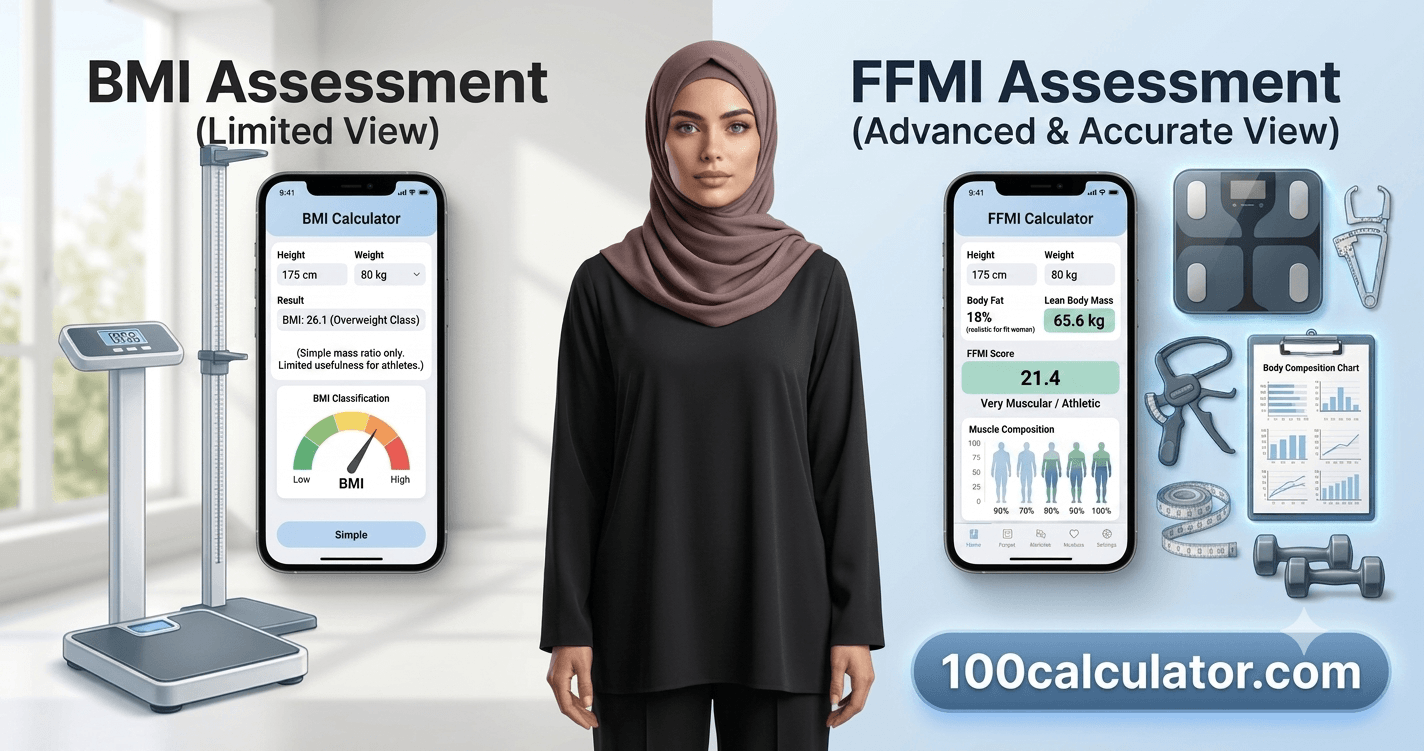
Step on a scale, run the numbers through a BMI calculator, and the result can call you "overweight" even if you train four times a week and can see your abs. That contradiction is usually what sends people looking for a better way to measure fitness.
BMI (Body Mass Index) measures your total body weight relative to your height, with no way to tell whether that weight is muscle, fat, or bone. FFMI (Fat-Free Mass Index) measures only your fat-free mass — muscle, bone, organs, and water — relative to your height, which makes it a much better gauge of muscularity for people who train regularly. Neither number tells the complete story by itself, though. BMI is still a fast, genuinely useful screening tool at a population level, and FFMI depends on an accurate body fat percentage reading to mean anything at all.
This guide breaks down what each metric actually measures, walks through how to calculate your own FFMI step by step, and looks at what counts as a typical or exceptional score for both men and women. Along the way, we'll cover exactly where BMI still earns its place despite its blind spots. If you'd rather skip the manual math, 100 Calculator's Fat Free Mass Index Calculator handles the calculation for you once you know your body fat percentage.
Before comparing the two, it helps to understand what each one was actually built to do.
What Is BMI, and How Is It Calculated?
BMI is a simple calculation that compares your weight to your height. It doesn't measure fat, muscle, or fitness directly. It's a mathematical shortcut that assumes a certain amount of weight is typical for a given height.
The BMI Formula
The metric version is straightforward: divide your weight in kilograms by your height in meters, squared.
BMI = weight (kg) ÷ height (m)²
If you're working in pounds and inches, the formula adjusts with a conversion factor:
BMI = [weight (lb) ÷ height (in)²] × 703
Both versions produce the same number. Someone who weighs 84 kg (185 lb) and is 1.78 m (5'10") tall, for example, comes out to a BMI of about 26.5 — a figure we'll come back to later in this guide.
Where BMI Came From
BMI didn't start out as a health tool. Belgian mathematician Adolphe Quetelet developed the weight-to-height-squared formula in the 1830s while trying to describe the characteristics of an "average man" for population statistics, not to assess any one person's health. (PubMed) The formula stayed known as the "Quetelet Index" for well over a century. Physiologist Ancel Keys gave it its modern name, Body Mass Index, in a 1972 paper, and it gradually became the default screening tool used in clinics and research worldwide.
That history matters, because it explains a lot of BMI's limitations. It was built to compare large groups of people, not to capture the physical condition of the person standing in front of you.
BMI Categories: What the Numbers Mean
Once you calculate a BMI number, it gets sorted into one of four categories used by the Centers for Disease Control and Prevention and the World Health Organization alike. (CDC)
| Category | BMI Range | What It Generally Suggests |
|---|---|---|
| Underweight | Below 18.5 | Body weight lower than typical for height |
| Healthy Weight | 18.5 – 24.9 | Body weight typical for height, at a population level |
| Overweight | 25.0 – 29.9 | Body weight higher than typical for height |
| Obesity | 30.0 and above | Substantially higher than typical for height; usually split into Class 1, 2, and 3 |
These cutoffs apply the same way to men and women, and to most adults regardless of age. They were never designed to account for how much of that weight comes from muscle versus fat, which is exactly where FFMI comes in.
What Is FFMI (Fat-Free Mass Index)?
FFMI measures the same basic relationship as BMI — a body measurement divided by height, squared — but it swaps out total body weight for fat-free mass. Fat-free mass includes your muscle, bones, organs, and water. It's everything left over once fat is subtracted out. For a closer look at the concept on its own, our guide on what fat-free mass index is and why it matters covers the basics in more depth.
The FFMI Formula
FFMI = fat-free mass (kg) ÷ height (m)²
To get fat-free mass, you first need your body fat percentage:
Fat-Free Mass (kg) = Body Weight (kg) × (1 − Body Fat % ÷ 100)
Because taller people naturally carry more fat-free mass just from having a bigger frame, researchers also use a height-adjusted version called normalized FFMI, which corrects everyone's score to what it would be at a reference height of 1.8 meters (about 5'11"):
Normalized FFMI = FFMI + 6.3 × (1.8 − height in meters)
If you're exactly 1.8 m tall, your raw and normalized FFMI are identical. Shorter than that, your normalized score goes up slightly; taller, and it comes down slightly. This is the version most FFMI charts and calculators reference, including 100 Calculator's Fat Free Mass Index Calculator.
Why FFMI Was Developed
FFMI wasn't built as a general fitness metric. It came out of a 1995 study published in the Clinical Journal of Sport Medicine (Kouri et al., 1995), which set out to figure out whether steroid use could be detected by comparing an athlete's lean mass to their height. The researchers found that drug-free athletes topped out at a well-defined ceiling, while steroid users routinely scored higher, a pattern we'll look at more closely later in this guide.
Since then, FFMI has been picked up more broadly by trainers, sports scientists, and natural bodybuilding federations as a quick way to describe how muscular someone is, independent of their height or their body fat level.
How to Calculate Your FFMI, Step by Step
Calculating your FFMI takes three steps and one number you'll need to estimate first: your body fat percentage.
Step 1: Find Your Body Fat Percentage
Body fat percentage is the one input you can't skip, and it's also the easiest place for errors to creep in. Common ways to estimate it include:
- Skinfold calipers, measured by a trained professional at a few standard sites on your body
- Bioelectrical impedance scales, the kind built into many bathroom scales and gym-based devices
- DEXA scans, which use low-dose X-rays and are generally considered the most accurate widely available option
Any of these will get you close enough to calculate a useful FFMI. Just remember that a small error in body fat percentage shifts your FFMI too, so treat the number as a solid estimate rather than something exact.
Step 2: Calculate Your Fat-Free Mass
Multiply your body weight by (1 minus your body fat percentage, as a decimal). Someone who weighs 84 kg (185 lb) at 15% body fat has a fat-free mass of 84 × (1 − 0.15) = 71.4 kg.
Step 3: Apply the FFMI Formula
Divide that fat-free mass by your height in meters, squared. For someone 1.78 m (5'10") tall: 71.4 ÷ (1.78)² = 71.4 ÷ 3.17, which comes out to an FFMI of about 22.5.
Add the height correction to get the normalized version: 22.5 + 6.3 × (1.8 − 1.78) = 22.5 + 0.13, or about 22.6.
For that same person, BMI would land at roughly 26.5, which falls in the "overweight" range on the BMI chart from earlier, despite a fat-free mass and body fat percentage that most people would call lean and athletic. We'll dig into exactly why that happens in a later section.
Normal FFMI Ranges for Men and Women
FFMI scores cluster into fairly predictable bands, though men and women fall into different ranges because of typical differences in muscle mass and hormones. The chart below shows how normalized FFMI commonly breaks down for each.
How to Read the FFMI Classifications
| Classification | Typical FFMI (Men) | Typical FFMI (Women) |
|---|---|---|
| Below Average | Under 18 | Under 14 |
| Average, Untrained | 18 – 20 | 14 – 16 |
| Trained, Athletic | 20 – 22 | 16 – 18 |
| Very Muscular | 22 – 23 | 18 – 19 |
| Exceptional, Near Natural Limit | 23 – 25 | 19 – 21 |
These ranges come from research and commentary built on the original Kouri study, which only examined male athletes. Female benchmarks are typically estimated by shifting the male ranges down by several points to reflect typical differences in muscle mass and testosterone levels, rather than from dedicated research on women specifically. Treat the women's column as a reasonable estimate, not a precisely measured standard.
If you're wondering what a "good" fat-free mass looks like in kilograms rather than as an index score, there isn't one useful answer. Fat-free mass in kilograms depends heavily on your height and frame size, which is exactly why the index version, dividing by height squared, exists in the first place. A 5'2" woman and a 5'9" woman could both have an excellent FFMI while carrying very different amounts of fat-free mass in kilograms. If you want a number that's actually comparable across different heights, FFMI is the more useful figure to track.
FFMI vs BMI: The Key Differences
Side by side, the two metrics answer different questions.
| Attribute | BMI | FFMI |
|---|---|---|
| What It Measures | Total body weight relative to height | Fat-free (lean) mass relative to height |
| What You Need | Weight and height only | Weight, height, and body fat percentage |
| Distinguishes Muscle From Fat | No | Yes |
| Best Used For | Quick population-level screening | Gauging muscularity in people who train regularly |
| Main Limitation | Can't tell muscle from fat | Depends on an accurate body fat reading |
BMI wins on convenience. You can calculate it in seconds with nothing more than a scale and a tape measure. FFMI wins on precision for anyone whose weight comes largely from muscle rather than fat, athletes, regular lifters, and generally muscular people among them. Neither one measures health directly; both are proxies that work better for some bodies than others.
Related Calculators
Put what you just read into practice, try these free tools instantly, no sign-up required.
Fat Free Mass Index Calculator
Measure your lean muscle mass relative to height with FFMI.
Macro / Protein Calculator
Calculate your daily protein, carbs, and fat intake targets.
BAC Calculator (Blood Alcohol Concentration)
Estimate your blood alcohol concentration based on drinks consumed.
Free Bioavailable Testosterone Calculator Online
Calculate free and bioavailable testosterone levels from lab results.
Calorie Deficit Calculator for PCOS
Plan a sustainable calorie deficit tailored for managing PCOS.
Why BMI Can Be Misleading for Athletes and Muscular Bodies
Go back to the earlier example: someone at 84 kg, 1.78 m tall, and 15% body fat. That body fat percentage sits squarely in the "Fitness" range on the American Council on Exercise's chart for men (ACE) — lean, visibly toned, nothing close to what most people picture when they hear "overweight." Yet the math puts that same person's BMI at 26.5, solidly inside the overweight category.
The problem isn't the arithmetic. BMI is doing exactly what it was built to do: comparing total weight to height. It simply has no way to ask where that weight came from. Muscle is denser than fat, so a muscular person weighs more per unit of size than someone carrying the same amount of fat, and BMI can't tell the difference.
This shows up most obviously in strength athletes, bodybuilders, and anyone who has trained consistently for a few years. It's common for people in these groups to land in the "overweight" or even "obese" BMI category while carrying a body fat percentage well within a healthy range.
A few signs suggest your BMI number might not be telling the full story:
- You train with weights regularly and can see visible muscle definition
- A body fat percentage test puts you in the "Fitness" or "Athletic" range for your sex
- Friends, trainers, or doctors describe you as lean despite a higher BMI number
- You compete in or train seriously for a strength-based sport
- Your waist circumference and other measurements look proportionate, even if your BMI doesn't
None of this means BMI is useless, just that it needs company. Pairing it with a body fat percentage reading, or with FFMI itself, gives a much clearer picture than either number alone.
What Counts as a Naturally "Good" or High FFMI?
An FFMI in the low 20s already puts most men ahead of the general population, and one in the high teens does the same for most women. But the number that gets the most attention online is 25, and it's worth understanding where that figure actually comes from.
The FFMI 25 Threshold
The Kouri et al., 1995 study that introduced FFMI compared 157 male athletes: 83 who had used anabolic-androgenic steroids, and 74 who had not. Among the drug-free group, normalized FFMI scores extended up to a well-defined limit of 25.0. Steroid users, by contrast, frequently scored higher, with some exceeding 30. A separate comparison of Mr. America winners from the pre-steroid era of 1939 to 1959 found a mean FFMI of 25.4, reinforcing that figures in the mid-20s represent something close to a natural ceiling for most men.
That's why an FFMI approaching or exceeding 25 sometimes raises questions about performance-enhancing drug use in competitive natural bodybuilding. It's worth being careful with that interpretation, though. This was one study, with a limited sample, and genetics, training history, and measurement error can all push an individual's number around. A high FFMI on its own is not proof of anything about how a specific person built their physique.
Genetics, Training Age, and Other Factors
Where any individual lands within the natural range depends on genetics, how many years they've trained consistently, muscle fiber type, hormone levels, and even bone density, since FFMI counts bone and organ mass along with muscle. Two people who train identically for the same number of years can land several points apart on the FFMI scale simply because of how they're built. Anyone curious about how hormones factor into natural muscle-building capacity can check their levels with 100 Calculator's Free Bioavailable Testosterone Calculator, though genetics and training history still matter just as much.
Should You Ignore BMI Completely?
Given everything BMI gets wrong for muscular bodies, it might seem like the number deserves no attention at all. That's not quite fair to it, either.
BMI still does a genuinely useful job at the population level. Public health researchers use it to track weight trends across millions of people, and for the average person who isn't unusually muscular or unusually short, it correlates reasonably well with body fat percentage. Cost and simplicity matter too: BMI needs nothing more than a scale and a tape measure, while FFMI requires a body fat percentage reading that carries its own margin of error.
The honest answer is that BMI works fine as a first-pass screening tool for most people, and works poorly for a specific slice of the population: athletes, dedicated lifters, and anyone whose weight leans heavily toward muscle rather than fat. If that describes you, it's worth looking past your BMI number and paying more attention to body fat percentage and FFMI instead. If it doesn't, BMI is still a reasonable, low-effort starting point.
Common Mistakes When Interpreting FFMI or BMI
A few habits tend to throw off how people read these numbers, regardless of which one they're using.
- Treating BMI as a diagnosis. It's a screening number, not a verdict on anyone's health or fitness level.
- Skipping the height correction on FFMI. Comparing raw FFMI scores between people of different heights isn't a fair comparison; normalized FFMI accounts for that.
- Using an unreliable body fat percentage. A rough visual guess or an inconsistent scale reading can shift your FFMI by several points in either direction.
- Chasing a specific number instead of a trend. One measurement is a snapshot. Tracking the same metric consistently over months tells you far more.
- Assuming a high FFMI always means something suspicious. Genetics, training age, and measurement error all play a role, and a single number never tells the whole story about any one person.
- Ignoring both metrics' shared blind spot. Neither BMI nor FFMI accounts for where fat is stored on your body, which matters for certain health risks.
Beyond BMI and FFMI: Other Ways to Measure Progress
BMI and FFMI are useful starting points, but they're not the only tools worth knowing about.
Waist Circumference and Waist-to-Hip Ratio
Where fat is stored matters for certain health risks, and neither BMI nor FFMI captures that. A simple tape measure around your waist adds context that both numbers miss. A waist circumference above roughly 40 inches (102 cm) for men or 35 inches (88 cm) for women is generally considered a sign of higher health risk, independent of overall weight.
Body Fat Percentage on Its Own
Since FFMI is built from your body fat percentage anyway, that number is worth tracking in its own right. It tells you directly what portion of your weight is fat, without needing a height-adjusted formula to interpret it. Supporting your fat-free mass with adequate protein also matters here; our guide on how much protein you really need and 100 Calculator's Macro / Protein Calculator can help you build a nutrition plan that supports the muscle you're trying to keep or build.
DEXA Scans and Other Clinical Tools
For the most precise numbers, a DEXA scan measures fat, lean mass, and bone density separately using low-dose X-rays. It's not something most people do regularly, since it usually requires a clinic visit and a fee, but it's a good option if you want a highly accurate baseline to check less precise home methods against.
None of these tools replace BMI or FFMI outright. Used together, they build a much fuller picture than any single number can.
Building a Simple Body Composition Tracking Plan
If you want a straightforward way to keep an eye on your own progress, a few habits make the numbers far more useful.
- Pick one body fat percentage method and stick with it. Switching between calipers, a bioelectrical impedance scale, and visual estimates from month to month makes your FFMI trend hard to trust.
- Measure at consistent times. Hydration, food intake, and time of day can all shift a body fat reading, so aim for similar conditions each time. First thing in the morning works well for most people.
- Track FFMI alongside BMI, not instead of it. Seeing both numbers side by side makes it obvious when BMI is being thrown off by muscle mass.
- Reassess every few months, not every few days. Meaningful changes in fat-free mass take time to show up. Frequent measuring mostly captures noise.
- Use the trend, not the single reading. One data point can't tell you much. Several months of consistent tracking can.
Once you have a body fat percentage reading, plugging your numbers into 100 Calculator's Fat Free Mass Index Calculator gives you an instant FFMI score, including the height-adjusted version, without needing to work through the formulas by hand.
What regular tracking actually gives you:
- A clearer picture of whether weight changes are coming from muscle or fat
- Context for a BMI number that might otherwise seem discouraging
- A way to notice plateaus early enough to adjust training or nutrition
- A benchmark to compare against your own history, not anyone else's
Disclaimer: This article is for general educational purposes only and isn't a substitute for professional medical or fitness advice. BMI, FFMI, and body fat percentage are all screening tools with real limitations, and none of them capture your complete health picture on their own. Talk with a doctor, registered dietitian, or qualified trainer before making significant changes to your training or nutrition based on any of these numbers.
More From Common Health Guides
Still building your knowledge of body composition, nutrition, and the other health tools mentioned above? These related guides dig deeper into the topics covered in this article.
Frequently Asked Questions
Is FFMI more accurate than BMI?
FFMI is more accurate for judging muscularity specifically, since it isolates fat-free mass instead of counting muscle and fat together. BMI is not inaccurate so much as incomplete: it measures total weight relative to height well, but has no way to separate what that weight is made of. For someone with an average body composition, both numbers tend to agree. For someone who is notably muscular or notably low in muscle mass, FFMI gives a much clearer picture, while BMI can be misleading in either direction.
Is BMI an accurate measure of fitness?
Not directly. BMI measures weight relative to height, not fitness, strength, endurance, or body composition. Two people with an identical BMI can have very different fitness levels depending on how much of their weight is muscle versus fat. BMI works better as a rough population-level screening tool than as a personal fitness test, which is exactly why metrics like FFMI and body fat percentage exist alongside it.
Why is BMI not a good metric for muscular people?
BMI can't distinguish muscle from fat, and muscle is denser than fat, so a muscular person weighs more for their size than someone carrying the same amount of fat. That pushes many athletes, lifters, and generally muscular people into "overweight" or "obese" BMI categories despite having a healthy or even low body fat percentage. BMI is still widely used today because it's fast, free, and reasonably useful for the general population. It just needs extra context for anyone outside that average build.
Is BMI accurate for athletes and gym-goers?
Not reliably. Athletes and regular gym-goers often carry more muscle mass than the general population BMI was built around, which can push their BMI into "overweight" territory even when their body fat percentage is low. This is one of BMI's most well-documented limitations. Pairing BMI with a body fat percentage reading or an FFMI calculation gives a much more accurate picture for anyone who trains seriously.
Why is my BMI high if I'm skinny or muscular?
A "high" BMI on a lean or muscular frame almost always comes down to the same issue: BMI only measures total weight against height, and muscle weighs more than fat for the same amount of space. If you have visible muscle definition and a lean-looking physique but a BMI in the "overweight" range, your weight is likely coming from fat-free mass rather than excess fat. Checking your body fat percentage or FFMI will usually confirm this.
What does a BMI of 20 or 26 actually mean?
On its own, a BMI number only tells you where your weight-to-height ratio falls on a population chart. A BMI of 20 sits in the "healthy weight" range (18.5–24.9), while 26 falls just inside "overweight" (25–29.9). Neither number describes your body shape, muscle mass, or how you look. Someone with a BMI of 20 could have a high body fat percentage and low muscle mass, while someone at 26 could be lean and muscular. The category alone doesn't say much without more context.
How rare is an FFMI of 25, and is it possible to reach naturally?
Research on drug-free athletes found that natural FFMI scores extended up to a well-defined limit of about 25, based on a 1995 study of 157 male athletes. A small number of genetically gifted, long-term trained natural lifters can approach or reach that range, but it represents something close to the natural ceiling for most men, not a typical training outcome. Reaching an FFMI in the low-to-mid 20s through years of consistent training is realistic; consistently exceeding 25 is uncommon without assistance.
What is considered a "natural" FFMI?
A "natural" FFMI generally refers to a score achieved through training, nutrition, and genetics alone, without performance-enhancing drugs. Based on research into drug-free athletes, natural FFMI scores for men commonly range from the high teens in untrained individuals up to the low-to-mid 20s in very experienced, genetically favored lifters. Scores that consistently exceed the mid-20s are less common naturally, though genetics and measurement error mean the line isn't perfectly sharp for every individual.
How reliable is FFMI as a measurement?
FFMI is only as reliable as the body fat percentage used to calculate it, since that's where fat-free mass comes from in the first place. A method like a DEXA scan gives a fairly precise reading, while a bathroom scale's bioelectrical impedance estimate can be off by several percentage points, especially if hydration levels change. Used consistently with the same measurement method over time, FFMI is a genuinely useful way to track muscularity — just don't treat a single reading as an exact number.
Is there a metric that's more effective than BMI overall?
There isn't one single metric that beats BMI in every situation, because different tools answer different questions. FFMI is more useful for judging muscularity, body fat percentage is more useful for judging leanness, and waist circumference adds information about health risk that neither BMI nor FFMI captures. For a well-rounded picture, combining two or three of these measurements works better than relying on any single number, BMI included.
Is there an ideal BMI for longevity?
Some large population studies have found the lowest mortality risk in a BMI range roughly between 22.5 and 25, though findings vary somewhat between studies and populations, and other research has found overweight individuals with similar mortality risk to those in the "healthy" range. This kind of population-level research doesn't translate cleanly into an individual target, since factors like muscle mass, age, and overall health matter just as much. A conversation with a healthcare provider is a better way to interpret what your own BMI means for you specifically.
Is BMI a physical fitness test?
No. BMI doesn't measure strength, endurance, flexibility, or cardiovascular fitness in any way. It's purely a ratio of weight to height. Someone with an excellent BMI could be sedentary and out of shape, while someone with a "high" BMI could be an elite athlete. If you're looking for a genuine fitness assessment, BMI isn't the right tool. Body fat percentage, FFMI, and actual performance markers like strength or cardio benchmarks reflect fitness far more directly.
What's the best way to track body composition without relying on BMI or FFMI alone?
Combining a few simple measurements tends to work better than any single number. Tracking body fat percentage with a consistent method, measuring waist circumference periodically, and taking progress photos alongside your BMI and FFMI calculations gives you multiple angles on the same underlying question: how your body composition is changing over time. No single measurement tool is perfect, but together they cover for each other's blind spots.
About 100 Calculator
100 Calculator is a free hub of online calculators and educational guides covering health, finance, trading, crypto, education, and more. Every tool is built to be fast, accurate, and genuinely free, with no account or signup required.
We built this guide, along with tools like the Fat Free Mass Index Calculator referenced throughout it, to make body composition math easier to understand and actually use. Head back to the 100 Calculator homepage to explore the full library of tools, or learn more about the team behind them on our About Us page.