How to Calculate Your Daily Macro and Protein Needs
A practical, no-guesswork walkthrough for figuring out exactly how many grams of protein, carbs, and fat you need each day — using the same math a dietitian would, broken down into plain English.
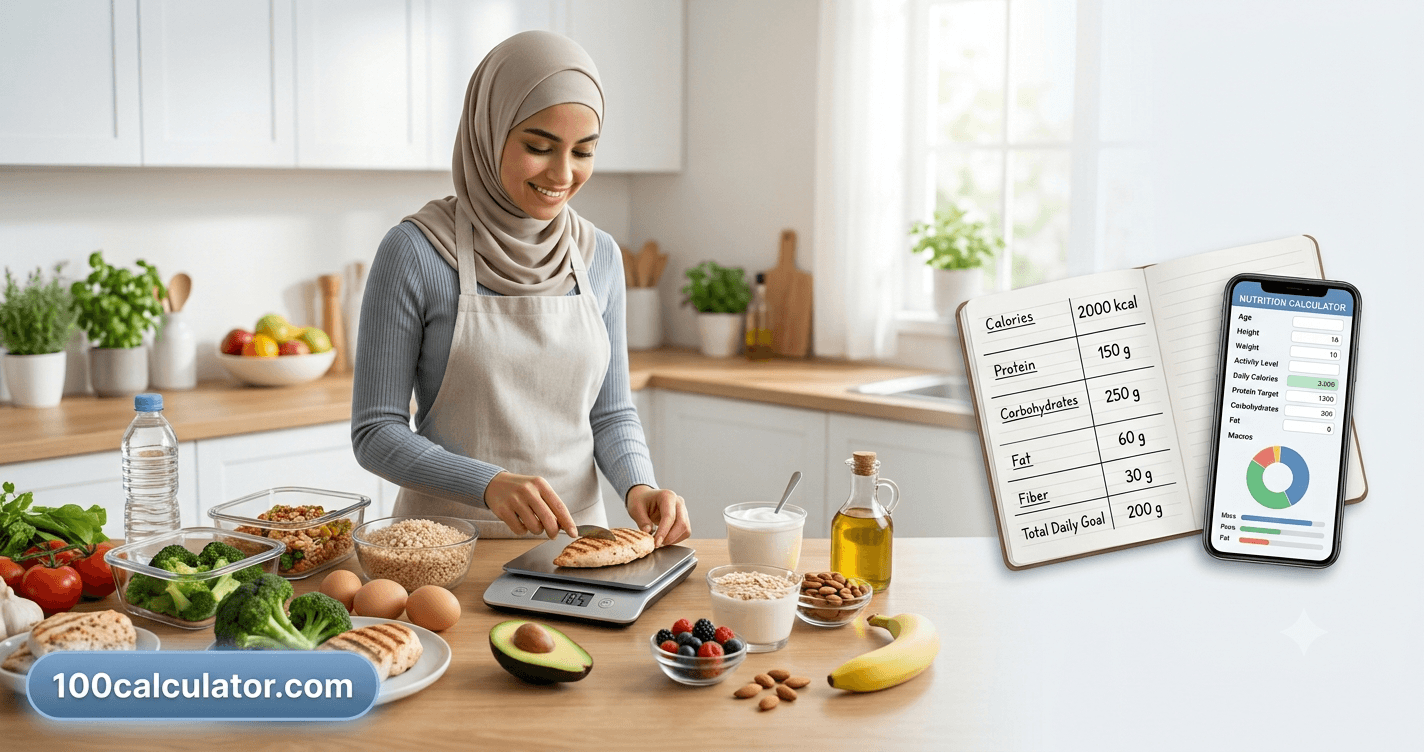
Nutrition labels, fitness apps, and diet coaches all throw around the word "macros" like everyone already knows what it means. If you've ever wondered how those numbers are actually calculated, or whether the split your favorite app assigned you even makes sense for your body, you're not alone.
Calculating your macros means figuring out how many grams of protein, carbohydrate, and fat you need each day, based on your calorie target and a gram-based split between the three. Protein is usually set first, since it's the macro most closely tied to your body weight and goals, and the remaining calories get divided between carbs and fat.
You don't need a nutrition degree to do this correctly. The math is the same handful of steps whether you're trying to lose fat, build muscle, or just eat in a way that keeps your energy steady — and once you've worked through it manually, you can get the same answer in seconds using 100 Calculator's Macro / Protein Calculator.
In this guide, we'll cover exactly how much protein you need (including the newly updated 2026 dietary guidelines), walk through the full macro calculation step by step, compare the most common macro splits, and go over practical ways to hit your targets without weighing every bite. First, let's define what a "macro" actually is and why protein tends to get top billing.
What Are Macros, and Why Do They Matter?
Macronutrients, or "macros" for short, are the three nutrient categories that supply calories: protein, carbohydrate, and fat. Unlike micronutrients (vitamins and minerals), which your body needs in tiny amounts, macros are needed in large quantities because they fuel almost everything your body does, from breathing to lifting weights.
The Three Macronutrients
Each macro plays a different role, and each one supplies a different amount of energy per gram:
| Macro | Calories per Gram | Main Job in the Body |
|---|---|---|
| Protein | 4 | Builds and repairs muscle, skin, and hormones |
| Carbohydrate | 4 | Primary fuel for your brain and working muscles |
| Fat | 9 | Supports hormone production and vitamin absorption |
The 4-4-9 Rule Explained
Every macro calculation eventually comes back to one simple conversion, often nicknamed the 4-4-9 rule: protein and carbohydrate each provide 4 calories per gram, while fat provides 9 calories per gram. If you track alcohol, it adds another 7 calories per gram. This is formally called the Atwater system, and it's the same math used to calculate the calorie counts on nutrition labels.
The 4-4-9 Rule
Calories = (protein g × 4) + (carbs g × 4) + (fat g ×
                          9)
Example: 150 g protein + 200 g carbs + 65 g fat = (150 × 4) + (200 × 4) + (65 × 9) = 600 + 800 + 585 = 1,985 calories.
This conversion is also why macro percentages and macro grams aren't the same thing. A macro split that's "30% protein" doesn't mean 30% of your food's weight is protein — it means 30% of your total calories come from protein, which you then divide by 4 to get grams.
How Much Protein Do You Actually Need?
Protein tends to get set first in any macro calculation because it's the macro most directly tied to your body weight, and the one most people fall short on. How much you need depends on your size, activity level, and goals — and the official guidance on this has actually changed recently.
The Old RDA vs. the Updated 2026 Protein Guidelines
For more than 70 years, the U.S. protein Recommended Dietary Allowance (RDA) sat at 0.8 grams per kilogram of body weight per day — about 56 grams for a 70 kg (154 lb) adult. That number was only ever designed as a minimum to prevent deficiency in nearly the entire population, not as an optimal target for an active, muscle-preserving body.
In January 2026, the HHS and USDA released the 2025–2030 Dietary Guidelines for Americans, raising the general protein target to 1.2 to 1.6 grams per kilogram of body weight per day. (Harvard T.H. Chan School of Public Health) For that same 70 kg adult, the updated range works out to roughly 84 to 112 grams a day — meaningfully higher than the old figure. Our protein intake guide walks through this shift in more detail if you want the full picture.
Protein Needs by Activity Level
The right number for you sits somewhere on a range, and that range shifts based on how active you are and whether you're trying to build or preserve muscle. The International Society of Sports Nutrition's position stand on protein is one of the most cited references for the higher end of this range. (ISSN)
| Activity Level | Protein Range | Example at 70 kg |
|---|---|---|
| Sedentary, general health | 0.8–1.2 g/kg | 56–84 g |
| Recreationally active | 1.2–1.6 g/kg | 84–112 g |
| Building or maintaining muscle | 1.4–2.0 g/kg | 98–140 g |
| Resistance training in a calorie deficit | 2.3–3.1 g/kg | 161–217 g |
That last row looks high, but it reflects real research: when you're eating below maintenance and lifting weights, extra protein helps protect the muscle you've already built. Outside of that specific situation, most people don't need to aim anywhere near the top of this range.
All of the ranges above are based on total body weight, which works well for most people. If you carry noticeably more or less muscle than average, basing protein on lean body mass instead gives a more precise number — 100 Calculator's Fat Free Mass Index Calculator is a quick way to estimate that figure first.
How to Calculate Your Macros, Step by Step
Here's the full method, broken into five steps. We'll work through a complete example as we go so you can see exactly how the numbers connect.
Step 1 — Find Your Daily Calorie Target
Everything starts with your total daily calorie target, since your macros are just that total divided into protein, carbs, and fat. A common starting point is the Mifflin-St Jeor equation, which estimates your maintenance calories (the amount that keeps your weight steady) before you adjust for weight loss or gain.
Estimating Maintenance Calories
Maintenance calories = BMR × activity factor
                          (1.2–1.9)
BMR (basal metabolic rate) is calculated from your weight, height, and age. Activity factor ranges from 1.2 (sedentary) to about 1.9 (very physically active).
From there, subtract roughly 500 calories a day for a moderate weight-loss pace, or add 250 to 500 for a muscle-building surplus. If manually estimating BMR sounds tedious, the Macro / Protein Calculator handles this step automatically once you enter your stats.
Step 2 — Set Your Protein Target First
Using the ranges from the previous section, multiply your body weight in kilograms by your chosen grams-per-kilogram target. If you only know your weight in pounds, divide by 2.2 first to get kilograms.
Protein Target
Protein (g) = body weight (kg) × target g/kg
Example: a 68 kg person aiming for a moderate weight loss target of 1.6 g/kg needs 68 × 1.6 ≈ 109 g of protein per day.
Step 3 — Pick a Carb-to-Fat Split for What's Left
Once protein is set, everything else — carbohydrate and fat — splits the remaining calories. There's no single correct ratio here; it comes down to preference, energy levels, and how you perform with more or less carbs. A common, reasonable starting point is somewhere near a 55/45 or 60/40 split between carbs and fat, which we'll use in the example below.
Step 4 — Convert Everything Into Grams
Now bring it together using the 4-4-9 rule. Let's finish the example from Step 2: a 68 kg person with a calorie target of 1,600 calories a day for weight loss.
Full Worked Example — 68 kg, 1,600 kcal Target
Protein: 109 g × 4 = 436 kcal

                          Remaining: 1,600 − 436 = 1,164 kcal

                          Carbs (55%): 1,164 × 0.55 = 640 kcal ÷ 4 = 160 g

                          Fat (45%): 1,164 × 0.45 = 524 kcal ÷ 9 ≈ 58 g
Final target: 109 g protein, 160 g carbs, 58 g fat — which adds back up to 1,600 calories.
Here's what that breakdown looks like as a share of total calories:
Step 5 — Check Your Numbers Against Real Food
A macro target only works if you can actually hit it with food you'll eat consistently. Before locking in your numbers, sketch out a rough day of meals and see if 109 grams of protein, for example, feels realistic given your schedule and preferences. If it doesn't, it's fine to adjust — a target you'll actually follow for months beats a "perfect" one you abandon after a week.
Free Online Tool
Skip the manual math entirely
100 Calculator's free Macro / Protein Calculator runs every step above automatically. Enter your weight, height, age, activity level, and goal, and it returns your daily protein, carb, and fat targets in grams — no spreadsheet required.
Common Macro Splits, Explained
If you've spent any time around fitness content, you've probably seen macro splits referred to by shorthand names like "40/30/30." Here's what the most common ones actually mean, since the numbers alone don't tell you which macro is which.
| Split | Protein | Carbs | Fat | Often Used For |
|---|---|---|---|---|
| General AMDR baseline | 10–35% | 45–65% | 20–35% | Wide, government-set acceptable range |
| 40/30/30 | 30% | 40% | 30% | Balanced, moderate-carb eating |
| 40-40-20 | 40% | 40% | 20% | Higher-protein fat loss or muscle focus |
| 50/30/20 (nutrition version) | 30% | 50% | 20% | Higher-carb, endurance-friendly eating |
40/30/30
This split usually means 40% of calories from carbohydrate, 30% from protein, and 30% from fat. It's most associated with the Zone diet, popularized decades ago, and it remains a reasonable, balanced starting point for a lot of people. There's nothing uniquely magical about this exact ratio — research generally shows that hitting an adequate protein target matters more than the precise split of the remaining calories — but it's a sensible default if you're not sure where to start.
40-40-20
This one shifts more calories toward protein: 40% protein, 40% carbohydrate, and 20% fat. It's popular among people trying to lose fat while preserving muscle, since the higher protein share tends to support satiety and satisfies the higher end of the activity-level ranges covered earlier. For a lot of people at a typical calorie intake, 40% protein works out to more grams than they actually need, so it's worth checking the gram total against your body weight, not just the percentage.
50/30/20 — and the Budget Rule It's Often Confused With
"50/30/20" has two completely different, equally common meanings, which trips a lot of people up. In personal finance, it's a popular budgeting rule (50% needs, 30% wants, 20% savings). In nutrition, it usually refers to a macro split of 50% carbohydrate, 30% protein, and 20% fat — a higher-carb approach often favored by endurance athletes who need more fuel for training.
How to Calculate Your Daily Macro and Protein Needs for Weight Loss
The core process for weight loss is identical to the general steps above, with two adjustments: your total calories drop below maintenance, and protein becomes even more important to protect.
Building Your Calorie Deficit
A calorie deficit simply means eating less than your maintenance number. A deficit of around 500 calories a day is a commonly used, moderate pace that tends to be sustainable for most people, generally producing weight loss of about 0.5 kg (roughly 1 lb) a week. Larger deficits can work short-term but are harder to stick with and more likely to cost you muscle along with fat.
Why Protein Matters Most During a Cut
When you're eating below maintenance, your body is more likely to break down muscle tissue for energy alongside fat, unless protein intake is high enough to signal that muscle should be protected. This is exactly why the research-backed range for resistance-trained people cutting calories climbs to 2.3–3.1 g/kg — well above general guidance. Protein is also the most filling macro, which makes a calorie deficit noticeably easier to stick to.
If your weight loss goals are tied to a condition like PCOS, our guide on how PCOS affects calorie needs and weight loss covers some of the extra factors worth knowing about, and 100 Calculator's Calorie Deficit Calculator for PCOS can help you build a starting calorie target around your specific situation.
A Sample Day at a Deficit
Using the 109 g protein / 160 g carb / 58 g fat target from the worked example earlier, a realistic day might spread out like this:
| Meal | Example | Approx. Protein |
|---|---|---|
| Breakfast | 3 eggs + Greek yogurt | 28 g |
| Lunch | Chicken breast, rice, vegetables | 35 g |
| Snack | Cottage cheese + fruit | 18 g |
| Dinner | Salmon, sweet potato, salad | 28 g |
How to Calculate Protein Needs as a Female
The formulas covered so far apply the same way regardless of sex, since they're based on your own body weight and activity level rather than a flat number. Still, a few things about female protein needs are worth calling out specifically, since generic advice often underestimates them.
Why Female Protein Needs Are Often Underestimated
Flat protein figures you'll see quoted online, like "46 grams a day," are usually built from a reference body weight around 57 kg (125 lb) using the older 0.8 g/kg RDA — a number that doesn't reflect most individual women's actual size or activity level. Using the grams-per-kilogram method from earlier in this guide instead of a flat number gives a far more accurate, individualized target for a woman of any size. Our protein intake guide goes deeper into why flat reference numbers tend to fall short.
100 Calculator's Nutrition Calculator for Women is built specifically around female-specific nutrition needs and is a useful next step if you want a more tailored starting point.
Pregnancy, Breastfeeding, and Perimenopause
Protein needs shift at a few key life stages. During pregnancy, the traditional RDA rises to about 1.1 g/kg of body weight per day starting in the second trimester, commonly cited as roughly 71 grams a day for an average-sized woman. (NIH) Some newer research suggests intakes toward the higher end of the general 1.2–1.6 g/kg range may be worth discussing with your provider, especially in the third trimester. Breastfeeding carries a similar bump.
In perimenopause, declining estrogen makes it easier to lose muscle mass, so many dietitians recommend leaning toward the higher end of the general 1.2–1.6 g/kg range, or slightly above it, to help offset that shift. As always, these are general guidelines rather than a personalized prescription — talk to your doctor about what's right for your specific situation, particularly during pregnancy.
How Much Protein Is In Your Food?
Grams on paper are only useful once you can translate them into actual meals. Here's roughly how much protein common foods provide:
| Food | Serving | Approx. Protein |
|---|---|---|
| Chicken breast, cooked | 100 g (3.5 oz) | 31 g |
| Salmon, cooked | 100 g (3.5 oz) | 22 g |
| Greek yogurt, plain nonfat | 1 cup (245 g) | 22 g |
| Cottage cheese | 1 cup (226 g) | 25 g |
| Lentils, cooked | 1 cup (198 g) | 18 g |
| Black beans, cooked | 1 cup (172 g) | 15 g |
| Eggs, large | 2 eggs | 12 g |
| Firm tofu | 100 g | 8 g |
| Almonds | 1 oz (about 23 almonds) | 6 g |
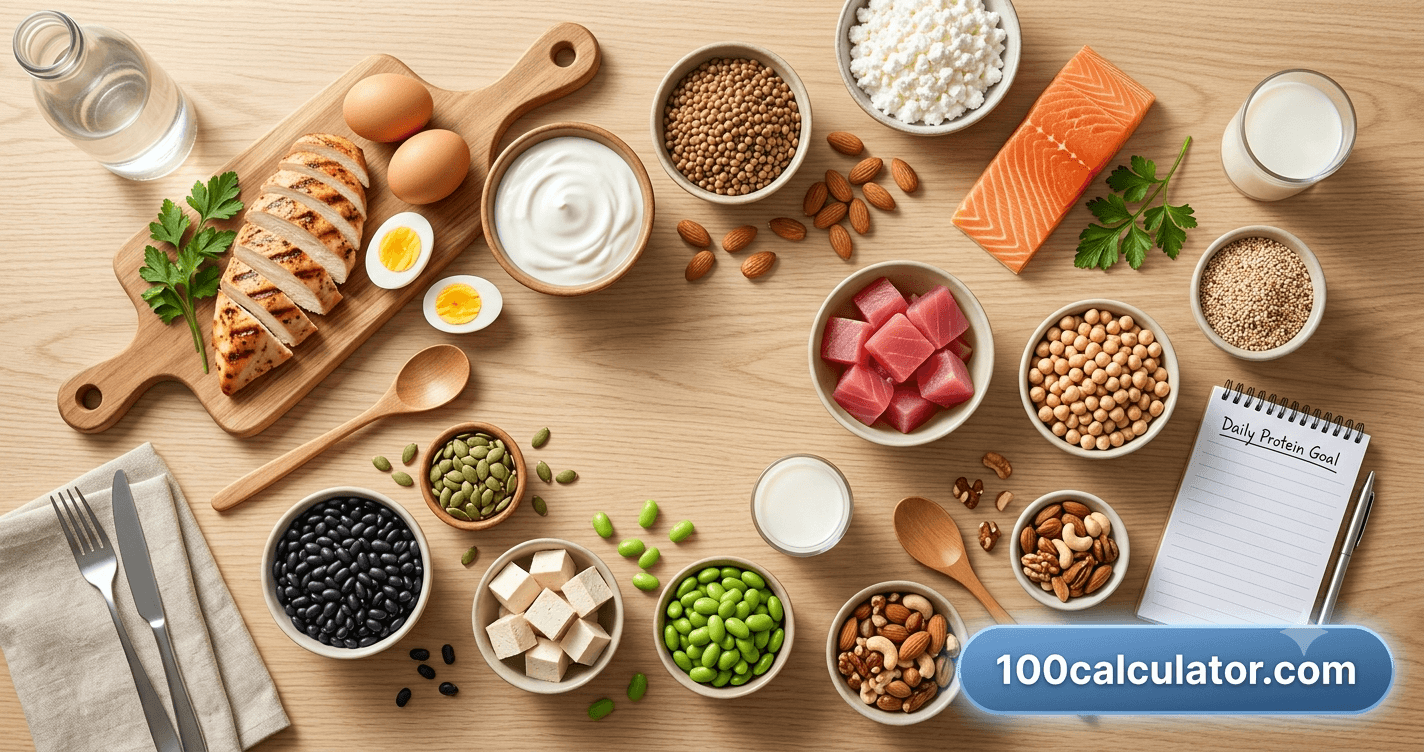
What 30 Grams of Protein Actually Looks Like
A single 100-gram cooked chicken breast is almost exactly 30 grams of protein on its own. If you'd rather mix sources, a cup of Greek yogurt plus one egg gets you close to the same number. Two eggs alone, by contrast, only provide about 12 grams — a fine start to a meal, but well short of a full serving on their own for most adults' daily targets.
How to Hit Your Protein Target Without Weighing Everything
A food scale gives you the most precision, but it's not the only way to stay roughly on target. These two habits cover most of what a scale would give you, without the extra step.
The Palm-and-Fist Method
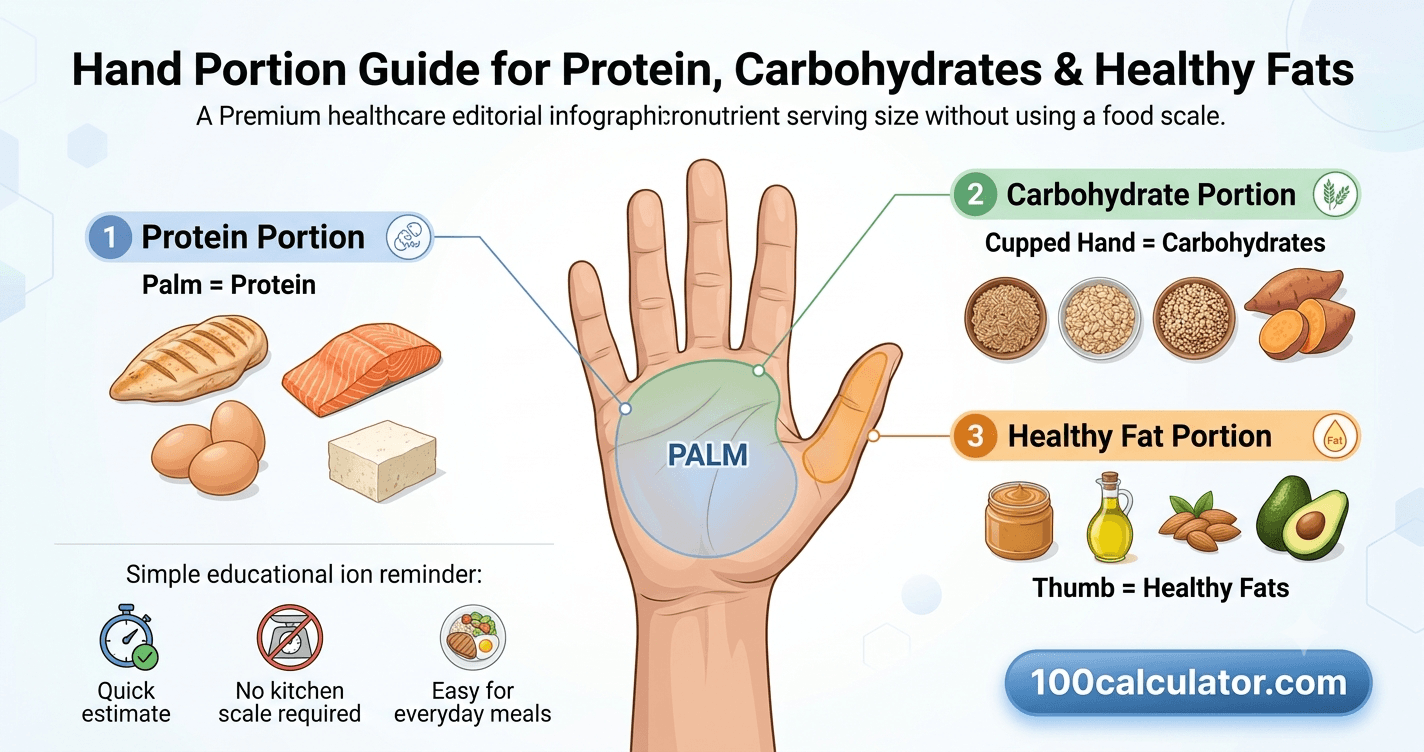
Use your own hand as a rough portion guide: a palm-sized portion of protein is typically around 20 to 30 grams, a cupped handful works reasonably well for carb-heavy foods, and a thumb-sized portion approximates a serving of fat. It's less exact than a scale, but consistent enough for day-to-day use once you've calibrated it against real weighed portions a few times.
Spacing Protein Across the Day
Research on muscle protein synthesis generally supports eating 20 to 40 grams of protein per meal, spaced roughly every three to four hours, rather than saving most of your protein for one large dinner. (ISSN) In practice, that usually means aiming for a solid protein source at breakfast, lunch, and dinner, rather than treating breakfast as an afterthought and loading up later.
Signs You Aren't Getting Enough Protein
True clinical protein deficiency is uncommon in places with reliable access to varied food, but plenty of people, especially those cutting calories aggressively or following very restrictive diets, still fall short of what supports steady energy and muscle maintenance. A few signs worth paying attention to:
- Ongoing hunger or cravings shortly after meals
- Noticeable muscle loss or feeling weaker than usual
- Hair thinning, brittle nails, or dry skin
- Getting sick more often than usual
- Cuts or bruises that heal more slowly
- Persistent fatigue or trouble concentrating
- Swelling in the hands, legs, or feet, in more severe cases
Most of these signs, especially on their own, have other common causes too, so this isn't a checklist for self-diagnosis. (Cleveland Clinic) If several show up together, particularly alongside a very low-calorie or restrictive diet, it's worth mentioning to a doctor or dietitian rather than guessing.
Related Calculators
Put what you just read into practice, try these free tools instantly, no sign-up required.
Fat Free Mass Index Calculator
Measure your lean muscle mass relative to height with FFMI.
Macro / Protein Calculator
Calculate your daily protein, carbs, and fat intake targets.
BAC Calculator (Blood Alcohol Concentration)
Estimate your blood alcohol concentration based on drinks consumed.
Free Bioavailable Testosterone Calculator Online
Calculate free and bioavailable testosterone levels from lab results.
Calorie Deficit Calculator for PCOS
Plan a sustainable calorie deficit tailored for managing PCOS.
Macros vs. Calories: Which Should You Track?
Neither is strictly "better" — they answer different questions. Total calories determine whether you lose, gain, or maintain weight, so they matter most if that's your primary goal. Macros determine how those calories are made up, which affects hunger, muscle, and how you perform in the gym.
For most beginners, starting with calories alone is simpler and still highly effective for weight management. Adding protein tracking on top, without worrying about carbs or fat precisely, is a reasonable middle step. Full macro tracking tends to add the most value for body recomposition goals or athletic performance, where composition and fueling matter as much as the number on the scale.
Common Macro Calculation Mistakes
A few habits quietly throw off macro calculations, even when the math itself is correct:
- Copying someone else's split exactly. A macro percentage that works for someone else's body weight and goals won't automatically translate to yours — recalculate from your own numbers.
- Setting protein too low. Percentage splits can hide a low gram total; always double-check the actual grams against your body weight, not just the percentage.
- Chasing macros while ignoring food quality. Technically, calories and macros count the same regardless of source, but fiber, vitamins, and minerals don't show up in a macro total, and they still matter for how you feel and function.
- Never recalculating. Your targets are based on your current weight and activity level, so they should be revisited every four to six weeks or after a meaningful weight change.
- Treating percentages as fixed law. A macro split is a flexible starting point, not a strict rule — it's fine to adjust it based on how you feel.
Building a Macro Routine That Actually Sticks
The most accurate macro target in the world is useless if it's too complicated to maintain. A few habits make it far easier to stick with:
- Set protein first, every time. It's the macro that matters most for body composition and hunger, and everything else can flex around it.
- Recalculate every four to six weeks, or sooner if your weight shifts by more than a few kilograms, since your targets are based on your current stats.
- Try a simple framework if full tracking feels like too much. Informal habit-based approaches like the "3-3-3" trend popular online — often some version of three balanced meals a day, each built around a protein source — aren't scientifically standardized, but they're a reasonable, low-effort way to build consistency before moving to precise tracking.
- Build meals around protein first, then fill in carbs and fat, rather than the reverse.
- Don't chase a "perfect" number. A reasonable range you can sustain for months beats an exact target you abandon after a week.
Once you've worked through the math once, checking your numbers again takes seconds with 100 Calculator's Macro / Protein Calculator — just update your weight and activity level whenever they change, and it recalculates your full protein, carb, and fat targets instantly.
Medical disclaimer: This article is for general educational purposes only and isn't a substitute for personalized advice from a registered dietitian or doctor. Protein and calorie needs vary based on age, health conditions, medications, and pregnancy status — for example, some kidney and liver conditions require lower protein intake than the general guidelines discussed here. Talk to a healthcare provider before making major changes to your diet, especially if you have an existing medical condition.
More From Our Common Health Guides
Want to dig deeper into the health topics covered above? These related guides expand on protein, body composition, and the other calculators referenced in this article.
Frequently Asked Questions
How do I calculate my protein needs per day?
Multiply your body weight in kilograms by a grams-per-kilogram target based on your activity level. For general health, that's roughly 1.2 to 1.6 grams per kilogram per day, per the updated 2026 U.S. Dietary Guidelines. If you know your weight in pounds instead, divide by 2.2 first. Someone who's 70 kg (154 lb) and moderately active might aim for 70 × 1.4 ≈ 98 grams of protein a day. Active people building muscle often use a slightly higher multiplier, up to about 2.0 g/kg.
What is the 4-4-9 rule in nutrition?
The 4-4-9 rule refers to how many calories each macronutrient provides per gram: protein and carbohydrate each supply 4 calories per gram, while fat supplies 9 calories per gram (alcohol adds 7 calories per gram if you're tracking it). It's officially called the Atwater system, and it's the same math nutrition labels and calculators use to convert grams into total calories. For example, a meal with 30 g protein, 40 g carbs, and 10 g fat provides (30×4) + (40×4) + (10×9) = 370 calories.
Is 40/30/30 a good macro split?
40/30/30 (usually 40% carbs, 30% protein, 30% fat) is a reasonable, balanced starting point for many people, popularized by the Zone diet decades ago. It leans slightly higher in protein and fat than a typical diet, which can support satiety and steady energy. There's nothing uniquely magical about this exact ratio, though — research generally shows that hitting an adequate protein target matters more than the precise split of the remaining calories, so treat it as a sensible default rather than a strict rule.
How much protein does a 70 kg person need per day?
At the current general guideline of 1.2 to 1.6 grams per kilogram, a 70 kg (about 154 lb) person needs roughly 84 to 112 grams of protein a day. Someone who's mostly sedentary could lean toward the lower end, while someone doing regular resistance training often benefits from the higher end or slightly above it, up to around 140 grams (2.0 g/kg). The older 0.8 g/kg reference, which works out to just 56 grams for the same person, is now considered a bare minimum rather than an optimal target.
Do I need 2 grams of protein per kilogram of body weight?
Not necessarily. 2.0 g/kg sits at the upper end of what's typically recommended, and it's most relevant for people doing serious resistance training who want to maximize muscle growth. For general health, 1.2 to 1.6 g/kg covers most adults, per current dietary guidelines. Intakes above 2.0 g/kg are mainly studied in resistance-trained individuals eating at a calorie deficit, where extra protein helps protect muscle mass. Outside of that context, 2 g/kg is usually more than most people need.
What happens if I don't eat enough protein?
In the short term, low protein intake usually shows up as increased hunger, since protein is the most filling macronutrient. Over time, it can lead to muscle loss, a weaker immune response, slower recovery from exercise, and changes to hair, skin, and nails. True clinical protein deficiency is uncommon in places with reliable access to varied food, but many people, especially those cutting calories aggressively or following restrictive diets, still fall short of what supports muscle maintenance and steady energy.
What are the signs of protein deficiency?
Common signs include ongoing hunger or food cravings, noticeable muscle loss, hair thinning or brittle nails, slower-healing cuts, getting sick more often, persistent fatigue, and in more severe cases, swelling in the hands or legs caused by fluid retention. Most of these symptoms have other, more common causes too, so one or two on their own aren't proof of a deficiency. If several show up together, especially alongside a very low-calorie or restrictive diet, it's worth mentioning to a doctor or dietitian.
Can I calculate my macros without weighing my food?
Yes. Hand-based portions work well for most people: a palm-sized portion of protein is roughly 20 to 30 grams, a cupped handful of carbs is a reasonable starting serving, and a thumb-sized amount of fat covers a typical portion. It's less precise than a food scale, but it's consistent enough to hit a general range day to day. Weighing food for a week or two first helps you calibrate what your hand portions actually look like, so estimating stays accurate afterward.
Is it better to count macros or calories?
Neither is strictly better — they answer different questions. Calories determine whether you lose, gain, or maintain weight, so they matter most if that's your main goal. Macros determine how those calories are made up, which affects muscle, hunger, and energy. Many people start with calories alone, since it's simpler, then add protein tracking once that's consistent. Full macro tracking adds the most value for body recomposition goals or athletic performance, where composition matters as much as the number on the scale.
What is a good macro split for losing weight?
There's no single required split for weight loss, since the calorie deficit itself is what drives fat loss. That said, a moderate-to-high protein target (1.2 to 1.6 g/kg, more if you're resistance training) combined with roughly 25 to 35% of calories from fat and the rest from carbohydrate tends to work well for most people, since it protects muscle and keeps hunger manageable during a deficit. Adjust carbs and fat based on your energy levels and what fits your lifestyle.
Are 2 eggs enough protein for the day?
No. Two large eggs provide about 12 grams of protein, which is a solid start to a meal but far short of most adults' daily target of roughly 80 to 140 grams. Eggs are a genuinely high-quality protein source, so they're worth including, but they work best paired with another protein source at the same meal, like Greek yogurt, beans, or a portion of meat or fish, to get closer to a meaningful serving.
How much protein should I eat for breakfast?
Aiming for around 25 to 35 grams of protein at breakfast is a reasonable target for most adults, in line with research suggesting that spreading protein evenly across meals, rather than saving it all for dinner, supports muscle maintenance better. A breakfast in that range might include three eggs with a side of Greek yogurt, or a protein smoothie made with milk, yogurt, and a scoop of protein powder.
What foods are highest in protein?
Lean meats, poultry, fish, and eggs are among the most protein-dense whole foods, typically providing 20 to 30-plus grams per serving. Plant-based options like lentils, black beans, tofu, and edamame are also strong sources, along with dairy products like Greek yogurt and cottage cheese. For a sense of scale, a 100-gram portion of cooked chicken breast provides about 31 grams of protein, almost as much as a full cup of cottage cheese.
Can I eat anything as long as I hit my macros?
Technically, calories and macros don't care where they come from — a food's protein, carb, and fat grams count the same whether it's from a vegetable or a candy bar. But food source still matters for fiber, vitamins, minerals, and how full you feel, none of which show up in a macro count. Most people get better long-term results building meals mostly around whole foods and using less nutrient-dense choices to round out the remaining grams, rather than the other way around.
Is 500 kcal the same as 500 calories?
Yes, in everyday nutrition language, "calorie" and "kcal" (kilocalorie) mean the same thing. Technically, one kilocalorie equals 1,000 small calories, a unit rarely used outside of physics, but food labels, apps, and calculators all use kilocalories whenever they say "calories." So a food listed as 500 calories on a nutrition label and one listed as 500 kcal contain exactly the same amount of energy.
About 100 Calculator
100 Calculator is a free hub of online calculators and educational guides covering health, finance, trading, crypto, education, and more. Every tool is built to be fast, accurate, and genuinely free, with no account or signup required.
We built this guide, and tools like the Macro / Protein Calculator referenced throughout it, to make everyday nutrition questions easier to answer without guesswork. Head back to the 100 Calculator homepage to explore the full library of tools, or learn more about the team behind them on our About Us page.