How Blood Alcohol Concentration Is Calculated
A plain-English walkthrough of the Widmark formula, what a BAC number like 0.08% or 0.15% actually means, and how drinks, body weight, and time all factor into the math.
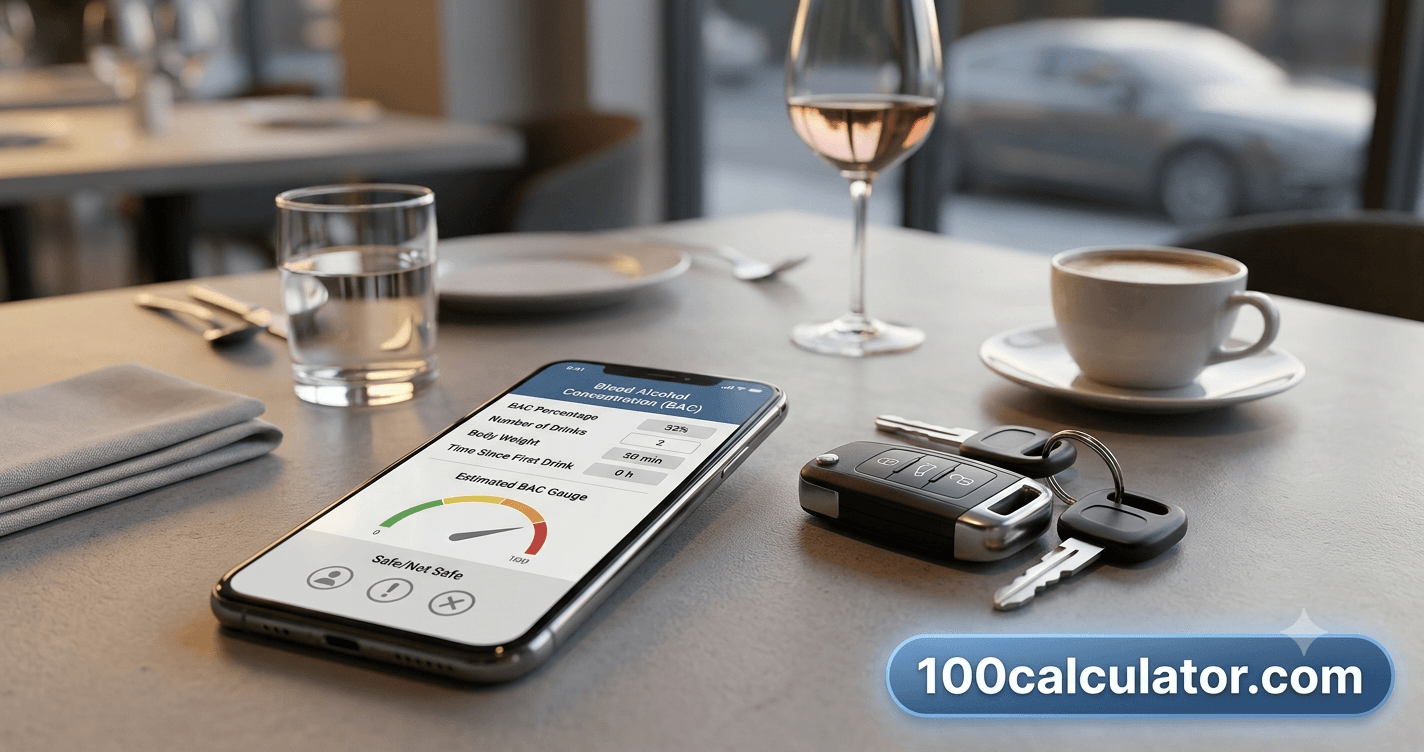
"How many drinks put me at 0.08?" is one of those questions that sounds simple until you actually try to answer it. The honest answer is that it depends on your weight, your sex, how fast you're drinking, and how much time has passed. That's exactly why a single number like "two beers" never quite works for everyone.
Blood alcohol concentration (BAC) is calculated using the Widmark formula, which divides the grams of alcohol you've consumed by your body weight and a sex-based distribution constant, then subtracts the amount your body has already eliminated over time. That's the same formula behind 100 Calculator's BAC Calculator (Blood Alcohol Concentration), and it's the same formula toxicologists have used since the 1930s.
In this guide, we'll break that formula down piece by piece, work through a real example, and cover the questions people search for most: what different BAC numbers actually mean, how standard drinks factor in, why "just drink water" doesn't lower your BAC any faster, and when a high BAC stops being a buzzkill and becomes a medical emergency.
What Is Blood Alcohol Concentration?
Blood alcohol concentration, often shortened to BAC and sometimes called blood alcohol content, is the amount of alcohol in your bloodstream, written as a percentage. A BAC of 0.08% means there are 0.08 grams of alcohol in every 100 milliliters of your blood. At 0.00%, there's none at all.
The two terms, blood alcohol concentration and blood alcohol content, mean the same thing and get used interchangeably in articles, apps, and even on breathalyzer printouts. Either way, the number is doing the same job: giving you a rough, standardized read on how much alcohol is currently circulating through your system.
BAC isn't something you can eyeball. Two people who've had the exact same three drinks over the exact same hour can land at noticeably different numbers, because body weight, sex, food, and metabolism all pull the result in different directions. That's the whole reason a formula exists in the first place: to turn "I've had a few" into something you can actually measure.
Why Understanding Your BAC Matters
It's tempting to treat BAC as trivia for bartenders and police officers, but the number affects more day-to-day decisions than most people realize.
Driving Safety and Legal Consequences
Every country with drunk-driving laws sets a legal BAC limit, and crossing it, even by a little, carries real consequences: fines, license suspension, and in many places, criminal charges. We'll walk through how those limits vary by country later in this guide, but the short version is that "under the limit" and "safe to drive" aren't the same thing. Reaction time and judgment start slipping well before most legal thresholds.
Health and Safety Reasons Beyond Driving
BAC also matters for anything that requires clear judgment or steady coordination: operating machinery, swimming, cooking, or even just navigating stairs safely. Understanding roughly where you land after a few drinks helps you make better calls about all of that, not just about whether to drive home.
There's a personal-awareness angle too. Knowing how your own body responds to alcohol, and roughly how long that response lasts, makes it a lot easier to pace yourself, plan a night out, or explain symptoms accurately if you ever need to talk to a doctor about your drinking habits.
How BAC Is Calculated: The Widmark Formula
Nearly every BAC calculator online, including ours, runs on the same underlying math: the Widmark formula. It's named after Erik Widmark, a Swedish scientist who studied how alcohol moves through the body and published his findings in the 1930s. Almost a century later, forensic toxicologists still use it, and so does most consumer BAC software.
The Formula, Broken Down
Here's the formula in its most common form:
Widmark Formula
BAC = (A ÷ (W × r)) × 100 − (0.015 × H)
A = total grams of alcohol consumed
W = your body weight, in grams
r = the Widmark distribution constant, roughly 0.68 for men and 0.55 for women, reflecting the fact that alcohol distributes through body water, and women's bodies carry a somewhat lower percentage of water on average
H = hours since you started drinking, multiplied by roughly 0.015%, the average rate your body eliminates alcohol per hour
In plain terms: figure out how much alcohol went in, divide it out across your body weight (adjusted for how alcohol distributes differently by sex), then subtract whatever your liver has already had time to process. The r constant and the 0.015% elimination rate are both population averages, not exact numbers for any one person. Actual results can swing by quite a bit depending on genetics, liver function, and how much body fat versus muscle someone carries.
Step-by-Step: A Worked Example
Say a 200-pound man has four standard drinks over two hours. Here's how the math plays out:
- Convert drinks to grams of alcohol. Each U.S. standard drink contains about 14 grams of pure alcohol, so four drinks equal 56 grams.
- Convert body weight to grams. 200 pounds works out to roughly 90,700 grams.
- Apply the male distribution constant. 90,700 × 0.68 ≈ 61,700.
- Divide and multiply by 100. 56 ÷ 61,700 × 100 ≈ 0.09%. That's his estimated peak BAC, if all four drinks hit his bloodstream at once.
- Subtract elimination over time. Two hours × 0.015% = 0.03%. Subtracting that from 0.09% leaves an estimated current BAC of about 0.06%.
Swap in the female distribution constant (0.55 instead of 0.68) and the same four drinks land at a noticeably higher number. That's the mathematical reason women generally reach a higher BAC than men do from an identical amount of alcohol, even at the same body weight.
BAC Measurement Units Explained
One of the most common sources of confusion isn't the math. It's the units. A BAC of "1.5" means something completely different depending on whether it's written as a percentage, a per-mille value, or milligrams per deciliter, and mixing them up makes a normal reading look terrifying (or a dangerous one look harmless).
Percentage, mg/dL, g/L, and Per Mille
In the U.S. and several other countries, BAC is written as a percentage, like 0.08%. That same value can also be written as 80 mg/dL (milligrams per deciliter), 80 mg/100mL, 0.8 g/L, or roughly 0.8 per mille (‰), a unit used in parts of Europe. They all describe the identical amount of alcohol in the blood; only the notation changes. The table below lines them up so you can convert at a glance.
| BAC (%) | mg/dL (= mg/100mL) | g/L (≈ ‰) |
|---|---|---|
| 0.02% | 20 mg/dL | 0.2 g/L |
| 0.05% | 50 mg/dL | 0.5 g/L |
| 0.08% | 80 mg/dL | 0.8 g/L |
| 0.10% | 100 mg/dL | 1.0 g/L |
| 0.13% | 130 mg/dL | 1.3 g/L |
| 0.15% | 150 mg/dL | 1.5 g/L |
| 0.20% | 200 mg/dL | 2.0 g/L |
| 0.25% | 250 mg/dL | 2.5 g/L |
| 0.30% | 300 mg/dL | 3.0 g/L |
This table also explains a question we see a lot: "is a blood alcohol level of 1.5, 1.3, or 2.5 high?" Written as raw numbers like that, without a percent sign, they're almost always g/L or per-mille readings. That puts 1.3 at 0.13%, 1.5 at 0.15%, and 2.5 at a seriously dangerous 0.25%. Likewise, "a blood alcohol level of 300" almost always means 300 mg/dL, which is 0.30%, well into the range where medical attention becomes a real concern, covered in detail later in this guide. A "normal" blood alcohol level in mg/dL, for what it's worth, is simply 0: sober is the baseline everything else is measured against.
On the low end, a BAC of 0.016% is quite mild, typically what you'd see very early on, often after well under a single standard drink for an average adult, or shortly after finishing one drink before your body has had much time to process it.
Standard Drinks and How They Affect BAC
The Widmark formula needs one input you can't get straight off a drink menu: grams of pure alcohol. That's where the "standard drink" comes in: a fixed unit that lets a tall beer, a small glass of wine, and a shot of liquor all get compared on equal footing.
What Counts as One Standard Drink
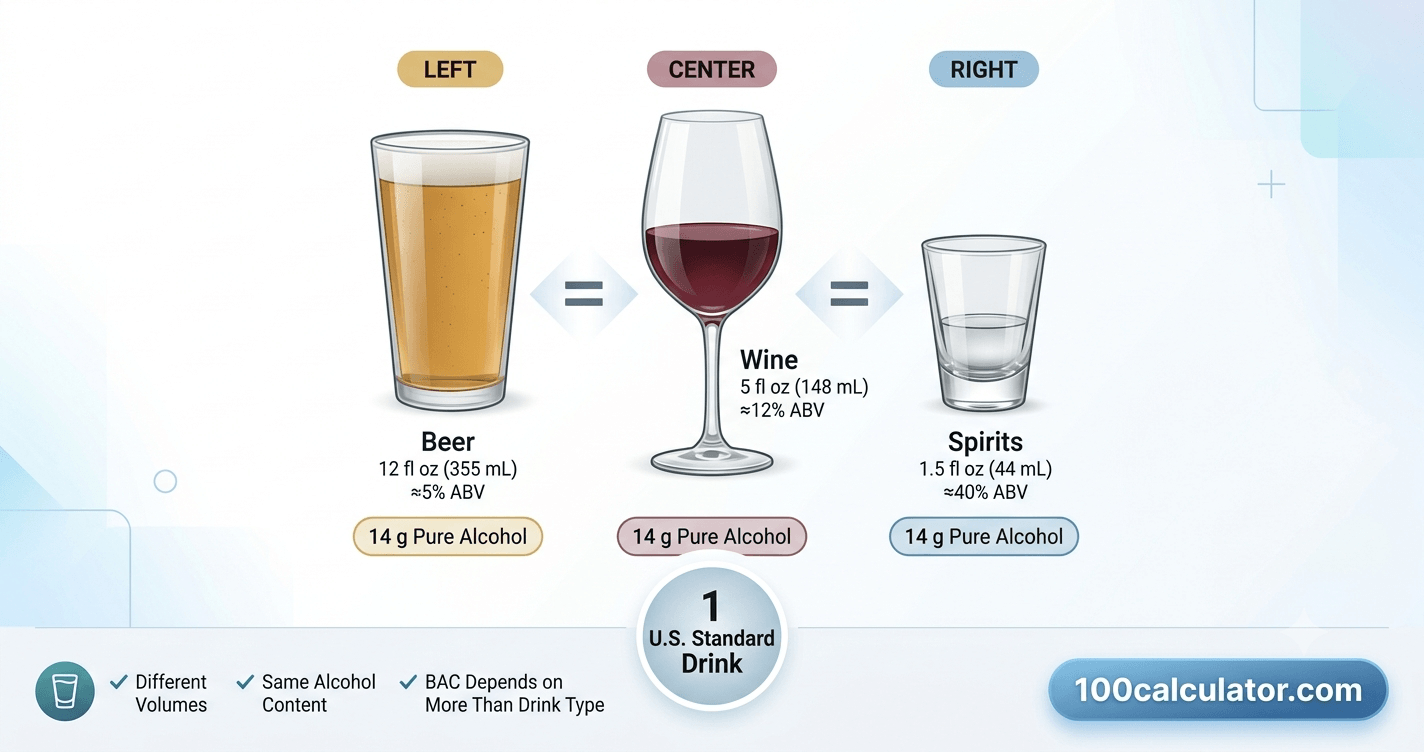
In the United States, the National Institute on Alcohol Abuse and Alcoholism (NIAAA) defines one standard drink as about 14 grams, or 0.6 fluid ounces, of pure alcohol. Despite looking nothing alike, each of the servings below delivers roughly that same amount:
| Drink Type | Typical Serving | Typical ABV |
|---|---|---|
| Regular beer | 12 fl oz (355 mL) | ~5% |
| Malt liquor | 8–9 fl oz (237–266 mL) | ~7% |
| Table wine | 5 fl oz (148 mL) | ~12% |
| Distilled spirits (80 proof) | 1.5 fl oz (44 mL) | ~40% |
Craft Beer, Big Pours, and Cocktails Are Often More Than One Drink
This is where a lot of BAC estimates quietly go wrong. A 7% craft IPA poured into a full pint glass is closer to two standard drinks, not one. A generous restaurant pour of wine can run 7–8 ounces instead of 5. A mixed cocktail with two shots of liquor is two standard drinks before the mixer even gets counted. If you're plugging numbers into a BAC calculator, counting "drinks" by the glass instead of by alcohol content is one of the easiest ways to underestimate your real BAC.
A quick way to sanity-check any drink: multiply its volume in ounces by its ABV as a decimal, then divide by 0.6. A 16-ounce IPA at 8% ABV works out to (16 × 0.08) ÷ 0.6 ≈ 2.1 standard drinks, more than double what a "one beer" mental count would suggest.
Factors That Change Your BAC
Two people can drink the exact same thing and land at very different BAC numbers. Here's what actually moves the needle.
Body Weight and Composition
Alcohol distributes through the water in your body, so a heavier person generally has more water volume to dilute the same amount of alcohol into, which usually means a lower BAC than a lighter person drinking the same amount. Body composition matters too: muscle holds more water than fat does, so two people at the same weight but different body-fat percentages can still land at somewhat different readings.
Biological Sex
This is baked directly into the Widmark formula through the r constant (0.68 for men, 0.55 for women). Women's bodies tend to carry a lower percentage of water and a higher percentage of fat on average, which means the same drink concentrates into a smaller water volume and produces a higher BAC than it would in a man of equal weight.
Food, Drinking Speed, and Hydration
Eating before or while drinking slows how fast alcohol moves from your stomach into your bloodstream, which lowers your peak BAC even though it doesn't change the total amount of alcohol you eventually process. Drinking quickly does the opposite: it overwhelms your liver's roughly one-drink-per-hour processing rate, pushing your peak BAC higher than sipping the same amount slowly would. Dehydration can also slightly concentrate your blood alcohol reading, which is part of why staying hydrated is genuinely a good idea, even though it doesn't remove alcohol from your system any faster (more on that myth shortly).
Medications and Health Conditions
Certain medications and health conditions change how your body absorbs or processes alcohol, sometimes significantly. Liver conditions in particular can slow elimination well below the 0.015%-per-hour average used in most calculators. If you take regular medication or manage a health condition, it's worth asking a doctor or pharmacist how alcohol interacts with it specifically, rather than relying on a general formula to account for it.
BAC Levels and What They Feel Like
Once you have a BAC number, the next question is usually "okay, but what does that actually mean?" Here's a general reference for how different ranges tend to feel, based on patterns described by the National Institute on Alcohol Abuse and Alcoholism and other health sources. Individual responses vary quite a bit, so treat these as a general guide rather than a guarantee of how you personally will feel at any given number.
| BAC Range | What It Commonly Feels Like | Legal / Safety Note |
|---|---|---|
| 0.01–0.03% | Slight warmth or relaxation; little outwardly noticeable change | Reaction time can already be measurably slower |
| 0.04–0.05% | Lowered inhibitions, mild euphoria, early judgment impairment | Legal driving limit in Utah and much of Europe |
| 0.06–0.07% | Reduced coordination, harder to judge distance and speed | Crash risk is already climbing sharply |
| 0.08% | Impaired coordination, judgment, and self-control; slower reaction time | Legal driving limit in most U.S. states, Canada, and the U.K. |
| 0.10–0.12% | Slurred speech, clear balance problems | Illegal to drive almost everywhere in the world |
| 0.15% | Major loss of balance and coordination; possible nausea | Enhanced-penalty DUI range in several U.S. states |
| 0.20–0.25% | Confusion, may need help standing, high blackout risk | Alcohol poisoning risk begins climbing sharply |
| 0.30% | Stupor; risk of losing consciousness | Medical attention should be strongly considered |
| 0.40% and above | Life-threatening: breathing and heart function can be affected | Medical emergency, call for help immediately |
This is also a good place to answer a related question directly: reaching 0.25% or higher generally takes somewhere in the neighborhood of eight to eleven standard drinks for an average adult, though body weight and sex shift that range considerably. At that point, the bigger concern shifts from impaired driving to the physical risk of the drinking itself, which we'll come back to in the emergency section near the end of this guide.
How Long BAC Takes to Reach Zero
Once you stop drinking, your BAC doesn't drop instantly. It keeps rising for another 30 to 40 minutes while alcohol still in your stomach finishes absorbing. Only after that peak does it start to fall, at a fairly steady, fairly slow rate.
The Only Thing That Lowers BAC Is Time
Your liver processes alcohol at an average rate of about 0.015% BAC per hour, roughly equivalent to one standard drink per hour. That rate doesn't speed up no matter what you do. A BAC of 0.08% takes about five to six hours to reach zero. A BAC of 0.16% takes roughly twice that, closer to ten to eleven hours. You can estimate it yourself with a simple calculation: hours to zero = current BAC ÷ 0.015.
Why Coffee, Cold Showers, and Sleep Don't Speed It Up
None of the classic "sober up fast" tricks actually lower your BAC. Coffee and cold showers might make you feel more alert, but alertness and sobriety aren't the same thing. Your liver keeps working at its own pace regardless of how awake you feel. Sleep doesn't speed elimination either, and it comes with its own risk: because BAC keeps climbing for 30 to 40 minutes after your last drink, someone who falls asleep still intoxicated can have their BAC continue rising for a while after they're already unconscious.
Common BAC Myths, Debunked
A handful of drinking "wisdom" gets repeated so often it starts to feel true. Here's what the science actually says.
- Myth: Coffee sobers you up. Fact: caffeine masks tiredness, not intoxication. Your BAC and your coordination are unaffected either way.
- Myth: A cold shower helps you sober up. Fact: it might wake you up, but it does nothing to your actual BAC.
- Myth: Drinking water lowers your BAC. Fact: water helps with hydration and may slightly change how concentrated a blood sample reads, but it doesn't remove alcohol that's already in your bloodstream.
- Myth: Beer is "safer" than liquor. Fact: a standard drink is a standard drink. 12 ounces of 5% beer and 1.5 ounces of 40% liquor contain the same amount of pure alcohol.
- Myth: Eating a big meal afterward sobers you up. Fact: food slows absorption if you eat it before or during drinking. Once alcohol is already in your bloodstream, eating afterward doesn't pull it back out.
- Myth: If you can sleep it off, you're fine. Fact: BAC keeps rising for 30 to 40 minutes after your last drink, even after you've fallen asleep, which is part of why "sleeping it off" carries real risk at high BAC levels.
Using a BAC Calculator the Right Way
A BAC calculator does the Widmark math for you, so you don't have to convert ounces to grams or dig up your weight in kilograms by hand. Most calculators, including 100 Calculator's BAC Calculator, ask for a similar set of inputs: your body weight, biological sex, how many standard drinks you've had, and how much time has passed since you started drinking. Enter those, and it returns an estimated BAC instantly.
Free Online Tool
Want the math done for you?
100 Calculator's BAC Calculator (Blood Alcohol Concentration) runs the Widmark formula in your browser. Enter your details and drinks, and it estimates your current BAC along with roughly how long it will take to reach zero, no account or signup needed.
A calculator is genuinely useful for building awareness of your own patterns, but it has hard limits. It doesn't know your actual metabolism, your liver health, or whether you ate a full dinner or skipped lunch. Treat the number it gives you as a ballpark estimate for learning and planning, never as proof that you're sober enough to drive, operate machinery, or make safety-critical decisions. If there's alcohol in your system and any doubt at all, the only reliably safe choice is not to drive.
Legal BAC Limits Around the World
Legal limits vary a surprising amount from country to country, and even within countries. Here's a general snapshot. Always check current local law before you travel or drive, since these thresholds do change over time.
| Region / Example | Typical Legal Limit |
|---|---|
| Most U.S. states, Canada, England & Wales | 0.08% |
| Utah (U.S.) | 0.05% |
| U.S. commercial (CDL) drivers | 0.04% |
| U.S. drivers under 21 | 0.00–0.02% (zero tolerance, varies by state) |
| Scotland, most of continental Europe, Australia, South Africa | 0.05% |
| Japan, China, India, several Nordic countries | 0.02–0.03% |
| Many countries worldwide (parts of the Middle East, several in Eastern Europe) | 0.00% (zero tolerance) |
Notice how much lower most of these limits are than the numbers we've been discussing throughout this guide. A 0.05% or 0.02% limit means noticeably less room for error than 0.08% does. In some countries, one drink can be enough to put you over. Being "technically" under whatever the local limit is doesn't mean you're unaffected, either; as the effects table earlier in this guide shows, judgment and reaction time are already measurably impaired well before most legal thresholds.
Related Calculators
Put what you just read into practice, try these free tools instantly, no sign-up required.
Fat Free Mass Index Calculator
Measure your lean muscle mass relative to height with FFMI.
Macro / Protein Calculator
Calculate your daily protein, carbs, and fat intake targets.
BAC Calculator (Blood Alcohol Concentration)
Estimate your blood alcohol concentration based on drinks consumed.
Free Bioavailable Testosterone Calculator Online
Calculate free and bioavailable testosterone levels from lab results.
Calorie Deficit Calculator for PCOS
Plan a sustainable calorie deficit tailored for managing PCOS.
When BAC Becomes a Medical Emergency
Everything up to this point has been about estimating BAC for awareness and planning. But at high enough levels, alcohol stops being a coordination problem and becomes a genuine medical emergency, one where knowing the warning signs can save a life.
What to Do
- Call emergency services right away. Don't wait to see if symptoms improve on their own.
- Stay with the person. Never leave someone alone if you suspect alcohol poisoning.
- Turn them onto their side if they're unconscious. This helps prevent choking if they vomit.
- Don't try to "fix" it yourself. Coffee, cold showers, and walking someone around don't reverse alcohol poisoning, and they can waste critical time.
- Never assume they'll "sleep it off." BAC keeps rising for 30 to 40 minutes after the last drink, even in someone who's already unconscious.
According to the National Institute on Alcohol Abuse and Alcoholism, alcohol poisoning typically begins around a BAC of 0.25% and becomes life-threatening above 0.30%, with levels above 0.40% carrying serious risk of respiratory depression, coma, and death. If you're ever unsure whether a situation is serious enough to call for help, treat it as though it is. Emergency responders would always rather be called for a false alarm than arrive too late.
Medical and legal disclaimer: This article is for general educational purposes only. It is not medical advice, and it is not a substitute for professional guidance from a doctor, pharmacist, or legal authority. BAC calculators, including the formula and tool referenced in this guide, provide estimates only. Actual blood alcohol concentration varies by individual and cannot be measured accurately without a breath, blood, or urine test administered by a qualified professional or device. Never use an estimated BAC to decide whether it is safe or legal to drive, operate machinery, or perform any other safety-critical task. Legal BAC limits vary by location and change over time; always confirm current regulations for your specific location. If you or someone near you shows signs of alcohol poisoning, treat it as a medical emergency and contact emergency services immediately.
Sources & References
This guide draws on guidance from the following organizations. We link to them directly so you can read further or double-check anything for yourself:
More From Our Common Health Guide
Curious about other health calculations we cover? These related guides dig into other topics from the same Common Health Guide series.
Frequently Asked Questions
What is BAC and how is it calculated?
Blood alcohol concentration (BAC), also called blood alcohol content, measures the amount of alcohol in your bloodstream, expressed as a percentage. A BAC of 0.08% means there are 0.08 grams of alcohol per 100 milliliters of blood. It's calculated using the Widmark formula, which combines how much alcohol you've had, your body weight, your biological sex, and the time elapsed since you started drinking. Online BAC calculators use this same formula to give you an estimate, though your actual BAC can vary based on food intake, metabolism, and other individual factors.
What is the Widmark formula?
The Widmark formula is the standard method for estimating BAC, developed by Swedish scientist Erik Widmark in the 1930s. It states that BAC equals the grams of alcohol you drank, divided by your body weight in grams multiplied by a distribution constant (0.68 for men, 0.55 for women), then multiplied by 100, minus the amount your body has already eliminated over time, at roughly 0.015% per hour. Forensic toxicologists, researchers, and most online BAC calculators still rely on this formula today, nearly a century after it was developed.
Is BAC calculated per 100 mL of blood?
Yes. In the U.S. and many other countries, BAC is expressed as grams of alcohol per 100 milliliters (or per deciliter) of blood. That's exactly what the percentage represents: a BAC of 0.08% means 0.08 grams of alcohol are present in every 100 mL of blood. This is also written as 80 mg/dL or 80 mg/100mL, all three describe the exact same amount, just in different notation.
What is 0.08 BAC in mg/100mL?
A BAC of 0.08% equals 80 mg/100mL, also written as 80 mg/dL. These describe the same amount of alcohol: multiply the percentage by 1,000 to convert it to mg/100mL, so 0.08% × 1,000 = 80 mg/100mL. This is the legal driving limit in most U.S. states, Canada, and the U.K. For a typical adult, reaching it usually takes about four standard drinks for women or five for men within roughly two hours, though body weight and other factors change this significantly.
How many drinks does it take to reach 0.05% BAC?
For most adults, reaching around 0.05% BAC typically takes roughly one to two standard drinks within about an hour, though this varies with body weight, biological sex, and how fast you're drinking. Smaller or lighter-weight people reach it faster than larger ones. Since 0.05% is the legal driving limit in Utah and in much of Europe, Australia, and South Africa, it's a meaningful number even though many people don't feel strongly affected at this level yet. Reaction time and judgment are already measurably impaired.
How many beers does it take to reach 0.08 BAC?
For a typical adult, reaching 0.08% BAC, the standard legal driving limit, usually takes about four drinks for women or five for men within roughly two hours, based on the National Institute on Alcohol Abuse and Alcoholism's definition of binge drinking. Body weight makes a real difference, though: a smaller person reaches 0.08% with fewer drinks than a larger person drinking the same amount over the same time. Food, hydration, and drinking speed shift the number further.
How many drinks is 0.25 BAC, and how dangerous is that level?
Reaching 0.25% BAC typically takes somewhere around eight to eleven standard drinks for an average adult within a few hours, though this varies enormously with body weight and sex. This level is genuinely dangerous: it's well past the point of severe motor impairment, and it puts someone at meaningfully higher risk of blackouts, injury from falls, and alcohol poisoning. At 0.25% and above, judgment and coordination are so impaired that the person may not realize they need help, which is exactly why this range calls for a sober friend nearby.
How high is 0.12 BAC, and what does it feel like?
A BAC of 0.12% is meaningfully above the 0.08% legal driving limit used in most places. At this level, most people experience noticeably slurred speech, impaired balance, slowed reaction time, and a reduced ability to judge distance and speed, all of which make driving far more dangerous than at 0.08%. Some people also feel nauseated or unusually emotional at this stage. Reaching 0.12% typically takes several more drinks than reaching 0.08%, and the crash risk at this level is substantially higher than at the legal limit.
Is a BAC of 0.40% dangerous?
Yes, a BAC of 0.40% is in a life-threatening range for most people. According to the National Institute on Alcohol Abuse and Alcoholism, BAC levels above 0.30% carry a real risk of losing consciousness, and levels above 0.40% can cause respiratory depression, coma, and death. At this stage, basic life-support functions like breathing and heart rate can start to shut down. If someone shows signs like slow or irregular breathing, unresponsiveness, or bluish or pale skin, treat it as a medical emergency and call for help immediately rather than waiting for it to pass.
Is 40% alcohol the same as 80 proof?
Yes, in the standard U.S. system. Alcohol proof is defined as twice the alcohol by volume (ABV), so 40% ABV always equals 80 proof, and 50% ABV equals 100 proof. This conversion applies to most spirits sold today, including common vodka, whiskey, gin, and rum. The historical British proof system used a different scale, but it was replaced by ABV labeling back in 1980, so you're very unlikely to run into it on a modern bottle.
How long does it take for BAC to drop from 0.08 to 0.00?
On average, it takes about five to six hours for BAC to drop from 0.08% to 0.00%, since the body eliminates alcohol at roughly 0.015% per hour. That means your BAC doesn't reach zero the moment you stop drinking, and if you had several drinks over a longer period, it can take noticeably longer than that. Nothing speeds this up. Time is the only thing that lowers BAC, which is why waiting it out with coffee or a nap doesn't actually get you sober any faster.
Will a few beers or a small sip show up on a breathalyzer?
Yes. Modern breathalyzers, especially law-enforcement-grade devices, can detect BAC levels as low as 0.01%, so even one drink is typically detectable shortly after you finish it. A single standard drink might only register for one to two hours, while three or more drinks can stay detectable for several hours, and a heavy drinking session can still show up the next morning. A small sip contains very little alcohol and would likely clear your system quickly, but a sensitive device tested immediately afterward could still pick up a trace.
Does drinking water, coffee, or sleeping help you sober up faster?
No. Water, coffee, cold showers, exercise, and sleep can make you feel more alert, but none of them speed up how quickly your liver breaks down alcohol. Time is the only thing that actually lowers your BAC, at a fairly fixed rate of about 0.015% per hour. Drinking water alongside alcohol is still a good idea since it helps with hydration and may modestly change how concentrated your blood alcohol reading appears, but it doesn't remove alcohol from your system any faster.
Is having 4 beers in 2 hours considered a lot?
For most women, four drinks in about two hours is enough to reach 0.08% BAC, which meets the clinical definition of binge drinking used by the National Institute on Alcohol Abuse and Alcoholism. For most men, that threshold is typically closer to five drinks in the same window, so four comes close but may land just under it, depending on body weight. Either way, four drinks in two hours is a fast pace of drinking that noticeably impairs coordination and judgment for the large majority of adults.
What is the "2-2-2 rule" for drinking?
The "2-2-2 rule" isn't an official medical guideline. It's an informal moderation idea that circulates in alcohol education and recovery communities, and different sources describe it slightly differently. Most versions suggest capping intake at no more than two drinks per occasion and limiting drinking to no more than two days a week, leaving plenty of alcohol-free time in between. It's a memorable way to think about pacing, but it isn't a substitute for guidance from health authorities like the NIAAA, which define low-risk drinking limits based on your sex and health history.
About 100 Calculator
100 Calculator is a free hub of online calculators and educational guides covering health, finance, trading, crypto, education, and more. Every tool is built to be fast, accurate, and genuinely free, with no account or signup required.
We built this guide, and the BAC Calculator referenced throughout it, to make a genuinely confusing topic easier to understand. Head back to the 100 Calculator homepage to explore the full library of tools, or learn more about the team behind them on our About Us page.