What Is Fat Free Mass Index and Why It Matters
A beginner-friendly breakdown of what Fat-Free Mass Index (FFMI) actually measures, how to calculate your own number, what counts as a normal range, and why it often tells you more about your health than the bathroom scale or BMI alone.
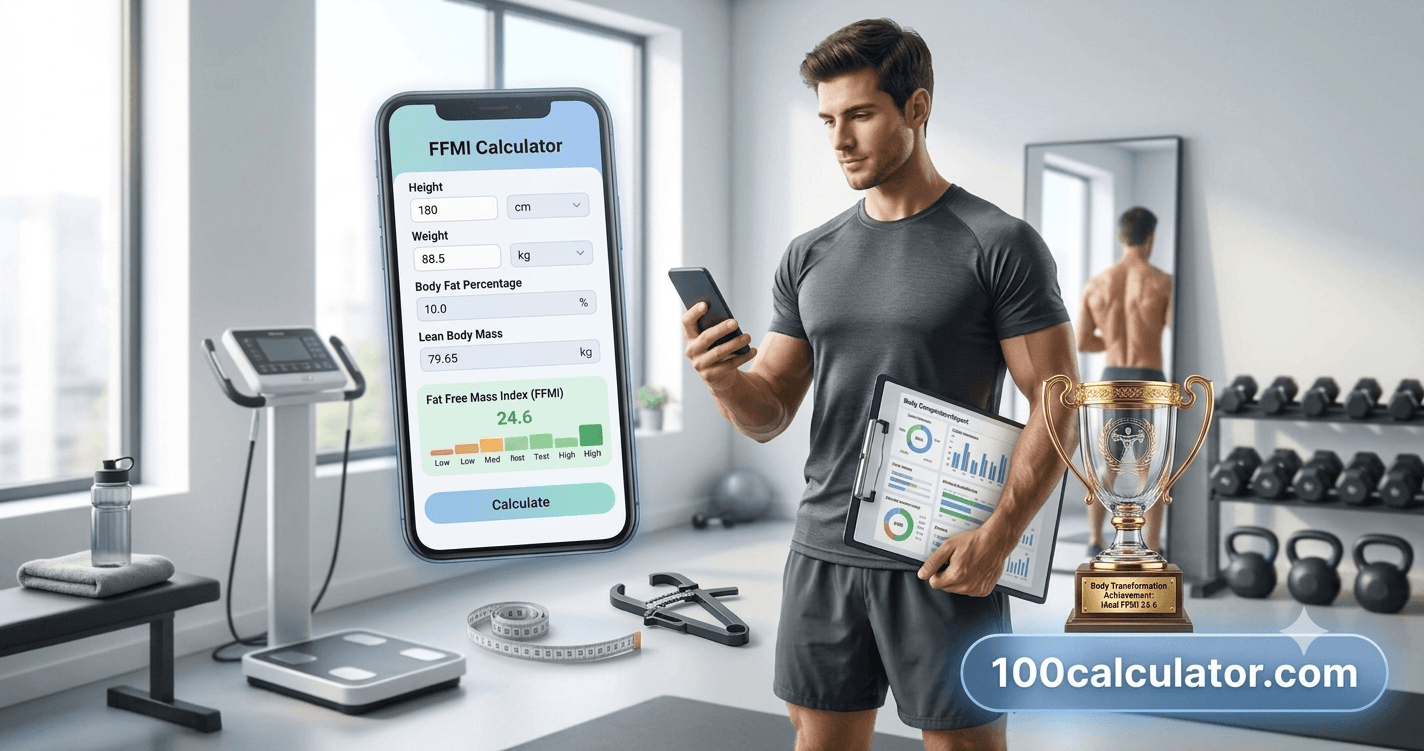
Step on a scale and the number alone can't tell you whether you've gained muscle or gained fat. That's the core problem with tracking body weight, or even BMI, by itself.
Fat-Free Mass Index (FFMI) is a measurement that shows how much muscle, bone, organ tissue, and water you carry relative to your height, expressed in kilograms per square meter (kg/m²). Unlike body weight, which mixes fat and lean tissue into a single number, FFMI isolates everything in your body that isn't fat. A higher FFMI generally means more lean tissue, most of it muscle, for your height.
FFMI was originally developed in the 1990s to help researchers screen for anabolic steroid use among competitive bodybuilders, but it's since become a practical tool for anyone who wants a clearer read on body composition than the bathroom scale provides. It's especially useful if you strength train regularly, since a rising FFMI over time is one of the clearest signs that your training and nutrition are actually building muscle rather than just moving the scale.
In this guide, we'll walk through exactly how FFMI is calculated, what counts as a normal range for men and women, why researchers believe there's a natural ceiling to how high it can climb, and how it compares to more familiar measurements like BMI. If you'd rather skip ahead and check your own number, 100 Calculator's Fat Free Mass Index Calculator does the math for you instantly.
Understanding Body Composition: Fat Mass vs. Fat-Free Mass
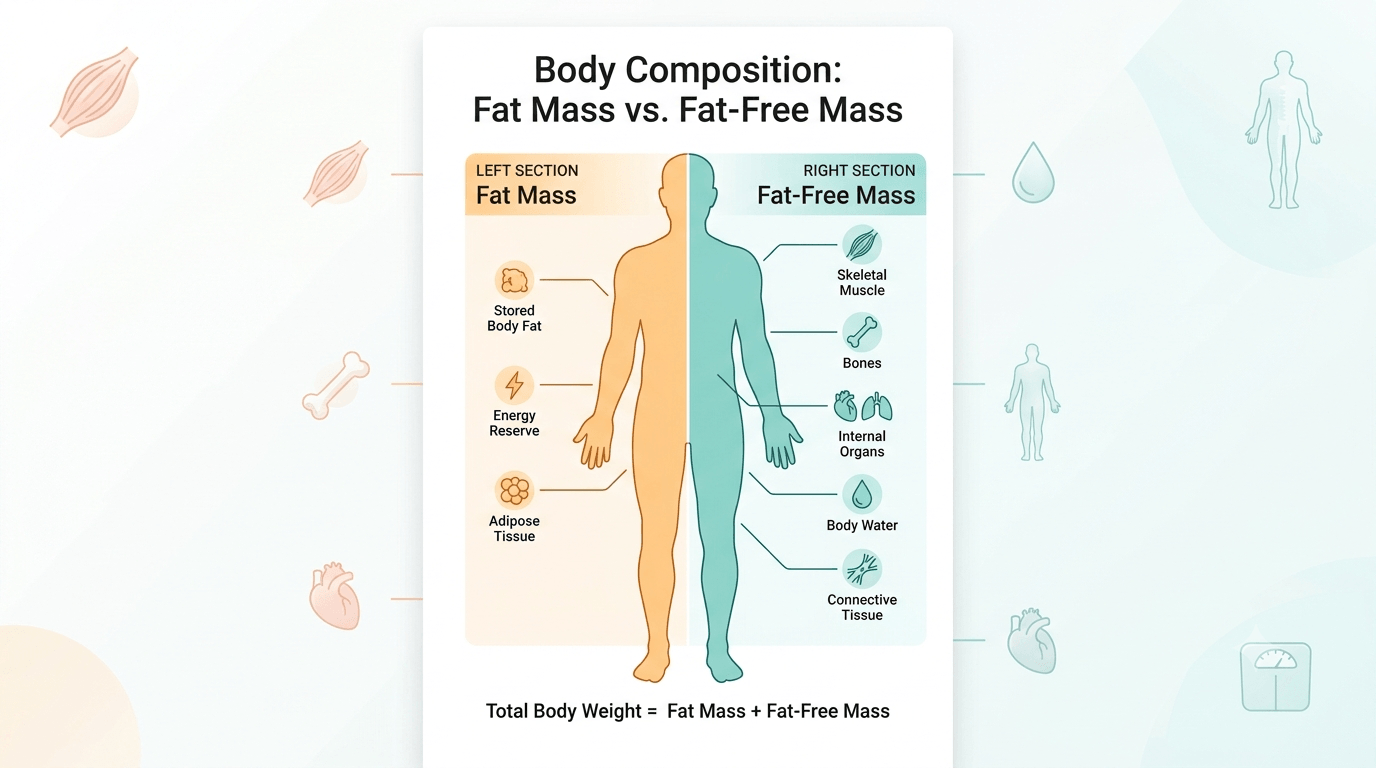
Every body is made up of two broad compartments: fat mass and fat-free mass. Fat mass is exactly what it sounds like — the fat stored under your skin and around your organs. Fat-free mass is everything else.
Body composition simply describes how your total weight splits between these two categories. Two people can weigh the exact same number on a scale and have completely different body compositions, which is why weight alone is such a limited way to track health or fitness progress.
What Fat-Free Mass Actually Includes
Fat-free mass isn't just muscle, even though muscle usually makes up most of it. It also includes:
- Skeletal muscle
- Bones and connective tissue
- Organs, including your heart, liver, and kidneys
- Body water, which makes up a large share of total fat-free mass
Because fat-free mass includes water and organ weight, it will always be higher than your muscle mass alone. That's worth remembering if you ever compare your FFMI to a muscle-mass-specific figure from somewhere else.
What Is Fat-Free Mass Index (FFMI)?
Fat-Free Mass Index takes your fat-free mass and adjusts it for your height, the same way Body Mass Index adjusts total weight for height. The result is a single number, in kg/m², that lets you compare muscularity across people of different heights on a level playing field.
FFMI was introduced in a 1995 study by researchers Kouri, Pope, Katz, and Oliva, who were trying to find a reliable way to flag anabolic steroid use among competitive bodybuilders. (Kouri et al., 1995) Since then, it's been adopted more broadly by strength coaches, natural bodybuilding federations, and fitness enthusiasts who want a more precise way to track muscle gain than body weight or BMI.
The FFMI Formula
Calculating FFMI takes two steps. First, you find your fat-free mass:
| Step | Formula |
|---|---|
| 1. Fat-free mass | Weight (kg) × (1 − Body Fat % ÷ 100) |
| 2. FFMI | Fat-Free Mass (kg) ÷ Height (m)² |
The only input FFMI needs that a scale can't give you is your body fat percentage, which has to come from a separate measurement — we'll cover how to get that later in this guide.
Normalized FFMI: Adjusting for Height
Because taller people need more total fat-free mass just to fill out a larger frame, raw FFMI can slightly favor shorter people when comparing muscularity. To correct for this, many calculators use a normalized (or adjusted) FFMI that references everyone to a standard height of 1.8 m, about 5'11":
| Measurement | Formula |
|---|---|
| Normalized FFMI | FFMI + 6.3 × (1.8 − Height in meters) |
This adjustment is small for most people — usually a point or two — but it makes comparisons between, say, a 5'5" and a 6'3" athlete more meaningful.
How to Calculate Your FFMI
You don't need any special equipment to calculate FFMI beyond a scale, a height measurement, and a way to estimate your body fat percentage.
Step-by-Step Calculation
- Weigh yourself and record your weight in kilograms (multiply pounds by 0.453592 if needed).
- Get your body fat percentage from a bioelectrical impedance scale, skinfold calipers, or a DEXA scan.
- Calculate your fat-free mass by multiplying your weight by one minus your body fat percentage as a decimal.
- Measure your height in meters (divide inches by 39.37, or centimeters by 100).
- Divide fat-free mass by height squared to get your raw FFMI.
- Apply the normalization formula if you want a height-adjusted number for comparison purposes.
A Worked Example
Say a man weighs 82 kg, stands 1.78 m tall, and has a body fat percentage of 18%, measured by a DEXA scan.
- Fat-free mass: 82 × (1 − 0.18) = 82 × 0.82 = 67.2 kg
- FFMI: 67.2 ÷ (1.78 × 1.78) = 67.2 ÷ 3.17 = 21.2
- Normalized FFMI: 21.2 + 6.3 × (1.8 − 1.78) = 21.2 + 0.13 = 21.3
An FFMI around 21 puts him solidly above the general population average, consistent with someone who trains regularly. If you'd rather skip the manual math, 100 Calculator's Fat Free Mass Index Calculator runs these same steps for you and returns your result instantly.
What Is a Normal Fat-Free Mass Index Range?
"Normal" depends on the population you're comparing against, but research gives a solid starting point. A 2003 body composition study measured FFMI in a large group of generally healthy adults and found that people within a normal BMI range typically fell into the ranges below. (Kyle et al., 2003)
| Measurement | Men | Women |
|---|---|---|
| Fat-Free Mass Index (FFMI) | 16.7 – 19.8 kg/m² | 14.6 – 16.8 kg/m² |
| Fat Mass Index (FMI) | 1.8 – 5.2 kg/m² | 3.9 – 8.2 kg/m² |
Fat-Free Mass Index for Men
For adult men, an FFMI in the high teens to around 20 is common for someone who isn't training specifically for muscle gain. Research measuring a large healthy adult population found a median FFMI of about 18.9 kg/m² in men aged 18 to 34. (Schutz et al., 2002) Men who strength train consistently for a few years often land in the low-to-mid 20s. As a rough kilogram reference, a man around 1.8 m tall with an FFMI in the normal range would carry roughly 54 to 64 kg (about 119 to 141 lb) of fat-free mass.
Fat-Free Mass Index for Women
Women naturally carry a lower FFMI than men, mainly due to differences in average muscle mass and hormone profiles. The same research found a median FFMI of about 15.4 kg/m² in women aged 18 to 34, with regular strength training typically pushing that number into the high teens over time. A woman around 1.65 m tall with an FFMI in the normal range would carry roughly 40 to 46 kg (about 88 to 101 lb) of fat-free mass — again, just an illustrative example, since taller or shorter women will naturally land outside this specific range.
Fitness communities and natural bodybuilding federations sometimes use more detailed, informal tiers — below average, average, above average, excellent, and superior — to describe FFMI progress. These tiers aren't official medical classifications, but they're a useful shorthand for tracking your own progress over time rather than comparing yourself to a single "normal" number.
FFMI and the Natural Muscle-Building Limit
One reason FFMI gets so much attention in fitness circles is a specific number: 25. You'll often see this cited as an approximate ceiling for how muscular someone can get through training and nutrition alone, without anabolic steroids.
Where the "FFMI of 25" Number Comes From
This figure traces back to the same 1995 study that introduced FFMI. Kouri and colleagues compared drug-free athletes to competitors who admitted to steroid use and found that none of the drug-free athletes in their sample exceeded a normalized FFMI of about 25, while several steroid users scored well above it. That finding turned 25 into a widely cited reference point for natural muscular potential.
What FFMI Can't Tell You
It's worth being careful with this number. The original study looked at a relatively small group of athletes, and the researchers themselves described 25 as an "apparent" upper limit, not an absolute biological ceiling. A small number of people with exceptional genetics, especially very tall or broad-framed individuals, can naturally reach slightly higher scores.
Fat-Free Mass Index vs. Body Mass Index (BMI)
BMI has been the default body-weight screening tool in medicine for decades, mostly because it only requires height and weight. But that simplicity is also its biggest weakness. Our FFMI vs BMI comparison guide covers this in more depth, but here's the short version.
Where BMI Falls Short
BMI divides your total weight by your height squared, with no way to separate how much of that weight is muscle versus fat. In June 2023, the American Medical Association adopted a policy formally acknowledging this limitation, recommending that BMI be used alongside other measures, like waist circumference or body composition, rather than as a standalone diagnosis. (AMA, 2023) The policy also noted that BMI's original reference data came largely from non-Hispanic white populations, which limits how well it applies across different body types and ethnic backgrounds.
This is exactly why a muscular athlete can land in the "overweight," or even "obese," BMI category despite carrying very little body fat — BMI simply can't see the difference.
Using FFMI and BMI Together
FFMI doesn't replace BMI so much as fill in what it's missing. BMI is still a fast, free way to flag when someone's total weight might be worth a closer look. FFMI, along with FMI covered next, tells you what that weight is actually made of.
| Question | BMI | FFMI |
|---|---|---|
| What it measures | Total weight relative to height | Fat-free mass relative to height |
| Distinguishes muscle from fat? | No | Yes, when paired with body fat % |
| Best used for | Quick, population-level screening | Tracking muscle gain or loss over time |
| Main limitation | Can't tell fat from muscle | Requires a body fat % measurement |
Used together, along with waist circumference, these numbers give a much fuller picture than either one alone.
Fat Mass Index (FMI): The Other Half of the Picture
If FFMI tells you how much lean tissue you're carrying, Fat Mass Index (FMI) tells you the other half of the story: how much fat you're carrying, also adjusted for height.
| Measurement | Formula |
|---|---|
| FMI | Fat Mass (kg) ÷ Height (m)² |
Because it's calculated the same way as FFMI and BMI, FMI is expressed in the same kg/m² units, which makes it easy to compare the two side by side.
What Counts as a Healthy FMI
Research measuring a large, generally healthy adult population found a median FMI of about 4.0 kg/m² in men and 5.5 kg/m² in women, with values trending higher as people move further past their twenties. (Schutz et al., 2002) Within a normal BMI, most men fall somewhere between roughly 1.8 and 5.2 kg/m², and most women between about 3.9 and 8.2 kg/m². Some researchers have proposed clinical cutoffs around 6.6 kg/m² and higher in men, and roughly 9 to 13 kg/m² in women, as a reasonable threshold for obesity-level fat mass, though exact numbers vary between studies and populations.
FMI's main advantage over body fat percentage alone is that it accounts for your frame size. Two people with the same body fat percentage but very different heights can be carrying meaningfully different amounts of fat mass in absolute terms — FMI captures that difference.
How to Measure Your Body Fat Percentage Accurately
Since FFMI and FMI both depend on knowing your body fat percentage, the accuracy of your result is only as good as the method you use to get that number.
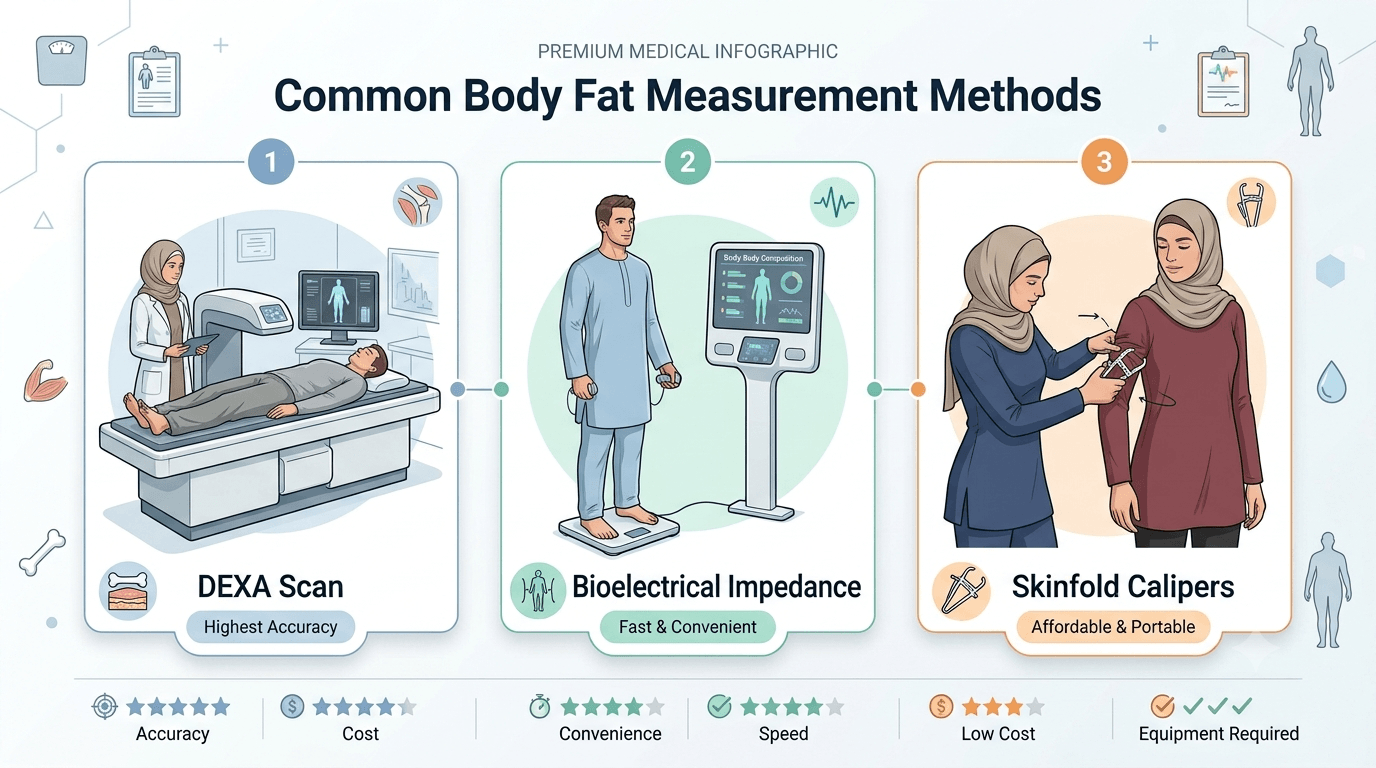
Comparing the Common Methods
| Method | Accuracy | Convenience | Notes |
|---|---|---|---|
| DEXA scan | Very high | Low, clinic visit required | Considered the clinical gold standard; also shows bone density |
| Bioelectrical impedance (BIA) | Moderate | High, home scales and handheld devices | Results shift with hydration, food intake, and time of day |
| Skinfold calipers | Moderate | Moderate | Accuracy depends heavily on technician skill and consistent measurement sites |
| Hydrostatic (underwater) weighing | High | Low, specialized equipment needed | Accurate but rarely accessible |
No method is perfect, and even the same method can give slightly different results from one day to the next. For tracking FFMI over time, consistency matters more than perfection — using the same method, ideally at a similar time of day and hydration level, gives a far more reliable trend than chasing the single most "accurate" number.
How to Increase Fat-Free Mass Safely
Building fat-free mass comes down to a fairly short list of proven habits, even if actually doing them consistently takes real effort.
Strength Training
Resistance training is the single most reliable way to build and preserve muscle, the largest component of fat-free mass. Progressive overload — gradually increasing the weight, reps, or difficulty of your workouts over time — signals your body to adapt by building more muscle tissue.
Protein Intake
Muscle tissue is built from protein, so adequate intake matters if you're trying to raise your FFMI. General guidance for people who strength train often falls between roughly 1.6 and 2.2 grams of protein per kilogram of body weight per day, though individual needs vary. Our protein intake guide breaks this down further, and 100 Calculator's Macro / Protein Calculator can help you find a target that fits your goals and current body weight.
Recovery and Consistency
Muscle isn't built during your workout — it's built during the recovery afterward, largely while you sleep. Consistent sleep, adequate calories, and enough rest between hard training sessions all matter as much as the workouts themselves. Hormonal factors play a role too; if you're curious how yours might be affecting your progress, 100 Calculator's Free Bioavailable Testosterone Calculator is a useful starting point alongside a conversation with your doctor.
A quick checklist to keep you on track:
- Train each major muscle group with resistance exercise at least twice a week
- Eat enough total calories to support muscle repair and growth
- Spread protein across meals rather than saving it all for one sitting
- Get consistent, adequate sleep
- Re-check your FFMI every few months, not every few days, to see a meaningful trend
Related Calculators
Put what you just read into practice, try these free tools instantly, no sign-up required.
Fat Free Mass Index Calculator
Measure your lean muscle mass relative to height with FFMI.
Macro / Protein Calculator
Calculate your daily protein, carbs, and fat intake targets.
BAC Calculator (Blood Alcohol Concentration)
Estimate your blood alcohol concentration based on drinks consumed.
Free Bioavailable Testosterone Calculator Online
Calculate free and bioavailable testosterone levels from lab results.
Calorie Deficit Calculator for PCOS
Plan a sustainable calorie deficit tailored for managing PCOS.
Body Fat Distribution and When to Take Notice
Not all fat carries the same health risk. Where your body stores fat matters as much as how much you're carrying overall.
Waist Circumference and Fat Distribution
Men tend to store extra fat around the abdomen first, a pattern often described as "android," or apple-shaped, driven largely by hormonal differences. Women more often store fat around the hips, thighs, and buttocks before menopause — a "gynoid," or pear-shaped, pattern — though this frequently shifts toward an abdominal pattern afterward, as estrogen levels drop.
Waist circumference is a simple, low-cost way to flag this kind of risk, even in someone with a "normal" BMI. Widely used cutoffs point to added health risk above 102 cm (40 in) for men and 88 cm (35 in) for women, since abdominal fat is more closely linked to insulin resistance, high blood pressure, and cardiovascular disease than fat stored elsewhere on the body. (WHO)
When to Talk to a Doctor
A single measurement rarely tells the whole story. It's worth bringing body composition changes up with a doctor if you notice:
- Your waist circumference steadily increasing despite a stable weight
- Rapid, unexplained loss of muscle or strength
- A BMI or FFMI that seems out of step with how you actually feel or perform physically
- Any sudden, unexplained change in body composition
None of these signs automatically mean something is wrong on their own, but they're exactly the kind of pattern worth flagging to a healthcare provider, especially alongside routine bloodwork.
Medical disclaimer: This article is for general educational purposes only and isn't a substitute for professional medical advice, diagnosis, or treatment. Body composition varies widely from person to person, so talk to a doctor, registered dietitian, or qualified fitness professional before making significant changes to your training or nutrition, especially if you have an existing health condition.
More From Common Health Guides
Still building your understanding of body composition and everyday health metrics? These related guides dig deeper into the topics covered above.
Frequently Asked Questions
What is a Fat-Free Mass Index (FFMI), and why is fat-free mass important?
Fat-free mass is the metabolically active tissue that drives strength, movement, and daily calorie burn — mostly muscle, along with bone, organs, and water. FFMI expresses that fat-free mass relative to your height, so it shows how much lean tissue you carry for your size. Higher fat-free mass generally means a higher resting metabolic rate and better functional strength, which is why tracking it gives a clearer picture than watching body weight alone.
What does the fat-free mass index indicate?
FFMI indicates how much fat-free mass you carry relative to your height, expressed in kg/m². It essentially answers "how much lean tissue does this person have for their size," independent of how tall or short they are. A higher FFMI usually points to more muscle, while a lower FFMI can flag reduced muscle mass that may be worth addressing through strength training and adequate protein.
Why are doctors moving away from relying only on BMI?
In June 2023, the American Medical Association adopted a policy calling BMI an imperfect measure on its own, since it can't distinguish fat from lean mass and doesn't reflect body composition differences across ages, sexes, and ethnic groups. The AMA now recommends pairing BMI with other measures, such as waist circumference or body composition, rather than relying on it alone.
Is losing fat-free mass a bad thing?
In most cases, yes — losing fat-free mass usually means losing muscle, which can lower your metabolism, reduce strength, and make daily tasks harder over time. This commonly happens during aggressive dieting or long periods of inactivity. The goal during weight loss is generally to lose mostly fat while preserving fat-free mass, which is why resistance training and adequate protein matter during a calorie deficit.
What's a good fat mass index (FMI)?
Research on generally healthy adults places a typical FMI around 3 to 6 kg/m² for men and 5 to 9 kg/m² for women, though exact cutoffs vary between studies and populations. FMI isolates just your fat tissue relative to height, making it a useful companion to FFMI for seeing your full body composition rather than relying on total weight alone.
What is a healthy fat-free mass in kilograms?
There's no single number, since it depends heavily on height. As a rough example, a man around 1.8 m (5'11") tall typically falls in a healthy fat-free mass range of about 54 to 64 kg (119 to 141 lb), while a woman around 1.65 m (5'5") tall typically falls around 40 to 46 kg (88 to 101 lb). Taller or shorter people will naturally fall outside these examples while still being perfectly healthy.
What happens if your fat mass is too high?
Excess fat mass, especially around the abdomen, is linked to a higher risk of insulin resistance, type 2 diabetes, high blood pressure, and cardiovascular disease. It can also place extra strain on joints and is associated with poorer outcomes across a range of chronic conditions. Where fat is stored matters too — visceral fat around the organs tends to carry more risk than fat stored elsewhere.
Why is my BMI high when I don't look overweight?
This usually happens when you carry more muscle than average, since BMI only measures total weight relative to height and can't distinguish muscle from fat. Someone with a high FFMI and a low body fat percentage can land in the "overweight" BMI category simply because muscle is denser than fat. This is exactly the gap FFMI was designed to fill.
What is the BMI for someone who is 70 kg and 5 ft 7 in tall?
5 ft 7 in converts to about 1.70 m, and BMI is weight in kilograms divided by height in meters squared. That works out to roughly 70 ÷ (1.70 × 1.70) ≈ 24.2, which falls in the "normal weight" range on the standard 18.5–24.9 BMI scale, close to the upper end. As always, this single number doesn't account for muscle mass or where fat is distributed on the body.
Do people with more muscle tend to live longer than people who are naturally lean?
Research consistently links low muscle mass with a higher risk of all-cause mortality, particularly in older adults, which suggests maintaining adequate muscle matters for long-term health. This isn't the same as saying more muscle is always better — extreme muscularity hasn't been shown to add extra benefit, and being naturally slim isn't unhealthy on its own as long as fat-free mass stays in a reasonable range.
What are the signs that your body is burning fat?
Common signs include gradual changes in how clothes fit, a slowly shrinking waist measurement, and body fat percentage trending down over several weeks when checked with a consistent method. The bathroom scale alone can be misleading, since water weight and muscle changes shift day to day — tracking measurements or photos over weeks gives a clearer trend than any single day's number.
What is the 3-3-3 rule for fat loss?
It's a popular, informal habit-based framework rather than a clinically established rule, and different sources describe it differently. One common version suggests three balanced meals a day, roughly three hours apart, alongside consistent hydration and about three hours of weekly activity. It can be a reasonable starting habit, but it isn't a substitute for individualized nutrition or training guidance.
Is a BMI of 26 considered overweight?
On the standard BMI scale, 26 falls within the "overweight" category, which spans 25 to 29.9. However, BMI alone can't tell you whether that extra weight is fat or muscle, so a BMI of 26 doesn't automatically mean someone is carrying excess body fat. Checking body fat percentage or FFMI alongside BMI gives a much more complete picture.
What's considered an unhealthy waist size?
Health organizations generally flag a waist circumference above 102 cm (40 in) for men and 88 cm (35 in) for women as a sign of increased health risk, since it's associated with more fat stored around the internal organs. Waist size is a useful, low-cost way to screen for abdominal fat, even in someone with a normal BMI.
Where do men typically gain weight first?
Men tend to store extra fat around the abdomen first, a pattern often called an "android" or apple-shaped distribution, largely driven by hormonal differences. Women more often store fat around the hips, thighs, and buttocks before menopause, though this can shift toward an abdominal pattern afterward as hormone levels change.
About 100 Calculator
100 Calculator is a free hub of online calculators and educational guides covering health, finance, trading, crypto, education, and more. Every tool is built to be fast, accurate, and genuinely free, with no account or signup required.
We built this guide, along with the Fat Free Mass Index Calculator referenced throughout it, to make body composition easier to understand and track. Head back to the 100 Calculator homepage to explore the full library of tools, or learn more about the team behind them on our About Us page.