Best Calorie Deficit Strategies for Women with PCOS
A practical, judgment-free guide to building a calorie deficit that actually works with PCOS — realistic pacing, the macros that matter most, a sample 7-day meal plan, and the habits that quietly stall progress.
If calorie counting seems to work differently for you than it does for everyone else, you're not imagining it. Insulin resistance, higher androgen levels, and a slower response to typical diet advice can all make a standard calorie deficit feel harder to stick to and slower to show results when you have PCOS.
A calorie deficit for PCOS is the same basic idea as any other calorie deficit — eating somewhat fewer calories than your body burns — but the size of the deficit, the food choices, and the timeline usually need to be adjusted to account for insulin resistance and hormone shifts. Get those three things right, and steady weight loss becomes realistic again, even if it takes a bit more patience than generic diet advice tends to admit.
This guide walks through how to build a calorie deficit that works with PCOS instead of against it: how many calories to cut, what a PCOS-friendly plate actually looks like, a sample 7-day meal plan, and the common habits that quietly stall progress. If you'd like your own starting numbers, 100 Calculator's Calorie Deficit Calculator for PCOS factors in your stats to estimate a reasonable target — this guide fills in the strategy around it.
First, it helps to understand exactly what a calorie deficit means once PCOS enters the picture, because that context shapes almost every decision that follows.
Understanding Calorie Deficits and PCOS
Before getting into strategy, it helps to be clear on what a calorie deficit actually is, and why PCOS changes how your body responds to one.
What a Calorie Deficit Actually Means
A calorie deficit simply means you're consistently taking in fewer calories than your body uses in a day. Your body makes up the difference by drawing on stored energy, mostly body fat, which is why a deficit is the foundation of nearly every weight-loss approach, regardless of the diet label attached to it.
The commonly used rule of thumb is that roughly 7,700 kilocalories equal about one kilogram of body fat. It's a useful ballpark for planning, not an exact formula — your actual results depend on muscle mass, hormones, and how consistently you stick with the deficit over time.
How PCOS Changes the Equation
Up to 70% or more of people with PCOS have some degree of insulin resistance, meaning their cells don't respond to insulin as efficiently as they should. When insulin stays elevated, the body tends to hold onto fat more readily and store more of it around the abdomen, while also nudging the ovaries to produce more androgens, which can intensify other PCOS symptoms. (ACOG) That's the core reason a generic "eat less, move more" approach often underperforms for PCOS — it doesn't account for what's driving the resistance to weight loss in the first place.
Our companion guide on how PCOS affects calorie needs and weight loss goes deeper into the biology behind this. For this guide, the key takeaway is simpler: the goal isn't to eat less than everyone else. It's to structure a moderate deficit around foods and habits that keep insulin and blood sugar steadier throughout the day.
Can Women with PCOS Actually Lose Weight?
Yes — and it's worth saying plainly, because a lot of PCOS content online implies otherwise. Weight loss with PCOS is slower for many people and requires more attention to insulin and hormones, but it is absolutely achievable with a consistent, well-structured approach.
Lean PCOS: Why Slimness Doesn't Rule It Out
PCOS does not automatically mean carrying extra weight. A meaningful share of people diagnosed with PCOS are at a lean or average body weight, a pattern often called "lean PCOS." These individuals can still have insulin resistance, elevated androgens, and irregular cycles — the hormonal picture matters more than the number on the scale.
Androgens also tend to shift where the body stores fat, favoring the abdomen over the hips and thighs for some people. That's a physiological pattern, not a reflection of effort or health, and body shape varies enormously from person to person even within PCOS. If you're curious how your measurements compare over time, our FFMI vs BMI comparison explains why body composition often tells a more useful story than weight alone.
How Much Weight Loss Actually Helps
Here's the number worth remembering: losing just 5% to 10% of body weight has been shown to meaningfully improve PCOS symptoms, including more regular periods, better cholesterol and insulin levels, and reduced acne or excess hair growth. (ACOG) For someone who weighs 80 kg, that's roughly 4 to 8 kg — a target that's both realistic and clinically meaningful, long before you'd reach any "ideal" weight chart number.
Weight loss doesn't cure PCOS, and it isn't guaranteed to resolve every symptom. But for most people, it's one of the most effective, evidence-backed levers available, which is exactly why building a sustainable calorie deficit is worth the effort.
How Many Calories Should You Cut? Building a Safe Deficit
This is where a lot of PCOS weight-loss attempts go wrong — not because the person lacks discipline, but because the deficit itself is too aggressive to sustain or too small to notice.
Why Extreme Deficits Can Backfire with PCOS
A very large calorie deficit puts real stress on the body, and stress raises cortisol. Elevated cortisol can work against insulin sensitivity, the exact thing you're trying to improve, while also increasing the odds of losing muscle instead of fat and making the whole plan harder to sustain. Crash diets are also one of the most common reasons people regain weight quickly once the restriction ends.
A moderate, sustainable deficit almost always outperforms an aggressive one over the course of months, simply because you can actually stick with it.
| Daily Deficit | Approx. Weekly Pace* | Best Suited For |
|---|---|---|
| Small (~250 kcal/day) | ~0.25 kg (0.5 lb) | Gentle starting point, easier to sustain |
| Moderate (~500 kcal/day) | ~0.5 kg (1 lb) | Most commonly recommended target |
| Larger (~750 kcal/day or more) | ~0.75 kg (1.5+ lb) | Only with medical or dietitian guidance |
*Figures are rough averages based on the standard estimate of roughly 7,700 kcal per kilogram of fat. Actual results vary with body composition, hormones, sleep, and consistency. Our Calorie Deficit Calculator for PCOS can turn these general ranges into a number based on your own stats.
A Realistic Timeline for PCOS Weight Loss
This is the honest answer to questions like "can I lose 10 kg in two months" or "how do I lose 20 kg with PCOS?" Ten kilograms in two months works out to roughly 1.25 kg a week, well beyond the moderate pace shown above, and would require a very large, hard-to-sustain deficit. It isn't impossible, but it isn't the recommended path, and it raises the odds of muscle loss, nutrient shortfalls, and rebound weight gain.
A more realistic version of the same goal: at a moderate pace of about 0.5 kg a week, 10 kg would take approximately five months, and 20 kg would take closer to nine or ten months. That's slower than most people want to hear, but it's a pace your hormones, energy levels, and daily life can actually accommodate — and it's far more likely to stay off once you get there.
The 30-30-30 Rule for PCOS: Does It Actually Work?
The 30-30-30 rule went viral for a reason: it's simple. Eat 30 grams of protein within 30 minutes of waking up, then do 30 minutes of low-intensity movement, such as walking. No calorie counting, no food group restrictions, just those two habits, every morning.
The individual pieces are genuinely well supported. Protein at breakfast increases satiety and can lower how much you eat later in the day, and gentle morning movement supports steadier blood sugar and consistent activity levels. Both of those mechanisms line up closely with what already helps manage insulin resistance in PCOS.
What isn't well supported is the specific "30-30-30" combination as a formula. It hasn't been studied as a unit, let alone in people with PCOS specifically, and exact numbers like 30 grams matter far less than consistently choosing a protein-forward breakfast and moving your body most mornings. Think of it as a helpful habit-building trick rather than a guaranteed PCOS protocol, and feel free to adjust the numbers to fit real life — 22 grams of protein or a 20-minute walk still counts.
Building a PCOS-Friendly Plate: Macros That Matter
A calorie deficit isn't only about the total number — what makes up those calories has an outsized effect on hunger, energy, and blood sugar stability when you have PCOS.
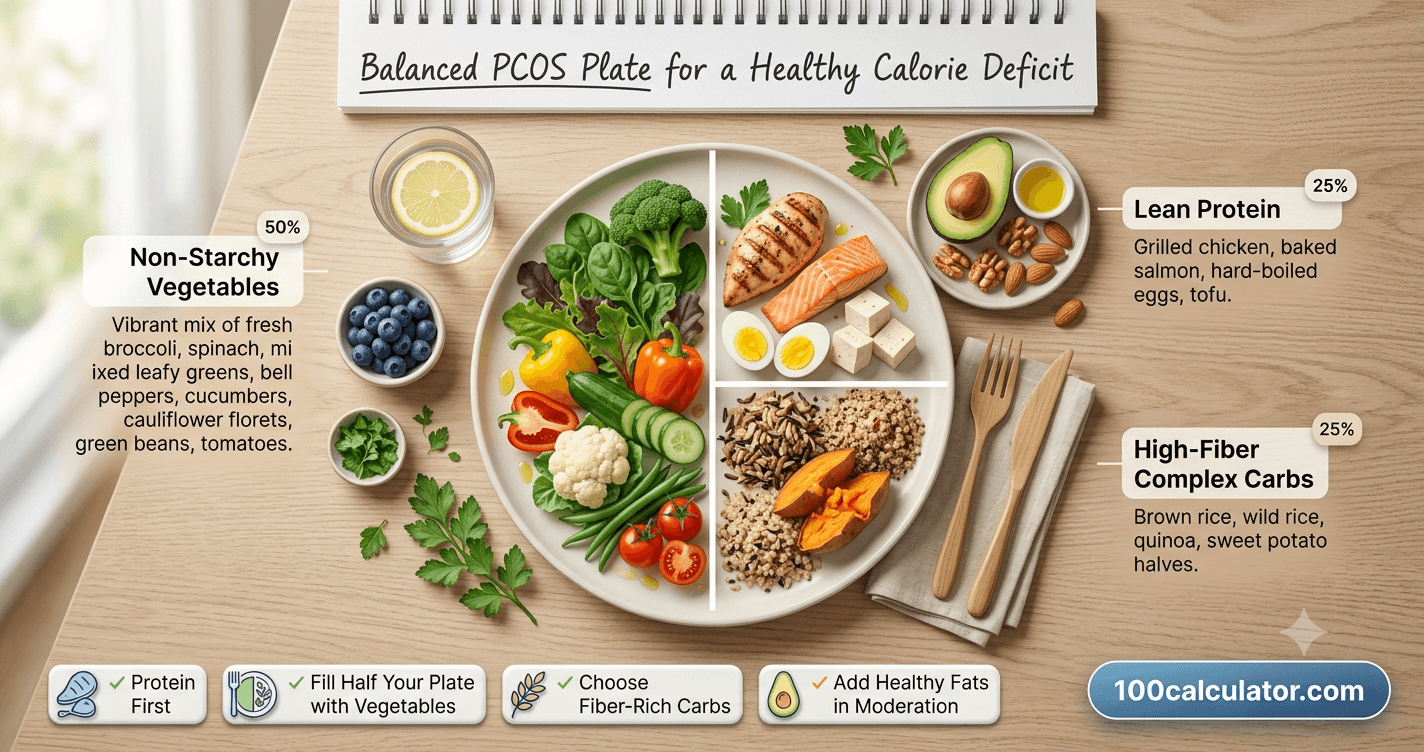
Protein
Protein is the single most useful macro to prioritize during a PCOS calorie deficit. It keeps you fuller for longer, helps protect muscle mass while you're eating less, and requires more energy to digest than carbs or fat. Aiming for a source of protein at every meal — eggs, poultry, fish, tofu, legumes, or Greek yogurt — is a simple habit that pays off. Our Macro / Protein Calculator can help you estimate a daily target based on your weight and activity level, and our protein intake guide breaks down how much is actually enough.
Fiber
Fiber slows down how quickly sugar enters your bloodstream after a meal, which directly supports insulin sensitivity. Vegetables, beans, lentils, oats, and berries are all easy, filling ways to add fiber without adding many calories, which makes them especially useful inside a deficit.
Healthy Fats
Fat isn't the enemy here. Unsaturated fats from olive oil, nuts, seeds, and fatty fish support hormone production and help meals feel satisfying, which makes a deficit easier to stick with. The goal is moderation, not elimination — fat is calorie-dense, so portion size still matters.
Carbohydrates: Choosing Quality Over Elimination
You don't need to cut carbs out entirely to manage insulin resistance, but the type of carb matters more than it does for someone without PCOS. Refined, low-fiber carbohydrates — white bread, sugary cereal, pastries, and sweetened drinks — digest quickly and cause a sharper rise in blood sugar and insulin. Whole grains, legumes, and starchy vegetables digest more slowly and put less strain on the same system.
If you're looking for the single "worst" carb for insulin resistance and abdominal fat, sugar-sweetened beverages are usually the top culprit health professionals point to: they deliver a large, fast dose of sugar with none of the fiber or protein that would slow it down. The chart below illustrates why that matters.
That sharp drop after a refined-carb spike is often exactly what triggers the mid-afternoon energy crash and sudden hunger that make a calorie deficit feel much harder than it needs to be.
Best Foods to Include in a PCOS Calorie Deficit
With the macro priorities in mind, here's a practical shortlist of foods that check multiple boxes at once — filling, nutrient-dense, and gentle on insulin.
| Food Group | Examples | Why It Helps |
|---|---|---|
| Lean protein | Chicken, fish, eggs, tofu, Greek yogurt | Satiety, muscle preservation |
| Non-starchy vegetables | Leafy greens, broccoli, peppers, zucchini | Fiber and volume with few calories |
| Whole grains & legumes | Oats, quinoa, lentils, chickpeas | Slower blood sugar rise than refined carbs |
| Healthy fats | Olive oil, avocado, nuts, fatty fish | Hormone support and satiety |
| Fermented dairy | Plain curd or yogurt, kefir | Protein plus gut-supportive cultures |
| Berries | Blueberries, raspberries, strawberries | Fiber and antioxidants, lower sugar impact |
Plain curd or yogurt deserves a special mention, since it's a common question: unsweetened curd is a solid choice for most people with PCOS, since it delivers protein and calcium without the added sugar found in flavored versions. Dairy tolerance does vary from person to person, so pay attention to how your body responds and talk to a doctor or dietitian if you suspect it's affecting your symptoms.
For a fuller picture of your overall nutrient needs alongside these food choices, 100 Calculator's Nutrition Calculator for Women can help you check whether your diet is covering the basics your body needs during a deficit.
Foods and Habits That Can Work Against Your Progress
No food is strictly "off-limits," but a few patterns consistently make a PCOS calorie deficit harder than it needs to be.
- Sugar-sweetened drinks. Soda, sweetened coffee drinks, and juice add a large, fast dose of sugar with no fiber to slow it down — easy to overconsume and easy to underestimate.
- Ultra-processed, refined-carb snacks. Chips, pastries, and packaged sweets are engineered to be easy to overeat and typically pair refined carbs with added fat and sugar.
- Skipping meals to "save" calories. This often backfires by increasing hunger later in the day, which makes overeating in the evening more likely.
- Alcohol in excess. Beyond its own calories, alcohol can affect blood sugar regulation and sleep quality, both of which matter for insulin sensitivity.
- Going carb-free for extended periods. Cutting out carbohydrates almost entirely for a couple of weeks typically causes a quick early drop on the scale, but a meaningful part of that is water weight, not fat loss. It isn't a required or specifically PCOS-targeted strategy, and it's hard to sustain long-term.
The goal is moderation and consistency, not a list of forbidden foods. A treat here and there fits into a sustainable deficit; the pattern over weeks and months is what actually moves the needle.
A Sample 7-Day PCOS Calorie Deficit Meal Plan
Use this as a starting template, not a rigid script. Swap in foods you enjoy and actually have access to — the plan only works if you can realistically repeat it. Each day pairs a protein source with fiber-rich carbs, vegetables, and a source of healthy fat at most meals.
| Day | Breakfast | Lunch | Dinner | Snack |
|---|---|---|---|---|
| Mon | Greek yogurt, berries, chia seeds | Grilled chicken salad, olive oil dressing | Baked salmon, quinoa, roasted broccoli | Apple with almond butter |
| Tue | Veggie omelet with spinach and feta | Lentil soup with a side salad | Stir-fried tofu with mixed vegetables | Handful of walnuts |
| Wed | Overnight oats with cinnamon and berries | Turkey and hummus whole-grain wrap | Grilled chicken, sweet potato, green beans | Plain curd with a drizzle of honey |
| Thu | Scrambled eggs with whole-grain toast | Quinoa bowl with chickpeas and vegetables | Baked cod, brown rice, steamed asparagus | Carrot sticks with hummus |
| Fri | Protein smoothie with spinach and berries | Grilled fish tacos with cabbage slaw | Lean beef stir-fry with brown rice | Small handful of almonds |
| Sat | Cottage cheese with sliced fruit | Chicken and vegetable soup | Bean and vegetable chili | Greek yogurt with berries |
| Sun | Whole-grain pancakes with Greek yogurt | Salmon salad with mixed greens | Roast chicken, roasted vegetables, farro | Orange or pear |
Notice what this plan doesn't include: strict portion weighing or a single "correct" calorie count for everyone. Pair these meal ideas with the ranges from the Calorie Deficit Calculator for PCOS and our macro and protein needs guide to size portions appropriately for your own body and goals.
Exercise Strategies That Support a PCOS Calorie Deficit
What you do outside the kitchen matters just as much as what's on your plate, especially since exercise directly affects insulin sensitivity.
Strength Training Protects Muscle During a Deficit
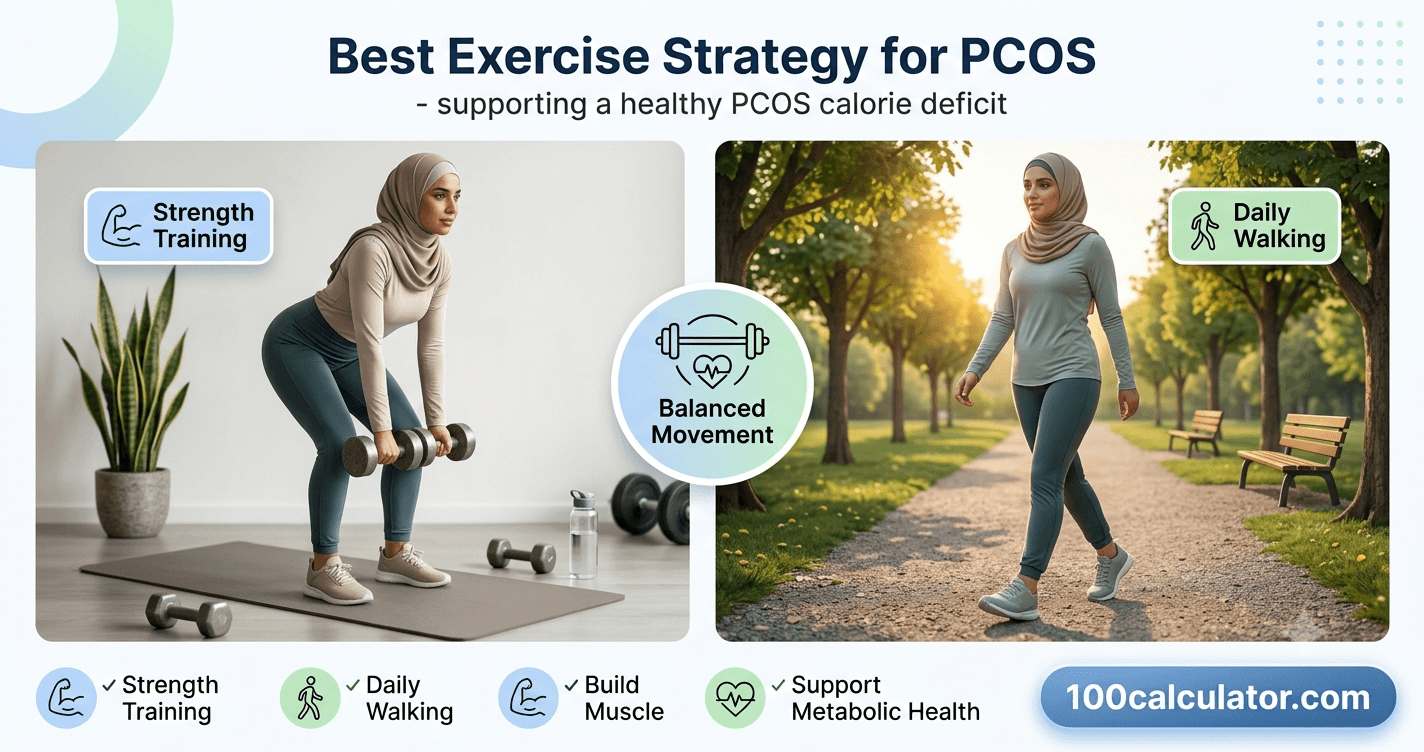
Lifting weights two to three times a week helps preserve muscle mass while you're in a calorie deficit, which matters because muscle tissue is more metabolically active than fat. Preserving it helps keep your metabolism steadier as the scale moves down. Our Fat Free Mass Index Calculator is a useful way to track whether you're losing fat while holding onto muscle, rather than just watching total weight.
Low-Intensity Movement and Walking
Daily walking, especially after meals, is one of the simplest and most sustainable ways to support blood sugar control. A 20 to 30 minute walk doesn't require recovery time the way intense training does, so it adds up consistently, week after week, without adding significant stress to the body.
Why More Exercise Isn't Always Better
It's tempting to think that harder, longer workouts will speed up results, but very intense training done too often can raise cortisol, which works against the insulin sensitivity you're trying to improve. A mix of strength training, walking, and adequate rest days tends to outperform an all-or-nothing approach, particularly for a condition where the stress response itself is part of the picture.
Supplements Sometimes Discussed for PCOS Weight Management
A few supplements come up often in PCOS research and forums, though none of them replace a solid foundation of food, movement, and, where needed, medication prescribed by a doctor.
- Inositol (myo-inositol and D-chiro-inositol). Studied for its potential role in supporting insulin sensitivity and ovulation in PCOS; results vary between individuals.
- Vitamin D. Low vitamin D levels are common in people with PCOS, and it plays a role in insulin function, though supplementing only helps if you're actually low, which a blood test can confirm.
- Magnesium. Involved in blood sugar regulation and sleep quality, both relevant to managing PCOS symptoms.
- Omega-3 fatty acids. Sometimes used to support healthy cholesterol levels and reduce inflammation alongside dietary changes.
Supplements aren't regulated the same way medications are, and quality and dosing vary widely between brands. Talk to a doctor before starting anything new, especially if you take other medications, since interactions are possible.
Approaches to PCOS also vary internationally. South Korea, for example, runs a dual healthcare system where many people combine conventional obstetric and gynecological care with treatment at licensed Traditional Korean Medicine hospitals, which commonly use herbal formulas alongside acupuncture as a complementary approach. Evidence for these therapies is still limited compared with conventional treatment, but it illustrates that lifestyle and medical management, not any single remedy, form the backbone of PCOS care worldwide.
Related Calculators
Put what you just read into practice, try these free tools instantly, no sign-up required.
Fat Free Mass Index Calculator
Measure your lean muscle mass relative to height with FFMI.
Macro / Protein Calculator
Calculate your daily protein, carbs, and fat intake targets.
BAC Calculator (Blood Alcohol Concentration)
Estimate your blood alcohol concentration based on drinks consumed.
Free Bioavailable Testosterone Calculator Online
Calculate free and bioavailable testosterone levels from lab results.
Calorie Deficit Calculator for PCOS
Plan a sustainable calorie deficit tailored for managing PCOS.
Common Reasons a PCOS Calorie Deficit Stops Working
Plateaus are frustrating, but they're rarely a sign that "nothing works for PCOS." More often, one of these factors is quietly at play.
- Underestimating intake. Cooking oils, dressings, and drinks are the most commonly undercounted sources of calories.
- Metabolic adaptation. As you lose weight, your body naturally needs somewhat fewer calories to maintain itself, so a deficit that worked at the start may need recalculating later.
- Poor sleep. Inadequate sleep disrupts hunger hormones and insulin sensitivity, making a deficit feel far harder to maintain.
- Chronic stress. Ongoing high cortisol can blunt weight-loss progress even when eating and exercise are on track.
- Undiagnosed thyroid issues. Thyroid conditions are more common in people with PCOS and can independently slow weight loss.
- Inconsistent tracking. A deficit that's followed five days a week, then abandoned on weekends, often nets out closer to maintenance over the full week.
If you've ruled these out and progress still stalls for several weeks, it's worth checking in with a doctor. Bloodwork can catch things a food log can't, and our guide on bioavailable testosterone explains one of the hormone markers that's sometimes part of that conversation.
Building a Routine That Actually Sticks
The most effective calorie deficit is the one you can repeat for months, not the one that looks most intense on paper. A few habits make that realistic:
- Start with a moderate deficit and commit to it for at least three to four weeks before judging results — early water-weight shifts can mask real progress or make it look faster than it is.
- Anchor breakfast around protein, borrowing the useful part of the 30-30-30 idea without stressing over the exact numbers.
- Move most days, mixing strength training with walking rather than relying on one intense session a week.
- Review progress monthly, using measurements and how clothes fit alongside the scale, since water retention and cycle timing can shift daily weight.
- Loop in a professional — a doctor or registered dietitian can personalize this framework around your labs, medications, and goals far better than a generic plan ever could.
Once you've got a rhythm going, plugging your current stats into 100 Calculator's Calorie Deficit Calculator for PCOS gives you an updated, no-signup estimate any time your weight, activity, or goals change — a simple way to keep the numbers honest as your body responds.
Medical disclaimer: This article is for general educational purposes only and isn't a substitute for professional medical, nutritional, or psychological advice, diagnosis, or treatment. Weight loss needs and safe calorie targets vary by individual health history, medications, and life stage, so talk to a licensed healthcare provider or registered dietitian before starting a new eating or exercise plan, especially if you have PCOS or another underlying condition.
Sources & References
This guide draws on guidance from established medical organizations and recent clinical publications, including:
- American College of Obstetricians and Gynecologists (ACOG) — Polycystic Ovary Syndrome (PCOS)
- Mayo Clinic — PCOS symptoms and causes
- Cleveland Clinic — Polycystic Ovary Syndrome
- Endocrine Society — Polyendocrine Metabolic Ovarian Syndrome name change announcement
- The Lancet — Global consensus process on the PCOS to PMOS name change
More From Common Health Guides
Want to dig deeper into the numbers behind this guide? These related articles cover the calculators and concepts mentioned above in more detail.
Frequently Asked Questions
What is a calorie deficit, and how does it work for someone with PCOS?
A calorie deficit means consistently eating fewer calories than your body burns, so it draws on stored fat for energy. With PCOS, the same principle applies, but insulin resistance and higher androgen levels often mean the deficit needs to be moderate rather than aggressive, and built around protein, fiber, and lower-glycemic carbohydrates to keep blood sugar steadier. This approach tends to be easier to sustain and less likely to trigger the energy crashes that derail progress.
What is the 30-30-30 rule, and does it help with PCOS specifically?
The 30-30-30 rule means eating 30 grams of protein within 30 minutes of waking, then doing 30 minutes of low-intensity exercise. It hasn't been studied as a specific PCOS protocol, but its individual parts, a protein-forward breakfast and consistent morning movement, are well supported for improving satiety and blood sugar stability, both relevant to managing insulin resistance. Treat the exact numbers as flexible guidelines rather than a rigid rule.
How much weight can I safely lose in a month with PCOS?
A commonly recommended pace is around 0.5 kg (about 1 lb) per week, which works out to roughly 2 kg a month. This pace is easier to sustain, protects muscle mass, and matches what research shows is needed for real symptom improvement — even 5% to 10% of body weight lost gradually can meaningfully help PCOS symptoms. Faster loss is possible but usually requires closer medical supervision.
Is it realistic to lose 10 kg in two months with PCOS?
It works out to about 1.25 kg a week, which is faster than the moderate pace generally recommended for sustainable, muscle-sparing weight loss. It isn't impossible, but it typically requires a large deficit that's hard to maintain and raises the risk of muscle loss, nutrient gaps, and rebound weight gain. A five-month timeline at a moderate pace is a more realistic and sustainable target for the same 10 kg goal.
Can a woman with PCOS be naturally slim, or does PCOS always cause weight gain?
Yes. A notable share of people with PCOS are at a lean or average body weight, often called "lean PCOS," and can still have insulin resistance, elevated androgens, and irregular cycles. Excess androgens can also shift fat storage toward the abdomen rather than the hips, which is a physiological pattern, not a measure of health or effort, and body shape still varies widely from person to person.
What are the "4 types" of PCOS I keep seeing mentioned online?
"Insulin-resistant," "inflammatory," "adrenal," and "post-pill" PCOS are terms used in functional and naturopathic medicine to describe different possible drivers behind the condition. They aren't official diagnostic categories. Clinically, PCOS is diagnosed using the Rotterdam criteria, which requires at least two of three features: irregular ovulation, elevated androgen levels, and polycystic ovaries on ultrasound. It's worth discussing any "type" framework with your doctor rather than self-diagnosing.
Why can't I lose weight with PCOS even though I'm eating less?
The most common culprits are underestimated calorie intake, an unrealistic deficit that's not actually being followed consistently, poor sleep, high stress, and undiagnosed thyroid issues, which are more common alongside PCOS. Insulin resistance itself can also slow visible progress even when you're technically in a deficit. If you've ruled these out and still aren't seeing movement after several weeks, it's worth reviewing bloodwork with a doctor.
Is there a "worst" carb for belly fat with PCOS, and can certain foods target it directly?
Sugar-sweetened drinks are usually flagged as the biggest culprit, since they spike blood sugar quickly with no fiber to slow the response. That said, no single food "shrinks" belly fat directly — spot reduction isn't how fat loss works. Reducing overall body fat through a consistent calorie deficit, built around fiber and protein, is what gradually reduces fat in the abdominal area along with everywhere else.
Can someone with PCOS or PCOD eat curd (yogurt)?
Yes, plain, unsweetened curd or yogurt is generally a good choice. It's a solid source of protein and calcium, and if it contains live cultures, it may support gut health as well. Flavored or sweetened varieties add extra sugar, so plain versions are the better everyday default. Dairy tolerance varies from person to person, so if you notice symptoms worsening, it's worth discussing with a doctor or dietitian.
Is PCOS a lifetime condition, or can it be reversed?
PCOS is generally considered a long-term hormonal and metabolic condition rather than something that gets "cured." That said, symptoms can improve significantly, sometimes dramatically, with sustained weight management, consistent exercise, and appropriate medical treatment. Many people see more regular cycles, improved insulin levels, and reduced symptoms over time, even though the underlying tendency toward the condition typically remains.
Which hormones are usually elevated in PCOS?
Androgens, often referred to as "male" hormones even though everyone produces some, are typically elevated in PCOS, including testosterone and DHEA-S. Insulin is also frequently elevated due to insulin resistance, and luteinizing hormone (LH) can run high relative to follicle-stimulating hormone (FSH). The exact pattern varies from person to person, which is one reason bloodwork is part of a proper diagnosis.
Is PCOS the same as PCOD?
Largely, yes. "PCOD" (polycystic ovarian disease) is a term used mostly in India and South Asia, while "PCOS" is the term used internationally. Some regional health resources describe PCOD as a milder, more common variation that responds well to lifestyle changes, while framing PCOS as more hormonally complex, but this distinction isn't universally standardized in medical literature. Your specific diagnosis and bloodwork matter more than which label is used.
Does having PCOS qualify you for Ozempic?
Ozempic (semaglutide) is FDA-approved for type 2 diabetes, and its higher-dose version, Wegovy, is approved for chronic weight management — neither is specifically approved for PCOS. Some doctors do prescribe it off-label for PCOS-related insulin resistance and weight management, particularly when other approaches haven't been enough, but it's not automatically appropriate for everyone with PCOS. This is a decision to make with a doctor based on your full health picture.
What's a good supplement routine for PCOS weight loss?
Inositol, vitamin D, magnesium, and omega-3 fatty acids are the ones most often discussed in PCOS research, typically for supporting insulin sensitivity, hormone balance, or inflammation. None of them work as a stand-alone weight-loss solution, and vitamin D only helps if you're actually deficient, which a blood test can confirm. Talk to a doctor before starting any supplement, especially alongside other medications.
Has PCOS really been renamed to PMOS?
Yes. In May 2026, a global consensus involving dozens of medical and patient organizations formally renamed PCOS to polyendocrine metabolic ovarian syndrome (PMOS), aiming to better reflect its hormonal and metabolic scope rather than focusing on ovarian cysts. Both names refer to the exact same condition, and health experts have noted that everyday adoption of the new name, including in patient records and common usage, will take time.
About 100 Calculator
100 Calculator is a free hub of online calculators and educational guides covering health, finance, trading, crypto, education, and more. Every tool is built to be fast, accurate, and genuinely free, with no account or signup required.
We built this guide, and the Calorie Deficit Calculator for PCOS referenced throughout it, to make a genuinely confusing topic a little easier to navigate. Head back to the 100 Calculator homepage to explore the full library of tools, or learn more about the team behind them on our About Us page.