Fertility Window Explained
A clear breakdown of what your fertility window actually is, how it differs from ovulation, and how to recognize it in your own cycle so you can plan around it with more confidence.
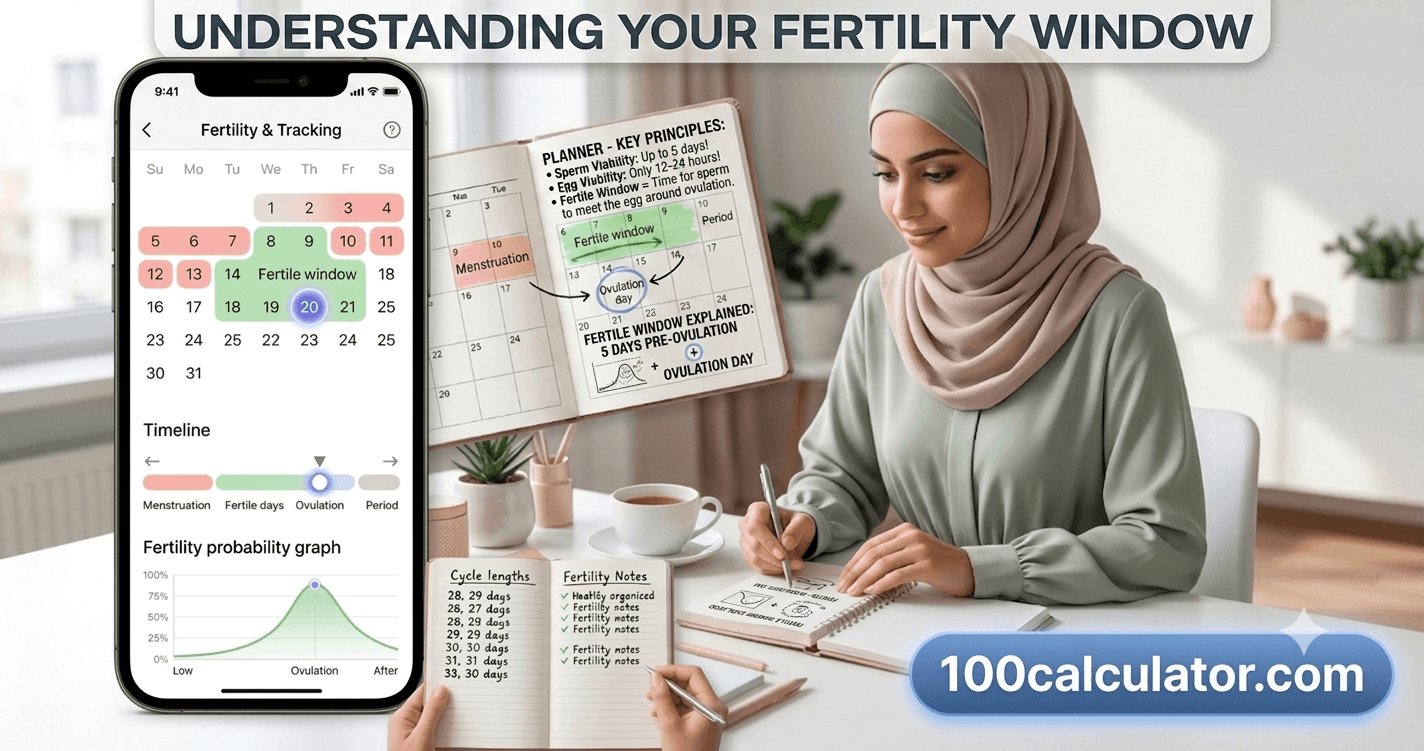
Trying to figure out your best days to conceive can feel like guesswork, especially when "ovulation" and "fertile window" get used as if they mean the same thing. They're related, but they're not identical, and knowing the difference matters if you're timing intercourse around conception.
Your fertile window is the span of days in your cycle when sex can actually lead to pregnancy — typically the five days before ovulation plus the day of ovulation itself, for about six fertile days total. It exists because sperm can survive inside the body for up to five days, while the egg released at ovulation is only fertilizable for about 12 to 24 hours. Line those two timelines up, and you get your best shot at conception.
This guide walks through what your fertile window actually is, how it differs from ovulation, how to estimate it for your own cycle length, the physical signs your body gives off, and which days genuinely matter most. If you'd like a head start on the math, 100 Calculator's Period & Fertility Tracker estimates your fertile window the moment you enter your last period and average cycle length, and once you conceive, our Pregnancy Due Date Calculator can estimate your due date from there.
What Is a Fertility Window?
A fertility window, sometimes written as "fertile window," is the block of days each cycle when conception is biologically possible. Outside of it, sex won't lead to pregnancy that particular cycle, no matter how well-timed it feels.
The window isn't arbitrary. It's built around two biological facts: sperm can live inside the female reproductive tract for up to five days, and an egg released during ovulation stays fertilizable for roughly 12 to 24 hours. (ACOG) Count backward five days from ovulation, add ovulation day itself, and you get the roughly six-day span most doctors call the fertile window.
Fertility Window vs. Ovulation: What's the Difference?
It's easy to use "ovulation" and "fertile window" as if they're interchangeable, but they describe two different parts of the same process.
Ovulation is a single event: the moment one of your ovaries releases a mature egg. It happens once per cycle and, for practical purposes, lasts about a day. The fertile window is broader — it's the entire stretch of days when sex can result in pregnancy, which includes the days leading up to ovulation as well as ovulation day itself. The window is wider than ovulation because sperm can wait inside the reproductive tract for up to five days, so sex several days before you actually ovulate can still lead to conception once the egg is released.
| Aspect | Ovulation | Fertile Window |
|---|---|---|
| What it is | Release of a mature egg from an ovary | The span of days when sex can lead to pregnancy |
| Duration | About 1 day | About 6 days |
| Timing | A single day, typically ~14 days before your next period | The 5 days before ovulation plus ovulation day |
| Why it matters | Marks when the egg becomes available | Accounts for how long sperm can survive while waiting for the egg |
The Menstrual Cycle and the 4 Phases of Fertility
Your fertile window sits inside a larger pattern: the four phases of your menstrual cycle. Seeing where each phase falls makes it much easier to understand why your fertile window lands where it does.
Menstrual Phase
This is your period, the days your body sheds the uterine lining built up during the previous cycle. It typically lasts three to seven days and marks day one of a new cycle. You're generally not fertile during your period, though sex near the end of a short period can occasionally lead to pregnancy if ovulation happens early that cycle.
Follicular Phase
The follicular phase runs from day one of your period until ovulation, so it overlaps with your period and continues afterward. Rising estrogen helps a group of follicles mature in the ovaries until one dominant follicle is ready to release an egg. A follicular phase that's on track usually looks like this:
- Cervical mucus gradually shifting from dry or sticky to clear and stretchy as ovulation approaches
- Steady or gradually rising energy compared with the days right before your period
- A cycle that starts around a similar timeframe from one month to the next
- No unusually heavy spotting or bleeding between periods
A follicular phase that runs unusually long, unusually short, or unpredictably from cycle to cycle is often the first place doctors look when investigating irregular ovulation, including conditions like polycystic ovary syndrome (PCOS). (ACOG)
Ovulation
Around the midpoint of an average cycle, a surge in luteinizing hormone (LH) triggers the release of a mature egg. This is ovulation, and it's the single event your entire fertile window is built around.
Luteal Phase
After ovulation, the ruptured follicle produces progesterone, which prepares the uterine lining for a possible pregnancy. This phase is far more consistent in length than the follicular phase, usually lasting 12 to 14 days no matter how long your overall cycle runs. If no pregnancy occurs, progesterone drops, the lining sheds, and your next period begins, restarting the cycle.
| Phase | Typical Timing (28-day cycle) | Fertility Status |
|---|---|---|
| Menstrual | Days 1–5 | Not fertile, with rare exceptions |
| Follicular | Days 1–13 | Fertility rises as ovulation approaches |
| Ovulation | Around day 14 | Peak fertility |
| Luteal | Days 15–28 | Not fertile |
When Does Your Fertile Window Start?
Fertile Window After Your Period
For most people, the fertile window doesn't begin the moment your period ends. It depends on how long your whole cycle is and when ovulation happens.
In a textbook 28-day cycle, ovulation happens around day 14, which puts the fertile window around days 9 through 14, counting the first day of your period as day one. If your period lasts five days, that means your fertile window opens just a few days after bleeding stops. In a shorter cycle, though, the window can start while you're still bleeding or right as your period ends, which is part of why "you can't get pregnant during your period" isn't a dependable rule.
Why Sperm Survival Extends the Window
Sperm doesn't need to arrive on ovulation day to fertilize an egg. According to the American College of Obstetricians and Gynecologists (ACOG), sperm can survive inside the female reproductive tract for up to five days, waiting in the fallopian tubes for an egg to appear. (ACOG) So yes, sperm can absolutely reach and fertilize an egg within 24 hours if intercourse happens close to or on ovulation day, but it can also arrive days earlier and still be viable once the egg is released. That five-day survival window is the entire reason your fertile window starts before ovulation instead of on it.
How Many Days Are You Fertile? Cycle Length Matters
Ovulation usually happens about 14 days before your next period starts, and that timing stays fairly consistent even when your overall cycle length varies. (Mayo Clinic) That makes cycle length one of the best clues for estimating your own fertile window.
Fertile Window for a 28-Day Cycle
In a 28-day cycle, ovulation typically falls around day 14, so the fertile window runs from roughly day 9 through day 14. The two most fertile days in this scenario are usually day 12 and day 13, the two days right before ovulation.
Fertile Window for a 30-Day Cycle
A slightly longer cycle shifts everything back by the same number of days. In a 30-day cycle, ovulation usually happens around day 16, which puts the fertile window around day 11 through day 16.
Fertile Window for Other Cycle Lengths
The same math applies to any regular cycle: subtract 14 from your average cycle length to estimate your ovulation day, then count back five more days to find where your fertile window opens.
| Cycle Length | Estimated Ovulation Day | Estimated Fertile Window |
|---|---|---|
| 21 days | Day 7 | Days 2–7 |
| 24 days | Day 10 | Days 5–10 |
| 26 days | Day 12 | Days 7–12 |
| 28 days | Day 14 | Days 9–14 |
| 30 days | Day 16 | Days 11–16 |
| 32 days | Day 18 | Days 13–18 |
| 35 days | Day 21 | Days 16–21 |
Signs and Symptoms of Your Fertile Window
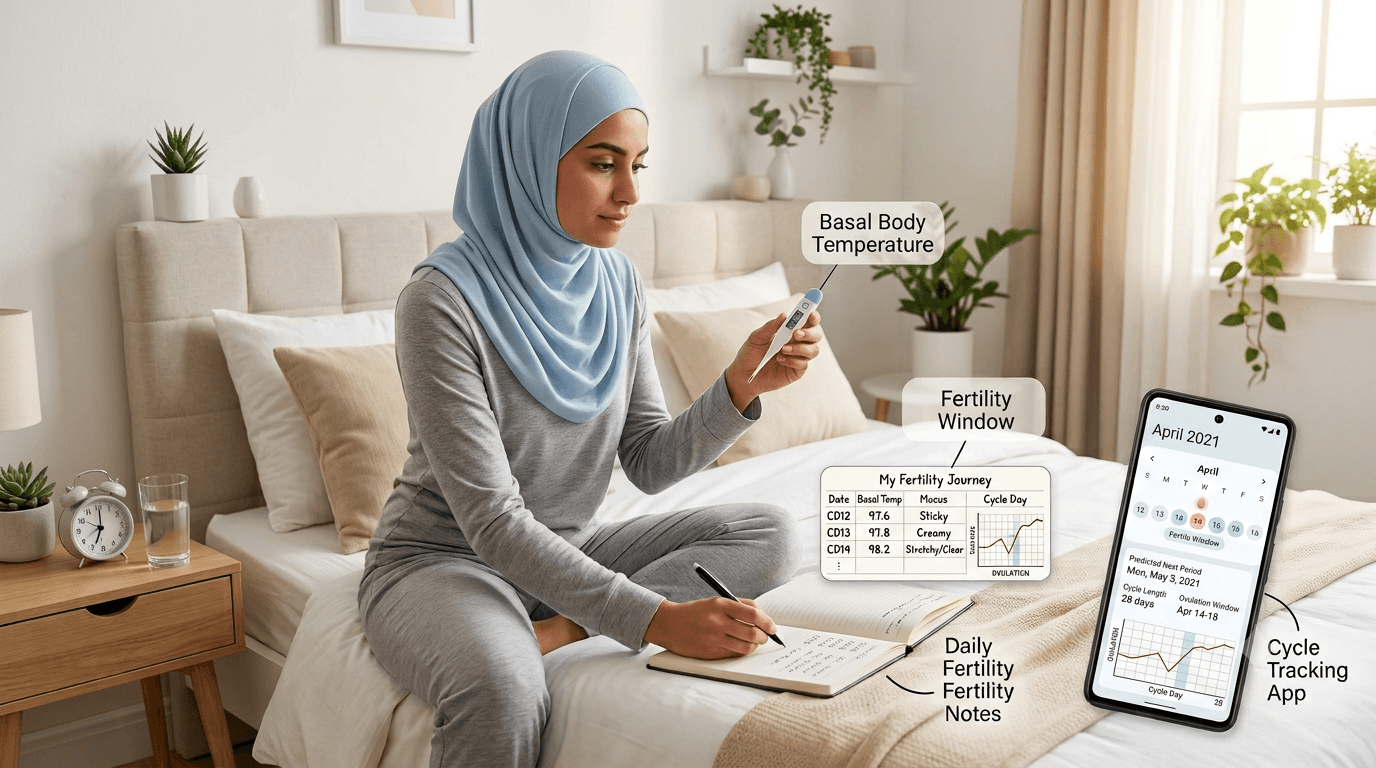
Your body gives off a handful of physical signals as you approach ovulation. Learning to recognize them helps you confirm your fertile window instead of relying on calendar math alone.
Cervical Mucus and Discharge Changes
Cervical mucus is widely considered the single most reliable physical sign of approaching ovulation. (ACOG) Right after your period, discharge tends to be minimal or dry. As your fertile window opens, it gradually becomes more noticeable, first cloudy or sticky, then, in the day or two right before ovulation, clear, stretchy, and slippery, often compared to raw egg whites. That egg-white stage is when you're most fertile. After ovulation, mucus usually thickens again or dries up.
Basal Body Temperature Shift
Basal body temperature (BBT) is your body's resting temperature first thing in the morning, before you get up, talk, or check your phone. It rises slightly, by about 0.5°F (0.3°C), right after ovulation and stays elevated until your next period. (Mayo Clinic) Because BBT only rises after ovulation has already happened, it confirms your fertile window after the fact rather than predicting it in advance, which makes it more useful for spotting your pattern over a few cycles than for catching the moment itself.
Other Signs of Ovulation to Watch For
Cervical mucus and temperature are the two most tracked signs, but several other cues can also show up around ovulation:
- Mittelschmerz — a brief, one-sided pelvic twinge or dull ache as the egg is released. (Cleveland Clinic)
- Breast tenderness or heaviness, tied to shifting hormones around ovulation
- A noticeable jump in sex drive, driven by rising estrogen
- Mild mood shifts, from more social and upbeat to slightly more irritable
- Light spotting for a day or so, caused by a brief dip in estrogen just before ovulation
Put together, cervical mucus changes, a basal body temperature rise, mittelschmerz, breast tenderness, increased libido, mood shifts, and light spotting make up what's often described as the seven signs of ovulation. Not everyone notices all seven, and that's completely normal. Some people ovulate with almost no noticeable symptoms at all.
Which Days Are the Most Fertile?
Not every day inside your fertile window carries equal odds. Fertility rises the closer you get to ovulation and peaks in the few days right before it, then drops off quickly afterward. (Mayo Clinic) That's because live sperm already waiting in the fallopian tubes when the egg is released have the best chance of reaching it in time.
Sex on ovulation day itself is still within the fertile window and can absolutely result in pregnancy, but it's not a guarantee. No single day offers a 100% chance of conceiving, even under ideal conditions. Fertility depends on egg quality, sperm health, timing, and a certain amount of chance, which is part of why even couples timing things carefully don't conceive every cycle.
In terms of the four cycle phases, this makes the tail end of the follicular phase, the few days leading into ovulation, the easiest phase to conceive in. Conception can't happen during the luteal phase or your period, since there's no egg available yet or the window has already closed.
| Timing Relative to Ovulation | Relative Chance of Pregnancy |
|---|---|
| 5–4 days before ovulation | Low, but possible — sperm can survive to meet the egg |
| 3–1 days before ovulation | Highest — this is peak fertility |
| Day of ovulation | High |
| 1+ day after ovulation | Very low to none — the egg is no longer viable |
Can You Get Pregnant Outside Your Fertile Window?
Once your fertile window closes, your odds of conceiving that cycle drop close to zero, though "close to zero" isn't quite the same as impossible.
The egg released during ovulation only survives for about 12 to 24 hours. Once that window passes without fertilization, it's gone for the cycle, and no amount of surviving sperm can bring it back. That makes getting pregnant seven days after your fertile window has closed extremely unlikely under normal circumstances, since both the egg and any sperm from that cycle are no longer viable by then.
The lowest-odds days of your cycle are generally your period itself and the stretch in the middle of your luteal phase, well after ovulation and well before your next fertile window opens.
How to Track and Calculate Your Fertile Window
There are a few practical ways to estimate your fertile window, ranging from simple math to combining multiple physical signs.
- The calendar method. Count back 14 days from your next expected period to estimate ovulation, then count back 5 more days to find where your fertile window opens. This works best if your cycles are fairly regular.
- Cervical mucus and BBT tracking. Combining cervical mucus observations with basal body temperature charting, sometimes called the symptothermal method, gives a clearer picture than either sign alone, since BBT confirms ovulation after it happens while mucus changes hint at it beforehand.
- Ovulation predictor kits (OPKs). These test your urine for a surge in luteinizing hormone (LH), which typically happens 24 to 36 hours before ovulation, giving a more precise heads-up than calendar counting alone.
- Fertility tracker apps and calculators. A fertile window calculator does the same date math automatically once you enter your last period and typical cycle length, which is useful if you'd rather not do the subtraction by hand every month.
Free Online Tool
Let a calculator do the math for you
100 Calculator's Period & Fertility Tracker estimates your fertile window and next period the moment you enter your last period date and average cycle length, right in your browser, with no account needed.
For a deeper look at combining these signs, our guide on how to calculate ovulation walks through each method step by step.
Fertile Window Myths vs. Facts
A few persistent myths make fertile window tracking more confusing than it needs to be. Here's what actually holds up.
| Myth | Fact |
|---|---|
| You can only get pregnant on the exact day of ovulation | You can conceive from sex up to five days before ovulation too, since sperm can survive that long while waiting for the egg |
| Your fertile window falls on the same calendar days every cycle | Ovulation timing can shift by several days cycle to cycle, even for people with regular periods |
| You can't get pregnant right before or during your period | It's less likely, but not impossible, especially with shorter or irregular cycles |
| Tracking your fertile window works as well as birth control | Fertility awareness methods can work well with careful, consistent use, but typical-use failure rates run considerably higher than perfect-use rates |
| A fertile window calculator is 100% accurate | Calculators estimate from averages; actual ovulation timing can vary month to month, especially with irregular cycles |
Related Calculators
Put what you just read into practice, try these free tools instantly, no sign-up required.
Period & Fertility Tracker
Track your menstrual cycle and predict fertile days with ease.
Pregnancy Due Date Calculator
Estimate your baby's due date based on your last period.
Baby Growth Memory Calendar
Track and celebrate your baby's growth milestones month by month.
Nutrition Calculator for Women
Calculate daily nutrient and calorie needs tailored for women's health.
Pregnancy Weight Gain Calculator
Monitor healthy weight gain throughout each trimester of pregnancy.
Tips to Improve Your Chances During Your Fertile Window
A handful of habits show up consistently in fertility guidance, regardless of exactly which day you're on.
- Have sex every 1 to 3 days throughout your fertile window rather than saving it all for ovulation day, since sperm availability matters more than hitting one perfect moment
- Maintain a moderate, healthy weight, since being significantly overweight or underweight is linked to irregular ovulation (Mayo Clinic)
- Avoid smoking and limit alcohol, both of which are linked to reduced fertility
- Manage stress where you can, since chronically high stress hormones can interfere with ovulation timing
- Talk to a healthcare provider if you're under 35 and haven't conceived after a year of trying, or over 35 and haven't conceived after six months
For more ways to support a healthy, predictable cycle, see our guide on tips to improve fertility. And if irregular ovulation seems tied to a condition like PCOS, 100 Calculator's Calorie Deficit Calculator for PCOS can help you build a nutrition plan around it, alongside your doctor's guidance.
Medical disclaimer: This article is for general educational purposes only and isn't a substitute for professional medical advice, diagnosis, or treatment. Fertility and ovulation patterns vary from person to person, so talk to a licensed healthcare provider about your own cycle, family planning goals, or any concerns about your reproductive health.
Sources & References
This guide draws on guidance from the following medical organizations and a peer-reviewed study:
- American College of Obstetricians and Gynecologists (ACOG) — Trying to Get Pregnant? Here's When to Have Sex
- ACOG — Fertility Awareness-Based Methods of Family Planning
- Mayo Clinic — How to Get Pregnant
- Mayo Clinic — Ovulation Signs: When Is Conception Most Likely?
- Cleveland Clinic — Ovulation Pain (Mittelschmerz)
- National Institutes of Health / PubMed Central — The Timing of the "Fertile Window" in the Menstrual Cycle
More From Women's Health Guides
Ready to dig deeper into cycle tracking, conception timing, or what comes after? These related guides build on the topics covered above.
Frequently Asked Questions
What is a fertility window?
Your fertility window is the span of days each cycle when sex can result in pregnancy. It typically covers the five days leading up to ovulation plus the day of ovulation itself, for about six fertile days total. It exists because sperm can survive inside the body for up to five days, while the egg released at ovulation stays fertilizable for roughly 12 to 24 hours.
What's the difference between the fertile window and ovulation?
Ovulation is a single event — the release of one mature egg from an ovary, usually once per cycle. The fertile window is broader: it's the entire stretch of days, including the days before ovulation, when sex can lead to pregnancy. The window is wider than ovulation itself because sperm can survive for days inside the body, waiting for the egg to be released.
What are the 4 stages of fertility?
The menstrual cycle has four phases: the menstrual phase (your period), the follicular phase (when an egg matures, running from day one of your period until ovulation), ovulation (when the mature egg is released), and the luteal phase (after ovulation, when the uterine lining prepares for a possible pregnancy). Your fertile window falls at the boundary between the follicular phase and ovulation.
When does your fertile window start after your period?
It depends on your cycle length, not simply on when your period ends. In a 28-day cycle, ovulation happens around day 14, so the fertile window opens around day 9. In shorter cycles, the window can start while you're still bleeding or just after your period ends, which is why "you can't get pregnant right after your period" isn't reliably true for everyone.
What are the signs of a fertile window?
The most tracked signs are changes in cervical mucus, which becomes clear, stretchy, and slippery as ovulation approaches, and a slight rise in basal body temperature right after ovulation. Some people also notice mittelschmerz (a one-sided pelvic twinge), breast tenderness, increased sex drive, mild mood changes, or light spotting. Not everyone notices every sign, and that's normal.
What are the 7 signs of ovulation?
Commonly cited signs of ovulation include changes in cervical mucus, a slight rise in basal body temperature, mittelschmerz (one-sided pelvic pain), breast tenderness, increased libido, mild mood shifts, and light spotting. Together, these seven signs are the ones most often used in fertility awareness tracking. Most people notice a few of these rather than all seven in any given cycle.
Can sperm really reach an egg within 24 hours?
Yes. Sperm can travel through the cervix and uterus to the fallopian tubes within minutes to hours after intercourse, well inside a 24-hour window. What makes the fertile window six days long, though, is that sperm can also survive inside the body for up to five days, waiting for an egg to be released, according to the American College of Obstetricians and Gynecologists.
What are signs of a healthy follicular phase?
A follicular phase that's on track usually shows gradually increasing cervical mucus that shifts from dry or sticky toward clear and stretchy, relatively stable cycle-to-cycle timing, and steady energy levels in the days leading up to ovulation. A follicular phase that runs unusually long, short, or unpredictably from cycle to cycle can be a sign of irregular ovulation, sometimes linked to conditions like PCOS.
Which part of the cycle is the most fertile?
The one to three days right before ovulation are generally the most fertile days of the cycle, since sperm already present when the egg is released have the best chance of fertilizing it. Ovulation day itself is also within the fertile window and still carries a good chance of pregnancy, but fertility rises in the days leading up to it rather than starting there.
What is the easiest phase of the cycle to get pregnant in?
Biologically speaking, conception can only happen during the follicular phase, specifically in its final few days leading into ovulation. During the luteal phase, after ovulation, and during your period, there's no viable egg available, so pregnancy isn't possible that cycle. That makes the tail end of the follicular phase the only phase where getting pregnant is realistically possible.
Will I 100% get pregnant if I have sex on ovulation day?
No single day guarantees pregnancy, even ovulation day itself. Having sex around ovulation gives you the best odds of any day in your cycle, but conception also depends on egg quality, sperm health, and a certain amount of chance. Most healthy couples who have regular, well-timed sex conceive within about a year, but it's normal for it to take more than one cycle.
Can I get pregnant 7 days after my fertile window ends?
It's extremely unlikely. The egg released during ovulation only survives about 12 to 24 hours, so once your fertile window closes, there's no longer a viable egg available that cycle. Seven days later, both the egg and any sperm from that cycle would no longer be viable, making pregnancy from sex at that point highly improbable under normal circumstances.
When is the lowest chance of getting pregnant during your cycle?
Generally, your period and the days in the middle of your luteal phase, well after ovulation and before your next fertile window opens, carry the lowest odds of pregnancy. That said, ovulation timing isn't perfectly predictable even in people with regular cycles, so fertile windows can occasionally shift earlier or later than expected, which is why cycle tracking works better as a guide than a guarantee.
Is it okay to be intimate with your partner during your period?
Yes. From a medical standpoint, menstrual blood isn't dangerous, and being intimate during a period carries no inherent health risk. Whether to do so is a personal choice, and comfort levels vary widely between couples, which is completely normal either way. Many people and cultures also have their own preferences or beliefs around this, so it's worth respecting whatever feels right within a relationship.
How accurate is a fertile window or ovulation calculator?
A fertile window calculator is a helpful starting estimate, not a guarantee. It works from averages, typically your last period and average cycle length, so it tends to be more accurate for people with regular cycles than for those with irregular ones. Combining a calculator's estimate with physical signs like cervical mucus or basal body temperature gives a more reliable picture than dates alone.
About 100 Calculator
100 Calculator is a free hub of online calculators and educational guides covering health, finance, trading, crypto, education, and more. Every tool is built to be fast, accurate, and genuinely free, with no account or signup required.
We built this guide, along with tools like the Period & Fertility Tracker referenced throughout it, to make everyday questions about your cycle and fertility easier to answer. Head back to the 100 Calculator homepage to explore the full library of tools, or learn more about the team behind them on our About Us page.