How to Calculate Ovulation
A beginner-friendly walkthrough of the math, the body signs, and the tools that help you pinpoint ovulation, so you know your fertile window whether you're trying to conceive, trying to avoid pregnancy, or simply getting to know your own cycle.
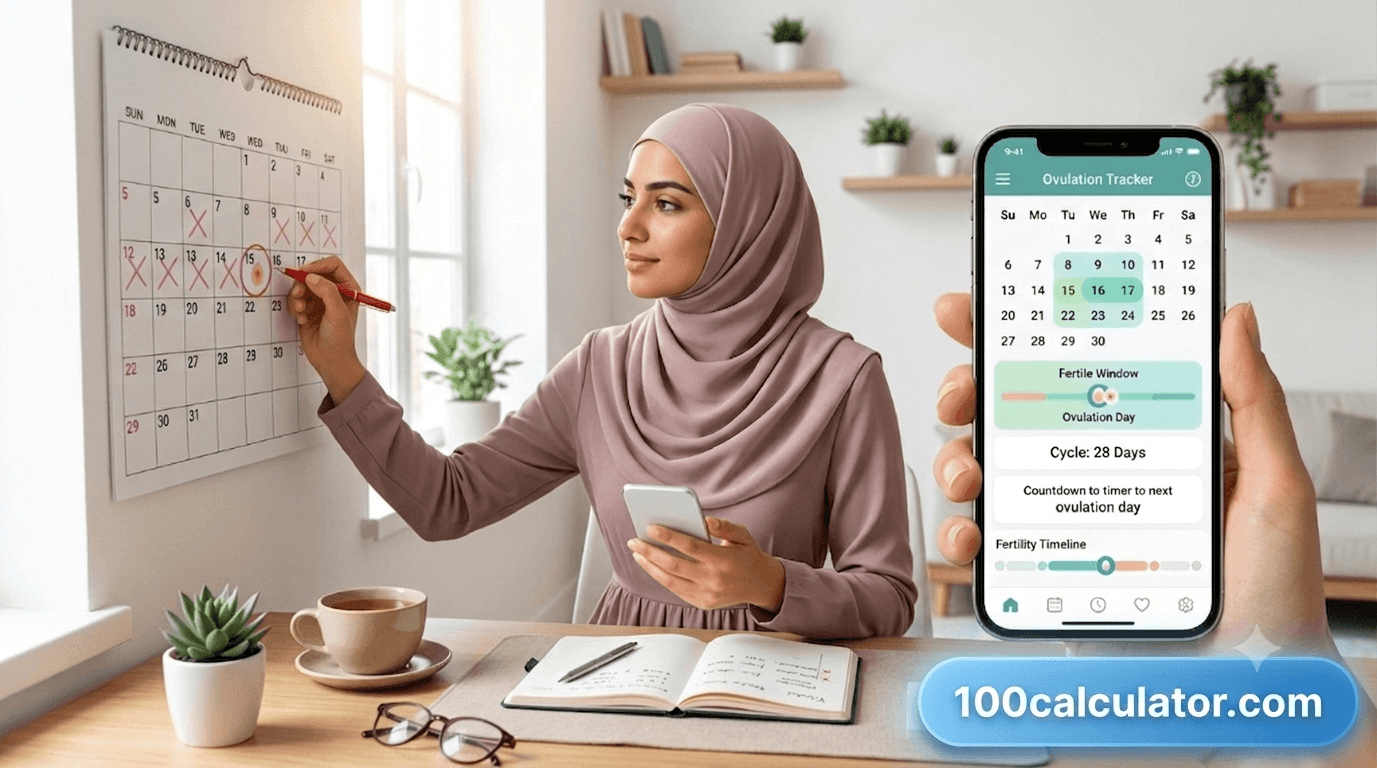
Ovulation is the day one of your ovaries releases a mature egg, and it's the single most important date to pin down if you're trying to get pregnant, trying to avoid it, or just want to understand your own cycle better. The simplest way to calculate it is to count backward 14 days from the first day of your next expected period. That works because the second half of most cycles, called the luteal phase, holds steady at around two weeks regardless of how long your overall cycle runs, so a 28-day cycle usually means ovulation around day 14, while a 32-day cycle points closer to day 18.
That single formula gets you a useful estimate, but it's only the starting point. Your actual ovulation day can shift from one cycle to the next, which is why body signs, ovulation tests, and a few cycles of tracking data all sharpen the picture over time. In this guide, we'll walk through the calendar method step by step, what to do if your cycles are irregular, the physical signs that confirm ovulation is happening, and a handful of common myths worth clearing up along the way.
Once you've got a working estimate, tools like 100 Calculator's Period & Fertility Tracker can handle the math automatically, and if a cycle does result in a positive pregnancy test, the Pregnancy Due Date Calculator picks up right where this guide leaves off.
Understanding Ovulation: The Basics
Ovulation is one event inside a much longer process. Each cycle, several follicles in your ovaries begin developing, and one typically pulls ahead to become the lead follicle. Rising estrogen from that follicle eventually triggers a sharp spike in luteinizing hormone (LH), and about 24 to 36 hours after that LH surge begins, the follicle ruptures and releases a mature egg. (Cleveland Clinic) The egg then travels down the fallopian tube, where it can be fertilized by sperm for roughly the next 24 hours.
What Happens During Ovulation
A follicle takes about two weeks to mature before it ruptures. Once it does, some people notice a brief, one-sided twinge as the egg is released, though plenty of people feel nothing at all. Either way, the biology is the same: one egg is released, the empty follicle turns into a temporary hormone-producing structure called the corpus luteum, and your body shifts into the second half of your cycle.
The Two Halves of Your Cycle
Your cycle splits into two phases around ovulation. The follicular phase runs from day one of your period until ovulation, and it's the unpredictable half. It can last anywhere from about a week to several weeks, depending on your body and what's going on in your life that month. The luteal phase runs from ovulation until your next period starts, and it's remarkably consistent, typically landing somewhere between 11 and 17 days, with most people settling closer to 12 to 14 days.
This asymmetry is the reason ovulation calculators work at all. Because the luteal phase barely budges from cycle to cycle, almost all the variation in a longer or shorter cycle happens before ovulation, not after it. That's the insight the entire calendar method in this guide is built on.
Why Calculating Ovulation Matters
Knowing your ovulation day is useful whether or not pregnancy is on your mind. If you're trying to conceive, timing intercourse around your fertile window meaningfully improves your odds each cycle, since that's the only stretch of the month when conception is actually possible. If you're avoiding pregnancy, understanding your fertile window, alongside a reliable method of contraception, helps you recognize higher-risk days. And even if pregnancy isn't a consideration at all, ovulation is a useful health signal on its own: cycles where ovulation happens consistently tend to reflect balanced hormones, while irregular or absent ovulation can be an early clue worth discussing with a doctor.
Here's what a solid ovulation estimate actually gives you:
- A specific window to time intercourse if you're trying to conceive
- A clearer sense of which days carry higher pregnancy risk if you're not
- An early signal if your cycle looks anovulatory (no egg released) for a stretch of months
- A head start on using 100 Calculator's Pregnancy Due Date Calculator the moment a cycle results in a positive test
- Something concrete to bring to a doctor if your cycle doesn't behave the way you expect
How to Calculate Ovulation Using the Calendar Method
The calendar method is the fastest way to estimate ovulation, and it only requires knowing one number: your average cycle length.
The Basic Formula
The calendar method uses one simple equation:
The logic is exactly what we covered above: since the luteal phase holds close to 14 days no matter how long your total cycle is, all of the extra days in a longer cycle happen before ovulation, not after it. A 30-day cycle doesn't push ovulation two days into the luteal phase, it pushes ovulation two days later in the follicular phase instead. (Office on Women's Health)
Step-by-Step: Calculate Your Ovulation Day
- Track two to three cycles first. Write down day one (the first day of full flow) for each cycle.
- Add up the cycle lengths and divide by the number of cycles to get your average. A single month can be thrown off by stress, travel, or illness, so an average is more trustworthy than one data point.
- Subtract 14 from your average cycle length. The result is your estimated ovulation day, counted from day one of your cycle.
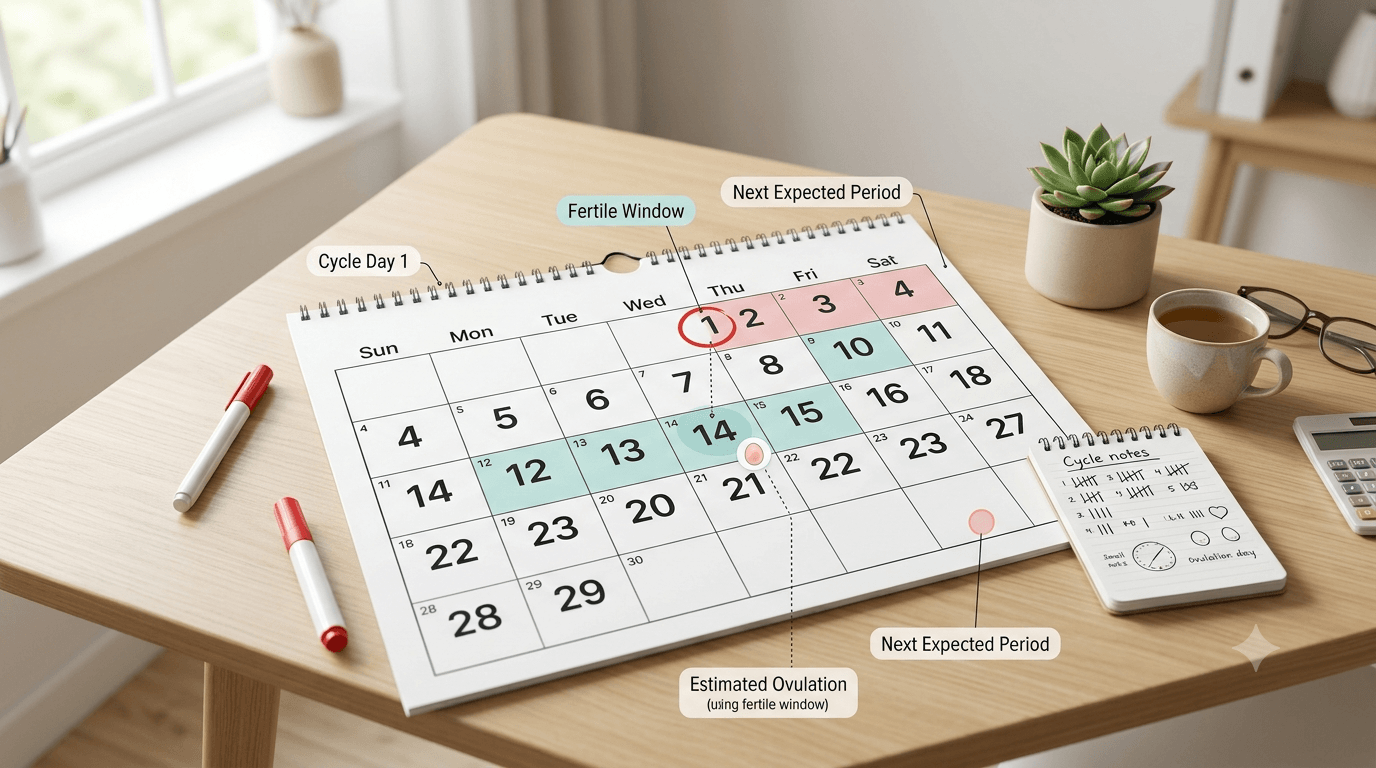
- Mark your fertile window as the five days leading up to that estimated day, plus the day itself, since sperm can survive for several days while waiting for the egg.
- Repeat each cycle. Your ovulation day can shift slightly from month to month even with a stable average, so refresh the estimate regularly rather than calculating it once and assuming it holds forever.
Example Calculation
Here's how the formula plays out across a range of typical cycle lengths:
| Cycle Length | Estimated Ovulation Day |
|---|---|
| 24 days | Day 10 |
| 26 days | Day 12 |
| 28 days | Day 14 |
| 30 days | Day 16 |
| 32 days | Day 18 |
| 35 days | Day 21 |
Say your last three cycles ran 27, 29, and 28 days. Add them together to get 84, then divide by 3 for an average cycle length of 28 days. Subtract 14, and your estimated ovulation day is cycle day 14, meaning if your period started on the 1st of the month, you'd expect to ovulate around the 14th, with your fertile window opening around the 9th.
How to Calculate Ovulation With an Irregular Cycle
If your cycles rarely land on the same length twice, a single average won't serve you especially well.
Using Your Shortest and Longest Cycle
A more forgiving version of the calendar method uses your shortest and longest cycles from the past six months to bracket a wider fertile window, instead of pinpointing one exact day:
This approach needs at least six cycles logged to be worth much, and it works best for cycles that fall somewhere in the typical 21-to-35-day range. Outside that range, or with cycles that skip months entirely, calendar math alone isn't reliable enough to lean on by itself.
When the Calendar Method Falls Short
A handful of situations make date-based predictions especially unreliable: recently coming off hormonal birth control, breastfeeding, perimenopause, high stress or major life changes, and conditions like polycystic ovary syndrome (PCOS) or a thyroid disorder that affect ovulation directly. In any of these cases, the body signs and tests covered in the next two sections matter more than the math.
Signs of Ovulation: What Your Body Tells You
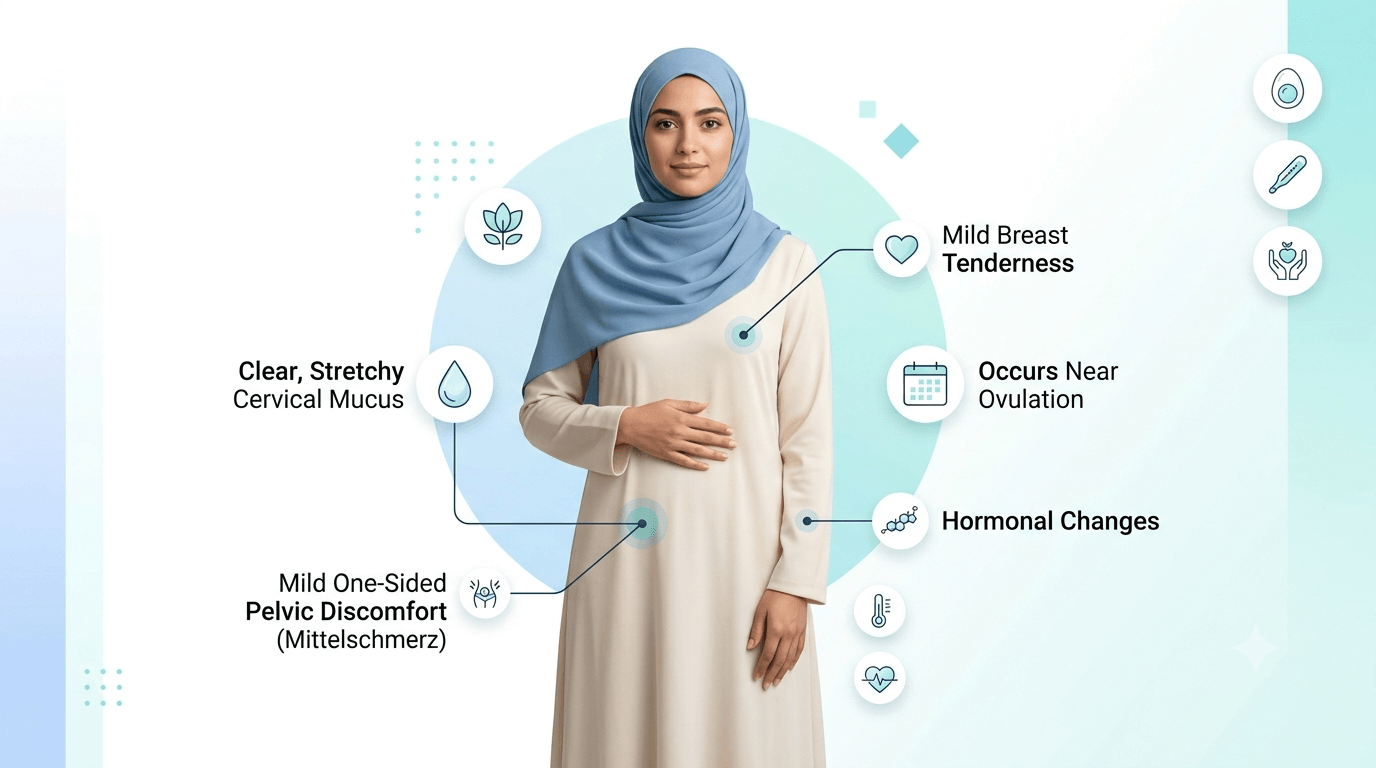
Calendar math gives you an estimate. Your body gives you confirmation. Most people notice at least a few of these signs as ovulation approaches or right after it happens, though it's completely normal to notice none of them at all despite ovulating on schedule.
The 7 Signs of Ovulation
- Cervical mucus changes — becomes clear, stretchy, and slippery, like raw egg white, in the days leading up to ovulation
- A one-sided pelvic twinge (mittelschmerz) — a dull ache or brief sharp pain low on one side, lasting minutes to a day or two
- A small rise in basal body temperature — typically about 0.4–1.0°F higher, appearing after ovulation, not before
- A positive ovulation predictor kit result — a detectable surge in luteinizing hormone (LH)
- Increased sex drive
- Breast tenderness
- Mild bloating or light spotting
(Cleveland Clinic) Ovulation pain is generally harmless, and its presence or absence doesn't say anything about how fertile a particular cycle is.
Which Signs Are Most Reliable?
Cervical mucus changes and basal body temperature are generally considered the two most dependable signs, since they're tied directly to the hormones driving your cycle rather than to more subjective feelings like mood or libido. (Cleveland Clinic) The catch is that basal body temperature only confirms ovulation after it's already happened; it can't predict it in advance. Cervical mucus, watched over a few cycles, is one of the only signs that can help you anticipate ovulation before it occurs, which is why it pairs so well with the calendar estimate from the section above.
Ovulation Tests, Trackers, and Apps
When you want more precision than the calendar alone can offer, a few tools can narrow things down further.
How Ovulation Predictor Kits (OPKs) Work
An ovulation predictor kit is a urine test, similar in format to a pregnancy test, that detects the surge in luteinizing hormone that triggers ovulation. Most kits turn positive roughly 24 to 36 hours before the egg is actually released, giving you a short, fairly precise heads-up window. (Mayo Clinic Health System) To use one well, start testing a few days before your calendar-based estimate, test at a consistent time of day, and treat a line as dark as or darker than the control line as a positive result.
Choosing an Ovulation Calculator or App
A good ovulation calculator app runs the same underlying math as the formula covered earlier, but it refines its prediction as you log more cycles, and many let you add cervical mucus or temperature readings for a fuller picture. Look for one that's transparent about how confident its prediction actually is, rather than presenting a single date as a guarantee. 100 Calculator's Period & Fertility Tracker runs the same calendar-based calculation covered in this guide, right in your browser, with no account or signup required.
Is Any Ovulation Calculator 100% Accurate?
No. No calendar-based tool, app, or kit can promise a 100 percent accurate ovulation date, and any product implying otherwise is overstating what the underlying science supports. Ovulation timing genuinely shifts from cycle to cycle, even for people with textbook, regular-looking periods. What actually improves your accuracy isn't a fancier calculator, it's combining methods. Pairing the calendar estimate with cervical mucus tracking, basal body temperature, and an OPK, sometimes called the symptothermal method, gets you far closer to your real fertile window than any single method alone.
Free Online Tool
Skip the manual math
100 Calculator's Period & Fertility Tracker takes your last period date and average cycle length and instantly estimates your ovulation day and fertile window, using the same formula explained in this guide.
Your Fertile Window and Peak Fertility Day
Understanding the fertile window is where a lot of the questions people have about ovulation actually get answered.
When Are You Most Fertile?
Your fertile window is the six-day stretch made up of the five days before ovulation and the day of ovulation itself. It's built around two simple biological facts: sperm can survive inside the body for three to five days, while a released egg is only viable for about 24 hours. (Cleveland Clinic) Overlap those two windows and you get the days when sex can actually lead to pregnancy. For someone with a 28-day cycle who ovulates around day 14, that means the fertile window runs from roughly day 9 through day 14.
Which Ovulation Day Is the Strongest?
Not every day in the fertile window carries equal odds. Conception probability climbs across the fertile window and peaks on the day immediately before ovulation and on ovulation day itself, since sperm deposited on those days have enough time to reach the fallopian tube without the egg's short lifespan running out first. If you can only prioritize a couple of days each cycle, those are the two to aim for.
Can You Get Pregnant Right After Your Period?
Yes, and for some people it's more possible than they'd expect. If your cycles run short, say 21 to 24 days, ovulation can happen as early as cycle day 7 to 10, which puts the tail end of your period and the days right after it inside or close to your fertile window. Sperm surviving up to five days only widens that possibility further. For a standard 28-to-30-day cycle, pregnancy in the days right after your period is less likely but still not impossible, particularly if your cycle runs shorter than usual that month or your period lasted longer than normal.
Common Ovulation Calculation Mistakes to Avoid
A few small habits can quietly throw off an otherwise solid ovulation estimate. Here's what to watch for:
- Assuming everyone ovulates on day 14. That's only accurate for a 28-day cycle. The real number is cycle length minus 14.
- Counting from the wrong start date. Cycle day one is the first day of full flow, not light spotting, and not the last day of bleeding.
- Judging your cycle off one month. A single cycle can be thrown off by travel, illness, or stress; a trustworthy average needs at least two to three cycles.
- Testing OPKs at the wrong time. Luteinizing hormone is usually easiest to detect from late morning through early evening, not first thing after waking.
- Relying on the calendar alone with irregular cycles. Combine calendar math with body signs once your cycle length swings by more than about a week.
- Ignoring lifestyle disruptions. Illness, jet lag, and major stress spikes can delay ovulation the same way they delay periods.
Ovulation Myths vs. Facts
Ovulation attracts a lot of confident-sounding advice that doesn't always hold up. Here's a quick reality check on some of the most common claims:
| Myth | Fact |
|---|---|
| Ovulation always happens on cycle day 14 | Only true for a 28-day cycle. The real formula is cycle length minus 14, so a 32-day cycle points closer to day 18. |
| Getting your period rules out pregnancy | Very unlikely, but not impossible, especially with short or irregular cycles where ovulation happens earlier than expected. |
| A calculator can predict your fertile day with total certainty | No calendar tool, app, or kit is 100 percent accurate. Combining methods narrows the estimate; nothing eliminates the guesswork entirely. |
| Timing intercourse around ovulation can choose your baby's sex | Well-controlled research, including a large 1995 study in the New England Journal of Medicine, found no link between timing and the sex of the baby. The only medically validated method is preimplantation genetic testing during IVF. |
| A shorter cycle means lower egg quality | Cycle length alone doesn't measure egg quality. A shorter cycle usually just means a shorter follicular phase; actual reserve and quality are assessed with hormone tests like AMH, not a calendar. |
| You ovulate every single cycle, without exception | Occasional anovulatory cycles, where no egg is released, happen even in people with regular-looking bleeding, and become more common with stress, illness, or approaching perimenopause. |
That third row is worth sitting with if you've ever searched for a "100 percent accurate ovulation calculator" or a calculator promising to help you choose your baby's sex. Neither claim holds up under the research, and it's worth being skeptical of any tool that presents either one as guaranteed.
How Age Affects Ovulation and Fertility
Ovulation calculations assume a functioning supply of eggs behind them, and that supply changes predictably over a lifetime.
Egg Count and Egg Quality Over Time
You're born with every egg you'll ever have. According to the American College of Obstetricians and Gynecologists (ACOG), that count starts at roughly 1 to 2 million eggs at birth, falls to somewhere between 300,000 and 500,000 by puberty, and drops to around 25,000 by age 37. (ACOG) By age 51, the average age of menopause in the United States, fewer than 1,000 eggs typically remain.
Egg quality declines alongside that quantity. Older eggs accumulate more DNA changes over time, which raises the chance of chromosomal differences that can make fertilization, implantation, or a full-term pregnancy less likely. This is a gradual, population-level trend rather than a hard cutoff. Plenty of people conceive naturally well into their late 30s and 40s, and individual results vary considerably.
What Age Is Considered Hardest to Get Pregnant?
Fertility research consistently points to the same general pattern: fertility is highest in the late teens through the late 20s, begins a gradual decline around age 30, and accelerates more noticeably after 35, with a further step down after 37 to 40. That's part of why 35 is often used as a marker for advanced maternal age in medical care, not because anything specific happens on that birthday, but because it roughly marks where the average decline curve steepens.
If you're over 35 and haven't conceived after six months of trying, or over 40 and it's been sooner than that, most guidelines suggest talking to a doctor rather than waiting the full year typically recommended for younger couples.
Related Calculators
Put what you just read into practice, try these free tools instantly, no sign-up required.
Period & Fertility Tracker
Track your menstrual cycle and predict fertile days with ease.
Pregnancy Due Date Calculator
Estimate your baby's due date based on your last period.
Baby Growth Memory Calendar
Track and celebrate your baby's growth milestones month by month.
Nutrition Calculator for Women
Calculate daily nutrient and calorie needs tailored for women's health.
Pregnancy Weight Gain Calculator
Monitor healthy weight gain throughout each trimester of pregnancy.
When to See a Doctor About Ovulation
Tracking is a great way to catch patterns early, but a few signs are worth a conversation with a healthcare provider regardless of what your calculator says. Consider reaching out if you notice:
- No period, or no signs of ovulation, for three or more months, and pregnancy isn't the reason
- You've been trying to conceive for 12 months without success, or 6 months if you're over 35
- Your cycles are consistently shorter than 21 days or longer than 35 days
- Ovulation pain is severe enough to disrupt your day, rather than a mild twinge
- You have a diagnosed condition like PCOS, endometriosis, or a thyroid disorder that affects your cycle
- Ovulation predictor kits come back negative repeatedly, over several cycles, despite testing correctly
Building a Simple Ovulation Tracking Routine
The most accurate ovulation estimate is the one you actually keep up with over several cycles. A handful of small habits make that much easier.
- Track two to three cycles first before trusting any average. A single unusual month can throw the math off.
- Calculate your estimated ovulation day using cycle length minus 14, or the shortest and longest cycle bracket if your cycles vary quite a bit.
- Start watching for cervical mucus changes about a week before your estimated day.
- Add an OPK a few days before your estimate if you want a sharper confirmation window.
- Log everything in one place, whether that's a notebook, an app, or 100 Calculator's Period & Fertility Tracker, so patterns are easy to spot over time.
- Review your data after a few cycles instead of reacting to any single unusual month. Ovulation timing naturally drifts a little from cycle to cycle.
Once you've got a positive pregnancy test, 100 Calculator's Pregnancy Due Date Calculator picks up right where this guide leaves off, turning your cycle data into an estimated due date in seconds. From there, tools like the Pregnancy Weight Gain Calculator and the Baby Growth Memory Calendar are natural next steps.
Medical disclaimer: This article is for general educational purposes only and isn't a substitute for professional medical advice, diagnosis, or treatment. Ovulation timing varies from person to person and cycle to cycle, so calculators and calendar-based estimates should be treated as a starting point, not a guarantee. Talk to a licensed healthcare provider about fertility concerns, contraception, or any significant changes in your cycle.
More From Women's Health Guides
Still building your knowledge of cycles, fertility, and pregnancy timing? These related guides dig deeper into the topics covered above.
Frequently Asked Questions
When will I ovulate after my period ends?
It depends on your total cycle length, not a fixed number of days after your period ends. The standard estimate is your cycle length minus 14, counting from the first day of your period. In a 28-day cycle, ovulation typically falls around day 14, roughly 9 days after a 5-day period ends. In a 32-day cycle, it shifts to around day 18. Tracking a few cycles gives you a more personal average than assuming a fixed number of days.
How do I calculate ovulation if my cycle isn't 28 or 30 days?
The same formula works for any cycle length: subtract 14 from your total cycle length, counted from the first day of one period to the day before the next. A 24-day cycle points to roughly day 10, while a 35-day cycle points closer to day 21. If your cycle length changes a lot from month to month, use your shortest and longest recent cycles to estimate a fertile window range instead of a single day, and consider adding body signs or an ovulation test for confirmation.
What are the 7 signs of ovulation?
The seven most commonly reported signs are clear, stretchy cervical mucus; a brief one-sided pelvic twinge called mittelschmerz; a small rise in basal body temperature; a positive result on an ovulation predictor kit; increased sex drive; breast tenderness; and mild bloating or light spotting. Not everyone notices all seven, and some people notice none at all despite ovulating normally, so the absence of symptoms alone isn't a reliable sign that ovulation isn't happening.
Can I get pregnant 3 days after my period ends?
Yes, it's possible, especially with shorter or irregular cycles. If ovulation happens early in your cycle, which is more common with cycles around 21 to 24 days, the days right after your period can fall inside or close to your fertile window. Since sperm can survive up to five days, sex a few days after your period ends can still lead to pregnancy even if ovulation hasn't happened yet.
Which ovulation day is the most fertile?
The day of ovulation and the day immediately before it generally carry the highest odds of conception, since sperm deposited then have time to reach the fallopian tube right as the egg becomes available. Conception probability rises gradually across the days leading up to ovulation and drops off quickly afterward, since the egg is only viable for about 24 hours once it's released.
Does having your period mean there's no chance of pregnancy?
It's very unlikely, but not impossible. Pregnancy during a period itself is rare because an egg usually isn't present, but people with short cycles can occasionally ovulate close enough to their bleeding that sperm surviving from period-time sex overlaps with an early ovulation. Bleeding that looks like a period can also sometimes be irregular bleeding or spotting rather than an actual period.
Do shorter cycles mean poor egg quality?
No, not on their own. A shorter overall cycle usually just means a shorter follicular phase, the time before ovulation, not lower-quality eggs. Egg quality and ovarian reserve are assessed through hormone testing, like AMH or FSH levels, or an antral follicle count, not by counting the days in your cycle. That said, a consistently very short cycle under 21 days is still worth mentioning to a doctor.
Can an ovulation calculator predict my fertile days with 100% accuracy?
No calculator, app, or kit can guarantee 100 percent accuracy, and it's worth being skeptical of any tool that claims otherwise. Ovulation timing shifts from cycle to cycle even in people with regular periods. What improves accuracy isn't a fancier calculator, it's combining the calendar estimate with body signs like cervical mucus and basal body temperature, plus an ovulation predictor kit for confirmation.
Can I use ovulation timing to choose my baby's sex?
Reputable research doesn't support this. A well-known 1995 study in the New England Journal of Medicine, along with other controlled research since, found no meaningful link between the timing of intercourse relative to ovulation and the sex of the baby. Popular theories like the Shettles method remain widely discussed, but they aren't backed by strong evidence. The only medically validated way to select a baby's sex is preimplantation genetic testing during IVF.
How does age affect ovulation and egg count?
You're born with all the eggs you'll ever have, and that number naturally declines over time. According to ACOG, egg count drops from roughly 1 to 2 million at birth to around 25,000 by age 37, and to fewer than 1,000 by the average age of menopause. Both egg quantity and quality decline gradually through your 20s and 30s, with a more noticeable drop after 35 and again after 37 to 40.
What are signs that you might not be ovulating?
Very irregular or absent periods, no noticeable change in cervical mucus across your cycle, no sustained rise in basal body temperature, and consistently negative ovulation predictor kits over several cycles can all point to anovulation, a cycle where no egg is released. Occasional anovulatory cycles are normal, but a repeated pattern is worth discussing with a doctor, especially if you're trying to conceive.
What's the difference between a period tracker and an ovulation calculator?
A period tracker logs when your bleeding starts and stops and predicts your next period. An ovulation calculator uses that same cycle data to estimate a different date, your fertile window, using the cycle-length-minus-14 formula. Many tools, including 100 Calculator's Period & Fertility Tracker, do both at once, since the two predictions come from the same underlying cycle information.
How soon before ovulation should I start using an ovulation predictor kit?
Start testing a few days before your calendar-based estimate. If your typical cycle is 28 days, that usually means beginning around cycle day 10 or 11. For irregular cycles, begin testing based on your shortest recent cycle rather than your average, so you don't miss an earlier-than-usual surge. Testing once or twice daily, at a consistent time, gives the most reliable results.
What are the earliest signs of pregnancy after ovulation?
The earliest possible signs, including implantation spotting, mild cramping, fatigue, breast tenderness, and a basal body temperature that stays elevated past when your period was due, typically don't show up until about a week or more after ovulation, if they show up at all. A home pregnancy test is the most reliable way to confirm early pregnancy, ideally taken on or after the day your period was expected. From there, 100 Calculator's Pregnancy Due Date Calculator can estimate your due date.
When should I see a doctor about ovulation concerns?
Reach out to a doctor if you've had no period or signs of ovulation for three or more months without pregnancy, if you've been trying to conceive for 12 months without success (or 6 months if you're over 35), if your cycles consistently fall outside the 21-to-35-day range, or if you have a diagnosed condition like PCOS or a thyroid disorder affecting your cycle.
About 100 Calculator
100 Calculator is a free hub of online calculators and educational guides covering health, finance, trading, crypto, education, and more. Every tool is built to be fast, accurate, and genuinely free, with no account or signup required.
We built this guide, along with tools like the Period & Fertility Tracker and Pregnancy Due Date Calculator referenced throughout it, to make questions about your cycle and fertility easier to work through on your own. Head back to the 100 Calculator homepage to explore the full library of tools, or learn more about the team behind them on our About Us page.