Signs of an Irregular Menstrual Cycle
A clear, practical breakdown of what actually counts as an irregular period, the most common causes by age, and how a period tracker can help you spot patterns worth mentioning to your doctor.
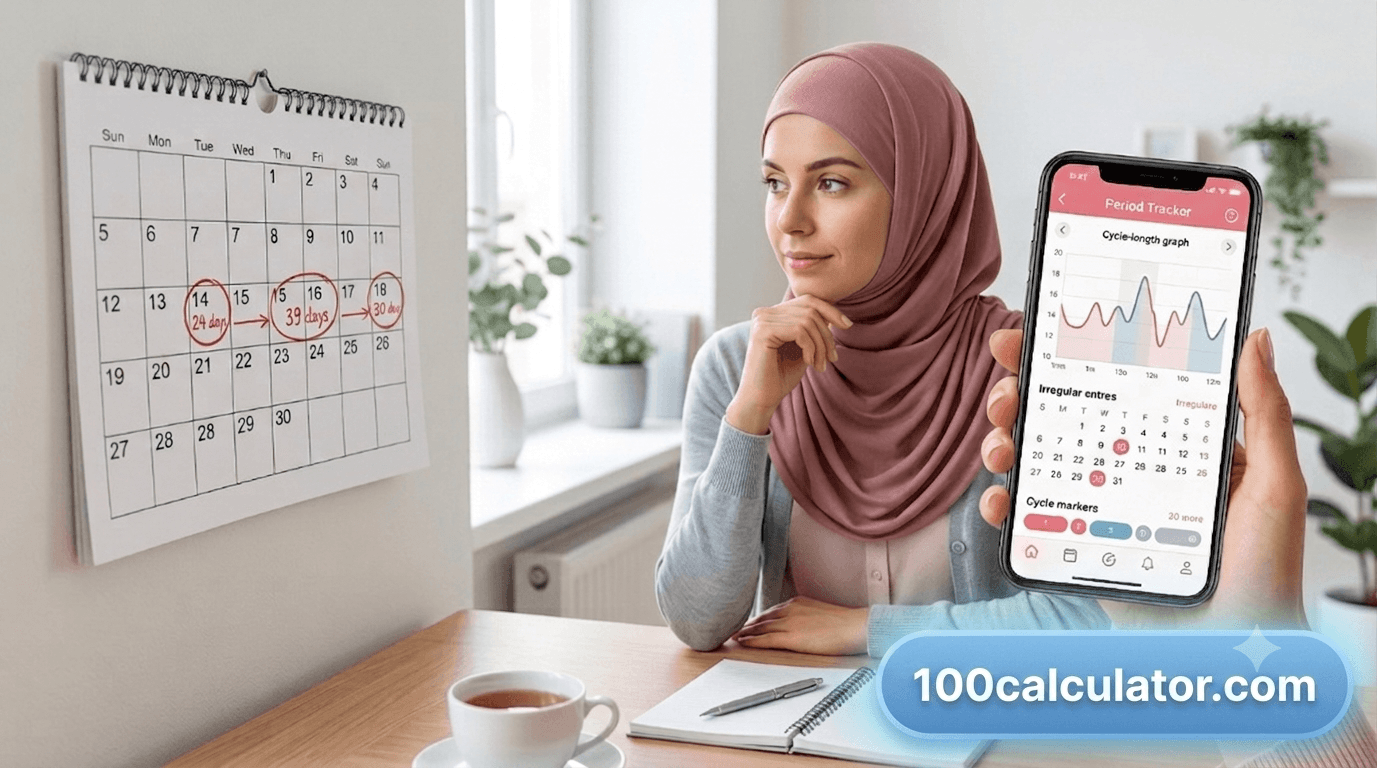
Most people are taught that a period arrives every 28 days like clockwork. Real cycles move around more than that, and figuring out where normal variation ends and an irregular cycle begins can be genuinely confusing.
An irregular menstrual cycle is one that falls outside the typical 21- to 35-day range, swings by more than about a week from cycle to cycle, skips months entirely, or comes with unusually heavy, light, or painful bleeding. A period tracker makes these patterns far easier to spot, since it turns scattered memories into a timeline you can actually look back on.
Irregular cycles are common, and the cause is usually something manageable, like stress, a change in weight, or starting a new form of birth control. Sometimes, though, an irregular cycle is a signal from a hormonal condition like PCOS or a thyroid disorder that's worth bringing to a doctor. Telling the difference is exactly what this guide walks through.
Below, we'll cover the specific signs that mark a cycle as irregular, the medical terms doctors use for different bleeding patterns, what tends to cause irregular periods in your 20s versus your 30s, how irregular cycles affect pregnancy chances, and when a change is worth a phone call to your doctor instead of just another cycle you shrug off. If you haven't started logging your dates yet, 100 Calculator's Period & Fertility Tracker is a fast way to see your own pattern take shape.
What Is an Irregular Menstrual Cycle?
An irregular menstrual cycle is a cycle that falls outside the typical 21- to 35-day range, varies by more than about a week from one cycle to the next, or comes with bleeding that's much heavier, lighter, longer, or more painful than your usual pattern. A single unusual cycle here and there isn't automatically a problem. What matters is whether that unpredictability keeps repeating.
Cycle length is measured from the first day of one period to the first day of the next, not from the last day of bleeding. Most adult cycles land somewhere between 21 and 35 days, though very few people hit the exact same number every single month. (ACOG) A little wobble is normal. A pattern that keeps shifting by a week or more, or a period that disappears for months at a time, is what doctors mean by "irregular."
| Pattern | Cycle Length | What It Usually Means |
|---|---|---|
| Regular | 21–35 days, roughly consistent | A typical adult cycle |
| Slightly irregular | Varies by about a week, cycle to cycle | Often normal; worth a few months of tracking |
| Irregular | Under 21 days, over 35 days, or skips months | Worth discussing with a doctor |
| Absent (amenorrhea) | No period for 90 days or longer, not pregnant | Worth a doctor visit |
How Cycle Length Is Measured
If you're still getting comfortable with the basics of counting cycle days, our guide on how to track your period accurately walks through the process step by step. The short version: mark day one on the first day of full flow, then count forward to the next day one to get your cycle length.
Signs of an Irregular Cycle to Watch For
Irregular cycles don't all look the same. Some show up mainly in timing. Others show up in the bleeding itself. Here are the signs worth paying attention to.
Your Cycle Length Keeps Shifting
If your cycle was 24 days last month, 33 days the month before, and 27 days the month before that, your body isn't settling into the rhythm a regular cycle typically has. A few days of drift is normal. Swings of a week or more, repeated over several months, are one of the clearest signs of an irregular cycle.
You Skip Periods Entirely
Going more than 35 days without a period, or missing one or more periods in a row while pregnancy isn't the reason, is called oligomenorrhea when it happens regularly. It's one of the more common signs people notice first, since it's hard to miss an entire month passing with no period at all.
Your Flow Is Much Heavier or Lighter Than Usual
Suddenly soaking through a pad or tampon every hour, passing large clots, or bleeding for more than seven days is worth noting. So is the opposite: a flow so light it barely counts as bleeding, especially if that's a real change from your usual pattern.
You're Spotting Between Periods
Light bleeding or spotting that shows up outside your expected period, especially after sex, is sometimes called intermenstrual bleeding. Occasional spotting can have simple explanations, like ovulation, but bleeding between periods that keeps happening is worth mentioning to a doctor.
Your Periods Are Unusually Painful
Cramping is a normal part of most periods, but pain that's new, getting worse, or intense enough to interfere with school, work, or daily life, sometimes called dysmenorrhea, can be a sign that something beyond a typical cycle is going on.
Quick summary of what to watch for:
- Cycle length that swings by more than about a week, month to month
- No period for 35 days or longer, without pregnancy
- Bleeding that's much heavier, lighter, or longer than your usual pattern
- Spotting between periods that keeps happening
- Pain severe enough to disrupt your regular activities
Regular vs. Irregular Period Signs
Some symptoms are just your body's normal way of announcing that a period is on its way. Others are signals that the cycle itself isn't behaving the way it usually does. Mixing the two up is one of the most common reasons people worry unnecessarily, or don't worry when they should.
In the days before a typical period, many people notice a familiar cluster of premenstrual signs: mild bloating, breast tenderness, cramping, fatigue, mood changes, acne breakouts, food cravings, lower back pain, and light spotting a day or so before flow starts. Feeling several of these in the same predictable window each month is usually just your cycle doing what it normally does, not a sign of irregularity.
Once a period arrives, the signs that you're actually menstruating are fairly consistent too: bleeding or spotting, cramping in the lower abdomen, fatigue, mood shifts, breast tenderness, lower back ache, and sometimes headaches. What makes a cycle irregular isn't any single symptom on this list. It's the timing and pattern surrounding them.
| Sign | Usually Just a Regular Cycle | Worth Watching for Irregularity |
|---|---|---|
| Timing | Shows up around the same number of days before your period, most months | Shows up with no predictable pattern at all |
| Bleeding start | Begins within your usual 21–35 day range | Comes early, comes late, or doesn't come |
| Flow | Similar amount and duration to your normal periods | Suddenly much heavier, lighter, or longer than usual |
| Pain | Manageable cramping that eases with rest or OTC relief | Pain severe enough to disrupt daily activities |
| Spotting | Brief spotting right before your period starts | Spotting between periods on a regular basis |
Common Types of Abnormal Menstruation
Doctors use specific medical terms to describe different patterns of irregular bleeding. (Cleveland Clinic) You don't need to memorize this list, but recognizing the terms can help you understand what a doctor means if one of them comes up at an appointment.
| Term | What It Means | Typical Pattern |
|---|---|---|
| Amenorrhea | No periods at all | No period for 90 days or more, unrelated to pregnancy |
| Oligomenorrhea | Infrequent periods | Periods more than 35 days apart, or fewer than 8 a year (Cleveland Clinic) |
| Polymenorrhea | Frequent periods | Periods less than 21 days apart |
| Menorrhagia | Heavy menstrual bleeding | Soaking through protection every 1–2 hours, or bleeding beyond 7 days |
| Hypomenorrhea | Unusually light periods | Very light flow, sometimes barely more than spotting |
| Metrorrhagia | Bleeding between periods | Irregular bleeding unrelated to your expected period |
| Dysmenorrhea | Painful periods | Cramping severe enough to interfere with daily life |
| Menometrorrhagia | Heavy and irregular bleeding combined | Heavy flow paired with unpredictable timing |
None of these terms is a diagnosis on its own. A doctor uses them to describe what's happening before working out why, usually with a symptom history, bloodwork, and sometimes an ultrasound.
What Causes Irregular Periods?
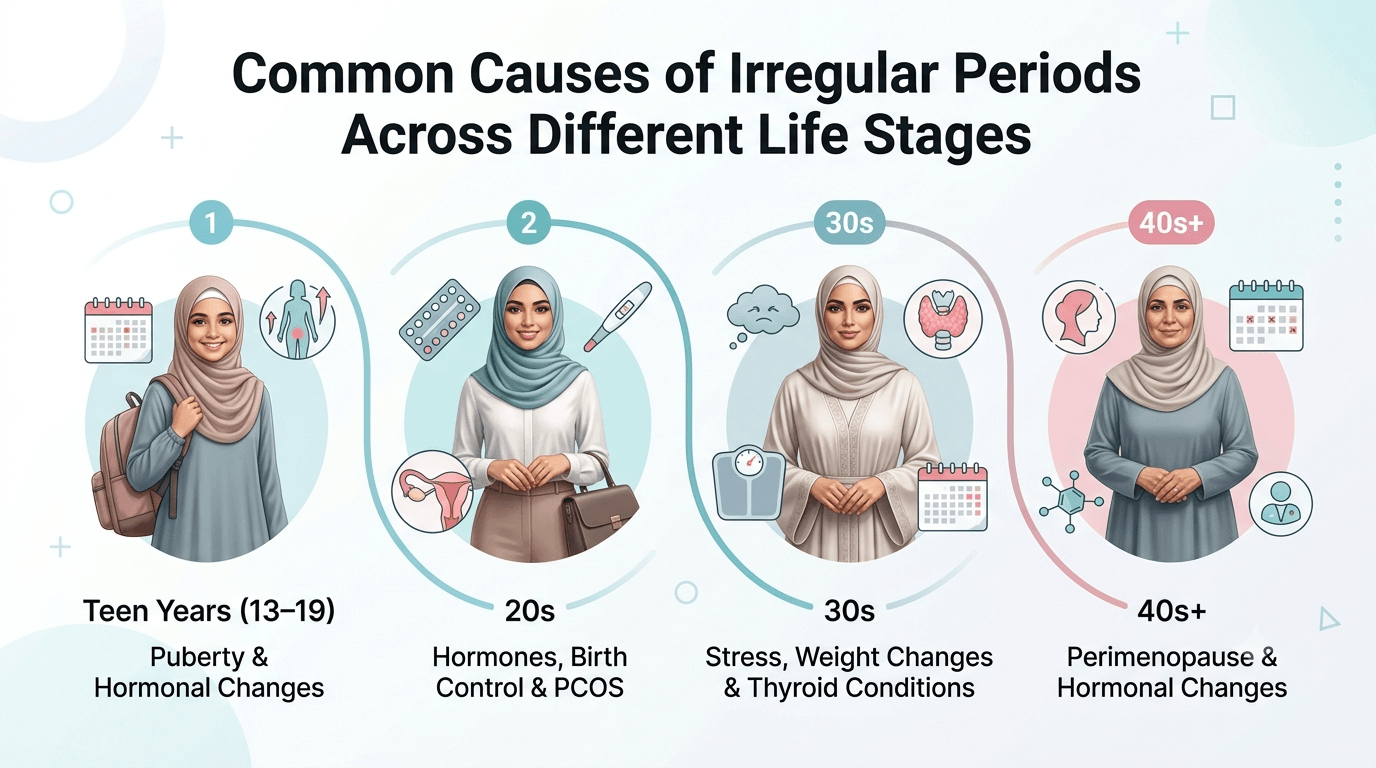
Irregular periods usually come down to something disrupting ovulation, whether that's a hormonal shift, a health condition, or simply a stretch of a stressful life. The most common causes tend to shift a little depending on your age and life stage.
Causes of Irregular Periods in Your 20s
Cycles often become more predictable by your 20s compared to the teenage years, but plenty can still throw them off. Starting or stopping hormonal birth control is one of the most common reasons, since it can take a few months for your natural cycle to settle back into rhythm. Polycystic ovary syndrome (PCOS) also frequently appears for the first time in your late teens and 20s, and irregular or missed periods are usually its first noticeable sign. (ACOG) Big swings in weight, disordered eating patterns, intense training schedules, and ordinary life stress, like finishing school or starting a demanding job, are also common at this age.
Causes of Irregular Periods in Your 30s
In your 30s, pregnancy and postpartum changes become a more common explanation, since cycles often stay irregular for a few months after childbirth or while breastfeeding. Thyroid conditions, which can develop at any age, are also frequently picked up during this decade, alongside uterine fibroids and polyps, which are noncancerous growths that can affect bleeding patterns. For a smaller number of people, early hormonal shifts related to perimenopause can begin in the late 30s, though this is far less typical than it becoming noticeable in your 40s. (ACOG)
Causes That Can Show Up at Any Age
Some causes aren't tied to a particular decade. Chronic stress raises cortisol, which can interfere with the hormonal signals that trigger ovulation. (Cleveland Clinic) Certain medications, including some antidepressants, blood thinners, and antipsychotics, can also affect your cycle. Thyroid disorders, whether the thyroid is overactive or underactive, are common at every adult age and are usually easy to check for with a simple blood test.
| Life Stage | Common Causes |
|---|---|
| Teens (first 1–3 years after a first period) | A still-maturing hormonal rhythm; irregularity is expected |
| 20s | Starting or stopping birth control, PCOS, stress, weight changes, intense exercise |
| 30s | Pregnancy or postpartum changes, thyroid conditions, fibroids or polyps, early perimenopause (less common) |
| 40s and beyond | Perimenopause, thyroid conditions, fibroids |
How Irregular Periods Affect Your Body
An irregular cycle isn't only a scheduling headache. Depending on the cause, it can have effects that reach beyond the days you're actually bleeding.
Iron Levels and Energy
Frequent heavy bleeding can lead to iron-deficiency anemia over time, since you're losing more iron than usual with each cycle. (Mayo Clinic) Low iron often shows up as fatigue, pale skin, shortness of breath, or trouble concentrating, symptoms that are easy to blame on a busy schedule instead of your cycle.
Fertility and Hormone Health
Irregular cycles are frequently tied to irregular or absent ovulation, which is also why they're one of the first things a doctor checks when someone is having trouble conceiving. This doesn't mean pregnancy is off the table. It usually just means the timing is harder to predict, which we'll cover in more detail shortly.
Bone and Long-Term Health
Estrogen plays a role in maintaining bone density, so cycles that stop for extended periods, whether from very low body weight, intense exercise, or a hormonal condition, can affect bone health over time. This is one of the reasons doctors take missed periods seriously even when someone doesn't feel unwell otherwise.
The Everyday, Practical Side
Not knowing when your period will show up can be genuinely stressful, whether that means packing extra supplies "just in case" or feeling caught off guard at an inconvenient moment. That unpredictability is a real effect of irregular cycles too, even though it doesn't show up on a lab test.
Can You Get Pregnant With Irregular Periods?
Yes. As long as you're still ovulating, pregnancy is possible with an irregular cycle. An irregular period doesn't mean ovulation has stopped altogether, just that it's harder to predict which day it will happen.
The main practical difference is timing. With a regular cycle, ovulation typically lands around the same point each month, which makes the fertile window easier to estimate. With an irregular cycle, ovulation can shift earlier or later from month to month, which is exactly why calendar counting alone tends to fall short. Our guide to how to calculate ovulation covers ways to track ovulation signs directly, which tend to work better than the calendar when your cycle isn't predictable.
Signs of Pregnancy When You Have Irregular Periods
A missed period is the classic first clue for pregnancy, but that clue isn't reliable if your periods are already unpredictable. These other early signs can be more useful:
- Breast tenderness or swelling, which can appear within a week or two of conception
- Nausea, with or without vomiting
- Fatigue that feels heavier than usual
- Frequent urination
- Light implantation spotting, usually pink or brown and much lighter than a period
None of these signs confirms pregnancy on their own, since several overlap with regular premenstrual symptoms. A home pregnancy test is still the most reliable next step. If your cycle length is unknown, a reasonable rule of thumb is to test around three weeks after unprotected sex, and to test again a week later if the first result is negative but symptoms continue. 100 Calculator's Pregnancy Due Date Calculator can help once a test comes back positive, even if your last cycle length was hard to pin down.
How to Track an Irregular Cycle
Tracking matters even more when your cycle is unpredictable, since it's the only way to tell the difference between normal month-to-month drift and a pattern that's genuinely worth a doctor's attention.
What to Log Every Cycle
A useful log doesn't need to be complicated. At a minimum, track:
- The first day of full flow, which marks day one of each cycle.
- How many days the bleeding lasts, plus how heavy it feels compared to your usual.
- Any spotting between periods, including the approximate date and how light it was.
- Pain levels, especially if cramping is worse than what you'd normally expect.
- Anything unusual happening in your life that month, like travel, illness, a new medication, or a stretch of high stress, since these often explain a single off cycle.
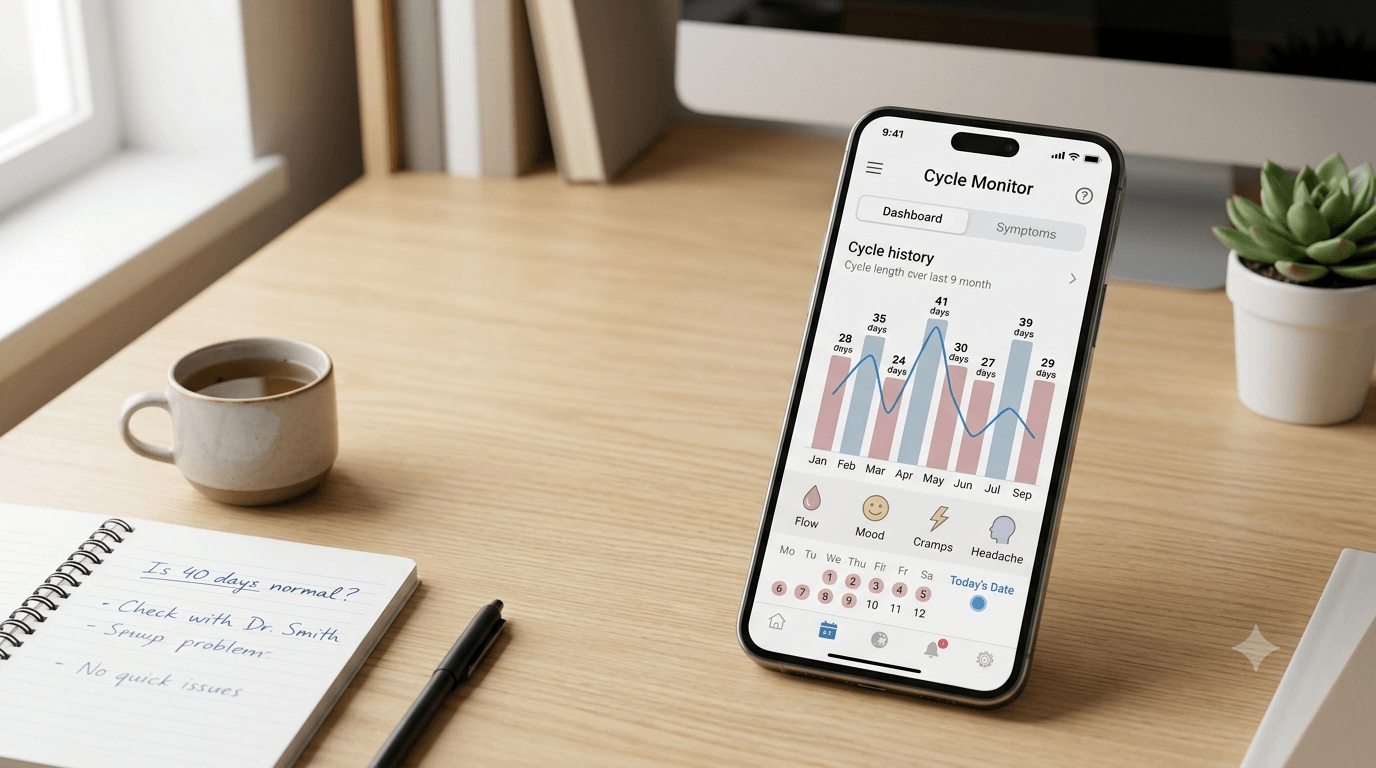
Free Online Tool
Let a period tracker do the math
100 Calculator's Period & Fertility Tracker logs your cycle dates and shows you the pattern at a glance, so you don't have to keep the numbers in your head. It won't diagnose anything, but it gives you and your doctor a much clearer starting point than guessing.
App or Calendar: Which Works Better for Irregular Cycles?
Either works, but an app or online tracker tends to handle irregularity better, since it can flag when a cycle falls outside your usual range instead of leaving you to spot the pattern by eye. If you'd rather stick with pen and paper, our guide to tracking your period accurately covers the calendar method in detail. Whichever method you choose, aim for at least three to six months of consistent logging before drawing conclusions. Irregular cycles are, by definition, less predictable, so a single data point tells you far less than a real pattern does.
Irregular Periods Treatment Options
Treatment depends entirely on the cause, so the right next step is a conversation with a doctor rather than guessing at a fix. That said, it helps to know what the general options look like.
Lifestyle Approaches That May Help
When stress, weight changes, or intense exercise are behind an irregular cycle, adjusting those factors is often the first thing a doctor recommends. That can mean building in more recovery time around intense training, working with a nutritionist if weight swings are extreme, or finding a more sustainable way to manage a stressful stretch of life. If weight or metabolic health seems connected to your cycle, 100 Calculator's Calorie Deficit Calculator for PCOS can help you build a more balanced plan alongside your doctor's guidance.
Medical Treatment Options
When a lifestyle change alone isn't enough, or when a condition like PCOS or a thyroid disorder is behind the irregularity, a doctor may recommend hormonal birth control to regulate the cycle, medication to address a thyroid imbalance, or other targeted treatment based on what bloodwork and an ultrasound show. There's no single treatment that works for everyone, which is exactly why an accurate diagnosis matters more than trying to guess a fix on your own.
Treatment Options Regardless of Marital Status
Doctors base treatment for irregular periods on your individual health, symptoms, and goals, not on whether you're married. If you're unmarried and hesitant to start a particular treatment because of cultural or personal concerns, it's worth saying so directly at your appointment. A good doctor will walk you through the full range of options, including ones that don't involve hormonal birth control, so you can choose whatever actually fits your situation.
Myths vs. Facts About Irregular Periods
A lot of confusion around irregular periods comes from a handful of persistent myths. Here's how a few of the most common ones stack up against what's actually true.
| Myth | Fact |
|---|---|
| An irregular period always means something is medically wrong | Occasional irregular cycles are common and often caused by everyday factors like stress or travel |
| You can't get pregnant if your periods are irregular | Pregnancy is possible as long as ovulation is still happening |
| Skipping one period means you have PCOS | A single skipped period has many possible causes; PCOS is diagnosed with symptoms plus tests, not one missed cycle |
| Irregular periods only matter if you're trying to conceive | They can also affect iron levels, bone health, and everyday predictability |
| Tracking isn't useful if your cycle is already irregular | Tracking is even more useful for irregular cycles, since it's the only way to see the real pattern |
Related Calculators
Put what you just read into practice, try these free tools instantly, no sign-up required.
Period & Fertility Tracker
Track your menstrual cycle and predict fertile days with ease.
Pregnancy Due Date Calculator
Estimate your baby's due date based on your last period.
Baby Growth Memory Calendar
Track and celebrate your baby's growth milestones month by month.
Nutrition Calculator for Women
Calculate daily nutrient and calorie needs tailored for women's health.
Pregnancy Weight Gain Calculator
Monitor healthy weight gain throughout each trimester of pregnancy.
When to See a Doctor
Tracking helps you notice patterns, but some signs are worth a conversation with a healthcare provider regardless of what your tracker says. (ACOG) Consider making an appointment if you notice:
- No period for three or more months, and pregnancy isn't the reason
- Cycle length that regularly swings by more than about a week
- Bleeding that lasts longer than seven days on a regular basis
- Needing to change a pad or tampon every hour or two for several hours in a row
- Pain severe enough to interfere with school, work, or daily activities
- Spotting between periods, or after sex, on a regular basis
- A previously predictable cycle that suddenly becomes erratic
- No period at all by age 15 or 16
None of these automatically means something is seriously wrong, but they're exactly the kind of detail that's easy to describe accurately once you've been tracking, and much harder to recall precisely from memory alone.
Medical disclaimer: This article is for general educational purposes only and isn't a substitute for professional medical advice, diagnosis, or treatment. Irregular cycles have many possible causes, so always talk to a licensed healthcare provider about your specific symptoms, especially if a pattern is new, worsening, or interfering with your daily life.
More From Women's Health Guides
Want to keep building your understanding of cycles, fertility, and pregnancy timing? These related guides dig deeper into the topics covered above.
Frequently Asked Questions
What is an irregular menstrual cycle?
An irregular menstrual cycle is one that falls outside the typical 21- to 35-day range, varies by more than about a week from cycle to cycle, or comes with unusually heavy, light, or painful bleeding. A cycle that skips months entirely, or bleeding that shows up between periods, also counts as irregular. A cycle or two of unusual timing isn't automatically a concern, but a pattern that keeps repeating over several months is worth tracking closely and mentioning to a doctor if it continues.
How do you know if your irregular period is coming?
With an irregular cycle, exact timing is hard to predict, but your body often still gives clues. Many people notice familiar premenstrual signs like bloating, breast tenderness, mild cramping, fatigue, or mood changes in the days beforehand, even if the number of days between periods keeps shifting. Logging these signs alongside your bleeding dates in a period tracker over a few months can help you spot your own early-warning pattern, even without a fixed schedule to count from.
What does an irregular period feel like?
Physically, an irregular period can feel similar to a regular one, with cramping, fatigue, and mood changes, but the unpredictability itself is often the bigger difference. Flow may feel heavier, lighter, or longer than what you're used to, and periods can arrive without much warning since your usual premenstrual signs may not show up on a consistent schedule. Some people also notice more intense cramping or spotting between periods, which isn't typical with a regular cycle.
How many days is a normal irregular period?
There's no single "normal" number for an irregular period, since irregularity is defined by inconsistency rather than a fixed length. That said, doctors generally consider bleeding that lasts longer than seven days, or a cycle shorter than 21 days or longer than 35 days, to be outside the typical range. If your period length keeps changing significantly from month to month, tracking it for a few cycles will give you a much clearer picture than trying to estimate a single "normal" duration.
What is the main cause of irregular periods?
There isn't one single cause, since irregular periods usually come down to anything that disrupts ovulation. The most common contributors include hormonal conditions like polycystic ovary syndrome (PCOS) and thyroid disorders, significant weight changes, high stress levels, intense exercise, and starting or stopping hormonal birth control. Because so many different things can cause irregular cycles, a doctor typically uses your symptoms, bloodwork, and sometimes an ultrasound to narrow down what's actually behind yours.
What are the 9 signs your period is coming?
In the days before a typical period, many people notice bloating, breast tenderness, cramping, fatigue, mood swings, acne breakouts, food cravings, lower back pain, and light spotting. Not everyone experiences all nine, and the mix can vary from cycle to cycle. Noticing several of these in a predictable window each month is usually just a normal premenstrual pattern, not a sign that anything is wrong with your cycle.
How do irregular periods start?
Irregular periods usually begin gradually rather than all at once. You might notice your cycle running a few days longer or shorter than usual, a period arriving early or late, or a month where it doesn't show up at all. For many people, the shift lines up with something identifiable, like starting a new birth control method, a stretch of high stress, a change in weight, or an underlying hormonal condition. Tracking from the first sign of a change makes it much easier to see whether it's a one-off or the start of a real pattern.
What are the 7 signs of menstruation?
Once a period actually starts, common signs include vaginal bleeding or spotting, cramping in the lower abdomen, fatigue, mood changes, breast tenderness, lower back pain, and headaches. Not everyone experiences every sign, and the intensity varies widely from person to person and cycle to cycle. These signs are considered a normal part of menstruation; what makes a cycle irregular is the pattern of timing and bleeding around them, not the presence of these symptoms themselves.
Can I get pregnant with irregular periods?
Yes. As long as ovulation is still happening, pregnancy is possible with an irregular cycle. The main difference is that ovulation can happen on a less predictable day each month, which makes the fertile window harder to estimate using the calendar alone. If you're trying to conceive with an irregular cycle, tracking ovulation signs directly, like cervical mucus changes or basal body temperature, tends to work better than counting days from your last period.
What are the signs of pregnancy when you have irregular periods?
Since a missed period isn't a reliable clue when your cycle is already unpredictable, other early signs become more useful: breast tenderness, nausea, fatigue, frequent urination, and light implantation spotting that's typically pink or brown and much lighter than a period. None of these confirms pregnancy by itself, since several overlap with normal premenstrual symptoms. A home pregnancy test, taken around three weeks after unprotected sex, is the most reliable way to know for sure.
Can stress cause irregular periods?
Yes. High stress raises cortisol, which can interfere with the hormonal signals your brain sends to your ovaries, sometimes delaying or even skipping ovulation entirely. Since your period typically follows ovulation by about two weeks, a delayed or skipped ovulation pushes back your whole cycle. This is usually temporary and resolves once the stressful period passes, but ongoing high stress that regularly disrupts your cycle is worth discussing with a doctor.
Is it normal to have irregular periods in your 20s or 30s?
Occasional irregular cycles in your 20s or 30s are common and often tied to everyday factors like stress, travel, weight changes, or starting and stopping birth control. In your 20s, PCOS is a frequent underlying cause when irregularity is persistent. In your 30s, pregnancy, postpartum changes, and thyroid conditions become more common explanations. A cycle or two of unusual timing usually isn't a concern, but a pattern that continues for several months is worth checking with a doctor.
When should I see a doctor about an irregular cycle?
It's worth seeing a doctor if you go three or more months without a period and aren't pregnant, if your cycle length regularly swings by more than about a week, if bleeding lasts longer than seven days or requires changing protection every hour or two, if you have pain severe enough to disrupt daily life, or if you notice spotting between periods or after sex on a regular basis. None of these automatically means something serious is wrong, but they're worth a conversation.
About 100 Calculator
100 Calculator is a free hub of online calculators and educational guides covering health, finance, trading, crypto, education, and more. Every tool is built to be fast, accurate, and genuinely free, with no account or signup required.
We built this guide, along with tools like the Period & Fertility Tracker and Calorie Deficit Calculator for PCOS referenced throughout it, to make everyday health questions a little easier to answer. Head back to the 100 Calculator homepage to explore the full library of tools, or learn more about the team behind them on our About Us page.