Pregnancy Week-by-Week Guide
A trimester-by-trimester walkthrough of how your baby grows, how your body changes, and what's typical at each stage of a 40-week pregnancy — from the first missed period to your due date.
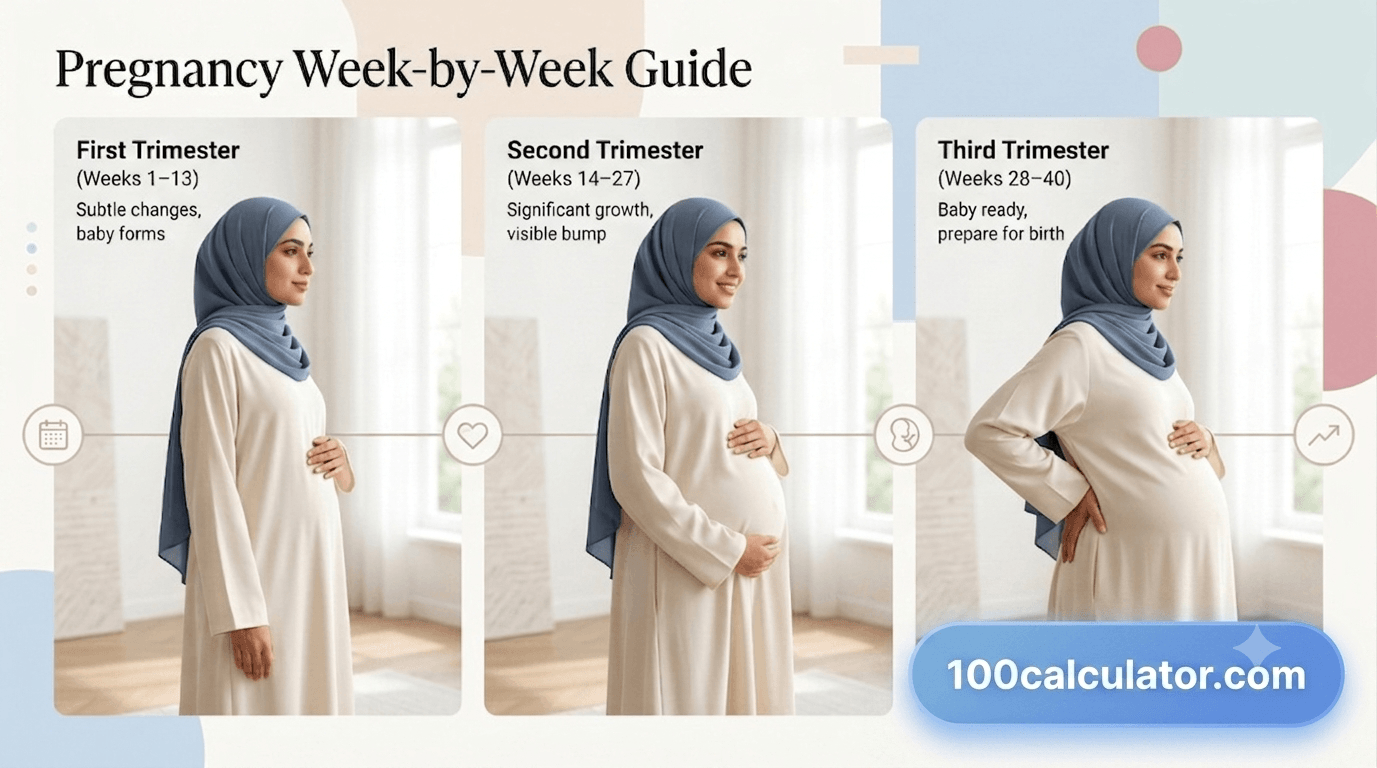
Pregnancy lasts about 40 weeks, and doctors count every single one of them starting from the first day of your last period — not from the moment you actually conceived. Those 40 weeks are grouped into three trimesters, and each one comes with its own pattern of fetal growth, body changes, and things worth keeping an eye on.
A week-by-week pregnancy guide tracks two things at once: how your baby is developing inside the womb (size, organs, movement) and how your own body is responding to it (hormones, energy, and physical changes). Most people find the first trimester the most symptom-heavy, the second the most comfortable, and the third the most physically demanding as the due date gets close.
You don't need to memorize every week to have a healthy pregnancy — your prenatal visits are designed to catch anything that needs attention. But knowing roughly what's typical for where you are can make the next several months feel a lot less like guesswork. If you just want a quick starting point, 100 Calculator's Pregnancy Due Date Calculator can estimate your due date and current week in seconds; this guide fills in everything around that number.
Below, we'll cover how weeks and trimesters are counted, how big your baby gets at each stage, what's happening developmentally, the body changes and symptoms that go with each trimester, and the specific things to avoid, watch for, and ask your doctor about along the way.
How Pregnancy Is Counted: Weeks, Trimesters, and Your Due Date
Pregnancy math confuses almost everyone at first, mostly because of one strange fact: your 40-week countdown starts before you're technically pregnant.
Why Week 1 Starts Before You're Actually Pregnant
Doctors date pregnancy from the first day of your last menstrual period (LMP), since that's usually the one date most people can pinpoint with confidence. Ovulation and conception typically happen about two weeks later, so by the time you're "4 weeks pregnant," you're really only about two weeks past conception. (ACOG) It's a strange system, but it's the one nearly every provider, app, and calculator uses, which is exactly why it's worth understanding early.
If your cycles are on the shorter or longer side, tracking your cycle for a month or two beforehand can make this starting date more accurate. Our guide on how to track your period accurately walks through exactly how to do that.
How the Three Trimesters Are Divided
The 40 weeks split into three trimesters of roughly 13 weeks each:
- First trimester: week 1 through 13 weeks, 6 days — fertilization and the formation of major organs
- Second trimester: 14 weeks through 27 weeks, 6 days — rapid growth and development
- Third trimester: 28 weeks through birth — weight gain and final organ maturity
That's according to the American College of Obstetricians and Gynecologists (ACOG), though your own provider's chart may round the boundaries slightly differently. Since pregnancy doesn't divide evenly into calendar months, here's roughly how weeks, trimesters, and "months" line up:
| Month | Approx. Weeks | Trimester |
|---|---|---|
| Month 1 | Weeks 1–4 | First |
| Month 2 | Weeks 5–8 | First |
| Month 3 | Weeks 9–13 | First |
| Month 4 | Weeks 14–17 | Second |
| Month 5 | Weeks 18–22 | Second |
| Month 6 | Weeks 23–27 | Second |
| Month 7 | Weeks 28–31 | Third |
| Month 8 | Weeks 32–35 | Third |
| Month 9 | Weeks 36–40 | Third |
This is also why pregnancy gets described as "nine months" even though 40 weeks is closer to nine and a half — most calendar months run a little longer than four weeks.
How Your Due Date Is Estimated (and Why It's Not a Deadline)
Your estimated due date (EDD) is usually calculated by counting 280 days, or 40 weeks, forward from the first day of your last period. If your periods are irregular or you're unsure of that date, an early ultrasound measuring the embryo's crown-rump length can estimate your due date just as accurately, sometimes more so. (ACOG) If the two estimates differ by more than about a week, your provider will typically use the ultrasound date instead.
Here's the part worth remembering: only about 1 in 20 people actually deliver on their exact due date. (ACOG) Think of your due date as the center of a window rather than a deadline — most people deliver somewhere in the couple of weeks around it. Our pregnancy due date guide and what if your due date changes articles go deeper into both sides of this.
Pregnancy by Trimester: A Quick Overview
Before getting into individual weeks, it helps to zoom out. Each trimester has a distinct personality, and knowing what's coming next can make the harder stretches easier to plan around.
Fertilization & Foundation
Every major organ system starts forming. Fatigue, nausea, and breast tenderness are common, and many people don't feel or look pregnant yet.
Growth & Movement
Often called the "golden" trimester. Energy tends to return, the bump becomes visible, and you'll likely feel your baby move for the first time.
Weight Gain & Final Prep
Your baby packs on most of their birth weight and finishes maturing the lungs and brain, while your body prepares for labor.
How Big Is Your Baby? A Week-by-Week Size Guide
Comparing your baby's size to a piece of fruit is a bit of a pregnancy tradition, and it turns out to be a genuinely useful way to picture growth that's otherwise hard to visualize.
How Doctors Measure Your Baby's Size
Early in pregnancy, your baby is curled up, so ultrasounds measure "crown-rump length" — from the top of the head to the bottom of the torso. Starting around week 20, your baby is measured head-to-heel instead, since the legs have uncurled enough to get a fuller length.
That measurement switch is exactly why size charts appear to show a sudden jump partway through the second trimester — your baby didn't grow ten centimeters overnight, the ruler just started measuring differently. Every figure below is an average, and plenty of healthy babies run smaller or larger than these numbers at any given week.
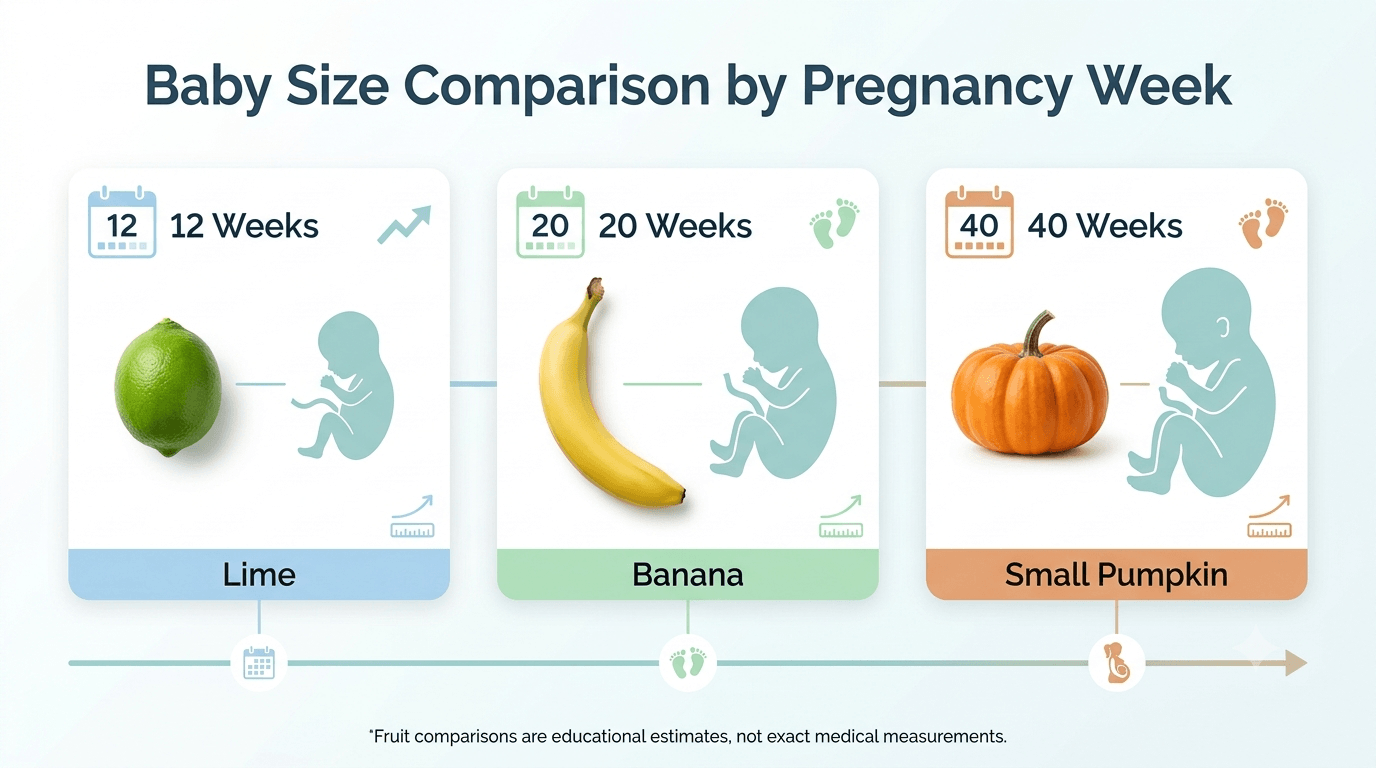
Week-by-Week Size Chart (Weeks 8–40)
| Week | About the Size Of | Approx. Length | Approx. Weight |
|---|---|---|---|
| 8 | A blueberry | 1.6 cm (0.6 in) | 1 g |
| 9 | A grape | 2.3 cm (0.9 in) | 2 g |
| 10 | A kumquat | 3.1 cm (1.2 in) | 4 g |
| 11 | A fig | 4.1 cm (1.6 in) | 7 g |
| 12 | A lime | 5.4 cm (2.1 in) | 14 g |
| 13 | A lemon | 7.4 cm (2.9 in) | 23 g |
| 14 | A peach | 8.7 cm (3.4 in) | 43 g |
| 15 | An apple | 10.1 cm (4.0 in) | 70 g |
| 16 | An avocado | 11.6 cm (4.6 in) | 100 g |
| 17 | A turnip | 13.0 cm (5.1 in) | 140 g |
| 18 | A bell pepper | 14.2 cm (5.6 in) | 190 g |
| 19 | A large tomato | 15.3 cm (6.0 in) | 240 g |
| 20 | A banana | 16.4 cm (6.5 in) | 300 g |
| 21 | A carrot | 26.7 cm (10.5 in)* | 360 g |
| 22 | A papaya | 27.8 cm (10.9 in) | 430 g |
| 23 | A large mango | 28.9 cm (11.4 in) | 500 g (1.1 lb) |
| 24 | An ear of corn | 30.0 cm (11.8 in) | 600 g (1.3 lb) |
| 25 | A cauliflower | 34.6 cm (13.6 in) | 660 g (1.5 lb) |
| 26 | A head of lettuce | 35.6 cm (14.0 in) | 760 g (1.7 lb) |
| 27 | A head of cabbage | 36.6 cm (14.4 in) | 875 g (1.9 lb) |
| 28 | An eggplant | 37.6 cm (14.8 in) | 1,005 g (2.2 lb) |
| 29 | A butternut squash | 38.6 cm (15.2 in) | 1,150 g (2.5 lb) |
| 30 | A large cabbage | 39.9 cm (15.7 in) | 1,320 g (2.9 lb) |
| 31 | A coconut | 41.1 cm (16.2 in) | 1,500 g (3.3 lb) |
| 32 | A jicama | 42.4 cm (16.7 in) | 1,700 g (3.7 lb) |
| 33 | A pineapple | 43.7 cm (17.2 in) | 1,920 g (4.2 lb) |
| 34 | A cantaloupe | 45.0 cm (17.7 in) | 2,150 g (4.7 lb) |
| 35 | A honeydew melon | 46.2 cm (18.2 in) | 2,380 g (5.2 lb) |
| 36 | A head of romaine | 47.4 cm (18.7 in) | 2,620 g (5.8 lb) |
| 37 | A bunch of Swiss chard | 48.6 cm (19.1 in) | 2,860 g (6.3 lb) |
| 38 | A leek | 49.8 cm (19.6 in) | 3,080 g (6.8 lb) |
| 39 | A mini watermelon | 50.7 cm (20.0 in) | 3,290 g (7.3 lb) |
| 40 | A small pumpkin | 51.2 cm (20.2 in) | 3,460 g (7.6 lb) |
*Week 21 shows the biggest single-week jump in the table because this is where measurement switches from crown-rump length to head-to-heel length, not because of one week of unusually fast growth.
Curious how your baby's estimated size compares to your own pregnancy weight gain so far? 100 Calculator's Pregnancy Weight Gain Calculator can help you see whether your gain is tracking within a typical range for your stage and starting weight.
Fetal Development Week by Week: Key Milestones
Growth in size is only half the story. Underneath that, your baby's organs, senses, and systems are developing on a fairly predictable schedule.
First Trimester Development (Weeks 1–13)
This is the busiest stretch for organ formation. The neural tube, which becomes the brain and spinal cord, forms within the first month, which is exactly why folic acid matters so early, often before a positive pregnancy test even shows up. By around week 6, the heart is beating, and by the end of the first trimester, arms, legs, fingers, toes, and external genitals have all started to form, along with early kidney and liver function.
Second Trimester Development (Weeks 14–27)
Development shifts from "building organs" to "growing and refining them." Your baby starts making coordinated movements you'll eventually feel, develops a sleep-wake pattern, grows hair, eyebrows, and eyelashes, and can often be seen sucking a thumb on ultrasound. By around 24 weeks, the lungs begin producing surfactant, a substance that will eventually let them expand with air after birth.
Third Trimester Development (Weeks 28–40)
The final stretch is largely about weight gain and fine- tuning. Your baby's brain and nervous system mature quickly, the lungs continue preparing for that first breath, and a layer of fat builds up to help with temperature regulation after birth. Most babies also settle into a head-down position sometime in the last several weeks, though there's variation in exactly when.
Some of the milestones parents ask about most:
- Heart begins beating: around week 6
- All major organs formed: by the end of week 13
- Fetal sex organs distinguishable on ultrasound: typically weeks 18–20
- Viability threshold: survival outside the womb becomes possible starting around week 24, with outcomes improving considerably each additional week
- Lungs reach maturity: generally by around week 36
Body Changes and Symptoms Through Pregnancy
While your baby is developing, your own body is going through some of the biggest hormonal shifts it will ever experience. Here's what tends to show up when.
First Trimester Symptoms
Nausea (often called morning sickness, though it can strike any time of day), fatigue, breast tenderness, and more frequent urination are the classic early signs. Mood swings are common too, driven by rapidly rising estrogen and progesterone.
Second Trimester Symptoms
Many people feel noticeably better here: nausea usually fades and energy comes back. New sensations take over instead, like round ligament pain (a quick, sharp twinge along the lower belly as the uterus stretches), a growing appetite, and the first flutters of fetal movement.
Third Trimester Symptoms
As your baby gets bigger, so does the physical load: Braxton Hicks contractions (irregular practice tightening of the uterus), lower back pain, swelling in the feet and ankles, shortness of breath, and trouble sleeping are all common in the home stretch.
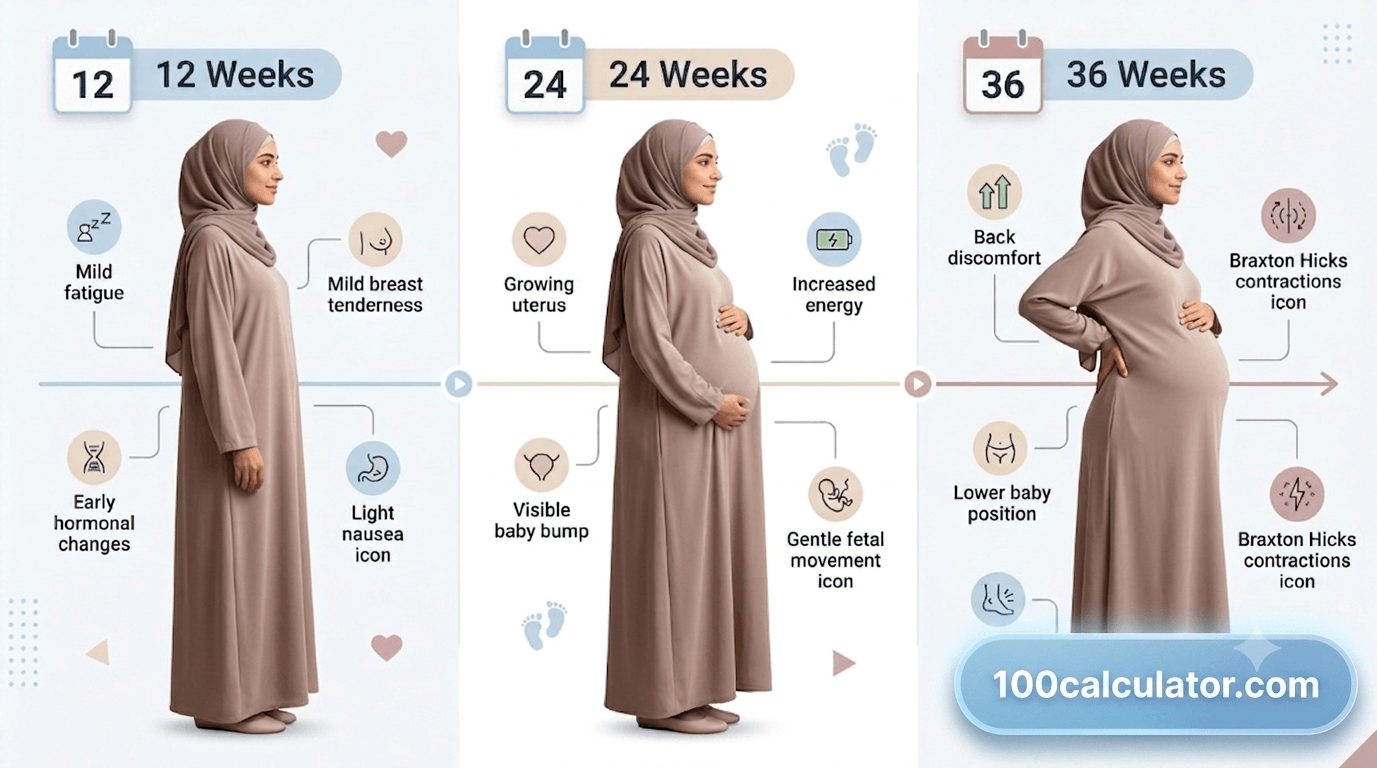
| Trimester | Typical Symptoms |
|---|---|
| First (weeks 1–13) | Nausea, fatigue, breast tenderness, frequent urination, mood swings |
| Second (weeks 14–27) | Renewed energy, round ligament pain, visible bump, first fetal movements, increased appetite |
| Third (weeks 28–40) | Braxton Hicks contractions, back pain, swelling, shortness of breath, disrupted sleep |
Heartbeat, Movement, and Ultrasound Milestones
A few moments tend to stand out more than any others during pregnancy: hearing the heartbeat for the first time, feeling that first flutter of movement, and seeing your baby on a screen.
When Can You Hear Your Baby's Heartbeat?
Cardiac activity typically begins around week 5 to 6 and can often be seen on a vaginal ultrasound as early as week 6. A handheld Doppler at your provider's office usually picks it up reliably between weeks 10 and 12, though it's not unusual to wait until a follow-up visit if the first attempt comes up quiet — that's about timing and baby's position far more often than anything concerning.
When Will You Feel Your Baby Move? (Quickening)
That first sensation of movement is called quickening, and it's often described as flutters or tiny bubbles. If this is your first pregnancy, it typically shows up between weeks 18 and 25; if you've been pregnant before, you may recognize it a bit earlier, sometimes around week 16. (Cleveland Clinic) By around 28 weeks, providers generally suggest paying closer attention to movement patterns and mentioning any noticeable, ongoing decrease to your care team.
Common Ultrasound and Screening Timeline
Exact timing varies by provider and individual risk factors, but many pregnancies follow a similar general pattern of scans and screenings:
| Approx. Timing | Common Test or Scan |
|---|---|
| Weeks 6–9 | Early dating ultrasound to confirm due date and heartbeat |
| Weeks 11–14 | First-trimester screening, including nuchal translucency |
| Weeks 18–22 | Detailed anatomy scan checking organ development |
| Weeks 24–28 | Glucose screening for gestational diabetes |
| Weeks 36–37 | Group B strep (GBS) screening |
What to Avoid During Pregnancy
Most day-to-day life doesn't need to change dramatically during pregnancy, but a handful of foods, substances, and medications carry enough risk that health authorities recommend avoiding or limiting them.
Foods and Drinks to Limit or Avoid
- High-mercury fish, such as shark, swordfish, king mackerel, and tilefish
- Raw or undercooked meat, seafood, and eggs, which carry a higher risk of bacteria and parasites
- Deli meats and hot dogs, unless heated until steaming, due to listeria risk
- Unpasteurized dairy, juice, and soft cheeses, for the same reason
- Excess caffeine, generally kept under about 200 mg a day, roughly one 12-ounce cup of coffee
Lower-mercury fish like salmon, shrimp, and canned light tuna are actually encouraged in moderation, since they support your baby's brain development. (Mayo Clinic) 100 Calculator's Nutrition Calculator for Women can help you check whether your overall diet is meeting your needs during pregnancy.
Alcohol, Smoking, and Recreational Drugs
There's no known safe amount or safe time to drink alcohol during pregnancy, and no type of alcohol is considered an exception. (CDC) Smoking and vaping expose your baby to nicotine and carbon monoxide, raising the risk of low birth weight and preterm birth, and recreational drug use carries its own serious risks. If you're currently using any of these and finding it hard to stop, tell your provider — they can connect you with support rather than judgment.
Medications, Supplements, and Activities to Check With Your Doctor
The FDA recommends avoiding NSAIDs, such as ibuprofen, naproxen, and full-dose aspirin, from around 20 weeks of pregnancy onward, since they've been linked to low amniotic fluid and other complications later in pregnancy. (FDA) Acetaminophen is generally the go-to option for pain and fever, but it's still worth confirming with your provider or pharmacist before starting or continuing any medication or supplement, including ones that felt routine before pregnancy.
A few activities are also worth a second thought: hot tubs and saunas can raise your core body temperature more than is ideal, contact sports carry a higher fall or impact risk, and changing cat litter comes with a small risk of toxoplasmosis exposure. None of these are emergencies if they've already happened — they're simply easy things to adjust going forward.
Warning Signs That Need Immediate Medical Attention
Most pregnancy symptoms are uncomfortable rather than dangerous, but a smaller set of signs should never be brushed off, according to the CDC's guidance on urgent maternal warning signs. (CDC) Contact your provider right away, or go to an emergency room, if you notice:
- Heavy vaginal bleeding
- A severe headache that won't go away, especially with vision changes
- Sudden or severe swelling in the face or hands
- Severe or constant abdominal pain that doesn't ease up
- A fever of 100.4°F (38°C) or higher
- Sudden shortness of breath or chest pain
- A noticeable decrease in your baby's movement after you've become familiar with their usual pattern
- Regular contractions, pelvic pressure, or fluid leakage before 37 weeks
None of these guarantee something is seriously wrong, but they're exactly the kind of symptoms your care team would rather hear about early. If something feels different or concerning and you're not sure whether it counts, it's always reasonable to call and ask.
Common Pregnancy Myths vs. Facts
Pregnancy attracts more folklore than almost any other life stage. Here's the reality behind a few of the most common claims.
| Myth | Fact |
|---|---|
| "You're eating for two" | Calorie needs rise only modestly, mainly in the second and third trimesters — not by double. |
| "Morning sickness only happens in the morning" | Pregnancy nausea can strike at any hour, and for some people it's worse in the evening. |
| "The shape of your bump tells you the baby's sex" | Bump shape depends on abdominal muscle tone, baby's position, and body type, not fetal sex. |
| "You can't exercise while pregnant" | Most low-risk pregnancies benefit from regular, moderate activity once cleared by a provider. |
| "Bump size tells you how far along you are" | Bump size varies widely with body type and fluid levels; it isn't a reliable way to judge your week or your baby's size. |
Related Calculators
Put what you just read into practice, try these free tools instantly, no sign-up required.
Period & Fertility Tracker
Track your menstrual cycle and predict fertile days with ease.
Pregnancy Due Date Calculator
Estimate your baby's due date based on your last period.
Baby Growth Memory Calendar
Track and celebrate your baby's growth milestones month by month.
Nutrition Calculator for Women
Calculate daily nutrient and calorie needs tailored for women's health.
Pregnancy Weight Gain Calculator
Monitor healthy weight gain throughout each trimester of pregnancy.
Building Your Prenatal Care Schedule
Regular prenatal visits are how your provider tracks your baby's growth and catches potential issues early, so it's worth understanding roughly what the schedule looks like.
A Typical Visit Schedule
The traditional model, in place for decades, calls for a visit about once a month until 28 weeks, every two weeks until 36 weeks, and weekly from 36 weeks until delivery. More recently, ACOG has also endorsed "tailored" prenatal care models that combine fewer in-person visits with telehealth check-ins for average-risk pregnancies, so your own provider's schedule may look somewhat different. (ACOG) Either way, the goal is the same: regular monitoring of your blood pressure, weight, and your baby's growth throughout pregnancy.
Common Tests and Screenings by Trimester
Your first prenatal visit, ideally before 10 weeks, typically covers your medical history, an initial round of bloodwork, and confirmation of your due date. From there, the screening timeline in the section above (NT scan, anatomy scan, glucose screening, and GBS testing) fills in most of the remaining major checkpoints, with blood pressure and fundal height checked at almost every visit from the second trimester onward.
If irregular cycles made it tricky to pin down your original due date, our guide on signs of an irregular menstrual cycle explains what can throw off that first estimate.
Tips for Tracking Your Pregnancy Week by Week
A little structure makes the next several months easier to follow, whether you're a spreadsheet person or prefer to keep things simple.
- Confirm your due date early using your last period and, if needed, an early ultrasound, so every other estimate in this guide lines up with your actual week.
- Log symptoms as they happen, not just dates. A quick note about nausea, energy, or movement patterns is genuinely useful at your next appointment.
- Take a weekly bump photo if you enjoy it, rather than comparing yourself to other people's photos online. Every body carries pregnancy differently, and your own week-by-week series will mean more to you than anyone else's.
- Write down questions between visits so you're not trying to remember them on the spot during a short appointment window.
- Involve a partner or support person in tracking milestones like the anatomy scan or first felt movement — it helps the pregnancy feel shared rather than solitary.
Once you know your due date, 100 Calculator's Pregnancy Due Date Calculator can show your current week at a glance, and the Baby Growth Memory Calendar is a simple way to keep a running record once your baby arrives.
Medical disclaimer: This article is for general educational purposes only and isn't a substitute for professional medical advice, diagnosis, or treatment. Every pregnancy is different, so always talk to a licensed healthcare provider about your specific symptoms, test results, or concerns.
More Pregnancy and Fertility Guides
If you're planning a pregnancy, currently expecting, or just trying to understand your cycle better, these related guides dig deeper into the topics touched on above.
Frequently Asked Questions
What actually happens during each week of pregnancy?
Each week brings a mix of fetal development and body changes. Early weeks focus on forming major organs, the middle weeks bring rapid growth and your baby's first movements, and the final weeks are mostly about weight gain and getting the lungs and brain ready for life outside the womb. Your own symptoms shift alongside these stages, from early nausea and fatigue to later back pain and Braxton Hicks contractions.
How is pregnancy counted in weeks and trimesters?
Pregnancy is counted from the first day of your last menstrual period, not from conception, which usually happens about two weeks later. The 40 weeks are grouped into three trimesters: weeks 1 through 13, weeks 14 through 27, and week 28 through birth. This is the same counting system your provider, apps, and due date calculators all use.
What symptoms are normal week by week during pregnancy?
Nausea, fatigue, and breast tenderness are typical in the first trimester. Energy usually returns in the second trimester, along with round ligament pain and the first fetal movements. The third trimester tends to bring Braxton Hicks contractions, back pain, swelling, and shortness of breath as your baby grows larger. Symptom severity varies a lot from person to person.
How does my baby develop week by week?
In the first trimester, major organs form and the heart starts beating around week 6. The second trimester brings coordinated movement, hair growth, and a developing sleep-wake pattern. In the third trimester, the brain and lungs mature quickly, and your baby gains most of their birth weight while settling into position for delivery.
When can I hear my baby's heartbeat or feel the baby move?
Cardiac activity can often be seen on an ultrasound around week 6, and a handheld Doppler at your provider's office usually picks it up between weeks 10 and 12. Feeling movement, called quickening, typically starts between weeks 18 and 25 for a first pregnancy, sometimes a bit earlier, around week 16, if you've been pregnant before.
How big is my baby each week of pregnancy?
Your baby grows from about the size of a blueberry at 8 weeks to roughly the size of a small pumpkin by 40 weeks, reaching around 51 cm (20 in) long and 3,460 g (7.6 lb) on average at full term. The full week-by-week size chart earlier in this guide covers every week from 8 through 40 in more detail.
What changes should I expect in my body week by week?
Expect nausea, fatigue, and breast changes early on, a visibly growing bump and renewed energy in the middle months, and increasing size, swelling, and reduced mobility as you approach your due date. Weight gain, skin changes, and shifts in posture happen gradually throughout, rather than in sudden jumps.
What foods, activities, and medications should I avoid during pregnancy?
Avoid high-mercury fish, raw or undercooked meat and eggs, unpasteurized dairy, and deli meats unless heated until steaming. Alcohol has no known safe amount during pregnancy, and smoking should be avoided entirely. NSAIDs like ibuprofen are generally avoided from 20 weeks onward, and any medication or supplement should be confirmed with your provider first.
What warning signs during pregnancy should never be ignored?
Contact your provider immediately for heavy vaginal bleeding, a severe headache with vision changes, sudden swelling, severe abdominal pain, a fever of 100.4°F or higher, sudden shortness of breath, a noticeable drop in your baby's movement, or contractions and fluid leakage before 37 weeks. When in doubt, it's always reasonable to call.
How accurate is my due date, and can it change during pregnancy?
Your due date is an estimate, calculated from your last period or an early ultrasound, and only about 1 in 20 people deliver on that exact day. It can shift if an early ultrasound measurement differs noticeably from your period-based estimate, which is why the date on your very first appointment isn't always the one you'll end up with.
What's the difference between gestational age and fetal age?
Gestational age counts from the first day of your last period, which is what your provider and due date calculator use. Fetal age (or conceptional age) counts from the actual moment of conception, roughly two weeks later. Almost all pregnancy tracking, including this guide, uses gestational age unless stated otherwise.
How many weeks are in each trimester?
Each trimester covers roughly 13 to 14 weeks. The first trimester runs from week 1 through 13 weeks and 6 days, the second from 14 weeks through 27 weeks and 6 days, and the third from 28 weeks through delivery, which typically falls somewhere around week 40.
Can I track my pregnancy without an app?
Yes. A calendar, notebook, or simple weekly note is just as effective for logging symptoms, movement, and appointment questions. If you'd rather skip downloading an app, 100 Calculator's free Pregnancy Due Date Calculator works entirely in your browser, with no account needed.
About 100 Calculator
100 Calculator is a free hub of online calculators and educational guides covering health, finance, trading, crypto, education, and more. Every tool is built to be fast, accurate, and genuinely free, with no account or signup required.
We built this guide, and tools like the Pregnancy Due Date Calculator referenced throughout it, to make major life stages like pregnancy a little easier to navigate. Head back to the 100 Calculator homepage to explore the full library of tools, or learn more about the team behind them on our About Us page.