Tips to Improve Fertility
A clear, evidence-based look at what actually helps when you're trying to conceive — nutrition, daily habits, and timing intercourse around ovulation — plus an honest look at what the research says matters far less than people think.
If you're trying to conceive, here's the short version: no single food, supplement, or trick guarantees a pregnancy, but a handful of habits are genuinely backed by research and can meaningfully improve your odds each cycle.
The tips with the strongest evidence behind them are timing intercourse around your fertile window, reaching and maintaining a healthy weight, taking a daily folic acid supplement, cutting back on smoking and heavy alcohol use, and protecting your sleep. Age plays the biggest role of all, since egg quantity and quality decline over time in a way lifestyle changes can't fully reverse. Knowing that upfront helps you put your energy toward what actually moves the needle instead of chasing fertility myths.
This guide walks through what's proven, what's promising but still unproven, and what's mostly folklore — covering nutrition, supplements, daily habits, how to time intercourse around ovulation, and how fertility tends to shift across your 20s, 30s, and 40s. If you're hoping to conceive this month, the timing section further down is the fastest place to jump to. For everyone else, it helps to start with what's actually happening in your body each cycle.
Understanding Fertility: How It Actually Works
What "Fertility" Actually Means
Fertility is your body's biological capacity to conceive and carry a pregnancy. For it to happen, several things have to line up within the same cycle: a mature egg has to be released, sperm has to reach it within a narrow window, and the fertilized egg has to implant successfully in the uterus. "Improving fertility," in practice, mostly means removing whatever obstacles you reasonably can from that process.
Ovulation Is the Event Everything Else Depends On
Almost every tip in this guide connects back to ovulation, the point in your cycle when an ovary releases a mature egg. In a typical 28-day cycle, this happens around day 14, though anywhere from day 11 to day 21 is considered normal. Once released, an egg survives for only about 12 to 24 hours, which is a big part of why timing matters so much. If you want a deeper walkthrough of the math behind this, our guide on how to calculate ovulation covers it step by step.
Why "Boosting" Fertility Has Real Limits
It's worth being upfront about this: age is the single biggest factor in fertility, and no diet or supplement reverses it. The American Society for Reproductive Medicine notes that while healthy habits support overall reproductive health, they don't offset the natural, age-related decline in egg quantity and quality (ASRM). The tips ahead genuinely help at the margins, especially if something like smoking, being significantly underweight, or chronic stress is working against you, but they aren't a substitute for medical care if you're facing a specific fertility challenge.
How to Know You're Ovulating
Before you can time anything around ovulation, it helps to recognize what it actually feels and looks like — and what it looks like when it isn't happening.
Common Signs You're Ovulating
Not everyone notices physical signs of ovulation, and that's completely normal. For those who do, these are the ones most consistently described by Cleveland Clinic and Mayo Clinic:
- Cervical mucus that turns clear, stretchy, and slippery, often compared to raw egg white
- A mild, one-sided pelvic twinge or ache, sometimes called ovulation pain
- A small dip in basal body temperature followed by a slight rise
- Breast tenderness
- Mild bloating
- Light spotting or slightly increased discharge
- For many people, a noticeable rise in sex drive around the middle of the cycle
(Cleveland Clinic) Cervical mucus tends to be the most reliable of these on its own, since it changes in a fairly predictable pattern across the month.
How to Confirm Ovulation Actually Happened
No home method offers complete certainty. A sustained rise in basal body temperature that holds for roughly the second half of your cycle is the most accessible sign, but it only confirms ovulation after the fact rather than predicting it in advance. An ovulation predictor kit that detects the LH surge is more direct, though occasional false positives happen. For definite confirmation, a doctor can check a mid-cycle progesterone level or use ultrasound to track a developing follicle. Combining two or three signs, rather than relying on just one, is the most reliable approach available without a clinic visit.
Signs You Might Not Be Ovulating
Anovulation, cycles where no egg is released, most often shows up as a change in your period pattern rather than one obvious symptom. Periods that are unusually far apart, unusually light, or missing for a few months in a row are the clearest signs (Cleveland Clinic). If you notice this pattern, it's worth a conversation with a doctor rather than trying to self-diagnose, since common, treatable causes like polycystic ovary syndrome (PCOS) or a thyroid imbalance are often behind it. Our guide to signs of an irregular menstrual cycle goes deeper into what's worth flagging.
Nutrition Tips to Improve Fertility
What the Research Actually Supports
It's tempting to look for one "fertility superfood," but the evidence doesn't point to a single ingredient. A 2022 committee opinion from the American Society for Reproductive Medicine found little strong evidence that any specific diet meaningfully improves natural fertility in people who are already ovulating regularly (ASRM). What the research supports more consistently is the bigger picture: fertility is measurably lower in people who are significantly underweight or who have obesity — in both directions, not just one.
Some observational research, including the long-running Nurses' Health Study, found that a diet higher in plant-based protein, healthy unsaturated fats, low-glycemic carbohydrates, and iron from plants or supplements was associated with a lower risk of ovulation-related infertility. Studies like this can't prove cause and effect, but the overall pattern lines up with general healthy-eating advice: more vegetables, whole grains, and healthy fats; less ultra-processed food and added sugar.
Is There a "Best Fruit" for Fertility?
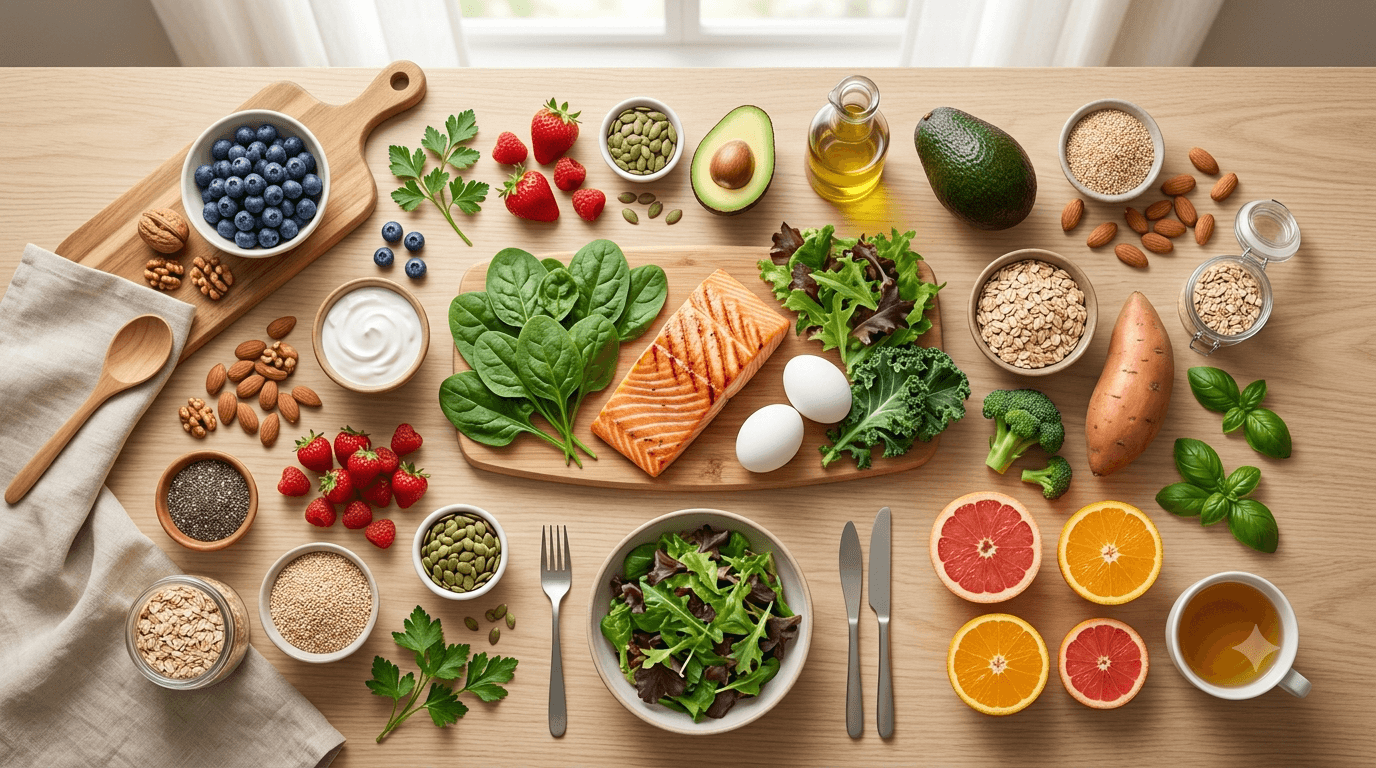
Not really, at least not one proven in research. Antioxidant-rich fruits like berries, citrus, and pomegranate fit comfortably into a fertility-friendly diet, since antioxidants help offset oxidative stress, a process linked to cellular aging, including in eggs. But no single fruit has been shown to meaningfully change your odds of conceiving, so it's more useful to think in terms of a varied diet than one ingredient to chase.
What to Drink (and What to Limit)
There's no special drink that speeds up conception. Water covers most of what your body actually needs. If you rely on caffeine, research suggests high intake — more than roughly five cups of coffee a day — is linked to reduced fertility, while one to two cups a day hasn't shown a clear negative effect (ASRM). Alcohol follows a similar pattern: heavier drinking is probably worth cutting back on while trying to conceive, and it's worth stopping entirely once you're pregnant, since no amount of alcohol has been shown safe during pregnancy.
Free Online Tool
Not sure your diet is covering the basics?
Nutrient needs shift with age, activity level, and whether you're trying to conceive. 100 Calculator's Nutrition Calculator for Women estimates your daily calorie and key micronutrient targets, so you can see where your current diet might be falling short. If you specifically want to check your protein intake, our Macro / Protein Calculator can help with that too.
Supplements and Nutrients Worth Knowing About
Folic Acid: The One With the Strongest Evidence
If you take away one supplement recommendation from this guide, make it this one. The CDC recommends that all women who could become pregnant get 400 micrograms of folic acid every day, ideally starting at least a month before conception, to lower the risk of neural tube defects in a future pregnancy (CDC). Since roughly half of pregnancies in the US are unplanned, many doctors recommend this for any woman of reproductive age who isn't actively avoiding pregnancy, not only people who are actively trying to conceive.
CoQ10 and Other Antioxidants: What the Evidence Shows So Far
CoQ10 has become a popular fertility supplement, and the underlying idea is reasonable: it's an antioxidant involved in how cells produce energy, and egg cells rely heavily on that system as they mature. Small studies, mostly done in fertility clinic settings, have found that CoQ10 may improve certain markers of egg quality in women over 35 or with a lower egg reserve. The evidence is still early, though — it hasn't been studied nearly as thoroughly for natural conception outside of IVF, and it isn't part of standard fertility guidelines yet. If you're considering it, talk to a doctor first, since it can interact with some medications, including blood thinners.
A Word on Supplements in General
Beyond folic acid, there isn't strong evidence that any specific supplement reliably boosts fertility in someone who's already ovulating regularly and eating a reasonably balanced diet. A standard prenatal vitamin is a low-risk way to cover common gaps like iron and vitamin D. Beyond that, more isn't automatically better — some vitamins can cause harm in excess — so it's worth mentioning anything you're taking or considering to a doctor, especially once you're actively trying to conceive.
Lifestyle Habits That Support Fertility
Day-to-day habits won't override your age or an underlying medical condition, but they genuinely add up, and several are well enough supported to prioritize.
Weight, Movement, and Sleep
Reaching and maintaining a weight that's healthy for your body matters more than any specific food, since fertility is measurably lower at both extremes, not just with excess weight. Regular, moderate movement supports that goal, though very intense daily training can sometimes disrupt ovulation, so more isn't automatically better here either. Sleep matters too: it affects the same hormonal signals that regulate your cycle, so protecting a consistent sleep schedule is a reasonable, low-effort habit to build.
Managing Stress Without Adding More Pressure
Stress and fertility have a complicated relationship. Chronic stress can interfere with the hormonal signals that trigger ovulation, but the pressure to "just relax" is rarely helpful advice on its own. Fertility researchers note that the stress of trying to conceive itself, especially when tied to strict tracking schedules, can reduce intimacy and satisfaction for some couples (ASRM). If tracking your cycle starts to feel like a source of anxiety rather than useful information, it's okay to loosen your approach for a cycle or two.
- Reach and maintain a weight that's healthy for your body
- Move regularly, but skip extremes — very intense daily training can disrupt ovulation
- Protect a consistent sleep schedule
- Build in real stress management — therapy, exercise, time outdoors, or simply protected downtime
- Don't smoke, and limit regular secondhand smoke exposure
- Keep alcohol light to moderate, and stop entirely once you're pregnant
- Take a daily folic acid or prenatal supplement if there's any chance you could conceive
Habits That Can Hurt Your Fertility
Just as some habits help, a few are consistently linked to lower fertility in research. None of these guarantee a problem on their own, but each is worth addressing if you're actively trying to conceive.
- Smoking, which is linked to a meaningfully higher risk of infertility and may speed up egg loss
- Heavy alcohol use, generally more than one to two drinks a day
- Very high caffeine intake, more than roughly five cups of coffee a day
- Chronic, unaddressed stress
- Extreme calorie restriction or over-exercising
- Being significantly underweight or living with untreated obesity
- Cannabis and other recreational drug use while trying to conceive
- Skipping folic acid, especially in the weeks before you start trying
Timing: Finding Your Most Fertile Days
If you're hoping to conceive this month, timing is the single most controllable factor left once the basics — nutrition, supplements, healthy habits — are already in place.
What Is the Fertile Window?
Your fertile window is the stretch of your cycle when sex can actually result in pregnancy. It spans about six days: the five days leading up to ovulation, plus the day of ovulation itself (ACOG). That's wider than most people expect, and it exists because sperm can survive inside the body for three to five days, waiting for an egg to be released. Our guide to the fertility window breaks this down in more detail.
What Days Are You Most Fertile?
Within that six-day window, some days matter more than others. Research consistently points to the two to three days right before ovulation, plus the day of ovulation itself, as the highest-probability window (Mayo Clinic). If you already know roughly when you ovulate — from tracking cycle length, cervical mucus, or an ovulation test — that's the stretch worth prioritizing if daily intercourse isn't realistic. 100 Calculator's Period & Fertility Tracker can estimate this window for you once you enter your last period and average cycle length.
How Often Should You Have Sex?
Guidance from the American Society for Reproductive Medicine points to sex every one to two days during the fertile window as ideal, though every two to three days produces nearly the same results (ASRM). There's no need to limit frequency out of concern for sperm count — in men with normal semen quality, daily ejaculation doesn't lower sperm counts, which is a persistent myth. What tends to matter more than any exact schedule is simply not skipping the fertile window entirely. Our guide to the best time to conceive walks through how to plan around it.
Fertility by Age: What Changes in Your 20s, 30s, and 40s
Age affects fertility more than any single habit on this list, mostly because of how egg supply naturally declines over time. Understanding the general pattern helps put the rest of this guide in context.
You're born with all the eggs you'll ever have, roughly 1 to 2 million at birth (ASRM). That number drops sharply over time: by around age 30, an estimated 88% of a woman's original egg supply is already gone, close to the commonly cited "90%" figure, and by 40, only about 3% remains, according to widely referenced research on ovarian reserve. This doesn't mean pregnancy is unlikely at 30 — most 30-year-olds are still quite fertile — but it explains why the decline speeds up earlier than many people expect.
| Decade | What's Typically Happening | What Tends to Help Most |
|---|---|---|
| 20s | Egg quantity and quality are generally at their best, and ovulation tends to be more predictable | Building steady habits now — stable weight, not smoking, folic acid — pays off later, even if you're not trying yet |
| 30s | Fertility declines gradually through the early 30s and more noticeably after 35 | Track your cycle if you're trying to conceive; see a doctor after 12 months trying, or 6 months if you're 35 or older |
| 40s | Egg quantity and quality decline more quickly, and pregnancy loss becomes more common | Earlier medical evaluation is generally recommended; a reproductive specialist can offer options tracking alone can't |
Related Calculators
Put what you just read into practice, try these free tools instantly, no sign-up required.
Period & Fertility Tracker
Track your menstrual cycle and predict fertile days with ease.
Pregnancy Due Date Calculator
Estimate your baby's due date based on your last period.
Baby Growth Memory Calendar
Track and celebrate your baby's growth milestones month by month.
Nutrition Calculator for Women
Calculate daily nutrient and calorie needs tailored for women's health.
Pregnancy Weight Gain Calculator
Monitor healthy weight gain throughout each trimester of pregnancy.
Fertility Myths vs. Facts
A lot of fertility advice circulates without much evidence behind it. Here's where a few common claims actually stand:
| Myth | Fact |
|---|---|
| You'll always know exactly when you ovulate | Ovulation signs can be subtle or absent for many people, so tracking makes timing far more reliable than guessing |
| A specific "superfood" can significantly boost fertility | No single food has been shown to meaningfully change your chances; overall diet quality and a healthy weight matter more |
| Having sex every day lowers sperm count | In men with normal semen quality, daily ejaculation doesn't reduce sperm counts |
| Lying down after sex helps sperm reach the egg | There's no scientific evidence that position after intercourse affects your chances of conceiving |
| Infertility is almost always the woman's issue | A male factor is involved in roughly half of infertility cases |
| You can only get pregnant on one specific day | Because sperm can survive several days, pregnancy is possible across a roughly six-day window, not just one day |
When to See a Doctor About Fertility
Most people don't need to see a fertility specialist right away, but there are clear guidelines for when it's worth moving up that timeline. The American College of Obstetricians and Gynecologists recommends a fertility evaluation after 12 months of regular, unprotected intercourse for women 35 or younger, after 6 months for women between 36 and 40, and right away for women over 40 (ACOG).
Signs Worth a Conversation With a Doctor Sooner
- Periods that are absent, extremely irregular, or unusually far apart
- A history of PCOS, endometriosis, thyroid problems, or previous pelvic surgery
- Two or more miscarriages
- Known fertility concerns in your partner
- Pain during sex, or pelvic pain outside of your period
If PCOS is part of the picture, our guide on calorie deficit explained and 100 Calculator's Calorie Deficit Calculator for PCOS can help you and your doctor build a nutrition plan that supports more regular ovulation.
Building a Fertility-Friendly Routine That Sticks
Pulling this into a simple plan makes it easier to actually follow through:
- Track your cycle for two to three months before making other changes, so you know your baseline. 100 Calculator's Period & Fertility Tracker can help estimate your fertile window as you go.
- Start a daily folic acid or prenatal supplement now, not after a positive test.
- Address the highest-impact habits first — smoking, heavy drinking, very high caffeine intake — rather than trying to fix everything at once.
- Time intercourse around your fertile window, aiming for every one to two days rather than a single "perfect" day.
- Revisit the calendar. If you're under 35 and it's been 12 months, or 35 or older and it's been 6 months, it's a reasonable time to book an appointment.
- Be patient with the process. Most healthy couples conceive within a year of trying, and a single "off" cycle rarely means anything is wrong.
And once you do see that positive test, 100 Calculator's Pregnancy Due Date Calculator is a natural next stop to estimate your due date and start planning ahead.
Medical disclaimer: This article is for general educational purposes only and isn't a substitute for professional medical advice, diagnosis, or treatment. Fertility depends on many individual factors, so always talk to a licensed healthcare provider about your specific situation, especially before starting a new supplement or if you have concerns about your fertility.
More From Women's Health Guides
Still building your knowledge of cycles, ovulation, and conception? These related guides dig deeper into the topics covered above.
Frequently Asked Questions
How can I increase my fertility fast?
There's no instant fix, but a few things make the biggest difference in any given cycle: timing intercourse during your fertile window (roughly the two to three days before ovulation through the day of ovulation), taking a daily folic acid supplement, and addressing habits like smoking or heavy drinking if they apply to you. Fertility responds to consistency over a few cycles more than to any single fast change, so give new habits at least a couple of months before expecting a difference.
How can I be 100% sure I ovulated?
No home method offers complete certainty. A sustained rise in basal body temperature across the second half of your cycle is the most accessible sign, since it confirms ovulation happened, though only after the fact. Ovulation predictor kits that detect the LH surge are more direct, but they occasionally give false positives. For definite confirmation, a doctor can check a mid-cycle progesterone blood test or use ultrasound to track a maturing follicle.
How do you get pregnant naturally?
Pregnancy happens when sperm fertilizes an egg during your fertile window, roughly the five days before ovulation through the day of ovulation itself. Timing intercourse every one to two days during this window, maintaining a healthy weight, taking folic acid, and avoiding smoking and heavy alcohol use all support the process. Most healthy couples under 35 conceive within a year of trying, often sooner.
At what age are 90% of your eggs gone?
By around age 30, research on ovarian reserve estimates that roughly 88% of a woman's original egg supply is already gone, close to the commonly cited 90% figure, and that number rises to about 97% by age 40. This comes from a widely referenced model of egg loss across a lifetime. It's a normal part of aging, not a sign anything is wrong, though it's a big part of why fertility declines earlier than many people expect.
Which fruit is best for conceiving?
No single fruit has been proven to boost fertility on its own. Antioxidant-rich fruits like berries, citrus, and pomegranate fit well into a fertility-friendly diet, since antioxidants may help protect egg and sperm cells from everyday cellular stress, but the research points to overall diet quality mattering more than any one food.
What 3 days can you get pregnant?
The highest-probability days are generally the two days before ovulation and the day of ovulation itself, sometimes described as the "peak" fertile window. That said, pregnancy is possible anywhere within about a six-day span — the five days before ovulation through the day of ovulation — since sperm can survive inside the body for several days waiting for an egg.
What are the signs of ovulation?
Common signs include clear, stretchy cervical mucus, a mild one-sided pelvic twinge, a small basal body temperature rise, breast tenderness, mild bloating, light spotting, and for many people, an increased sex drive. Not everyone notices all of these, and some people don't notice any physical signs at all, which is completely normal.
What are signs of not ovulating?
The clearest sign of anovulation is a change in your period pattern rather than one specific symptom: periods that are unusually irregular, very light, very far apart, or missing for a few months in a row. If you notice this pattern, it's worth discussing with a doctor, since common and treatable causes like PCOS or a thyroid imbalance are often behind it.
What habits hurt fertility?
Smoking, heavy alcohol use, very high caffeine intake (more than about five cups of coffee a day), chronic unmanaged stress, extreme calorie restriction or over-exercising, and being significantly underweight or living with untreated obesity are all linked to lower fertility in research. Recreational drug use, including cannabis, is also best avoided while trying to conceive.
How can I increase egg quality?
Egg quality naturally declines with age, and no supplement or diet fully reverses that process. What you can influence is supporting your overall reproductive health: not smoking, maintaining a healthy weight, managing chronic conditions, and eating a balanced diet. Some research suggests CoQ10 may help specific markers of egg quality in women over 35, but the evidence is still developing, so it's worth discussing with a doctor rather than starting on your own.
What can I drink to conceive faster?
No drink speeds up conception. Water is the most useful default, since staying hydrated supports overall health, including cervical mucus production. Keeping caffeine to roughly one to two cups of coffee a day and limiting alcohol are more about avoiding potential downsides than adding any special benefit.
How long should we try before seeing a fertility doctor?
Guidelines from ACOG recommend seeing a doctor after 12 months of regular, unprotected intercourse if you're 35 or younger, after 6 months if you're between 36 and 40, and right away if you're over 40. See a doctor sooner at any age if you have irregular or absent periods, a known condition like PCOS or endometriosis, or you've had two or more miscarriages.
About 100 Calculator
100 Calculator is a free hub of online calculators and educational guides covering health, finance, trading, crypto, education, and more. Every tool is built to be fast, accurate, and genuinely free, with no account or signup required.
We built this guide, along with tools like the Nutrition Calculator for Women and Period & Fertility Tracker referenced throughout it, to make everyday health questions a little easier to answer. Head back to the 100 Calculator homepage to explore the full library of tools, or learn more about the team behind them on our About Us page.