How Synastry Reveals Compatibility Between Two Charts
A beginner-friendly walkthrough of synastry — the astrology technique that overlays two birth charts to show how two people naturally communicate, attract each other, and clash.
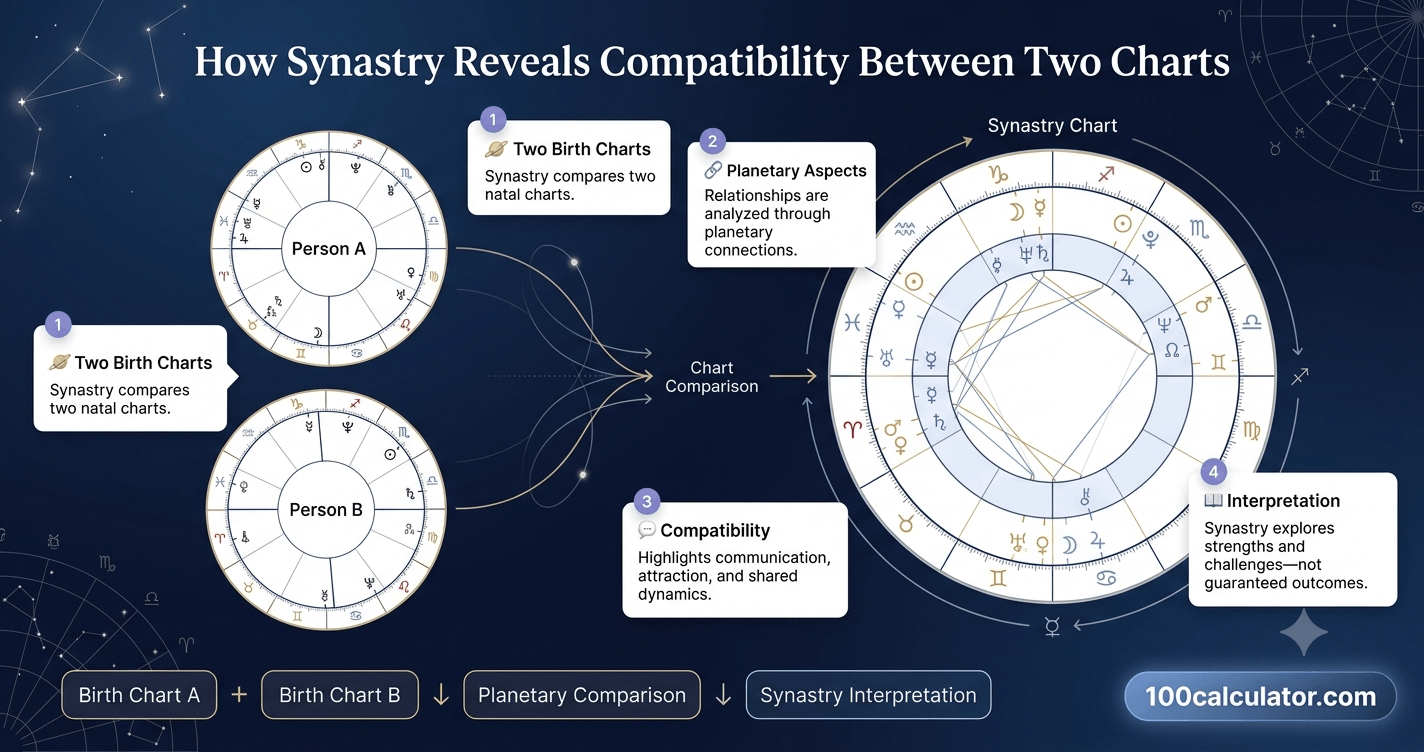
If you've ever wondered why you click instantly with one person and feel constant friction with another, astrology has a specific answer for that question: synastry.
Synastry is the astrological practice of comparing two people's birth charts by overlaying them, then studying the angles, or aspects, formed between one person's planets and the other's to reveal patterns in communication, attraction, emotional compatibility, and friction. Astrologers have used this method for centuries to look at romantic partnerships, and it works just as well for friendships, family relationships, and even coworkers. All you need is accurate birth information for both people involved.
In this guide, we'll walk through how synastry actually works, which planets and aspects matter most, and how to read a comparison without getting lost in the details. If you want a head start, 100 Calculator's Compatibility (Synastry) Calculator does the chart comparison for you the moment you enter both birth details.
First, let's cover what synastry actually is and how it's different from reading a single chart on its own.
Understanding Synastry: The Basics
Before comparing two charts, it helps to know what you're actually looking at. Synastry builds directly on the idea of a natal chart, so a quick refresher makes the rest of this guide much easier to follow.
What a Natal Chart Is, in Brief
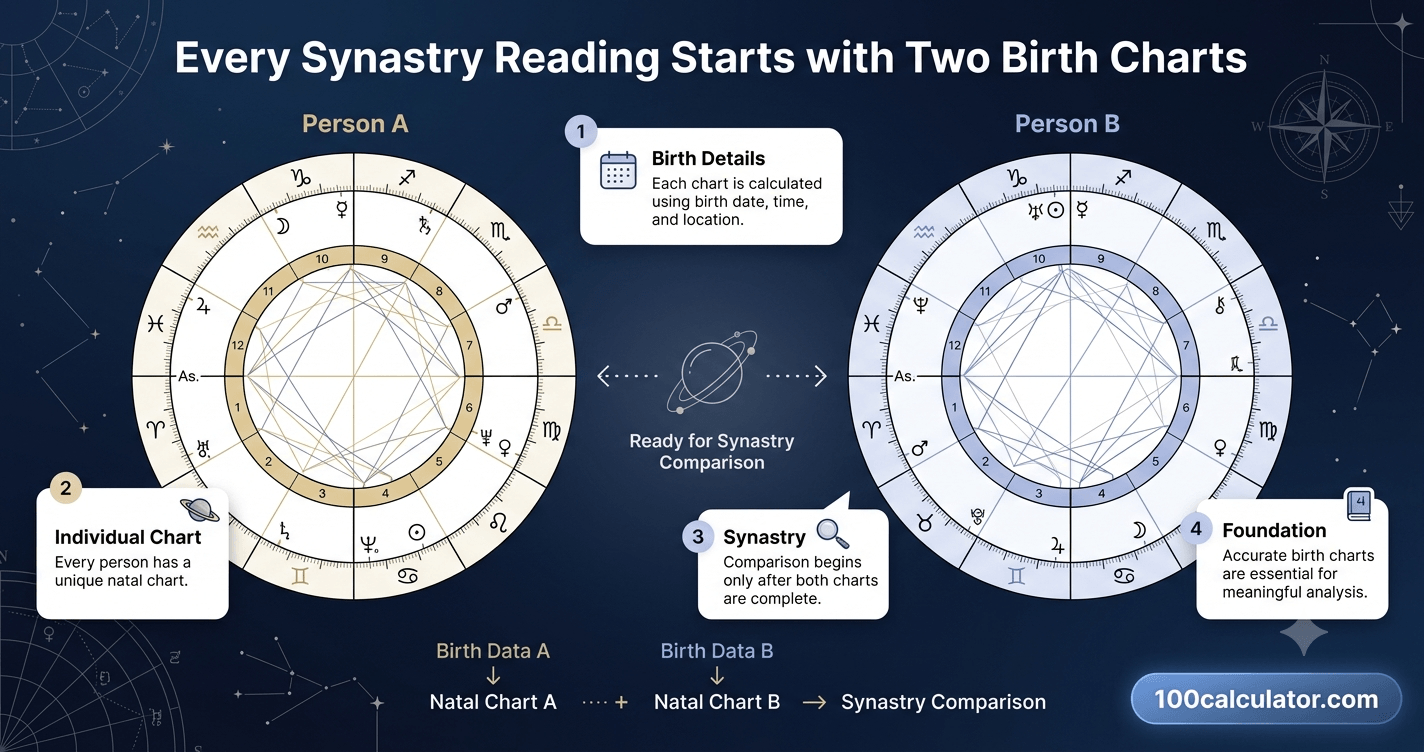
A natal chart, also called a birth chart, is a snapshot of exactly where the sun, moon, and planets were positioned in the sky at the moment you were born, based on your birth date, time, and location. Each planet lands in a specific zodiac sign and a specific house, and together those placements form the basis of an individual astrology reading. If you've never worked with your own chart before, our guide on how to read your birth chart as a complete beginner is a good place to start before diving into synastry.
What Makes Synastry Different
A regular chart reading looks at one person on their own. Synastry takes two separate charts, usually yours and someone else's, and lays them side by side to study how they interact. Instead of asking what a placement means for one person, synastry asks what happens when your Venus meets their Mars, or your Moon meets their Saturn. It's a relationship-focused technique, not a solo one.
The Building Blocks: Planets, Signs, Houses, and Aspects
Every synastry reading rests on four ingredients: the planets themselves, the zodiac signs each planet sits in, the houses each planet falls into, and the aspects formed between one person's planets and the other's. If any of these building blocks feel unfamiliar, our guides on what your Sun, Moon, and Rising signs mean and what each house in your birth chart represents cover them in more depth.
Why People Use Synastry to Explore Compatibility
Synastry gets a lot of attention for romantic compatibility, but that's really just one use case. A synastry comparison can highlight useful patterns in almost any relationship where two people spend meaningful time together.
Understanding Communication Styles
Mercury governs how each person thinks and communicates, so comparing Mercury placements shows whether two people tend to process conversations the same way or very differently. Easy Mercury aspects often mean conversations flow naturally; challenging ones don't mean you can't communicate, just that it may take more patience and clarity.
Spotting Emotional Compatibility
The Moon reflects emotional needs and instincts, the parts of yourself that show up when you're comfortable, tired, or stressed. Comparing two Moons in synastry says a lot about whether two people are likely to feel emotionally understood by each other. Our guide on what your Moon sign reveals about your emotions goes deeper into this placement on its own.
Recognizing Friction Points Early
No two charts line up perfectly, and that's normal. Synastry can flag friction points, like a tense Mars contact or a heavy Saturn aspect, before they show up as recurring arguments, giving both people a heads-up about where extra patience might help.
Not Just for Romance
Family members, close friends, and even business partners have synastry too. The same overlay process works for any two birth charts; only the specific planets and houses you focus on tend to shift depending on the relationship.
A quick look at what a synastry comparison can reveal:
- A sense of how naturally you communicate with someone
- Where your emotional needs line up, and where they might differ
- Early clues about physical and romantic attraction
- Friction points worth navigating with intention, not fear
- Insight into friendships and family ties, not just romance
How to Read a Synastry Chart Step by Step
Reading a synastry chart isn't complicated once you know the order of operations. Here's the process astrologers actually follow.
- Gather accurate birth data for both people. You'll need each person's date of birth, birth time, and birth location. Birth time matters more than people expect, since it determines the houses and the exact degree of the Moon and Ascendant. Our guide on how to find where the planets were at your birth walks through this step in more detail.
- Generate both natal charts. Before you can compare anything, each person needs a complete individual chart. This is the same process used for any birth chart reading; you're just doing it twice. 100 Calculator's Birth Chart Calculator and our guide on why planetary positions matter in birth chart reading cover this step.
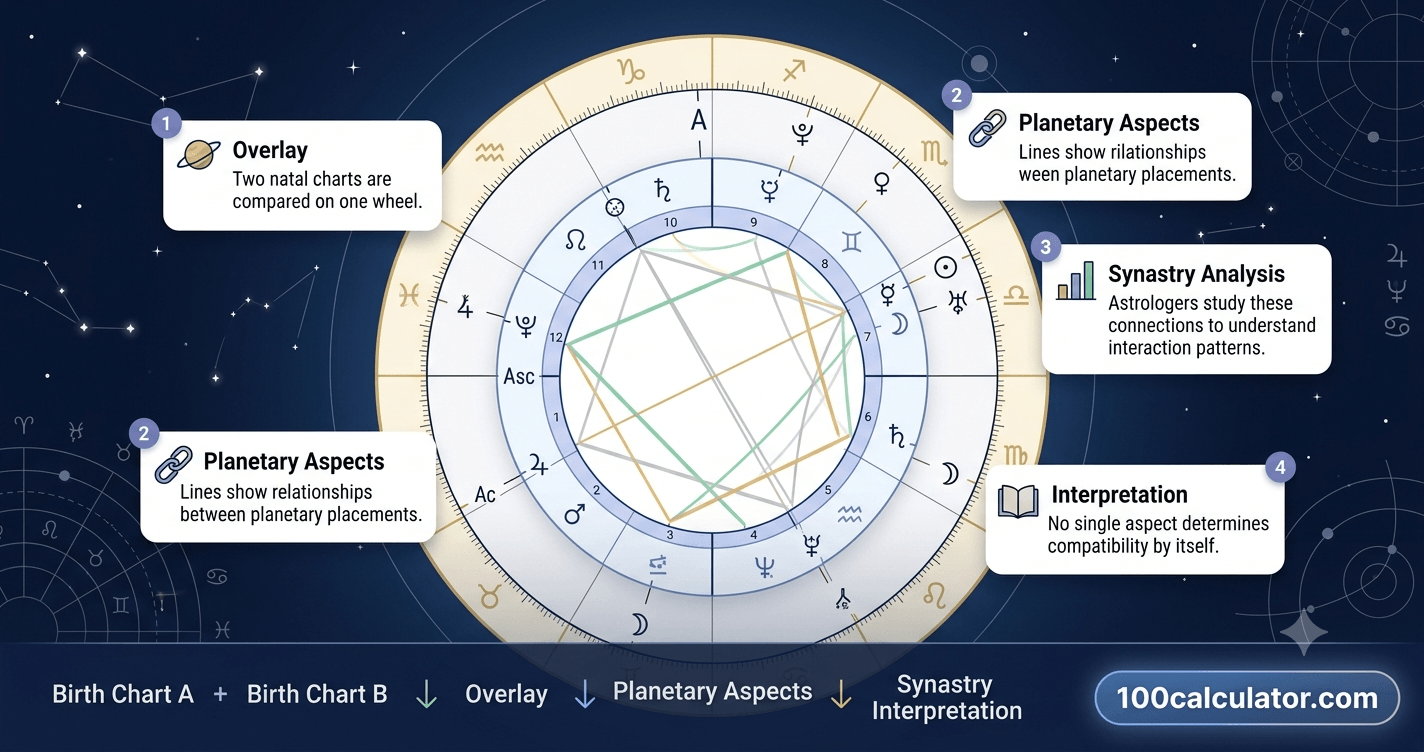
- Overlay the charts. This is the step that actually makes it synastry. One chart is placed on top of the other, usually with one person's planets on the inner wheel and the other's on the outer wheel, so both sets of placements sit on the same circle.
- Study the aspects between planets. With both charts overlaid, look at the angles formed between one person's planets and the other's. These angles, called aspects, are the heart of any synastry reading, and we'll break down exactly what each one means in the next section.
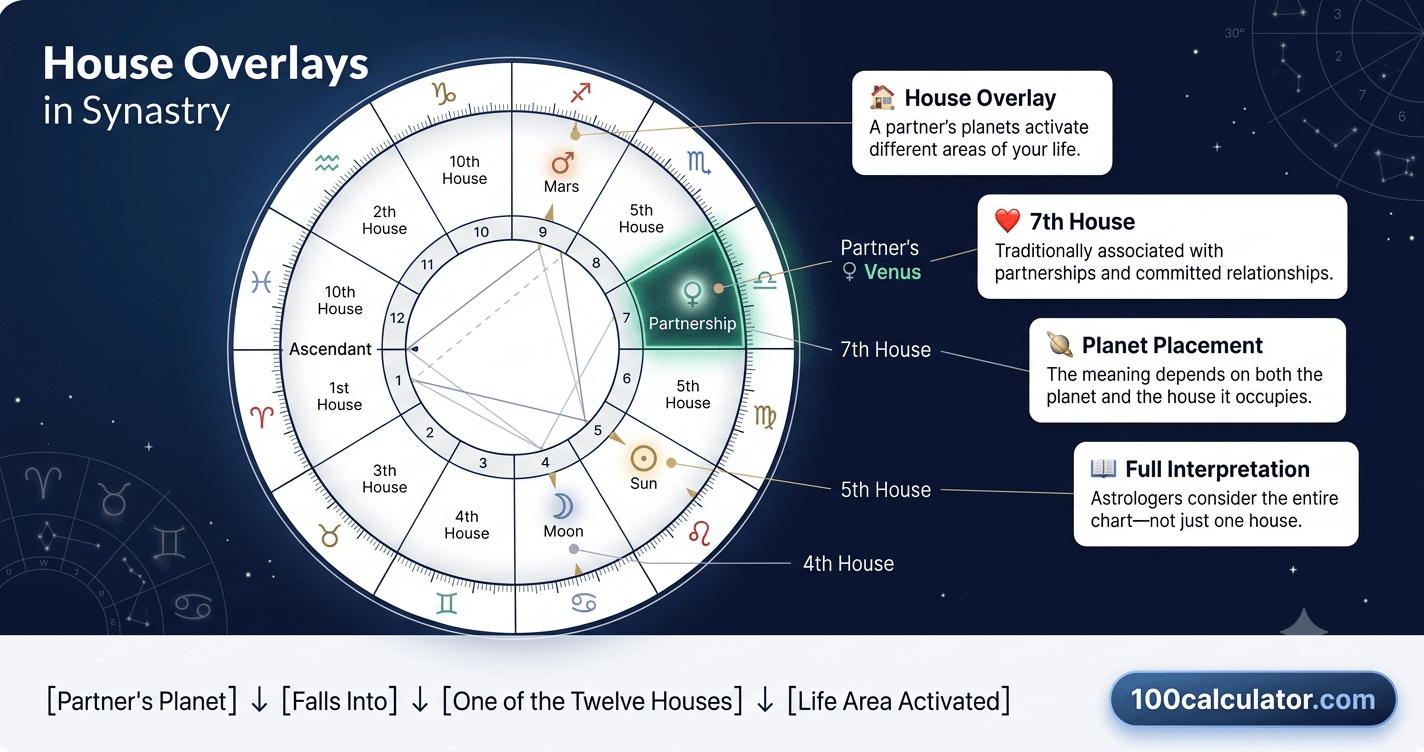
- Check the house overlays. Finally, note which of your houses the other person's planets fall into, and vice versa. A partner's Venus landing in your 5th house of romance tells a different story than that same Venus landing in your 10th house of career.
Free Online Tool
Prefer not to calculate all of this by hand?
100 Calculator's Compatibility (Synastry) Calculator runs right in your browser. Enter both birth details, and it overlays the charts and lists the key aspects for you instantly, with no account required.
The Planets That Matter Most in Synastry
Every planet plays some role in synastry, but a handful of them carry most of the weight in a typical reading.
Sun and Moon: Identity and Emotional Needs
The Sun represents core identity, the version of yourself you're actively trying to become. The Moon represents emotional needs and instincts. When your Sun connects well with someone else's Moon, or the other way around, it often means one person's basic sense of self resonates with the other's emotional world. Our guide on Moon sign vs Sun sign: why both matter in astrology explains why these two placements are treated so differently.
Venus and Mars: Attraction and Chemistry
Venus shows what you find attractive and how you like to give and receive affection. Mars shows drive, desire, and how you assert yourself. Together, Venus and Mars contacts between two charts are some of the most closely watched placements in romantic synastry, since they speak directly to chemistry.
Mercury: Communication Compatibility
Mercury governs communication and thinking style. Easy Mercury contacts usually mean conversations feel effortless; challenging ones don't block communication, but they might mean two people process the same conversation in noticeably different ways.
Saturn: Commitment and Long-Term Stability
Saturn is the planet of structure, responsibility, and time. Saturn contacts in synastry often show up in relationships that last, since Saturn adds a sense of weight and commitment, though it can also feel restrictive depending on the aspect involved.
| Planet | What It Represents | What to Watch For |
|---|---|---|
| Sun | Core identity and sense of self | How well your basic personalities mesh |
| Moon | Emotional needs and instincts | Whether you feel emotionally understood |
| Mercury | Communication style and thinking | How easily you talk things through |
| Venus | Love language and what you find attractive | Shared taste in affection and romance |
| Mars | Drive, desire, and self-assertion | Physical chemistry and conflict style |
| Saturn | Commitment, structure, and stability | Whether the connection can go the distance |
Key Synastry Aspects and What They Mean
An aspect is simply the angle between two planets, measured in degrees. Some angles create ease, others create tension, and a full synastry reading usually includes a mix of both.
Conjunctions
A conjunction happens when two planets sit at roughly the same degree, 0° apart. It blends and intensifies whatever those two planets represent. A Sun-Sun conjunction can mean two very similar personalities; a Mars-Saturn conjunction can mean intense drive paired with real discipline, or real frustration, depending on the rest of the chart.
Trines and Sextiles (Harmonious Aspects)
Trines (120°) and sextiles (60°) are considered harmonious aspects. They create a natural, easy flow between the two planets involved. The tradeoff is that harmonious aspects can be easy to take for granted, since they rarely demand active attention.
Squares and Oppositions (Challenging Aspects)
Squares (90°) and oppositions (180°) create tension. That tension isn't automatically bad; it often points to exactly where a relationship needs conscious effort, and plenty of long, meaningful relationships include several of these more challenging angles.
| Aspect | Approximate Angle | General Tendency |
|---|---|---|
| Conjunction | 0° | Intensifies whatever the two planets represent, for better or worse |
| Sextile | 60° | Easy, supportive energy that takes a little effort to use well |
| Square | 90° | Tension and friction that can motivate growth or cause conflict |
| Trine | 120° | Natural, effortless flow between the two planets involved |
| Opposition | 180° | Strong pull in opposite directions that can create balance or a power struggle |
Grouped by feel, the five aspects generally fall into three categories:
Easy Flow
△ · ⎕
Trine & Sextile
Natural ease between the two planets. Supportive, but easy to overlook since it rarely demands attention.
Amplified
☉ · 0°
Conjunction
Blends two planets into one intensified theme. Whether that feels good depends on which planets are involved.
Growth Edge
□ · ☿
Square & Opposition
Creates tension. Can spark conflict, but also pushes both people to grow in ways easy aspects rarely do.
House Overlays: Where Their Planets Land in Your Chart
Aspects tell you how two planets interact. House overlays tell you where in your life that interaction shows up.
What It Means When Someone's Planets Fall in Your 7th House
The 7th house rules partnership, so when someone's planets land there, the relationship itself tends to feel like a natural, central partnership almost immediately. It's one of the most commonly discussed overlays in romantic synastry.
What It Means When Someone's Planets Fall in Your 4th, 8th, or 10th House
Someone's planets landing in your 4th house often brings a sense of home and family. The 8th house adds emotional or physical intensity and shared resources. The 10th house connects the relationship to your public life, career, or reputation. Our guide on what each house in your birth chart represents breaks down what all twelve houses mean individually.
| House | Theme When a Partner's Planet Lands Here |
|---|---|
| 1st House | Their presence strongly affects how you show up and see yourself |
| 4th House | A sense of home, family, and emotional safety together |
| 5th House | Romance, fun, and creative chemistry |
| 7th House | Partnership themes come up directly; a very common romantic marker |
| 8th House | Deep emotional or physical intensity, and shared resources |
| 10th House | The relationship affects your public life, goals, or reputation |
Common Synastry Patterns Worth Knowing
A few specific planet pairings come up again and again in synastry discussions. Here's what to know about each.
Sun-Moon Connections
When one person's Sun aligns closely with the other's Moon, it often points to a natural sense of mutual understanding, since one person's core identity resonates with the other's emotional needs. This is frequently cited as one of the most supportive connections in romantic synastry.
Venus-Mars Connections
Venus meeting Mars, especially through a conjunction or trine, often points to strong physical and romantic chemistry. It's one of the most talked-about patterns in relationship astrology, though attraction alone doesn't guarantee compatibility elsewhere in the chart.
Saturn Contacts
Saturn touching someone's Sun, Moon, or Venus tends to add a feeling of seriousness and staying power. These contacts can feel heavy at first, but they're common in relationships that go the distance. Our guide on which planet placements matter most in synastry looks at these patterns, and several others, in more detail.
Common Mistakes People Make When Reading Synastry
Even people who know their way around a chart can fall into a few predictable traps.
- Reading only one aspect in isolation. A single square doesn't ruin a chart, and a single trine doesn't guarantee a great connection; the full picture always matters more than any one line.
- Skipping birth time. Using a default or guessed birth time throws off the Moon, houses, and Ascendant, some of the most important synastry factors.
- Treating synastry as a verdict. A chart comparison highlights tendencies, not a fixed outcome. How two people actually communicate and grow together still matters most.
- Ignoring your own chart. Synastry is a two-way comparison. It's just as important to look at how the other person's planets land on your chart as the reverse.
- Focusing only on romance. Synastry works for friendships, family, and coworkers too, and limiting it to romantic partners misses a lot of what it can show.
Synastry vs. Composite Charts vs. Sun Sign Compatibility
Synastry is one of several ways astrologers compare two people. It helps to know how it differs from the other common methods.
| Method | What It Compares | Best For |
|---|---|---|
| Sun sign compatibility | Just one placement per person, based on birth date | A quick, general starting point |
| Synastry | Two full individual charts, planet by planet | Detailed, personalized compatibility insight |
| Composite chart | A single blended chart representing the relationship itself | Understanding the relationship as its own "entity" |
Sun sign compatibility is the simplest and least detailed method, since it only looks at one placement per person. Synastry goes much further, comparing every planet and the exact angles between them. A composite chart takes a different approach entirely, blending both charts into a single new chart that represents the relationship as its own entity, separate from either individual. Many astrologers use synastry and composite charts together for a fuller picture.
Related Calculators
Put what you just read into practice, try these free tools instantly, no sign-up required.
Free Sun Moon Rising Calculator
Discover your Sun, Moon, and Rising zodiac signs instantly.
Planetary Positions Calculator
View accurate planetary positions for any date and location.
Birth Chart Calculator
Generate your complete natal birth chart based on birth details.
My Moon Sign Calculator
Find your Moon sign to understand your emotional inner self.
Compatibility (Synastry) Calculator
Check zodiac compatibility between you and your partner.
What Synastry Can't Tell You
Synastry is a useful lens, but it has real limits worth naming clearly.
It can't tell you whether a relationship will last, whether someone is trustworthy, or whether two people are compatible in the ways that matter most day to day, like shared values, timing, and effort. Two charts full of harmonious aspects can still describe a relationship that struggles, and two charts full of challenging aspects can still describe two people who communicate well and choose each other again and again.
Astrology, including synastry, isn't backed by scientific research. That doesn't make it meaningless as a tool for reflection and conversation, but it does mean it shouldn't replace how two people actually treat each other.
Getting Started With Your Own Synastry Reading
Ready to try a synastry comparison of your own? A few habits make the process much easier.
- Gather accurate birth details first for both people, ideally exact birth times, before you calculate anything.
- Start with the big five — Sun, Moon, Venus, Mars, and Saturn — before trying to interpret every planet at once.
- Note the aspects between those planets first, then move on to house overlays once the basics feel familiar.
- Look at the full picture. One standout aspect, good or bad, rarely tells the whole story on its own.
- Treat it as a conversation starter, not a final answer, especially with people who don't share your interest in astrology.
Once you're ready to see how your own chart lines up with someone else's, 100 Calculator's Compatibility (Synastry) Calculator handles the chart overlay and lists the key aspects for you, using exactly the process walked through in this guide. If you'd also like to check your own Moon placement first, 100 Calculator's My Moon Sign Calculator and Free Sun Moon Rising Calculator are both good starting points.
Content disclaimer: Synastry and astrology are symbolic, interpretive traditions, not scientifically validated methods for predicting relationship outcomes. This article is for educational and entertainment purposes and isn't a substitute for professional relationship counseling, therapy, or your own judgment about the people in your life.
More From Astrology Self Discovery
Still building your knowledge of charts, placements, and compatibility? These related guides dig deeper into the topics covered above.
Frequently Asked Questions
What is synastry in astrology?
Synastry is the practice of comparing two birth charts to see how two people's planets interact with each other. Astrologers place both charts side by side, or overlaid, and study the angles between one person's planets and the other's to understand communication, attraction, emotional compatibility, and potential friction points in the relationship.
How does a synastry calculator work?
A synastry calculator takes each person's birth date, time, and location, calculates both natal charts, and then compares the planetary positions between them. It identifies the aspects, or angles, formed between one person's planets and the other's, so you don't have to calculate degrees by hand.
What information do I need for a synastry reading?
You need each person's date of birth, birth time, and birth location. Birth time matters most for placements like the Moon, Ascendant, and house positions, since these shift throughout the day. Date and general location are usually enough for slower-moving planets like Jupiter, Saturn, and beyond.
What's the difference between synastry and a composite chart?
Synastry compares two separate, individual birth charts side by side. A composite chart is different: it blends both people's charts into a single new chart representing the relationship itself, rather than either person individually. Many astrologers look at both for a fuller picture.
Which planets matter most in synastry?
The Sun and Moon usually get the most attention, since they represent core identity and emotional needs. Venus and Mars show attraction and chemistry, Mercury reflects communication style, and Saturn contacts often reveal how stable or long-lasting a connection might feel.
What does a Venus-Mars conjunction in synastry mean?
When one person's Venus lines up closely with the other's Mars, it often points to strong physical and romantic attraction between the two people. This is one of the most commonly discussed aspects in romantic synastry, though it works alongside every other aspect in the full chart, not on its own.
Are squares in synastry always a bad sign?
Not necessarily. Squares create tension and friction, but tension isn't automatically negative. Many long, meaningful relationships include a few challenging aspects that push both people to grow. What matters more is the overall balance between harmonious and challenging aspects across the whole chart comparison.
Can synastry predict whether a relationship will work?
No. Synastry can highlight natural strengths and likely friction points, but it can't predict outcomes. Communication, effort, timing, and personal choices shape a relationship far more than any chart comparison. Most astrologers treat synastry as a reflection tool, not a forecast.
Does synastry only apply to romantic relationships?
No. Synastry works for any two-person connection, including friendships, family relationships, and even coworkers. The planets involved and what you're looking for shift depending on the relationship type, but the overlay method used to compare the two charts stays exactly the same either way.
What's a good Sun-Moon connection in synastry?
When one person's Sun aligns closely with the other's Moon, it often suggests the two people naturally understand and support each other, since one person's core identity resonates with the other's emotional needs. This is one of the most talked-about connections in romantic synastry.
How accurate does birth time need to be for synastry?
As accurate as possible. The Moon changes zodiac signs roughly every two and a half days, while the Ascendant and house cusps shift every few minutes. A birth time that's off by even an hour can change these placements, so it's worth double-checking against a birth certificate when you can.
What if I don't know my exact birth time?
You can still get useful information from a synastry reading using a default time, but treat any Moon, Ascendant, or house-based results as approximate. Checking a birth certificate or hospital record is the most reliable way to find an exact time if you don't already know it.
What is a house overlay in synastry?
A house overlay looks at which of your houses one person's planets fall into when their chart is placed on top of yours. For example, if their Venus lands in your 7th house of partnership, that placement adds its own layer of meaning beyond the aspects alone.
Is synastry backed by scientific evidence?
No. Synastry is a symbolic, interpretive tradition within astrology, and it hasn't been validated by scientific research. Many people still find it useful as a starting point for self-reflection and conversation, but it shouldn't replace real communication or professional relationship guidance.
How is synastry different from comparing sun signs?
Sun sign compatibility only looks at one placement for each person, based on birth date alone. Synastry compares the entire chart, including the Moon, rising sign, and every other planet, along with the exact angles between them, giving a much more detailed and individualized picture.
About 100 Calculator
100 Calculator is a free hub of online calculators and educational guides covering health, finance, trading, crypto, astrology, education, and more. Every tool is built to be fast, accurate, and genuinely free, with no account or signup required.
We built this guide, and tools like the Compatibility (Synastry) Calculator referenced throughout it, to make self-discovery topics like astrology a little easier to explore. Head back to the 100 Calculator homepage to explore the full library of tools, or learn more about the team behind them on our About Us page.