What Each House in Your Birth Chart Represents
A beginner-friendly walkthrough of all 12 houses in a birth chart — what each one governs, how astrologers group them, and how to find your own house placements in just a few minutes.
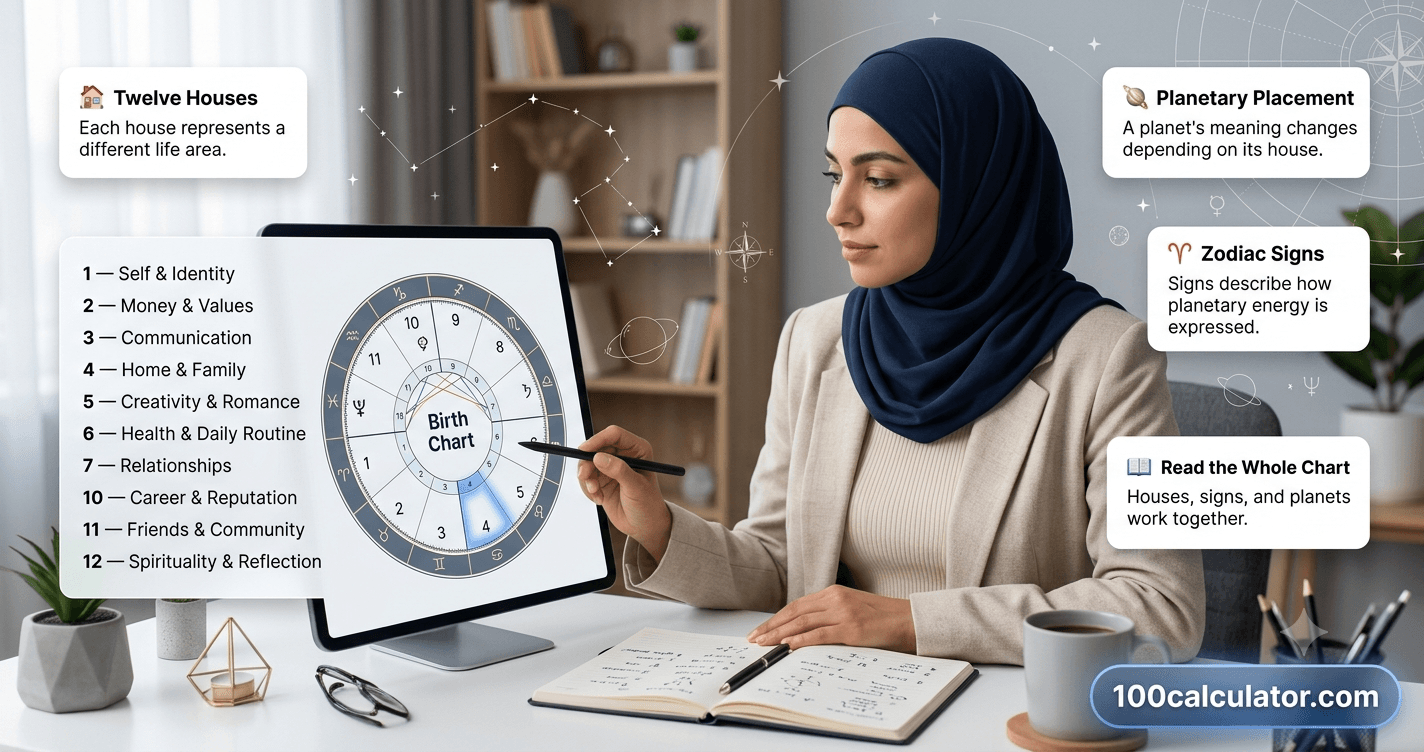
Every birth chart is really just a map of where the planets were the moment you were born, but the houses are what turn that map into a story about your life specifically. If you've looked at your chart and felt a little lost once you got past your sun sign, the houses are usually where things start clicking into place.
In astrology, a house is one of twelve divisions of the sky based on the exact time and place of your birth. Each house represents a different area of life, from your identity and money to your relationships and career, and whichever planets and signs land in each house shape how that part of your life tends to show up for you.
This guide walks through what each of the twelve houses represents, how astrologers group them into angular, succedent, and cadent categories, and how planets and rulerships add even more detail once you understand the basics. If you don't know your own house placements yet, 100 Calculator's Birth Chart Calculator can generate your full chart, houses included, in a couple of minutes using just your birth date, time, and location.
By the end, you'll be able to look at any birth chart — yours or a friend's — and actually understand what each section of that circle is trying to tell you.
What Is a House in Astrology?
Picture your birth chart as a circle representing the entire sky above and below the horizon at the exact instant you were born. The houses slice that circle into twelve wedges, each tied to a different area of life. While the planets and signs describe what kind of energy is at play, the houses describe where in your life that energy tends to show up.
Houses vs. Signs vs. Planets: What's the Difference?
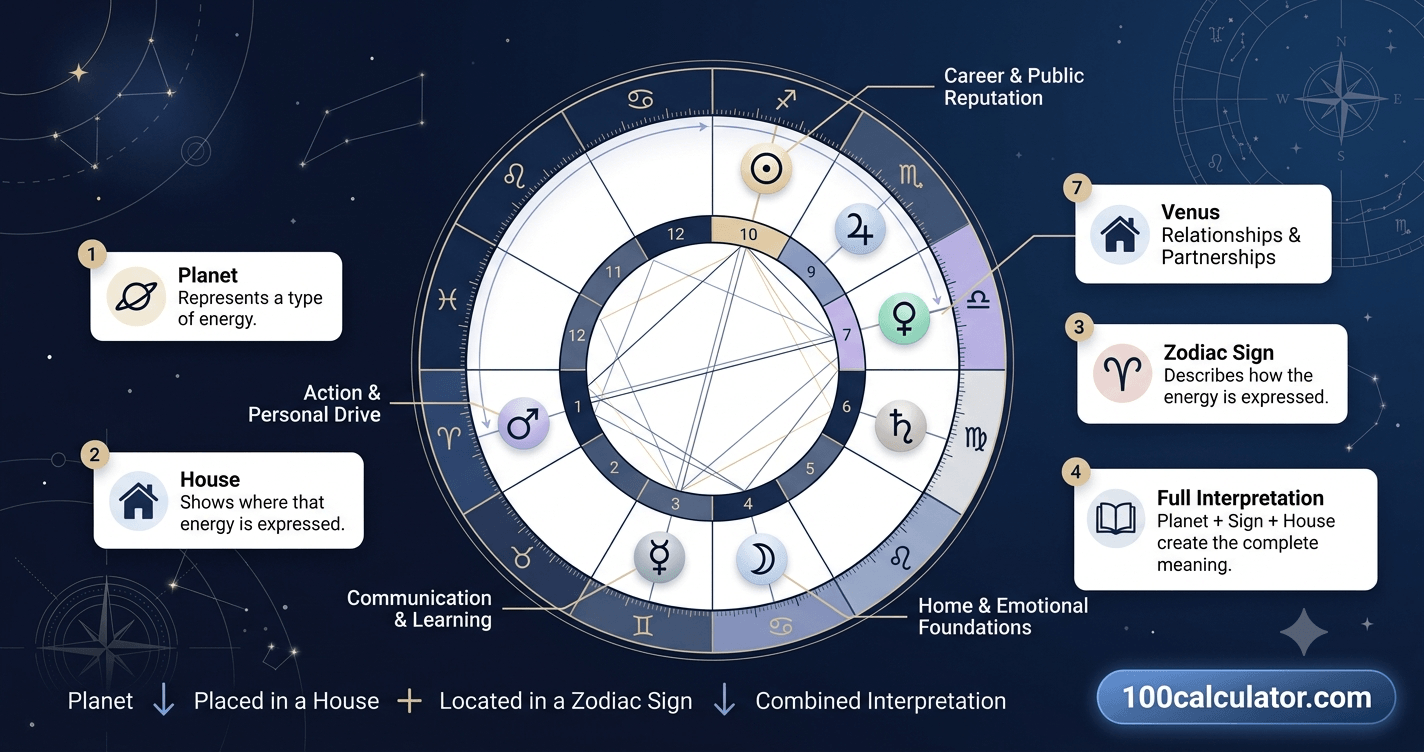
This is genuinely one of the most confusing parts of astrology for beginners, so it's worth slowing down here. Signs, like Aries or Taurus, describe how something expresses itself: its style and personality. Planets, like Venus or Mars, describe what is happening: the specific area of psychology or life force involved. Houses describe where it plays out: which part of your life the energy shows up in most strongly.
A simple way to remember it: if your Venus (what) is in Scorpio (how) in your 8th house (where), that might describe someone whose approach to love and relationships is intense and transformative, and plays out most strongly around deep intimacy and shared resources. Our guide on what your Sun, Moon, and Rising signs mean is a good companion piece if signs and planets still feel a little tangled.
Why Your Exact Birth Time and Location Matter
Unlike your sun sign, which only depends on your birth date, your houses depend on your exact birth time and location. That's because houses are based on the sky's position relative to the horizon at your specific location, and that position shifts by roughly one degree every four minutes as the Earth rotates. A birth time that's off by even 15 to 20 minutes can shift your Ascendant, and with it, every house cusp in your chart.
Free Online Tool
See your own houses in minutes
100 Calculator's Birth Chart Calculator plots all twelve houses for you the moment you enter your birth date, time, and location, right in your browser, with no account required.
The Three Types of Houses: Angular, Succedent, and Cadent
Astrologers group the 12 houses into three categories of four houses each, based on how directly they tend to show up in daily life. This isn't the only way to organize the houses, but it's one of the most common frameworks you'll come across, and it's genuinely useful once you understand it.
Angular
1 · 4 · 7 · 10
Where Life Takes Direct Action
These four houses sit at the chart's cardinal points and tend to be the most outwardly visible, shaping identity, home, relationships, and career.
Succedent
2 · 5 · 8 · 11
Where You Build and Sustain
Following each angular house, these four are about consolidating resources, whether that's money, creativity, intimacy, or community.
Cadent
3 · 6 · 9 · 12
Where You Learn and Adapt
Sitting just before each angular house, these four favor flexibility, information, and the internal processing that happens before a big shift.
You don't need to memorize this grouping to read your own chart, but keeping it in the back of your mind helps explain why some house placements feel more obvious in someone's personality while others feel more like quiet undercurrents.
The Angular Houses: 1st, 4th, 7th, and 10th
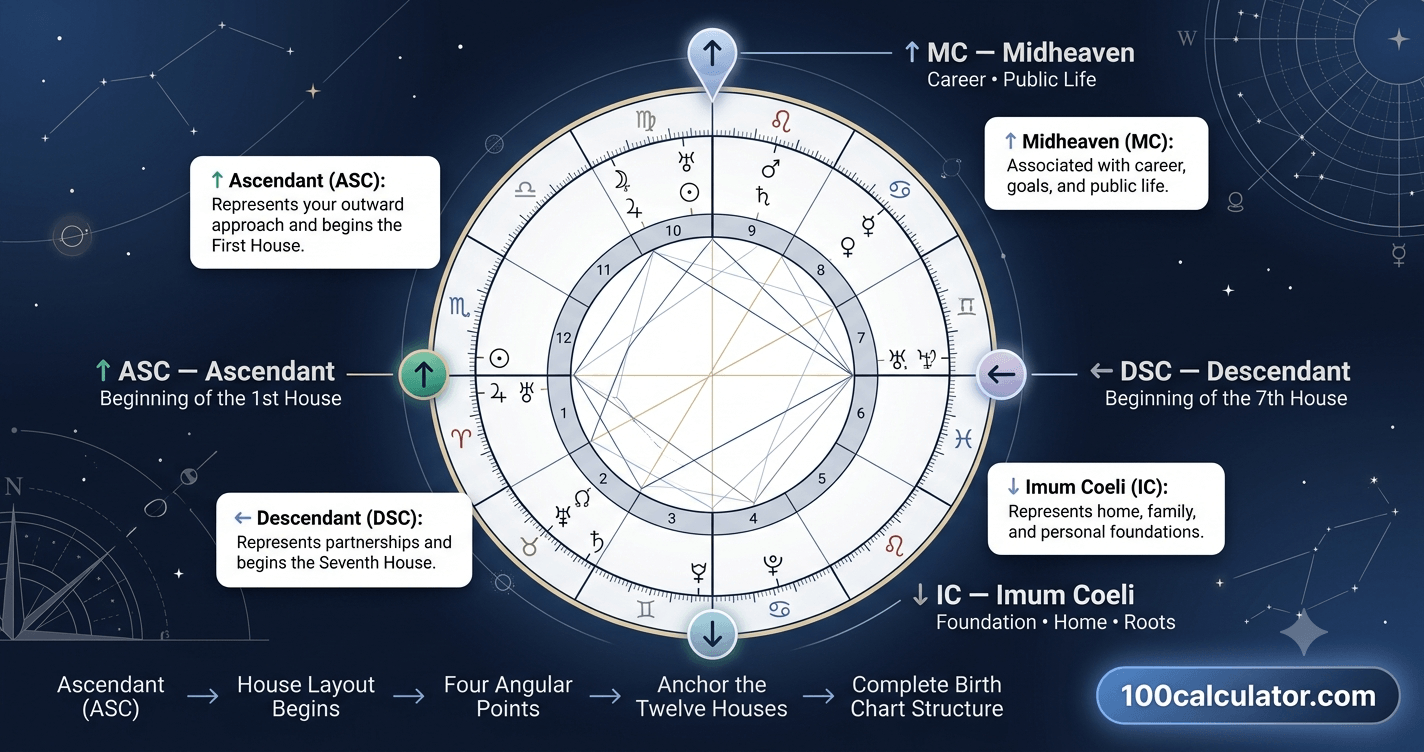
Angular houses sit at the four cardinal points of your chart: the Ascendant, IC, Descendant, and Midheaven. Many astrologers consider these the most noticeable houses in a chart, since planets placed here tend to express themselves openly and shape how other people experience you. Here's what each one covers.
1st House — Self and Identity
The 1st house sits right at your Ascendant, the exact degree that was rising on the eastern horizon the moment you were born. It's often called the "house of self" because it colors how you come across to other people, especially in first impressions. This house also relates to your physical presentation and the instinctive way you approach new situations before you've had time to think them through. Naturally associated with Aries and Mars, the 1st house carries an energetic, initiating quality regardless of which sign actually sits there in your own chart. If you've ever wondered why your rising sign feels like a mask you wear, this house is why.
4th House — Home and Family
Sitting at the very bottom of the chart, the 4th house is anchored by the IC, one of the four angular points. It represents home, family, and the emotional roots you grew up with, along with your sense of where you belong. This house often reflects your relationship with a parent, though astrologers vary on exactly which one, and the private, unseen side of your life that you don't necessarily show at work or in public. Naturally linked to Cancer and the Moon, the 4th house carries a nurturing, protective quality, and planets placed here often show up strongly in your home life and sense of emotional security.
7th House — Partnerships
Directly opposite the 1st house, the 7th house sits at the Descendant and governs one-on-one relationships of all kinds: marriage, business partnerships, and, in older traditions, open rivals. Where the 1st house is about you, the 7th house is about the other person you're directly relating to. It often reveals the qualities you're drawn to in a partner and the kind of dynamic you tend to create in close relationships. Naturally ruled by Libra and Venus, this house carries themes of balance, compromise, and fairness. If you're curious how houses connect to relationship compatibility, our guide on how synastry reveals compatibility between two charts builds on many of these same 7th house ideas.
10th House — Career and Public Life
At the very top of the chart sits the Midheaven, which forms the cusp of the 10th house. This is your career house, but it covers more than just your job. It also speaks to your public reputation, long-term direction, and how the wider world sees you, including your relationship with authority figures and your sense of ambition. Naturally associated with Capricorn and Saturn, the 10th house carries a disciplined, achievement-oriented quality. A planet placed here often plays a visible role in your professional life or public image, whether you consciously aim for that or not.
The Succedent Houses: 2nd, 5th, 8th, and 11th
Succedent houses follow directly after each angular house, and their theme reflects that position. They're about building, sustaining, and following through on whatever the angular house before them set in motion. Planets here often show up as steady, long-term patterns rather than sudden events.
2nd House — Money and Self-Worth
The 2nd house governs your finances, possessions, and the resources you build over time, but it runs deeper than your bank account. It also touches your sense of self-worth, personal values, and what genuinely feels valuable to you, whether that's money, comfort, or a skill you've spent years developing. Naturally ruled by Taurus and Venus, this house carries a steady, resource-building energy, less about sudden windfalls and more about what you accumulate and hold onto over the long run. Planets placed here often shape your relationship with money and material security, for better or worse.
5th House — Creativity, Romance, and Joy
The 5th house is where self-expression lives: creativity, romance, hobbies, and anything you do simply because it brings you joy rather than because you have to. It's also traditionally connected to children, both the experience of raising them and, more broadly, anything you create and feel proud of, from a painting to a small business idea. Naturally associated with Leo and the Sun, this house carries a warm, expressive quality, less about obligation and more about play. If several planets fall here, it often points to someone who needs regular creative or romantic outlets to feel fully like themselves.
8th House — Transformation and Shared Resources
Often called one of the more intense houses, the 8th house covers deep transformation, intimacy, and anything shared with someone else: joint finances, inheritances, debt, and other people's resources. It's also linked to the psychological undercurrents beneath the surface, the things we don't talk about casually but that shape us deeply. Traditionally ruled by Mars, and in modern astrology by Scorpio and Pluto, this house carries an all-or-nothing energy. Planets here often point to areas where you experience real growth, but usually only after going through something that asks a lot of you first.
11th House — Friendships and Community
The 11th house governs friendships, group involvement, and the communities you choose rather than the family you're born into. It also covers your hopes for the future, long-term goals, and the bigger causes or social circles you feel drawn to. Naturally ruled by Aquarius, and in modern astrology by Uranus (Saturn in traditional systems), this house carries a forward-looking, collective quality. It's less about one-on-one closeness, which is the 7th house's territory, and more about how you show up and contribute within a group.
The Cadent Houses: 3rd, 6th, 9th, and 12th
Cadent houses come right before each angular house, and they carry a learning, adapting, and transitional quality. Think of them as the processing stage before the next major turning point in the chart. Planets placed here often relate to flexibility, information gathering, and personal growth rather than outward action.
3rd House — Communication and Everyday Learning
The 3rd house covers communication: how you think, talk, and process everyday information. It's also connected to siblings, short trips close to home, and the early education that shaped how you learn to learn. Naturally ruled by Gemini and Mercury, this house carries a quick, curious energy focused on the details of daily life rather than big-picture philosophy, which is the territory of its opposite, the 9th house. Planets placed here often show up clearly in how someone writes, speaks, or picks up new information.
6th House — Health, Routine, and Service
The 6th house governs your daily habits, work routine, and physical health: basically, the systems you rely on to keep your life running smoothly day to day. It's also connected to service, how you help others in practical, hands-on ways, whether through a job, volunteering, or everyday acts of care. Naturally ruled by Virgo and Mercury, this house carries a detail-oriented, improvement-focused quality. Planets placed here often point to areas where structure and consistency genuinely matter for someone's health and wellbeing.
9th House — Philosophy, Travel, and Higher Learning
The 9th house is about expansion: higher education, long-distance travel, philosophy, and the belief systems you build as you get older. Where the 3rd house is about everyday information, the 9th house is about the bigger questions: what you believe, why you believe it, and how far you're willing to go, literally and mentally, to find out. Naturally ruled by Sagittarius and Jupiter, this house carries an optimistic, adventurous quality. Planets here often point to someone who feels most alive when they're learning something new or somewhere far from home.
12th House — Rest, Subconscious, and Letting Go
The 12th house is often described as the most private and least understood house in the chart. It covers your subconscious mind, rest, solitude, and anything hidden, including patterns you're not fully aware of yourself. It's also linked to spirituality, closure, and letting go of what no longer serves you. Naturally ruled by Pisces, and in modern astrology by Neptune (Jupiter in traditional systems), this house carries a dreamy, boundary-dissolving quality. Planets here often need real quiet and downtime to function well, even if that's not obvious from the outside.
All 12 Houses at a Glance
If you want a quick reference while you're looking at your own chart, this table lays out all twelve houses side by side.
| House | Type | Core Theme | Natural Ruler |
|---|---|---|---|
| 1st | Angular | Self & identity | Aries / Mars |
| 2nd | Succedent | Money & values | Taurus / Venus |
| 3rd | Cadent | Communication & learning | Gemini / Mercury |
| 4th | Angular | Home & family | Cancer / Moon |
| 5th | Succedent | Creativity & romance | Leo / Sun |
| 6th | Cadent | Health & routine | Virgo / Mercury |
| 7th | Angular | Partnerships | Libra / Venus |
| 8th | Succedent | Transformation & shared resources | Scorpio / Pluto |
| 9th | Cadent | Philosophy & travel | Sagittarius / Jupiter |
| 10th | Angular | Career & reputation | Capricorn / Saturn |
| 11th | Succedent | Friendships & community | Aquarius / Uranus |
| 12th | Cadent | Subconscious & rest | Pisces / Neptune |
Keep in mind that the sign actually sitting on each house cusp in your own chart may be different from its natural ruler shown here. This table reflects the traditional association, not necessarily what's in your personal chart.
How a Planet Changes What a House Means
A house on its own describes an area of life, but it's the planets placed inside that house that show what's actually happening there. An empty house isn't a bad thing or a sign that area of life is missing.
When a planet does fall in a house, it brings its own themes along. Mars in the 6th house, for example, might show up as someone who channels their drive and energy into work and daily routine, sometimes to the point of overdoing it. The same Mars in the 11th house might instead show up as someone who brings that same energy into group projects and causes they care about.
If you want to go deeper into how planetary placements interact with your chart, our guide on how to find where the planets were at your birth walks through the process step by step, and why planetary positions matter in birth chart reading covers how each planet's role shifts depending on where it lands.
House Rulers and the Sign on the Cusp
Every house has a "ruler": the planet that rules the zodiac sign sitting on that house's cusp in your specific chart. This is different from the house's natural ruler, the sign it's traditionally associated with, shown in the table above. Your personal house rulers depend entirely on your unique birth chart.
For example, if Scorpio sits on your 2nd house cusp, your 2nd house ruler is Mars, or Pluto depending on which system your astrologer uses, even though the 2nd house is naturally associated with Taurus and Venus. Wherever that ruling planet sits in your chart adds another layer of meaning to that house.
This is a more advanced layer of chart reading, and you don't need to master it right away. Most beginners get plenty of value just from understanding what each house represents and which planets sit inside it before tackling rulership chains. Our guide on what your Sun, Moon, and Rising signs mean is a good next stop if you want to build your foundation first.
Related Calculators
Put what you just read into practice, try these free tools instantly, no sign-up required.
Free Sun Moon Rising Calculator
Discover your Sun, Moon, and Rising zodiac signs instantly.
Planetary Positions Calculator
View accurate planetary positions for any date and location.
Birth Chart Calculator
Generate your complete natal birth chart based on birth details.
My Moon Sign Calculator
Find your Moon sign to understand your emotional inner self.
Compatibility (Synastry) Calculator
Check zodiac compatibility between you and your partner.
Popular House Systems: Placidus, Whole Sign, and Equal House
Here's something that surprises a lot of beginners: there isn't just one agreed-upon way to calculate house cusps. Different house systems use different math to divide the sky into twelve houses, and astrologers don't all agree on which one is "correct."
| System | How It Divides Houses | Best Known For |
|---|---|---|
| Placidus | Divides the sky based on time, so house sizes vary depending on your birth latitude | The most widely used system in modern Western astrology |
| Whole Sign | Assigns one entire zodiac sign to each house, starting with your rising sign | One of the oldest systems, popular again in traditional astrology |
| Equal House | Divides the chart into twelve equal 30° segments starting from the Ascendant | A simpler alternative when a birth time is uncertain |
None of these systems is universally considered "more correct" than the others. They're different lenses for looking at the same chart, and many astrologers have a personal preference. If you're just starting out, Whole Sign houses are often considered the easiest system to learn because each house lines up neatly with one sign. 100 Calculator's Birth Chart Calculator uses a standard, widely accepted system to generate your houses, so you don't need to pick one yourself to get started.
Common Mistakes People Make When Reading Houses
A few habits tend to trip up beginners when they first start looking at houses. Here's what to watch for:
- Confusing houses with signs. Your rising sign and your 1st house aren't quite the same thing, though they're closely related.
- Treating an empty house as a "missing" area of life. Every house still has a sign on its cusp, which quietly colors that part of your life even without a planet there.
- Using an inaccurate birth time. Even 15 to 20 minutes off can shift your Ascendant and every house cusp that follows.
- Assuming every astrologer uses the same house system. Comparing your chart across different apps or sites can produce slightly different house placements if they use different systems.
- Reading a house in isolation. A house's meaning always blends with the sign on its cusp and any planets inside it; none of these pieces tell the full story alone.
How to Find Your Own House Placements
To see your own houses, you'll need three pieces of information: your birth date, your birth time (as exact as possible), and your birth location (a city is usually enough, since the calculation needs your latitude and longitude).
Once you have those details, 100 Calculator's Birth Chart Calculator plots all twelve houses for you instantly, along with your Ascendant, Midheaven, and planetary placements, right in your browser, with no account required. If you're not sure where to start once you have your chart in front of you, our guide on how to read your birth chart as a complete beginner walks through the whole process, and how to find your big three astrology placements is a good next step for understanding your Sun, Moon, and Rising signs together.
Disclaimer: This article is for general educational and entertainment purposes only. Astrology is a symbolic and interpretive tradition, not a scientifically validated method for predicting events or diagnosing personal, medical, financial, or psychological matters. Use your birth chart as a tool for self-reflection, and consult a qualified professional for decisions related to your health, finances, or wellbeing.
More From Astrology Self Discovery
Still building your foundation in chart reading? These related guides dig deeper into the topics covered above.
Frequently Asked Questions
What is a house in astrology?
A house is one of twelve divisions of the sky based on the exact time and place of your birth. Each house represents a different area of life, such as identity, money, relationships, or career. While your zodiac signs and planets describe personality traits and psychological themes, your houses show where in your life those themes tend to show up most strongly.
How many houses are in a birth chart?
Every birth chart has twelve houses, regardless of which house system is used to calculate them. They're numbered 1 through 12, starting from the Ascendant and moving counterclockwise around the chart. Together, the twelve houses cover every major area of life, from your identity and home to your career and subconscious mind.
What's the difference between a house and a zodiac sign?
A zodiac sign describes a style or personality: how something expresses itself. A house describes a life area: where that expression tends to show up. For example, having Leo energy suggests warmth and self-expression as a style, while the 5th house is the life area of creativity and romance. When Leo sits on your 5th house cusp, both align, but they're still two separate layers of your chart.
Why do I need my exact birth time to see my houses?
Houses are calculated based on the sky's position relative to the horizon at your exact birth location and moment, and that position shifts roughly one degree every four minutes as the Earth rotates. A birth time that's off by even 15 to 20 minutes can shift your Ascendant and every house cusp that follows, so accuracy matters more here than it does for your basic sun sign.
What are angular houses?
Angular houses are the 1st, 4th, 7th, and 10th houses, sitting at the four cardinal points of the chart: the Ascendant, IC, Descendant, and Midheaven. Many astrologers consider these the most outwardly visible houses, since planets placed here tend to shape identity, home life, relationships, and career in ways that are easy for other people to notice.
What are succedent houses?
Succedent houses are the 2nd, 5th, 8th, and 11th houses, each following directly after an angular house. They're generally associated with building and sustaining what the angular house before them set in motion, whether that's money, creativity, intimacy, or community. Planets placed in succedent houses often show up as steady, long-term patterns rather than sudden events.
What are cadent houses?
Cadent houses are the 3rd, 6th, 9th, and 12th houses, sitting just before each angular house. They carry a learning, adapting, and transitional quality, often described as the processing stage before the next major turning point in the chart. Planets placed here tend to relate to flexibility, information gathering, and internal growth rather than outward action.
What does it mean if a house has no planets in it?
An empty house isn't a sign that area of life is missing from someone's experience. Every house still has a zodiac sign on its cusp, which quietly influences that part of life even without a planet placed there. Empty houses often just mean that area runs more in the background, guided by the sign and its ruling planet elsewhere in the chart, rather than by a specific planet sitting directly in that house.
What does the 1st house represent?
The 1st house represents your identity, physical presentation, and the instinctive way you approach new situations. It's anchored by your Ascendant, the sign that was rising on the eastern horizon at your exact birth time, which is why the 1st house is often described as the "mask" you show the world before people get to know you better.
What does the 7th house represent?
The 7th house represents one-on-one partnerships, including marriage and close business relationships, along with the qualities you're drawn to in a partner. Sitting directly opposite the 1st house at the Descendant, it reflects how you show up in close relationships and the kind of dynamic you tend to create when relating closely to another person.
What's the difference between the 4th house and the 10th house?
The 4th house and 10th house sit directly opposite each other and represent two different sides of life. The 4th house covers home, family, and your private emotional foundation, while the 10th house covers career, public reputation, and how the wider world sees you. Together, they describe the balance between your private life and your public one.
What is a house cusp?
A house cusp is the exact degree where one house ends and the next begins. The zodiac sign sitting on a house's cusp influences how that area of life tends to express itself, and the planet that rules that sign becomes the "ruler" of that house, adding another layer of meaning once you start reading rulership chains.
What's the difference between Placidus and Whole Sign houses?
Placidus divides the sky using a time-based calculation, so house sizes vary depending on your birth latitude, and it's the most widely used system in modern Western astrology. Whole Sign houses assign one entire zodiac sign to each house, starting with your rising sign, and is one of the oldest systems still used today. Neither is considered more "correct"; they're different methods for organizing the same chart.
Can two people born on the same day have different houses?
Yes, easily. Two people born on the same date but at different times, or in different locations, can have noticeably different house placements, even if they share the same sun sign. This is exactly why house placements need an accurate birth time and location, while your sun sign only needs your birth date to calculate.
Is astrology scientifically proven?
No. Astrology is a symbolic, interpretive tradition rather than a scientifically validated system, and there's no peer-reviewed evidence that planetary positions at birth influence personality or life events. Many people still find value in astrology as a tool for self-reflection and a shared language for talking about personality and life patterns, but it shouldn't be treated as a substitute for professional advice.
How can I find my own house placements?
You'll need your birth date, birth time (as exact as possible), and birth location. Once you have those, 100 Calculator's free Birth Chart Calculator plots all twelve houses for you instantly, along with your Ascendant, Midheaven, and planetary placements, right in your browser with no account required.
About 100 Calculator
100 Calculator is a free hub of online calculators and educational guides covering health, finance, astrology, education, and more. Every tool is built to be fast, easy to use, and genuinely free, with no account or signup required.
We built this guide, along with tools like the Birth Chart Calculator referenced throughout it, to make exploring astrology a little more approachable for beginners. Head back to the 100 Calculator homepage to explore the full library of tools, or learn more about the team behind them on our About Us page.