How to Find Your Big Three Astrology Placements
A clear, beginner-friendly walkthrough of your Sun, Moon, and Rising signs — what each one means, why your exact birth time matters, and how to read all three together using a free calculator.
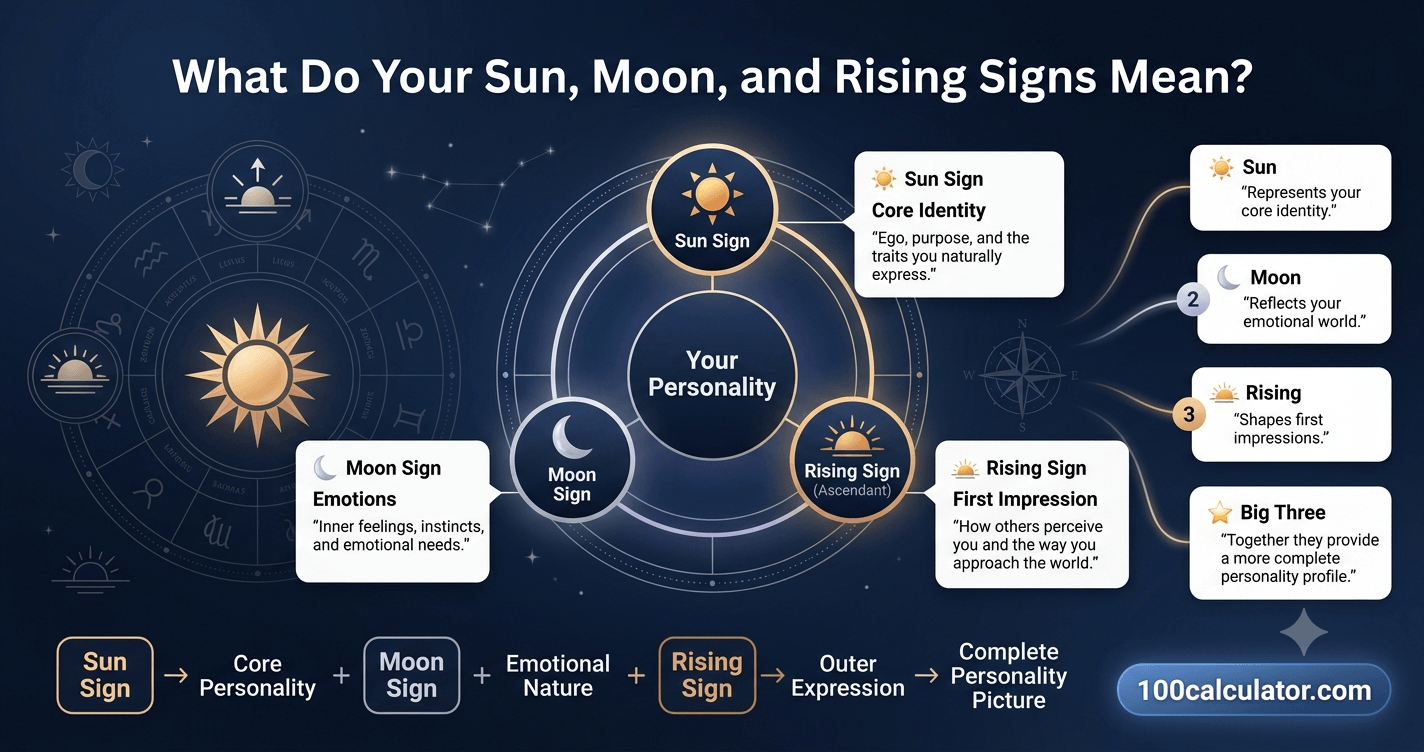
Ask someone their zodiac sign, and they'll usually give you one word: Leo, Pisces, Scorpio. That's a fine starting point, but it's only one-third of the story. In astrology, your Sun sign describes your core identity, while two other placements fill in the rest of the picture. Together, all three are what astrologers call your "Big Three."
Your Big Three are your Sun sign, Moon sign, and Rising sign, also called your Ascendant — the three placements in your birth chart that most shape how you see yourself, how you feel and react internally, and how you come across to other people. Your Sun sign only needs your birth date. Your Moon and Rising signs need your exact birth time and location too, which is why so many people never get past their Sun sign on their own.
The fastest way to find all three is to enter your birth details into 100 Calculator's Free Sun Moon Rising Calculator, which works out your chart instantly. In this guide, we'll walk through what each placement actually means, why birth time and location matter so much, how to read your three placements together, and what a few real combinations tend to look like.
What Are Your Big Three Placements?
"Big Three" is just astrology shorthand for looking at three chart placements together instead of one. Most people only ever learn their Sun sign, since that's the one printed in newspaper horoscopes and asked about at parties. But a birth chart actually maps out where the sun, the moon, and every visible planet was at the exact moment you were born, and three of those points get talked about more than any other because they describe the broadest, most recognizable parts of your personality.
Here's a quick side-by-side look at what each one covers, before we go through them individually.
| Placement | Determined By | What It Reveals | Changes Roughly Every |
|---|---|---|---|
| Sun sign | Your birth date | Core identity, ego, general personality | 30 days |
| Moon sign | Exact birth date and time | Emotions, instincts, inner comfort | 2–2.5 days |
| Rising sign (Ascendant) | Exact birth time and location | First impressions, outward approach | 2 hours |
None of the three "wins" over the others. A Sun sign known for being outgoing can still show up quiet and guarded if the Moon sign underneath it is more private, and a naturally bold personality can come across as reserved at first if the Rising sign softens the introduction. Looking at your Big Three together, rather than just your Sun sign alone, is what makes a chart feel more accurate to the people who read it closely. For a closer look at each placement on its own, see our guide on what your Sun, Moon, and Rising signs mean.
Your Sun Sign: Your Core Identity
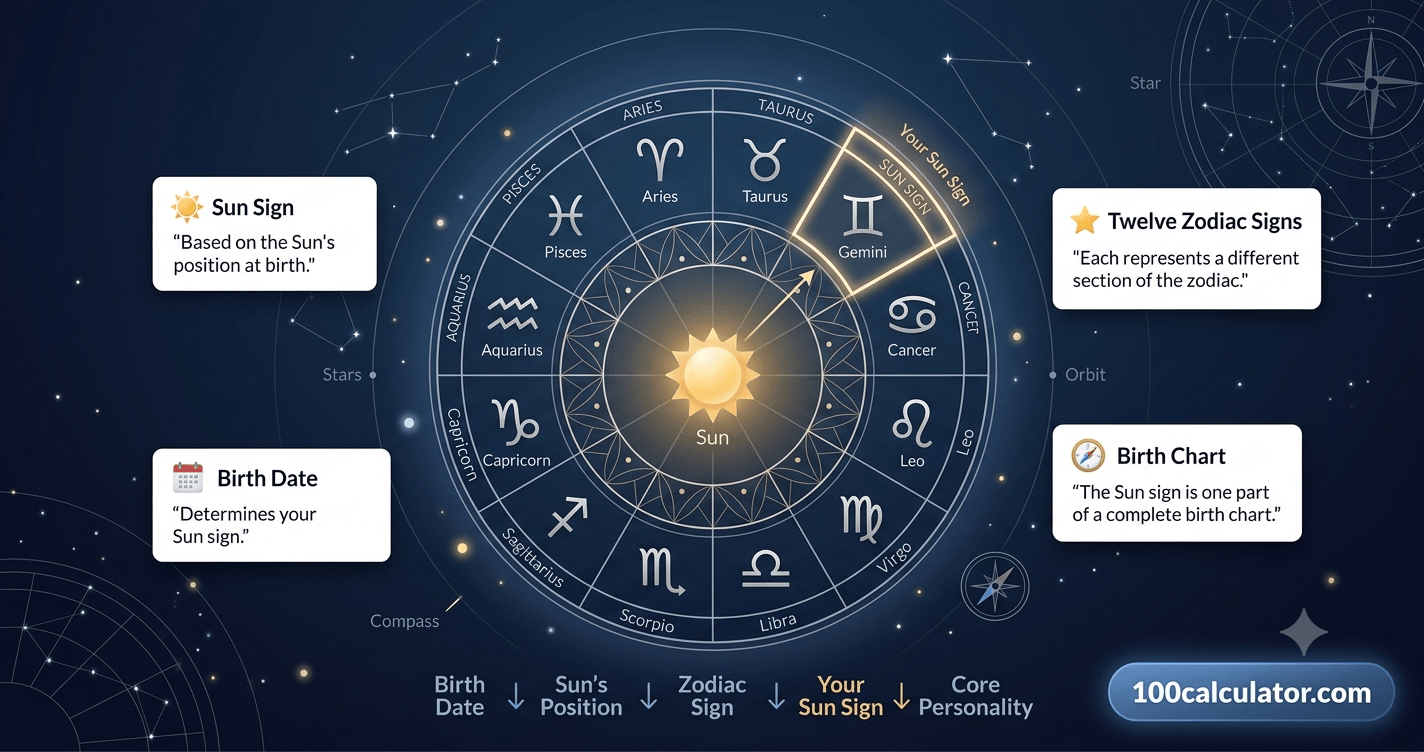
Your Sun sign is the one everyone already knows, whether they mean to or not. It's based entirely on your birth date, since it's the zodiac sign the sun appeared to be moving through, as seen from Earth, on the day you were born. No birth time or location needed, just the date.
In astrology, the Sun sign is tied to your core identity: your basic personality, your sense of self, and the general direction you're drawn toward in life. It's the broadest of your Big Three, which is exactly why it's the easiest one to guess about a stranger and the one most horoscope columns are built around.
The Twelve Sun Signs and Their Dates
Every Sun sign covers roughly a month, though the exact start and end day can shift by a day or two depending on the year. Here's the standard range for each one:
| Sign | Element | Approximate Dates |
|---|---|---|
| Aries | Fire | March 21 – April 19 |
| Taurus | Earth | April 20 – May 20 |
| Gemini | Air | May 21 – June 20 |
| Cancer | Water | June 21 – July 22 |
| Leo | Fire | July 23 – August 22 |
| Virgo | Earth | August 23 – September 22 |
| Libra | Air | September 23 – October 22 |
| Scorpio | Water | October 23 – November 21 |
| Sagittarius | Fire | November 22 – December 21 |
| Capricorn | Earth | December 22 – January 19 |
| Aquarius | Air | January 20 – February 18 |
| Pisces | Water | February 19 – March 20 |
If your birthday falls within a day or two of a boundary, sometimes called being "born on the cusp," a calculator is worth using instead of guessing, since the sun's exact position depends on the year and time, not just the date on the calendar.
Your Moon Sign: Your Emotional Inner World
Your Moon sign is the zodiac sign the moon was passing through at the exact date and time you were born. Unlike the sun, the moon moves fast, circling all twelve signs roughly every 27 to 29 days, so it spends only about two to two and a half days in each one.
That speed is exactly why your Moon sign needs an accurate birth time. Two people born on the same day can easily end up with different Moon signs if the moon happened to shift signs sometime between their births.
In astrology, the Moon sign is linked to your emotional inner world: how you process feelings, what makes you feel safe, and how you act when no one else is watching. Where your Sun sign is who you are on the surface, your Moon sign sits closer to who you are in private. Our guide on what your Moon sign reveals about your emotions goes deeper into this if you'd like more detail.
If you already know your exact birth time, 100 Calculator's My Moon Sign Calculator can look up your Moon sign on its own, without needing to run your full chart first.
Your Rising Sign: How the World Sees You
Your Rising sign, or Ascendant, is the zodiac sign that was coming up over the eastern horizon at the exact moment and place you were born. Because Earth completes a full rotation roughly every 24 hours, the horizon lines up with a new sign about every two hours, which makes the Rising sign the most time-sensitive of your Big Three.
Astrologers treat the Rising sign as the doorway into your birth chart. It marks the start of your first house, and every other placement in your chart, including your Sun and Moon, is measured relative to it. That's part of why an accurate birth time matters so much: shift the time by even thirty minutes, and your Rising sign, along with the house position of everything else, can change.
What Your Rising Sign Shapes
In astrology, your Rising sign is generally linked to:
- Your first impression on people who don't know you well yet
- Your outward style, mannerisms, and general "vibe"
- How you instinctively react in unfamiliar situations
- The starting point of your first house, and the layout of your entire chart
Our guide on what each house in your birth chart represents explains how the Rising sign sets up the other eleven houses in more detail.
Why Your Exact Birth Time and Location Matter
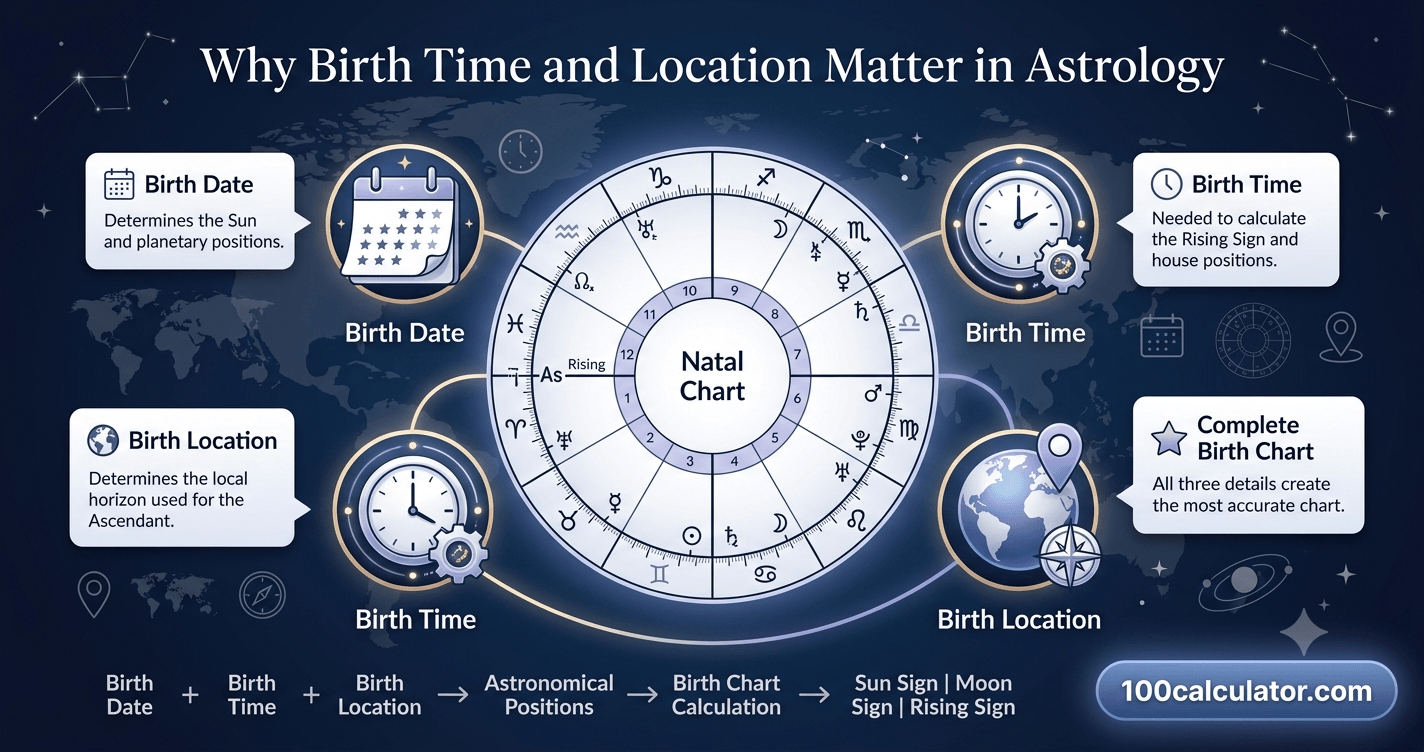
Your Sun sign only cares about the date. Your Moon and Rising signs care about the clock and the map too, and that's where a lot of Big Three lookups go wrong.
The moon changes signs roughly every two to two and a half days, and the Rising sign changes roughly every two hours. Get the time wrong by even an hour, and you risk landing on the wrong Rising sign entirely, or the wrong Moon sign if your birth happened close to when the moon shifted.
Where to Find Your Exact Birth Time
- Check your birth certificate. Most list an exact time, usually near the date and place of birth.
- Ask the hospital or birth registrar where you were born, since many keep birth time records on file for years afterward.
- Ask a parent or family member who was present, especially if a birth certificate isn't available.
Location matters too, since the Rising sign is calculated using your birth time relative to your birth city's position and time zone. If you want to go a layer deeper and see exactly where every planet was positioned at your birth, our guide on how to find where the planets were at your birth walks through that process.
How to Find Your Big Three, Step by Step
Once you have your birth details ready, actually finding your Big Three only takes a few minutes.
- Gather your exact birth date. Month, day, and year.
- Gather your exact birth time. As close to the minute as you can get it, from a birth certificate or a family member.
- Gather your birth location. City and country, or state, is usually enough for a calculator to work out your time zone automatically.
- Enter your details into a calculator. This handles the astronomical math for you instantly, instead of requiring you to look up ephemeris tables by hand.
- Read your results. You'll get three signs back: your Sun, your Moon, and your Rising (Ascendant).
- Write them down somewhere. You'll likely refer back to them anytime you read more about astrology going forward.
Using a Free Sun Moon Rising Calculator
Doing this by hand means cross-referencing an astronomical ephemeris and adjusting for your local time zone and daylight saving rules on the exact day you were born, which is a lot of manual work for three data points. A calculator skips all of that.
Free Online Tool
Skip the manual math
100 Calculator's Free Sun Moon Rising Calculator takes your birth date, time, and location and returns your Sun, Moon, and Rising signs right in your browser, with no account or signup required.
How to Read Your Big Three Together
Once you have all three signs, the more useful, and more interesting, step is reading them as a set instead of three separate facts.
Sun, Moon, and Rising as Three Layers
A common way astrologers describe the Big Three is as three layers, from the outside in: your Rising sign is what people notice first, your Sun sign is closer to who you actually are, and your Moon sign is the private layer underneath both.
↗
Rising
The First-Impression You
The outer layer. What people notice before they get to know you.
☉
Sun
The Core You
The middle layer. Your identity, ego, and general personality.
☽
Moon
The Private You
The inner layer. Emotions, instincts, and what makes you feel safe.
These layers filter each other. A Sun sign known for being blunt might come across as gentler if the Rising sign is naturally diplomatic. A Moon sign that needs a lot of quiet, alone time can sit underneath a Sun sign that looks perfectly social from the outside. Neither reading is "wrong." They're just describing different layers of the same person. Our guide comparing Moon sign vs. Sun sign looks specifically at how those two placements can pull in different directions.
Big Three Combination Examples
Seeing a few combinations laid out can make the "layers" idea click faster than a definition alone. These are illustrative, not exhaustive. Astrology doesn't rank combinations as "good" or "bad," just different.
A Few Example Combinations
| Sun | Moon | Rising | General Flavor |
|---|---|---|---|
| Leo | Cancer | Virgo | A warm, confident core with deep private feelings, wrapped in a modest, detail-oriented first impression |
| Aries | Pisces | Libra | Bold instincts paired with a dreamy inner world, approached through a diplomatic, easygoing exterior |
| Virgo | Scorpio | Sagittarius | A precise, practical identity with intense emotions, introduced with adventurous, upbeat energy |
| Capricorn | Gemini | Leo | Ambitious and disciplined at the core, mentally curious underneath, making a bold, magnetic first impression |
Take the first row as an example: a Leo Sun brings a warm, confident core identity. A Cancer Moon underneath it adds real emotional depth and a strong need for close, comfortable relationships. A Virgo Rising wraps both of those in a more modest, detail-oriented first impression, so this person might come across as reserved and practical at first, before their warmth shows through once people get to know them.
Try mapping your own three signs against each other the same way: what does your Sun sign want, what does your Moon sign need, and how does your Rising sign tend to introduce both of those to new people?
Common Mistakes When Finding Your Big Three
A few avoidable mistakes account for most of the "this doesn't sound like me at all" reactions people have to their Big Three.
- Guessing the birth time. "Morning" or "afternoon" isn't precise enough for a Moon or Rising sign, especially if the actual moment falls close to a sign change.
- Ignoring time zones and daylight saving time. A birth certificate time is local to where and when you were born, and older daylight saving rules can trip up manual calculations.
- Only looking up the Sun sign and stopping there. It's the easiest of the three to find, but it's also only one-third of the full picture.
- Treating "born on the cusp" as its own sign. There's no thirteenth sign for people born near a boundary date. The sun is always in exactly one sign or the other at any given moment.
- Skipping the birth location. Without it, a calculator can't correctly work out your Rising sign, even with an accurate time.
Big Three vs. Your Full Birth Chart
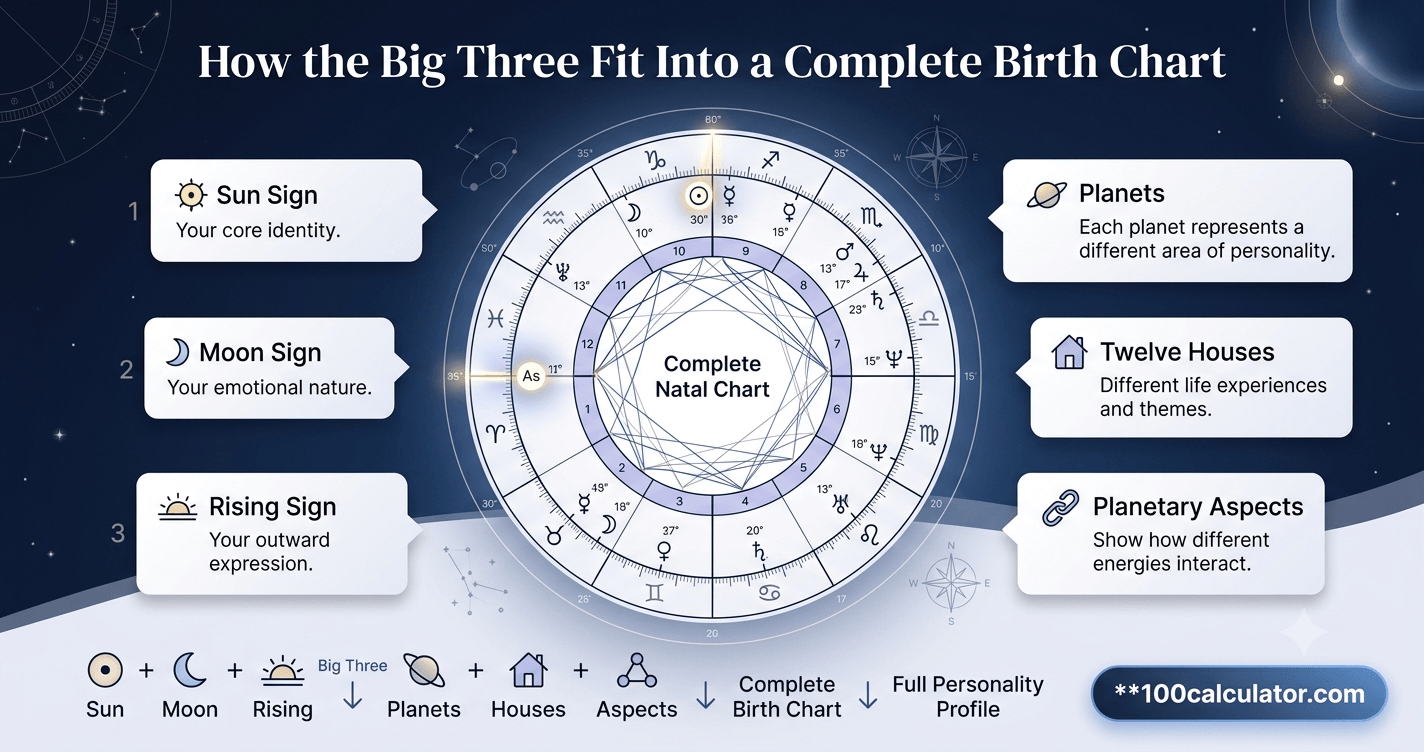
Your Big Three is a genuinely useful starting point, but it's a summary, not the whole document. A full birth chart maps out where every visible planet, not just the sun and moon, was positioned at your birth, along with all twelve houses and the angles between planets, called aspects.
What a Full Chart Adds
Beyond your Big Three, a complete chart adds placements like Mercury, which shapes communication style, Venus, which shapes relationships and taste, and Mars, which shapes drive and how you handle conflict, each sitting in its own sign and house. Our guide on why planetary positions matter in birth chart reading walks through what each additional planet contributes.
If you're ready to look beyond your Big Three, 100 Calculator's Planetary Positions Calculator shows where every planet was at your birth, and the Birth Chart Calculator puts the whole picture together into one chart. If you're brand new to reading a chart, our beginner's guide to reading your birth chart is a good next stop.
Related Calculators
Put what you just read into practice, try these free tools instantly, no sign-up required.
Free Sun Moon Rising Calculator
Discover your Sun, Moon, and Rising zodiac signs instantly.
Planetary Positions Calculator
View accurate planetary positions for any date and location.
Birth Chart Calculator
Generate your complete natal birth chart based on birth details.
My Moon Sign Calculator
Find your Moon sign to understand your emotional inner self.
Compatibility (Synastry) Calculator
Check zodiac compatibility between you and your partner.
What to Do With Your Big Three Next
Once you know your Big Three, the most common next step is simple reflection: does the Sun, Moon, and Rising combination sound like you, and does it explain anything about how you come across versus how you actually feel? Many people find the Rising sign the biggest surprise, since it's rarely the placement they were expecting.
Comparing Charts With Synastry
A popular next step is comparing your Big Three, or your full chart, against someone else's. This is called synastry, and it's the basis for most astrological compatibility readings. Our guide on how synastry reveals compatibility between two charts explains how that comparison works, and which planet placements matter most in synastry breaks down which points astrologers weigh most heavily.
If you want to try it yourself, 100 Calculator's Compatibility (Synastry) Calculator compares two birth charts side by side. Whatever you do with it, your Big Three is a solid, beginner-friendly place to start exploring your chart, and the Free Sun Moon Rising Calculator is the fastest way back to it whenever you want to double-check your placements or look someone else's up.
More From Astrology Self Discovery
Still exploring your chart? These related guides dig deeper into the placements and ideas covered above.
Frequently Asked Questions
What are the "Big Three" in astrology?
Your Big Three are the three most talked-about placements in your birth chart: your Sun sign, your Moon sign, and your Rising sign, also called your Ascendant. Your Sun sign reflects your core identity, your Moon sign reflects your emotional inner world, and your Rising sign reflects how you come across to other people. Looking at all three together gives a fuller picture than looking at your Sun sign alone.
How can I find my Big Three for free?
The fastest way is to use a free tool like 100 Calculator's Free Sun Moon Rising Calculator. Enter your birth date, exact birth time, and birth location, and it works out your Sun, Moon, and Rising signs for you instantly. Doing it by hand requires an astronomical ephemeris and some manual chart math, so most beginners find a calculator far easier than working it out on paper.
What is a Sun sign?
Your Sun sign is the zodiac sign the sun appeared to be passing through on the day you were born. It's what most people mean when they casually ask "what's your sign," and it's the sign used in daily newspaper horoscopes. In astrology, it's associated with your core identity, ego, and general personality.
What is a Moon sign?
Your Moon sign is the zodiac sign the moon was passing through at your exact birth date and time. Because the moon changes signs roughly every two to two and a half days, you need an accurate birth time to find it correctly. In astrology, the Moon sign is linked to emotions, instincts, and what makes you feel comfortable or secure.
What is a Rising sign, or Ascendant?
Your Rising sign, or Ascendant, is the zodiac sign that was coming up over the eastern horizon at the exact moment and place you were born. It changes roughly every two hours, so it needs both an accurate birth time and birth location to calculate. It's associated with first impressions, your outward style, and how you instinctively react to new situations.
Do I need my exact birth time to find my Big Three?
You need your birth date for your Sun sign, but your Moon and Rising signs both depend on the exact time you were born. The Moon changes signs every couple of days, and the Rising sign changes roughly every two hours, so even being off by an hour or two can change the result, especially for your Rising sign.
What should I do if I don't know my exact birth time?
Check your birth certificate or hospital birth records first, since these usually list an exact time. If that's not available, ask a parent or family member who was present. Without an accurate time, your Sun sign will still be reliable, but your Moon sign may be uncertain if the moon changed signs that day, and your Rising sign can't be calculated accurately at all.
How often does the Moon sign change?
The moon moves through all twelve zodiac signs roughly every 27 to 29 days, spending about two to two and a half days in each one. That's fast enough that two people born on the same date, but at different times, can sometimes end up with different Moon signs.
How often does the Rising sign change?
The Rising sign changes roughly every two hours, since it's based on which zodiac sign is on the eastern horizon at the moment of birth, and the whole zodiac appears to rotate past that point about once every 24 hours. This is why even siblings born a few hours apart can end up with different Rising signs.
Can two people share the exact same Big Three?
Yes, especially if they were born on the same date, close to the same time, and in the same general location. Twins born minutes apart often share all three, though even a few minutes' difference can shift the Rising sign. People born on completely different dates almost never share all three placements.
Which of the Big Three matters most?
There's no single "most important" placement; each one describes a different layer of you. That said, many astrologers treat the Rising sign as especially significant, since it sets the tone for your entire birth chart and determines where all your other placements land within the twelve houses.
What's the difference between my Sun sign and my "zodiac sign"?
In casual conversation, they usually mean the same thing. When someone asks your "zodiac sign" without any other context, they're almost always asking for your Sun sign, the one based on your birth date. Your Moon and Rising signs are also technically zodiac signs, just less commonly asked about by default.
Does my Rising sign change if I move somewhere else after I'm born?
No. Your Rising sign is fixed at the exact moment and place of your birth and doesn't change based on where you live afterward. It's calculated once, using your birth details, and stays the same for your entire life.
Is astrology scientifically proven?
No. NASA and other scientific organizations classify astrology as a belief system and cultural tradition rather than a science, since its claims haven't been demonstrated through controlled, repeatable evidence. Many people still find real personal value in astrology as a tool for self-reflection and conversation, which is how this guide approaches it.
What should I learn about next after finding my Big Three?
Once you know your Big Three, a natural next step is looking at your full birth chart, which adds the other planets, the twelve houses, and the angles between them. From there, many people explore synastry, which compares two people's charts to look at compatibility.
About 100 Calculator
100 Calculator is a free hub of online calculators and educational guides covering health, finance, trading, crypto, astrology, education, and more. Every tool is built to be fast, easy to use, and genuinely free, with no account or signup required.
We built this guide, and tools like the Free Sun Moon Rising Calculator referenced throughout it, to make self-discovery topics like astrology a little easier to explore. Head back to the 100 Calculator homepage to explore the full library of tools, or learn more about the team behind them on our About Us page.