How to Find Where the Planets Were at Your Birth
A clear, beginner-friendly walkthrough for finding exactly where the Sun, Moon, and every other planet sat in the sky the moment you were born — using a free calculator, an astrological ephemeris, or just your basic birth details.
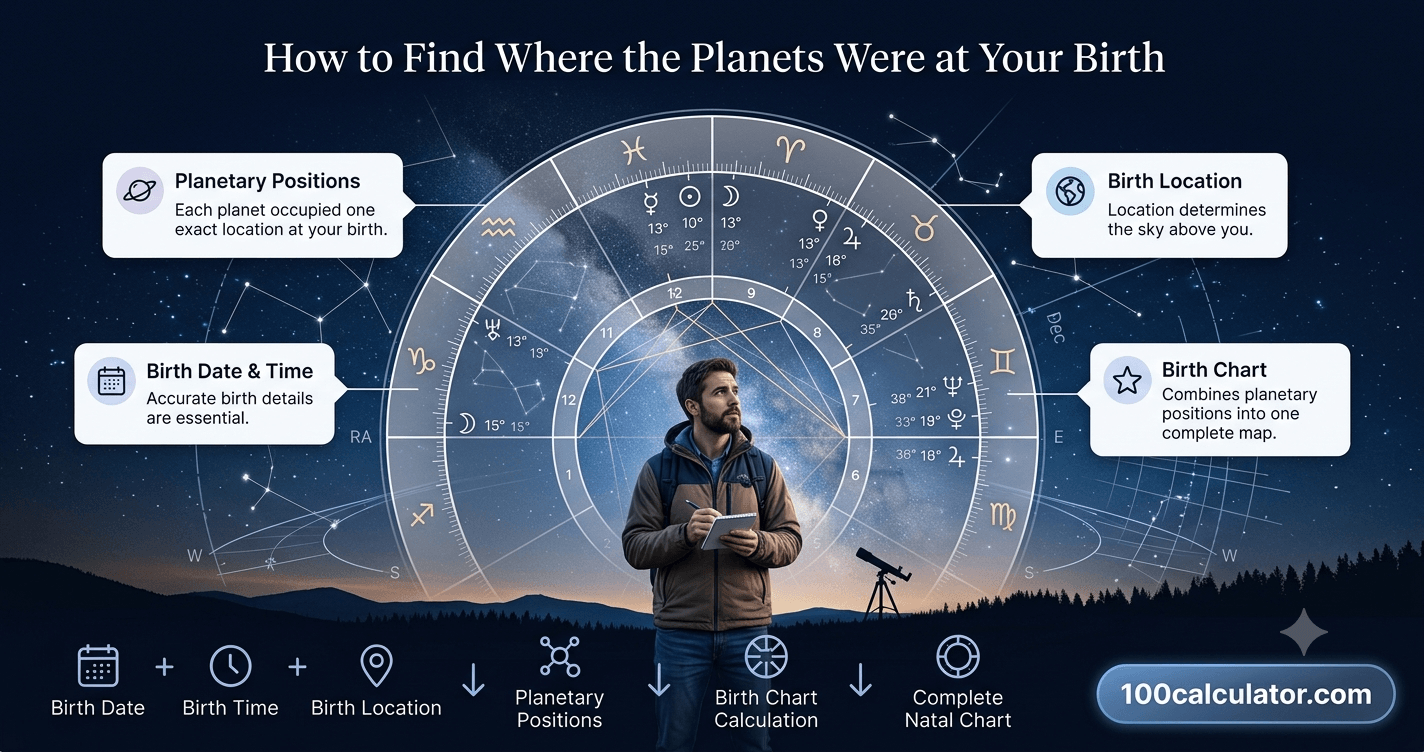
Every person has one exact moment they were born, and at that moment, every planet in the solar system was sitting in a specific spot in the sky. That snapshot is the foundation of a birth chart, sometimes called a natal chart.
Finding your planetary positions means figuring out which zodiac sign — and often which house — each planet was passing through the moment you were born. The fastest way to do this is with a planetary positions calculator: enter your birth date, time, and location, and it returns your full set of placements in seconds. You can also work it out by hand using an astrological ephemeris, a reference table that tracks where each planet sits on any given day.
This guide walks through both methods. We'll cover what you need before you start, how to read your results once you have them, what each planet actually represents, and what to do if you don't know your exact birth time. By the end, you'll be able to look at a list of your planetary positions and understand what you're looking at, not just hold a printout of symbols and degrees.
If you want to skip ahead and get your results right now, 100 Calculator's Planetary Positions Calculator does the math for you the moment you enter your birth details.
Understanding Planetary Positions in Astrology
Before finding your own placements, it helps to understand what "planetary positions" actually means and where the information comes from.
What Is a Birth Chart?
A birth chart, also called a natal chart, is a map of the sky at the exact moment someone was born, drawn from a specific location on Earth. It shows which zodiac sign each planet was passing through, and if you know your birth time, which of the 12 houses each planet fell into. Your planetary positions are the raw data that make up this chart. Once you know where each planet was, you, or an astrologer, can start interpreting what that combination might mean.
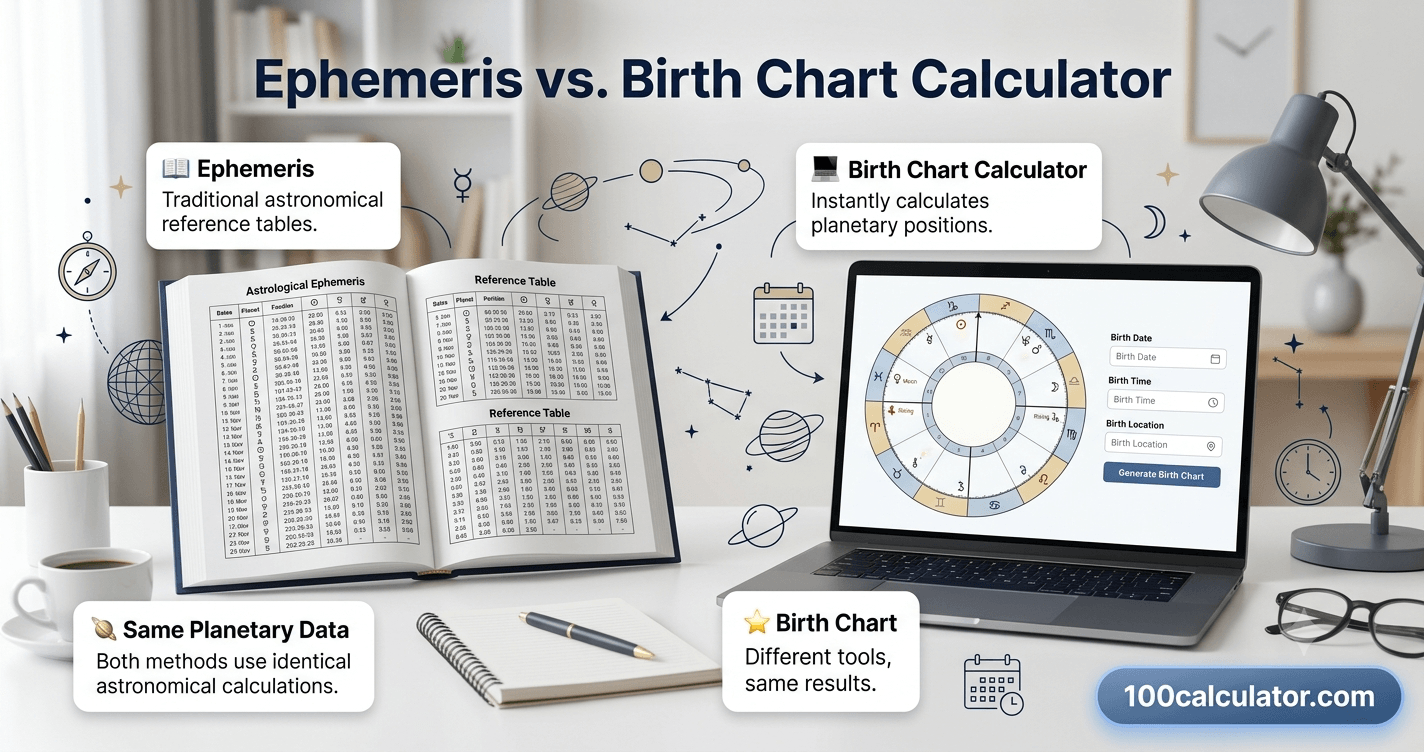
What Is an Ephemeris?
An ephemeris is a table, originally printed in books and now usually digital, that lists the position of the Sun, Moon, and planets for every day of the year. Astrologers and astronomers both use ephemeris data, though for different purposes: astronomers use it to track real orbital mechanics, and astrologers use the same positions to build birth charts. Modern ephemeris data is calculated from precise orbital models, including the kind of data NASA's Jet Propulsion Laboratory publishes through its (Horizons ephemeris system), which tracks the position of every planet with a high degree of accuracy.
Why Find Your Planetary Positions? The Real Benefits
Some people look up their placements once out of curiosity and never think about it again. Others use their chart as an ongoing tool for self-reflection. Either way, there are a few concrete reasons this information is worth having.
Understanding Your Personality in More Depth
Most people only know their Sun sign, which is the sign most horoscope columns are written for. But your Sun sign is just one placement out of ten. Your Moon, Mercury, Venus, and Mars all add detail that a Sun sign alone can't capture, which is part of why a horoscope written for "everyone born under Leo" can feel like it's missing something. Knowing your full set of placements fills in that picture.
Making Sense of Astrology Readings and Horoscopes
Once you know your placements, astrology content stops feeling like guesswork. You can read about "Venus in Scorpio" and know that's actually part of your own chart, rather than wondering if any of it applies to you. Our guide to What Do Your Sun, Moon, and Rising Signs Mean? is a good next step for putting your three most personal placements into context.
Comparing Charts With Someone Else
Planetary positions are also the starting point for synastry, which is the practice of comparing two people's charts to look at compatibility patterns. You can't compare charts without first knowing what's in each one, which is why finding your own placements usually comes before anything else.
A quick look at what this information actually gives you:
- A fuller picture of your personality beyond just your Sun sign
- Context for horoscopes and astrology content that references specific placements
- A foundation for comparing your chart with someone else's through synastry
- A reference point if you ever want a professional or in-depth reading
- A simple way to satisfy curiosity about the exact moment you were born
What You Need Before You Start
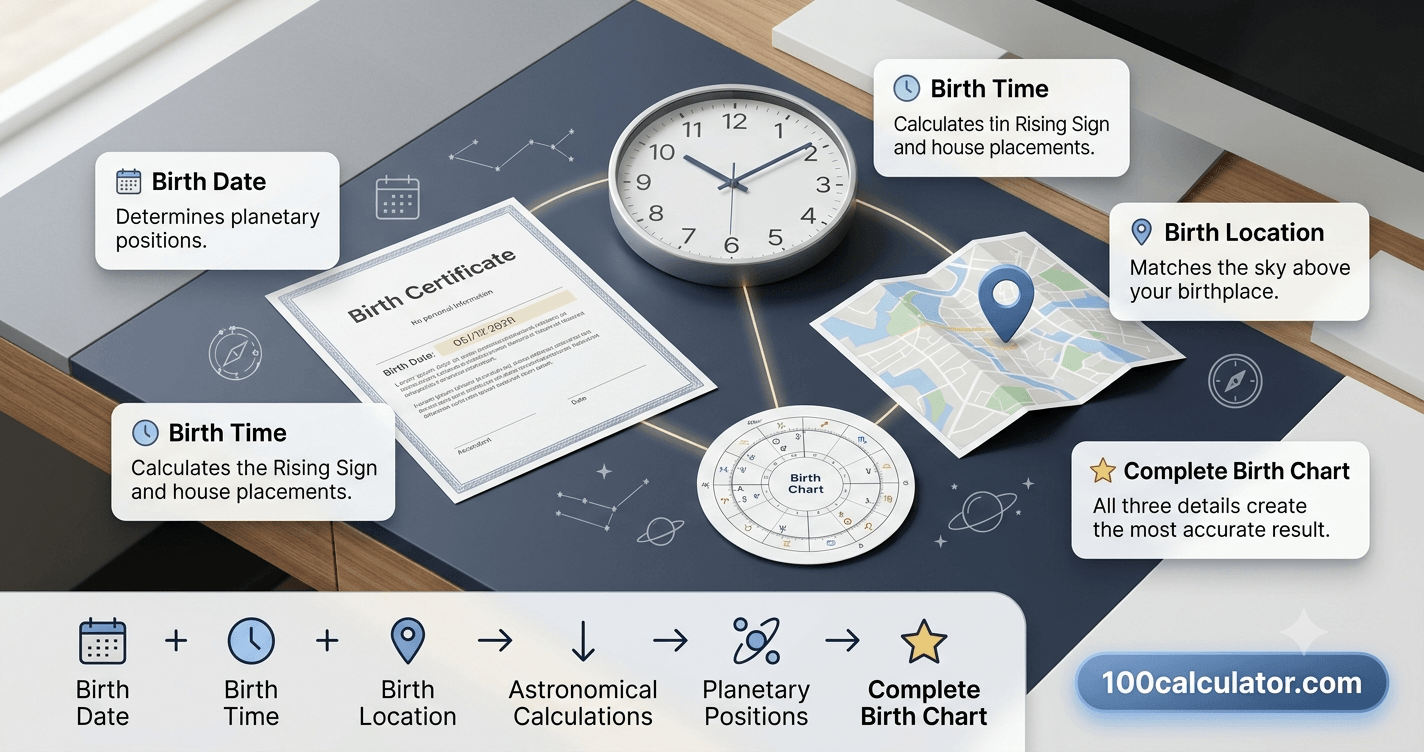
A planetary positions calculator is only as accurate as the information you give it. Three details matter.
Your Exact Birth Date
This one is usually easy, since most people know their birth date without needing to check anything. It's still worth confirming against a birth certificate if you're not entirely sure, especially if you were born close to midnight, since a birth just before or after midnight can shift which day's positions actually apply.
Your Exact Birth Time
This is the detail most people have to go dig up. Your birth time changes where the Moon and faster-moving points sit, and it's the only thing that determines your rising sign and house placements. The Moon moves roughly 12 to 13 degrees a day, which is enough to shift from one zodiac sign to another within a single day, so even a few hours of difference can change your Moon sign. Your birth certificate, hospital paperwork, or baby book are the most reliable places to find it.
Your Birth Location
Your birth city, or the nearest city if you were born somewhere small, is used to calculate your local time zone and, more importantly, your houses. Houses are tied to the horizon and meridian at your specific location, so two people born at the same moment in different cities will have the same planetary signs but different house placements.
How to Find Your Planetary Positions With a Calculator
A calculator is the fastest and most accurate way to get your placements, since it runs the same kind of ephemeris math astrologers use by hand, without you needing to do any of it yourself.
Step-by-Step: Using a Planetary Positions Calculator
- Enter your birth date exactly as it appears on your birth certificate.
- Enter your birth time as precisely as you have it. Even an approximate time is better than leaving it blank, though an exact time gives more reliable house placements.
- Enter your birth location, either as a city or exact coordinates if you have them.
- Review your results, which should list each planet next to its zodiac sign and degree, and its house if you provided a birth time.
- Save or screenshot your results so you're not stuck re-entering your birth details every time you want to reference them.
What a Good Calculator Should Show You
At minimum, look for a calculator that lists all ten planets, from the Sun through Pluto, the exact sign and degree for each one, and, if you gave a birth time, the house each planet falls into. Some calculators also flag which planets were retrograde at your birth, which is a useful bonus but not essential for a first look.
Free Online Tool
Skip the manual math
100 Calculator's Planetary Positions Calculator runs right in your browser. Enter your birth date, time, and location, and it returns every placement at once, with no account or signup required.
How to Read an Astrological Ephemeris by Hand
If you'd rather understand the mechanics than rely on a calculator, you can look up your placements manually using a printed or digital ephemeris. It takes longer, but it's a good way to actually understand what a calculator is doing behind the scenes.
What an Ephemeris Table Looks Like
A typical ephemeris page lists one row per day, with a column for each planet showing its sign and exact degree at a fixed reference time, usually midnight or noon Greenwich Mean Time. To find a planet's position on your birth date, you look up the row for that date and read across.
Converting Your Birth Time to the Right Time Standard
This is the step most people get wrong. Ephemeris tables are built around a single time standard, usually Greenwich Mean Time or Universal Time, not your local time zone. Before looking anything up, you need to convert your birth time to that standard by accounting for your time zone and, for older birth dates, whether daylight saving time was in effect. Getting this step wrong is one of the most common reasons a manually calculated chart doesn't match what a calculator produces.
Limits of the Manual Method
Because most planets don't change sign every day, an ephemeris is usually accurate enough for the Sun, Mercury, Venus, and Mars. The Moon is the exception: it moves fast enough that you often need to interpolate between two days' entries to get an accurate placement. Houses can't be calculated from an ephemeris at all; they require a separate calculation involving your birth time and location, which is exactly the kind of math a calculator or a dedicated Birth Chart Calculator handles automatically.
The Ten Planets and What Their Position Means
Modern Western astrology tracks ten points, referred to collectively as "the planets" even though two of them technically aren't planets at all.
The Personal Planets
The Sun, Moon, Mercury, Venus, and Mars are called the personal planets because they move quickly and shape the parts of your personality that feel the most individual — things like your core identity, your emotional instincts, how you communicate, what you're drawn to, and how you take action. Because they move fast, these are also the placements most likely to differ from a family member born on a different day, even within the same year. Our guide on What Your Moon Sign Reveals About Your Emotions goes deeper into just one of these five.
The Social Planets
Jupiter and Saturn move more slowly, spending roughly a year in each sign. They're called the social planets because they tend to describe patterns that show up across a whole generation of people born around the same time, alongside more personal themes around growth, luck, discipline, and responsibility.
The Outer, Generational Planets
Uranus, Neptune, and Pluto move so slowly that everyone born within several years of you shares the same sign for each one. Uranus can stay in a single sign for about seven years, Neptune for about fourteen, and Pluto anywhere from roughly twelve to over twenty, depending on the sign. Because of this, these three placements say less about your individual personality and more about the broader generation you were born into. Pluto is still tracked alongside the other nine points in most modern charts, even after it was (reclassified as a dwarf planet) by the International Astronomical Union in 2006, since its astrological use was never tied to its official planetary status. It's really the house each outer planet falls into, which does depend on your exact birth details, that adds a personal layer to these three.
| Planet | Category | What It Represents |
|---|---|---|
| Sun | Personal | Core identity, ego, and the self you're becoming |
| Moon | Personal | Emotions, instincts, and what makes you feel safe |
| Mercury | Personal | How you think, process information, and communicate |
| Venus | Personal | What you value, love, and find beautiful |
| Mars | Personal | Drive, desire, and how you take action |
| Jupiter | Social | Growth, optimism, and where you seek meaning |
| Saturn | Social | Discipline, boundaries, and long-term responsibility |
| Uranus | Outer | Change, individuality, and sudden disruption |
| Neptune | Outer | Imagination, intuition, and blurred boundaries |
| Pluto | Outer | Transformation, power, and deep psychological patterns |
Zodiac Signs and How They Shape Each Planet
Every planet's position includes a zodiac sign, and the sign is what colors how that planet tends to express itself. The same placement, say Mars, behaves differently depending on whether it falls in fiery Aries or grounded Taurus.
The Four Elements
Each of the 12 signs belongs to one of four elements: fire, earth, air, or water. This is a quick way to get a general sense of a placement before looking at anything more specific. Fire signs tend to be read as energetic and direct, earth signs as practical and grounded, air signs as communicative and idea-driven, and water signs as emotional and intuitive.
The Three Modalities
Signs are also grouped into three modalities that describe how they tend to approach action. Cardinal signs are associated with starting things, fixed signs with sustaining them, and mutable signs with adapting them. Every element has exactly one sign in each modality, which is why the wheel above always adds up to 12.
| Sign | Element | Modality |
|---|---|---|
| Aries | Fire | Cardinal |
| Taurus | Earth | Fixed |
| Gemini | Air | Mutable |
| Cancer | Water | Cardinal |
| Leo | Fire | Fixed |
| Virgo | Earth | Mutable |
| Libra | Air | Cardinal |
| Scorpio | Water | Fixed |
| Sagittarius | Fire | Mutable |
| Capricorn | Earth | Cardinal |
| Aquarius | Air | Fixed |
| Pisces | Water | Mutable |
Understanding Astrological Houses
If planets are what's happening, houses are where it's happening: the specific area of life a placement tends to show up in.
The 12 Houses at a Glance
There are 12 houses, and every birth chart uses all of them, no matter how many planets land in each one. Some houses end up empty, which isn't a problem; it just means that area of life isn't especially emphasized by your placements. Our guide on What Each House in Your Birth Chart Represents walks through all 12 in more depth.
| House | Traditionally Associated With |
|---|---|
| 1st House | Identity, appearance, and first impressions |
| 2nd House | Money, possessions, and self-worth |
| 3rd House | Communication, siblings, and everyday learning |
| 4th House | Home, family, and roots |
| 5th House | Creativity, romance, and self-expression |
| 6th House | Daily routines, health, and work habits |
| 7th House | Partnerships, marriage, and one-on-one relationships |
| 8th House | Shared resources, intimacy, and transformation |
| 9th House | Travel, higher education, and beliefs |
| 10th House | Career, public reputation, and life direction |
| 11th House | Friendships, community, and future goals |
| 12th House | Rest, the subconscious, and letting go |
Why Houses Need an Exact Birth Time
Unlike signs, houses shift throughout the day. The same planet can land in a completely different house depending on whether you were born at 6am or 6pm, even on the same date, in the same city. This is the main reason an exact birth time matters so much: without it, a calculator can usually still give you accurate signs, but it has to guess at your houses, or skip them entirely.
Retrograde Planets at Birth
Retrograde is a term you'll see next to some of your placements, and it's worth understanding rather than skipping past.
What Retrograde Actually Means
From Earth, planets occasionally appear to move backward through the zodiac for a period of time. This is an optical effect caused by the difference in orbital speed between Earth and the planet being observed. The planet hasn't actually reversed direction; it just looks that way from our point of view. If a planet was retrograde at the moment you were born, your results will usually note it next to that placement.
Which Planets Are Commonly Retrograde at Birth
Mercury, Venus, and Mars are retrograde less often, since they orbit faster and only appear to slow down and reverse for a few weeks at a time. Jupiter, Saturn, Uranus, Neptune, and Pluto move much more slowly around the zodiac, which means each one spends a large portion of every year in apparent retrograde motion. Having one of these outer planets retrograde at birth is fairly common, not unusual.
Does Retrograde Mean Something Went "Wrong"?
Not in any factual sense; it's simply where the planet was. In astrological interpretation, a retrograde placement is sometimes read as that planet's energy being turned inward or expressed differently than usual, but that's an interpretive framework, not a measurable effect. Treat it as one more detail about your chart, not a flaw to correct.
Common Mistakes to Avoid When Calculating Planetary Positions
A few small errors show up often enough that they're worth calling out directly.
- Using your local time zone in an ephemeris built for GMT or UT. This is the single most common reason a manual calculation doesn't match a calculator's result.
- Guessing your birth time. A rough estimate is fine for signs, but it will often produce the wrong house placements, and can even change your rising sign.
- Forgetting daylight saving time. If you were born decades ago, check whether daylight saving was in effect on your birth date, since it changes the GMT or UT conversion.
- Mixing up your birth city with your current city. Houses are calculated from where you were born, not where you live now.
- Assuming every calculator uses the same house system. There are several house systems in use, with Placidus and Whole Sign being two common ones, and switching between them can shift which house a planet falls into, especially near a house cusp.
What If You Don't Know Your Exact Birth Time?
This is more common than it might seem, and it doesn't mean you're stuck without any information.
Where to Look for Your Exact Birth Time
Start with your birth certificate, which records an official time in most places. If that's not available, hospital birth records, a baby book, or a family member who was present can often fill in the gap. Some hospitals will release birth records on request even years later.
Using a Solar Chart Instead
If you truly can't find your birth time, most calculators can still generate what's called a solar chart, which sets your Sun's position as your rising sign and builds your houses from there. It won't give you an accurate rising sign or house placements, but it's a reasonable stand-in, and every planet's sign position is still completely accurate, since signs don't depend on birth time the way houses do.
Related Calculators
Put what you just read into practice, try these free tools instantly, no sign-up required.
Free Sun Moon Rising Calculator
Discover your Sun, Moon, and Rising zodiac signs instantly.
Planetary Positions Calculator
View accurate planetary positions for any date and location.
Birth Chart Calculator
Generate your complete natal birth chart based on birth details.
My Moon Sign Calculator
Find your Moon sign to understand your emotional inner self.
Compatibility (Synastry) Calculator
Check zodiac compatibility between you and your partner.
Turning Your Planetary Positions Into a Full Chart Reading
Once you have your placements, they become useful the moment you start connecting them to each other.
Reading Your Placements Sign by Sign
A good starting point is your "big three": Sun, Moon, and rising sign, since together they cover your core identity, your emotional inner world, and how you tend to come across to other people. From there, you can work outward through the rest of your personal planets. Our How to Find Your Big Three Astrology Placements guide and our How to Read Your Birth Chart as a Complete Beginner guide are both good next steps once you have your full list of placements.
Exploring Compatibility With Synastry
If you're curious how your chart interacts with someone else's, synastry compares two full sets of planetary positions to look at where two people's placements support or challenge each other. You'll need both people's complete placements first, which is exactly what this guide has walked you through finding. Our guides on How Synastry Reveals Compatibility Between Two Charts and Which Planet Placements Matter Most in Synastry? cover this in more detail, and 100 Calculator's Compatibility (Synastry) Calculator can run the comparison for you once you have both sets of placements.
If your Moon sign is what you're most curious about right now, 100 Calculator's My Moon Sign Calculator and Free Sun Moon Rising Calculator are both quick ways to isolate that single placement without pulling up your entire chart.
A note on this guide: This article is meant for education and self-reflection, not scientific or predictive fact. Astrology is a symbolic practice with a long cultural history, but it hasn't been validated as a scientific method, and it isn't a substitute for professional medical, psychological, financial, or legal advice. If you're facing a decision that affects your health, finances, or wellbeing, talk to a qualified professional rather than relying on a chart alone.
More From Astrology Self Discovery
Still curious about your chart? These related guides dig deeper into the topics covered above, from reading your full chart to comparing it with someone else's.
Frequently Asked Questions
What is a planetary positions calculator?
A planetary positions calculator is a free online tool that tells you which zodiac sign, and often which house, each planet was in at the exact moment you were born. You enter your birth date, time, and location, and it runs the same ephemeris-based math an astrologer would use by hand, returning your full set of placements in seconds.
How do I find out where the planets were when I was born?
The fastest way is a planetary positions calculator: enter your birth date, time, and location, and it returns every placement at once. You can also look up each planet's position manually using an astrological ephemeris, though that method takes longer and requires converting your birth time to Greenwich Mean Time or Universal Time first.
Do I need my exact birth time to calculate planetary positions?
You need an exact birth time to get accurate house placements and a reliable rising sign. The sign each planet was in doesn't depend on birth time for most planets, so you can still get accurate sign results for the Sun, Mercury, Venus, Mars, and the outer planets without one. It's really just your Moon, houses, and rising sign that need a precise time.
What happens if I don't know my exact birth time?
You can still get accurate zodiac signs for most of your planets. What you'll miss is an accurate rising sign and house placements, since both depend on the exact time and location of your birth. Many calculators offer a solar chart as a workaround, which uses your Sun's position to estimate a chart without a birth time.
What's the difference between planetary positions and a full birth chart?
Planetary positions are the raw data: which sign and house each planet was in when you were born. A full birth chart takes that data and adds interpretation, including the angles between your planets, your rising sign, and how everything relates to everything else. You need your planetary positions before you can build or read a full chart.
Why does my birth location affect my planetary positions?
Your birth location determines your local time zone, which affects the time conversion needed for accurate positions, and it's essential for calculating your houses and rising sign, both of which are tied to the horizon and meridian at your specific location. Two people born at the same moment in different cities will share the same planetary signs but have different houses.
What is an ephemeris?
An ephemeris is a reference table that lists the position of the Sun, Moon, and planets for every day of the year, expressed as a zodiac sign and exact degree. Astrologers use ephemeris data to build birth charts by hand, while the same underlying orbital data is also used in astronomy to track real planetary motion.
What are the personal planets in astrology?
The personal planets are the Sun, Moon, Mercury, Venus, and Mars. They move quickly through the zodiac, with the Moon changing sign every two to three days, which is why these five placements tend to feel the most individual and are usually different even between people born just days apart.
What does it mean if a planet was retrograde when I was born?
Retrograde describes a planet that appeared to move backward through the zodiac from Earth's point of view at the moment you were born, an optical effect caused by orbital speed differences, not an actual reversal. Outer planets like Jupiter, Saturn, Uranus, Neptune, and Pluto are retrograde for a large part of every year, so having one at birth is common rather than unusual.
How accurate are free online planetary position calculators?
A well-built calculator uses the same ephemeris-based orbital data that professional astrology software relies on, so the sign and degree results are typically very accurate. House placements depend on which house system the calculator uses, and results can shift slightly near a house cusp depending on that choice, so it's worth treating houses as a close estimate rather than an absolute if your birth time is uncertain.
What are astrological houses?
Houses are 12 divisions of the sky based on your exact birth time and location, and each one is traditionally linked to a different area of life, like relationships, career, or home. Unlike signs, houses shift throughout the day, which is why an exact birth time is required to calculate them accurately.
What's the difference between my Sun sign, Moon sign, and rising sign?
Your Sun sign reflects your core identity and is based only on your birth date. Your Moon sign reflects your emotional instincts and can only be calculated with an accurate birth time, since the Moon changes sign every two to three days. Your rising sign, also based on birth time and location, reflects how you tend to come across to others. Together, these three are often called your "big three."
Is Pluto still used in astrology charts?
Yes. The International Astronomical Union reclassified Pluto as a dwarf planet in 2006 for astronomical purposes, but most astrologers still include it as one of the ten points tracked in a standard birth chart, since its astrological use was never tied to its official planetary classification.
Can two people born on the same day have different charts?
Yes, if they were born at different times or in different locations, which is common even for same-day births. Their planetary signs will likely be similar or identical, but their houses and rising sign can differ significantly, especially if their birth times were several hours apart.
What time zone should I use for my birth time?
Use the local time zone that was in effect at your birth location on your exact birth date, including daylight saving time if it applied. A good calculator handles this conversion automatically once you enter your birth location, but if you're calculating by hand from an ephemeris, you'll need to convert your local time to Greenwich Mean Time or Universal Time yourself.
Can I calculate planetary positions without using any calculator?
Yes, using a printed or digital astrological ephemeris. You'll need to convert your birth time to Greenwich Mean Time or Universal Time, then look up each planet's listed position for your birth date. It's a slower process than using a calculator, and it won't give you houses without a separate calculation, but it works for finding the sign each planet was in.
About 100 Calculator
100 Calculator is a free hub of online calculators and educational guides covering health, finance, trading, crypto, astrology, education, and more. Every tool is built to be fast, accurate, and genuinely free, with no account or signup required.
We built this guide, and tools like the Planetary Positions Calculator referenced throughout it, to make self-discovery topics like astrology a little easier to explore. Head back to the 100 Calculator homepage to explore the full library of tools, or learn more about the team behind them on our About Us page.