How to Read Your Birth Chart as a Complete Beginner
A clear, beginner-friendly walkthrough of every piece of your birth chart, planets, signs, houses, and aspects, so you can generate your chart and actually understand what it's telling you.
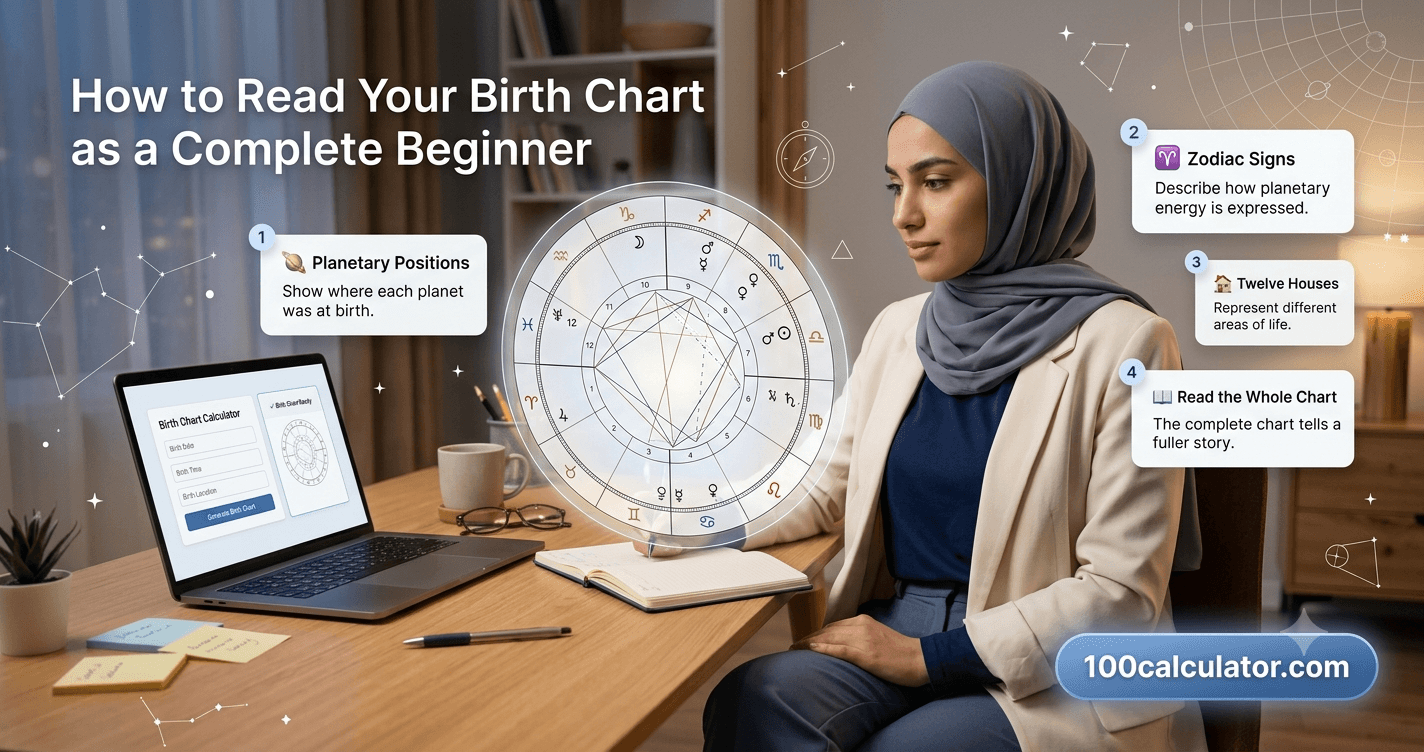
Most people know their zodiac sign. Far fewer know what a birth chart actually is, or how to make sense of the wheel full of symbols an online calculator hands them. That gap is exactly what this guide closes.
A birth chart, also called a natal chart, is a map of where the sun, moon, and planets were positioned in the sky at the exact date, time, and place you were born, plotted onto a wheel of 12 zodiac signs and 12 houses. Astrologers use it as a personalized tool for self-reflection, built entirely from your own birth details rather than a generic horoscope written for everyone born under the same sign.
Once you have your chart generated, and 100 Calculator's Birth Chart Calculator can do that instantly, reading it comes down to learning a small set of building blocks: planets, signs, and houses, plus how they interact through what astrologers call aspects. None of it requires memorizing an entire system before it becomes useful. Even just identifying your Sun, Moon, and Rising signs gives you something worth reflecting on.
In this guide, we'll walk through what you need before you start, the core pieces of a chart, and a simple step-by-step approach for reading your own for the first time, plus the mistakes most beginners make early on.
What Is a Birth Chart, Exactly?
A birth chart is essentially a photograph of the sky, taken at the moment you took your first breath, from the exact spot on Earth where you were born. Astrologers calculate the positions of the sun, moon, and eight other planets at that specific moment, then map those positions onto a circular wheel.
The wheel is divided in two ways at once. First, it's divided into the 12 zodiac signs, the familiar Aries-through-Pisces band that wraps around the sky. Second, it's divided into 12 houses, which are based on the Earth's rotation at your specific birth time and location rather than the stars themselves. Every planet in your chart sits inside both a sign and a house at the same time, which is part of what makes each birth chart so individual.
You'll sometimes see this document called a natal chart or a natal horoscope. All three terms mean the same thing. "Natal" simply comes from the Latin word for birth, so a natal chart is, quite literally, a birth chart.
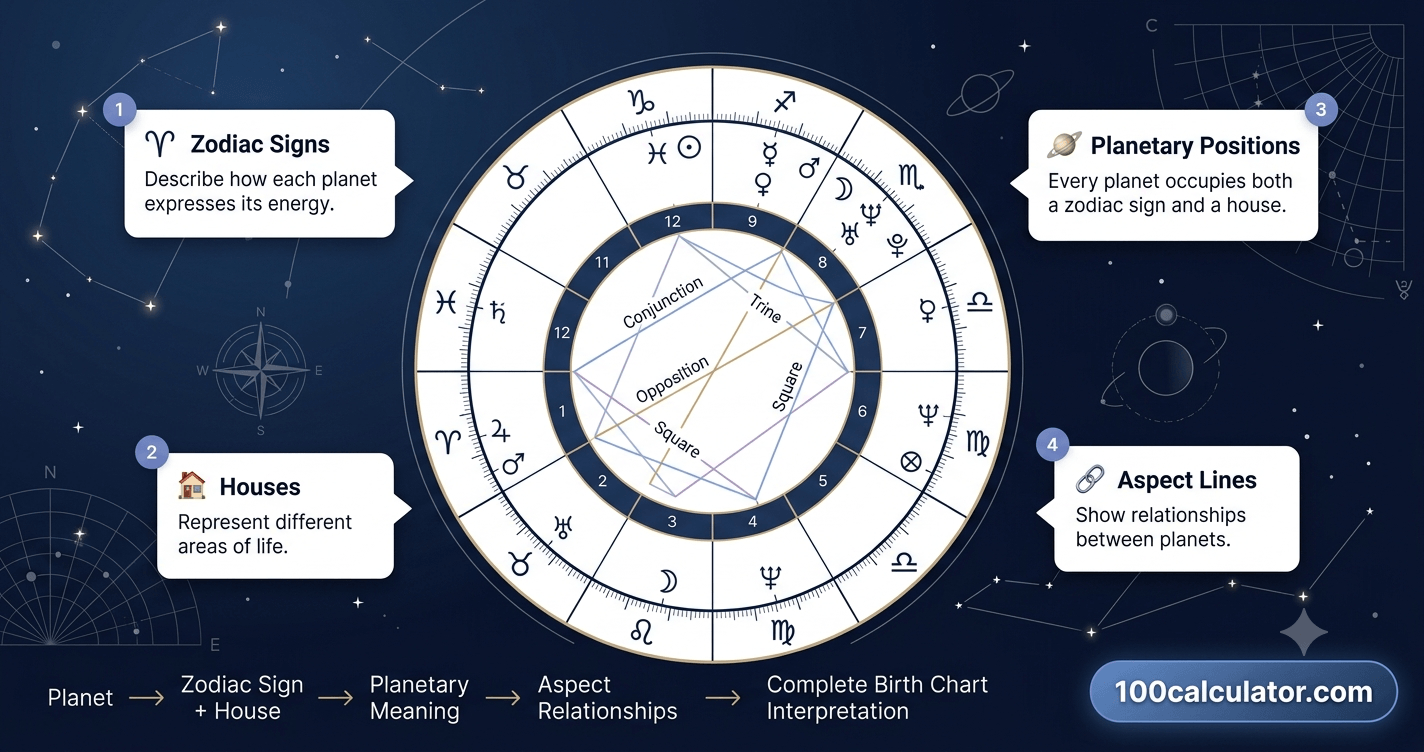
Calculating a birth chart by hand involves cross-referencing planetary tables, called an ephemeris, and adjusting for your exact birth location, which is part of why astrologers historically trained for years before they could do it reliably. A birth chart calculator handles all of that instantly today, which means the real skill worth learning now is interpretation, not calculation.
Why Learn to Read Your Own Birth Chart?
Plenty of people are happy to have someone else interpret their chart for them, and that's a completely reasonable choice. But learning to read your own chart has a few real advantages.
You get to explore at your own pace, revisiting placements as they become relevant instead of trying to absorb an entire reading in one sitting. You also start to notice patterns an outside reading might skim past, like how a particular sign or house keeps showing up across several of your placements. And because a birth chart is genuinely just yours, built from your own birth details, learning to read it tends to feel more personal than reading a generic sun-sign horoscope written for a twelfth of the population.
None of this requires becoming a professional astrologer. Most people who read their own chart are doing it for the same reason people enjoy a personality framework like Myers-Briggs or the Enneagram: as a structured way to reflect on themselves, not as a rulebook to live by.
Once your own chart feels familiar, some people go further and compare it with someone else's using 100 Calculator's Compatibility (Synastry) Calculator, a practice called synastry. Our guide on how synastry reveals compatibility between two charts covers that next step, but it isn't something you need to worry about as a beginner.
What You Need Before You Start Reading Your Chart
Before any of the interpretation makes sense, you need an actual chart in front of you. That comes down to three pieces of information.
- Your exact birth date (day, month, year)
- Your exact birth time, ideally down to the minute
- Your birth location (city and country), since houses and your rising sign are calculated relative to that exact spot on Earth
Your birth date is easy. Your birth time is the one people most often have to dig for. Check your birth certificate first, since many include it. If yours doesn't, hospital birth records or a baby book are the next best sources, followed by asking a parent who was there.
Once you have all three pieces, generating the chart itself takes seconds.
Free Online Tool
Generate your chart in seconds
100 Calculator's Birth Chart Calculator runs right in your browser. Enter your birth date, time, and location, and it maps every planet onto the wheel for you, with no account required.
The rest of this guide assumes you're looking at a completed chart and want to understand what it's showing you.
The Three Building Blocks: Planets, Signs, and Houses
Every single placement in a birth chart, no matter how complicated it looks at first glance, breaks down into the same three-part structure: a planet, a sign, and a house.
Think of it as a simple sentence. The planet is the subject, or what kind of energy you're looking at. The sign is the adjective, or the style that energy tends to take. The house is the setting, or where in your life it tends to show up.
Take "Venus in Leo in the 5th house" as an example. Venus, the planet, represents love, beauty, and what you value. Leo, the sign, expresses things in a bold, warm, expressive way. The 5th house, the house, governs romance, creativity, and self-expression. Put together, this placement suggests someone who shows affection and creativity in a big, hard-to-miss way, and who probably lights up when given room to be seen.
Once this three-part structure clicks, the rest of chart reading is really just applying it over and over to each planet in your chart.
Understanding Your Big Three: Sun, Moon, and Rising
When astrologers say "Big Three," they mean your Sun sign, Moon sign, and Rising sign together. These three placements carry the most individual weight in a chart and are almost always the first thing beginners learn to find.
Your Sun Sign: Core Identity
Your Sun sign is what most people mean when they mention their zodiac sign. It reflects your core sense of self, your basic personality, and the general direction you tend to grow toward over your lifetime. It changes sign roughly once a month, which is why it's the easiest placement to know without any calculation at all.
Your Moon Sign: Emotional World
Your Moon sign reflects your inner emotional life: what makes you feel safe, how you process feelings, and what you need to feel comfortable. It moves through a new sign roughly every two and a half days, so it's far more specific to you than your Sun sign alone. Our guide on what your Moon sign reveals about your emotions goes deeper into this placement, and 100 Calculator's My Moon Sign Calculator can confirm yours directly.
Your Rising Sign: First Impressions
Your Rising sign, or Ascendant, is the zodiac sign that was rising on the eastern horizon at your exact birth time. It shapes first impressions, mannerisms, and how you tend to approach new situations, almost like a filter your personality passes through before the world sees it. Because it shifts roughly every two hours, it's the placement most affected by an inaccurate birth time.
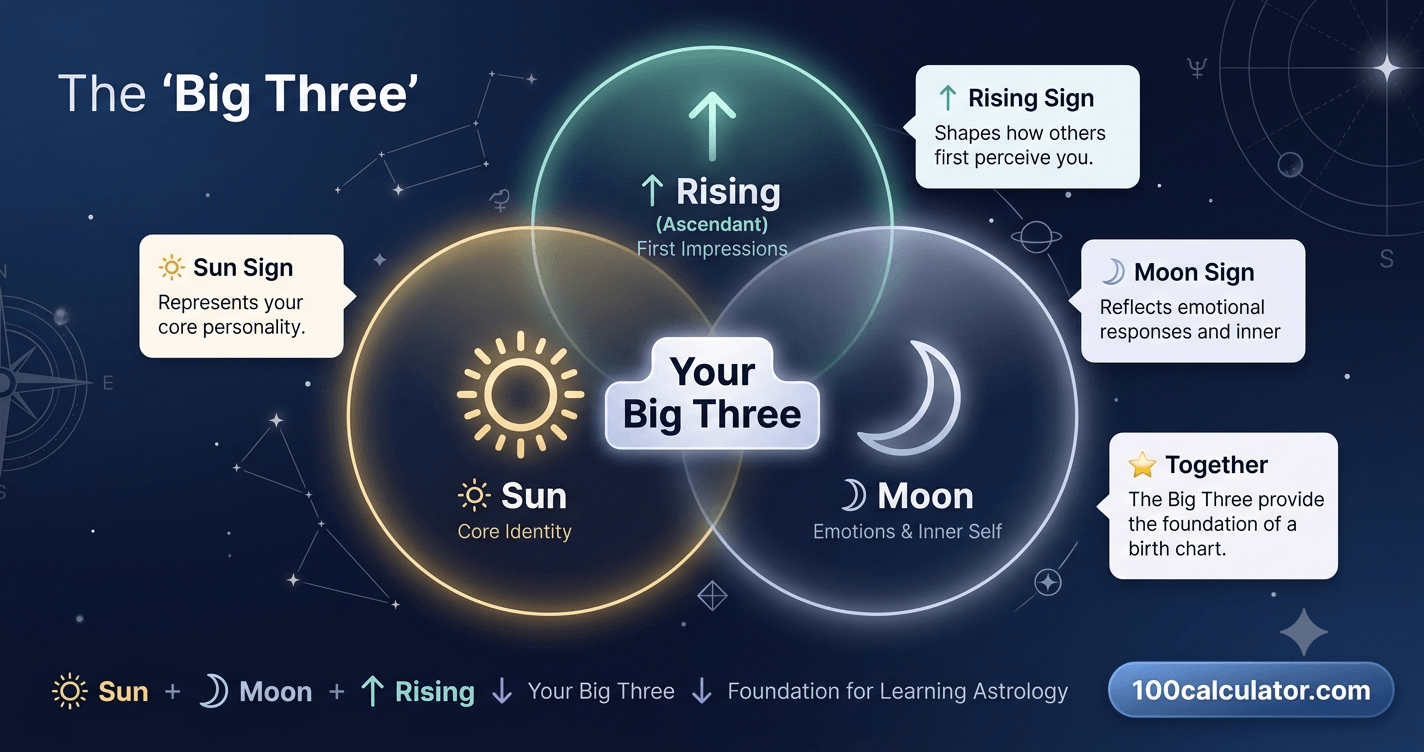
| Placement | What It Reflects | How Often It Changes |
|---|---|---|
| Sun sign | Core identity and general personality | About once a month |
| Moon sign | Emotional needs and inner world | About every 2.5 days |
| Rising sign | First impressions and outward approach | About every 2 hours |
For a deeper walkthrough of each one, see our guides on what your Sun, Moon, and Rising signs mean and how to find your Big Three astrology placements.
Or, if you'd rather look all three up at once, 100 Calculator's Sun Moon Rising Calculator does exactly that.
The 12 Houses and What Each One Represents
If planets and signs describe what kind of energy is at play, houses describe where it shows up in your life. Each of the 12 houses governs a different area, from your identity and money to relationships and career.
| House | Life Area |
|---|---|
| 1st House | Identity, appearance, first impressions |
| 2nd House | Money, possessions, personal values |
| 3rd House | Communication, learning, siblings |
| 4th House | Home, family, roots |
| 5th House | Romance, creativity, self-expression |
| 6th House | Daily routines, health, work habits |
| 7th House | Partnerships, marriage, close relationships |
| 8th House | Shared resources, intimacy, transformation |
| 9th House | Travel, higher learning, beliefs |
| 10th House | Career, public reputation, ambition |
| 11th House | Friendships, community, long-term goals |
| 12th House | Rest, the subconscious, letting go |
The 1st, 4th, 7th, and 10th houses are called angular houses, and they carry extra weight in a chart because they sit at the four most sensitive points of the wheel: the Ascendant, the Imum Coeli, the Descendant, and the Midheaven. Any planet in one of these four houses tends to stand out more prominently in how a person comes across.
For a deeper walkthrough, see what each house in your birth chart represents.
The Planets and What They Represent
Modern Western astrology works with ten chart points, usually just called "planets" for simplicity, even though the Sun is technically a star, the Moon is a satellite, and Pluto is classified as a dwarf planet. Each one represents a different piece of your personality or experience.
| Planet | Represents | Keywords |
|---|---|---|
| Sun | Core identity and ego | Self, vitality, purpose |
| Moon | Emotions and instincts | Comfort, mood, home |
| Mercury | Communication and thinking | Ideas, learning, speech |
| Venus | Love and values | Beauty, relationships, money |
| Mars | Drive and action | Ambition, conflict, energy |
| Jupiter | Growth and beliefs | Luck, expansion, optimism |
| Saturn | Structure and discipline | Responsibility, limits, maturity |
| Uranus | Change and individuality | Rebellion, innovation, surprise |
| Neptune | Dreams and intuition | Imagination, spirituality, illusion |
| Pluto | Transformation and power | Intensity, rebirth, control |
Astrologers sometimes group these into "personal planets" (Sun through Mars, which move quickly and shape your individual personality) and "outer planets" (Jupiter through Pluto, which move slowly and affect entire generations more than any one person specifically). Your personal planets tend to say the most about you as an individual.
If you'd rather see this laid out for your specific chart, 100 Calculator's Planetary Positions Calculator shows exactly which sign and house each planet fell in at the moment you were born.
Our guides on how to find where the planets were at your birth and why planetary positions matter in birth chart reading walk through this in more depth.
Aspects: How Planets Interact With Each Other
An aspect is the angle formed between two planets in your chart, measured in degrees. Aspects describe how different parts of your personality talk to each other, whether they work smoothly together or create some friction.
| Aspect | Approx. Angle | General Feel |
|---|---|---|
| Conjunction | 0° | Blended, intense |
| Sextile | 60° | Easygoing, supportive |
| Square | 90° | Tense, motivating |
| Trine | 120° | Harmonious, flowing |
| Opposition | 180° | Pulling in two directions |
You don't need to calculate these angles yourself. Most birth chart calculators, including 100 Calculator's, display the aspects directly, or make it straightforward to see which planets sit closest together. As a beginner, it's enough to notice which aspects show up most in your chart and treat squares and oppositions as areas of internal tension worth reflecting on, rather than anything to worry about.
How to Read Your Birth Chart Step by Step
With the building blocks in place, here's a simple order to work through when you sit down with your own chart for the first time.
- Generate your chart first. Enter your exact birth date, time, and location into a calculator like 100 Calculator's Birth Chart Calculator so you have an actual wheel to work from.
- Find your Big Three. Locate your Sun, Moon, and Rising signs before anything else. These three placements give you the clearest, most reliable starting point.
- Check your Sun's house placement. The house your Sun falls in shows where your core identity tends to express itself most naturally.
- Look for a stellium. Scan your chart for three or more planets grouped in the same sign or house. A stellium usually points to a theme that carries extra weight for you.
- Note your angular houses. Check what, if anything, sits in your 1st, 4th, 7th, and 10th houses, since planets here tend to stand out the most.
- Scan your major aspects. Start with any aspects involving your Sun, Moon, or Rising sign, since these usually describe the patterns you notice most in daily life.
- Zoom out before zooming in. Read for broad themes first. Trying to interpret every single placement in one sitting is the fastest way to feel overwhelmed.
Common Mistakes Beginners Make When Reading a Birth Chart
A few habits tend to trip up new chart readers more than anything else. Here's what to watch for.
- Only looking at the Sun sign. Your Sun sign is one placement out of dozens. Stopping there is like reading the first sentence of a book and assuming you know the whole story.
- Using a guessed birth time. An approximate time might be fine for the Sun and Moon, but it can put the wrong sign entirely on your Ascendant and shift every house cusp in your chart.
- Treating the chart as fixed fate. Most modern astrologers describe a birth chart as a set of tendencies and potential patterns, not a script you're locked into.
- Trying to memorize everything at once. Chart reading is a skill that builds with repetition. Learning your Big Three first, then adding a layer at a time, works far better than trying to absorb an entire system in one sitting.
- Ignoring the houses. It's easy to focus only on signs and skip the houses entirely, but the houses are what tell you where a placement actually shows up in your life.
Birth Chart Myths vs Facts
A few misconceptions tend to trip up beginners before they even get started. Clearing them up early makes the rest of your chart reading a lot less confusing.
| Myth | Fact |
|---|---|
| Your zodiac sign is your whole personality. | Your Sun sign is one placement among dozens. Your Moon, Rising, and other planets all shape your personality too. |
| Everyone born on your birthday has the same chart as you. | Birth time and location shift the rising sign and house placements significantly, so charts are highly individual even among people born on the same date. |
| A birth chart predicts exactly what will happen in your life. | Most astrologers today treat a birth chart as a tool for reflection and pattern recognition, not a literal prediction of specific events. |
| You need years of study before your chart is useful to you. | Even knowing just your Big Three gives you something meaningful to reflect on. Depth comes with time, but usefulness doesn't have to wait for it. |
Disclaimer: This article is for general educational and entertainment purposes only. Astrology is a symbolic, self-reflective practice rather than a scientifically validated system, and it shouldn't replace professional advice on health, finances, relationships, or other major life decisions. Treat your birth chart as a starting point for reflection, not a fixed prediction of who you are or what will happen.
More From Astrology Self Discovery
Ready to go further with your chart? These related guides dig deeper into the placements and topics covered above.
Frequently Asked Questions
What is a birth chart?
A birth chart, also called a natal chart, is a map of exactly where the sun, moon, and planets were positioned in the sky at the moment and place you were born. Astrologers plot these positions onto a circular wheel divided into 12 zodiac signs and 12 houses. Because it's based on your specific birth date, time, and location, no two birth charts are exactly alike unless two people were born at nearly the same moment in the same place.
Is a natal chart the same thing as a birth chart?
Yes. "Natal chart" and "birth chart" describe the same thing and are used interchangeably in astrology. Both refer to the astrological snapshot calculated from your exact birth date, time, and location. You may also see it called a "natal horoscope," which again means the same chart, just a slightly older or more formal term.
Do I need my exact birth time to read my chart?
Your exact birth time matters most for your rising sign and house placements, both of which shift roughly every two hours. Your Sun sign and, in most cases, your Moon sign will still be accurate without a precise time, since they typically only change sign once every few weeks or roughly every two and a half days. If you want a fully accurate chart, though, an exact birth time is worth tracking down.
What if I don't know my exact birth time?
Check your birth certificate first, since many include the exact time. If that's not available, hospital records or baby books sometimes have it, or a parent may remember. Without an exact time, you can still explore your Sun and Moon signs with confidence, but treat your rising sign and house placements as approximate until you can confirm the time.
What's the difference between my Sun sign and my Rising sign?
Your Sun sign reflects your core identity and is what most people mean when they mention their "zodiac sign." Your Rising sign, or Ascendant, reflects the impression you give at first meeting and sits at the very start of your first house. They're calculated differently, change on different schedules, and often show different sides of the same person.
What are the 12 houses in astrology?
The 12 houses divide your birth chart into different areas of life, such as identity, money, communication, home, relationships, and career. While the planets and signs describe what kind of energy is at play and how it tends to show up, the houses describe where in your life that energy tends to play out.
How many planets are used in a birth chart?
Modern Western astrology typically uses 10 "planets": the Sun, Moon, Mercury, Venus, Mars, Jupiter, Saturn, Uranus, Neptune, and Pluto. Astronomically, the Sun is a star and the Moon is a satellite, and Pluto is classified as a dwarf planet, but astrology groups all ten together as chart points because each one represents a distinct area of personality or experience.
What is a stellium?
A stellium is when three or more planets cluster together in the same zodiac sign or the same house. It suggests that a particular theme, whether it's a sign's traits or a house's area of life, carries extra weight in your chart. Stelliums are one of the easier patterns for beginners to spot once they know what to look for.
What are aspects in astrology?
Aspects are the angles formed between two planets in your chart, measured in degrees. Some angles, like the trine or sextile, are generally read as easygoing, while others, like the square or opposition, are read as more tense or motivating. Aspects show how different parts of your personality or life themes interact with each other.
Can two people born on the same day have different birth charts?
Yes, and often quite different ones. Two people born on the same date can still have different birth times and be born in different locations, both of which change the rising sign, house placements, and sometimes even the Moon sign. Only people born at nearly the same moment in the same place will end up with closely matching charts.
Is astrology scientifically proven?
No. Astrology isn't recognized as a science, and there's no scientific evidence that planetary positions influence personality or life events. Most people who use birth charts today treat them as a tool for self-reflection and personal insight rather than as a proven or predictive system, and that's the spirit in which this guide is written.
How long does it take to learn to read a birth chart?
Most beginners can learn the basics, their Sun, Moon, and Rising signs plus a general sense of the houses, within an hour or two of focused reading. Getting comfortable with planetary aspects and more detailed chart patterns usually takes longer and comes more naturally with practice, looking at your own chart, and comparing it to a few others you know well.
What's the easiest way to start reading my own chart?
Start with your Big Three: your Sun, Moon, and Rising signs. From there, look at which house your Sun falls in, since that shows where your core identity tends to express itself most. Save the finer details, like aspects and minor placements, for once the basics feel familiar.
Do I need special software to read a birth chart?
No. A free online calculator, like 100 Calculator's Birth Chart Calculator, can generate your chart instantly once you enter your birth date, time, and location. From there, you're just reading and interpreting what's already been calculated for you, no software or subscription required.
What is the ascendant or rising sign, and why does it matter?
The ascendant, or rising sign, is the zodiac sign that was rising on the eastern horizon at the exact moment you were born. It sits at the start of your first house and often shapes first impressions, mannerisms, and how you tend to approach new situations. Because it shifts roughly every two hours, it's the placement most sensitive to an accurate birth time.
About 100 Calculator
100 Calculator is a free hub of online calculators and educational guides covering health, finance, trading, crypto, astrology, education, and more. Every tool is built to be fast, accurate, and genuinely free, with no account or signup required.
We built this guide, and the Birth Chart Calculator referenced throughout it, to make astrology a little more approachable for people just getting started. Head back to the 100 Calculator homepage to explore the full library of tools, or learn more about the team behind them on our About Us page.