Why Planetary Positions Matter in Birth Chart Reading
A beginner-friendly walkthrough of what planetary positions actually are, why they matter more than your sun sign alone, and how to start reading your own birth chart one placement at a time.
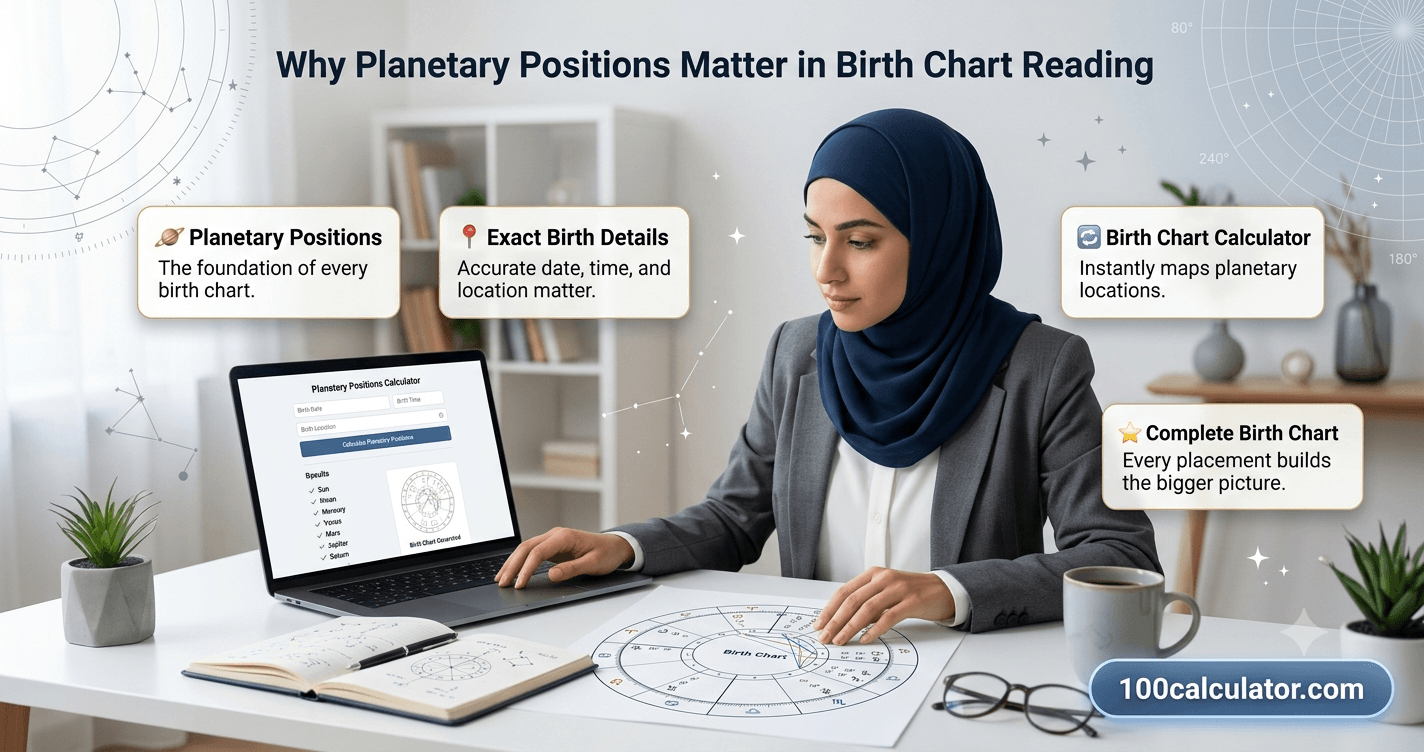
If you've ever read a horoscope and thought it didn't quite sound like you, there's a reasonable explanation. A daily horoscope only looks at one placement, your sun sign, out of eleven total placements in your full birth chart. The other ten, each sitting in their own zodiac sign and house, fill in the rest of the picture.
Planetary positions matter in birth chart reading because they're the actual building blocks a chart is made of. A birth chart plots exactly where the sun, moon, and planets sat in the sky the moment and place you were born, and each planet's sign and house adds a distinct layer to your personality, separate from what your sun sign alone can tell you.
If you want to see your own results right away, 100 Calculator's Planetary Positions Calculator works them out instantly from your birth date, time, and location. Understanding what those results actually mean, though, takes a little more context.
In this guide, we'll walk through what a birth chart is, what each planet represents, how zodiac signs and houses shape that meaning, and how to start reading your own placements the way a beginner astrologer would, one piece at a time.
What Is a Birth Chart, Exactly?
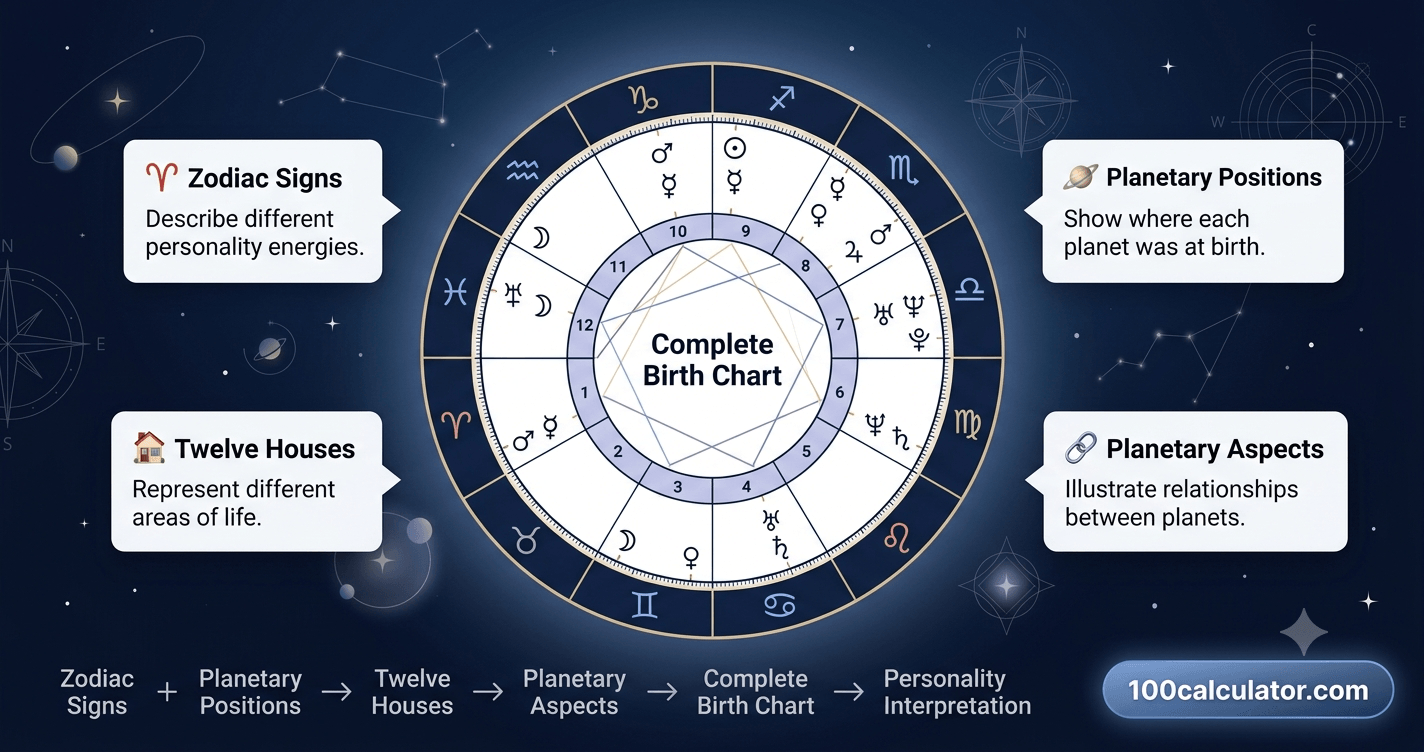
A birth chart, also called a natal chart, is a personalized map of the sky calculated for the exact date, time, and place you were born. Picture it as a snapshot: at the moment you took your first breath, the sun, moon, and eight planets were each sitting in a specific zodiac sign, and every one of those placements landed inside one of twelve houses arranged around a circular wheel.
Modern astrologers, and the calculators that do this math automatically, use your birth details to recreate that exact snapshot. The result isn't a single sign, like the one you'd see on a horoscope page. It's a full chart of ten planetary placements, each with its own sign and house, layered together into something closer to a personality map than a single label.
The Three Building Blocks: Planet, Sign, and House
Every planetary position in your chart is really three pieces of information working together:
- Planet — what kind of energy is involved, like communication (Mercury) or ambition (Mars)
- Sign — how that energy tends to express itself, from bold and direct (Aries) to careful and grounded (Taurus)
- House — which area of your life that energy shows up in most, like career, relationships, or home
On its own, none of these three pieces tells the whole story. A planet without a sign is just a type of energy with no particular flavor. A sign without a house describes how something behaves but not where. Put all three together, and you get a specific, personal placement, something closer to "assertive energy, expressed carefully, showing up in your career" than a one-word label.
What You Need for an Accurate Chart
To calculate an accurate birth chart, you need three pieces of information: your birth date, your birth time, and your birth location. The date and location are usually easy to track down, but the birth time matters more than most people expect, since it's what determines your rising sign and where the house lines fall around your chart. We'll come back to why that one detail changes so much later in this guide.
Why Planetary Positions Matter More Than Your Sun Sign Alone
It's easy to assume astrology begins and ends with your sun sign, since that's the one most horoscope columns and quizzes focus on. But your sun sign is only one of eleven placements in your chart, and it mostly reflects your core identity, not your emotions, communication style, or how you handle relationships.
More Than a Sun Sign Horoscope
A daily horoscope has to generalize, since it's written for everyone who shares your sun sign, roughly one-twelfth of the population. Your full set of planetary positions is unique to your exact birth date, time, and location, which is why two people with the same sun sign can feel like completely different people once you look at their whole chart.
A Snapshot of the Sky the Moment You Were Born
Because the planets are always moving, no two moments in the sky look exactly alike. Your birth chart captures that one specific arrangement and holds onto it. It doesn't change as you get older; it's a fixed record of the sky at your birth, which is what makes it a personal starting point for reflection rather than a generic daily forecast.
A few things a full set of planetary positions reveals that your sun sign alone can't:
- How you process emotions and what makes you feel secure, through your moon sign
- How you tend to come across to people who don't know you well, through your rising sign
- How you communicate, love, and take action, through Mercury, Venus, and Mars
- Which specific areas of your life, like career or relationships, certain themes show up in most, through the houses
- Broader generational patterns you share with people born around the same years, through the outer planets
Free Online Tool
Curious what your own chart actually shows?
100 Calculator's Planetary Positions Calculator plots every planet's sign and house from your birth date, time, and location, right in your browser, with no account required.
What Each Planet Represents in Your Birth Chart
Astrology groups the ten planets used in a birth chart (the sun and moon are included here even though they're technically not planets) into three categories, based on how quickly each one moves through the zodiac. That speed roughly matches how personal or universal each planet's meaning tends to be.
The Personal Planets: Sun, Moon, Mercury, Venus, and Mars
Personal planets move quickly, so they shape the parts of your personality that feel most individual and everyday.
Sun
Your core identity and the basic energy you're here to express
Moon
Your emotional world, instincts, and what makes you feel safe. See our guide to what your moon sign reveals.
Mercury
How you think, process information, and communicate
Venus
What you value, how you love, and what you find beautiful
Mars
How you take action, assert yourself, and pursue what you want
The Social Planets: Jupiter and Saturn
Social planets move more slowly, taking a year or more to pass through a single sign, so they describe how you relate to bigger structures like career, community, and long-term growth.
The Outer Planets: Uranus, Neptune, and Pluto
Outer planets move so slowly, sometimes spending a decade or more in a single sign, that they say less about your individual personality and more about the generation you were born into.
Uranus
Where you break from convention and seek independence
Neptune
Your imagination, intuition, and sense of something bigger than yourself
Pluto
Where you experience deep transformation and personal power
Here's how those three groups compare side by side:
| Category | Planets | Typical Time in One Sign | What It Shapes |
|---|---|---|---|
| Personal | Sun, Moon, Mercury, Venus, Mars | A few days to a few months | Everyday personality and habits |
| Social | Jupiter, Saturn | About 1 to 2.5 years | Growth, responsibility, and community |
| Outer | Uranus, Neptune, Pluto | Roughly 7 to 30 years | Generational trends more than individual traits |
Free Online Tool
Want to see where each planet sits in your chart?
100 Calculator's Planetary Positions Calculator lists all ten placements at once, so you're not looking each one up separately.
How Zodiac Signs Shape the Way a Planet Expresses Itself
If a planet is the "what," the zodiac sign it's placed in is the "how." The same planet acts differently depending on which of the twelve signs it lands in, since each sign brings its own style, pace, and priorities to whatever that planet represents.
The Four Elements: Fire, Earth, Air, and Water
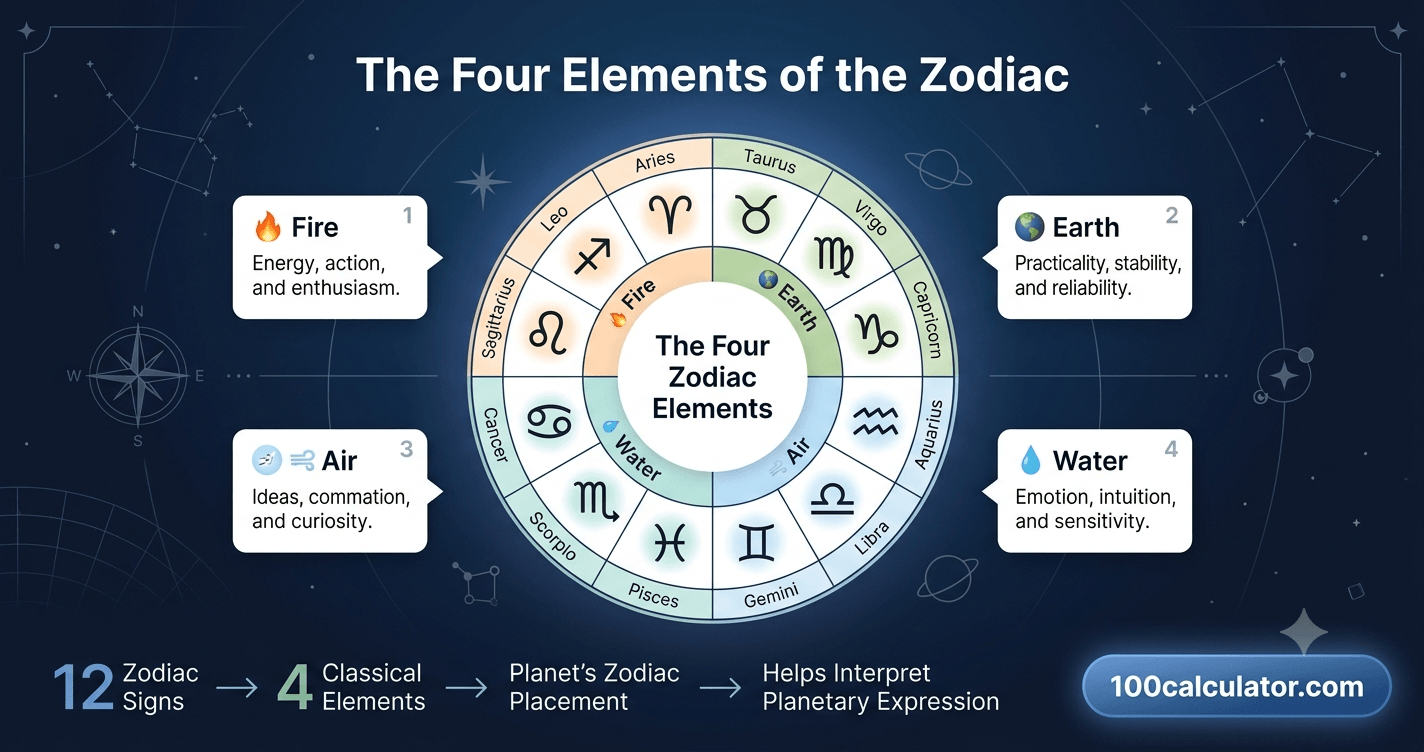
A quick way to get a feel for a sign, even before learning all twelve individually, is to know its element. Each sign belongs to one of four elements, and signs that share an element tend to share a general style:
| Element | Signs | General Style |
|---|---|---|
| Fire | Aries, Leo, Sagittarius | Energetic, spontaneous, action-driven |
| Earth | Taurus, Virgo, Capricorn | Practical, grounded, steady |
| Air | Gemini, Libra, Aquarius | Thoughtful, social, idea-driven |
| Water | Cancer, Scorpio, Pisces | Emotional, intuitive, sensitive |
Example: Mars in Aries vs. Mars in Cancer
Mars represents drive and how you take action. In Aries, a fire sign, Mars feels right at home: quick to act, competitive, and comfortable jumping in without overthinking it. In Cancer, a water sign, that same drive to take action gets filtered through emotional awareness. Someone with Mars in Cancer might take action to protect people they care about, but hesitate before a conflict that feels too direct. Same planet, same basic energy, a noticeably different style.
How Houses Show Where a Planet's Energy Plays Out
If the planet is the "what" and the sign is the "how," the house is the "where." Your birth chart wheel is divided into twelve houses, and whichever house a planet falls into points to the specific area of life where that planet's energy tends to show up most.
The Twelve Houses at a Glance
Houses are grouped into three types based on their position in the chart: angular houses (1st, 4th, 7th, 10th) tend to carry the most weight, succedent houses (2nd, 5th, 8th, 11th) build on them, and cadent houses (3rd, 6th, 9th, 12th) connect and process. Our guide on what each house in your birth chart represents covers all twelve in more depth, but here's a quick overview:
| House | Type | Life Area |
|---|---|---|
| 1st | Angular | Self and first impressions |
| 2nd | Succedent | Money, possessions, and values |
| 3rd | Cadent | Communication and learning |
| 4th | Angular | Home, family, and roots |
| 5th | Succedent | Creativity, romance, and self-expression |
| 6th | Cadent | Daily routines, health, and work habits |
| 7th | Angular | Partnerships and close relationships |
| 8th | Succedent | Shared resources and transformation |
| 9th | Cadent | Travel, higher learning, and beliefs |
| 10th | Angular | Career and public reputation |
| 11th | Succedent | Friendships and future goals |
| 12th | Cadent | Rest, subconscious, and letting go |
Example: Venus in the 2nd House vs. the 10th House
Venus represents what you value and find beautiful. In the 2nd house, which relates to money and personal resources, Venus often shows up as a genuine appreciation for comfort, quality, and financial stability. In the 10th house, which relates to career and public reputation, that same Venus might show up as a career built around beauty, art, relationships, or simply being well-liked in a public role. Same planet, same core meaning, expressed in a completely different part of life.
The Big Three: Sun, Moon, and Rising Sign
Most beginners start learning astrology with three placements, often called the Big Three: your sun sign, moon sign, and rising sign. Our guide on what your sun, moon, and rising signs mean goes deeper into each one, but here's the short version.
Why Your Rising Sign Needs an Exact Birth Time
Your rising sign, also called your ascendant, is the zodiac sign that was rising on the eastern horizon at the exact moment you were born. Because the sky rotates fully every 24 hours, the rising sign changes roughly every two hours, so a birth time that's off by even an hour can shift it to a different sign entirely. This is also why your rising sign sets the starting point for your whole house system, which is why getting it right affects far more than just this one placement.
How the Big Three Work Together
Think of the sun as who you fundamentally are, the moon as how you feel and process things privately, and the rising sign as how you tend to come across before anyone gets to know you. Someone can have a bold, outgoing sun sign paired with a private, sensitive moon sign, which is often why astrology "explains" the gap between how someone acts in public and how they feel underneath it. Our guide on moon sign vs. sun sign looks at that specific relationship in more depth.
100 Calculator's Free Sun Moon Rising Calculator works out all three placements at once, and our step-by-step guide on how to find your Big Three astrology placements walks through reading the results.
If you only need one specific placement, the My Moon Sign Calculator narrows things down to just your moon sign.
Retrograde Planets and What They Mean in a Birth Chart
From Earth, planets sometimes appear to slow down, stop, and drift backward across the sky for a few weeks before resuming their normal path forward. This is called being retrograde, and it's an optical illusion caused by the difference in orbital speed between Earth and the other planet, not an actual change in direction.
Birth Chart Retrogrades vs. Current Retrogrades
If a planet was retrograde at the exact moment you were born, that's a permanent part of your chart. In birth chart reading, a retrograde planet is often described as energy that gets processed more internally, reflectively, or unconventionally than usual. That's a general pattern, not a strict rule, and it's just one more layer to weigh alongside the planet's sign and house.
Mercury retrogrades roughly three to four times a year, for about three weeks each time, which is why it comes up in conversation so often. Other planets retrograde less frequently, or for longer stretches, depending on how far they sit from the sun.
Common Mistakes People Make When Reading Planetary Positions
Even once you understand the basics, a few habits tend to trip up beginners. Here's what to watch for:
- Only reading your sun sign and assuming it covers your whole personality, when it's really just one placement out of eleven.
- Ignoring the house system, which means missing which specific area of your life a placement affects most.
- Using a rounded or approximate birth time, which can throw off your rising sign and every house placement that depends on it.
- Reading one placement in isolation instead of noticing how it interacts with the rest of the chart.
- Treating a birth chart as a fixed prediction instead of a reflective starting point, since astrology isn't a scientifically validated forecasting method.
- Mixing up a birth chart retrograde with a current retrograde transit, which describe two very different things.
How to Find Your Own Planetary Positions
Once you understand what planetary positions actually mean, finding your own is the easy part. You have two main options: use an online calculator, which does the astronomical math for you instantly, or work from an ephemeris, a detailed astronomical reference table, by hand. Our guide on how to find where the planets were at your birth walks through both approaches in more detail.
What Information You'll Need
Whichever method you use, you'll need the same three pieces of information:
| Information | Why It Matters |
|---|---|
| Birth date | Determines your sun sign and roughly where the slower-moving planets sit |
| Birth time | Determines your rising sign and every house placement in your chart |
| Birth location | Determines the exact house lines, since they shift with latitude and longitude |
How to Read Your Results
Once you have your list of placements, a little structure makes it easier to absorb than reading straight down the list:
- Start with your Big Three: sun, moon, and rising sign
- Move on to your other personal planets: Mercury, Venus, and Mars
- Note which house each of those planets falls into
- Check for any retrograde symbols next to a planet
- Notice if several planets cluster in the same house or sign, which usually means that theme is emphasized
Free Online Tool
Ready to find your own placements?
100 Calculator's Planetary Positions Calculator and Birth Chart Calculator both handle the math for you instantly, with no account required.
Putting It All Together: Reading Your Chart as a Story
A birth chart can feel overwhelming with ten planets, twelve signs, and twelve houses all interacting at once. The good news is that you don't need to interpret all of it simultaneously to get something useful out of it.
Start With the Big Three, Then Build Outward
Begin with your sun, moon, and rising sign, since those three placements carry the most weight and are the easiest to relate to. From there, add your other personal planets: Mercury, Venus, and Mars. Save the social and outer planets for later, since their slower movement means they say more about your generation than about you specifically. Our guide on how to read your birth chart as a complete beginner walks through this same approach in more detail.
A Simple Example of Reading a Placement
Say your chart shows Mercury in Gemini in the 3rd house. Mercury represents communication, Gemini is naturally curious and quick-witted, and the 3rd house relates to everyday communication and learning. Put together, that's someone who likely communicates quickly, asks a lot of questions, and enjoys learning several things at once, expressed through everyday conversation, writing, or short bursts of curiosity rather than one deep specialty. That's the same three-step process, planet plus sign plus house, applied to every placement in your chart.
Related Calculators
Put what you just read into practice, try these free tools instantly, no sign-up required.
Free Sun Moon Rising Calculator
Discover your Sun, Moon, and Rising zodiac signs instantly.
Planetary Positions Calculator
View accurate planetary positions for any date and location.
Birth Chart Calculator
Generate your complete natal birth chart based on birth details.
My Moon Sign Calculator
Find your Moon sign to understand your emotional inner self.
Compatibility (Synastry) Calculator
Check zodiac compatibility between you and your partner.
When Professional Guidance Helps
A calculator can tell you exactly where your planets sit, and this guide can explain what each one generally means. Interpreting how dozens of placements interact at once, especially for specific questions like relationship compatibility or a major life decision, is where a professional astrologer can add depth beyond what any calculator or article can offer.
If you're curious how your chart compares with someone else's, our guide on how synastry reveals compatibility between two charts covers the basics, and our piece on which planet placements matter most in synastry goes a step further.
100 Calculator's Compatibility (Synastry) Calculator is a good starting point if you want to explore this yourself before booking a professional reading.
Disclaimer: This article is for entertainment and self-reflection purposes and isn't a scientifically validated method for predicting personality or future events. Use your birth chart as a starting point for reflection and conversation, not as a substitute for professional medical, legal, financial, or psychological advice.
More From Astrology Self Discovery
Still exploring what your chart has to say? These related guides dig deeper into the placements and concepts covered above.
Frequently Asked Questions
What is a birth chart?
A birth chart, also called a natal chart, is a map of where the sun, moon, and planets were positioned at the exact moment and place you were born. It's built using your birth date, birth time, and birth location, then plotted onto a circular wheel divided into twelve houses. Astrologers use this chart to explore personality traits, emotional patterns, and life themes through the lens of planetary symbolism.
What do planetary positions mean in astrology?
A planetary position describes which zodiac sign and house a planet occupied when you were born. The planet represents what kind of energy is involved, like communication or ambition, the sign describes how that energy tends to show up, and the house points to which area of life it plays out in most, such as career, relationships, or home life. Together, these three pieces give a much fuller picture than a sign alone.
Do I need my exact birth time for an accurate birth chart?
Yes, an exact birth time matters a lot, especially for your rising sign and house placements, since the rising sign changes roughly every two hours. Without an accurate time, your sun and moon sign are usually still reliable, but house positions and your ascendant can be off. If you're unsure of your exact time, check your birth certificate, ask a parent, or use a chart calculated for around noon as a rough starting point.
What's the difference between my sun sign and my full birth chart?
Your sun sign is just one placement in a much bigger picture. It's based only on your birth date and reflects your core identity, but a full birth chart adds the moon, rising sign, and eight other planets, each placed in a specific sign and house. Two people with the same sun sign can have very different charts overall, since everything else depends on their exact birth time and location.
What are personal planets, social planets, and outer planets?
Personal planets, the sun, moon, Mercury, Venus, and Mars, move quickly through the zodiac and shape your everyday personality and habits. Social planets, Jupiter and Saturn, move more slowly and relate to growth, responsibility, and how you fit into your community. Outer planets, Uranus, Neptune, and Pluto, move so slowly that they stay in one sign for years, so they tend to describe generational trends more than individual traits.
What is the "Big Three" in astrology?
The Big Three refers to your sun sign, moon sign, and rising sign, the three placements most beginners learn first. The sun represents your core identity, the moon reflects your emotional inner world, and the rising sign, also called the ascendant, shapes how you tend to come across to others. Looking at all three together usually gives a more accurate picture than any one placement on its own.
Why does my rising sign matter if I already know my sun sign?
Your rising sign shapes your outward style, first impressions, and how you instinctively approach new situations, which can be quite different from your sun sign's core identity. It also sets the starting point for your entire house system, so it affects where every other planet in your chart lands. Skipping the rising sign means missing a big part of how your chart is actually organized.
What does it mean if a planet is retrograde in my birth chart?
A planet is retrograde in your birth chart if it appeared to be moving backward through the zodiac, from Earth's point of view, at the moment you were born. This is different from a current retrograde transit, like the Mercury retrograde periods people talk about online. In a birth chart, a retrograde planet is often interpreted as energy that gets expressed in a more internal, reflective, or unconventional way.
Do houses matter as much as zodiac signs in a birth chart?
Yes, houses are just as important as signs, even though beginners often overlook them. The sign shows how a planet's energy tends to express itself, while the house shows which area of your life that energy shows up in most, like relationships, career, or home. A planet in the same sign can look quite different depending on which house it falls into.
Can two people born on the same day have different birth charts?
Yes, easily. Two people born on the same date can have noticeably different charts if they were born at different times or in different locations, since both affect the rising sign and house placements. Even siblings born a few years apart on the same calendar date will usually have different charts overall, because the slower-moving planets will have shifted position.
What's the easiest way to find my planetary positions?
The simplest way is to use an online tool like 100 Calculator's Planetary Positions Calculator, which works out every planet's sign and house instantly once you enter your birth date, birth time, and birth location. This saves you from manually calculating planetary movements, which traditionally required detailed astronomical reference tables called ephemerides. Once you have your placements, you can start looking up what each one means.
What if I don't know my exact birth time?
If you don't know your exact birth time, your sun sign and most personal planet placements will still usually be accurate, since those rarely change more than once within a single day. Your moon sign might be affected if it changed signs that day, and your rising sign and house placements become much less reliable without a time. Checking your birth certificate or a hospital record is usually the most reliable way to find it.
Do different house systems give different chart results?
Yes, astrologers use several different house systems, such as Placidus, Whole Sign, and Equal House, and they can place the same planet in a different house depending on which system is used. This mostly affects house placements rather than signs. Most online birth chart calculators default to a commonly used system like Placidus or Whole Sign, which works well for most beginners getting started.
Should I focus on a few planets first, or try to read my whole chart at once?
Starting with a few placements is usually easier and less overwhelming. Most beginners start with their Big Three, the sun, moon, and rising sign, before moving on to personal planets like Venus and Mars, and finally the slower-moving social and outer planets. Trying to interpret every placement, house, and aspect at once often leads to confusion rather than genuine insight.
Is astrology scientifically proven?
No, astrology is not a scientifically validated system for predicting personality or events, and there's no established mechanism explaining how planetary positions would influence someone's life. Many people still find value in astrology as a tool for self-reflection and conversation starting points about their personality and experiences. It's best approached as a symbolic framework rather than a factual or predictive science.
How is a birth chart different from a daily horoscope?
A daily horoscope is a general prediction written for everyone with the same sun sign, so it isn't personalized beyond that one placement. A birth chart is unique to your exact birth date, time, and location, and includes ten planets spread across twelve houses, making it a far more detailed and individual picture than a horoscope could ever offer.
About 100 Calculator
100 Calculator is a free hub of online calculators and educational guides covering health, finance, trading, crypto, astrology, education, and more. Every tool is built to be fast, accurate, and genuinely free, with no account or signup required.
We built this guide, and tools like the Planetary Positions Calculator referenced throughout it, to make self-discovery topics like astrology a little easier to explore. Head back to the 100 Calculator homepage to explore the full library of tools, or learn more about the team behind them on our About Us page.