Which Planet Placements Matter Most in Synastry?
A beginner-friendly walkthrough of the planets that actually move the needle in a synastry comparison — Sun, Moon, Venus, Mars, Ascendant, and a few others — so you can read a chart overlay without getting lost in it.
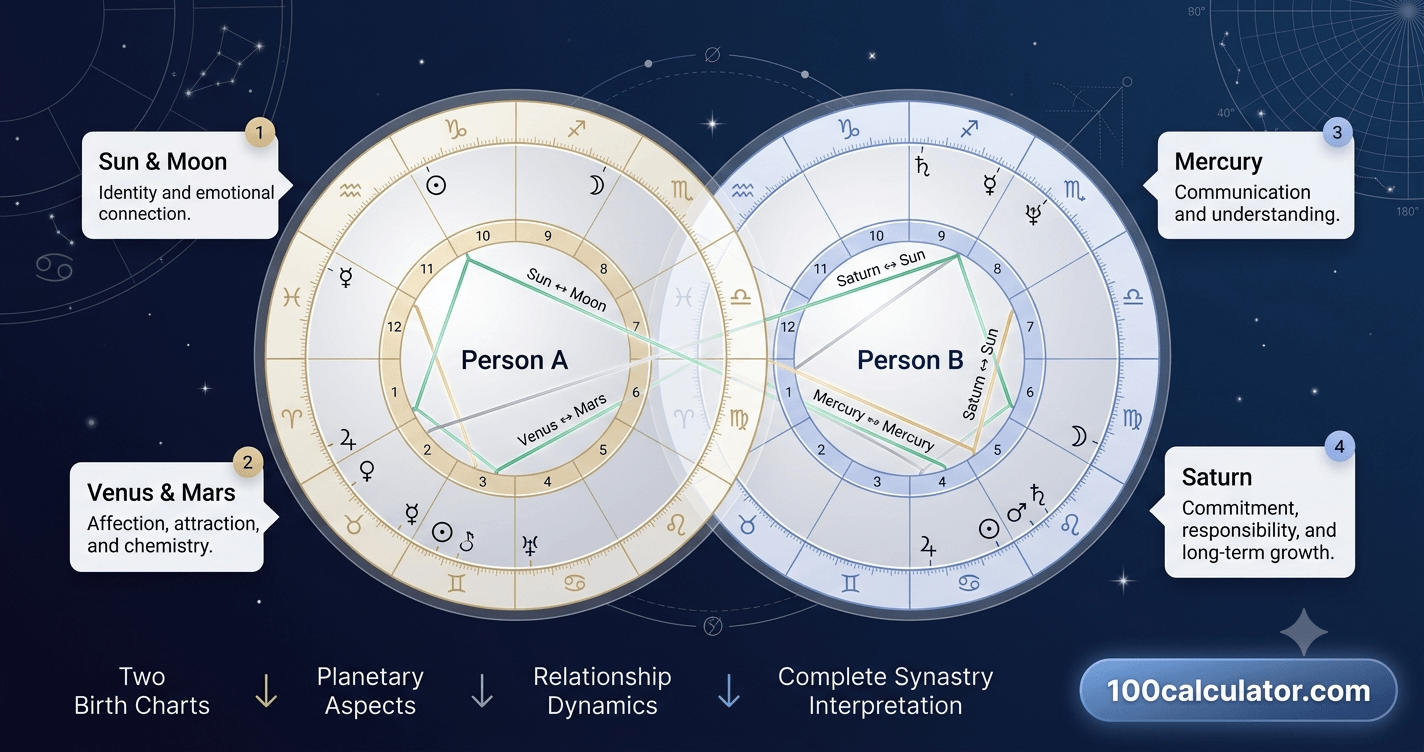
Two people can share a sun sign and still feel like they're speaking different languages. Two people with "incompatible" signs can feel like they've known each other for years. That gap between a sun-sign horoscope and how a relationship actually feels is exactly what synastry tries to explain.
In synastry, the Sun, Moon, Venus, Mars, and Ascendant carry the most weight, because these five points describe identity, emotional needs, attraction, and first impressions — the basic ingredients of how two people experience each other. Aspects between these five points, especially conjunctions, trines, oppositions, and squares, tend to matter far more than matching sun signs or shared placements in the slower outer planets.
If you want to see these placements mapped out for you and a specific person, 100 Calculator's Compatibility (Synastry) Calculator compares both birth charts and lists the aspects between them, so you're not doing the math by hand.
In this guide, we'll walk through which planets carry the most weight in a chart comparison, how astrologers read the angles between them, and how to look at your own synastry chart without getting stuck on a hundred minor aspects that don't really move the needle. First, it helps to understand what synastry actually is and how it's different from a plain sun-sign comparison.
Understanding Synastry: How Astrologers Compare Two Charts
Every birth chart, sometimes called a natal chart, is a snapshot of exactly where the Sun, Moon, and planets sat in the sky at the moment and place someone was born. If you haven't put yours together yet, our guide on how to read your birth chart as a complete beginner covers the basics first.
Synastry takes two of these snapshots, yours and someone else's, and lays them on top of each other. Astrologers then study the angles, called aspects, formed between every planet in one chart and every planet in the other. Our companion piece on how synastry reveals compatibility between two charts covers the overlay process itself in more depth; this guide focuses specifically on which placements are worth paying attention to first.
What Makes Synastry Different from Sun Sign Compatibility
A sun-sign compatibility chart only compares one placement: the Sun. That narrows every person down to one of twelve categories, which is fast but not very specific. Synastry compares the Sun, Moon, and every other planet in both charts, plus the Ascendant and house placements, so it can describe up to a hundred planet-to-planet relationships instead of just one. That's a lot of information, which is exactly why knowing which placements matter most saves you from drowning in minor details.
A synastry comparison, done well, can help you notice:
- Where you two naturally click, and where you might have to work at it a little more
- How each of you tends to show and receive affection
- Whether your emotional rhythms move at a similar pace
- Where a first spark of chemistry might actually be coming from
- A structured, fairly fun way to talk about a relationship together
Key Terms You'll Run Into in a Synastry Reading
A handful of terms come up constantly once you start comparing charts. Here's what each one means before we go further:
| Term | What It Means |
|---|---|
| Natal chart | One person's individual birth chart, based on their birth date, time, and location |
| Synastry chart | Two natal charts overlaid so the aspects between them can be studied together |
| Composite chart | A separate, blended chart built from the midpoints between each pair of matching planets |
| Aspect | The angular distance between two planets, measured in degrees around the chart |
| Orb | The allowed margin of error around an exact aspect angle before it's still counted |
| Personal planets | The Sun, Moon, Mercury, Venus, and Mars, which move fast and describe individual traits |
| Outer planets | Jupiter, Saturn, Uranus, Neptune, and Pluto, which move slowly and describe broader themes |
Aspects and Orbs: How Astrologers Read the Angles
Before you can figure out which planets matter most, it helps to understand how astrologers measure the relationship between any two of them in the first place. An aspect is simply the angular distance between two planets, measured around the 360-degree zodiac wheel. Certain angles have been read as meaningful for centuries, and each one carries its own traditional flavor.
| Aspect | Angle | Traditionally Read As |
|---|---|---|
| Conjunction | 0° | Blended and intense, can go either way |
| Sextile | 60° | Easy, opportunity-based, low friction |
| Square | 90° | Friction that tends to push growth |
| Trine | 120° | Effortless flow, comes naturally |
| Opposition | 180° | A pull between two poles, mutual awareness |
What Is an Orb, and Why Does It Matter?
Aspects are rarely exact to the degree, so astrologers use an orb, or allowed margin of error, to decide whether an angle still counts. Most astrologers allow a few degrees of wiggle room on either side, often somewhere around 5 to 8 degrees for major aspects involving the personal planets, with tighter orbs used for minor aspects. A conjunction that's exact to the degree is generally read as stronger than one that's 7 degrees off, even though both technically qualify. This is one reason our guide to why planetary positions matter is worth reading alongside this one.
The Five Personal Planets That Matter Most in Synastry
Out of every planet in a chart, five points do most of the heavy lifting when it comes to how a relationship actually feels. These are usually the first placements an astrologer checks, and the ones worth learning first if you're comparing your own chart with someone else's.
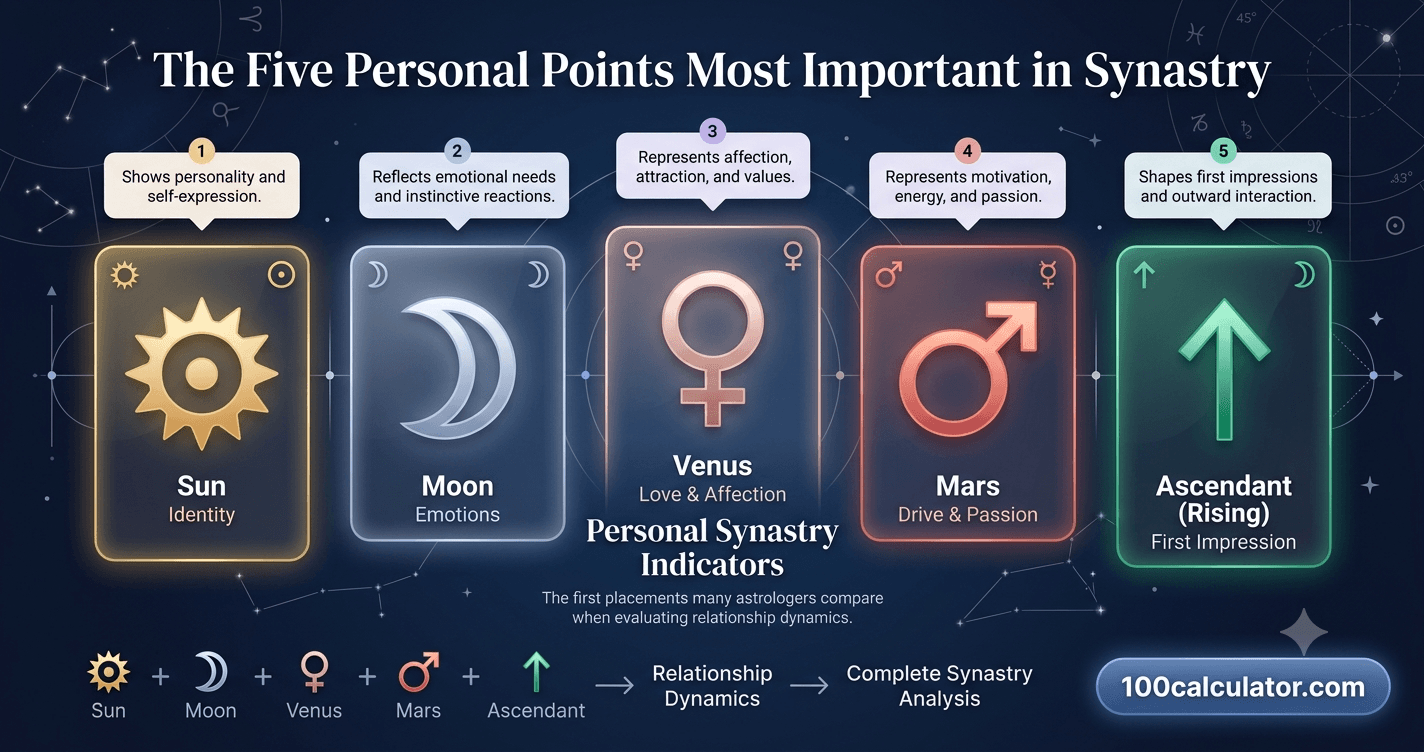
Sun
Core identity & purpose
Shows how each of you shines and what you're building toward.
Moon
Emotional needs
Reveals what makes each of you feel safe and understood.
Venus
Love & attraction style
Shapes how affection is shown and what feels appealing.
Mars
Drive & desire
Points to chemistry, motivation, and conflict style.
Ascendant
First impression
Colors the instant chemistry felt before anything is said.
Sun: Core Identity and Direction
The Sun describes who someone is at the core: their sense of self, their confidence, and the direction they're generally headed in life. When one person's planet lines up well with the other's Sun, it often shows up as feeling genuinely seen and encouraged to be yourself around them.
Moon: Emotional Needs and Comfort
The Moon governs emotional needs, habits, and what makes someone feel secure. Moon contacts between two charts often explain why a relationship feels comfortable fast, or why it takes real effort to feel at ease with someone. If you haven't looked yours up yet, the My Moon Sign Calculator finds it in seconds, and our guide on what your Moon sign reveals about your emotions goes deeper into this placement on its own.
Venus: Love Language and Attraction
Venus shapes what someone finds attractive and how they naturally express affection, whether that's through words, gifts, physical closeness, or quality time. Venus contacts in synastry are a common reason two people describe a connection as feeling instantly warm.
Mars: Drive, Desire, and Conflict Style
Mars represents motivation, physical energy, and how someone pursues what they want, including how they handle disagreement. Mars contacts often show up as physical chemistry, but they can just as easily point to friction if the two people's styles clash.
Ascendant: First Impressions and Instant Chemistry
The Ascendant, or rising sign, is the sign that was rising on the eastern horizon at the moment of birth. It shapes the outward impression someone gives off before anyone gets to know them well. If you're not sure of yours yet, the Sun Moon Rising Calculator is a quick way to check it, and our piece on how to find your big three astrology placements explains why the Ascendant gets grouped with the Sun and Moon as one of the most important points in a chart.
Sun-Moon Contacts: The Classic Sign of Recognition
If there's one combination experienced astrologers check first, it's aspects between one person's Sun and the other's Moon. The Sun represents who someone is; the Moon represents what makes them feel safe. An aspect that connects the two touches both pieces at once, which is why it so often reads as immediate recognition, like you understand each other before you've had time to actually explain yourselves.
A supportive Sun-Moon aspect, such as a trine or sextile, tends to feel easy from early on. A tighter aspect, like a conjunction, can feel intense in a similar way, sometimes almost too familiar too fast. A square or opposition between the Sun and Moon doesn't rule out a good relationship, but it can mean one person's core identity occasionally rubs against the other's emotional needs, which is worth noticing rather than ignoring.
Venus and Mars: Where Attraction Lives
If Sun-Moon contacts explain recognition, Venus and Mars explain chemistry. These two planets describe what draws people together physically and romantically, and they're usually the second place astrologers look after the Sun and Moon.
Venus-Mars Aspects and Romantic Chemistry
Venus-Mars aspects are one of the most commonly cited indicators of physical and romantic chemistry in synastry, since Venus describes what someone finds attractive and Mars describes how they pursue it. An easy aspect, like a trine or sextile, often points to chemistry that feels natural and mutual, without either person having to push for it. A tighter aspect, like a conjunction or square, can bring intense attraction too, sometimes with more push-pull mixed in.
Moon-Venus and Moon-Moon: Comfort and Emotional Safety
Moon-Venus aspects tend to soften a connection, blending emotional comfort with affection in a way that feels nurturing rather than purely exciting. Moon-Moon aspects, where both people's Moons connect directly, often point to a shared emotional rhythm: similar comfort routines, similar reactions to stress, and a sense of being on the same wavelength without much explaining required.
Saturn Contacts: Commitment, Stability, and Growing Pains
Saturn represents structure, responsibility, time, and long-term commitment. When one person's Saturn touches the other's personal planets, especially the Sun, Moon, or Venus, astrologers often read it as a "long-haul" indicator, a sign the relationship has real staying power once both people put in the work.
That said, Saturn contacts don't always feel exciting at first. They can bring a sense of weight, responsibility, or even restriction, especially early in a relationship. This isn't automatically a bad sign; it's often the difference between a connection that stays fun but stays shallow, and one that asks both people to actually grow up a little.
Beyond the Big Five: Mercury, Jupiter, and the Outer Planets
The Sun, Moon, Venus, Mars, and Ascendant get most of the attention, but a few other planets add useful texture to a synastry reading once the basics are covered.
Mercury: Communication and Mental Connection
Mercury governs how someone thinks, talks, and processes information. Mercury contacts between two charts often explain why a conversation with one person flows easily while another requires more patience, independent of how well the two of you get along otherwise.
Jupiter: Shared Growth and Optimism
Jupiter represents growth, generosity, and optimism. Jupiter contacts to someone's personal planets often feel encouraging, like being around someone who makes you feel more hopeful or more willing to take a chance on something.
Uranus, Neptune, and Pluto: Intensity Without Much Individual Detail
Uranus, Neptune, and Pluto move so slowly that they can add real intensity to a chart comparison, around excitement, idealism, or transformation, but they carry less weight for telling two specific people apart. Uranus takes about 84 years to complete one orbit, Neptune around 165, and Pluto roughly 248, which means most people born within a few years of each other share nearly identical positions for all three. Our guide on how to find where the planets were at your birth is a useful next step if you want to see your own outer planet placements alongside the faster-moving ones.
The Ascendant and 7th House: Partnership Themes
Two more placements round out a solid synastry reading, and both depend on knowing an accurate birth time.
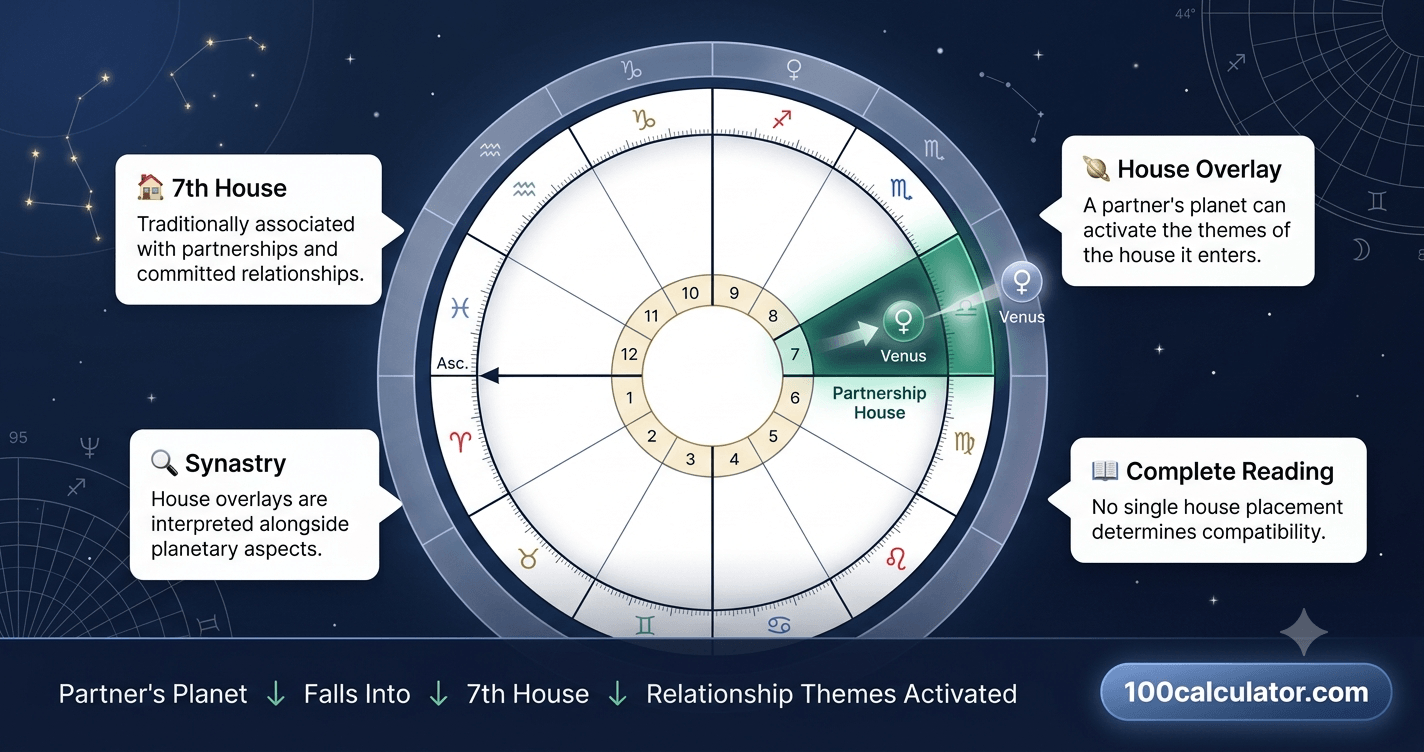
We covered the Ascendant's role in first impressions earlier, but it's worth repeating here: when someone's planet lands close to the other person's Ascendant, it often shows up as an immediate pull, even before either person consciously notices why. The 7th house adds a related layer. Traditionally called the house of partnership, it covers marriage, close one-on-one relationships, and how someone shows up once they're committed to another person. In synastry, astrologers check whether one person's planets fall inside the other's 7th house, since a planet placed there often shapes how that specific partnership feels or what role that person tends to play in it. Our guide on what each house in your birth chart represents explains the 7th house alongside the other eleven.
How to Read Your Own Synastry Chart, Step by Step
You don't need years of study to start noticing the placements that matter most. Here's a simple order to work through:
- Gather both birth details. You'll want an accurate date, time, and location of birth for both people. The time matters most for the Ascendant and houses; the planets themselves are usually accurate even with an approximate time.
- Build both individual charts first. A Birth Chart Calculator or Planetary Positions Calculator gives you each person's placements on their own, which makes the comparison easier to follow.
- Run the comparison. A synastry calculator lines up both charts and lists the aspects between them automatically, instead of you measuring angles by hand.
- Start with the big five. Look at aspects involving the Sun, Moon, Venus, Mars, and Ascendant before anything else. These will tell you the most in the least amount of reading.
- Look at the pattern, not one aspect. One tough square doesn't undo a chart full of supportive contacts, and one easy trine doesn't outweigh a pattern of friction elsewhere. Read the whole picture before drawing a conclusion.
Free Online Tool
Skip the manual angle math
100 Calculator's Compatibility (Synastry) Calculator takes both sets of birth details and lays out the aspects between the two charts for you, right in your browser, with no account required.
Common Mistakes to Avoid When Reading Synastry
A few habits quietly lead people to the wrong conclusions about a chart comparison. Here's what to watch for:
- Fixating on one placement. A single hard aspect doesn't define a relationship any more than a single easy one guarantees it.
- Ignoring the orb. An aspect that's several degrees from exact is much weaker than one that's tight, even though both technically count.
- Treating squares and oppositions as automatically bad. They create friction, not failure. Plenty of long relationships run on a few well-handled hard aspects.
- Comparing sun signs and stopping there. Two "incompatible" sun signs can still have several supportive Moon, Venus, and Mars aspects that matter more day to day. Our piece on Moon sign vs Sun sign digs into why relying on just one placement leaves out most of the picture.
- Skipping the Ascendant entirely. Because it needs an accurate birth time, it's tempting to leave it out, but planet-to-planet aspects still work fine without one. Just hold off on Ascendant-based conclusions until you have a reliable time.
- Reading the chart without any context. Aspects describe dynamics. How two real people communicate and treat each other still matters more than any single placement.
Related Calculators
Put what you just read into practice, try these free tools instantly, no sign-up required.
Free Sun Moon Rising Calculator
Discover your Sun, Moon, and Rising zodiac signs instantly.
Planetary Positions Calculator
View accurate planetary positions for any date and location.
Birth Chart Calculator
Generate your complete natal birth chart based on birth details.
My Moon Sign Calculator
Find your Moon sign to understand your emotional inner self.
Compatibility (Synastry) Calculator
Check zodiac compatibility between you and your partner.
Myths vs Facts About Synastry Compatibility
A lot of confusion around synastry comes from a handful of ideas that sound reasonable but don't hold up once you look closer.
| Myth | Fact |
|---|---|
| "Bad synastry means the relationship is doomed." | Challenging aspects point to friction, not failure. Many long, healthy relationships have several of them. |
| "Matching sun signs is enough to know you're compatible." | Sun-sign compatibility looks at just one placement out of dozens that matter in a full comparison. |
| "More aspects always means more compatibility." | A handful of strong contacts between the Sun, Moon, Venus, Mars, and Ascendant usually says more than dozens of minor ones. |
| "Synastry can tell you if a relationship will last." | It describes patterns and dynamics. It can't predict effort, timing, or how two people choose to treat each other. |
| "You need a professional astrologer to read synastry." | The basics, checking the big five planets and the major aspects between them, are learnable with practice and a reliable chart calculator. |
A note on how to use this guide: Synastry is a symbolic, tradition-based practice, not a scientifically validated method for predicting how a relationship will turn out. Treat it as a reflective tool and a fun way to talk about a relationship with someone, not as a substitute for direct communication, professional counseling, or your own judgment about whether a relationship is healthy for you.
More From Astrology Self Discovery
Still building your knowledge of charts, placements, and what they mean? These related guides dig deeper into the topics covered above.
Frequently Asked Questions
What is synastry in astrology?
Synastry is the branch of astrology that compares two people's birth charts to see how their planets interact. Instead of just comparing sun signs, it overlays both charts and studies the angles, or aspects, between every planet in one chart and every planet in the other. The word comes from the Greek for "together" and "star." Astrologers use it mainly for romantic relationships, though the same method works for friendships, family, and business partnerships.
Which planets matter most in synastry?
The Sun, Moon, Venus, Mars, and Ascendant carry the most weight, since they describe core identity, emotional needs, attraction, drive, and first impressions. Aspects between these five points in two charts tend to shape how a relationship actually feels day to day. Outer planets like Uranus, Neptune, and Pluto still matter, but they move so slowly that they're often shared by an entire generation, which makes them less useful for telling two specific people apart.
What does a Venus-Mars aspect mean in synastry?
Venus-Mars aspects are one of the most commonly cited indicators of physical and romantic chemistry in synastry, since Venus describes what someone finds attractive and Mars describes how they pursue it. An easy aspect, like a trine or sextile, often points to chemistry that feels natural and mutual. A tighter aspect, like a conjunction or square, can bring intense attraction too, sometimes with more friction or a push-pull dynamic mixed in.
Are squares and oppositions always a bad sign in synastry?
No. Squares and oppositions create tension, but tension isn't automatically negative. It often points to growth, passion, or a dynamic that keeps a relationship interesting rather than flat. Plenty of long, happy relationships have several challenging aspects between the charts. What tends to matter more is how both people handle friction when it comes up, which synastry alone can't tell you.
What's the difference between synastry and a composite chart?
Synastry compares two separate, complete birth charts side by side and studies the aspects between them, so both people stay distinct in the analysis. A composite chart is different: it calculates the midpoint between each pair of matching planets and builds one new, blended chart that represents the relationship as its own entity. Many astrologers look at both, since they answer slightly different questions.
Do I need an exact birth time to check synastry?
An exact birth time isn't required for the Sun, Moon, and planet placements themselves, but it does matter for the Ascendant and house positions, which shift roughly every two hours. Without a birth time, you can still compare planet-to-planet aspects with reasonable accuracy. If you want to look at 7th house overlays or Ascendant contacts specifically, a birth certificate or hospital record is worth tracking down first.
What is an orb in astrology?
An orb is the amount of wiggle room astrologers allow around an exact aspect angle before it still counts as active. A trine is technically 120 degrees exactly, but most astrologers still count it if the planets are within a few degrees on either side. Major aspects involving personal planets typically get a wider orb than minor aspects, and tighter orbs are generally read as stronger.
Why do Sun-Moon aspects matter so much in synastry?
The Sun represents core identity and the Moon represents emotional needs, so an aspect between one person's Sun and the other's Moon touches both who someone is and what makes them feel secure. A supportive Sun-Moon aspect often shows up as an easy sense of being understood early on. It's one of the first contacts experienced astrologers check when comparing two charts.
What does the 7th house mean in synastry?
The 7th house is traditionally called the house of partnership, covering marriage, close one-on-one relationships, and how someone shows up in committed pairings. In synastry, astrologers check whether one person's planets land inside the other's 7th house, since a planet placed there often shapes how that partnership feels or what role that person plays in it.
Can two people with difficult synastry still have a good relationship?
Yes. Synastry is a description of dynamics, not a verdict on whether a relationship will succeed. Two people can have several challenging aspects and still build a strong, lasting relationship through communication, effort, and shared values, and two people with an "easy" chart comparison can still struggle if those other pieces aren't there. Charts describe patterns; people decide what to do with them.
How is synastry different from sun sign compatibility?
Sun sign compatibility only compares one placement, the Sun, which narrows every person down to one of twelve categories. Synastry compares the Sun, Moon, and every other planet in both charts, along with the Ascendant and house placements, so it accounts for far more of each person's astrological makeup. It's a more detailed, more individualized way of looking at the same basic question.
Do outer planets like Neptune and Pluto matter in synastry?
They can add meaningful themes, especially around intensity, idealism, or transformation, but they matter less for telling two specific people apart. Neptune takes about 165 years to complete one orbit and Pluto around 248, so most people born within a few years of each other share nearly identical outer-planet positions. Aspects to the personal planets usually reveal more about a specific relationship.
Does synastry apply to friendships and family relationships too?
Yes. Synastry works the same way for any relationship, not just romantic ones. Family and friendship charts are read a little differently, since Venus and Mars carry less weight for a sibling relationship than they would for a partner, but the same aspect-by-aspect comparison applies. Many astrologers use it to understand parent-child dynamics or long friendships just as often as romantic pairings.
What role does the Ascendant play in attraction?
The Ascendant, or rising sign, describes the impression someone gives off before they've said much of anything, sometimes called the "mask" a person wears in public. When one person's planet lands close to the other's Ascendant, it often shows up as an immediate pull or a strong first impression, even before either person consciously notices why.
Is synastry scientifically proven?
No. Synastry is a symbolic, tradition-based practice, not a scientifically validated method for predicting relationship outcomes. There's no peer-reviewed evidence that planetary positions influence human relationships. Many people still find it a genuinely useful, reflective way to talk about a relationship or notice patterns worth discussing. It's best treated as a conversation starter rather than a verdict.
About 100 Calculator
100 Calculator is a free hub of online calculators and educational guides covering health, finance, trading, crypto, astrology, education, and more. Every tool is built to be fast, easy to use, and genuinely free, with no account or signup required.
We built this guide, and tools like the Compatibility (Synastry) Calculator referenced throughout it, to make astrology a little easier to explore on your own terms. Head back to the 100 Calculator homepage to browse the full library of tools, or learn more about the team behind them on our About Us page.