What Do Your Sun, Moon, and Rising Signs Mean?
A beginner-friendly walkthrough of your "big three" — what your Sun, Moon, and Rising signs actually represent, how they work together, and how to find all three of your own in a couple of minutes.
If you've ever taken a quick horoscope quiz online, you already know your Sun sign. But if someone asks about your Moon or Rising sign and you draw a blank, you're not alone. Most people learn their Sun sign first and stop there, even though it's only one-third of the picture.
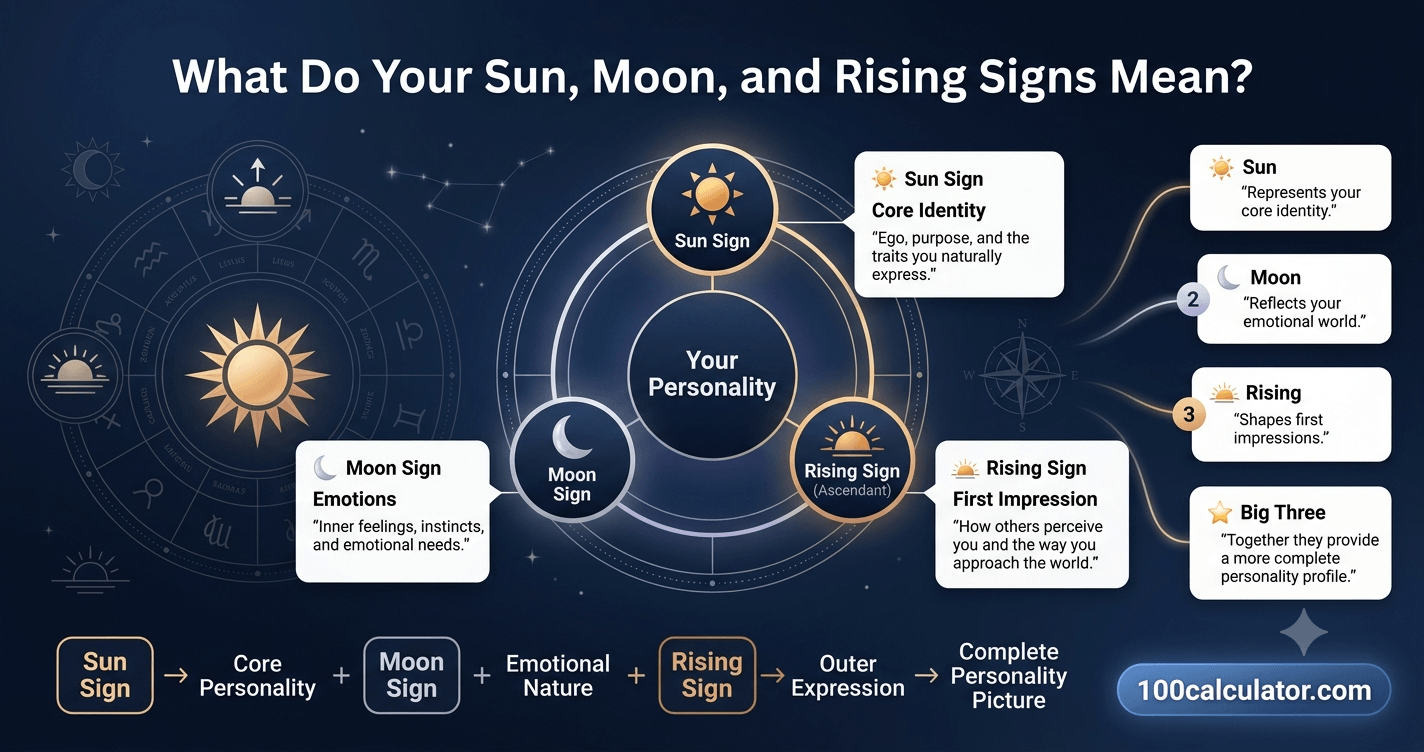
Your Sun, Moon, and Rising signs — often called your "big three" — are the three placements astrologers usually look at first when reading a birth chart. Together, they say more about your personality than any single sign can on its own.
Your Sun sign reflects your core identity and how you express yourself, your Moon sign reflects your inner emotional world, and your Rising sign (also called your Ascendant) reflects the impression you give other people when they first meet you. All three come from the exact date, time, and location you were born, which is why two people can share a Sun sign and still feel like completely different people.
In this guide, we'll walk through what each placement means, how they interact, and how to find all three of your own in a couple of minutes with 100 Calculator's Free Sun Moon Rising Calculator. If you already know your birth details, keep them handy — you'll be able to look up your own big three as we go.
Understanding the "Big Three" in Astrology
Astrology is built around a simple idea: the exact position of the sky at the moment and place you were born can be mapped and interpreted. That full map is called a birth chart, or natal chart, and it includes dozens of placements. The "big three" — Sun, Moon, and Rising — are just the three most talked-about ones, because together they cover the most ground for understanding a person.
Where the "Big Three" Idea Comes From
Newspaper horoscopes only ever use your Sun sign, because it's the only placement you can work out from a birthday alone. That's convenient for a daily column, but it's also why so many people think astrology begins and ends with "I'm a Leo" or "I'm a Scorpio." Astrologers who read full charts have always used more than one placement — the Sun, Moon, and Rising sign combination just became the popular shorthand for "the essentials" once people started asking for more than a single-line horoscope.
Why These Three Placements Get So Much Attention
Each of the big three describes a different layer of you. The Sun is your identity and how you express it. The Moon is your emotional and instinctive side, mostly hidden from public view. The Rising sign is your outward presentation — the first impression you make before anyone gets to know the rest of you. Read together, those three layers give a much more rounded picture than any one of them alone.
Worth knowing
Astrology is a symbolic and cultural practice, not a scientifically validated system. Nothing in this guide should be treated as fact, prediction, or a substitute for professional advice. Think of it as a framework for self-reflection and conversation rather than a rulebook.
Here's the short version of what's ahead:
Sun Sign
Who You Are
Your core identity, ego, and the way you naturally express yourself to the world.
Moon Sign
How You Feel
Your emotional instincts and the private inner world you don't always show other people.
Rising Sign
How You Come Across
The first impression you give and the energy people notice about you right away.
Want more detail on how astrologers weigh these three placements against each other? Our guide to finding your big three astrology placements walks through it step by step. For now, let's take each one in turn.
What Is Your Sun Sign?
Your Sun sign is whichever zodiac sign the Sun appeared to be passing through, from Earth's point of view, on the day you were born. It's the placement most people mean when they casually ask "what's your sign," and it's the only one of the big three you can work out from a birthday alone.
What Your Sun Sign Represents
In astrology, the Sun sign is generally described as your core identity: your basic personality, your ego, and the traits you lead with. It's often treated as the answer to "who are you at your center," separate from how you feel privately or how others perceive you on first meeting. That's also why it tends to be the placement people feel most confident describing about themselves.
How Your Sun Sign Is Determined
The Sun moves through each zodiac sign roughly once a month, so your Sun sign depends only on your birth date. The approximate date ranges are widely used as a quick reference, though the exact "cusp" date can shift by a day depending on the year:
| Sign | Approximate Dates |
|---|---|
| Aries | March 21 – April 19 |
| Taurus | April 20 – May 20 |
| Gemini | May 21 – June 20 |
| Cancer | June 21 – July 22 |
| Leo | July 23 – August 22 |
| Virgo | August 23 – September 22 |
| Libra | September 23 – October 22 |
| Scorpio | October 23 – November 21 |
| Sagittarius | November 22 – December 21 |
| Capricorn | December 22 – January 19 |
| Aquarius | January 20 – February 18 |
| Pisces | February 19 – March 20 |
If your birthday lands within a day or two of one of these boundaries, it's worth double-checking with an exact calculator rather than relying on memory, since the cutoff can move slightly from year to year.
What Is Your Moon Sign?
Your Moon sign is whichever zodiac sign the Moon was passing through at your exact time of birth. Unlike the Sun, the Moon moves quickly through the zodiac, so this placement needs a bit more information than your Sun sign does.
What Your Moon Sign Represents
Where the Sun sign is about identity, the Moon sign is about instinct. It's usually described as your emotional reactions, what genuinely comforts you when you're stressed, and the private side of yourself you don't always show at work or to new acquaintances. Some astrologers describe it as the "home" version of you, the one that shows up when you're not performing for anyone. Our guide on what your Moon sign reveals about your emotions goes deeper into this side of the chart.
Why the Moon Sign Needs a Birth Date and Time
The Moon moves through roughly one zodiac sign every two to three days, which is much faster than the Sun's pace of about one sign per month. Most days, your birth date alone is enough to pin down your Moon sign. But if you were born close to the moment the Moon shifted from one sign to the next, even a rough birth time can be the difference between two possible answers. If you want to compare how these two placements typically get discussed together, see our breakdown of Moon sign vs. Sun sign.
Curious what your own instincts look like on paper? 100 Calculator's My Moon Sign Calculator works this out for you once you enter your birth date and time.
What Is Your Rising Sign (Ascendant)?
Your Rising sign, also called your Ascendant, is whichever zodiac sign was climbing above the eastern horizon at the exact moment and place you were born. Of the big three, it's the one that depends most heavily on precision, since it's tied to your specific birth minute, not just your birth day.
What Your Rising Sign Represents
The Rising sign is usually described as your outward presentation: the energy people pick up on before they really know you, and the general demeanor you carry into new situations. Some astrologers call it the "mask" you wear in public, though that phrase can sound more negative than it's meant to. It's less about hiding your real self and more about the entry point other people use to first read you. Our beginner's guide to reading your birth chart covers how the Rising sign fits into the rest of the chart.
Why the Rising Sign Changes Every Couple of Hours
As the Earth rotates, a new zodiac sign appears to rise over the eastern horizon roughly every two hours. That makes the Rising sign the most time-sensitive placement by far — far more sensitive than the Moon, and nowhere near as forgiving as the Sun. Two siblings born on the same day, a few hours apart, can end up with completely different Rising signs even though they share a Sun sign and, usually, a Moon sign too.
Tip
If you don't know your birth time down to the minute, your Sun sign is still fully reliable, and your Moon sign usually is too. Only the Rising sign truly needs that level of precision, so treat it as an estimate until you can confirm the exact time.
Since the Rising sign sits at the starting point of a full chart, it's also the easiest of the big three to place visually. 100 Calculator's Birth Chart Calculator lays out your Ascendant alongside the rest of your placements on one wheel.
How to Calculate Your Sun, Moon, and Rising Signs
You don't need to learn any astronomy to find your big three. A calculator does the actual math; you just need to have the right details ready before you start.
Information You'll Need Before You Start
- Your exact birth date — day, month, and year
- Your birth time, as close to exact as possible
- Your birth city and country
- A couple of minutes to enter everything
Worth knowing
If your birth certificate lists a suspiciously round time, like exactly on the hour, it may have been estimated rather than recorded precisely. Treat your Rising sign result as an estimate rather than a certainty in that case, especially if it lands close to the boundary between two signs.
Step-by-Step With a Sun Moon Rising Calculator
- Gather your birth date, time, and location from a birth certificate, hospital record, or a family member if you're not sure.
- Enter your details into a calculator built for this specific purpose, rather than estimating by hand from memorized date ranges.
- Review your three results — Sun, Moon, and Rising — together rather than in isolation.
- Compare them against the descriptions in this guide to see how the three layers might show up differently in your own life.
Free Online Tool
Find all three signs in one place
100 Calculator's Free Sun Moon Rising Calculator runs right in your browser. Enter your birth date, time, and location, and it calculates your Sun, Moon, and Rising signs instantly, with no account required.
Once you're comfortable with the big three, you can go further with our guide on how to find where the planets were at your birth, which covers the rest of your chart beyond these three placements.
Sun vs. Moon vs. Rising: How They're Different
Seeing all three placements side by side makes it easier to remember what each one actually depends on, and why some are far more time-sensitive than others.
| Placement | Based On | What It Reveals | Changes Roughly Every |
|---|---|---|---|
| Sun sign | Birth date | Your core identity and self-expression | About once a month |
| Moon sign | Birth date and time | Your emotional instincts and inner world | About every 2–3 days |
| Rising sign (Ascendant) | Birth date, time, and location | The first impression you give others | About every 2 hours |
Notice the pattern: the more specific the placement gets about your first impression on others, the more precisely it depends on your exact birth details. For a closer look at how just two of these three interact, our guide to Moon sign vs. Sun sign breaks that relationship down further.
How the Big Three Work Together
None of the three placements is meant to be read alone. Astrologers generally treat them as layers that combine, not competing answers to the same question.
Same Sun Sign, Very Different People
Picture two people who both have their Sun in Leo. The first also has Moon in Cancer and Rising in Virgo — they might come across as reserved and detail-oriented at first, while feeling things deeply in private. The second has Moon in Aries and Rising in Sagittarius — they might seem bold and outspoken from the moment you meet them, wearing their emotions much closer to the surface. Same core Sun sign, two very different overall impressions.
What It Means When Placements Seem to Clash
It's common to feel like your placements contradict each other — outgoing in public but craving quiet time at home, for example. That's not usually treated as a flaw in the chart. It's a reminder that identity, emotion, and presentation are three different things, and a person can reasonably be more than one of them at once depending on the setting.
Expert insight
Professional astrologers generally read a chart holistically, weighing placements against each other rather than treating any single sign as a final verdict. If you're comparing your own big three, look for how they might interact rather than picking whichever one description "wins."
Common Misconceptions About the Big Three
A few mix-ups come up again and again once people start looking beyond their Sun sign. Clearing these up early makes the rest of your chart easier to make sense of.
- "My zodiac sign" means my whole chart. In everyday conversation, "zodiac sign" almost always means just the Sun sign. It's really only one of many placements, including your Moon and Rising signs.
- Astrology signs match the constellations you'd see in the sky tonight. Most Western astrology uses the tropical zodiac, which is based on the seasons and the Earth's position relative to the Sun, not on where the constellations currently sit. The two systems have drifted apart over the centuries, so "your sign" in this system isn't meant to describe the sky as it looks right now.
- A "difficult" placement means something is wrong with you. Modern astrology generally frames placements as tendencies and flavors, not fixed judgments. A placement some people find challenging often just points to an area worth paying attention to, not a flaw to fix.
- The Rising sign is minor or optional. Many astrologers treat it as being just as important as the Sun sign for understanding how someone actually comes across day to day, even though it's less talked about casually.
Common Mistakes When Reading Your Big Three
A few habits make the big three feel less useful than they actually are. Here's what to watch for once you have your results.
- Guessing your birth time instead of looking it up. A rounded or estimated time can quietly shift your Rising sign to a neighboring one.
- Only ever mentioning your Sun sign in conversation, which leaves out two-thirds of what astrologers actually look at.
- Assuming one placement defines your whole personality, rather than reading all three as different layers that combine.
- Skipping the location field in a calculator, which changes the Rising sign result even when the date and time stay the same.
- Treating general descriptions as fixed rules instead of starting points for reflection.
Beyond the Big Three: Where to Go Next
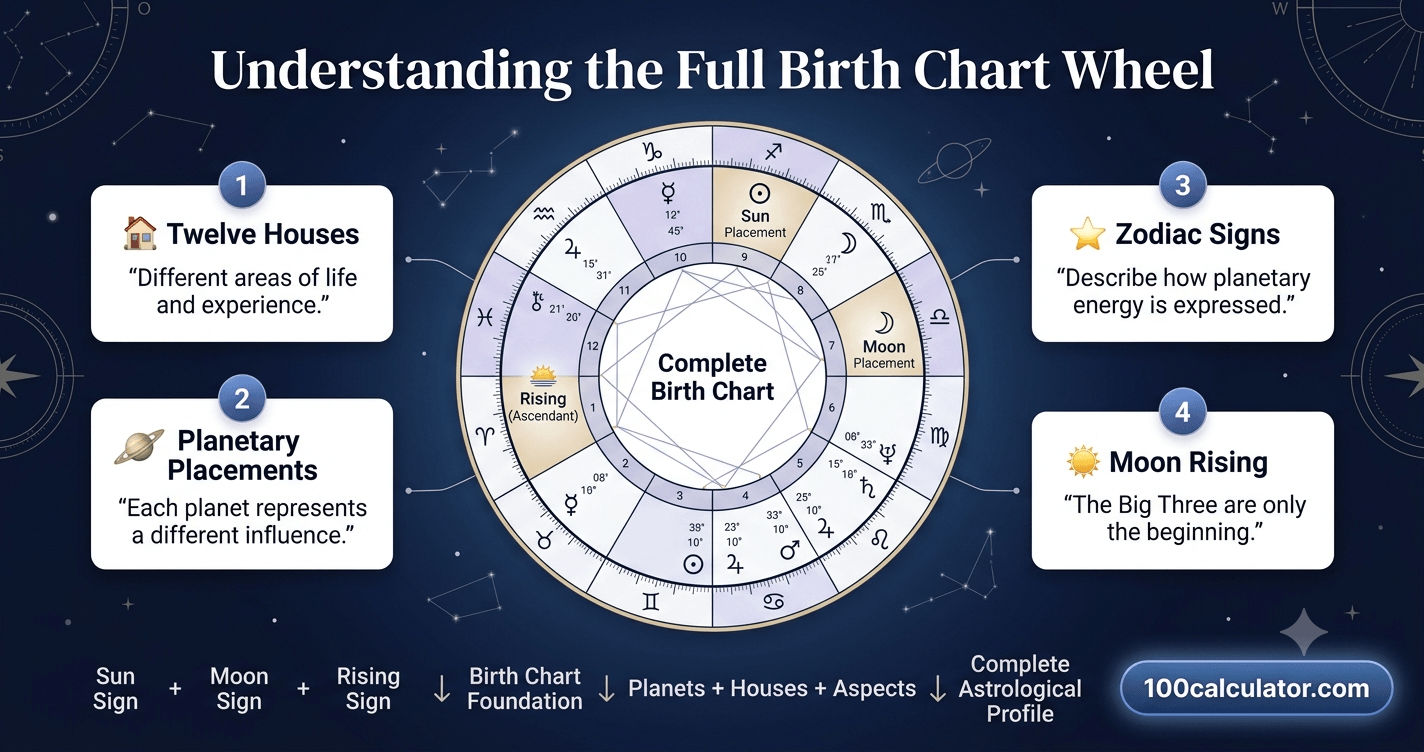
The Sun, Moon, and Rising signs are a solid starting point, but they're only three placements out of a full birth chart. Once you're comfortable with your big three, there's more to explore.
Houses and Your Full Birth Chart
A complete birth chart also includes the other planets — Mercury, Venus, Mars, and beyond — along with twelve "houses," each representing a different area of life like relationships, career, or home. Our guides on what each house in your birth chart represents and why planetary positions matter in birth chart reading are good next steps. When you're ready to map out the rest of your placements, 100 Calculator's Planetary Positions Calculator can help.
Compatibility and Synastry
Once you know your own big three, a natural next step is comparing your chart with someone else's. This practice is called synastry, and it looks at how two people's placements interact with each other. Our articles on how synastry reveals compatibility between two charts and which planet placements matter most in synastry cover this in more depth, and 100 Calculator's Compatibility (Synastry) Calculator can run the comparison for you.
A note on astrology: This article is for entertainment, self-reflection, and educational purposes only. Astrology is a symbolic and cultural practice, not a scientifically validated method for predicting events or determining personality. Use it as a starting point for curiosity and conversation, not as a substitute for professional medical, legal, financial, or mental health advice.
Related Calculators
Put what you just read into practice, try these free tools instantly, no sign-up required.
Free Sun Moon Rising Calculator
Discover your Sun, Moon, and Rising zodiac signs instantly.
Planetary Positions Calculator
View accurate planetary positions for any date and location.
Birth Chart Calculator
Generate your complete natal birth chart based on birth details.
My Moon Sign Calculator
Find your Moon sign to understand your emotional inner self.
Compatibility (Synastry) Calculator
Check zodiac compatibility between you and your partner.
More From Astrology Self Discovery
Ready to keep exploring your chart? These related guides dig deeper into the placements and ideas covered above.
Frequently Asked Questions
What do your Sun, Moon, and Rising signs mean?
Your Sun, Moon, and Rising signs, often called your big three, are the three placements astrologers usually look at first. Your Sun sign reflects your core identity and how you express yourself. Your Moon sign reflects your emotional instincts and inner world. Your Rising sign, also called your Ascendant, reflects the impression you give people when they first meet you. Together, they offer a fuller picture of your personality than any single sign on its own.
What's the difference between your Sun sign and your Rising sign?
Your Sun sign is based only on your birth date and reflects your core identity. Your Rising sign is based on your exact birth time and location, and it reflects how you come across to other people, especially on first meeting. Two people can share the same Sun sign and have completely different Rising signs, which is a big part of why they might not seem alike at all.
Why is my Rising sign different from my Sun sign?
Your Rising sign depends on the exact time and place you were born, not just the date. Because the sky appears to shift roughly one zodiac sign every two hours as Earth rotates, your Rising sign is far more specific to your individual birth moment than your Sun sign, which only depends on the date. That's why family members born on different days can end up with very different Rising signs even when their Sun signs are close together.
Do I need my exact birth time to find my Rising sign?
Yes. The Rising sign changes roughly every two hours, so even a difference of 20 to 30 minutes can shift it to a neighboring sign. If you want an accurate Rising sign, use the most precise birth time you have, ideally down to the minute, along with your birth city. Your Sun sign, and in most cases your Moon sign, don't need this same level of precision.
What if I don't know my exact birth time?
Check your birth certificate or hospital paperwork first, since many list the exact time. If that's not available, a parent or family member may remember an approximate time. Without a reasonably accurate time, your Sun sign will still be reliable, and your Moon sign usually will be too, but treat any Rising sign result as an estimate rather than a certainty until you can confirm the real time.
What does your Moon sign say about you?
Your Moon sign reflects your emotional instincts, the reactions that show up before you've had time to think them through. It points to what genuinely comforts you, how you process stress, and the side of yourself you usually only show to people you trust. Where your Sun sign is more about your outward identity, your Moon sign lives in your private, internal world.
Which matters more: Sun sign, Moon sign, or Rising sign?
None of the three is automatically more important than the others. Astrologers generally treat them as three different layers of the same person: the Sun as identity, the Moon as emotion, and the Rising sign as outward presentation. Which one feels most accurate to you often depends on the situation, since each placement tends to show up more strongly in different parts of your life.
Can two people share a Sun sign and still seem like opposites?
Yes, and it happens often. Two people can have identical Sun signs while having completely different Moon and Rising signs, which changes how their shared Sun sign actually plays out day to day. One might come across as bold and outspoken thanks to an energetic Rising sign, while the other seems quiet and reserved because of a more private Rising sign, even though their core Sun sign is the same.
How often does the Rising sign change?
The Rising sign changes roughly every two hours as the Earth rotates, since it's based on whichever zodiac sign was on the eastern horizon at your exact moment of birth. That's a much faster rate of change than the Sun sign, which shifts about once a month, or the Moon sign, which shifts roughly every two to three days.
Is my Rising sign the same thing as my "zodiac sign"?
Not usually. When people casually ask what your zodiac sign is, they almost always mean your Sun sign, since that's the one you can figure out from a birthday alone. Your Rising sign is a separate placement that requires your birth time and location, and it's typically discussed specifically as your Rising sign or Ascendant rather than just your zodiac sign.
How accurate is a free Sun Moon Rising Calculator?
A calculator is only as accurate as the birth details you enter. If you provide the correct birth date, time, and location, 100 Calculator's Free Sun Moon Rising Calculator works out your placements using the same astronomical positions professional astrologers rely on. The main source of error is usually an incorrect or estimated birth time, which mostly affects the Rising sign and, less often, a Moon sign near a sign change.
Is astrology scientifically proven?
No. Astrology is a symbolic and cultural practice, not a scientifically validated system, and there's no established mechanism by which planetary positions at birth would shape personality. Many people still find value in it as a framework for self-reflection and conversation. It's best treated as a personal or cultural tool rather than a factual predictor of events or a substitute for professional advice.
Can your Moon sign and Sun sign be the same sign?
Yes. Since the Sun and Moon move independently through the zodiac, it's entirely possible, and not unusual, for both to land in the same sign. When that happens, some astrologers say the trait associated with that sign tends to feel especially strong, since both your outward identity and inner emotional world point in a similar direction.
What if my Sun, Moon, and Rising signs seem to contradict each other?
That's normal and doesn't mean anything is wrong with your chart. Each placement describes a different part of you: identity, emotion, and outward presentation. It's common to feel bold and outgoing in public because of your Rising sign while still needing quiet time to recharge because of your Moon sign. Astrologers usually read these differences as layers rather than contradictions.
Do twins born minutes apart have the same big three?
Usually the same Sun sign and Moon sign, since those rarely change within a few minutes. The Rising sign is more likely to differ if the twins were born on opposite sides of a sign change, though this is uncommon since Rising signs shift roughly every two hours. Twins born close together in time will typically share all three, with small placement differences elsewhere in their charts.
What's the easiest way to find all three signs at once?
The fastest way is to use a dedicated tool like 100 Calculator's Free Sun Moon Rising Calculator. Enter your birth date, time, and location, and it works out all three placements at once instead of requiring separate lookups or manual charts. Just make sure your birth details are as accurate as possible, since the Rising sign in particular depends on precise timing.
About 100 Calculator
100 Calculator is a free hub of online calculators and educational guides covering health, finance, trading, crypto, education, astrology, and more. Every tool is built to be fast, accurate, and genuinely free, with no account or signup required.
We built this guide, and tools like the Free Sun Moon Rising Calculator referenced throughout it, to make self-discovery topics a little easier to explore. Head back to the 100 Calculator homepage to explore the full library of tools, or learn more about the team behind them on our About Us page.