Common Crypto Profit Calculation Mistakes to Avoid
A practical, no-fluff breakdown of the calculation mistakes that quietly shrink your crypto profit — fees, cost basis, slippage, taxes, and more — plus the exact math to get your real numbers right.
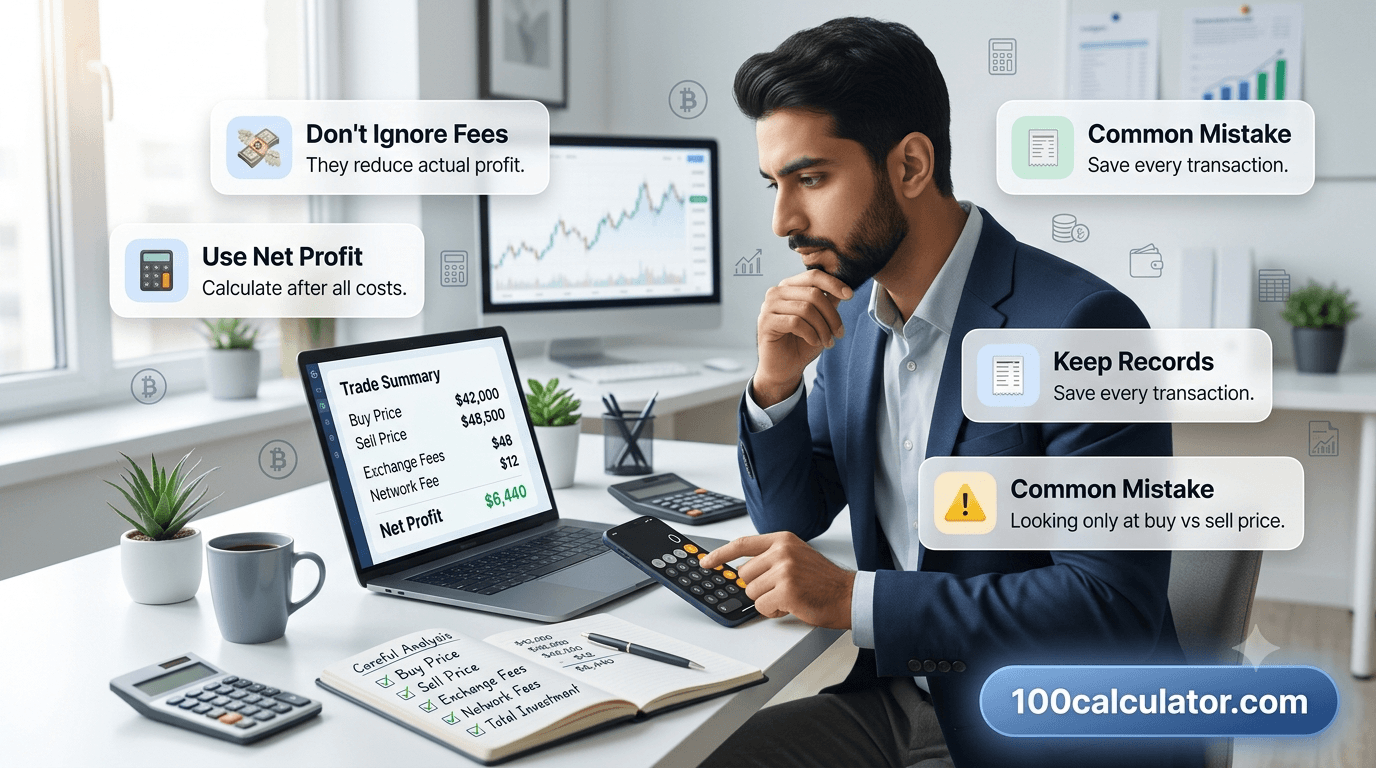
Say you bought Bitcoin at $30,000 and sold it a few months later at $40,000. On paper, that looks like a clean $10,000 profit. Then you remember the trading fee on the way in, the trading fee on the way out, and the small withdrawal fee you paid to move the coins to your bank. Suddenly that "obvious" $10,000 isn't quite right anymore.
This happens to almost everyone who tracks crypto profit on their own. The most common crypto profit calculation mistakes come down to ignoring fees, using the wrong cost basis, confusing paper gains with real ones, and forgetting that gas or network costs quietly eat into what you actually keep. None of these mistakes are complicated once you know to look for them, but each one is easy to miss when you're doing the math by hand.
This guide walks through the calculation mistakes that trip up crypto traders most often, shows the real math with a worked example, and points you to 100 Calculator's Crypto Profit & Exchange Fee Calculator if you'd rather skip manual spreadsheets altogether. First, it helps to understand what "profit" actually means in a crypto trade, since that's where most of these mistakes begin.
How Crypto Profit Is Actually Calculated
Profit sounds simple: sell for more than you paid, and the difference is yours. In crypto, that difference is only the starting point, not the final number.
Every real crypto profit calculation has two layers. The first is gross profit, which is just your sell price minus your buy price. The second is net profit, which is your gross profit minus every fee you paid along the way, including trading fees, withdrawal fees, and any on-chain network fees. Net profit is the number that actually matters, since it reflects what you can spend, reinvest, or report on a tax return.
The Basic Profit Formula
At its simplest, crypto profit looks like this:
Gross Profit = (Sell Price − Buy Price) × Quantity
That formula works fine for a single buy, a single sell, and zero fees. The moment you add fees, multiple purchases at different prices, or a partial sale, this simple version starts giving you a number that's technically correct but practically misleading. We'll build out the full version, fees and all, later in this guide.
Why Crypto Profit Is Trickier Than Stock Profit
A few things make crypto profit harder to calculate accurately than a typical stock trade. Exchanges charge fees on both the buy and the sell side, and often a separate fee just to withdraw your funds. Trading happens 24/7 across multiple exchanges and wallets, so your buy history can be scattered across several places. Crypto-to-crypto trades, like swapping Ethereum for a smaller token, can also count as a taxable event in many countries, even if you never touched cash. On top of all that, blockchain network fees, commonly called gas fees, add a cost that has no real equivalent in traditional stock trading.
Common Crypto Profit Mistakes at a Glance
Before going through each mistake in detail, here's a quick summary of the ones that come up most often, and the simplest way to fix each one.
| Mistake | Why It Happens | Quick Fix |
|---|---|---|
| Ignoring fees | Trading, withdrawal, and network fees are easy to overlook | Subtract every fee, not just the trading fee |
| Wrong cost basis | Assuming every coin was bought at the same price | Pick FIFO, LIFO, or average cost, and stay consistent |
| Mismanaging partial sells | Not recalculating your average price after selling part of a position | Recompute your remaining cost basis after every sale |
| Realized vs unrealized gains | Treating a paper gain as locked-in profit | Only count profit once you've actually sold |
| Overlooking slippage | Assuming the quoted price is the price you actually got | Compare your fill price to the quote afterward |
| Forgetting taxes | Assuming only cashing out to a bank counts as taxable | Check your local rules before you trade, not after |
| Mixing up currencies | Comparing prices across different trading pairs | Convert everything to one base currency first |
| Ignoring gas fees | Skipping on-chain fees on small DeFi trades | Factor gas costs into your break-even price |
Mistake #1: Ignoring Trading, Withdrawal, and Network Fees
Fees are the single biggest reason a back-of-the-napkin profit calculation ends up wrong. Most people remember the trading fee on their sell order, but forget everything else that chips away at the final number.
Maker and Taker Fees
Most exchanges charge what's called a maker fee or a taker fee on every trade. A maker fee applies when your order adds liquidity to the order book, like a limit order that sits and waits to be filled. A taker fee applies when your order removes liquidity immediately, like a market order that fills right away. Taker fees are usually a little higher than maker fees, and both can apply on the buy side and the sell side of a trade.
Withdrawal and Network Fees Add Up Too
Beyond the trading fee itself, many exchanges charge a separate fee to withdraw crypto to an external wallet or to your bank account. If you bought on one platform and sold on another, you may have paid a withdrawal fee to move the coins in between, and that fee belongs in your profit calculation too, even though it technically happened between the buy and the sell.
Mistake #2: Using the Wrong Cost Basis Method
Cost basis is what you actually paid to acquire a crypto asset, including fees. It sounds straightforward until you've bought the same coin multiple times at different prices, which is exactly what happens if you dollar-cost average or simply buy more whenever the price dips.
FIFO, LIFO, and Average Cost Explained
There are a few standard ways to decide which purchase price applies when you sell:
| Method | How It Works | Best For |
|---|---|---|
| FIFO (First In, First Out) | Assumes the coins you bought first are the ones you sell first | Simple, consistent tracking; often the default in many countries |
| LIFO (Last In, First Out) | Assumes the coins you bought most recently are the ones you sell first | Managing short-term gains in specific situations |
| Average Cost | Blends the price of every purchase into one average cost per coin | Long-term holders who buy in regularly, like with DCA |
| Specific Identification | Lets you choose exactly which purchase lot you're selling | Traders who track individual lots closely and want full control |
Why the Method You Choose Changes Your Number
Switching between FIFO and average cost on the same set of trades can genuinely change your profit number, sometimes by a meaningful amount if your buy prices varied a lot. If you've been building a position gradually, our guide on how to calculate your average cost basis in crypto walks through the average cost method step by step, or you can plug your own numbers into the Crypto Average Cost Basis Calculator directly.
For the tax side of things, our piece on why cost basis matters for crypto tax reporting covers how this choice affects what you report at tax time.
Mistake #3: Mismanaging Partial Sells and Multiple Buy-Ins
Buying crypto in stages, rather than all at once, is common and often a smart strategy. It also makes profit calculation more complicated the moment you sell only part of what you hold.
A Simple Example With Three Buys
Imagine you bought Ethereum in three separate purchases: 0.2 ETH at $2,000, 0.3 ETH at $2,400, and 0.5 ETH at $2,800. That's 1 ETH total, at a blended average cost of $2,520 per coin.
Now say you sell 0.4 ETH at $3,000. Using the average cost method, that 0.4 ETH carries a cost basis of $1,008 (0.4 × $2,520), against sale proceeds of $1,200, for a profit of $192 on that portion. The remaining 0.6 ETH keeps the same $2,520 average cost basis, just at a smaller quantity, ready for whenever you sell the rest.
The mistake most people make here is comparing the entire sale to only their most recent, or lowest, purchase price, instead of the blended cost across everything they're holding. That single shortcut can make a real profit look much bigger, or a real loss look like a gain.
If you're building your position through regular purchases rather than partial sells, our guide on how dollar-cost averaging works for crypto investors explains how that strategy affects your average cost over time, and the Crypto Dollar Cost Averaging (DCA) tool can model it using your own numbers.
Mistake #4: Confusing Realized Profit With Unrealized (Paper) Gains
Watching your portfolio value climb feels like profit, but it isn't, not yet.
Unrealized profit, sometimes called a paper gain, is the increase in value of crypto you're still holding. It only becomes real, or realized, once you actually sell. Until then, it's a number that can just as easily shrink back down if the price drops before you cash out.
This mistake shows up most often when someone checks their exchange balance, sees it's up 40%, and mentally counts that as money already made. It isn't spendable, it isn't taxable in most places, and it isn't guaranteed to still be there tomorrow.
Mistake #5: Overlooking Slippage on Larger Trades
The price you see when you place an order isn't always the price you actually get.
What Causes Slippage
Slippage happens when there isn't enough liquidity at your exact quoted price to fill your entire order, so part or all of the trade executes at a slightly different price. It tends to show up most on larger trades, less liquid tokens, or during fast-moving markets when prices are shifting by the second.
A trade that looked like it would net a certain profit based on the quoted price can end up a little lower once slippage is factored in, especially on market orders rather than limit orders. Comparing your actual average fill price to the price you saw before confirming the trade is the easiest way to catch this.
Mistake #6: Forgetting That Crypto Profit May Be Taxable
It's easy to assume taxes only apply once you convert crypto back into your local currency. In many places, that assumption is wrong.
Depending on where you live, selling crypto for cash, trading one cryptocurrency for another, and in some cases even spending crypto directly, can all count as separate taxable events. Each one may need its own profit or loss calculation, using whichever cost basis method your local tax rules require or allow.
Tax treatment for crypto varies a lot from country to country, and the rules keep evolving as regulators catch up with how people actually use crypto. This isn't tax advice, and nothing in this guide should be treated as a substitute for checking your own country's current rules or speaking with a tax professional who's familiar with digital assets.
Mistake #7: Mixing Up Currencies When Calculating Profit
Crypto prices are quoted in all sorts of pairs: BTC/USDT, ETH/BTC, a token priced only against another token. Comparing numbers across different pairs without converting them first is an easy way to miscalculate profit.
If you bought a token priced in BTC and later sold it priced in USDT, you can't just subtract one number from the other. You need to convert both sides of the trade into a single base currency, usually your local fiat currency like USD, EUR, or GBP, using the exchange rate at the time each trade happened.
This becomes especially important if you're trading between two cryptocurrencies directly, without ever touching fiat. Converting everything to one consistent currency, at the time of each transaction, is the only way to get a profit number that actually means something.
Mistake #8: Ignoring Gas Fees on DeFi and On-Chain Trades
Gas fees are the cost of getting a transaction processed on a blockchain, and they're easy to forget because they're paid separately from the trade itself.
How Gas Fees Eat Into Small Trades
On networks like Ethereum, gas fees rise and fall with how busy the network is at any given moment. A $10 gas fee barely matters on a $5,000 trade, but it can wipe out a meaningful chunk of profit on a $50 trade. Swapping tokens directly through a decentralized exchange usually means paying gas on top of any trading fee the platform itself charges, so both costs need to be included.
If you're trading small amounts regularly, our guides on why Ethereum gas fees rise and fall throughout the day and how to convert Ethereum gas fees into USD costs can help you time trades around lower fee periods.
You can also plug your own transaction details into the Ethereum Gas Fee to USD Calculator to see the dollar cost before you confirm a trade.
How to Calculate Your Crypto Profit Correctly (Step-by-Step)
Once you know what to watch for, calculating crypto profit accurately just means being methodical about it.
The Net Profit Formula
Here's the full formula, fees and all:
Net Crypto Profit Formula
Net Profit = Net Sale Proceeds − Total Cost Basis
Net Sale Proceeds: what you received from selling, after subtracting selling fees and any withdrawal or network fees
Total Cost Basis: what you paid to acquire the asset, including buying fees, based on the cost basis method you're using
Step-by-Step Walkthrough With Real Numbers
- List every purchase that makes up your current holdings, including price, quantity, and any fees paid on each buy.
- Add up your total cost basis: the sum of (price × quantity) plus fees, across every purchase.
- Calculate your gross proceeds when you sell: sale price × quantity sold.
- Subtract selling fees and any withdrawal or network fees from your gross proceeds to get your net proceeds.
- Subtract your total cost basis from your net proceeds. What's left is your net profit, or loss.
- Recalculate for what's left if you only sold part of your holdings, before your next sale.
Here's how that looks with real numbers. Say you made two purchases of Bitcoin: 0.5 BTC at $30,000 plus a $15 trading fee, and 0.5 BTC at $34,000 plus a $17 trading fee. Your total cost basis comes to $32,032 for 1 BTC.
Later, you sell all 1 BTC at $40,000. The exchange charges a $40 selling fee, and you pay a $10 network fee to withdraw the proceeds. Your net proceeds come to $39,950 ($40,000 − $40 − $10).
Net Profit = $39,950 − $32,032 = $7,918
That $7,918 is your real, fee-adjusted profit, a meaningfully more accurate number than the $10,000 you'd get by just subtracting $30,000 from $40,000 without accounting for any fees at all.
Free Online Tool
Rather skip the manual math?
100 Calculator's Crypto Profit & Exchange Fee Calculator runs this exact calculation for you. Enter your buy price, sell price, quantity, and fees, and it works out your net profit instantly, with no spreadsheet required.
Related Calculators
Put what you just read into practice, try these free tools instantly, no sign-up required.
Crypto Dollar Cost Averaging (DCA)
Plan recurring crypto purchases using a dollar-cost averaging strategy.
Crypto Average Cost Basis Calculator
Calculate your average cost basis across multiple crypto purchases.
Market Cap What If Calculator
Estimate a coin's price if it reached a target market cap.
Crypto Profit & Exchange Fee Calculator
Calculate your crypto trading profit after exchange fees.
Ethereum Gas Fee to USD Calculator
Convert Ethereum gas fees into real-time USD cost estimates.
A Quick Checklist Before You Calculate Profit
Before you finalize any crypto profit number, whether it's for your own records or for taxes, run through this list:
- Every trading fee, on both the buy and sell side, is included
- Withdrawal, deposit, and network or gas fees are accounted for
- You're using one consistent cost basis method across all your trades
- Partial sells have an updated, recalculated cost basis for what's left
- Unrealized gains aren't being counted as if they were already realized
- All prices are converted into a single base currency
- You've noted which trades might be taxable events in your country
Once you've checked off this list, you'll have a genuinely accurate profit number instead of a rough estimate. If you'd rather not run through all of this by hand every time, our Crypto Profit & Exchange Fee Calculator handles the fee math automatically, and our guide on how to calculate crypto trading profit correctly walks through the process in even more depth.
Financial disclaimer: This article is for general educational purposes only and isn't financial, investment, or tax advice. Cryptocurrency trading carries risk, and profit and tax calculations can vary based on your country, exchange, and personal circumstances. Always double-check your numbers and talk to a qualified financial or tax professional before making investment decisions or filing taxes.
More From Our Crypto Tools Guide
These related guides from our Crypto Tools Guide cover more of the calculations and strategies mentioned throughout this article.
Frequently Asked Questions
What's the most common mistake people make when calculating crypto profit?
The most common mistake is only looking at the difference between your buy price and sell price while ignoring fees. Trading fees, withdrawal fees, and network or gas fees can all quietly shrink a profit that looked much bigger on paper. A more accurate calculation subtracts every fee involved, not just the one shown on your trade confirmation screen.
Do I need to include exchange fees when calculating crypto profit?
Yes. Trading fees, along with any withdrawal or deposit fees tied to a specific trade, are part of your real cost and should always be subtracted from your gross profit. Skipping them overstates how much you actually made, especially if you trade often or move funds between wallets and exchanges.
What's the difference between realized and unrealized crypto profit?
Unrealized profit, often called a paper gain, is the increase in value of crypto you still hold and haven't sold. Realized profit is money you've actually locked in by selling. Only realized profit is real, spendable money, since unrealized gains can shrink or disappear if the price drops again before you sell.
Which cost basis method should I use for crypto: FIFO, LIFO, or average cost?
There's no single best method for everyone. FIFO is simple and widely used, average cost works well if you buy in regularly through dollar-cost averaging, and LIFO or specific identification give more control if you're managing short-term positions closely. What matters most is picking one method and using it consistently, especially for tax reporting.
Do gas fees count as part of my crypto profit or loss?
Yes. Gas fees you pay to send, swap, or interact with crypto on-chain are a real cost and belong in your profit calculation, just like a trading fee. They matter most on smaller trades, where a fixed gas fee can eat up a much bigger share of your gains.
How does slippage affect my actual crypto profit?
Slippage happens when the price you actually pay or receive differs from the price you saw when you placed the trade, usually because of low liquidity or a fast-moving market. On larger trades, slippage can quietly reduce your real profit below what the quoted price suggested, so it's worth comparing your fill price to the quote afterward.
Is crypto profit taxable?
In many countries, yes, though the exact rules vary and change over time. Selling crypto for cash, trading one crypto for another, and sometimes even spending crypto can all be treated as taxable events depending on where you live. This isn't tax advice, so check your local tax authority's guidance or speak with a professional before you file.
What's the difference between gross profit and net profit in crypto trading?
Gross profit is simply your sell price minus your buy price, before anything else is subtracted. Net profit is what's left after you subtract every fee involved, including trading, withdrawal, and network costs. Net profit is the number that actually reflects what you walked away with.
How do I calculate profit when I bought crypto at different prices?
You'll need to combine your purchases into a single cost basis using a method like average cost or FIFO. Add up what you paid across every buy, including fees, then divide by your total quantity to get an average cost per coin. That average is the number you compare against your sale price.
Does converting one crypto to another count as a taxable event?
In many countries, yes. Trading Bitcoin for Ethereum, for example, is often treated the same as selling Bitcoin for cash and then buying Ethereum with it, which can trigger a taxable gain or loss on the Bitcoin side of the trade. Rules differ by country, so check local guidance before assuming a crypto-to-crypto trade is tax-free.
Why does my exchange show a different profit number than my own calculation?
Many exchange dashboards calculate profit using just the trade price, without factoring in withdrawal fees, deposit fees, or fees paid on a different platform where you originally bought the coin. If you've moved crypto between wallets or exchanges, your own manual calculation is usually more accurate than a single platform's built-in number.
What happens to my cost basis if I only sell part of my crypto holdings?
You'll need to recalculate the cost basis for whatever you have left, based on the method you're using. With average cost, for instance, your remaining coins keep the same average price per coin; you just apply that same average to a smaller quantity going forward.
Should I calculate crypto profit in USD or in crypto?
Most traders and tax authorities calculate profit in fiat currency, like USD, since that's the standard unit for reporting gains and comparing performance over time. If you're trading between two cryptocurrencies, it still helps to convert both sides of the trade into your base fiat currency, so you're working with one consistent number.
What's the easiest way to calculate crypto profit without doing the math by hand?
A dedicated calculator that accounts for your buy price, sell price, quantity, and every fee in between is usually the fastest and most reliable option. 100 Calculator's Crypto Profit & Exchange Fee Calculator is built for exactly this, so you can skip manual spreadsheet work and get an accurate number in seconds.
About 100 Calculator
100 Calculator is a free hub of online calculators and educational guides covering health, finance, trading, crypto, education, and more. Every tool is built to be fast, accurate, and genuinely free, with no account or signup required.
We built this guide, and tools like the Crypto Profit & Exchange Fee Calculator referenced throughout it, to make everyday crypto questions a little easier to answer. Head back to the 100 Calculator homepage to explore the full library of tools, or learn more about the team behind them on our About Us page.