How to Convert Ethereum Gas Fees into USD Costs
A plain-English walkthrough of what an Ethereum gas fee actually is, how the math behind it works, and how to turn that Gwei number in your wallet into a real dollar amount.

You confirm a swap on Ethereum, glance at the wallet screen, and see something like "0.0041 ETH" listed as the gas fee. That number alone doesn't tell you much. What you actually want to know is how many dollars just left your wallet, and whether that was a fair price for what you did.
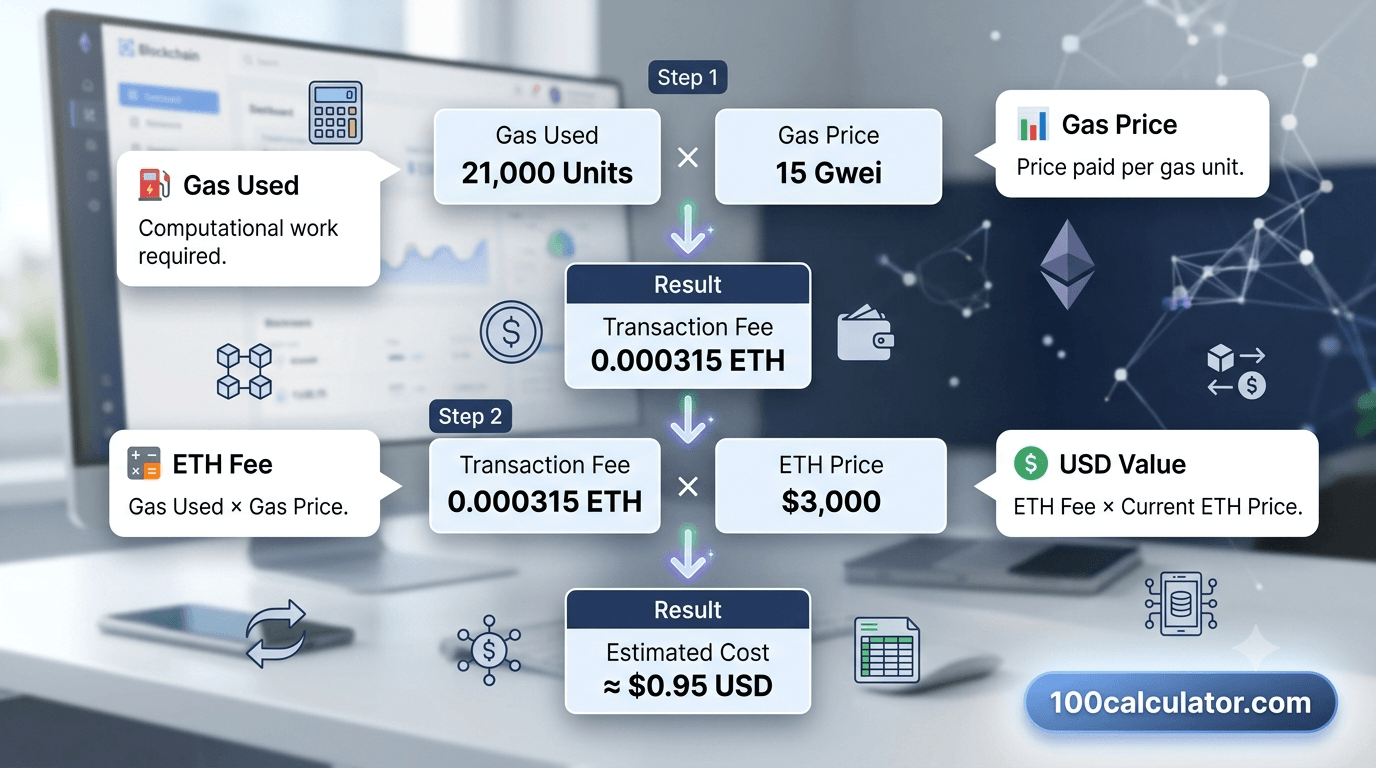
To convert an Ethereum gas fee to USD, multiply the gas used by the gas price in Gwei to get the fee in ETH, then multiply that ETH amount by the current ETH-to-USD exchange rate. Gwei is a small unit of ETH, used because gas prices in whole ETH would be a string of awkward decimals. Once you have the fee in ETH, converting it to dollars is ordinary currency conversion.
If you'd rather skip the arithmetic, 100 Calculator's Ethereum Gas Fee to USD Calculator does this conversion instantly using a live ETH price. Understanding what's happening behind that number is still worth a few minutes, though, since it explains why fees swing so much from one day to the next and helps you spot when you're about to overpay.
We'll start with what a gas fee actually is, walk through the exact math with real numbers, compare typical costs across common transaction types, and cover the easiest ways to pay less.
What Is an Ethereum Gas Fee?
Gas is the unit Ethereum uses to measure computational effort. Every action on the network, from sending ETH to swapping tokens on a decentralized exchange, requires the network's computers to do some amount of work, and that work has to be paid for somehow.
A gas fee is the amount of gas a transaction uses, multiplied by the price of gas at that moment. The fee is paid in ETH, even though gas prices are usually quoted in a smaller unit called Gwei, since whole-ETH numbers would be tiny, hard-to-read decimals for something as small as a token swap.
Think of gas the way you'd think of postage. A short letter costs less to mail than a heavy package, because you're paying for the work of moving it, not for what's inside. Ethereum gas works the same way: simple actions use less gas and cost less, complicated ones use more gas and cost more, and the price per unit of gas moves with demand.
One detail worth knowing early: the fee is charged once a transaction is included in a block, whether that transaction ultimately succeeds or not. We'll come back to why that matters in the mistakes section further down.
Why Ethereum Charges Gas Fees
Preventing Spam and Infinite Loops
Without some cost attached to using the network, nothing would stop someone from flooding Ethereum with pointless transactions, or writing a contract that loops forever. Gas fees put a real cost on computation, which keeps the network usable for everyone else.
Every transaction sets a gas limit, the maximum amount of gas it's allowed to consume. If a transaction runs out of gas partway through, the Ethereum Virtual Machine reverts any changes it made, but it still keeps the gas already spent. That's the network charging for work actually performed, not just work promised.
Who Actually Receives the Fee
Since the 2021 update known as EIP-1559, a gas fee doesn't go to one place. Part of it, the base fee, is set automatically by the network based on how busy it is, and that part is burned, meaning it's permanently removed from circulation rather than paid to anyone. (EIP-1559) The rest, the priority fee, or tip, goes to the validator who includes your transaction in a block.
That split matters because it explains why you can't simply pay a validator directly to jump the queue. The network sets a floor price everyone has to clear, and your tip is what makes a validator want to pick your transaction over someone else's.
Gwei, Wei, and ETH Explained
Ethereum's fee system uses three related units, and mixing them up is one of the easiest ways to misread a transaction.
Wei is the smallest possible unit of ETH, similar to how a cent is the smallest common unit of a dollar, except far smaller. One ETH equals 1,000,000,000,000,000,000 wei. Gwei, short for "giga-wei," is one billion wei, or 0.000000001 ETH. Gas prices are almost always quoted in Gwei, because whole-ETH figures would be a string of zeros that's hard to read at a glance.
| Unit | Value in ETH | Common Use |
|---|---|---|
| Wei | 0.000000000000000001 ETH | Smallest unit; rarely used directly |
| Gwei | 0.000000001 ETH | Standard unit for quoting gas prices |
| ETH | 1 ETH | The currency gas fees are ultimately paid in |
Why Gwei Instead of Plain ETH
Saying a transaction costs "0.000000315 ETH" is technically correct but hard to reason about. Saying the gas price is "15 Gwei" is something a wallet, a block explorer, or a person can glance at and immediately compare to yesterday's average. Gwei exists purely to make gas prices readable, not because it's a separate currency.
How Gas Fees Are Calculated
The Core Formula
Every gas fee comes down to one calculation:
The Gas Fee Formula
Gas Used × (Base Fee + Priority Fee) = Total Fee
(Gwei)
Total Fee (Gwei) × 0.000000001 = Total Fee (ETH)
Gas Used — the actual computational work your transaction consumed, measured in gas units.
Base Fee — the network-set minimum price per unit of gas, adjusted automatically based on demand, and burned once paid.
Priority Fee — the tip you add per unit of gas to make your transaction more attractive to validators.
Once you have the total fee in ETH, converting to US dollars is a separate, simple step: multiply the ETH amount by the current ETH-to-USD exchange rate. That's the entire calculation 100 Calculator's Ethereum Gas Fee to USD Calculator runs for you automatically.
Gas Limit vs. Gas Used
It's easy to confuse the gas limit with the gas fee, but they're not the same thing. The gas limit is the maximum amount of gas you're willing to let a transaction consume, a safety cap you or your wallet sets. Gas used is what the transaction actually consumed. You only pay for gas used, not your full gas limit, and any difference is automatically returned to your wallet.
A standard ETH transfer requires exactly 21,000 units of gas, a fixed figure set by the protocol. (ethereum.org) That number never changes with network conditions; what changes is the price you pay per unit of that gas.
Step-by-Step: Converting a Gas Fee to USD by Hand
The formula above is simple, but it helps to walk through it with real numbers. Here are two examples: a basic ETH transfer, and a more demanding token swap.
Example 1: A Simple ETH Transfer
- Check the gas used. A standard ETH transfer uses 21,000 gas units, a fixed amount set by the protocol.
- Check the gas price. Say the network is quiet and the combined base fee plus tip comes to 15 Gwei.
- Multiply gas used by gas price. 21,000 × 15 = 315,000 Gwei.
- Convert Gwei to ETH. 315,000 × 0.000000001 = 0.000315 ETH.
- Convert ETH to USD. At an example price of $2,000 per ETH, 0.000315 × 2,000 = $0.63.
A plain transfer during a quiet moment on the network costs well under a dollar. That's the baseline every other transaction gets compared to.
Example 2: A Token Swap
- Check the gas used. A typical swap on a decentralized exchange uses somewhere around 150,000 gas units, since it involves more contract logic than a simple transfer.
- Check the gas price. Say the network is busier this time, with a combined gas price of 25 Gwei.
- Multiply gas used by gas price. 150,000 × 25 = 3,750,000 Gwei.
- Convert Gwei to ETH. 3,750,000 × 0.000000001 = 0.00375 ETH.
- Convert ETH to USD. At $2,000 per ETH, 0.00375 × 2,000 = $7.50.
Same formula both times. The swap costs more mainly because it uses more gas units, not because something mysterious happened to the price.
The $2,000 figure above is a round number chosen to keep the math easy to follow. ETH's real price changes constantly, so for an actual transaction, plug the live price into 100 Calculator's Ethereum Gas Fee to USD Calculator instead of estimating by hand.
Using an Ethereum Gas Fee to USD Calculator
Doing the math by hand is useful once, mostly so you understand what's happening underneath. For everyday use, a calculator that pulls in the current ETH price saves time and avoids arithmetic mistakes.
Free Online Tool
Skip the manual conversion
100 Calculator's Ethereum Gas Fee to USD Calculator takes your gas used and gas price in Gwei, applies a current ETH-to-USD rate, and gives you an instant dollar figure, with no signup or wallet connection required.
A calculator like this is especially handy when you're weighing options before committing to a transaction, like deciding whether to wait an hour for gas prices to drop or confirm a swap right away.
What Makes Gas Prices Rise and Fall
Network Congestion and Demand
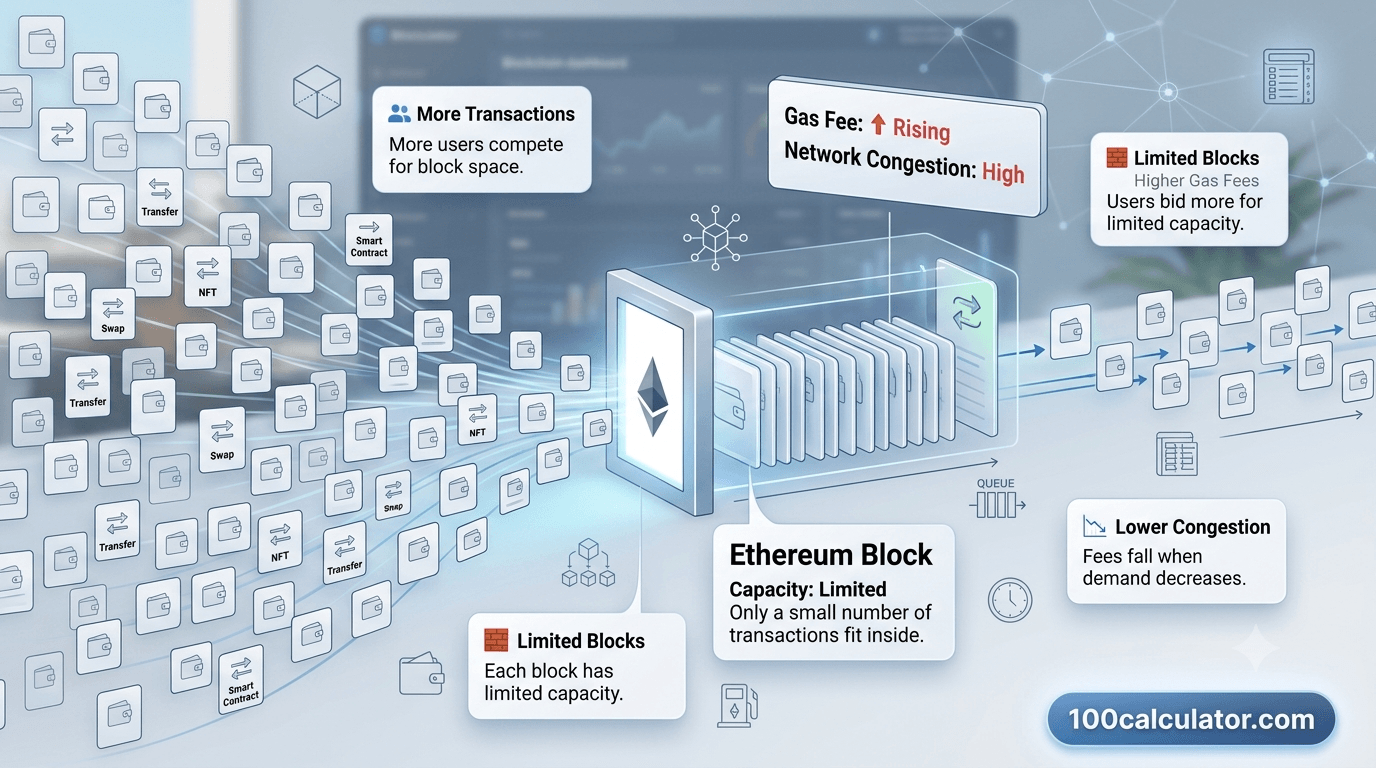
Gas prices move the way prices move in any auction: when more people want block space than a block can hold, the price to get in rises. Ethereum blocks have a target size, and when transactions pile in faster than blocks can process them, the base fee increases automatically to bring demand back down.
Time of Day and Day of Week
Ethereum activity tends to track when large regions of the world are awake and online, so gas prices often dip during quieter overnight hours and climb during peak activity. This pattern isn't a guarantee, since a single popular NFT drop or token launch can spike demand at any hour, but it's a reasonable starting point if your transaction can wait. Our guide on why Ethereum gas fees rise and fall throughout the day breaks this pattern down in more detail.
Transaction Complexity
Beyond network-wide demand, the specific action you're taking matters too. A transaction that touches multiple contracts, like a swap routed through several liquidity pools, uses more gas units than a plain transfer, so it costs more even at the exact same Gwei price.
Typical Gas Costs for Common Transactions
Gas prices swing constantly, but gas units, the amount of computational work each action requires, stay far more stable. Knowing roughly how much gas different actions use explains why some transactions cost more than others even when network conditions haven't changed.
| Transaction Type | Typical Gas Units | Cost at 15 Gwei | Cost at 50 Gwei |
|---|---|---|---|
| Simple ETH transfer | 21,000 (fixed) | $0.63 | $2.10 |
| ERC-20 token transfer | ~45,000–65,000 | ~$1.65 | ~$5.50 |
| Token swap (decentralized exchange) | ~100,000–200,000 | ~$4.50 | ~$15.00 |
| NFT mint | Varies widely, often 50,000–300,000+ | ~$3.60 | ~$12.00 |
Dollar figures assume ETH at $2,000 and use a representative gas amount from the middle of each range, so treat them as a starting point for comparison rather than an exact quote. NFT mint costs in particular depend heavily on how the specific contract is written.
The pattern to notice: it's the gas units, not some hidden markup, that make a swap cost roughly seven times more than a plain transfer at the same Gwei price. Complexity is what you're really paying for.
Choosing a Gas Speed: Slow, Standard, or Fast
Most wallets let you pick from a few preset speeds instead of setting your own priority fee manually. Each one trades cost for confirmation time.
LOWEST COST
10+ min
Low Priority
A small tip gives validators little reason to prioritize you over other transactions. Reasonable when you're not in a hurry.
MOST COMMON
1–3 min
Standard Priority
What most wallets suggest by default, balancing cost against speed for everyday transactions.
FASTEST
Under 1 min
High Priority
A larger tip pushes your transaction toward the front of the line. Worth it when timing matters.
When Speed Actually Matters
For most everyday transfers, the standard setting is fine. Speed becomes worth paying extra for when you're racing a price that's moving, competing for a limited NFT mint, or trying to get a liquidation-sensitive DeFi position settled before conditions change.
Practical Ways to Lower Your Gas Costs
None of these make gas free, but small habits add up, especially if you transact often.
- Time non-urgent transactions for quieter periods, since gas prices often ease up outside peak hours
- Batch actions together when an app supports it, so you pay one gas fee instead of several
- Use a Layer 2 network for supported apps, since these networks settle transactions far more cheaply than Ethereum's main network
- Check your wallet's suggested gas limit instead of raising it unnecessarily; a limit that's too low can cause a failed transaction that still burns gas
- Avoid re-approving token allowances you don't need anymore, since each approval is its own gas-charged transaction
- Compare estimated costs across a couple of gas speed tiers before confirming larger transactions
Common Mistakes When Estimating Gas Fees
- Treating the wallet's estimate as a guarantee. It's based on the current base fee; the network can move before your transaction confirms.
- Forgetting that a failed transaction can still cost gas. If it's included in a block and then reverts, the gas used up to that point is gone.
- Comparing Gwei prices without accounting for gas units. A high Gwei price on a cheap action can still cost less than a low Gwei price on an expensive one.
- Ignoring Layer 2 options entirely. Many popular apps now run on networks where the same action costs a fraction of mainnet Ethereum.
- Setting a gas limit far below what a complex transaction needs, which leads to a failed, gas-consuming transaction instead of a successful one.
Related Calculators
Put what you just read into practice, try these free tools instantly, no sign-up required.
Crypto Dollar Cost Averaging (DCA)
Plan recurring crypto purchases using a dollar-cost averaging strategy.
Crypto Average Cost Basis Calculator
Calculate your average cost basis across multiple crypto purchases.
Market Cap What If Calculator
Estimate a coin's price if it reached a target market cap.
Crypto Profit & Exchange Fee Calculator
Calculate your crypto trading profit after exchange fees.
Ethereum Gas Fee to USD Calculator
Convert Ethereum gas fees into real-time USD cost estimates.
Gas Fees, Cost Basis, and Your Crypto Records
Adding Gas to Your Cost Basis
Gas fees aren't just a cost of doing business; they can affect your records too. Many people add the gas fee paid on a purchase to that asset's cost basis, and subtract the gas fee paid on a sale from the proceeds, which changes the gain or loss calculated later. Rules vary by country and situation, so this is a good conversation to have with a tax professional rather than something to assume.
If you're tracking cost basis across multiple purchases, 100 Calculator's Crypto Average Cost Basis Calculator can help you see the full picture, and our guide on why cost basis matters for crypto tax reporting goes deeper into how this works.
Gas Fees as a Trading Cost
If you swap tokens often, gas fees function much like a trading commission: a small amount that quietly eats into returns if you're not tracking it. Someone dollar-cost averaging into a token with many small purchases pays gas on every single one, which is worth weighing against making fewer, larger purchases instead. Our guide on how dollar cost averaging works for crypto investors walks through that trade-off, and 100 Calculator's Crypto Profit & Exchange Fee Calculator can factor fees into your actual profit picture rather than just looking at price movement.
Disclaimer: This article is for general educational purposes and isn't financial, tax, or investment advice. Gas fees, ETH prices, and network conditions change constantly, so treat every dollar figure here as an illustration rather than a live quote. For decisions about taxes, trading, or how gas fees affect your specific situation, talk to a qualified tax professional or financial advisor.
Sources & References
This guide draws on ethereum.org's official documentation on gas and fees, the original EIP-1559 proposal that introduced the base fee and priority fee system, and Etherscan's gas tracker for readers who want to check live network conditions.
More From Our Crypto Tools Guide
Still getting comfortable with Ethereum's fee system, or curious about other crypto topics covered on this side of the site? These guides go deeper into related questions.
Frequently Asked Questions
What is an Ethereum gas fee?
A gas fee is the cost of doing something on the Ethereum network, whether that's sending ETH, swapping tokens, or interacting with a smart contract. It's calculated by multiplying the amount of gas your transaction uses by the current price per unit of gas, then paid in ETH. Simple actions use less gas and cost less; complex actions that touch multiple contracts use more gas and cost more.
How do I convert an Ethereum gas fee to USD?
Multiply the gas used by the gas price in Gwei to get the total fee in Gwei, then multiply that number by 0.000000001 to convert it to ETH. Finally, multiply the ETH amount by the current ETH-to-USD exchange rate. 100 Calculator's Ethereum Gas Fee to USD Calculator does all three steps for you using a live exchange rate.
What is Gwei?
Gwei is a small denomination of ETH, equal to one billionth of an ETH, or 0.000000001 ETH. It exists to make gas prices easier to read and compare, since quoting fees in whole ETH would mean dealing with long strings of decimal zeros for even routine transactions. "Gwei" is short for "giga-wei," since one Gwei equals one billion wei, the smallest possible unit of ETH.
What's the difference between the base fee and the priority fee?
The base fee is set automatically by the Ethereum network based on how congested it is, and it's burned once paid, meaning it's removed from circulation rather than given to anyone. The priority fee, or tip, is an extra amount you offer on top of the base fee to make your transaction more attractive to the validator who decides which transactions go into the next block.
Why are Ethereum gas fees so high sometimes?
Gas fees rise when demand for space in the next block outpaces the network's capacity, similar to how prices rise in any auction with more bidders than spots available. Popular NFT drops, major token launches, and periods of heavy trading activity are common triggers. Complex transactions that touch multiple smart contracts also use more gas units, adding to the cost independent of congestion.
How much gas does a simple ETH transfer use?
A basic ETH transfer, sending ETH from one wallet to another with no additional smart contract logic, uses exactly 21,000 gas units. This figure is fixed by the Ethereum protocol itself and doesn't change with network conditions. What does change is the gas price, so the same 21,000-gas transfer can cost very different amounts in USD depending on when you send it.
How much gas does sending an ERC-20 token use?
Sending an ERC-20 token typically uses somewhere between 45,000 and 65,000 gas units, more than a plain ETH transfer because the transaction has to update the token contract's internal balance records rather than just moving native ETH. The exact figure depends on how the specific token's contract is written, so treat this as a typical range rather than a fixed number.
Why did my token swap cost more gas than a plain transfer?
A swap on a decentralized exchange usually involves several steps behind the scenes, like checking token approvals, calculating exchange rates, and updating liquidity pool balances, often across more than one smart contract. That extra computational work is commonly in the range of 100,000 to 200,000 gas units, several times more than a simple transfer, which is why swaps cost noticeably more even at the same Gwei price.
Do I still pay gas if my transaction fails?
It depends on when the failure happens. If your transaction is rejected before it's included in a block, for example because your gas limit was clearly too low, no gas is consumed. But if it's included in a block and then runs out of gas or reverts partway through execution, the gas used up to that point is still charged, even though the transaction didn't succeed.
Is unused gas refunded if I don't need my full gas limit?
Yes. You only pay for gas actually used, not your entire gas limit. If you set a gas limit higher than what your transaction ends up needing, the unused portion is automatically returned to your wallet. This is separate from the base fee itself, which you can't get back once a transaction is confirmed, since it's burned rather than held by anyone.
Are gas fees burned, or does someone keep them?
Both happen, just to different parts of the fee. The base fee portion is burned, permanently removed from ETH's circulating supply, while the priority fee, or tip, goes to the validator who included your transaction in a block. This split was introduced with the EIP-1559 upgrade specifically to make base fees predictable while still giving validators an incentive to process transactions quickly.
How can I lower my Ethereum gas fees?
Timing non-urgent transactions for quieter network periods, batching multiple actions into one transaction when an app allows it, and using a Layer 2 network for supported apps are the most effective ways to pay less. Double-checking your gas limit instead of setting it unnecessarily high, and avoiding repeated token approvals you no longer need, help too.
Are Layer 2 network fees calculated the same way?
The same basic idea, gas used multiplied by gas price, still applies on Layer 2 networks. What's different is the cost, since these networks batch many users' transactions together and only periodically post compressed data back to Ethereum's main network, spreading that cost across everyone. That's why the same action often costs a small fraction of what it would on Ethereum's mainnet.
Do all cryptocurrencies charge gas fees like Ethereum?
Most blockchains charge some kind of network fee to process transactions, but not all of them use the term "gas" or calculate it the same way. Ethereum's gas model, and the fee models of other EVM-compatible networks, work roughly as described here. Bitcoin, for example, calculates fees based on transaction size in bytes rather than computational gas units, even though the underlying purpose is similar.
Does the ETH price affect how much I pay in gas?
Yes, indirectly. Gas itself is priced in Gwei, a unit of ETH, so the gas fee in ETH terms depends only on gas used and gas price in Gwei. But your final cost in US dollars also depends on ETH's market price at that moment, since the same amount of ETH is worth more or less depending on where the exchange rate stands.
Should I keep records of gas fees for taxes?
In many places, gas fees can affect your cost basis or reportable gains, so keeping a record of what you paid, and when, is a reasonable habit if you transact regularly. Tax treatment of gas fees varies by country and can change, so this is a good detail to confirm with a tax professional familiar with cryptocurrency rather than assuming one universal rule applies.
About 100 Calculator
100 Calculator is a free hub of online calculators and educational guides covering health, finance, trading, crypto, education, and more. Every tool is built to be fast, accurate, and genuinely free, with no account or signup required.
We built this guide, and tools like the Ethereum Gas Fee to USD Calculator referenced throughout it, to make everyday crypto questions easier to answer without needing a developer background. Head back to the 100 Calculator homepage to explore the full library of tools, or learn more about the team behind them on our About Us page.