DCA vs Lump Sum: Which Crypto Strategy Wins Long-Term?
A practical, numbers-first look at dollar-cost averaging versus investing a lump sum in crypto, including what the research actually shows, where it breaks down for a volatile asset like Bitcoin, and how to pick the approach that fits your own situation.
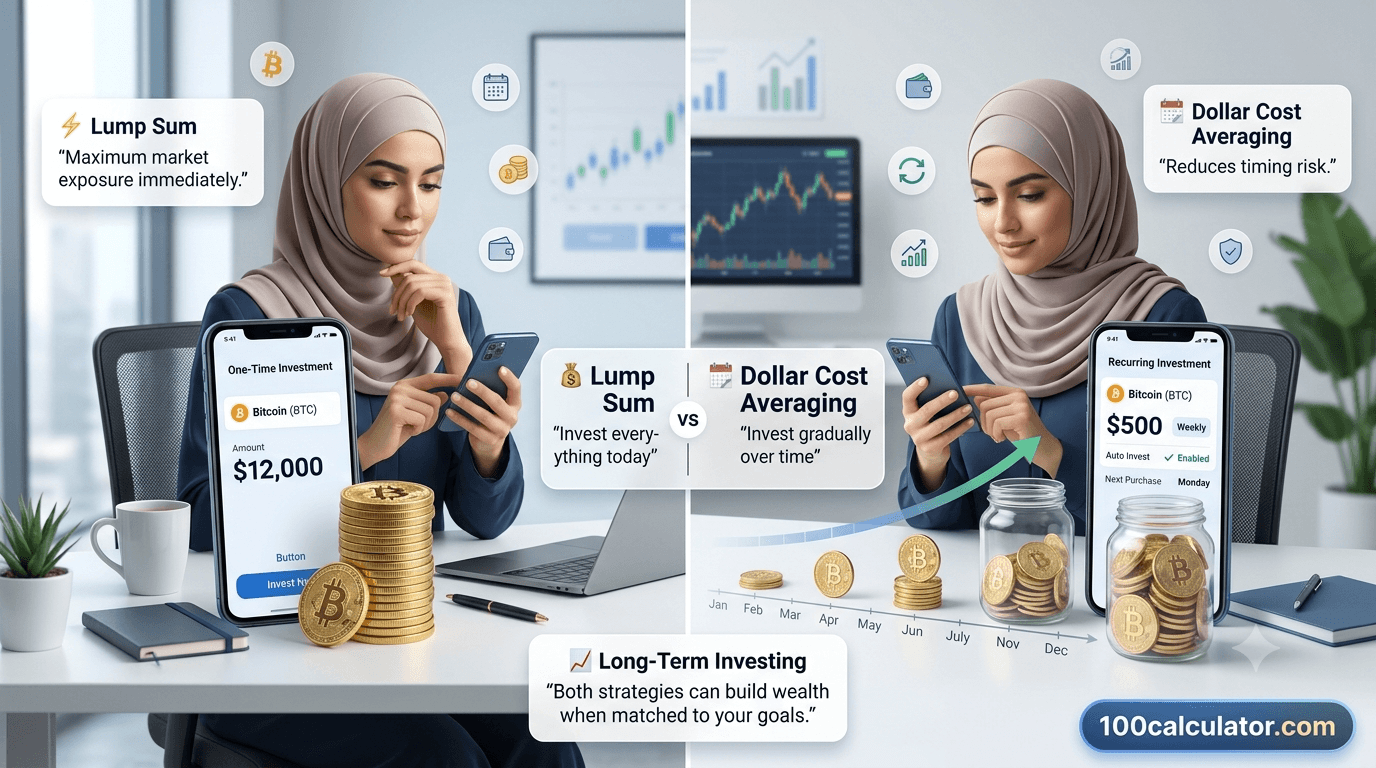
Say you just got a work bonus, sold an old investment, or simply set aside a few thousand dollars you want to put into crypto. Now you're stuck on a question that trips up even experienced investors: put it all in at once, or spread it out over the next few months?
Dollar-cost averaging (DCA) means splitting a fixed amount of money into equal chunks and investing them on a regular schedule regardless of price, while lump-sum investing means putting the entire amount to work immediately. Research on traditional markets generally favors lump sum for raw returns, since money invested sooner spends more time exposed to a market that trends upward more often than not. DCA trades some of that expected return for a smoother ride and less regret if prices drop right after you invest.
Crypto makes this decision higher-stakes than it is with stocks or bonds, because prices can move 5-10% in a single day instead of a single month. That volatility cuts both ways: it raises what you stand to gain by being fully invested early, and it raises what you stand to lose if your timing is bad.
Neither approach is universally "better." The right one depends on your risk tolerance, your time horizon, and whether the money is already sitting in your account or still coming in paycheck by paycheck. This guide walks through how each strategy actually works, what the research shows, and how to figure out which one fits your situation using 100 Calculator's Crypto Dollar Cost Averaging (DCA) calculator to run your own numbers.
What Is Dollar-Cost Averaging (DCA)?
Dollar-cost averaging is an investing method where you divide the total amount you want to invest into equal parts and invest one part at fixed intervals — weekly, biweekly, or monthly — no matter what the price is doing that day. The goal isn't to predict the market. It's to take the guesswork out of timing by showing up on a schedule and letting the average work itself out.
We cover the full mechanics in our dedicated guide on how dollar-cost averaging works for crypto investors, but here's the short version: when the price is low, your fixed dollar amount buys more units. When the price is high, it buys fewer. Over enough cycles, this tends to pull your average purchase price toward the middle of the range, rather than leaving you exposed to whatever the price happened to be on one single day.
How DCA Works, Step by Step
- Decide your total budget. This is money you can afford to have tied up and, in a worst case, afford to lose — not rent money or an emergency fund.
- Pick an interval. Weekly and monthly are the two most common choices for individual investors.
- Divide your budget by the number of intervals to get a fixed purchase amount, then stick to that number regardless of headlines or price swings.
- Buy on schedule, ideally through an automated recurring order so the decision is made in advance, not in the moment.
- Track your average cost basis as you go, so you know exactly what you've paid per unit overall, not just what the current price is.

Key Terms: Average Cost and Cost Basis
Two terms come up constantly in this discussion, and it's worth being precise about both. Your average cost is what you paid per unit across all your purchases combined, not the price on any single day. Your cost basis is the total amount you've invested, which is what tax authorities and portfolio trackers use to calculate gains or losses when you eventually sell.
The Formula
Average Cost = Total Amount Invested ÷ Total Units Purchased
Total Amount Invested — every dollar you've put in across all your DCA purchases, added together.
Total Units Purchased — the total amount of crypto you've accumulated from those purchases, added together.
Because DCA naturally buys more units when the price dips, your average cost usually ends up lower than the simple average of the prices you bought at. We'll walk through exactly why in the numbers example below. If you'd rather skip the manual math, 100 Calculator's Crypto Average Cost Basis Calculator does this for you automatically as you log each purchase.
What Is Lump-Sum Investing?
Lump-sum investing is the opposite approach: you take the entire amount you've set aside and invest it all at once, on a single day, rather than spreading it out. There's no schedule to follow and no ongoing decisions to make — the money is either working for you in the market, or it's sitting in cash. With lump sum, you choose the market instead.
How Lump-Sum Investing Works
The mechanics are about as simple as investing gets: you decide on your total amount, you buy on a chosen day, and your entire position is now exposed to whatever the market does next. There's no averaging effect, because there's only one purchase price. Your cost basis and your entry price are the same number.
The appeal is straightforward — your full investment starts compounding and participating in market gains immediately, rather than waiting on the sidelines while later installments are still being deployed. The trade-off is just as straightforward: if the price drops the week after you buy, all of your money felt that drop, not just a fraction of it.
DCA vs Lump Sum: A Real-Numbers Example
Numbers make this a lot easier to reason about than theory alone. Here's a quick comparison of the two approaches before we dig into a worked example:
| Factor | Dollar-Cost Averaging | Lump-Sum Investing |
|---|---|---|
| How it works | Fixed amount invested on a schedule | Full amount invested immediately |
| Historical average return | Slightly lower, on average | Slightly higher, more often than not |
| Volatility exposure | Phased in gradually | Full exposure from day one |
| Emotional difficulty | Generally easier to stick with | Harder if price drops right after buying |
| Best suited for | Newer investors, cautious temperaments | Confident investors, long time horizons |
| Ongoing effort | Requires a recurring schedule | One decision, then done |
Now let's put actual numbers behind it. Imagine two investors each have $6,000 to put into crypto. Investor A puts it all in during month one. Investor B splits it into six $1,000 purchases, one per month. The prices below are hypothetical, used only to illustrate how the math behaves during a dip-and-recovery — they aren't real historical Bitcoin prices.
| Month | Hypothetical Price | Lump Sum Units Owned | DCA Units Bought This Month |
|---|---|---|---|
| 1 | $30,000 | 0.2000 (full amount bought here) | 0.0333 |
| 2 | $24,000 | 0.2000 (unchanged) | 0.0417 |
| 3 | $21,000 | 0.2000 (unchanged) | 0.0476 |
| 4 | $27,000 | 0.2000 (unchanged) | 0.0370 |
| 5 | $33,000 | 0.2000 (unchanged) | 0.0303 |
| 6 | $36,000 | 0.2000 (unchanged) | 0.0278 |
By month six, Investor A still holds exactly 0.2000 units, worth $7,200 at the $36,000 price — a $1,200 gain, or 20%. Investor B has accumulated roughly 0.2177 units by buying more during the dip in months two and three, worth about $7,839 at the same price — a $1,839 gain, or roughly 30.6%. Investor B's average cost works out to about $27,560 per unit, noticeably below the simple average of the six monthly prices ($28,500), because the dip months contributed more units to the total.
It's worth being upfront about the other side of this example, too. If the price had simply climbed from $30,000 to $36,000 in a straight line, without ever dipping below the starting point, the lump-sum investor would have come out ahead instead, because all of their money was exposed to the entire climb from day one, while the DCA investor's later purchases would have bought in at progressively higher prices. Which scenario plays out in real life is exactly what makes this decision hard — and it's the subject of the research in the next section.
What the Research Actually Shows
This isn't a new debate, and it isn't unique to crypto. Investment researchers have studied dollar-cost averaging versus lump-sum investing in traditional stock and bond markets for decades, and the findings are remarkably consistent.
The Vanguard Research on DCA vs Lump Sum
Vanguard, one of the world's largest asset managers, published a widely cited 2012 study comparing the two strategies across the U.S., U.K., and Australian markets using decades of rolling historical periods. Investing a lump sum immediately, rather than spreading it out over 12 months, came out ahead roughly two-thirds of the time. A more recent Vanguard update, using nearly 50 years of global market data through 2022, found lump sum winning somewhere between about 62% and 74% of the time depending on the mix of stocks and bonds in the portfolio. (Vanguard)
Vanguard's own explanation for the result is simple: markets have historically trended upward over long periods more often than they've trended down, so money invested sooner spends more time exposed to that upward drift. Delaying part of your investment to average in slowly is, in Vanguard's words, really just a way of taking your market risk later instead of avoiding it.
Does the Same Math Apply to Crypto?
The directional logic likely still holds for crypto — if you believe an asset trends upward over the long run, investing sooner gives your money more time to participate in that trend. But it's worth being honest about a limitation here: Vanguard's research covers traditional stock and bond markets with roughly a century of price history. There isn't a single, widely agreed-upon equivalent study for crypto, and the handful of crypto-specific backtests that do exist disagree with each other quite a bit, largely because the result depends heavily on which exact months you test and how long Bitcoin's relatively short price history has been trending upward during that window.
That's a meaningfully different situation from a hundred-year study across three mature economies, so treat any specific crypto win-rate percentage you come across with some skepticism — including ones that sound precise. The safer takeaway is the general principle, not a specific number: a strongly trending asset usually rewards being invested sooner, and a volatile, younger asset raises both the potential reward and the potential regret of that choice.
Why Lump Sum Wins More Often
Once you understand the mechanism, the result stops feeling counterintuitive. A few things are happening at once.
Markets Trend Upward More Than They Trend Down
Any asset that's expected to grow in value over time, by definition, spends more of its history rising than falling. If that weren't true, there would be no rational reason to invest in it at all. Because of that basic assumption, the money that gets invested earliest has the longest runway to benefit from that upward drift, while money held back in cash is, by definition, not participating in it.
Time in the Market vs. Timing the Market
Choosing to DCA instead of investing a lump sum is still a form of market timing — you're betting that waiting to deploy the rest of your money will work out better than investing it today. Vanguard's research frames it exactly this way: delaying part of an investment doesn't remove market risk, it just postpones when you take it on. Cash sitting on the sidelines also isn't risk-free in the sense that matters here — it's simply guaranteed to miss out on any gains that happen while it waits.
If you want to see how this plays out over a longer horizon than six months, 100 Calculator's guide to how compound interest grows your money over time covers the same "time in the market matters" idea in a more traditional savings context.
Why DCA Still Makes Sense
None of this means dollar-cost averaging is a bad strategy — it means DCA is solving a different problem than "maximize expected return." It's solving for regret, discipline, and risk management, which matter just as much as raw returns for most real investors.
Regret Minimization and Loss Aversion
People generally feel the pain of a loss more sharply than the pleasure of an equivalent gain — a well-known pattern in behavioral finance sometimes called loss aversion. Investing a large sum right before a sharp drop is a specific, memorable kind of regret that DCA is designed to soften, since only a fraction of your money would have been exposed to that particular bad week.
DCA Reduces the Cost of Being Wrong About Timing
Nobody can reliably predict short-term price movements, including professional traders. DCA is, in effect, an admission of that uncertainty. By spreading purchases out, you're deliberately avoiding the single worst-case outcome — putting everything in right at a local peak — in exchange for also giving up the single best-case outcome of buying everything right at a local bottom. For a lot of people, trading away that best case to avoid the worst case is a completely reasonable deal.
How Crypto's Volatility Changes Things
Everything above holds true in traditional markets, but crypto's volatility raises the stakes on both sides of the decision more than stocks or bonds typically do.
Bitcoin's Boom-and-Bust History
Bitcoin has gone through several dramatic cycles since it started trading. One of the clearest examples: after peaking near $20,000 in December 2017, Bitcoin's price fell to roughly $3,200 by December 2018, an 84% decline over about a year. An investor who put a lump sum in right at that peak would have needed years to fully recover, while an investor DCA-ing through that same period would have kept buying at progressively lower prices on the way down, lowering their average cost substantially.
That kind of swing simply doesn't happen as often, or as fast, in a diversified stock and bond portfolio, which is exactly why the "two-thirds of the time" finding from traditional markets deserves some adjustment before you apply it directly to crypto.
Sequence-of-Returns Risk in a Volatile Asset
The order your returns arrive in matters, not just the average return over time — a concept often called sequence-of-returns risk. A lump sum invested right before a steep, prolonged drop behaves very differently than the same money invested right before a steep, prolonged rise, even if both periods eventually average out to similar long-term growth. Because crypto's swings are so much larger than a typical stock index, the difference between a "lucky" entry point and an "unlucky" one is amplified as well.
This is the core reason many crypto investors lean toward DCA more heavily than traditional-market investors do, even though the underlying math still slightly favors lump sum on average: the downside of bad timing is simply larger and more frequent in an asset this volatile.
DCA vs Lump Sum: Which Strategy Fits You?
There's no single right answer here, but there are questions that reliably point people toward one approach or the other.
Signs DCA might fit you better:
- You're new to crypto and haven't sat through a real drawdown yet
- Watching price swings makes you want to check your portfolio constantly
- You'd rather have a predictable routine than make a single high-stakes decision
- You genuinely have no view on whether now is a good or bad time to buy
Signs lump sum might fit you better:
- You've already held crypto through at least one significant downturn without panic-selling
- Your time horizon is genuinely long — five years or more, not five months
- This money isn't earmarked for near-term expenses or emergencies
- You tend to keep delaying decisions when given the option to "wait for a better time"

In practice, most people land somewhere between the two extremes. Here's how that spectrum tends to break down:
Cautious Investor
Full DCA
Spread It Out Completely
Invest in equal chunks on a fixed schedule, regardless of price. A good fit if you're newer to crypto or find volatility genuinely stressful.
Balanced Investor
Hybrid Split
Invest Some Now, Average the Rest
Put a portion in immediately, then DCA the remainder over the following months. Captures some upside while still smoothing your entry price.
Confident Investor
Full Lump Sum
Invest It All Right Away
Put the entire amount in at once. Best suited to a long time horizon, high risk tolerance, and conviction in the asset's long-term trajectory.
Common Mistakes to Avoid With Either Strategy
A handful of habits tend to undermine both strategies, regardless of which one you pick.
- Abandoning DCA the first time it feels wrong. If the price drops right after you start, that's the plan working as intended, not a sign to stop — stopping partway through is often the worst outcome of all, since you miss the cheaper purchases the dip was supposed to give you.
- Treating "waiting for a dip" as free money. Holding cash on the sidelines while you wait for a better entry point is itself a market-timing bet, and it has a real cost: every day the money isn't invested is a day it can't grow.
- Ignoring exchange and trading fees. Frequent small DCA purchases can rack up more in fees than one larger purchase, depending on your platform. Check the fee structure with 100 Calculator's Crypto Profit & Exchange Fee Calculator before locking in a frequency.
- Investing money you might need soon. Neither strategy is a substitute for an emergency fund. If there's a real chance you'll need this money within the next year or two, that's a sizing problem, not a DCA-versus-lump-sum problem.
- Going all-in on a single asset with no sizing plan. Whichever strategy you choose, it's worth thinking through how much of your overall portfolio a single position should represent. Our guide on position sizing rules every crypto trader should know and 100 Calculator's Crypto Position Size Calculator can help you think that through.
Can You Combine DCA and Lump Sum?
Yes, and for a lot of investors this middle path is the most comfortable option. Rather than treating it as an all-or-nothing choice, you can split your money and use both strategies at once.
A Simple Hybrid Formula
A common version of this approach: invest a portion of your total amount immediately as a lump sum, then DCA the remaining portion over the next few months. A 50/50 split is a reasonable, easy-to-remember starting point, but there's nothing special about that exact ratio — some investors prefer 70/30 to lean closer to lump sum, while others prefer 30/70 to lean closer to a full DCA schedule. The right split is whichever one you can actually follow through on without second-guessing it every week.
This hybrid approach gives you partial exposure to any immediate upside, while still keeping some of your capital in reserve to buy at a lower average price if the market dips shortly after you start. It won't mathematically outperform whichever pure strategy turns out to be "correct" in hindsight, but it also won't be the worst possible outcome of either one — which, for most people, is a trade worth making.
Building a DCA Plan You'll Actually Stick To
If you've decided DCA, or a hybrid approach, fits your situation, here's how to turn that decision into an actual plan.
Choosing Your Amount and Frequency
- Start with your total budget, then divide it by how many purchases you want to make. Six to twelve installments is a common range for deploying an existing lump sum gradually.
- Pick a frequency you can maintain without thinking about it — weekly and monthly are the easiest to automate and track.
- Choose a platform with clear, predictable fees, since frequent small purchases are more sensitive to fee structure than a single large one.
- Decide your end date in advance. If the goal is deploying a specific lump sum you already have, research on traditional markets suggests keeping that window relatively short — Vanguard's own guidance points toward finishing within about a year, since stretching it out further mostly just adds more months where your money sits in cash instead of the market.
Automating It So You Don't Have to Think About It
The single biggest threat to a DCA plan is you, mid-decline, deciding to skip "just this one" purchase. Setting up automatic recurring buys, if your platform supports it, removes that decision point entirely. From there, your only remaining job is tracking your average cost as you go, which 100 Calculator's average cost basis tool can handle for you each time you log a new purchase.
Related Calculators
Put what you just read into practice, try these free tools instantly, no sign-up required.
Crypto Dollar Cost Averaging (DCA)
Plan recurring crypto purchases using a dollar-cost averaging strategy.
Crypto Average Cost Basis Calculator
Calculate your average cost basis across multiple crypto purchases.
Market Cap What If Calculator
Estimate a coin's price if it reached a target market cap.
Crypto Profit & Exchange Fee Calculator
Calculate your crypto trading profit after exchange fees.
Ethereum Gas Fee to USD Calculator
Convert Ethereum gas fees into real-time USD cost estimates.
When to Revisit Your Strategy
A DCA or lump-sum decision isn't necessarily permanent. A few situations are worth pausing and reconsidering your plan:
- Your original DCA schedule has finished and you have a new lump sum to decide on
- Your time horizon has changed — for example, you now expect to need this money sooner than planned
- Your risk tolerance has genuinely shifted, rather than just reacting to a single bad week
- You're well into an extended downturn and are considering switching strategies mid-plan
On that last point specifically: switching from DCA to lump sum, or the reverse, purely because of how the last few weeks have gone is usually an emotional decision dressed up as a strategic one. It's worth reviewing your plan on a set schedule — say, every three to six months — rather than every time the price moves.
Investment disclaimer: This article is for general educational purposes only and isn't financial or investment advice. Cryptocurrency markets are highly volatile and carry significant risk, including the possible loss of your entire investment. The historical research and hypothetical examples described here don't guarantee future results. Always do your own research and consider speaking with a licensed financial advisor before making investment decisions.
Sources & References
- Vanguard — Dollar-Cost Averaging vs. Lump-Sum Investing
More From Our Crypto Tools Guide
Want to go deeper on the tools and calculations that support a crypto investing strategy? These related guides cover the topics that come up most alongside DCA and lump-sum investing.
Frequently Asked Questions
What is dollar-cost averaging in crypto?
Dollar-cost averaging in crypto means dividing a fixed amount of money into equal parts and investing one part at regular intervals — weekly or monthly, for example — regardless of the current price. Because your fixed dollar amount buys more units when prices are low and fewer when prices are high, this tends to pull your average purchase price toward the middle of the range instead of leaving you exposed to a single day's price.
What is lump-sum investing?
Lump-sum investing means putting an entire amount of money into an investment all at once, rather than spreading it out over time. Your cost basis and entry price are the same single number, and your full investment is immediately exposed to whatever the market does next, for better or worse.
Is DCA better than lump sum for Bitcoin?
Research on traditional markets shows lump sum wins on raw returns roughly two-thirds of the time, and the same "time in the market" logic likely applies to Bitcoin. But there isn't a single, well-established equivalent study for crypto specifically, and Bitcoin's much larger price swings raise the cost of bad timing. Many investors choose DCA for the smoother ride and reduced regret, even knowing lump sum may have a slight statistical edge.
How often should I dollar-cost average into crypto?
Weekly and monthly are the two most common intervals, mainly because they're easy to automate and track. There's no universally "correct" frequency — a shorter interval spreads your risk across more data points but may increase exchange fees, while a longer interval reduces fees but leaves you exposed to bigger single-day price swings on each purchase.
Does DCA actually reduce risk, or just reduce regret?
Both, to some degree. DCA reduces the impact of any single bad entry point, which is a genuine reduction in timing risk. But it doesn't reduce your exposure to the asset's overall long-term direction — if the price simply keeps rising, DCA doesn't protect you from anything, it just reduces how much of that rise your money captured.
Can you lose money using DCA?
Yes. Dollar-cost averaging lowers the risk of a single bad entry point, but it doesn't protect you from a sustained decline in the asset's price overall. If crypto prices fall and stay lower than your average cost, a DCA portfolio can still show a loss, just usually a smaller one than a lump sum invested at the peak of that same period.
What's a reasonable amount to start DCA with?
There's no fixed minimum — the more important number is your total budget relative to your overall finances, not the size of each individual purchase. A useful gut check is money you could genuinely afford to lose entirely without affecting your rent, bills, or emergency savings. From there, divide that total by your chosen number of purchases to land on a per-interval amount.
Is lump-sum investing riskier in crypto than in stocks?
In practical terms, yes. Crypto's day-to-day price swings are typically much larger than a diversified stock index, so a lump sum invested right before a sharp drop will feel that drop more intensely in crypto than it would in a broad stock market fund. The underlying logic of lump-sum investing is the same in both cases — it's the size of the potential swings that differs.
How do I calculate my average cost basis with DCA?
Add up every dollar you've invested across all your DCA purchases, then divide that total by the total number of units you've accumulated. The result is your average cost per unit, which is usually lower than the simple average of the prices you bought at, since your fixed dollar amount naturally buys more units when prices dip. 100 Calculator's free cost basis calculator can track this for you automatically.
Should complete beginners use DCA or lump sum?
Most beginners find DCA easier to stick with, simply because they haven't yet experienced a real crypto drawdown and don't know how they'll react emotionally. Starting with DCA, or a hybrid split that eases into the market, is a reasonable way to build that experience before committing a larger amount as a lump sum later on.
Can you combine DCA and lump sum investing?
Yes. A common hybrid approach is investing a portion of your total amount immediately, then dollar-cost averaging the rest over the following months. A 50/50 split is an easy starting point, though the exact ratio matters less than picking a split you'll actually follow through on without second-guessing it.
What happens if the price only goes up after I start DCA-ing?
Your later purchases will buy fewer units at progressively higher prices, and a lump sum invested on day one would have outperformed your DCA plan in that specific scenario. This is the trade-off DCA makes deliberately — it gives up some of that best-case outcome in exchange for avoiding the worst-case outcome of buying everything right before a drop.
Does DCA still make sense in a bear market?
DCA can work well during a prolonged decline, since each purchase buys more units as the price keeps falling, lowering your average cost over time. The trade-off is that it only pays off if the asset eventually recovers — DCA doesn't protect you from a decline that never reverses, it only lowers the average price you paid during it.
How long should a DCA plan last?
If you're deploying a specific lump sum you already have, research on traditional markets suggests keeping the window relatively short, often around six to twelve months, since stretching it out further mainly increases the time your money sits in cash rather than the market. If you're instead investing money as you earn it, an ongoing DCA schedule can simply continue for as long as you're saving.
Is DCA a form of market timing?
In a subtle way, yes. Choosing to delay part of your investment is itself a bet that waiting will work out better than investing today, which is the same basic assumption behind any market-timing decision. The difference is that DCA spreads that bet across several smaller decisions instead of one large one, which is why it tends to feel less like timing the market even though it shares the same underlying logic.
What's the biggest mistake people make with DCA in crypto?
Stopping partway through the plan, usually right after a price drop, out of fear that things will keep getting worse. That's often the exact moment the strategy is designed to take advantage of, since it's when your fixed dollar amount buys the most units. Deciding your schedule in advance and automating it removes much of the temptation to second-guess it mid-decline.
About 100 Calculator
100 Calculator is a free hub of online calculators and educational guides covering health, finance, trading, crypto, education, and more. Every tool is built to be fast, accurate, and genuinely free, with no account or signup required.
We built this guide, along with tools like the Crypto Dollar Cost Averaging (DCA) calculator and Average Cost Basis Calculator referenced throughout it, to make crypto investing decisions a little less confusing. Head back to the 100 Calculator homepage to explore the full library of tools, or learn more about the team behind them on our About Us page.