How Dollar Cost Averaging Works for Crypto Investors
A practical, beginner-friendly walkthrough of how dollar cost averaging works, why crypto investors rely on it, and how to build a DCA plan you can actually stick with through both green weeks and red ones.

If you've ever stared at a crypto price chart trying to guess the "right" moment to buy, you already know how stressful that decision can feel. Prices can move 5% or more in a single day, and waiting for the perfect entry point often means you never buy at all.
Dollar cost averaging is a strategy where you invest a fixed amount of money into an asset at regular intervals — weekly or monthly, for example — no matter what the price is doing that day. Instead of trying to time the market with one large purchase, you spread your buying out over weeks or months, which naturally smooths out the ups and downs.
For crypto investors, this matters more than it does in most other markets. Bitcoin, Ethereum, and other coins can move further and faster than stocks or bonds typically do, which makes picking a single "best" day to buy nearly impossible, even for people who watch the market for a living.
This guide walks through how dollar cost averaging actually works, why it's become such a common strategy among crypto investors specifically, and how to set up a DCA plan you can realistically stick with. We'll also cover how DCA compares to investing a lump sum all at once, the math behind your average cost basis, and a few habits that quietly work against a DCA plan. If you'd rather skip the math and see your own numbers, 100 Calculator's Crypto Dollar Cost Averaging (DCA) tool can run the calculations for you.
Understanding Dollar Cost Averaging
Dollar cost averaging isn't a crypto-specific idea. It's a long-standing investing strategy that predates Bitcoin by decades, originally used for stocks, mutual funds, and retirement accounts. The U.S. Securities and Exchange Commission still describes it as a strategy that (SEC) can help manage risk by following a consistent pattern of adding new money to an investment over a long period of time, regardless of short-term price swings.
The idea translates directly to crypto. Instead of trying to predict whether Bitcoin will be higher or lower next week, you commit to buying a set dollar amount on a set schedule and let the strategy handle the timing for you.
What Dollar Cost Averaging Actually Means
At its core, DCA has three ingredients: a fixed amount of money, a fixed interval, and a specific coin or set of coins. You might decide to invest $50 every Friday into Bitcoin, or $200 on the first of every month split between Bitcoin and Ethereum. The exact amount and schedule matter less than the consistency — the strategy only works if you actually follow it through both good weeks and bad ones.
Why It's Called "Averaging"
The "averaging" part comes from what happens to your cost per coin over time. Because you invest the same dollar amount every time, you automatically buy more coins when the price is low and fewer coins when the price is high, a pattern (FINRA) also highlights as the core mechanic of the strategy. Over several purchases, this pulls your average cost per coin down compared to what you'd pay buying the same total amount at a single random moment. We'll walk through the exact math later in this guide.
Why Crypto Investors Use Dollar Cost Averaging
Crypto has a few characteristics that make dollar cost averaging especially useful, more so than it might be for a typical index fund.
Crypto's Volatility Makes Timing Nearly Impossible
Bitcoin and most altcoins can move 5 to 10% or more in a single day, and far more than that across a full bull or bear cycle. That volatility makes market timing genuinely difficult, even for people who watch the market closely. Spreading purchases out over time means no single bad-timing decision can hurt your whole position at once — a rough entry point on one purchase tends to get balanced out by the purchases around it.
A coin's price alone doesn't tell the whole story, either. Our guide on how market cap works and why price alone is misleading explains why a "cheap" coin isn't automatically a better buy than an expensive one.
DCA Removes the Emotional Decision-Making
Buying during a crash feels wrong even when it's statistically a reasonable entry point, and buying during a rally feels exciting even when prices are stretched. DCA takes that emotional weight off the table by turning "should I buy today?" into a decision you already made weeks or months ago.
It Builds a Habit You Can Actually Sustain
A single large purchase requires having a lump sum ready and the confidence to deploy it all at once. DCA works with whatever you can set aside each paycheck or each month, which makes it realistic for investors who are building a position gradually rather than starting with a windfall.
How to Set Up a Crypto DCA Plan
Setting up a DCA plan takes less time than most people expect. The steps below cover the core decisions — you can always adjust the amount or schedule later as your budget or goals change.
- Decide how much you can invest without affecting your daily finances. This should be money you won't need for rent, bills, or an emergency fund. Crypto is volatile enough that you don't want to be forced to sell at a bad time. 100 Calculator's Crypto Position Size Calculator can help you think through a reasonable amount relative to the rest of your portfolio.
- Pick which coin or coins you want to DCA into. Many beginners start with Bitcoin or Ethereum specifically because they have the longest track record and the deepest liquidity, though your plan can include others.
- Choose your interval. Weekly, biweekly, and monthly are the three most common choices — we compare them in the next section.
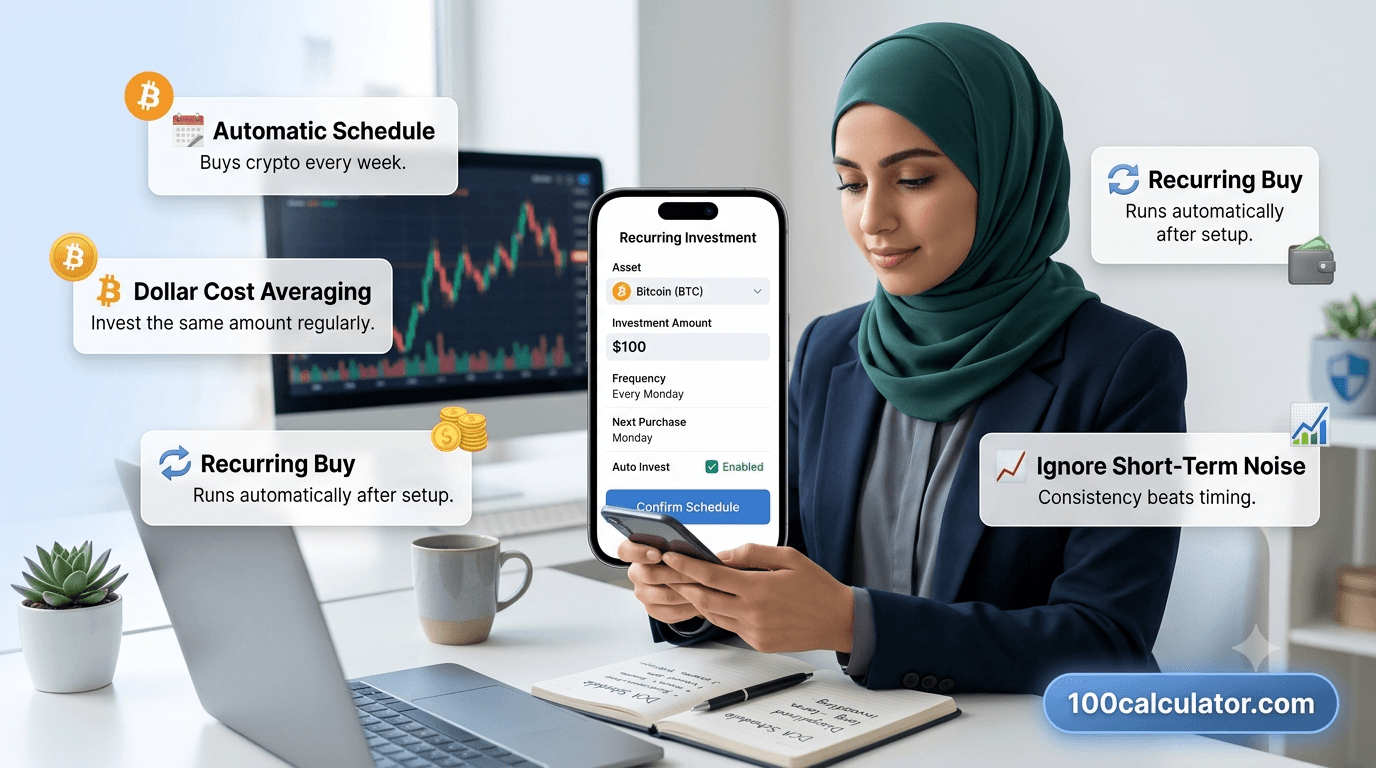
- Set up recurring buys on your exchange, or block time on your calendar to buy manually if your platform doesn't support automation.
- Track your purchases as you go, either with a spreadsheet or a tool like 100 Calculator's Crypto Dollar Cost Averaging (DCA) calculator, so you always know your average cost basis.
Choosing a DCA Style That Matches Your Risk Tolerance
How aggressively you DCA, meaning how much you invest and how often, usually comes down to your own comfort with risk and your available budget. These three general styles are a useful starting point:
Conservative
Weekly
Small, Frequent Buys
Spreads risk across the most price points and is the easiest style to stick with on a tight budget.
Moderate
Biweekly
A Practical Middle Ground
Fits most paycheck schedules and still captures most of DCA's smoothing benefit without frequent transactions.
Aggressive
Monthly
Closer to Lump Sum
Fewer, larger purchases mean less smoothing and more exposure to short-term price swings on each buy.
Free Online Tool
Want to see your numbers instead of doing the math by hand?
100 Calculator's Crypto Dollar Cost Averaging (DCA) calculator runs the projections for you. Enter your amount, interval, and time horizon, and it estimates how your position could grow — no account or signup required.
Choosing Your DCA Interval
The right interval depends on your platform's fees, your paycheck schedule, and how hands-on you want to be. Here's how the most common options compare:
| Interval | Best For | Things to Watch For |
|---|---|---|
| Daily | Investors who want maximum smoothing and don't mind frequent transactions | Trading and network fees add up fastest with daily buys |
| Weekly | Most beginners — a practical balance of smoothing and simplicity | Still frequent enough that fees matter on very small amounts |
| Biweekly | Investors paid every two weeks who want DCA to match payday | Slightly less smoothing than weekly, still very manageable |
| Monthly | Investors who want minimal maintenance and lower total fees | Each purchase carries more weight, so timing within the month matters a bit more |
Dollar Cost Averaging vs. Lump Sum Investing
If you already have a lump sum sitting in cash — savings, a bonus, or profits from selling another asset — you have a real choice to make: invest it all right away, or spread it in gradually with DCA. Both are reasonable strategies, and the better one depends on what you're optimizing for.
What the Research Says About Traditional Markets
Research on traditional stock and bond markets has generally found that investing a lump sum right away outperforms spreading it out over time more often than not. A widely cited 2012 Vanguard study looked at historical data across the U.S., U.K., and Australian markets and found that a lump-sum approach beat a 12-month DCA approach in roughly two out of three rolling 10-year periods, mainly because those markets tended to rise over the long run, so money sitting in cash while you wait to invest it misses out on gains more often than it avoids losses.
Why Crypto Changes the Calculus
That research is based on decades of stock and bond market history, and crypto doesn't have anywhere near that track record. Its price swings are also considerably larger than what most stock and bond portfolios experience. A lump-sum purchase made at the wrong moment can lose a meaningful share of its value within days, in a way that's rare in more established markets. For many crypto investors, DCA's real value isn't necessarily higher expected returns — it's reducing the odds of a single terrible entry point and making the whole process easier to stick with emotionally.
| Factor | Dollar Cost Averaging | Lump Sum Investing |
|---|---|---|
| Timing risk | Spread across many purchases | Concentrated in one purchase |
| Simplicity | Requires an ongoing routine | One decision, then you're done |
| Upfront capital needed | Works with small, regular amounts | Requires the full amount at once |
| Emotional difficulty | Generally easier to stick with | Can be harder to commit to all at once |
| Best suited for | Building a position gradually from income | Investing a windfall you already have |
If you're weighing this decision for a specific lump sum, our guide on DCA vs. lump sum: which crypto strategy wins long-term goes deeper into the numbers.
Tracking Your Average Cost Basis
Once you've made a handful of DCA purchases, you'll want to know your average cost basis — essentially, what you paid per coin across all your purchases combined. This number tells you whether you're currently sitting on a gain or a loss, and it's also the figure you'll need for tax reporting.
Average Cost Formula
Average Cost per Coin = Total Amount Invested ÷ Total Coins Purchased
Total Amount Invested — the sum of every DCA purchase you've made, in dollars
Total Coins Purchased — the sum of every coin or token amount you received across those purchases
This is different from simply averaging your purchase prices together, because it automatically weights toward the purchases where you bought more coins, which, thanks to DCA, tend to be the purchases you made when prices were lower. We'll work through a full example with real numbers later in this guide.
Doing this by hand gets tedious once you've made more than a handful of purchases, so 100 Calculator's Crypto Average Cost Basis Calculator can total everything up automatically. Your average cost basis also matters at tax time — our guide on why cost basis matters for crypto tax reporting explains how this number affects what you may owe when you eventually sell.
Pros and Cons of Dollar Cost Averaging in Crypto
DCA is a genuinely useful strategy for a lot of crypto investors, but it isn't automatically the right choice for everyone. Here's an honest look at both sides.
Advantages of Dollar Cost Averaging
- Removes the pressure of trying to time the market perfectly
- Naturally buys more coins when prices dip and fewer when prices spike
- Works with whatever amount you can set aside regularly, not just large lump sums
- Reduces the emotional swings of watching a single big purchase move up or down
- Builds a consistent habit that's easy to automate and forget about
Limitations to Keep in Mind
- In markets that trend upward over time, DCA has historically underperformed investing a lump sum right away.
- Frequent small purchases can rack up transaction or network fees if your exchange charges per transaction.
- DCA doesn't protect you from a coin's long-term decline — it only smooths out short-term timing risk.
- It requires discipline to keep buying during downturns, which is exactly when it's psychologically hardest to do.
Common DCA Mistakes to Avoid
A DCA plan is simple in theory, but a few habits quietly undermine it in practice.
- Stopping during a downturn. This is the single most common mistake — pausing your buys exactly when prices are low defeats the purpose of the strategy.
- Changing your schedule based on price predictions. If you buy extra during dips and skip weeks during rallies, you're not really dollar cost averaging anymore — you're timing the market with a different name.
- Ignoring fees on small purchases. A $2 flat fee on a $20 weekly buy works out to a 10% cost before your investment has any chance to grow. Our guide on common crypto profit calculation mistakes to avoid covers other ways fees quietly eat into returns.
- Forgetting to track your purchases. Without a running record, you won't know your true average cost basis or how you're actually performing.
- Treating DCA as a guarantee. It reduces timing risk, but it doesn't guarantee a profit, especially if the asset you're buying declines over the long run. Once you've been DCA-ing for a while, our guide on how to calculate crypto trading profit correctly can help you see where you actually stand, or you can run the numbers directly with 100 Calculator's Crypto Profit & Exchange Fee Calculator.
Automating Your Crypto DCA Strategy
The easiest way to make DCA stick is to remove yourself from the equation as much as possible.
Recurring Buys on an Exchange
Most major crypto exchanges let you schedule recurring purchases that pull from a linked bank account or card automatically, similar to a subscription payment. Once it's set up, your DCA plan runs in the background without requiring you to log in and manually place an order every week.
Buying Directly On-Chain
Some investors prefer to buy directly through a wallet or decentralized exchange instead of a centralized platform. This gives you more control over your coins, but network fees, commonly called gas fees on Ethereum, fluctuate throughout the day and can eat into small, frequent purchases. Our guides on why Ethereum gas fees rise and fall throughout the day and how to convert Ethereum gas fees into USD costs can help you time on-chain purchases around cheaper fee windows.
Manual Tracking as a Backup
If your exchange doesn't support automation, a simple spreadsheet works fine. Just log the date, amount invested, price, and coins received for every purchase. The important part isn't the tool, it's the consistency.
A Hypothetical Example: How the Averaging Effect Works
Numbers make this easier to see than theory alone. The example below uses simplified, hypothetical prices, not actual historical crypto data, purely to illustrate how the math behind DCA works.
Say you decide to invest $100 every week for eight weeks into a hypothetical token, and the price happens to move around like this:
| Week | Price per Token | Amount Invested | Tokens Purchased |
|---|---|---|---|
| 1 | $50 | $100 | 2.000 |
| 2 | $40 | $100 | 2.500 |
| 3 | $25 | $100 | 4.000 |
| 4 | $50 | $100 | 2.000 |
| 5 | $20 | $100 | 5.000 |
| 6 | $40 | $100 | 2.500 |
| 7 | $50 | $100 | 2.000 |
| 8 | $25 | $100 | 4.000 |
| Total | — | $800 | 24.000 |
After eight weeks, you've invested $800 total and ended up with 24 tokens. Using the formula from earlier, your average cost per token is $800 ÷ 24 = $33.33.
Compare that to the simple average of the eight prices you saw ($50, $40, $25, $50, $20, $40, $50, $25), which works out to $37.50. Your actual DCA cost came in about 11% lower than that simple average, because your fixed $100 bought more tokens on the cheap weeks ($20 and $25) and fewer on the expensive weeks ($50). That gap is the entire mathematical case for dollar cost averaging in one example.
When Dollar Cost Averaging Might Not Fit Your Goals
DCA is a strong default for a lot of crypto investors, but it isn't the only reasonable approach.
- If you already have a lump sum and a long time horizon, and you're comfortable with the possibility of a rough first few months, investing it all at once has historically produced higher expected returns in traditional markets, as covered earlier in this guide.
- If your budget genuinely can't spare regular contributions, forcing a DCA schedule you can't sustain does more harm than good. It's better to invest what you can, when you can.
- If you're using crypto for short-term trading rather than long-term investing, DCA isn't really designed for that. It's a long-horizon strategy, not a trading technique.
- If a coin's fundamentals genuinely concern you, no amount of DCA discipline fixes buying into an asset you don't believe in long-term. DCA manages timing risk, not the risk of picking the wrong asset.
Related Calculators
Put what you just read into practice, try these free tools instantly, no sign-up required.
Crypto Dollar Cost Averaging (DCA)
Plan recurring crypto purchases using a dollar-cost averaging strategy.
Crypto Average Cost Basis Calculator
Calculate your average cost basis across multiple crypto purchases.
Market Cap What If Calculator
Estimate a coin's price if it reached a target market cap.
Crypto Profit & Exchange Fee Calculator
Calculate your crypto trading profit after exchange fees.
Ethereum Gas Fee to USD Calculator
Convert Ethereum gas fees into real-time USD cost estimates.
Building a DCA Routine That Actually Sticks
The most effective DCA plan is the one you actually keep up with. A handful of small habits make that much easier.
- Automate what you can. A recurring buy you don't have to remember is a recurring buy you're far more likely to actually keep up with.
- Pick an amount you won't miss. If a down month means skipping your DCA purchase, the amount is probably too high.
- Review your position monthly, not daily. Checking your average cost basis and portfolio value once a month is plenty. Checking daily just adds stress without adding useful information.
- Don't chase the schedule. Resist the urge to add extra buys during a dip or skip buys during a rally. The whole point of DCA is following the plan regardless of price.
- Revisit your plan every few months. Your budget, goals, and risk tolerance can change, and it's fine to adjust your DCA amount or interval as long as you're not doing it based on short-term price predictions.
Once you've settled on a plan, 100 Calculator's Crypto Dollar Cost Averaging (DCA) calculator can project how your strategy plays out over time, and the Crypto Average Cost Basis Calculator can keep a running tally of exactly what you've paid so far.
Investment disclaimer: This article is for general educational purposes only and isn't financial or investment advice. Cryptocurrency is highly volatile, and dollar cost averaging reduces timing risk without eliminating the risk of loss — you can still lose money, including your full investment. Past performance and historical research, including the studies referenced in this guide, don't guarantee future results. Always do your own research and consider speaking with a licensed financial advisor before making investment decisions.
More From Crypto Tools Guides
Still building your understanding of crypto investing, cost basis, and fees? These related guides dig deeper into the topics covered above.
Frequently Asked Questions
What is dollar cost averaging in crypto?
Dollar cost averaging (DCA) means investing a fixed dollar amount into a cryptocurrency at regular intervals, such as weekly or monthly, regardless of the current price. Instead of trying to pick the "right" moment to buy, you spread your purchases out over time, which naturally buys more coins when prices are low and fewer when prices are high. This lowers your average cost per coin compared to investing the same total amount all at once, and it removes much of the guesswork and emotional pressure from timing the market.
Is dollar cost averaging good for Bitcoin?
Many investors consider DCA one of the more practical ways to build a Bitcoin position over time. Bitcoin's price can swing significantly within days, which makes picking a single ideal entry point difficult even for experienced traders. Spreading purchases out reduces the impact of any one bad-timing decision and makes the process easier to stick with emotionally, especially during volatile stretches.
How does DCA reduce risk when investing in crypto?
DCA reduces timing risk specifically, meaning the risk of putting a large amount of money in right before a price drop. Because you're buying at many different price points instead of one, a single poorly timed purchase has a much smaller effect on your overall position. It doesn't reduce the underlying risk that a cryptocurrency could decline in value long-term — it only spreads out when you're exposed to short-term price swings.
Is DCA better than lump sum investing in crypto?
It depends on what you're optimizing for. Research on traditional markets shows lump-sum investing has historically outperformed DCA more often than not, because markets tend to rise over time. But crypto's volatility is much higher than traditional markets, and DCA's main benefit is behavioral — it's easier to follow through on and reduces the odds of a single terrible entry point. If you already have a lump sum and a long time horizon, lump sum investing is worth considering. If you're building a position gradually from income, DCA is usually the more realistic choice.
How much money do I need to start DCA in crypto?
There's no minimum requirement, and that's part of DCA's appeal. Many exchanges let you buy fractional amounts of Bitcoin or other coins, so you can start with as little as $10 or $20 per purchase. What matters more than the amount is consistency — a small amount invested reliably every week or month tends to build a more meaningful position over time than an occasional larger purchase you don't stick with.
How often should I DCA into crypto?
Weekly and monthly are the two most common intervals, and both work well. Weekly purchases smooth out price swings slightly more, while monthly purchases mean fewer transactions and potentially lower total fees. The better choice usually comes down to your pay schedule and how your exchange charges fees — a flat per-transaction fee makes less frequent, larger purchases more efficient.
Can I automate crypto DCA?
Yes. Most major crypto exchanges offer a recurring buy feature that automatically purchases a set dollar amount on a schedule you choose, similar to a subscription payment. This is generally the easiest way to stick with a DCA plan, since it removes the need to remember and manually place an order every week or month.
Does DCA guarantee a profit?
No. Dollar cost averaging reduces timing risk, but it doesn't guarantee a positive return. If a cryptocurrency's price declines over your entire investing period, DCA will still result in a loss, just like any other buying strategy — it simply means that loss is spread across many purchases rather than concentrated in one.
What's a good DCA schedule for beginners?
A simple weekly or biweekly purchase into one or two well-established coins, like Bitcoin or Ethereum, is a reasonable starting point for most beginners. Start with an amount that feels comfortable even if the price drops right after you buy — that's the real test of whether your DCA amount is sustainable. You can always increase it later.
Do exchange fees affect DCA results?
Yes, and they matter more than many beginners expect. If your exchange charges a flat fee per transaction, buying very small amounts very frequently can mean a meaningful percentage of each purchase goes to fees rather than crypto. Check your exchange's fee structure before choosing an interval, and consider less frequent, larger purchases if fees are eating into small buys.
How do I calculate my average cost basis with DCA?
Add up the total dollar amount you've invested across all your purchases, then divide it by the total number of coins or tokens you've received. The result is your average cost per coin, which tells you whether your current position is at a gain or a loss. 100 Calculator's Crypto Average Cost Basis Calculator can total this up automatically once you enter your purchase history.
Should I DCA into one coin or several?
Either approach works, and it depends on your goals. DCA-ing into a single coin like Bitcoin keeps things simple and concentrates your position in the asset with the longest track record. Splitting your DCA amount across several coins adds diversification, which can reduce the impact of any single coin performing poorly, though it also means tracking more than one average cost basis.
What's the difference between DCA and buying the dip?
DCA follows a fixed schedule regardless of price, while "buying the dip" means purchasing extra specifically when prices have dropped. Buying the dip requires correctly identifying when a drop has actually bottomed out, which is a form of market timing, something DCA is specifically designed to avoid. Mixing the two approaches isn't wrong, but it's a different, more active strategy than pure DCA.
Can DCA work in a bear market?
Yes, and some investors consider bear markets the period where DCA is most valuable. Continuing to buy consistently while prices are lower means each purchase accumulates more coins per dollar, which can pay off significantly if and when prices recover. The hardest part is psychological — sticking with your schedule during a downturn is exactly when it feels least comfortable to keep buying.
How long should I DCA before expecting results?
Most financial guidance suggests thinking of DCA as a multi-month or multi-year strategy rather than something that pays off in weeks. A handful of purchases isn't enough data to judge whether the strategy is "working" — the averaging effect becomes more meaningful the more purchases you make across different market conditions. Give your plan enough time to actually experience both up and down periods.
Do I need to track every DCA purchase for taxes?
In most jurisdictions, yes. Each crypto purchase establishes a cost basis that matters when you eventually sell, trade, or spend that crypto. Keeping a running record of the date, amount, price, and quantity for every DCA purchase makes tax reporting significantly easier later. Our guide on why cost basis matters for crypto tax reporting covers this in more detail, and a licensed tax professional can advise on rules specific to your location.
About 100 Calculator
100 Calculator is a free hub of online calculators and educational guides covering health, finance, trading, crypto, education, and more. Every tool is built to be fast, accurate, and genuinely free, with no account or signup required.
We built this guide, and tools like the Crypto Dollar Cost Averaging (DCA) calculator referenced throughout it, to make everyday investing questions easier to work through. Head back to the 100 Calculator homepage to explore the full library of tools, or learn more about the team behind them on our About Us page.