Why Ethereum Gas Fees Rise and Fall Throughout the Day
A plain-English look at what actually sets the price of an Ethereum transaction, why that price keeps moving hour by hour, and how to check the real cost before you hit send.

If you've ever sent the exact same type of Ethereum transaction twice and paid a completely different amount both times, you're not imagining it. Gas fees on Ethereum aren't a fixed price list — they're recalculated block by block, based on how much demand there is for space on the network at that exact moment.
Ethereum gas fees rise and fall because every block has a limited amount of space, and the price to use that space adjusts automatically based on how many people are trying to transact at once. When demand climbs — during busy trading hours, a popular NFT mint, or big market news — fees rise. When demand drops, like late at night or over a quiet weekend, fees ease back down.
None of this is random. Because Ethereum users are real people spread across time zones, and human activity follows fairly predictable patterns, there's a genuine daily and weekly rhythm underneath the noise. Knowing that rhythm can save you real money on any transaction that isn't urgent.
In this guide, we'll break down exactly how the fee is calculated, when it tends to be cheapest and priciest, what causes sudden spikes, and how to check today's actual cost in plain U.S. dollars using 100 Calculator's Ethereum Gas Fee to USD Calculator before you ever click confirm.
What Is an Ethereum Gas Fee?
Every time you do something on Ethereum — send ETH, swap tokens, mint an NFT, or interact with a smart contract — a global network of computers called validators has to process that request and permanently record it. None of that computing work is free. "Gas" is simply the unit Ethereum uses to measure how much computational effort a given action takes, and the "gas fee" is what you pay to cover that effort.
A plain ETH transfer is a light action and uses a small, fixed amount of gas. Minting an NFT or swapping tokens on a decentralized exchange does more work under the hood, so it uses more gas. But the fee you actually pay isn't only about how much gas an action uses — it's also about how much you pay per unit of that gas, and that price per unit is exactly what moves throughout the day.
Gas, Gwei, and Wei Explained
Gas fees are priced in a unit called gwei, which is one-billionth of a single ETH (1 ETH equals 1,000,000,000 gwei). There's an even smaller unit called wei, which mostly shows up in developer tools rather than everyday wallets. Gwei exists for the same reason we use cents instead of tiny fractions of a dollar — transaction costs are usually worth a sliver of one ETH, and gwei turns that into a number that's actually easy to read and compare.
Why Ethereum Needs Gas Fees at All
Gas fees do two jobs at once. First, they compensate the validators who supply computing power and security to the network. Second, they act as a built-in spam filter. If sending a transaction cost nothing, anyone could flood the network with pointless requests for free. Because every action costs something, spamming the network also costs the spammer real money, which keeps that kind of abuse rare.
How Ethereum Gas Fees Are Calculated
Since 2021, Ethereum has priced gas using a system called EIP-1559, and it's the reason fees behave the way they do today. Instead of one flat number you have to guess at, every transaction's price per unit of gas comes from two separate pieces working together: a base fee and a priority fee. (Ethereum.org)
Base Fee: The Network's Automatic Price
The base fee isn't chosen by a company or a person — it recalculates automatically, once per block, based on how full the previous block was. Ethereum aims to keep blocks about half full on average. When a block runs more than half full, the base fee for the next block rises, by as much as 12.5%. When a block runs under half full, it eases back down by up to the same amount. That 12.5% ceiling means fees can climb quickly during a sudden rush, but they can't jump to an extreme in a single step — it takes several busy blocks in a row to really push the price up.
One detail worth knowing: the base fee is burned. It isn't handed to validators or to any organization — it's permanently destroyed. In practice, that means the base fee behaves less like a bill from a company and more like a live reading of how busy the network currently is.
Priority Fee: Paying Validators to Go Faster
On top of the base fee, you can add a priority fee, often called a tip. This part does go to the validator who packages your transaction into a block, and it's your way of saying "please include me sooner." During quiet periods, a very small tip is usually enough to get processed within the next block or two. During busy periods, a larger tip matters more, because you're effectively competing with everyone else trying to get into the same limited block space.
Gas Limit vs. Gas Used
Two more terms are easy to mix up. Gas limit is the maximum amount of gas you're willing to let a transaction use — a safety cap, similar to setting a spending limit before you start. Gas used is what the transaction actually consumed once it finished. If you set your gas limit too low for what the transaction genuinely needs, it can fail partway through, and you'll still owe the fee for the gas already spent trying, even though the transaction never went through.
Why Ethereum Gas Fees Change Throughout the Day
Put those two ideas together — a base fee that reacts to how full recent blocks were, and a network with a fixed cap on how much a single block can hold — and the daily rise and fall starts to make sense. Ethereum doesn't slow down or speed up how often blocks are created, a new one arrives roughly every 12 seconds no matter what, so when more people want to transact than a block can comfortably fit, the price adjusts instead of the speed.
Block Space Is a Fixed, Shared Resource
Every Ethereum block has a gas limit — a hard cap on the total computational work it can contain, currently around 60 million gas following the network's most recent capacity upgrade. That space is shared by everyone trying to transact at that moment: someone sending ETH to a friend, a trader executing a swap, and a project minting a thousand NFTs are all competing for the same handful of upcoming blocks.
When total demand comfortably fits inside that space, blocks run under half full and the base fee eases down. When demand exceeds what a block can hold, people who want in sooner start attaching bigger tips or accepting a higher base fee, and the price climbs until enough people decide to wait instead.
Demand Sets the Price, Not a Company
It helps to remember that no one is manually raising or lowering Ethereum gas prices. The base fee follows a straightforward, published formula that reacts only to how full recent blocks were — nothing else. That's genuinely useful context, because it means the fluctuation covered in this guide isn't a pricing decision anyone is making. It's closer to a live thermometer reading of network activity.
The Daily Pattern: Peak Hours vs. Off-Peak Hours
Because Ethereum is used by people all over the world, and people everywhere tend to be active during their own daytime and quiet while asleep, gas prices follow a fairly consistent daily rhythm on top of the occasional random spike. It isn't a strict schedule, but it's consistent enough that many longtime users plan around it.
Peak Hours: The U.S.–Europe Overlap
The busiest stretch tends to fall somewhere in the mid-afternoon to evening window, UTC time — roughly the hours when the U.S. workday is in full swing and Europe is finishing out its afternoon. That overlap briefly combines two of the network's largest active user bases at once, and demand for block space rises to match.
Off-Peak Hours: The Early Morning Lull
The quietest stretch is usually the mirror image: the very early morning hours UTC, when most of the U.S. is asleep and Europe hasn't started its day yet. Asia-Pacific users are awake during part of this window, but overall network activity still tends to run lighter than during the U.S.–Europe overlap, and gas prices often ease down accordingly.
Here's a simple way to think about where any given hour usually falls:
Usually Cheapest
Low
Overnight, Any Day (UTC)
Roughly the early morning hours UTC, when both major regions are quiet. Good for transactions that aren't time-sensitive.
Average
Typical
Weekday Mornings & Late Evenings
Outside the busiest afternoon stretch, weekday fees tend to settle into a fairly ordinary, predictable range.
Usually Priciest
High
Weekday Afternoon–Evening (UTC)
When U.S. and European activity overlap, or a popular NFT or token launch is happening, demand — and price — tends to climb.
The Weekly Pattern: Weekdays vs. Weekends
Zoom out from hours to days, and a similar rhythm shows up. Weekdays, especially midweek, tend to carry more trading activity, DeFi protocol usage, and project launches — a lot of which is tied to people's working routines. Weekends generally see less of that professional and institutional activity, so overall demand, and average gas prices, tends to ease off.
| Aspect | Weekdays | Weekends |
|---|---|---|
| Typical demand | Higher, especially midweek | Lower on average |
| Common activity | Trading, DeFi actions, project launches, NFT drops | Casual transfers, personal transactions |
| Best for | Time-sensitive transactions | Transactions you can delay |
None of this is a guarantee for any specific moment. A major announcement on a Saturday can still spike fees for a few hours. As a general planning tool, though, weekday-versus-weekend is a reasonable rule of thumb.
What Causes Sudden Gas Fee Spikes
The daily and weekly rhythm explains the gentle rise and fall you'll see most of the time, but Ethereum gas fees can also jump sharply within minutes, independent of what time it is. These spikes come from sudden bursts of demand that have nothing to do with the clock.
NFT Drops and Token Launches
When a highly anticipated NFT collection or token goes live, thousands of people can try to transact within the same few minutes, all racing to be included in the very next block. That concentrated rush can push gas prices many times higher than normal for as long as the demand lasts, then bring them back down once the initial wave passes.
DeFi Liquidations and Market Volatility
Sharp price swings in the crypto market often trigger a wave of activity on decentralized finance platforms — loans getting liquidated, traders rushing to close positions, or people moving funds to safety. Because this activity is unplanned and time-sensitive, everyone involved is often willing to pay noticeably more to get their transaction through quickly, which pushes fees up across the whole network, not just for those specific transactions.
Network Congestion From Bots
Automated trading bots and MEV (maximal extractable value) searchers constantly scan the network for profitable opportunities, and during volatile periods they can submit large numbers of competing transactions in a short window. This kind of automated activity can add to congestion on top of ordinary human demand, especially during major market moves.
How Much Does a Transaction Actually Cost?
Once you know the formula, working out a real-world cost is straightforward, even by hand.
The Basic Formula
Transaction Fee = Gas Used × (Base Fee + Priority Fee)
Gas Used — how much computational work your specific transaction actually required.
Base Fee — the price per unit of gas, set automatically by the network and burned rather than paid to anyone.
Priority Fee — an optional tip per unit of gas that goes directly to the validator to encourage faster inclusion.
Here's an illustrative example, not a live quote. Say a simple ETH transfer needs 21,000 units of gas, a fixed amount for this specific action, the current base fee is 20 gwei, and you add a 2 gwei priority fee. Your total gas price is 22 gwei. Multiply that by 21,000 units of gas and the transaction costs 462,000 gwei, or 0.000462 ETH. To see that in U.S. dollars, you'd multiply by whatever ETH happens to be trading at that day. If ETH were worth $3,000, that transaction would cost roughly $1.39.
Doing that math by hand works fine for a simple example, but it gets tedious fast once you're dealing with a token swap, an NFT mint, or a more complex smart contract interaction, especially with ETH's price shifting too. For a deeper walkthrough with more worked examples, see our companion guide on how to convert Ethereum gas fees into USD costs.
Free Online Tool
Skip the mental math
100 Calculator's Ethereum Gas Fee to USD Calculator converts your gas price and gas usage straight into a U.S. dollar estimate, so you're not stacking gwei, ETH, and live prices in your head before deciding whether a transaction is worth sending right now.
How to Check Ethereum Gas Fees in Real Time
Everything in this guide so far explains the pattern, but the only way to know the actual cost of your transaction right now is to check it. No article can tell you today's exact number in advance.
Using the Ethereum Gas Fee to USD Calculator
100 Calculator's Ethereum Gas Fee to USD Calculator is built for exactly this moment. Instead of mentally converting gwei to ETH to dollars, you get the U.S. dollar cost directly, which makes it far easier to judge whether now is a good time to send a transaction or whether it's worth waiting a few hours.
- Enter the gas price you're seeing in your wallet, in gwei.
- Enter the gas limit or gas used for the type of transaction you're planning.
- The calculator converts the result into an estimated USD cost using a current ETH price, so you can weigh it against how urgent the transaction actually is.
Reading a Gas Tracker
Alongside a calculator, many people also glance at a live gas tracker, often built into block explorers or wallet apps, to see the current base fee and how it's trended over the last several minutes or hours. A tracker won't tell you why the price sits where it does, but it's a fast way to confirm whether right now happens to fall on the cheap or expensive side of the daily pattern described earlier.
Practical Tips to Pay Less in Gas Fees
None of these tips require special tools or technical skill. They're mostly a matter of timing and using your wallet's defaults instead of second-guessing them.
Time Your Transactions
If a transaction isn't urgent, the single biggest lever you have is simply waiting for a quieter window, typically overnight or over a weekend, based on the patterns described earlier. Checking a live tracker or calculator before you send, rather than assuming based on the clock alone, protects you from the exceptions, like a surprise spike on an otherwise quiet Sunday.
Set a Sensible Gas Limit
Most modern wallets estimate a safe gas limit automatically, and it's usually best to leave that estimate alone rather than guessing a lower number to save money. Setting the limit too tight risks a failed transaction that still costs you gas for the attempt, which ends up more expensive than simply paying the estimated fee in the first place.
Consider Layer 2 Networks
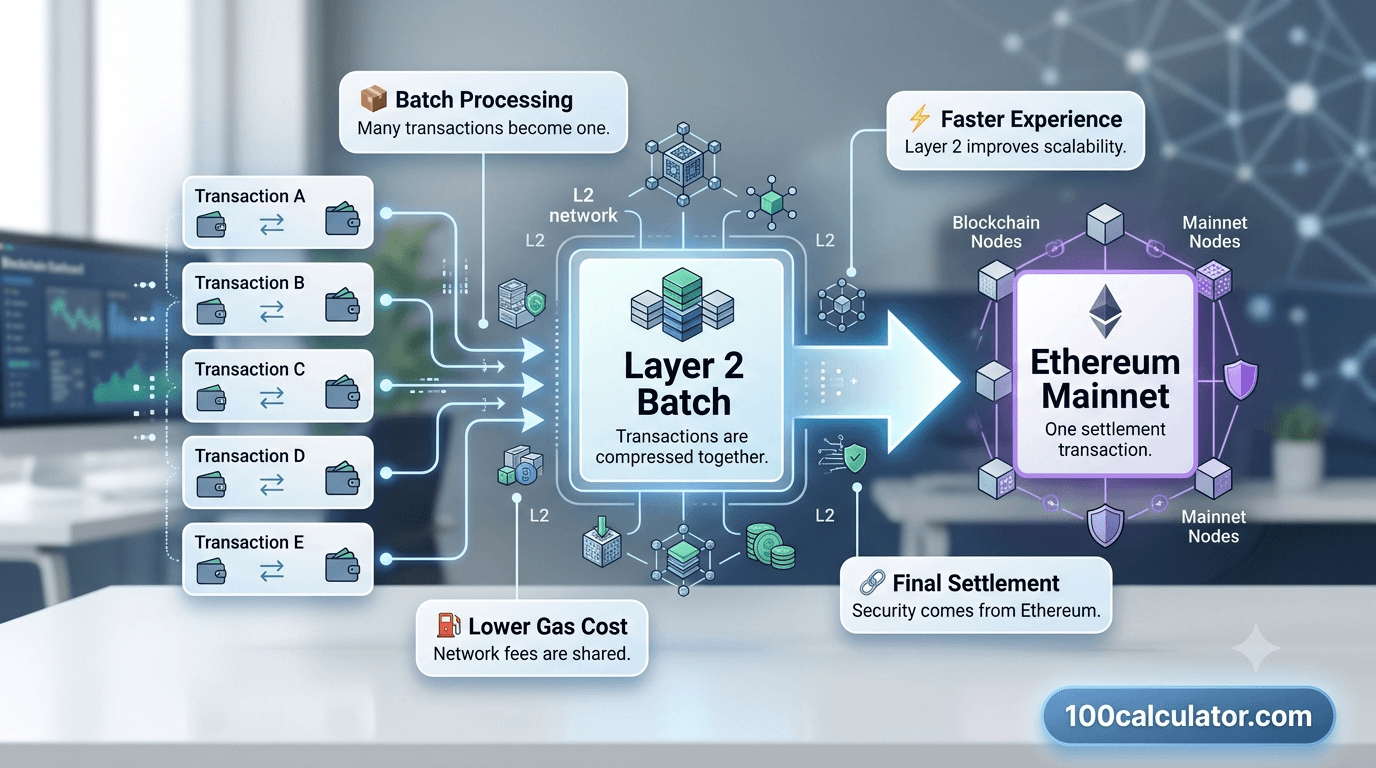
For anything beyond an occasional transaction, moving routine activity to a Layer 2 network can cut costs dramatically compared with using Ethereum's main chain directly, since these networks handle the bulk of the work off-chain and only settle a compressed summary back to Ethereum. We'll compare this in more detail shortly. If you regularly buy ETH on a schedule rather than all at once, 100 Calculator's Crypto Dollar Cost Averaging (DCA) tool can help you plan those purchases without needing to manually time each one around gas prices.
Quick pre-send checklist:
- Check a live gas tracker or calculator, not just the clock
- Confirm your wallet's suggested gas limit rather than lowering it manually
- Weigh how urgent the transaction really is against the current price
- Consider whether the same action is available more cheaply on a Layer 2 network
Common Mistakes That Waste Money on Gas
Even experienced users lose money to a handful of avoidable habits. Here's what to watch for:
- Sending time-sensitive transactions during predictable peak hours without checking a tracker first.
- Setting a custom gas limit far below the wallet's suggested estimate to try to save money, which risks a failed transaction instead.
- Ignoring the priority fee entirely during a busy period, which can leave a transaction stuck pending for a long time.
- Assuming a weekend automatically means low fees, without confirming with a live tool.
- Forgetting that a failed transaction from an underfunded gas limit still costs real ETH, even though nothing succeeded.
- Comparing today's Ethereum fees to headlines from 2021 rather than checking the current, generally lower baseline.
If gas costs are quietly eating into the profit on your trades, 100 Calculator's Crypto Profit & Exchange Fee Calculator factors those costs in so you can see your real return, not just the price difference. Our guide on common crypto profit calculation mistakes to avoid covers a few more blind spots worth knowing about.
Ethereum Layer 2 Networks vs. Mainnet Gas Fees
Ethereum's main chain, often called Ethereum mainnet or Layer 1, is where the network's strongest security lives, but that security comes at the cost of limited, shared block space. Layer 2 networks are separate chains built on top of Ethereum that handle transactions more cheaply, then periodically post a compressed batch of that activity back to the main chain for final settlement.
| Aspect | Ethereum Mainnet (L1) | Layer 2 Networks |
|---|---|---|
| Typical fees | Follows the daily and weekly pattern above | Usually a small fraction of mainnet cost |
| Security model | Directly secured by Ethereum validators | Ultimately settles back to Ethereum, with its own added assumptions |
| Best for | High-value transactions where maximum security matters most | Frequent, smaller, everyday transactions |
| Main fee driver | Congestion on the main chain | Mostly the cost of posting data back to Ethereum, plus L2 execution |
This is a big part of why so much everyday crypto activity, small swaps, gaming, frequent transfers, has shifted to Layer 2s in recent years. It isn't that mainnet became unusable; it's that L2s are simply a better fit for transactions where paying for Layer 1's extra security every single time isn't worth it. If you're actively trading through a volatile stretch, 100 Calculator's Crypto Position Size Calculator can help you size trades appropriately for the risk you're taking on, gas costs included.
Related Calculators
Put what you just read into practice, try these free tools instantly, no sign-up required.
Crypto Dollar Cost Averaging (DCA)
Plan recurring crypto purchases using a dollar-cost averaging strategy.
Crypto Average Cost Basis Calculator
Calculate your average cost basis across multiple crypto purchases.
Market Cap What If Calculator
Estimate a coin's price if it reached a target market cap.
Crypto Profit & Exchange Fee Calculator
Calculate your crypto trading profit after exchange fees.
Ethereum Gas Fee to USD Calculator
Convert Ethereum gas fees into real-time USD cost estimates.
Is It Still Worth Timing Your Transactions in 2026?
It's a fair question. Ethereum's overall gas prices today are meaningfully lower on average than during the network's busiest years, largely because so much everyday activity has moved to Layer 2 networks, and because the network's base capacity has grown through recent upgrades. (Ethereum.org) That's a genuinely positive shift for anyone using the network day to day.
Even so, the underlying mechanism hasn't changed: price still responds to demand, block by block. That means the daily and weekly pattern covered in this guide still applies, it's just operating on a smaller overall scale than it used to. For an everyday transfer, the dollar difference between a peak hour and a quiet hour might be small enough not to matter much. For a larger, gas-heavy transaction, or during a genuine demand spike, the same timing logic can still save a meaningful amount. Checking a calculator before you send costs nothing and removes the guesswork either way.
Disclaimer: This article is for general educational purposes only and isn't financial, investment, or tax advice. Ethereum gas fees, network conditions, and cryptocurrency prices change constantly and can differ significantly from the illustrative examples described here. Always verify current costs with a live calculator or gas tracker before sending a transaction, and consult a qualified professional for guidance specific to your situation.
Sources & References
More From the Crypto Tools Guide
Still building your knowledge of crypto costs, cost basis, and trading math? These related guides dig deeper into the topics covered above.
Frequently Asked Questions
Why do Ethereum gas fees change throughout the day?
Ethereum's base fee adjusts automatically, block by block, based on how full recent blocks have been. When more people are trying to transact at the same time, blocks fill up faster than the network can add space, and the price rises to help sort out who gets included next. When fewer people are transacting, blocks run under capacity and the price eases back down. It's a live response to demand, not a fixed schedule.
What time of day are Ethereum gas fees usually lowest?
Gas fees tend to be lowest during the very early morning hours UTC, when most of the U.S. is asleep and Europe hasn't started its day yet. This isn't guaranteed for any specific moment, so it's worth confirming with a live gas tracker or calculator before relying on it for a time-sensitive transaction.
What time of day are Ethereum gas fees usually highest?
Fees tend to climb during the overlap between U.S. and European business hours, roughly the afternoon into the evening, UTC time. That's when two of the network's largest active user bases are online at once, which pushes demand for block space higher than at other points in the day.
Are Ethereum gas fees cheaper on weekends?
Generally, yes. Weekends tend to see less trading activity, fewer DeFi protocol actions, and fewer project launches compared with weekdays, so average demand, and average gas prices, tends to run a bit lower. A major announcement or market move can still spike fees on a weekend, so it isn't a strict rule.
What is the base fee in an Ethereum transaction?
The base fee is the mandatory portion of a gas fee, set automatically by the Ethereum protocol rather than by any individual user. It adjusts up or down by as much as 12.5% per block based on how full the previous block was, and it's burned, permanently removed from circulation, rather than paid to a validator.
What is a priority fee, or "tip," on Ethereum?
The priority fee is an optional amount you add on top of the base fee to encourage a validator to include your transaction sooner. It goes directly to the validator, unlike the base fee, which is burned. During busy periods, a higher tip generally means faster confirmation.
Why is the base fee burned instead of paid to someone?
Burning the base fee, introduced with the EIP-1559 upgrade, permanently removes that ETH from circulation. It also means the base fee behaves like a neutral measure of network demand rather than a payment that anyone has an incentive to inflate, since no one actually collects it.
What causes sudden spikes in Ethereum gas fees?
Sudden spikes usually come from a burst of demand that has nothing to do with the time of day, such as a popular NFT collection minting, a hyped token launch, or a wave of DeFi liquidations during volatile markets. Automated trading bots can add to this during especially active periods.
What is gwei, and how is it different from wei and ETH?
Gwei, wei, and ETH are all units of the same currency, just at different scales. One ETH equals 1,000,000,000, one billion, gwei, and one gwei equals 1,000,000,000 wei. Gas fees are usually shown in gwei because it produces easier-to-read numbers than describing tiny fractions of a whole ETH.
How do I convert an Ethereum gas fee into US dollars?
Multiply the gas used by the total gas price, base fee plus priority fee, to get the cost in gwei, convert that to ETH by dividing by one billion, then multiply by the current ETH-to-USD price. 100 Calculator's Ethereum Gas Fee to USD Calculator handles this conversion for you automatically.
Are Layer 2 networks always cheaper than Ethereum mainnet?
In most everyday situations, yes, Layer 2 transactions cost noticeably less than the same action on Ethereum's main chain, since much of the work happens off the main chain. The trade-off is a slightly different security and trust model, which is worth understanding before moving large amounts of value.
Can I set my own gas fee on Ethereum?
You can set your own priority fee, or tip, and your maximum fee per gas, but the base fee itself is set automatically by the network and can't be negotiated. Most wallets suggest a reasonable default for both the tip and the gas limit, which works well for most users.
What happens if I set my gas limit too low?
If your gas limit is too low for what the transaction actually requires, it can run out of gas partway through and fail. You still pay for the gas that was consumed before it failed, even though the transaction didn't complete, so it's generally safer to leave your wallet's suggested gas limit alone.
Is it safe to wait for lower gas fees before sending a transaction?
For most non-urgent transactions, yes, waiting for a quieter window is a completely reasonable way to save money. The main risk is for time-sensitive actions, like closing a trade during a fast-moving market, where waiting could cost you more in missed opportunity than you'd save on gas.
Do Ethereum gas fees still spike as badly as they did in 2021?
Not typically. Average gas fees today are considerably lower than during Ethereum's busiest years, mainly because so much everyday activity has shifted to Layer 2 networks and because the network's base capacity has grown through recent upgrades. Sudden spikes from major events can still happen, just usually from a lower starting point.
What's the best way to check current Ethereum gas prices?
A live gas tracker, often built into block explorers and many wallets, shows the current base fee and its recent trend. Pairing that with 100 Calculator's Ethereum Gas Fee to USD Calculator lets you see exactly what a transaction will cost in U.S. dollars before you confirm it.
About 100 Calculator
100 Calculator is a free hub of online calculators and educational guides covering health, finance, trading, crypto, education, and more. Every tool is built to be fast, accurate, and genuinely free, with no account or signup required.
We built this guide, and tools like the Ethereum Gas Fee to USD Calculator referenced throughout it, to make everyday crypto questions easier to answer without a computer science degree. Head back to the 100 Calculator homepage to explore the full library of tools, or learn more about the team behind them on our About Us page.