How Market Cap Works and Why Price Alone Is Misleading
A clear, beginner-friendly breakdown of what market cap actually measures, why a coin's price alone can't tell you how big it really is, and how to run the numbers yourself with a market cap calculator.
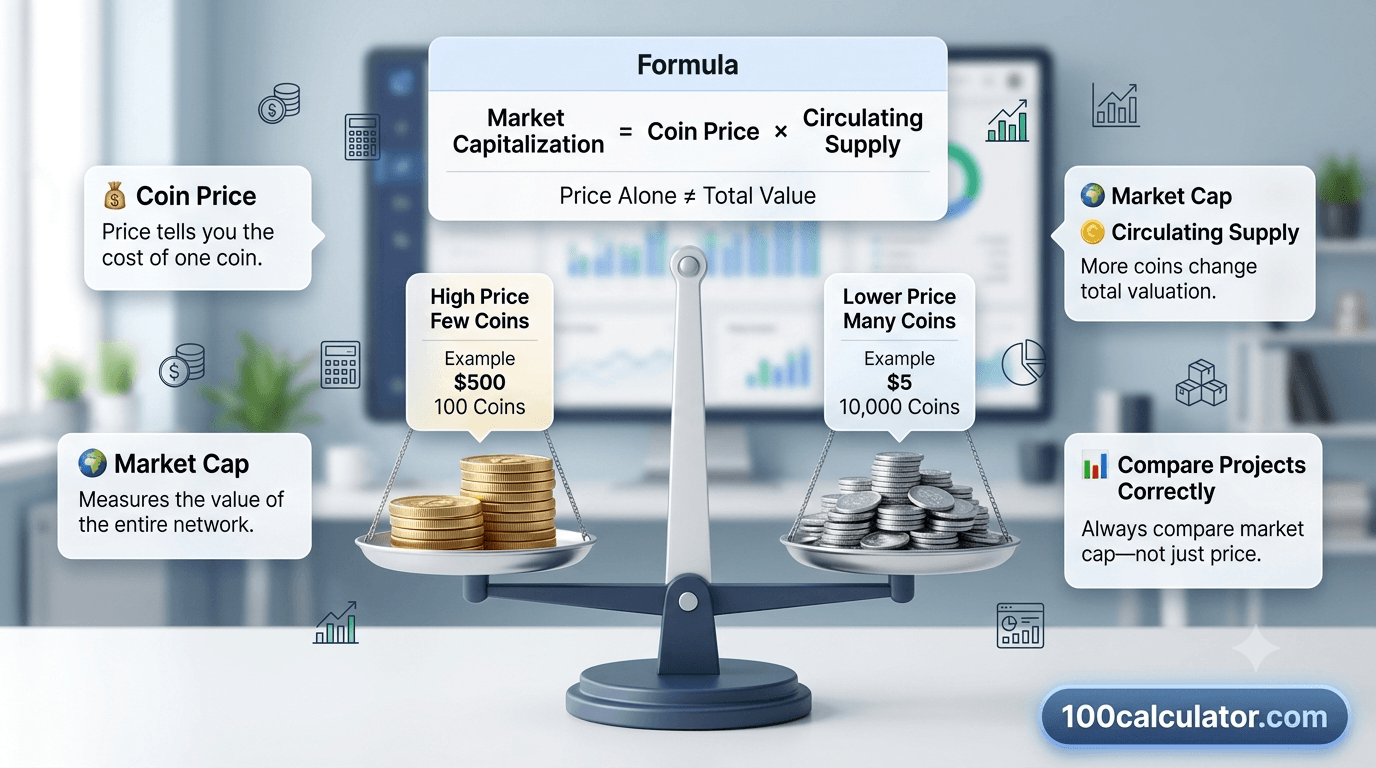
If you've ever looked at two cryptocurrencies and assumed the one with the lower price tag was the "cheaper" coin, you're not alone, and you're also not quite looking at the right number. Price only tells you what one unit of a coin costs right now. It says nothing about how many of those units exist, and that's exactly the gap market cap is built to close.
Market cap, short for market capitalization, is a coin's price multiplied by its circulating supply. It's the number that represents how much total value the market has assigned to a cryptocurrency, which is why a coin trading at a few cents can be worth more, in total, than a coin trading at tens of thousands of dollars.
This guide walks through how market cap is calculated, why price by itself is such a misleading shortcut, and how concepts like circulating supply, fully diluted valuation, and market cap tiers fit together. We'll also get into the math behind the popular "what if my coin reached Bitcoin's market cap" question, since that's exactly the kind of scenario 100 Calculator's Market Cap What If Calculator was built to answer. By the end, you'll be able to look at any two coins and know which numbers actually matter.
What Is Market Cap? A Quick Definition
Market capitalization, or market cap, is the total dollar value of all the coins or tokens currently in circulation for a given cryptocurrency. It's calculated with one simple multiplication: current price times circulating supply.
The idea isn't unique to crypto. Market cap started as a stock market concept, and the U.S. Securities and Exchange Commission's own investor glossary defines it the same way for public companies (SEC): share price multiplied by the number of outstanding shares. Crypto just swaps "shares" for "coins," and the math stays identical.
What makes market cap useful is that it lets you compare two completely different assets on equal footing. A stock priced at $5 and a stock priced at $500 aren't automatically "cheap" or "expensive" relative to each other, and the same is true for cryptocurrencies. Market cap strips price out of the comparison and replaces it with a single number that reflects total size.
Market cap matters to more than just active traders. Anyone comparing coins before buying, checking where a project ranks against competitors, or trying to understand why a headline calls one coin "the third-largest cryptocurrency" is relying on market cap, whether they realize it or not. It's the number behind almost every crypto ranking list you'll come across.
The most common misconception is treating price as a stand-in for market cap. They're related, but they answer different questions. Price tells you what one coin costs today. Market cap tells you how big the entire project is. Mixing the two up is how a coin priced at $0.001 can look "cheaper" than one priced at $30,000, when the lower-priced coin might actually represent a much larger total market value.
How Market Cap Is Calculated
Once you know what market cap represents, the actual calculation is refreshingly simple. Here's the formula, and a couple of examples to make it concrete.
The Market Cap Formula
The formula behind market cap couldn't be simpler:
Formula
Market Cap = Current Price × Circulating Supply
Current Price — what one coin or token costs right now, usually in USD.
Circulating Supply — the number of coins currently available and trading in the market, not the total that will eventually exist.
Multiply those two numbers, and you get a single figure representing the coin's total market value. Every major crypto tracking site uses this same formula, which is why market cap rankings tend to line up closely across different platforms.
A Simple Example With Real Numbers
Numbers make this easier to picture. Imagine a coin priced at $2, with 500 million coins in circulation:
Market Cap = $2 × 500,000,000 = $1,000,000,000
That coin has a $1 billion market cap. Now imagine the price stays exactly the same, but the circulating supply grows to 750 million coins, maybe because more tokens were released from a reserve:
Market Cap = $2 × 750,000,000 = $1,500,000,000
Nothing changed about the price, yet the market cap grew by $500 million. This is exactly why market cap and price can move independently of each other, and why watching only the price misses half the picture.
Why Price Alone Is a Misleading Metric
Price is the number most people see first, on an exchange, in a headline, or in a friend's excited text message. It's also the number that tells you the least about a coin's actual size. Here's why.
A Low Price Doesn't Mean a Coin Is Cheap
A coin priced at $0.02 isn't automatically a bargain compared to one priced at $2,000. What matters is how many coins exist. If that $0.02 coin has 500 billion coins in circulation, its market cap is $10 billion, larger than plenty of coins trading at much higher prices.
The table below shows this with a hypothetical example. None of these are real coins or real prices, just illustrative numbers to show how the math plays out.
| Coin | Price | Circulating Supply | Market Cap |
|---|---|---|---|
| Coin A | $0.02 | 500,000,000,000 | $10,000,000,000 |
| Coin B | $40.00 | 100,000,000 | $4,000,000,000 |
| Coin C | $2,000.00 | 20,000,000 | $40,000,000,000 |
Coin A has the lowest price of the three by far, yet its market cap is more than double Coin B's. Coin C, priced 100,000 times higher than Coin A, has a market cap four times larger. Price rank and market cap rank don't have to match at all.
A High Price Doesn't Mean a Coin Is Expensive
The same logic works in reverse. A coin priced at $50,000 isn't automatically a bigger project than one priced at $50. If the $50,000 coin has a tiny circulating supply, say 500,000 coins, its market cap is $25 billion. A $50 coin with 2 billion coins in circulation has a market cap of $100 billion, four times larger, despite a price that's a thousand times smaller.
This is the core reason experienced crypto users almost never compare two coins by price alone. Price tells you what a single coin costs to buy. It doesn't tell you anything about the size of the project behind it.
Circulating Supply vs. Total Supply vs. Max Supply
Market cap is only as accurate as the supply number behind it, and "supply" isn't one single figure. Crypto trackers typically use three different supply numbers, and mixing them up is one of the easiest ways to miscalculate market cap.
- Circulating Supply. The coins currently available and moving in the open market. This is the number market cap is supposed to use.
- Total Supply. Circulating coins plus any that already exist but are locked, reserved for a team or treasury, or not yet distributed, minus anything that's been permanently burned.
- Max Supply. The absolute ceiling on how many coins or tokens will ever be created. Some cryptocurrencies, like Bitcoin, have a fixed max supply. Others have no hard cap at all, and new coins can keep being created indefinitely.
Using total supply or max supply instead of circulating supply in a market cap calculation will inflate the number, sometimes dramatically. That inflated number actually has its own name and its own use, which is where fully diluted valuation comes in.
Fully Diluted Valuation (FDV) Explained
Fully diluted valuation, or FDV, answers a different question than market cap. Instead of using circulating supply, FDV uses max supply, the total number of coins that would exist if every single one were already in circulation today.
FDV = Current Price × Max Supply
The gap between market cap and FDV matters because it hints at how much future supply could eventually reach the market. A coin with a market cap of $50 million but an FDV of $2 billion still has 97.5% of its total supply waiting in the wings, whether that's through mining, staking rewards, team vesting schedules, or scheduled token unlocks. Once that supply starts circulating, it can put real downward pressure on price if demand doesn't grow just as fast.
Market Cap vs. FDV: A Side-by-Side Example
Picture a coin priced at $5, with 200 million coins currently circulating out of a 1 billion max supply.
Market Cap = $5 × 200,000,000 = $1,000,000,000
FDV = $5 × 1,000,000,000 = $5,000,000,000
The market cap looks like a solid $1 billion. The FDV tells a bigger story: only 20% of this coin's total possible supply is even circulating yet. The chart below shows the same numbers visually.
Market Cap Tiers: Large-Cap, Mid-Cap, and Small-Cap Coins
Once you understand how market cap is calculated, it's useful to know how the crypto industry groups coins by size. You'll see terms like "large-cap," "mid-cap," and "small-cap" thrown around constantly on exchanges, trackers, and crypto news sites.
There's no regulator or standards body that sets official cutoffs for these tiers in crypto, unlike some traditional stock market indexes. Different trackers draw the lines in slightly different places, but the table below reflects roughly how these terms are commonly used.
| Tier | Typical Market Cap Range | What It Usually Means |
|---|---|---|
| Large-cap | Roughly $10 billion and above | Established, widely held, generally lower volatility than smaller coins |
| Mid-cap | Roughly $1 billion to $10 billion | Reasonably established, still room to grow, moderate volatility |
| Small-cap | Roughly $100 million to $1 billion | Newer or less proven, higher volatility |
| Micro-cap | Under roughly $100 million | Highest risk and volatility, often thin trading volume |
These tiers are a starting point for thinking about risk, not a guarantee. A large-cap coin can still drop sharply in price, and a small-cap coin isn't destined to fail. What tier a coin sits in mainly tells you how established and widely held it currently is, which tends to correlate with, but never fully predicts, how much its price swings around.
The "What If My Coin Reached Bitcoin's Market Cap" Question
If you've spent time in crypto communities, you've probably seen the question in one form or another: "What if my coin reached Bitcoin's market cap? What would the price be?" It's one of the most common thought experiments in crypto, and it's exactly the scenario our related guide, What If Your Coin Reached Bitcoin's Market Cap?, and 100 Calculator's Market Cap What If Calculator are both built around.
The math is a rearranged version of the market cap formula. Instead of solving for market cap, you solve for the price a coin would need to hit a specific market cap target:
Implied Price = Target Market Cap ÷ Circulating Supply
Let's walk through a hypothetical example. Say a token is priced at $0.10, with 2 billion coins in circulation. Its current market cap is $200 million ($0.10 × 2,000,000,000). Now let's ask: what price would this token need to reach a hypothetical target market cap of $1 trillion, purely for the sake of the exercise?
Implied Price = $1,000,000,000,000 ÷ 2,000,000,000 = $500
On paper, that's a jump from $0.10 to $500, a 5,000x increase.
Free Online Tool
Run the numbers yourself
100 Calculator's Market Cap What If Calculator does this math instantly. Enter any coin's price and circulating supply, then compare it against a target market cap to see the implied price and how many times over the current price that would be.
Why This Math Rarely Plays Out in Real Life
The math above is accurate, but the scenario behind it usually isn't realistic, and it's worth understanding why. A trillion-dollar market cap doesn't appear out of thin air. It requires that much additional real capital, spread across millions of buyers, to actually flow into a coin and stay there. Moving a coin's market cap from $200 million to $1 trillion isn't just a bigger number on a screen, it's roughly a 5,000-fold increase in the total value the market assigns to that project, which would require an enormous, sustained shift in demand.
How to Use a Market Cap Calculator Step by Step
Running these numbers by hand works fine for a single example, but it gets tedious fast if you want to compare several coins or test a few different scenarios. A market cap calculator handles the arithmetic instantly. Here's the general process, which is how 100 Calculator's Market Cap What If Calculator and similar tools work:
- Decide what you're solving for. Are you calculating a coin's market cap from its price and supply, or working out the implied price for a target market cap?
- Enter the coin's current price. This is the number you'd see on any exchange or price tracker.
- Enter the circulating supply. If you're comparing a real coin, this figure is publicly available on most crypto tracking sites.
- For a "what if" scenario, enter a target market cap. This could be a round number or another coin's current market cap.
- Read the result. You'll get either the resulting market cap, or the implied price along with how many times that is over the coin's current price.
- Sanity-check the number. Compare the result against realistic benchmarks, like the total size of the crypto market, before treating it as a serious price target.
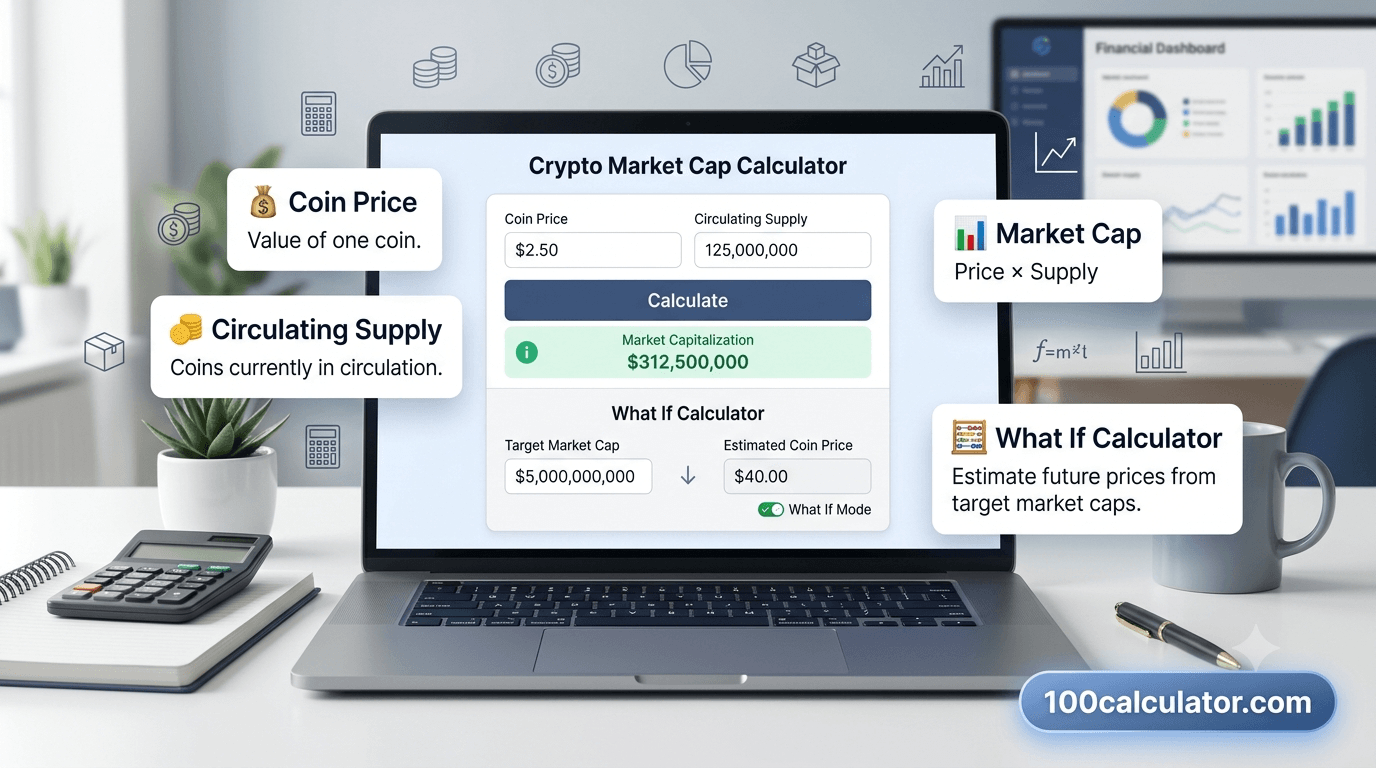
Use this same process to compare your own coin to Bitcoin, check how a supply increase would affect market cap, or simply confirm a number you saw somewhere else.
Common Market Cap Mistakes to Avoid
A few habits consistently throw off how people read and use market cap. Watching for these will save you from some of the most common, and most avoidable, misunderstandings.
- Assuming a low price means a coin is "cheap" or has more room to grow
- Comparing two coins' prices directly without checking supply
- Skipping fully diluted valuation before judging a project's real size
- Treating market cap as the same as money actually invested
- Ignoring trading volume and liquidity alongside market cap
- Assuming a high market cap automatically makes a coin safe
- Doing "what if" math from memory instead of checking the actual numbers
None of these mistakes are complicated to avoid once you know to look for them, which is really the whole point of understanding how market cap works in the first place.
Market Cap Myths vs. Facts
A handful of myths about market cap circulate so often that they start to sound like common knowledge. Here's what's actually true.
| Myth | Fact |
|---|---|
| A lower price means more room to grow | Growth potential depends on adoption and use, not the size of the number in front of the dollar sign |
| Market cap shows exactly how much money people have invested | Market cap is a snapshot based on the last traded price, not a record of actual cash invested |
| Two coins priced the same are "worth" the same | Market cap, not price, reflects total valuation, and it depends heavily on supply |
| Market cap can't be pushed around by a few trades | Thin trading volume means a handful of trades can move the price, and the market cap, quite a bit |
| A high market cap coin can't fail | A high market cap can lower some risks, but it doesn't eliminate volatility or the possibility of a project failing |
Related Calculators
Put what you just read into practice, try these free tools instantly, no sign-up required.
Crypto Dollar Cost Averaging (DCA)
Plan recurring crypto purchases using a dollar-cost averaging strategy.
Crypto Average Cost Basis Calculator
Calculate your average cost basis across multiple crypto purchases.
Market Cap What If Calculator
Estimate a coin's price if it reached a target market cap.
Crypto Profit & Exchange Fee Calculator
Calculate your crypto trading profit after exchange fees.
Ethereum Gas Fee to USD Calculator
Convert Ethereum gas fees into real-time USD cost estimates.
What Market Cap Can't Tell You
Even when you calculate market cap correctly, it has real limits. Understanding what it leaves out is just as important as understanding what it shows.
- Liquidity. Market cap doesn't reflect how easily a coin can actually be bought or sold at its current price. A coin can have a large market cap and still have a thin order book, meaning a large trade could move the price significantly.
- Real invested capital. Market cap is a snapshot based on the last traded price, not a running total of every dollar ever invested. Only a fraction of a coin's supply usually trades on any given day, so market cap can shift a lot more than the actual money changing hands would suggest.
- Project quality. A high market cap doesn't confirm strong technology, an active development team, or real-world use. It reflects what the market currently believes a coin is worth, and market sentiment can be wrong, especially in the short term.
- Future dilution. Market cap alone won't warn you about upcoming token unlocks or vesting schedules. That's exactly what checking FDV alongside market cap is for, as covered earlier in this guide.
Market cap won't tell you everything about a cryptocurrency, but it will stop you from making one of the most common beginner mistakes: judging a coin's size by its price tag alone. Whenever you're comparing coins, sizing up a new project, or just curious what a coin's price would look like at a different valuation, 100 Calculator's Market Cap What If Calculator can run the numbers for you in seconds. And once you've decided to actually build a position, tools like the Crypto Dollar Cost Averaging (DCA) calculator and the Crypto Average Cost Basis Calculator can help you manage it with the same level of clarity.
Financial disclaimer: This article is for general educational purposes only and isn't financial, investment, or trading advice. Cryptocurrency markets are highly volatile, and market cap, FDV, and any other metric discussed here should be treated as one input among many, not a guarantee of future performance. Always do your own research and consider speaking with a qualified financial advisor before making investment decisions.
Sources & References
More From the Crypto Tools Guide
Still building your understanding of crypto valuation and investing math? These related guides dig deeper into the topics covered above.
Frequently Asked Questions
What is market cap in crypto?
Market cap, short for market capitalization, is the total value of a cryptocurrency's circulating supply. You calculate it by multiplying a coin's current price by the number of coins currently in circulation. It's the standard way to compare the overall size of different cryptocurrencies, since price alone doesn't account for how many coins exist.
How do you calculate cryptocurrency market cap?
Multiply the coin's current price by its circulating supply: Market Cap = Price × Circulating Supply. For example, a coin priced at $2 with 500 million coins in circulation has a market cap of $1 billion. Most crypto tracking sites and calculators, including 100 Calculator's Market Cap What If Calculator, do this math for you automatically.
Does a low coin price mean it's a good deal?
Not on its own. A low price only tells you what one coin costs, not how much of the total supply you're buying or how the project is valued overall. A coin priced at a fraction of a cent can still have a market cap in the billions if enough coins exist, so price alone shouldn't be your measure of value.
What's the difference between market cap and fully diluted valuation (FDV)?
Market cap uses only the circulating supply, the coins available right now. FDV, or fully diluted valuation, uses the max supply, meaning every coin that could ever exist, including tokens not yet released. A large gap between the two is a signal that a lot of future supply could eventually enter the market and affect the price.
What's the difference between circulating supply, total supply, and max supply?
Circulating supply is the number of coins currently available to the public. Total supply includes circulating coins plus any that exist but are locked, reserved, or not yet released. Max supply is the absolute limit on how many coins will ever be created, though some cryptocurrencies don't have one at all.
Is a higher market cap always better or safer?
Not necessarily. A higher market cap generally suggests a more established, more widely held cryptocurrency, which can mean lower volatility than a brand-new coin. But market cap alone doesn't guarantee safety, good management, real usage, or protection from price swings, so it's best treated as one data point rather than a full risk assessment.
How do you calculate what price a coin would need to reach another coin's market cap?
Divide the target market cap by the coin's circulating supply: Implied Price = Target Market Cap ÷ Circulating Supply. This is the math behind popular "what if my coin reached Bitcoin's market cap" comparisons, and it's exactly what 100 Calculator's Market Cap What If Calculator does automatically when you enter both numbers.
What counts as a large-cap, mid-cap, or small-cap cryptocurrency?
There's no official rulebook, but many crypto trackers loosely use large-cap for coins above roughly $10 billion, mid-cap for roughly $1 billion to $10 billion, small-cap for roughly $100 million to $1 billion, and micro-cap for anything smaller. Different sites draw these lines slightly differently, so treat the labels as general guides, not fixed rules.
Why do two coins with the same price have completely different market caps?
Because market cap depends on supply as well as price. Two coins can both be priced at $1, but if one has 10 million coins in circulation and the other has 10 billion, their market caps will be worlds apart, $10 million versus $10 billion. Price tells you the cost of one coin; market cap tells you the size of the whole project.
Does market cap show how much money people have actually invested in a coin?
No, and this is one of the most common misunderstandings. Market cap is a snapshot calculated from the last traded price, not a record of total cash that has flowed into a coin. Because only a small portion of coins usually trade at any given time, market cap can move a lot more than the actual money changing hands would suggest.
Can a cryptocurrency's market cap be manipulated?
It can be pushed around more easily than people expect, especially for smaller coins. Because market cap is based on the last traded price, a handful of trades in a thinly traded coin can shift that price, and therefore the market cap, without much real money moving at all. This is one reason market cap alone isn't a complete safety signal.
Is market cap the same as trading volume?
No. Market cap measures a cryptocurrency's total value at its current price. Trading volume measures how much of that cryptocurrency has changed hands, usually over the last 24 hours. A coin can have a large market cap but relatively low daily trading volume, which often signals lower liquidity than the market cap number alone suggests.
Can a coin have a high market cap but still be hard to sell?
Yes. Market cap is calculated from price and supply, not from how easily you can actually buy or sell at that price. A coin can show a large market cap on paper while having thin order books and low trading volume, which means trying to sell a large position could move the price significantly before the trade completes.
What's a healthy market cap for a new cryptocurrency?
There's no set number that makes a market cap "healthy." What matters more is whether the market cap makes sense next to the project's actual usage, trading volume, and how much of the supply is already circulating versus locked up for later. A very high market cap on a brand-new project with little real activity is worth a closer look.
Should I only invest in high market cap coins?
That's a personal decision that depends on your own goals and risk tolerance, not something a single article can decide for you. Higher market cap coins are often more established and can be less volatile, while smaller ones can carry more risk along with more potential upside. This is educational information, not investment advice, so it's worth researching thoroughly and speaking with a financial professional before deciding.
About 100 Calculator
100 Calculator is a free hub of online calculators and educational guides covering health, finance, trading, crypto, education, and more. Every tool is built to be fast, accurate, and genuinely free, with no account or signup required.
We built this guide, and tools like the Market Cap What If Calculator referenced throughout it, to make crypto math easier to understand before you put real money behind it. Head back to the 100 Calculator homepage to explore the full library of tools, or learn more about the team behind them on our About Us page.