How to Calculate Crypto Trading Profit Correctly
A clear, beginner-friendly walkthrough of the exact math behind crypto trading profit — including exchange fees, cost basis, and the difference between realized and unrealized gains — so your numbers reflect what you actually keep.

If a crypto trade ever looked great on the exchange screen but felt smaller once the money actually hit your wallet, fees were probably the reason. Calculating your real trading profit means looking past the gap between your buy price and sell price and accounting for every fee along the way, plus how you're tracking cost basis if you bought at more than one price.
Crypto trading profit is the money you actually keep after selling or trading a digital asset — calculated as your sale proceeds minus your total cost basis minus every fee charged on the trade, not just the difference between your buy price and sell price. Skip the fees and your numbers look better than reality. Skip cost basis tracking and multi-purchase trades get messy fast.
This guide walks through the exact formula, how exchange fees factor in, how to handle purchases made at different prices, and the mistakes that most often throw off the math. If you'd rather skip the manual arithmetic, 100 Calculator's Crypto Profit & Exchange Fee Calculator does this math for you the moment you enter your trade details.
First, it helps to pin down exactly what "profit" means in a crypto trade, since that's what the rest of this guide builds on.
What Is Crypto Trading Profit, Exactly?
In the simplest terms, crypto trading profit is the difference between what you paid for a digital asset and what you received when you sold or traded it away. That much is intuitive. Where people usually go wrong is stopping the math there, before fees and cost basis enter the picture.
A more complete definition treats profit as everything that changed hands during the trade, not just the two headline prices. That includes trading fees on both the buy and sell side, any network or withdrawal fees involved in moving the asset, and — if you bought the same coin more than once at different prices — which purchase price actually counts toward this particular sale.
Gross Profit vs. Net Profit
Gross profit is your sale price minus your purchase price, with no fees subtracted. It's the number most people calculate in their head, and it's usually the number an exchange shows first.
Net profit takes that same gross figure and subtracts every fee you paid, on both sides of the trade. Net profit is the number that actually reflects what landed in your wallet, which is why it's the one worth tracking. Every calculation in this guide builds toward net profit, since that's the figure that matters when you're deciding whether a trade was actually worth it.
Why Accurate Profit Tracking Matters
It's easy to eyeball a trade and assume you know how you did. The sell price was higher than the buy price, so that's a win, right? Usually, yes — but by how much is a different question, and fees plus cost basis can shrink that number more than most people expect.
This matters most when you're trading often, using smaller position sizes, or holding several coins bought at different prices. In those situations, the gap between your gut-feel profit and your actual profit can be significant enough to change whether a strategy is genuinely working.
A few months of accurate tracking gives you a real picture of your trading, not just a feeling:
- A true answer to whether you're actually making money, not just a sense that you are
- A number you can fairly compare against other trades, coins, or investments
- The records you'd need if a tax authority ever asks how you calculated a gain or loss
- An early warning if fees are quietly eating a bigger share of your gains than you realized
- Confidence that a trade that looks like a big win on screen is still a win after costs
The Basic Crypto Profit Formula
Once you separate gross profit from net profit, the actual formula is straightforward. It just needs every piece filled in honestly, fees included.
Profit in Dollar Terms
The core formula for net profit on a single trade looks like this:
Formula
Net Profit = (Sell Price × Quantity) − (Buy Price × Quantity) − Total Fees
Sell Price — the price per unit when you sold or traded the asset away
Buy Price — the price per unit when you originally acquired it
Quantity — how many coins or tokens were involved in the trade
Total Fees — every fee charged on both the buy and the sell, added together
When Buy Price and Sell Price are multiplied by the same Quantity, you can simplify this to (Sell Price − Buy Price) × Quantity − Total Fees, which gives the same result. The fees are what most manual calculations skip, which is exactly why they deserve their own section below.
Profit as a Percentage (ROI)
A dollar amount only tells part of the story, since a $200 profit means something very different on a $1,000 trade than it does on a $10,000 trade. Return on investment, or ROI, expresses profit as a percentage of what you actually spent.
Formula
ROI % = (Net Profit ÷ Total Cost Basis) × 100
Net Profit — the dollar figure from the formula above
Total Cost Basis — everything you spent to acquire the position, including buy-side fees
ROI is especially useful once you're comparing several trades against each other, since it puts every trade on the same scale regardless of position size.
How Exchange Fees Quietly Eat Into Your Profit
Fees rarely look dramatic on their own. A 0.5% trading fee sounds small. But fees apply on both the buy and the sell, and depending on how you're trading, there can be more than one type stacking on top of each other.
Maker Fees vs. Taker Fees
Most exchanges split trading fees into two tiers. A maker fee applies when your order adds liquidity to the order book — typically a limit order that sits and waits to be filled. A taker fee applies when your order removes liquidity, which usually means a market order that fills immediately against existing orders. Taker fees are generally the higher of the two, since you're getting the convenience of an instant fill.
Network and Withdrawal Fees
Beyond the trading fee itself, moving crypto onto an exchange, between wallets, or off an exchange usually costs something — a network fee, often called a gas fee on Ethereum and similar chains, or a flat withdrawal fee set by the exchange. These are easy to forget because they're charged separately from the trade itself, but they're a real cost of getting your funds in position or cashing out. Our guide on why Ethereum gas fees rise and fall throughout the day explains what drives these costs up and down, and 100 Calculator's Ethereum Gas Fee to USD Calculator can convert a gas cost into a dollar figure you can add straight into your profit math.
The Spread: A Fee You Don't Always See
Some platforms build their cost into the price itself rather than charging a separate line-item fee. The spread is the gap between the price you'd pay to buy and the price you'd receive to sell at the same instant. It's less visible than a percentage-based fee, but it still reduces your real profit, so it's worth checking whether your platform charges an explicit fee, builds in a spread, or does both.

Step-by-Step: Calculating Profit on a Single Trade
Here's the process laid out in order, so you can follow it with your own trade details:
- Gather your trade details. You'll need the buy price, sell price, quantity, and every fee charged on both sides.
- Calculate your total cost basis. Multiply buy price by quantity, then add the buy-side fee.
- Calculate your gross sale proceeds. Multiply sell price by quantity.
- Subtract the sell-side fee from gross proceeds to get your net proceeds.
- Subtract your cost basis from net proceeds. The result is your net profit.
- Divide net profit by cost basis and multiply by 100 if you also want your ROI percentage.
Worked Example
Say you buy 500 tokens of a coin at $2.00 each, and your exchange charges a 1% fee on the trade. A few weeks later, you sell all 500 tokens at $2.40 each, with another 1% fee on the sell. Here's how the math plays out:
| Step | Calculation | Result |
|---|---|---|
| Buy cost | 500 × $2.00 | $1,000 |
| Buy fee (1%) | 1% × $1,000 | $10 |
| Total cost basis | $1,000 + $10 | $1,010 |
| Gross sale proceeds | 500 × $2.40 | $1,200 |
| Sell fee (1%) | 1% × $1,200 | $12 |
| Net sale proceeds | $1,200 − $12 | $1,188 |
| Net profit | $1,188 − $1,010 | $178 |
| ROI | $178 ÷ $1,010 × 100 | ≈ 17.6% |
Notice the gap: ignoring fees entirely, this trade looks like a flat $200 gross profit, a clean 20% gain. Once both fees are factored in, the real net profit is $178, about 17.6%. That $22 difference — 11% of the gross profit — went straight to fees on a single trade.
Cost Basis Methods When You've Bought at Multiple Prices
The worked example above is simple because there was only one purchase. Real trading often looks messier — you buy a little here, a little there, at different prices, then sell only part of your holding. When that happens, you need a consistent method for deciding which purchase price counts as the "cost" for the coins you just sold.
First In, First Out (FIFO)
FIFO assumes the coins you bought first are the ones you sell first. It's one of the more widely used default methods, partly because it's simple to follow and partly because several tax authorities require or default to it.
Last In, First Out (LIFO)
LIFO assumes the opposite — your most recent purchase is the first one considered sold. This can change your calculated gain significantly if prices have moved a lot between your first and most recent purchase, and it isn't accepted everywhere.
Average Cost Method
Average cost blends every purchase into a single weighted price per coin, which makes it the simplest method to maintain if you're buying regularly, such as with a dollar-cost averaging strategy. Here's a short example: say you buy 0.4 units of a coin at $1,800, then later buy 0.6 units at $2,200.
| Purchase | Quantity | Price | Cost |
|---|---|---|---|
| Buy 1 | 0.4 | $1,800 | $720 |
| Buy 2 | 0.6 | $2,200 | $1,320 |
| Total | 1.0 | Average: $2,040 | $2,040 |
Your average cost basis is $2,040 per whole coin ($2,040 total cost ÷ 1.0 total units). If you later sell that full 1.0 unit at $2,500, your gross profit before fees is $460 ($2,500 − $2,040), regardless of which of the two purchases you'd otherwise think of as "the one you sold." Our guide on how to calculate your average cost basis in crypto walks through more scenarios, and 100 Calculator's Crypto Average Cost Basis Calculator can run this math for you across any number of purchases.
If you're building your position gradually rather than buying all at once, 100 Calculator's Crypto Dollar Cost Averaging (DCA) tool can project how a recurring purchase plan affects your average cost over time.
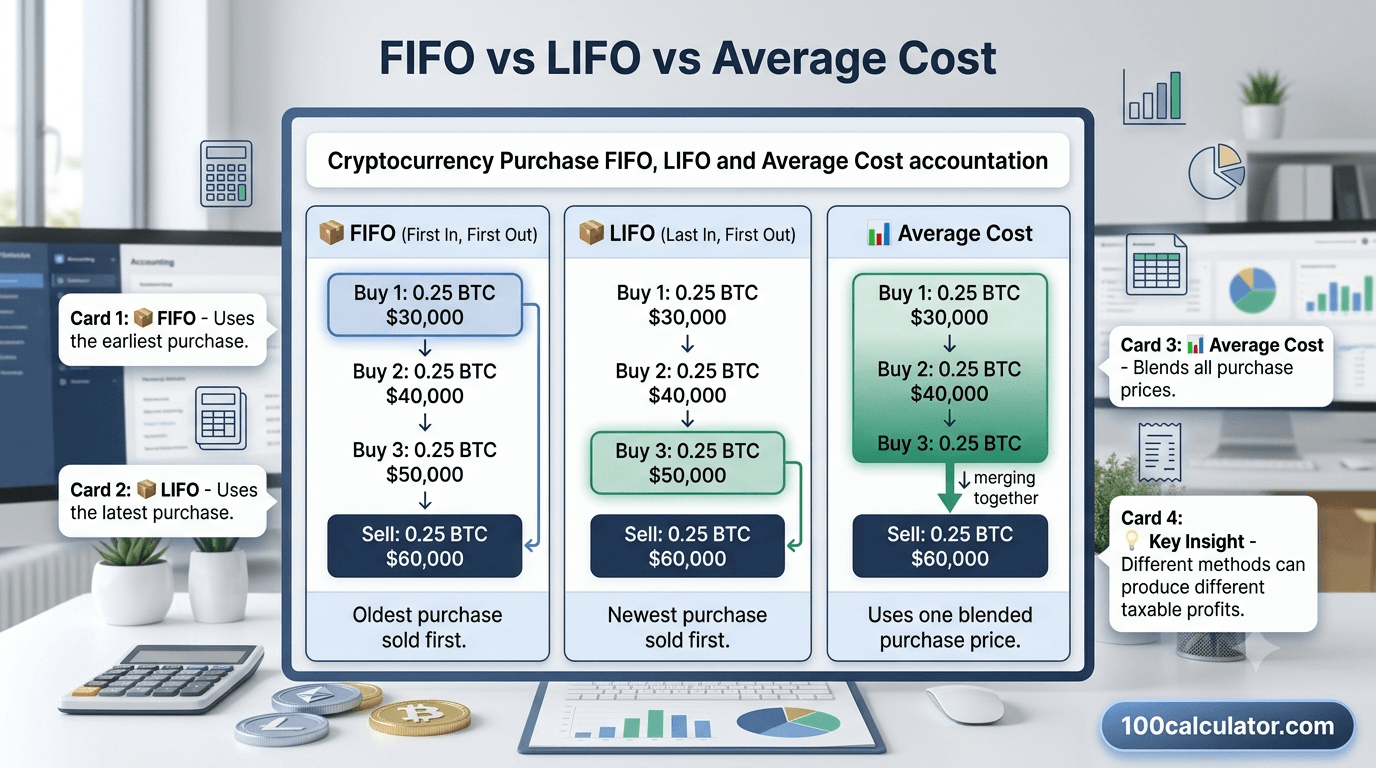
Which Method Should You Use?
| Method | How It Works | Best For |
|---|---|---|
| FIFO | Earliest purchase counted as sold first | Simple tracking; often a tax authority default |
| LIFO | Most recent purchase counted as sold first | Traders comparing short-term positions, where permitted |
| Average Cost | All purchases blended into one price | Regular or dollar-cost-averaged buying patterns |
| Specific Identification | You choose exactly which lot is sold | Traders who keep detailed per-purchase records |
The right method often depends on what your country's tax rules allow, more than personal preference. We cover that connection in more detail in our guide on why cost basis matters for crypto tax reporting.
Realized vs. Unrealized Profit
Unrealized profit (or loss) is a paper number — the gap between what a coin is worth right now and what you paid for it, as long as you still hold it. Realized profit is what happens the moment you actually sell, trade, or spend the asset, which locks that number in for good, whether it goes up or down from there afterward.
Why the Difference Matters
This distinction matters for two practical reasons. First, only realized gains are typically relevant for tax purposes — an unrealized gain sitting in your wallet generally isn't a taxable event until you act on it. Second, unrealized profit can vanish. A position that's up 40% today can be up 10%, or down, by the time you decide to sell, so it's worth treating unrealized numbers as an estimate rather than money you've already made.
Common Mistakes That Throw Off Your Profit Numbers
A handful of habits quietly distort profit calculations even when someone is genuinely trying to track things carefully. Here's what to watch for:
- Ignoring fees on one side of the trade. Some people remember the sell-side fee but forget the buy-side fee, or vice versa.
- Forgetting network or withdrawal fees that were charged separately from the trade itself.
- Mixing up gross profit and net profit when comparing trades or reporting results to yourself.
- Not tracking cost basis consistently once you've bought the same coin more than once at different prices.
- Treating unrealized gains as spendable profit before actually selling or trading the position.
- Comparing trades by percentage alone, without checking whether the position sizes were similar enough to make the comparison fair.
- Skipping small trades because they feel too minor to matter — the fees and gains add up across many small trades just as they do across a few large ones.
Our guide on common crypto profit calculation mistakes to avoid goes through several of these in more depth, with examples of how each one changes the final number.
Trickier Situations That Complicate Profit Calculations
Everything above covers a straightforward buy-then-sell trade. A few other common situations add extra layers worth knowing about, even if you don't run into them right away.
Crypto-to-Crypto Trades
Trading one cryptocurrency directly for another, say ETH for SOL, is more complex than a simple crypto-to- fiat sale, because there's no dollar amount printed on the trade itself. To calculate profit, you need to establish the fair market value of both assets, in your local currency, at the time of the trade. That value becomes both your sale proceeds for the asset you gave up and your new cost basis for the asset you received.
Leveraged and Margin Positions
Trading with borrowed funds changes the math further, since profit and loss are calculated against your margin rather than the full position size, and a price move against you can trigger a forced liquidation before you choose to exit. That's a topic broad enough for its own guide, but if leverage is part of your trading, 100 Calculator's Crypto Liquidation Price Calculator is a useful starting point for understanding where your risk actually sits.
Providing Liquidity in DeFi Pools
Depositing a pair of assets into a decentralized liquidity pool introduces a different kind of profit complication called impermanent loss, where the value of your deposited assets can end up lower than if you'd simply held them, even while you're earning fees from the pool. If you're providing liquidity anywhere, it's worth running your position through 100 Calculator's Impermanent Loss Calculator before assuming the fee income alone tells the full story.
Crypto Profit and Taxes: What to Keep in Mind
Profit calculation and tax calculation are related but not identical. Your net profit is a trading result; your taxable gain is what a tax authority says you owe on that result, and the two can differ based on the cost basis method you're required or allowed to use.
Taxable Events to Watch For
Tax rules vary significantly by country, so treat the following as general patterns rather than advice for your specific situation. In the United States, for example, the IRS treats digital assets as property, meaning general property transaction tax principles apply to crypto transactions (IRS). That framing is common in other jurisdictions too, which is part of why crypto-to-crypto trades — not just cashing out to fiat — are so often treated as taxable disposals.
Why Good Records Matter
Whatever method your tax authority requires, you'll need a full record of every purchase price, sale price, date, and fee to apply it correctly. This is exactly why cost basis tracking and profit calculation are worth doing consistently as you trade, rather than trying to reconstruct a year of activity from memory when a filing deadline approaches.
Tracking Profit Across Multiple Trades and Exchanges
One trade is easy to calculate by hand. Dozens of trades across two or three exchanges is where manual tracking starts to break down, especially once cost basis needs to carry over correctly between them.
Spreadsheets vs. Trackers vs. a Calculator
A spreadsheet that logs every buy and sell with its price, quantity, and fees gives you full control, if you're comfortable building your own formulas and keeping them consistent. A dedicated portfolio tracker can pull data automatically but sometimes hides exactly how it's calculating fees or cost basis. A calculator built specifically for this math, like 100 Calculator's Crypto Profit & Exchange Fee Calculator, sits in between — fast to use for a single trade, transparent about the formula, and far less error-prone than doing the arithmetic by hand every time.
If you're actively sizing new positions rather than just reviewing past ones, 100 Calculator's Crypto Position Size Calculator can help you decide how much to put into a trade before you make it, based on how much you're willing to risk.
Related Calculators
Put what you just read into practice, try these free tools instantly, no sign-up required.
Crypto Dollar Cost Averaging (DCA)
Plan recurring crypto purchases using a dollar-cost averaging strategy.
Crypto Average Cost Basis Calculator
Calculate your average cost basis across multiple crypto purchases.
Market Cap What If Calculator
Estimate a coin's price if it reached a target market cap.
Crypto Profit & Exchange Fee Calculator
Calculate your crypto trading profit after exchange fees.
Ethereum Gas Fee to USD Calculator
Convert Ethereum gas fees into real-time USD cost estimates.
Building a Simple Habit for Tracking Your Trades
The most accurate profit number is the one built from records you actually kept, consistently, as you traded. A few habits make that realistic instead of a chore:
- Log every trade the same day you make it — price, quantity, and every fee charged, while the details are still fresh.
- Keep gross and net numbers in separate columns so you never accidentally mix the two together.
- Pick one cost basis method and stick with it for a given tax year, rather than switching partway through.
- Reconcile your own log against each exchange's statement once a month, so small errors don't compound over time.
- Review your total profit, not just per-trade numbers, at least once a quarter to see the bigger picture.
Once you've got your trade details in front of you, 100 Calculator's Crypto Profit & Exchange Fee Calculator turns this whole process into a quick, no-signup check — enter your buy price, sell price, quantity, and fees, and get your net profit and ROI instantly.
Financial disclaimer: This article is for general educational purposes only and isn't a substitute for professional financial, investment, or tax advice. Cryptocurrency prices are volatile and trading carries real risk of loss, and tax rules for digital assets vary by country and change over time. Always talk to a licensed financial advisor or tax professional about your specific situation before making trading or tax decisions.
More From Our Crypto Tools Guide
Still working out the details of fees, cost basis, or trading strategy? These related guides dig deeper into the topics covered above.
Frequently Asked Questions
How do you calculate profit on a crypto trade?
To calculate profit on a crypto trade, subtract your total cost basis, what you paid including fees, from your net sale proceeds, what you received after fees. The basic formula is: Net Profit = (Sell Price × Quantity) − (Buy Price × Quantity) − Total Fees. This gives you your actual take-home profit rather than just the difference between the buy and sell price.
What's the difference between gross profit and net profit in crypto trading?
Gross profit is simply your sale price minus your purchase price, before any fees are subtracted. Net profit takes gross profit and subtracts every fee you paid on both the buy and sell side, plus any network or withdrawal fees. Net profit is the number that reflects what you actually keep, so it's the one worth tracking.
Do exchange fees really make that much difference to my profit?
Yes, especially if you trade often or in smaller amounts. A fee on both the buy and sell side of a trade can easily account for 10% or more of your gross profit, as shown in the worked example earlier in this guide. Fees that look small as a percentage add up quickly across dozens or hundreds of trades, which is why they belong in every profit calculation.
What's the difference between a maker fee and a taker fee?
A maker fee applies when your order adds liquidity to the order book, usually a limit order that isn't filled immediately. A taker fee applies when your order removes liquidity, usually a market order that fills right away. Maker fees are typically lower than taker fees, so using limit orders when possible can reduce your trading costs.
Do network or gas fees count toward my profit calculation?
Yes. Network fees, sometimes called gas fees, and withdrawal fees are real costs of moving or trading your crypto, even though they aren't always labeled as a "trading fee." If you paid a fee to move funds onto an exchange, between wallets, or off an exchange as part of a trade, it should be included in your total cost when calculating profit.
What cost basis method should I use for crypto?
The best cost basis method often depends on your country's tax rules, since some jurisdictions require a specific method like FIFO while others allow you to choose. Average cost is usually the simplest for casual tracking, while FIFO and specific identification give more control over which purchase lots count as sold. When in doubt, check your local tax authority's guidance or ask a tax professional.
Is trading one cryptocurrency for another a taxable event?
In many countries, yes. Trading one cryptocurrency for another is generally treated as disposing of the first asset and acquiring the second, which can trigger a taxable gain or loss even though you never touched fiat currency. Tax treatment varies by country, so it's worth confirming the specific rule that applies to you.
How do I calculate profit if I bought the same coin at different prices?
When you've bought the same coin at different prices, you need a cost basis method to decide which purchase price, or blend of prices, counts when you sell. Average cost combines all your purchase prices into one weighted number. FIFO assumes your earliest purchases are sold first. Both are valid starting points, but the method you use can change your calculated profit.
What is ROI in crypto trading and how is it calculated?
ROI, or return on investment, expresses your profit as a percentage of what you spent rather than a raw dollar amount. The formula is: ROI % = (Net Profit ÷ Total Cost Basis) × 100. A $200 profit sounds identical whether you invested $1,000 or $10,000, but the ROI tells you which trade actually performed better relative to what you put in.
What's the difference between realized and unrealized crypto gains?
Unrealized gains or losses exist on paper only, based on a coin's current price compared to what you paid, as long as you still hold it. Realized gains or losses happen the moment you actually sell, trade, or spend the asset, locking in the result. Only realized gains are relevant for tax purposes in most countries, and only realized profit is money you can actually spend.
Why does my exchange's profit and loss number look different from my own math?
Exchanges often calculate profit and loss differently than you might expect, sometimes ignoring fees, using a different cost basis method, or only reflecting realized trades rather than your full position. If the numbers don't match, check whether the exchange is including fees, which cost basis method it's using, and whether it's showing realized or unrealized figures.
Is unrealized profit the same as money I've actually made?
No. Unrealized profit is a snapshot of what your position is worth right now if you sold at the current price, but prices can move before you actually do. It only becomes real, spendable profit once you sell or trade the asset and lock in that value. Until then, it can shrink, disappear, or grow further.
What is slippage and how does it affect my real profit?
Slippage happens when your order executes at a different price than you expected, usually because the market moved or there wasn't enough liquidity at your target price. It's most common with market orders during volatile periods or on lower-volume coins. Slippage isn't a fee in the traditional sense, but it still reduces your actual profit compared to the price you saw when you placed the order.
What's the easiest way to track profit across multiple exchanges?
A spreadsheet that logs every buy and sell with its price, quantity, and fees works well if you're comfortable building your own formulas. A dedicated portfolio tracker or a calculator built for crypto profit and fees can save time and reduce math errors, especially once you're tracking trades across more than one exchange.
Do I need to calculate profit on every single trade, even small ones?
For your own understanding, you don't need to calculate profit on every micro-trade in detail, but it helps to at least log the basic numbers, price, quantity, and fees, for each one. Small trades still add up, and having the raw data means you can calculate accurate totals later, even if you don't work out the profit on each individual trade right away.
Can a calculator do this math for me instead of doing it by hand?
Yes. A calculator handles the fee math, cost basis subtraction, and percentage calculations automatically, which reduces the chance of manual errors, especially once fees and multiple purchase prices are involved. 100 Calculator's Crypto Profit & Exchange Fee Calculator is built for exactly this, letting you enter your trade details and see your net profit right away.
About 100 Calculator
100 Calculator is a free hub of online calculators and educational guides covering health, finance, trading, crypto, education, and more. Every tool is built to be fast, accurate, and genuinely free, with no account or signup required.
We built this guide, and tools like the Crypto Profit & Exchange Fee Calculator referenced throughout it, to make everyday crypto questions a little easier to answer. Head back to the 100 Calculator homepage to explore the full library of tools, or learn more about the team behind them on our About Us page.