What If Your Coin Reached Bitcoin's Market Cap?
The math behind these "what if" price targets is simpler than most people expect — and once you see the real numbers side by side, it's a lot easier to tell a genuine long shot from a realistic one.

If your coin reached Bitcoin's market cap, its price would equal Bitcoin's total market cap divided by your coin's circulating supply — that's the entire formula. The hard part isn't the division. It's understanding what "reaching" that market cap would actually require, and why the resulting price on its own doesn't tell you much.
You've probably seen posts like this: "If Coin X gets Bitcoin's market cap, it's going to $500" or "DOGE at $50 is inevitable." These spread fast because the math really is that simple. Market cap equals price times circulating supply, so once you know the target market cap and a coin's supply, solving for price only takes one step.
What usually gets left out is scale. As of mid-2026, Bitcoin's market cap sits at roughly $1.28 trillion — more than the entire economic output of most countries. Getting any other coin to that same number isn't just a line going up on a chart. It means trillions of real dollars choosing that asset over every other place they could sit, and staying there.
This guide walks through the exact formula, works through real numbers using Bitcoin's, Ethereum's, and Dogecoin's actual current figures, and covers the assumptions that separate a fun thought experiment from an actual price prediction. If you'd rather skip the manual math for your own numbers, 100 Calculator's Market Cap What If Calculator runs this exact formula instantly for any coin.
What "Market Cap" Really Means
Before working out any hypothetical price, it helps to know exactly what market cap measures — because it's easy to assume it means something it doesn't.
The Market Cap Formula
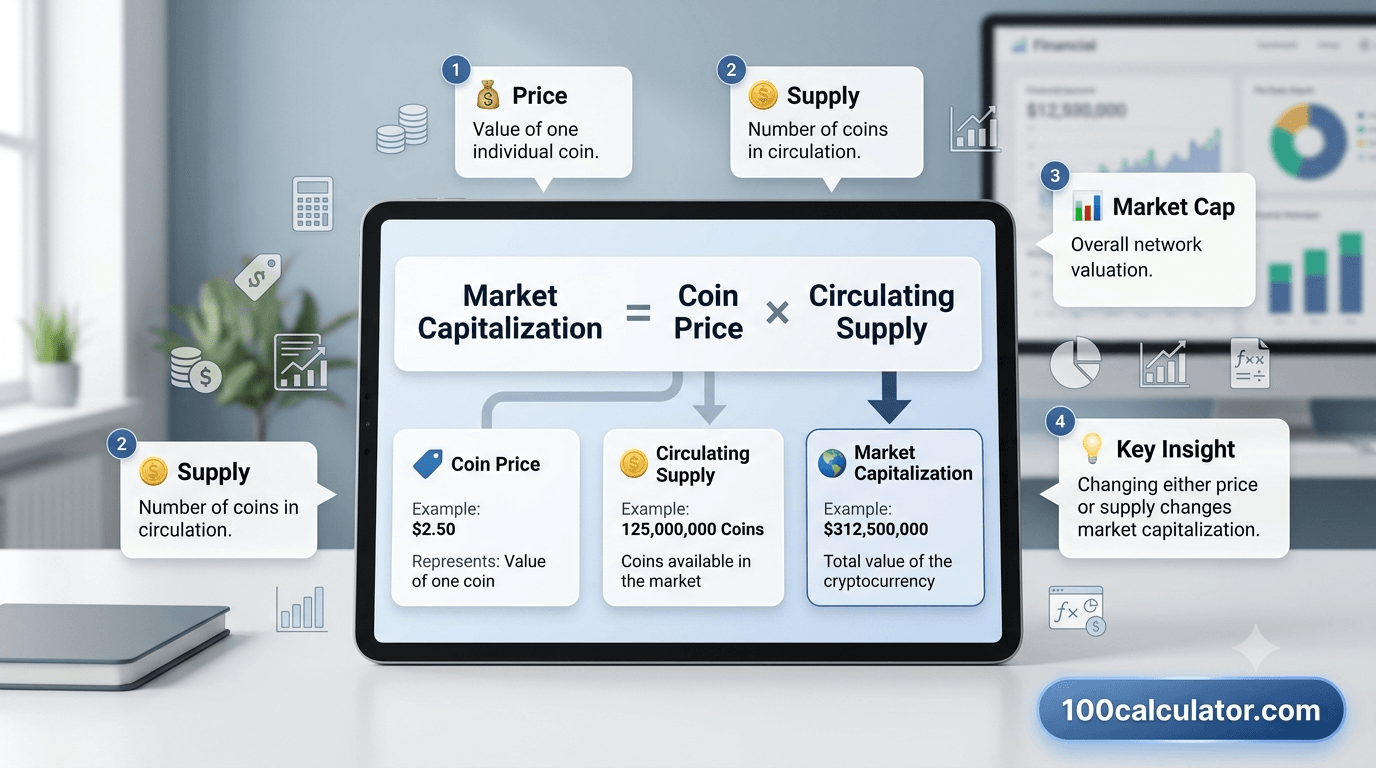
Market cap, short for market capitalization, is the total value of every coin currently in circulation. You get it with one calculation:
Market Cap = Current Price × Circulating Supply
Current Price — what one coin is worth right now, in dollars.
Circulating Supply — the number of coins that are actually out and tradable today.
Why a Coin's Price Alone Doesn't Tell You Much
Here's where a lot of confusion starts. Price and market cap are related, but they aren't the same thing, and a coin's price by itself says almost nothing about how big that coin actually is.
Take Dogecoin. As of mid-2026, DOGE trades for around $0.072 — about as close to "cheap" as a widely traded coin gets. But with roughly 160 billion DOGE in circulation, that works out to a market cap of about $11.5 billion, which puts it solidly among the largest cryptocurrencies by total value.
Now imagine a different coin priced at $50 with only 10 million tokens in circulation. That coin's market cap would be $500 million — less than one-twentieth the size of Dogecoin's, despite trading at a price that's nearly 700 times higher per token. Price tells you what one unit costs. Market cap tells you how big the whole thing is. Our guide on how market cap works and why price alone is misleading covers this exact distinction in more detail.
The Formula for a Coin's Hypothetical Price
Once you understand what market cap actually measures, the "what if" question becomes a simple rearranging of that same formula.
Solving for Price Instead of Market Cap
If market cap equals price times supply, then price equals market cap divided by supply. That's the entire trick behind every "what if my coin reached X's market cap" calculation you've ever seen:
Hypothetical Price = Target Market Cap ÷ Your Coin's Circulating Supply
Target Market Cap — the market cap you're comparing against, such as Bitcoin's current figure.
Circulating Supply — your coin's own circulating supply, not its total or maximum supply.
Notice that your coin's current price never enters this equation at all. The hypothetical price depends entirely on the target market cap and your coin's supply — nothing else. That's exactly why a coin's current price is such a poor guide to how "cheap" or "expensive" it really is relative to a bigger target.
A Simple Worked Example
Say a coin — we'll call it Coin X — has 1 billion tokens in circulation and currently trades at $1.00, giving it a $1 billion market cap. If Coin X reached Bitcoin's market cap of roughly $1.28 trillion, the math looks like this:
| Step | Value |
|---|---|
| Target market cap (Bitcoin) | $1,280,000,000,000 |
| Coin X circulating supply | 1,000,000,000 tokens |
| Hypothetical price | $1,280 per token |
| Increase from current $1.00 | 1,280x |
That's a price of $1,280, up from $1.00 — a 1,280x increase. The number looks dramatic, but notice it came entirely from the size of the target market cap divided by supply. Change either one of those two numbers and the hypothetical price changes completely, which is exactly what the next section walks through using real coins instead of a made-up example.
Step-by-Step: What If Your Coin Reached Bitcoin's Market Cap
Here's the exact process to run this calculation for any coin you're curious about.
- Find Bitcoin's current market cap. As of mid-2026, that's approximately $1.28 trillion, though it changes by the minute — 100 Calculator's Market Cap What If Calculator pulls current figures automatically so you don't have to track this down yourself.
- Find your coin's circulating supply, not its total or maximum supply. This is usually listed right next to the price on any major exchange or price-tracking site.
- Divide Bitcoin's market cap by your coin's circulating supply. The result is your coin's hypothetical price at that market cap.
- Compare that number to the current price to see the multiple. Divide the hypothetical price by the current price, and that tells you how many times over the price would need to grow.
That fourth step matters more than people give it credit for. A hypothetical price of $50 sounds achievable for a coin already worth $10. It sounds a lot less realistic once you see it actually represents a thousand-fold increase because the coin's circulating supply is enormous.
Real Numbers: What Reaching Bitcoin's Market Cap Would Mean for Ethereum and Dogecoin
Made-up numbers are useful for learning the formula, but real numbers make the scale of this question much clearer. Here's what the same calculation looks like using Bitcoin's, Ethereum's, and Dogecoin's actual figures as of mid-2026.
| Coin | Current Price | Circulating Supply | Current Market Cap | Price at BTC's Market Cap | Multiple Needed |
|---|---|---|---|---|---|
| Bitcoin (target) | ~$64,000 | ~20.06M BTC | ~$1.28T | — | — |
| Ethereum | ~$1,820 | ~120.7M ETH | ~$220B | ~$10,600 | ~5.8x |
| Dogecoin | ~$0.072 | ~160B DOGE | ~$11.5B | ~$8.00 | ~111x |
Notice something interesting: Ethereum would need "only" a 5.8x increase to match Bitcoin's market cap, while Dogecoin would need roughly 111x. That's not because Ethereum is somehow a "better" coin for this purpose — it's because Ethereum's market cap already sits much closer to Bitcoin's. The size of the gap between a coin's current market cap and the target market cap is what actually determines the multiple, not the coin's price, its brand recognition, or how much people are talking about it on social media.
These figures shift constantly, since crypto prices move every minute of every day. If you want current numbers instead of a snapshot from when this was published, 100 Calculator's Market Cap What If Calculator pulls live data so you're always working from an up-to-date figure rather than one that's already gone stale.
Why This Question Is Everywhere in Crypto Communities
If you spend any time in crypto forums, Discord servers, or social media threads, "what if [coin] hit [bigger coin]'s market cap" is one of the most recurring conversations you'll run into. There are a few honest reasons this question keeps coming back.
A low price per token feels like more room to grow, even though it has nothing to do with how much upside is actually left. Psychologically, buying 10,000 tokens at a fraction of a cent each feels more accessible — and more exciting to imagine multiplying — than buying a sliver of a token priced in the tens of thousands. The math doesn't actually work that way, but the feeling is real, and it's a big part of why meme coins and low-priced altcoins attract this kind of speculation so often.
There's also a genuine curiosity behind it. Bitcoin's dominance is one of the most talked-about numbers in the entire crypto market, so it makes a natural benchmark. Asking what it would take for a coin to get there is a reasonable way to size up a project against the biggest name in the space — as long as the answer is treated as a thought experiment rather than a forecast, which is exactly the distinction the rest of this guide focuses on.
Why Reaching a Certain Market Cap Is Harder Than the Math Suggests
The formula takes five seconds. Actually getting a coin's market cap to grow that much is a different story entirely, for reasons the math alone doesn't capture.
New Money Actually Has to Show Up and Stay
Market cap isn't a pool of money sitting somewhere waiting to be claimed. It's a snapshot valuation based on the most recent trade price, multiplied by supply. For that number to climb from a few billion dollars to over a trillion, real buyers need to keep purchasing at higher and higher prices — and just as important, the sellers who take profit along the way need to be replaced by new buyers willing to hold at that valuation. That's a fundamentally different, and far larger, undertaking than a number rising on a chart.
Thin Order Books Cut Both Ways
Smaller-cap coins often move a lot on relatively little buying, because there simply aren't as many sell orders sitting between the current price and a higher one. That's part of why low-cap coins can pump quickly. But the same thin liquidity that lets a coin rise fast also means it can't absorb the kind of sustained, massive capital inflow needed to reach a trillion-dollar valuation without a huge amount of new participation — exchanges, infrastructure, and market depth all need to grow alongside the price.
Selling Pressure Doesn't Pause Along the Way
Every stage of a price increase creates sellers — early holders taking profit, miners or validators covering costs, and in the case of coins with ongoing issuance like Dogecoin, a steady stream of newly created supply that needs buyers too. None of this makes a huge market cap impossible, but it does mean the number needs sustained demand at every step, not just a single burst of buying.

Market Cap vs. Fully Diluted Valuation (FDV): Why the Difference Matters
There's one more wrinkle that changes this calculation significantly for a lot of coins: the difference between market cap and fully diluted valuation, or FDV.
What FDV Actually Measures
Market cap only counts coins currently in circulation. FDV goes a step further and multiplies the current price by the total or maximum supply — including coins that are locked, reserved for a project's team, or scheduled to unlock at some point in the future.
For Bitcoin, this distinction barely matters. With roughly 20.06 million of the eventual 21 million BTC already mined, market cap and FDV sit within a few percentage points of each other. But for many newer tokens, the gap between circulating supply and total supply can be enormous — sometimes only a small fraction of the eventual total supply is actually circulating in the years right after launch.
Why This Matters for "What If" Calculations
If you calculate a hypothetical price using circulating supply, but a large amount of additional supply is scheduled to unlock later, that hypothetical price won't hold once those extra tokens hit the market. More tokens in circulation means the same market cap has to be divided among more units, which pushes the price back down — a process often called dilution.
| Metric | Uses This Supply Number | Bitcoin's Approximate Figure |
|---|---|---|
| Market Cap | Circulating supply only | ~20.06M BTC |
| Fully Diluted Valuation | Total / maximum supply | ~21M BTC (hard-capped) |
Before treating any "what if" price target as meaningful, it's worth checking whether the coin in question has a large amount of locked or unreleased supply still to come. If it does, the realistic long-term price at a given market cap is lower than a circulating-supply-only calculation suggests.
Common Mistakes People Make With "What If" Market Cap Math
A handful of mistakes come up again and again in these calculations, whether you're doing the math yourself or reading someone else's claim online.
- Treating market cap as money already invested. A rising market cap doesn't mean billions of new dollars have physically flowed in — it can climb or drop from price movement alone.
- Using total supply instead of circulating supply, which inflates or deflates the hypothetical price depending on which direction the mix-up goes.
- Ignoring scheduled token unlocks, which can dilute a coin's price even after it technically reaches a target market cap.
- Comparing coins with completely different supply models, like a fixed-supply coin against one with ongoing issuance, without accounting for that difference.
- Treating the hypothetical price as a prediction instead of a thought experiment, especially when it's used to justify a specific investment decision.
- Skipping the "multiple needed" step, which is often the number that actually reveals how unlikely a scenario is.
What Would Actually Have to Happen for a Coin to Reach Bitcoin's Market Cap
None of this means a coin reaching a market cap like Bitcoin's is impossible — Bitcoin itself started at a market cap of essentially zero. But it's worth being honest about the scale of what that would require.
Sustained demand over years, not weeks. Every major cryptocurrency that's grown into a large market cap did so over multiple market cycles, not a single rally. A coin would need buyers to keep showing up consistently across bull markets and bear markets alike.
A genuinely differentiated reason to hold. Coins that have grown into large, durable market caps generally offer something specific — a store-of-value narrative, a smart contract platform other projects build on, a real use case beyond speculation. "Which coin might rally" is a very different question from "which coin has a reason for trillions of dollars to want to hold it long-term."
Institutional and infrastructure growth alongside the price. Reaching a trillion-dollar valuation typically comes with, and depends on, the exchanges, custody solutions, and regulatory clarity needed to let that much capital enter safely. Price and infrastructure tend to grow together, not price alone.
Manageable sell pressure along the way. Coins with capped or slow-growing supply have an easier time holding onto price gains than coins where a large, ongoing stream of new tokens constantly needs new buyers just to keep the price flat, let alone rising.
None of these conditions guarantee anything, and no one can responsibly predict which coins, if any, will meet them. What they do is separate a realistic long-term growth story from a number pulled out of a market cap calculation with no plan attached to it.
Related Calculators
Put what you just read into practice, try these free tools instantly, no sign-up required.
Crypto Dollar Cost Averaging (DCA)
Plan recurring crypto purchases using a dollar-cost averaging strategy.
Crypto Average Cost Basis Calculator
Calculate your average cost basis across multiple crypto purchases.
Market Cap What If Calculator
Estimate a coin's price if it reached a target market cap.
Crypto Profit & Exchange Fee Calculator
Calculate your crypto trading profit after exchange fees.
Ethereum Gas Fee to USD Calculator
Convert Ethereum gas fees into real-time USD cost estimates.
Using Market Cap "What If" Scenarios the Smart Way
Run correctly, this kind of calculation is genuinely useful — just not as a prediction tool.
- It's a gut check against hype. If a price target implies a multiple you can immediately see is enormous, that's valuable context before making any decision based on someone else's claim.
- It compares coins on equal footing. Looking at market cap instead of price strips away the illusion that a "cheap" coin has more room to grow than an "expensive" one just because of where the decimal point sits.
- It's a starting point for realistic goal-setting. Rather than anchoring to Bitcoin's market cap, it's often more useful to ask what a coin's price would be at the market cap of a comparable project closer to its current size and growth stage.
If you're tracking your own position alongside these scenarios, 100 Calculator's Crypto Average Cost Basis Calculator can show exactly what you've paid on average across multiple purchases, and the Crypto Profit & Exchange Fee Calculator can show what a given price target would actually mean for your holdings after fees. Pairing a "what if" market cap scenario with your real numbers turns an abstract exercise into something you can actually plan around.
For anyone building a position gradually rather than all at once, our guide on how dollar cost averaging works for crypto investors and 100 Calculator's Crypto Dollar Cost Averaging (DCA) tool cover that approach in more depth.
How to Use the Market Cap What If Calculator
Running this calculation by hand works fine for a single estimate, but it gets tedious fast if you want to check multiple coins or multiple targets.
Free Online Tool
Skip the manual math
100 Calculator's Market Cap What If Calculator handles the entire process in a few seconds. Enter your coin's circulating supply and current price, then choose a target — Bitcoin's current market cap, another coin's market cap, or a custom number of your own — and it instantly shows your coin's hypothetical price along with the multiple needed to get there, using live market data instead of numbers that are already out of date.
Here's the typical way to use it:
- Enter your coin's circulating supply and current price, or let the tool pull it automatically if your coin is supported.
- Pick a target market cap — Bitcoin, Ethereum, or any custom figure you want to test.
- Review the hypothetical price and the multiple needed, then repeat with a different target to compare scenarios side by side.
Used this way, the calculator turns a five-minute manual calculation into something you can check in seconds, for as many coins and targets as you're curious about — while always working from current numbers instead of the mid-2026 snapshot used throughout this guide.
Financial disclaimer: This article is for general educational purposes only and isn't financial or investment advice. Cryptocurrency prices are highly volatile, and hypothetical scenarios are not reliable indicators of future results. Market cap figures, prices, and supply data change constantly and were accurate only as of the time this guide was written. Always do your own research and consult a licensed financial advisor before making investment decisions.
More From Our Crypto Tools Guide
Still building your understanding of crypto valuation, cost basis, and fees? These related guides dig deeper into the topics covered above.
Frequently Asked Questions
What does it mean for a coin to "reach" Bitcoin's market cap?
It means the coin's price times its circulating supply would equal Bitcoin's current market cap, which sits at roughly $1.28 trillion as of mid-2026. Since market cap depends on both price and supply, a coin's exact price at that market cap depends entirely on how many tokens it has in circulation — a coin with more tokens needs a lower price per token to reach the same total value, and vice versa.
How do you calculate a coin's market cap?
Market cap equals current price multiplied by circulating supply. For example, a coin trading at $2 with 500 million tokens in circulation has a market cap of $1 billion. Circulating supply refers only to tokens that are actually tradable right now, not tokens that are locked, reserved, or scheduled to be released in the future.
What is the formula for finding a coin's price at a different market cap?
Divide the target market cap by your coin's circulating supply: hypothetical price equals target market cap divided by circulating supply. This is simply the market cap formula rearranged to solve for price instead. It works for any target market cap you want to test, whether that's Bitcoin's, another coin's, or a custom number of your own.
Why can a cheap coin have a bigger market cap than an expensive one?
Because market cap depends on price multiplied by supply, not price alone. A coin priced at a fraction of a cent with hundreds of billions of tokens in circulation can easily have a larger total market cap than a coin priced in the thousands with only a few million tokens available. Price tells you the cost of one unit; market cap tells you the total size of the asset.
Is it realistic for an altcoin to reach Bitcoin's market cap?
For most altcoins, it would require an extraordinarily large, sustained increase in demand, often hundreds or thousands of times their current market cap. It isn't mathematically impossible, since Bitcoin itself grew from a market cap of zero, but it would take years of consistent adoption, a genuine use case, and enough new capital to outweigh ongoing selling. Treat these scenarios as thought experiments rather than realistic short-term targets.
What's the difference between market cap and fully diluted valuation?
Market cap uses only circulating supply — coins currently tradable. Fully diluted valuation, or FDV, uses the total or maximum supply, including coins that are locked or not yet released. For Bitcoin, the two figures are nearly identical since almost all bitcoin is already mined. For many newer tokens, FDV can be dramatically higher than market cap, which matters if you're calculating a long-term hypothetical price.
Does a coin's market cap represent the total money invested in it?
No. Market cap is a live valuation based on the most recent trade price multiplied by circulating supply, not a running total of dollars that have flowed in. It can rise or fall by billions of dollars purely from price movement, without any new money actually being invested or withdrawn.
What's the difference between market cap and trading volume?
Market cap measures the total value of all coins currently in circulation at the current price. Trading volume measures how much of the coin has changed hands, usually over a 24-hour period. A coin can have a large market cap with relatively low daily trading volume, or a smaller market cap with unusually high volume during a period of active buying or selling.
Why do meme coins need such a huge market cap to hit $1?
Because meme coins typically have enormous circulating supplies, often in the tens or hundreds of billions of tokens. Since market cap equals price times supply, a $1 price on a coin with 150 billion tokens in circulation implies a $150 billion market cap — a figure only a handful of cryptocurrencies have ever reached. The huge supply is what makes a seemingly small price target represent such a large total valuation.
What would actually have to happen for a small coin to reach Bitcoin's market cap?
It would need years of sustained demand rather than a single rally, a genuine reason for people to hold it long-term beyond speculation, and enough new capital entering consistently to outweigh ongoing selling pressure. Infrastructure like exchange support and regulatory clarity typically needs to grow alongside the price too. None of this is guaranteed for any coin, which is why these scenarios work best as thought experiments rather than predictions.
Can a coin's supply change after I calculate a "what if" price?
Yes, and this is a common source of confusion. Coins with ongoing issuance, like Dogecoin, continually add new supply, which changes the calculation over time. Coins with scheduled token unlocks can see their circulating supply jump significantly at a future date. Either change affects the hypothetical price, since supply is one of the two numbers the entire calculation depends on.
Is comparing two coins' market caps always a fair comparison?
Not always. Coins with fundamentally different supply models, such as a fixed-supply coin like Bitcoin versus an inflationary coin with no maximum supply, aren't perfectly comparable even at the same market cap number, since one faces ongoing dilution pressure that the other doesn't. It's a useful starting point, but supply model, token utility, and adoption all matter too.
Should I use circulating supply or total supply for this calculation?
Circulating supply is the correct number for a market cap calculation, since it reflects tokens that are actually tradable right now. Using total or maximum supply instead gives you a fully diluted valuation calculation, which is a different, and for many tokens much larger, number. Mixing the two up is one of the most common mistakes people make with this math.
How often does Bitcoin's market cap change?
Constantly. Bitcoin trades 24 hours a day, seven days a week, and its market cap updates in real time as its price moves, since circulating supply changes only gradually through mining. The roughly $1.28 trillion figure referenced in this guide reflects mid-2026 data and will already look different by the time you're reading this.
Can I use this same "what if" math for stocks?
The same basic formula applies, since stock market capitalization is also calculated as share price multiplied by shares outstanding. However, stocks involve additional factors like earnings, dividends, and company fundamentals that don't have a direct equivalent in most cryptocurrencies, so a "what if" comparison between a stock and a crypto asset should be treated even more cautiously than a crypto-to-crypto comparison.
Should I make investment decisions based on "what if" market cap scenarios?
These calculations are useful for understanding scale and comparing coins on equal footing, but they aren't predictions and shouldn't be the sole basis for an investment decision. A hypothetical price says nothing about whether the demand needed to reach it will ever materialize. Use them as one input alongside research into a project's fundamentals, not as a standalone reason to buy.
About 100 Calculator
100 Calculator is a free hub of online calculators and educational guides covering health, finance, trading, crypto, education, and more. Every tool is built to be fast, accurate, and genuinely free, with no account or signup required.
We built this guide, along with the Market Cap What If Calculator referenced throughout it, to make crypto valuation math a little less confusing and a lot more transparent. Head back to the 100 Calculator homepage to explore the full library of tools, or learn more about the team behind them on our About Us page.