Position Sizing Rules Every Crypto Trader Should Know
A practical, beginner-friendly walkthrough of how much to risk per trade, how to calculate position size step by step, and how leverage changes the math — so one bad trade never has to wreck your account.
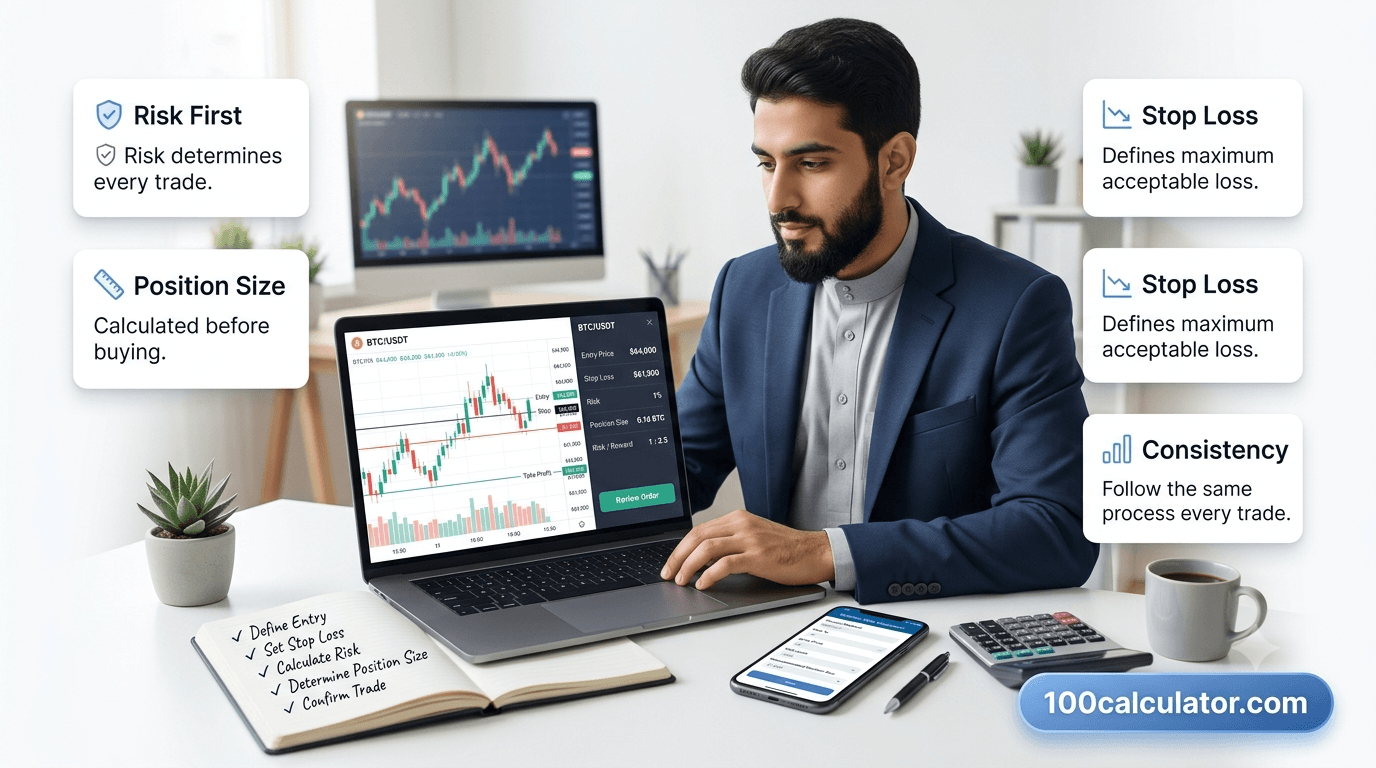
Position sizing is the single most practical risk management skill in crypto trading, and it has nothing to do with predicting where the market goes next. It's the math that tells you how many coins or contracts to buy so that if a trade goes wrong, the loss is small enough to shrug off instead of one that damages your account.
Position sizing means deciding how much of your account to risk on a single trade, then working backward from your stop-loss distance to calculate exactly how many coins or contracts to buy, so your potential loss matches the risk percentage you chose in advance. Most new traders do the opposite: they size positions by feel, buying "a bit more" when confident and "a bit less" when nervous. That approach works fine until a losing streak hits a larger-than-usual position, and the damage compounds fast.
Crypto makes this worse than most markets. Prices can swing 5-15% in a single day, and many exchanges offer leverage of 20x, 50x, or higher on futures products, meaning a small account balance can control a surprisingly large position if the sizing math isn't done carefully.
This guide walks through the position sizing rules experienced traders actually use: percentage-based risk rules, the formula for calculating position size from a stop-loss, how leverage changes that math, and the mistakes that quietly undo otherwise solid trading plans. If you'd rather skip the manual arithmetic, 100 Calculator's Crypto Position Size Calculator does this calculation for you, though understanding the logic behind it will help you use any calculator correctly and adjust it as your account changes. If you're still working out how much of your capital to risk in the first place, our companion guide on sizing crypto positions based on risk tolerance is worth reading alongside this one.
What Is Position Sizing in Crypto Trading?
Position sizing is the process of deciding exactly how much money, or how many coins, to commit to a single trade. It's a calculation, not a guess: you start with how much of your account you're willing to risk, work out the distance between your entry price and your stop-loss, and use those two numbers to arrive at a position size.
That's different from simply deciding "I want to buy $2,000 of Bitcoin." That number might be perfectly reasonable, or it might represent far more risk than you realize, depending on where your stop-loss sits. Position sizing turns a vague dollar amount into a figure that's actually tied to how much you stand to lose.
Position Size vs. Risk: What's the Difference?
These two terms get mixed up constantly, and the confusion causes real problems. Your position size is the total value of what you've bought — for example, $5,000 worth of Ethereum. Your risk is only the portion of that position you'd actually lose if your stop-loss gets hit, which is usually a much smaller number.
Here's why that gap matters: with a tight stop-loss close to your entry price, you can hold a fairly large position while still risking only a small percentage of your account. With a wide stop-loss, the same dollar risk buys a much smaller position. Neither is automatically right or wrong. What matters is that your risk, not your position size, stays within a percentage you decided on in advance.
Why Crypto Position Sizing Differs From Stocks or Forex
Position sizing works the same way mathematically in every market, but crypto adds a few wrinkles. Cryptocurrencies routinely move 5-15% in a single day, far more than most stocks or major currency pairs, so a stop-loss distance that looks tight in forex can look enormous in crypto. Exchanges also commonly offer very high leverage on crypto derivatives, sometimes 50x, 100x, or more, which means small account balances can control surprisingly large positions if a trader isn't careful with the sizing math.
Crypto markets also trade 24 hours a day, without the overnight and weekend pauses stocks get, so open positions stay exposed to price movement around the clock. That's one more reason position sizing carries extra weight here compared to markets that close for part of the day.
Why Position Sizing Matters More in Crypto
Every trading strategy, no matter how good the entries look, eventually runs into a losing streak. Position sizing determines whether that streak is a manageable dip or the end of your trading account. It's the difference between a strategy that survives a rough month and one that doesn't.
Think of position sizing as your account's shock absorber. A solid entry strategy might only be right 55% of the time, which still means plenty of losses. Without a sizing rule capping each loss, a string of bad trades can shrink an account far faster than most traders expect, and the smaller the account gets, the harder it becomes to recover using normal-sized wins.
Crypto Volatility and Position Sizing
Volatility simply means how much a price moves over a given period. Bitcoin has generally shown less day-to-day volatility than most altcoins, but both can swing sharply around major news, exchange listings, or macroeconomic events. Because your stop-loss distance is part of the position sizing formula, more volatility usually means a wider stop is needed to avoid getting stopped out by normal price noise, which in turn calls for a smaller position size to keep your dollar risk the same.
Leverage and Position Sizing
Leverage lets you control a larger position with a smaller amount of your own money, borrowing the rest from the exchange. It doesn't increase how much you should risk — that's still governed by your stop-loss distance and risk percentage — but it does change how much margin you need to post and how close your liquidation price sits to your entry. We cover this in detail later in this guide, since it's one of the areas where crypto traders most often get position sizing wrong.
A quick look at what disciplined position sizing actually gives you:
- A maximum, predictable loss on any single trade
- The ability to survive a losing streak without serious damage
- Consistency across trades, so results reflect your strategy rather than luck
- Less emotional decision-making, since size is calculated, not felt
- A clearer sense of whether a trade is even worth taking
Core Position Sizing Rules Every Crypto Trader Should Know
Most position sizing approaches boil down to deciding what percentage of your account you're willing to risk on a single trade, then sizing the position so a stop-loss hit costs exactly that percentage, no more.
The 1% Rule
The 1% rule is the most widely taught starting point: never risk more than 1% of your total account balance on a single trade. On a $5,000 account, that's a maximum of $50 at risk, regardless of how large the actual position ends up being.
The appeal of the 1% rule is how forgiving it is. Even ten losing trades in a row, which happens more often than most new traders expect, only brings a 1%-risk account down by roughly 9-10%, a drawdown that's uncomfortable but very recoverable. We'll walk through the exact math behind that later in this guide.
Choosing Between 0.5%, 1%, and 2%
There's no universally correct number, and how much to risk depends on your experience, your strategy's track record, and your own risk tolerance. The SEC's Investor.gov describes risk tolerance as your ability and willingness to lose some or all of an investment in exchange for potentially greater returns. Your position sizing rule is really that idea translated into one specific, repeatable number.
If you're newer to crypto trading, or your strategy hasn't been tested through a full losing streak yet, the lower end of that range gives you more room for error while you learn. If you've traded a strategy long enough to know its real win rate, a slightly higher percentage may be reasonable. For a deeper look at matching your risk percentage to your own risk tolerance, see our guide on sizing crypto positions based on risk tolerance.
Conservative
0.5–1%
Capital Preservation
Prioritizes staying in the game over fast growth. A common choice for beginners, smaller accounts, or volatile altcoins that need extra room for the stop-loss.
Moderate
1–2%
Balanced Growth
The range most general risk guidelines land on. Balances meaningful account growth with a drawdown an average trader can realistically recover from.
Aggressive
2–5%
Higher Risk Tolerance
Faster potential growth, but losing streaks bite much harder. Better suited to experienced traders with a tested strategy and strict discipline.
How to Calculate Your Position Size Step by Step
Once you know your risk percentage, calculating position size is simple, three-step arithmetic. You don't need special software to do it, though a calculator removes any chance of a math error under pressure.
The Position Sizing Formula
Position Sizing Formula
Position Size = (Account Balance × Risk %) ÷ (Entry Price − Stop-Loss Price)
Account Balance × Risk % — your dollar risk, the most you're willing to lose on this trade
Entry Price − Stop-Loss Price — your risk per coin or contract
Multiply the result by your entry price to get the position's total dollar value.
Worked Example With Real Numbers
Say you have a $10,000 account and you're using the 1% rule, so your dollar risk is $100. You're looking at a Bitcoin trade with an entry price of $60,000 and a stop-loss at $58,800, based on a recent support level on the chart.
Your risk per coin is $60,000 − $58,800 = $1,200. Divide your dollar risk by that number: $100 ÷ $1,200 = 0.083 BTC. That's your position size. At the $60,000 entry price, that works out to a position worth roughly $5,000 — half your account, even though you're only risking 1% of it.
That gap between position size ($5,000) and risk ($100) often surprises new traders. It's a normal result of a stop-loss that sits fairly close to the entry price, and it's exactly why the formula, not a gut-feel dollar amount, should drive your sizing decision.
Free Online Tool
Skip the manual math
100 Calculator's Crypto Position Size Calculator runs this exact formula for you. Enter your account balance, risk percentage, entry price, and stop-loss, and it returns your position size instantly, in both coins and dollar value.
Position Sizing With Leverage and Liquidation Risk
Leverage is where crypto position sizing gets more complicated, and where a lot of account-ending mistakes happen. It's worth slowing down here.
How Leverage Changes the Math
Leverage lets you open a position larger than your account balance would normally allow, by borrowing the difference from the exchange and posting only a fraction of the position's value as margin. Using the earlier example, a $5,000 BTC position at 10x leverage only requires roughly $500 of your own margin.
Your risk calculation doesn't change: you're still only risking $100 based on your stop-loss distance. What changes is capital efficiency — that $500 of margin frees up the rest of your account for other positions, or simply stays uninvested. The trade-off is that leverage introduces a second price level to track alongside your stop-loss: your liquidation price.
Stop-Loss vs. Liquidation Price
Your stop-loss is an order you set yourself, meant to close the trade before losses get out of hand. Your liquidation price is set by the exchange — it's the price at which your posted margin can no longer cover further losses, forcing the position closed automatically, often with an added fee.
Higher leverage brings your liquidation price much closer to your entry price. A modest, sudden price swing that would barely touch a low-leverage position can liquidate a highly leveraged one outright, sometimes before a stop-loss order even has the chance to fill, particularly during fast moves or brief dips in exchange liquidity. This is one of the risks the CFTC has flagged in its guidance on margined virtual currency trading: leverage amplifies losses just as readily as it amplifies gains.
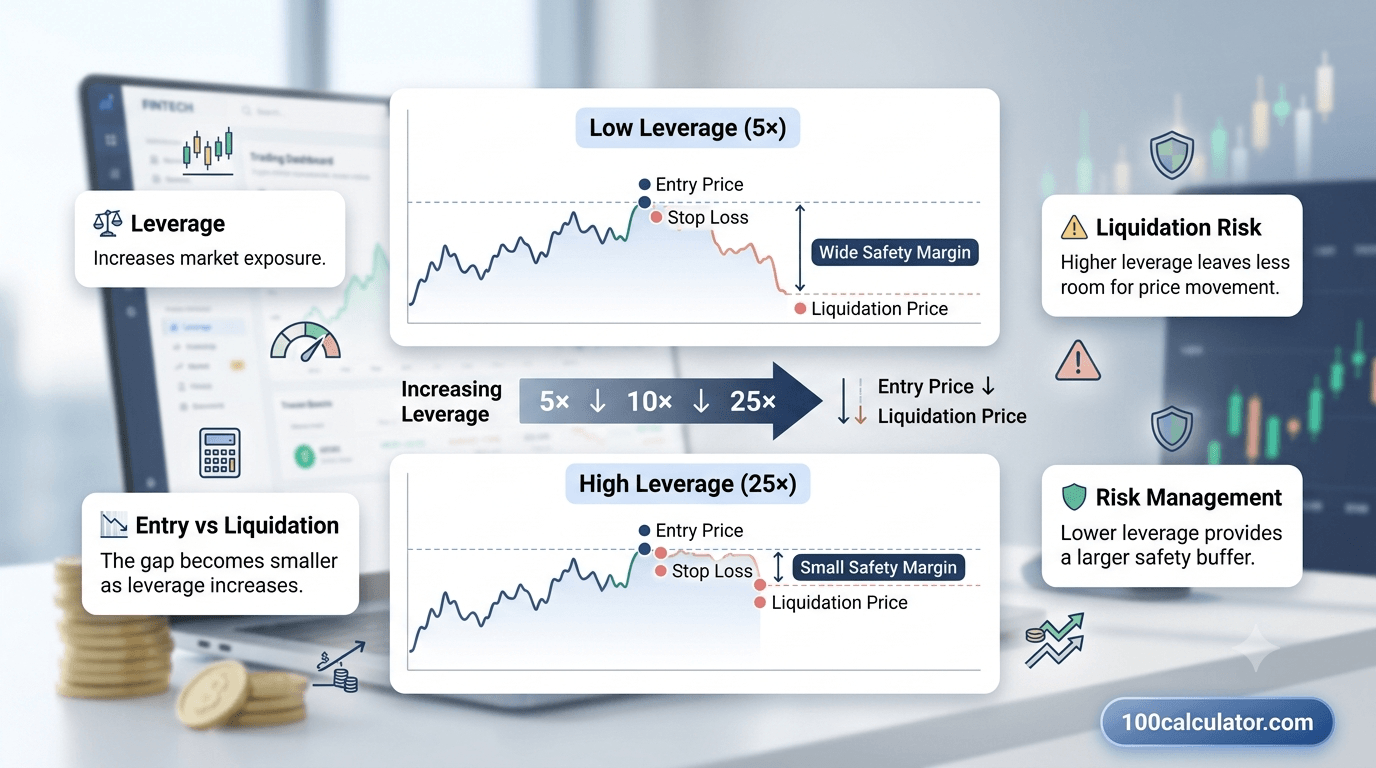
The practical takeaway is to check your liquidation price before entering a leveraged trade, and make sure it sits comfortably beyond your stop-loss, not right next to it. If your stop-loss and liquidation price are too close together, lowering your leverage, not widening your stop, is usually the safer fix. Our guides on how liquidation price is calculated in crypto futures and how to avoid liquidation when trading with leverage go through this in more depth, and 100 Calculator's Crypto Liquidation Price Calculator can check the exact number for your position before you enter.
Adjusting Position Size for Volatility: Bitcoin vs. Altcoins
Not every crypto asset moves the same amount day to day, and position sizing should account for that.
Why Altcoins Often Need Smaller Positions
Smaller-cap altcoins tend to swing more sharply than Bitcoin, both up and down, since they typically trade with less volume and can be more sensitive to news, listings, or a handful of large trades. That extra movement usually means a stop-loss needs more breathing room to avoid getting triggered by ordinary price noise rather than an actual trend change.
Since the position sizing formula divides risk by the distance between entry and stop-loss, a wider stop on a volatile altcoin naturally produces a smaller position size for the same dollar risk. This is the formula doing exactly what it's supposed to: keeping your risk consistent even though different assets behave very differently.
Using Stop-Loss Distance as a Volatility Gauge
A practical way to set an appropriate stop-loss is to look at how far the asset has typically moved recently, rather than picking a round number like "2% below entry" out of habit. Many traders use the Average True Range (ATR), a long-standing technical indicator that measures typical price movement over a set period, to set a stop-loss distance that fits current volatility instead of guessing. Whatever method you use, the goal stays the same: a stop-loss wide enough to survive normal volatility, but tight enough that the resulting position size still makes sense for your account.
The Real Cost of Skipping Position Sizing
It's easy to underestimate how much a single risk percentage matters until you see the math laid out across a losing streak.
The table below shows what happens to an account after ten consecutive losing trades, at different risk percentages per trade, assuming each loss is a full stop-loss hit with no wins offsetting them along the way.
| Risk Per Trade | Capital Remaining | Drawdown | Gain Needed to Recover |
|---|---|---|---|
| 1% | ~90.4% | ~9.6% | ~10.6% |
| 2% | ~81.7% | ~18.3% | ~22.4% |
| 5% | ~59.9% | ~40.1% | ~67.0% |
| 10% | ~34.9% | ~65.1% | ~186.8% |
| 20% | ~10.7% | ~89.3% | ~831.3% |
The pattern is worth sitting with. Risking 1% per trade leaves roughly 90% of an account intact after ten straight losses. Risking 20% per trade leaves barely 11%, and getting back to even from there would require a gain of over 800%, an outcome that's extremely difficult even in crypto's more volatile conditions. Our Drawdown Recovery Calculator can show exactly how much of a gain any specific drawdown would take to recover from.
Ten losses in a row might sound unlikely, but across enough trades, most strategies eventually run into a stretch like this. Position sizing is really a bet on that eventuality — not whether a losing streak happens, but whether your account survives it.
Common Position Sizing Mistakes to Avoid
Even traders who understand the formula sometimes drift away from it under pressure. Here's what to watch for:
- Sizing by feeling instead of by formula. A position that "feels right" isn't tied to any actual risk percentage, and confidence has a way of growing right before a loss.
- Using the same position size for every trade. Different setups have different stop-loss distances, so a fixed dollar or coin amount, rather than a calculated one, means your real risk quietly changes from trade to trade.
- Increasing size after a loss to "win it back." This is one of the fastest ways to turn a normal losing streak into a serious drawdown, since it flips the sizing logic backward at exactly the wrong moment.
- Forgetting that leverage moves your liquidation price, not just your position size. A trader can size correctly for risk and still get liquidated because they never checked how close that price sat to their stop-loss.
- Ignoring fees and slippage. Trading fees and price slippage on entry and exit eat into your actual risk slightly more than the raw math suggests, especially on lower-liquidity altcoins.
- Setting a stop-loss too tight just to justify a bigger position. Sizing should follow the stop-loss, not the other way around. A stop placed too close to the entry usually gets hit by ordinary volatility, not a real trend change.
- Not recalculating after account changes. A risk percentage that made sense at one account balance can produce an oversized or undersized position once the balance has grown or shrunk significantly.
Position Sizing Across Different Trading Styles
How you size a position often depends on how long you plan to hold it. A rule that works well for a day trade doesn't always translate to a swing trade or a long-term position.
| Trading Style | Typical Holding Period | Sizing Consideration |
|---|---|---|
| Day Trading | Minutes to hours | Higher trade frequency usually calls for a smaller risk percentage per trade, since more trades mean more chances for a losing streak to compound |
| Swing Trading | Days to weeks | Wider stop-losses to ride out normal volatility, with position size adjusted down accordingly and fewer positions open at once |
| Long-Term Holding / DCA | Months to years | Sizing is usually based on what percentage of a total portfolio to hold in a given asset, rather than a single stop-loss distance |
Funding fees are another factor that matters more the longer a leveraged futures position stays open, since they're charged repeatedly rather than once. Our guides on what a funding rate is in crypto futures trading and how funding fees affect long-term futures positions cover this in more detail, and the Crypto Futures Funding Fee Calculator can estimate the cost for a specific position.
When and How to Adjust Your Position Size Over Time
Position sizing isn't a one-time decision. It should respond to how your trading is actually going.
Reducing Size After a Losing Streak
Many experienced traders cut their risk percentage, often by half, after three or four consecutive losses. This isn't an admission that the strategy is broken — it's a way to reduce pressure on the account while sorting out whether the losses reflect normal variance or an actual problem with the approach. Once trading feels steady again, risk can gradually return to its usual level.
Growing Size After Wins or Account Growth
Percentage-based position sizing already scales up automatically as an account grows, since 1% of a larger balance is a larger dollar amount. The mistake to avoid is increasing the risk percentage itself after a winning streak, rather than letting the existing percentage do the scaling. A string of wins says as little about future performance as a string of losses does, and both can tempt traders into changing a rule that was working fine.
Tools That Make Position Sizing Easier
Doing this math by hand works, but it's easy to make a small error under pressure, especially mid-trade. A few free calculators can handle the heavy lifting so you can focus on the trade itself.
- 100 Calculator's Crypto Position Size Calculator calculates position size directly from your account balance, risk percentage, entry price, and stop-loss
- The Crypto Liquidation Price Calculator shows exactly where a leveraged position would be forced closed, so you can compare it against your stop-loss
- The Risk Reward Ratio Calculator checks whether a trade's potential reward justifies the risk you've calculated, a useful second check before entering
- The Crypto Average Cost Basis Calculator helps track your true entry price across multiple buys, which accurate position sizing depends on
- If you also trade traditional markets, the general Position Size Calculator uses the same formula for stocks, forex, or futures
Related Calculators
Put what you just read into practice, try these free tools instantly, no sign-up required.
Crypto Position Size Calculator
Calculate the right crypto position size for your risk level.
Crypto Liquidation Price Calculator
Find the price at which your leveraged crypto position liquidates.
Crypto Futures Funding Fee Calculator
Estimate funding fees paid or earned on crypto futures positions.
APY ↔ APR Crypto Yield Calculator
Convert between APY and APR to compare real crypto yields.
Impermanent Loss Calculator
Estimate impermanent loss when providing liquidity to a pool.
Building a Position Sizing Routine That Sticks
The most effective position sizing rule is the one you actually follow every time, not the most sophisticated one on paper. A handful of habits make that much easier.
- Decide your maximum risk percentage in advance and write it down somewhere you'll actually see it before placing a trade.
- Check your current account balance before sizing a trade, rather than relying on last week's number.
- Set your stop-loss based on chart structure or recent volatility first, then calculate position size from that — never the other way around.
- Run the numbers through the formula, or a calculator, every single time, even when a trade feels obvious.
- If you're using leverage, check your liquidation price against your stop-loss before entering.
- Cut your risk percentage after a defined losing streak, and return to normal only once you're trading with a clear head.
- Review your sizing rules every few months, since your account, experience, and risk tolerance will all change over time.
Position sizing won't make every trade a winner, and it isn't meant to. What it does is make sure that when a trade goes wrong, and eventually one will, the loss is small enough that your account, and your ability to keep trading with a clear head, both stay intact.
Risk disclaimer: This article is for general educational purposes only and isn't financial or investment advice. Cryptocurrency trading, especially with leverage, carries a high risk of loss and may not be suitable for every investor. Position sizing and risk management can reduce how much a single trade can hurt your account, but they can't eliminate the risk of loss altogether. Always do your own research, and consider speaking with a licensed financial advisor before making trading decisions.
More From Crypto Calculator Guides
Want to go deeper on leverage, liquidation, or crypto yield mechanics? These related guides from the Crypto Calculator Guide series cover the topics that come up alongside position sizing.
Frequently Asked Questions
What is position sizing in crypto trading?
Position sizing is the process of deciding how much of your capital to put into a single trade. It usually starts with how much you're willing to lose, your risk amount, rather than how much you want to make, then works backward using your stop-loss distance to figure out how many coins or contracts to buy. Good position sizing keeps one bad trade from doing serious damage to your account.
What is the 1% rule in crypto trading?
The 1% rule means you never risk more than 1% of your total trading account on a single trade. If you have $5,000, that's a maximum of $50 at risk, not $50 invested. Many traders use this rule because it lets an account survive a long losing streak without significant damage, which matters given how volatile crypto markets can be.
How do you calculate crypto position size step by step?
First, multiply your account balance by your risk percentage to get your dollar risk. Then find the price difference between your entry point and your stop-loss. Divide your dollar risk by that price difference to get your position size in coins. Multiply by the entry price if you want the position's dollar value. A crypto position size calculator does this automatically.
What is the difference between position size and risk amount?
Risk amount is the maximum you could lose if your stop-loss is hit. Position size is the actual dollar value or number of coins you buy. These aren't the same: with a tight stop-loss, you can hold a large position while only risking a small percentage of your account, and with a wide stop, the same risk amount buys a much smaller position.
What percentage of my account should I risk per trade?
There's no single correct number, but many traders use somewhere between 0.5% and 2% per trade, with 1% being a common starting point. Crypto's volatility makes the lower end of that range more forgiving for beginners. Risking more than 2-3% consistently increases the odds of a damaging losing streak.
How does leverage change my position size calculation?
Leverage lets you open a larger position with less of your own capital, but it doesn't change how much you should risk, that's still based on your stop-loss distance and risk percentage. What leverage changes is how close your liquidation price sits to your entry price, so higher leverage leaves less room for the market to move against you before you're forced out.
Can position sizing help me avoid liquidation?
Yes, indirectly. Liquidation happens when losses eat through your posted margin, so using appropriate position sizing and leverage, combined with a stop-loss placed before your liquidation price, reduces the chance that a normal price swing ends your trade involuntarily. Position sizing alone can't eliminate liquidation risk, but it's one of the main ways to manage it.
Should I use the same position size for Bitcoin and altcoins?
Not usually. Altcoins tend to move more sharply than Bitcoin, which often means a wider stop-loss is needed to avoid getting stopped out by normal noise. Since position size is based on stop-loss distance, a wider stop on a more volatile altcoin naturally calls for a smaller position size to keep your dollar risk the same.
What is the Kelly Criterion, and is it useful for crypto trading?
The Kelly Criterion is a formula from probability theory that calculates a theoretically optimal bet size based on your win rate and average win-to-loss ratio. Some traders use a fraction of it, like half-Kelly, as a sizing guide. It can be a useful reference, but it depends on knowing your true edge precisely, which is hard to measure in volatile, fast-changing crypto markets.
How do I size a position without setting a stop-loss?
Position sizing without a stop-loss is much harder, since the whole formula relies on knowing your risk per unit. Some traders use a percentage-of-portfolio approach instead, capping any single position at a set share of total capital. This approach is more common in long-term holding or DCA strategies than in active trading.
Does position sizing apply to spot trading, or only leveraged trading?
It applies to both. Spot traders don't face liquidation risk, but they can still lose money if a position drops before they sell, so calculating risk based on a stop-loss or a personal exit rule is just as useful. The core formula works the same way for both spot and leveraged trades.
How much of my total portfolio should go into one crypto trade?
This depends on your trading style and how many positions you typically hold. Active traders risking 1-2% per trade on individual setups are answering a different question than long-term holders deciding what share of their overall portfolio to hold in crypto. As a general guide, concentrating a large share of your capital in one volatile asset increases risk.
How should I adjust position size after a losing streak?
Many traders cut their risk percentage, sometimes by half, after three or four consecutive losses. This reduces the pressure on your account while you figure out whether the losses reflect bad luck or a flawed strategy. Once you're trading normally again with a clear head, you can gradually return to your usual position size.
Is a fixed dollar risk amount better than a percentage-based risk?
Neither is universally better. A fixed dollar amount, like always risking $100, is simple and predictable, but it doesn't adjust as your account grows or shrinks. Percentage-based risk automatically scales with your account balance, which most traders prefer for that reason, though it requires recalculating position size before every trade.
What tools can calculate crypto position size automatically?
100 Calculator's free Crypto Position Size Calculator handles the math for you: enter your account balance, risk percentage, entry price, and stop-loss level, and it returns your position size instantly. This removes manual calculation errors and lets you check position size quickly before entering a trade.
How often should I recalculate my position size?
Ideally, before every single trade. Your account balance changes after every win or loss, and your stop-loss distance changes with every setup, so a position size that was correct last week may not be correct today. Treating position sizing as a fixed, one-time decision is one of the more common mistakes traders make.
About 100 Calculator
100 Calculator is a free hub of online calculators and educational guides covering health, finance, trading, crypto, education, and more. Every tool is built to be fast, accurate, and genuinely free, with no account or signup required.
We built this guide, and tools like the Crypto Position Size Calculator referenced throughout it, to make trading math easier to get right before you place a trade, not after. Head back to the 100 Calculator homepage to explore the full library of tools, or learn more about the team behind them on our About Us page.