APY vs APR in Crypto: What Is the Real Difference?
A plain-English breakdown of what APY and APR actually measure, why crypto platforms don't always agree on which one to show you, and how to tell whether a yield number is genuinely better — or just presented differently.
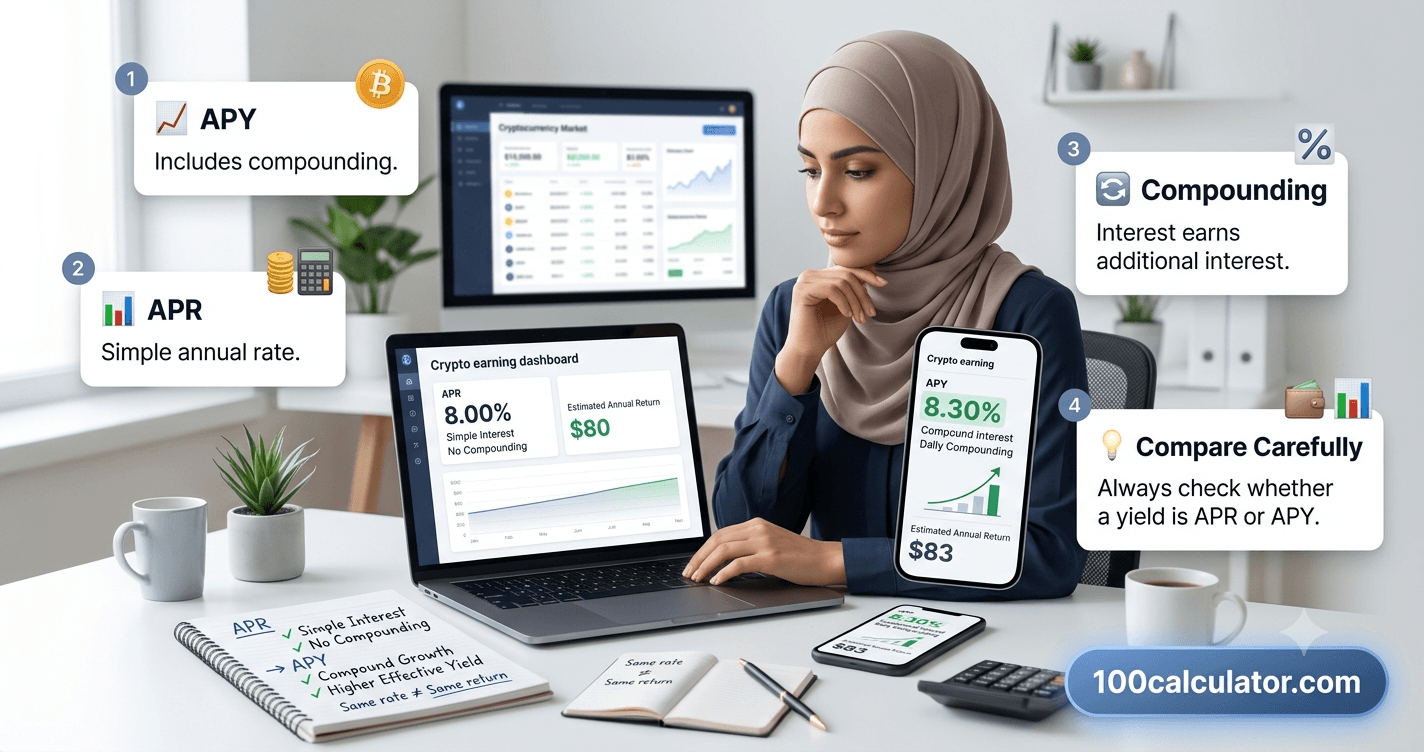
APY and APR both describe a yearly rate of return, but they're not interchangeable, and crypto platforms don't always use them consistently.
APR (annual percentage rate) is a simple yearly rate that doesn't account for compounding. APY (annual percentage yield) does account for compounding, so it reflects what you'd actually earn if your returns get reinvested automatically. On the exact same underlying rate, APY will always be equal to or higher than APR — never lower.
That difference matters more in crypto than it does in a traditional savings account, mostly because there's no single regulator forcing every platform to disclose the same number the same way. A staking platform might advertise a big APY to make a reward rate look as attractive as possible. A lending platform quoting your borrowing cost might show APR instead, since it's the more conservative figure. Neither number is wrong, exactly — they're measuring different things, and mixing them up when comparing two offers can make one platform look better than it really is.
This guide walks through what APR and APY actually measure, how to convert one into the other, and why compounding frequency changes the math. It also covers where you're most likely to run into each term across staking, lending, and liquidity pools. Along the way, you can plug your own numbers into 100 Calculator's APY ↔ APR Crypto Yield Calculator to see the real difference for yourself.
APR and APY: Where These Terms Actually Come From
Before crypto ever used the terms APY and APR, they were already standard vocabulary in traditional banking and lending. Knowing where they came from helps explain why crypto platforms use them so differently today.
APR and the Truth in Lending Act
In the United States, the Truth in Lending Act requires lenders to disclose the annual percentage rate on loans and credit cards. This lets borrowers compare the true cost of borrowing across different products. This disclosure requirement, known as Regulation Z, is enforced by the (CFPB). It's specifically designed as a cost figure — a simple yearly rate that doesn't assume any compounding advantage for the lender.
APY and the Truth in Savings Act
On the savings side, the Truth in Savings Act requires banks to disclose the annual percentage yield on deposit accounts like savings accounts and certificates of deposit. This rule, known as Regulation DD, defines APY as a rate that reflects both the interest rate and the frequency of compounding (CFPB) — the opposite intent of APR. Where APR is meant to show the cost to a borrower, APY is meant to show the return to a saver, compounding included. The SEC's Investor.gov glossary describes this same compounding effect in plain terms: interest paid on both your original principal and on interest you've already earned.
Why This History Matters for Crypto
Crypto platforms aren't traditional banks or lenders, so they generally aren't bound by Regulation Z or Regulation DD. That's exactly why you'll see APY used to advertise a staking reward and APR used to describe a borrowing cost on the very same platform. Each term is being used the way it was originally intended, even without a regulator requiring it. It also means there's no guarantee two platforms are calculating their advertised rate the same way. That's one more reason it helps to understand the math yourself, rather than relying on the label alone.
If you want to see how this same compounding logic works outside of crypto, our guide on how compound interest grows your money over time breaks down the traditional-finance version of it. 100 Calculator's Premium Compound Interest Calculator applies the same idea to any savings goal.
What Is APR in Crypto?
In crypto, APR usually shows up as a flat, stated yearly rate with no compounding built into the number itself. If a lending platform advertises a 12% APR on a stablecoin loan, that 12% is the baseline cost (or reward, if you're the one lending) before anything gets reinvested.
APR is common in crypto lending and borrowing markets, where it functions similarly to a traditional loan rate. It tells you what a position will cost you, or pay you, over a year, assuming the balance stays the same the whole time. Some staking programs also quote APR, particularly ones where rewards aren't automatically restaked and you have to manually claim and reinvest them yourself.
The key thing to remember is that APR is a simple rate. It doesn't tell you what happens if rewards compound, and it doesn't include fees unless a platform specifically says it does. Two platforms can advertise the exact same APR and still produce different real-world returns, depending on how often that rate is applied and whether rewards get reinvested automatically.
What Is APY in Crypto?
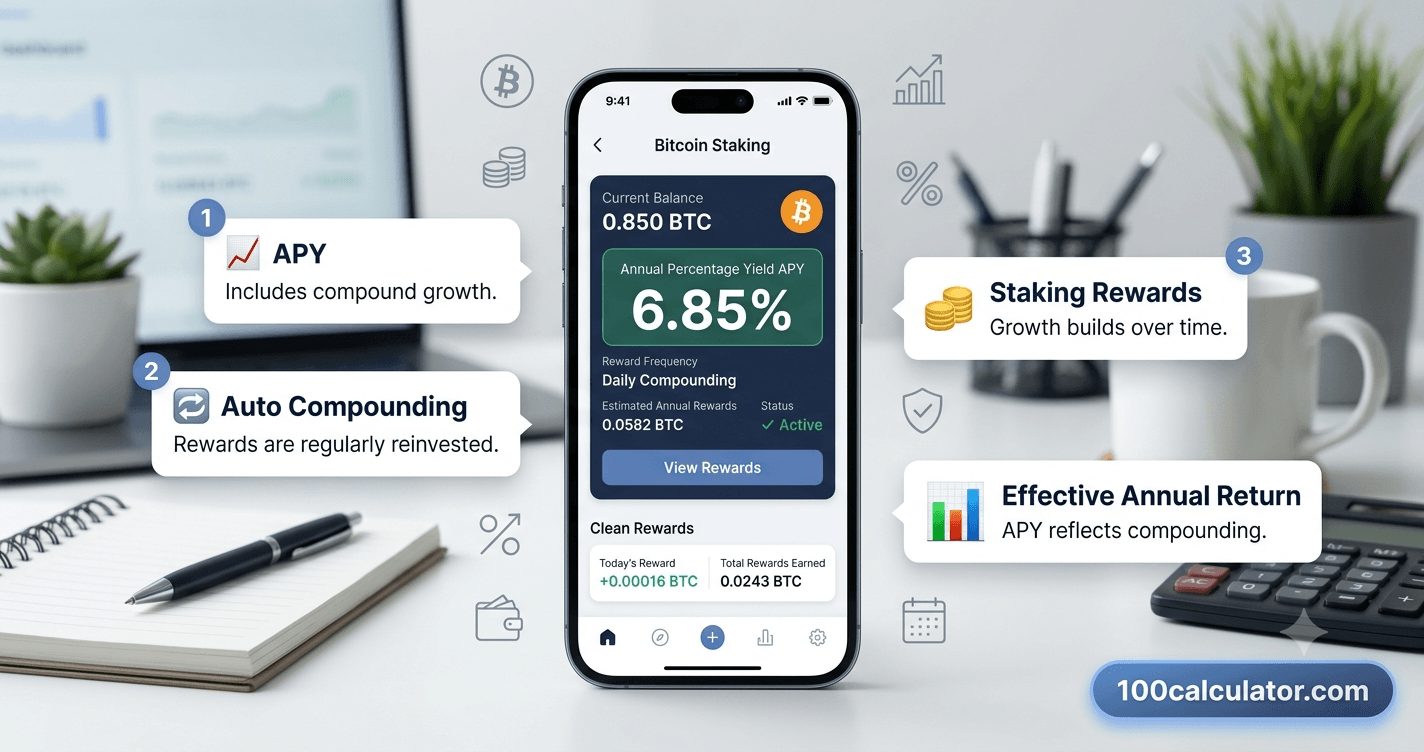
APY shows up most often on staking rewards, crypto savings products, and liquidity pool yields. Anywhere a platform assumes your returns will be reinvested, or "compounded," automatically over the course of a year, is a place you'll likely see APY.
If a staking pool advertises an 8% APY, that number already accounts for the fact that your staking rewards get added back to your staked balance and start earning their own rewards. This is why APY numbers are almost always higher than the underlying nominal rate they're built from. The compounding effect does real work over a full year, even when it's a modest boost on a monthly basis.
Ethereum's own documentation on staking describes rewards as being paid to validators for the work of proposing and confirming blocks. Platforms that offer liquid or pooled staking typically auto-compound those rewards before calculating the APY they advertise. Because APY assumes ongoing compounding, it's generally the more optimistic-looking number between the two — which is exactly why it's the one you'll see highlighted on a marketing page.
The Real Difference Between APY and APR
At the most basic level, the difference comes down to one thing: compounding.
The Cost Figure
APR
A flat yearly rate with no compounding built in. Common for borrowing costs and rewards that aren't automatically reinvested.
The Return Figure
APY
Includes the effect of compounding. Common for staking rewards, savings-style products, and liquidity pool yields.
If a platform pays out and reinvests rewards only once a year, APR and APY are actually the same number. Compounding only pulls them apart once rewards are added back more than once annually. The more frequently that happens, the bigger the gap between the two figures becomes.
| Factor | APR | APY |
|---|---|---|
| Accounts for compounding? | No | Yes |
| Typically used for | Borrowing costs, some staking | Staking rewards, savings, liquidity pools |
| On the same nominal rate | Lower or equal | Higher or equal |
| Regulatory origin | Truth in Lending Act (Reg Z) | Truth in Savings Act (Reg DD) |
| Best for comparing | Cost of borrowing | Real return on a deposit or stake |
If you've worked with traditional savings or loans before, this distinction might sound familiar. It's the same underlying idea covered in our guide on simple interest vs compound interest, just applied to crypto instead of a bank account.
How to Convert APR to APY (The Formula)
Converting APR to APY isn't complicated once you know the formula, and it's worth understanding even if you plan to use a calculator, because it explains why the two numbers diverge the way they do.
The APY Formula
APY = (1 + r / n)ⁿ − 1
r = the APR, expressed as a decimal (12% = 0.12)
n = the number of times the rate compounds per year
A Worked Example
Say a platform advertises a 12% APR on a stablecoin lending pool, and that rate compounds daily (n = 365). Plugging that into the formula:
APY = (1 + 0.12 / 365)365 − 1 ≈ 0.1275, or about 12.75%
That 0.75 percentage point gap between the 12% APR and the 12.75% APY might look small, but on a larger balance held for several years, that difference compounds into real money. Rather than working through the exponent by hand every time, you can enter the rate and compounding frequency into 100 Calculator's APY ↔ APR Crypto Yield Calculator and get the converted number instantly, in either direction.
It's worth noting that this formula assumes compounding happens like clockwork, at fixed, regular intervals. In practice, some crypto platforms compound continuously, essentially adding tiny amounts of interest constantly rather than at set intervals, which uses a slightly different version of the formula: APY = er − 1. The gap between daily and continuous compounding is usually tiny, a few hundredths of a percentage point, so daily compounding is a reasonable stand-in for most real-world crypto yield calculations.
How Compounding Frequency Changes Your Actual Return
The more often a rate compounds, the higher the resulting APY climbs — but that increase isn't linear, and it flattens out faster than most people expect.
Take a 10% APR and run it through the formula at different compounding frequencies:
| Compounding Frequency | Times Per Year | Resulting APY |
|---|---|---|
| Annually | 1 | 10.00% |
| Quarterly | 4 | 10.38% |
| Monthly | 12 | 10.47% |
| Weekly | 52 | 10.51% |
| Daily | 365 | 10.52% |
Notice how most of the gain happens early. Moving from annual to monthly compounding adds nearly half a percentage point, but moving all the way from monthly to daily only adds a fraction more. Past daily compounding, returns diminish so much that continuous compounding barely moves the number at all.
This is the same math that shows up in traditional finance. Our guide on how daily compounding differs from monthly or yearly walks through the identical pattern for bank savings accounts, and 100 Calculator's Daily Compound Interest Calculator lets you model it with your own numbers. For a deeper look at how this specifically plays out in crypto, our article on how compounding frequency changes your crypto yield goes further into the mechanics behind auto-compounding staking pools.
Where Crypto Platforms Use APR vs APY
Not every corner of crypto uses these terms the same way. Here's where you're most likely to run into each one.
Staking Rewards
Staking is the most common place you'll see APY advertised. When you stake a proof-of-stake asset, validators earn rewards for confirming transactions and keeping the network secure. Platforms that offer pooled or liquid staking typically auto-compound those rewards before quoting you an APY. If you're staking directly and manually claiming rewards instead of using a pooled service, your actual return depends on how consistently you restake. Skip a few reward cycles, and your real return drifts below the advertised APY.
Crypto Lending and Borrowing
On lending platforms, you'll typically see APR used to describe what a borrower pays, since it's the more conservative, cost-focused figure. Lenders supplying assets to a pool sometimes see APY instead, especially if the platform automatically compounds the interest they earn. If you're borrowing against crypto collateral, other recurring costs can stack on top of your borrowing rate, too. Our guide on what a funding rate is in crypto futures trading covers a related cost that shows up in futures trading rather than spot lending. 100 Calculator's Crypto Futures Funding Fee Calculator can help you estimate it.
Liquidity Pools and Yield Farming
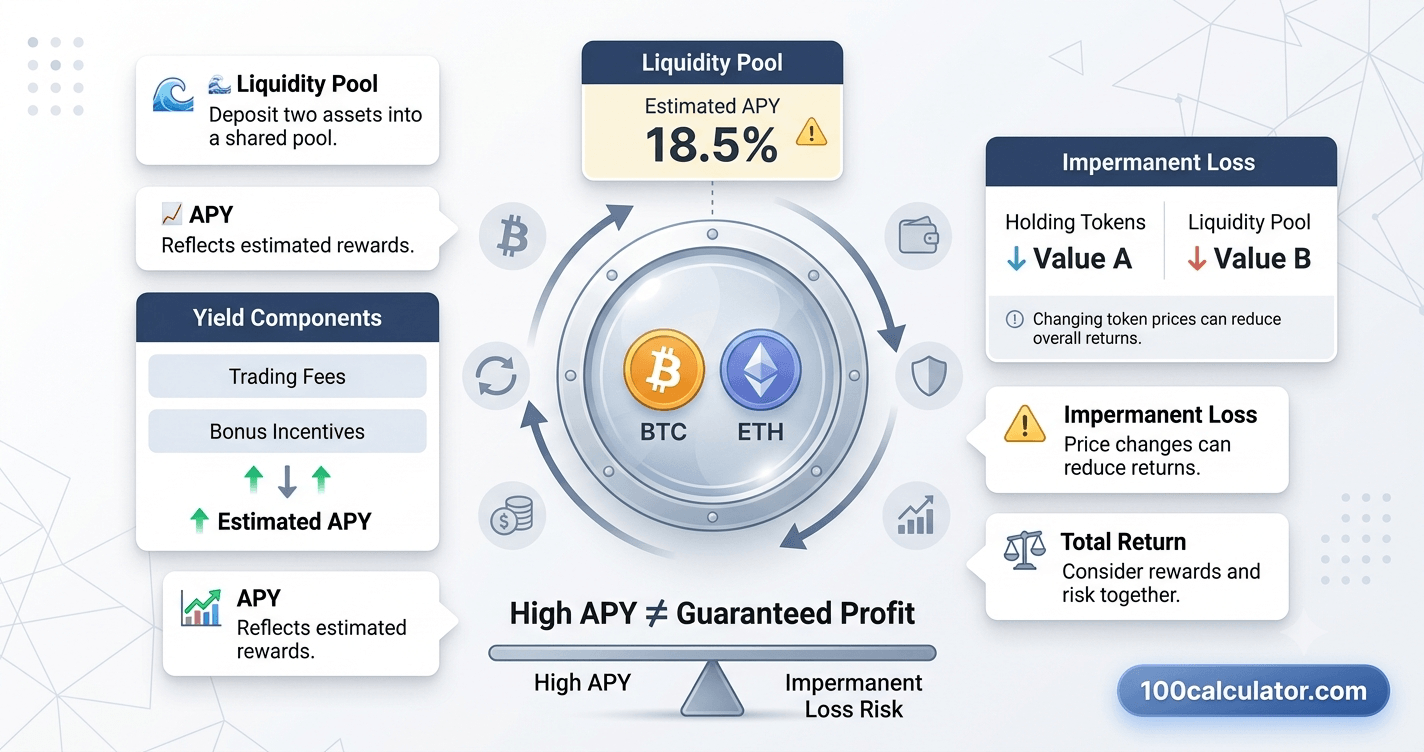
Liquidity pool yields are usually shown as APY, combining trading fees earned from the pool with any bonus token rewards a platform offers to attract liquidity. These numbers can be the most volatile of all, since they depend on trading volume, pool size, and how many other people are providing liquidity at the same time. A pool's advertised APY can swing sharply from one week to the next.
Centralized Exchange "Earn" Products
Many centralized exchanges offer simple "earn" or "savings" products where you deposit a token and receive a fixed or variable yield. These are usually advertised as APY, closely mirroring how a traditional high-yield savings account is marketed. The underlying protections, like deposit insurance, generally aren't the same as an FDIC-insured bank account, though.
Common Mistakes When Comparing Crypto Yields
Even once you understand the difference between APY and APR, a few habits can still throw off your comparisons.
- Comparing an APR from one platform directly against an APY from another, without converting them to the same basis first
- Assuming an advertised rate already includes fees, when many platforms quote APY or APR before fees are subtracted
- Treating a variable APY as if it were locked in for the full year
- Ignoring how often you actually need to manually restake rewards to achieve the compounding an advertised APY assumes
- Overlooking impermanent loss or token price risk when a liquidity pool's APY looks unusually high
- Forgetting that a headline APY is often a current snapshot, not a forward-looking promise
The fix for most of these is simple: convert every offer to the same basis before comparing numbers side by side. APY is usually the more useful one to standardize on, since it reflects your real, compounded return.
Why a Higher APY Doesn't Always Mean a Better Return
A bigger APY number looks better on paper, but it doesn't tell you where that yield is actually coming from. That question matters more in crypto than almost anywhere else in finance.
Impermanent Loss in Liquidity Pools
When you provide liquidity to a pool holding two different tokens, the value of what you can withdraw depends on the price ratio between those tokens. If that ratio shifts after you deposit, so does your payout. If that ratio moves significantly, you can end up with less value than if you'd simply held the two tokens separately — a gap known as impermanent loss. It's called "impermanent" because the loss only becomes permanent if you withdraw while prices are still out of balance; if the ratio returns to where it started, the loss disappears. A pool's advertised APY generally reflects trading fees and bonus rewards, not this effect, so a high APY can still produce a lower overall return once impermanent loss is factored in. Our guide on what impermanent loss is in crypto liquidity pools breaks this down in more detail. 100 Calculator's Impermanent Loss Calculator can help you estimate the impact on a specific pool before you deposit.
Token Price Volatility
Many crypto yields are paid in a platform's own token rather than in a stablecoin or the asset you originally deposited. A 40% APY sounds appealing, but if the reward token's price drops sharply, the dollar value of what you actually earn can fall well below what the percentage suggested.
Smart Contract and Platform Risk
Every yield-generating crypto product runs on code, and code can contain bugs, be exploited, or behave differently than intended under stress. A platform offering an appealing APY is still only as reliable as its underlying smart contracts and the team maintaining them. That's a risk with no real equivalent in a traditional, FDIC-insured savings account. Because of this, many experienced crypto users treat position sizing as part of yield strategy, not just trading. 100 Calculator's Crypto Position Size Calculator can help you think through how much of a portfolio makes sense to commit to any single yield product.
When a Sky-High APY Is a Red Flag
Extremely high APY figures — especially anything in the triple digits — are usually driven by temporary incentive programs, low liquidity, or unsustainable token emissions rather than organic yield. That doesn't automatically mean a platform is a scam, but it's worth asking a simple question before depositing: where, specifically, is this yield coming from? If a platform can't explain that clearly, or the answer amounts to "new tokens being printed to pay early depositors," it's worth treating the number with real skepticism.
Fixed APY vs Variable APY
Beyond the APR/APY split, it's worth understanding one more distinction: whether the rate you're looking at is fixed or variable.
A fixed APY is locked in for a set term, similar to a traditional certificate of deposit. You know going in exactly what return you'll earn if you hold the position for the full term, though you typically give up some flexibility to withdraw early without a penalty.
A variable APY can move up or down throughout the term. It responds to factors like how much total value is staked in a pool, current borrowing demand, network activity, or a platform's own reward schedule. Most staking and liquidity pool yields fall into this category — the APY you see today is a snapshot, not a promise about tomorrow.
Neither structure is inherently better; the right choice depends on whether you value predictability or you're comfortable with a return that can shift with market conditions. What matters most is knowing which one you're looking at before you commit funds, since a "10% APY" advertised today can look very different a few months from now if it's variable.
Using 100 Calculator's APY ↔ APR Crypto Yield Calculator
Once you understand the formula, converting rates by hand is doable, but it's tedious to redo every time you want to compare a new offer. That's exactly what 100 Calculator's APY ↔ APR Crypto Yield Calculator is built for.
Enter a stated APR and a compounding frequency, and it converts the rate to APY instantly. You can also work in the other direction if you already have an APY and want the equivalent simple rate. It's a fast way to put two offers on equal footing before deciding where to commit funds, without opening a spreadsheet or working through the exponent yourself.
Free Online Tool
Compare crypto yields on equal footing
100 Calculator's APY ↔ APR Crypto Yield Calculator converts between the two instantly, in either direction, so you can compare offers accurately before committing funds. No account or signup required.
Related Calculators
Put what you just read into practice, try these free tools instantly, no sign-up required.
Crypto Position Size Calculator
Calculate the right crypto position size for your risk level.
Crypto Liquidation Price Calculator
Find the price at which your leveraged crypto position liquidates.
Crypto Futures Funding Fee Calculator
Estimate funding fees paid or earned on crypto futures positions.
APY ↔ APR Crypto Yield Calculator
Convert between APY and APR to compare real crypto yields.
Impermanent Loss Calculator
Estimate impermanent loss when providing liquidity to a pool.
A Simple Routine for Comparing Crypto Yield Offers
A few consistent habits make it much easier to evaluate crypto yield offers without getting misled by how a number is presented.
- Convert every offer to APY first. Since APY reflects your real, compounded return, putting every offer on this basis makes side-by-side comparisons meaningful. Use 100 Calculator's APY ↔ APR Crypto Yield Calculator rather than estimating by hand.
- Check whether the rate is fixed or variable. A locked-in 6% is a very different commitment than a variable rate that simply happens to be 6% today.
- Identify what the yield is actually paid in. A yield paid in a stablecoin behaves very differently from one paid in a volatile reward token.
- Look for impermanent loss exposure. If the yield comes from a liquidity pool, check what assets are paired and how volatile that pairing has historically been. 100 Calculator's Impermanent Loss Calculator can help estimate this before you deposit.
- Size your position deliberately. Even an attractive, legitimate yield shouldn't take up more of a portfolio than you're comfortable losing entirely. 100 Calculator's Crypto Position Size Calculator and Crypto Profit & Exchange Fee Calculator can help you plan around position size and fees together.
- Revisit the numbers periodically. A variable APY you checked once can look completely different a month later, so it's worth rechecking rates on any position you plan to hold for the long term.
None of these steps take long individually, but together, they turn a flashy headline rate into a number you can actually trust.
Financial disclaimer: This article is for general educational purposes only and isn't financial, investment, or tax advice. Cryptocurrency yields, staking rewards, and DeFi products carry real risk, including price volatility, smart contract vulnerabilities, and the possibility of losing your principal. Always research a platform independently and consider speaking with a licensed financial advisor before committing funds to any crypto yield product.
Sources & References
This guide draws on definitions and disclosure rules from the following official sources:
More From the Crypto Calculator Guide
Still building your knowledge of crypto yields, leverage, and risk? These related guides dig deeper into the topics covered above.
Frequently Asked Questions
What is the difference between APY and APR in crypto?
APR (annual percentage rate) is a simple, non-compounding yearly rate. APY (annual percentage yield) includes the effect of compounding, so it reflects what you'd actually earn if your returns get reinvested. On the same underlying rate, APY is always equal to or higher than APR, because compounding lets you earn returns on your returns instead of just on your original balance.
What does APR stand for?
APR stands for annual percentage rate. It expresses a rate of return or cost of borrowing as a simple yearly figure, without accounting for how often interest or rewards compound during the year. In traditional finance, APR is the number lenders are required to disclose so borrowers can compare loan costs on equal footing.
What does APY stand for?
APY stands for annual percentage yield. It shows the total return you'd earn over a year on a deposit or staked asset, factoring in compounding. Interest or rewards earned during the year get added to your balance and start earning their own returns. APY is the number banks are required to show on savings products.
Is APY always higher than APR?
For the same stated rate, yes, APY will be equal to or higher than APR, never lower. If there's no compounding at all, meaning interest or rewards are paid out just once a year, APY and APR match exactly. Once compounding happens more than once a year, APY pulls ahead, and the more frequently it compounds, the bigger that gap becomes.
How do you convert APR to APY?
Use the formula APY = (1 + r/n)^n − 1, where r is the APR as a decimal and n is the number of compounding periods per year. For example, a 12% APR compounded daily works out to roughly a 12.75% APY. 100 Calculator's APY ↔ APR Crypto Yield Calculator does this conversion automatically in either direction.
Why do staking platforms usually show APY instead of APR?
Staking rewards are typically distributed and automatically reinvested at regular intervals, so showing APY gives a more accurate picture of what a staker would actually accumulate over a year. APY also tends to look higher than a flat APR on the same underlying reward rate, which is part of why it has become the standard way to advertise staking returns.
Why do crypto loans sometimes show APR instead of APY?
For borrowing, APR is the more conservative and comparable figure, since it represents the base cost of the loan without assuming any compounding advantage to the borrower. Some lending platforms also apply interest without automatic reinvestment, which makes APR the more technically accurate description of the actual cost.
Does a higher APY always mean a better return?
Not necessarily. A high APY can come from real, sustainable compounding, or it can be inflated by token price volatility, temporary incentive rewards, or a fee structure that isn't obvious up front. Impermanent loss in liquidity pools and smart contract risk can also erase gains a high APY seems to promise. It helps to look at what's driving the number, not just the number itself.
Is crypto APY guaranteed?
No. Unlike a bank savings account, crypto yields aren't backed by deposit insurance like FDIC coverage, and advertised APY figures are usually estimates based on current conditions rather than fixed guarantees. Staking rewards, lending rates, and liquidity pool yields can all change, sometimes significantly, based on network activity, market conditions, and platform policy.
Can APY change from day to day?
Yes. Many crypto platforms show a variable APY that adjusts based on factors like total value staked, trading volume, borrowing demand, or token price. A platform might advertise an APY range or a current snapshot rate rather than a fixed number, so it's worth checking whether the rate you see is locked in or can move.
Does compounding frequency make a real difference in returns?
It makes a measurable difference, though the effect shrinks the more often compounding already happens. Moving from annual to monthly compounding on a 10% rate adds close to half a percentage point to your effective yield, while moving from monthly to daily adds only a fraction more. Compounding frequency matters most when the underlying stated rate itself is high.
What is the formula for converting APR to APY?
The standard formula is APY = (1 + r/n)^n − 1, where r is the annual percentage rate expressed as a decimal and n is how many times per year the rate compounds. If a platform compounds continuously rather than at fixed intervals, the formula becomes APY = e^r − 1, though the difference from daily compounding is usually tiny.
Are crypto yield disclosures regulated the same way as bank APY?
Not in the same way. Traditional U.S. banks must disclose APY under Regulation DD, the Truth in Savings Act, and lenders must disclose APR under Regulation Z, the Truth in Lending Act. Most crypto platforms aren't bound by these specific disclosure rules, which is part of why APY and APR get used inconsistently across different crypto products.
What's the difference between fixed and variable APY?
A fixed APY stays the same for a set term, similar to a certificate of deposit, giving you a predictable return as long as you hold the position for that period. A variable APY can move up or down based on market conditions, network activity, or platform-specific factors. Your actual return may end up different from the rate you saw when you started.
Does impermanent loss reduce the APY a platform advertises?
The advertised APY on a liquidity pool usually reflects trading fees and any bonus token rewards, not impermanent loss. Impermanent loss is a separate effect caused by price changes between the two pooled assets. It can offset or exceed the yield you earn, even when the advertised APY looks attractive on its own.
Is a very high APY a warning sign?
It can be. Extremely high APY figures, especially triple-digit numbers, are often driven by temporary incentive tokens, low liquidity, or unsustainable emission schedules rather than organic returns. That doesn't automatically mean a platform is fraudulent, but it's worth understanding exactly where the yield is coming from before committing significant funds.
How often do crypto platforms compound staking rewards?
It depends on the platform and the underlying blockchain. Some networks distribute rewards roughly once per day and auto-compound them, others compound less frequently, and some require you to manually claim and restake rewards yourself. If you don't restake earned rewards, you won't actually get the compounding effect that the advertised APY assumes.
Can APR and APY ever be the same number?
Yes, when there's no compounding within the year, for example if interest or rewards are calculated and paid out just once, at the end of the year. In that specific case, the annual percentage rate and the annual percentage yield are mathematically identical.
About 100 Calculator
100 Calculator is a free hub of online calculators and educational guides covering health, finance, trading, crypto, education, and more. Every tool is built to be fast, accurate, and genuinely free, with no account or signup required.
We built this guide, and tools like the APY ↔ APR Crypto Yield Calculator referenced throughout it, to make crypto math easier to understand before you commit real money to a platform. Head back to the 100 Calculator homepage to explore the full library of tools, or learn more about the team behind them on our About Us page.