What Is a Funding Rate in Crypto Futures Trading?
A plain-English breakdown of what the funding rate is, why perpetual futures need it, and how to work out exactly what it costs (or pays) you before you open a position.
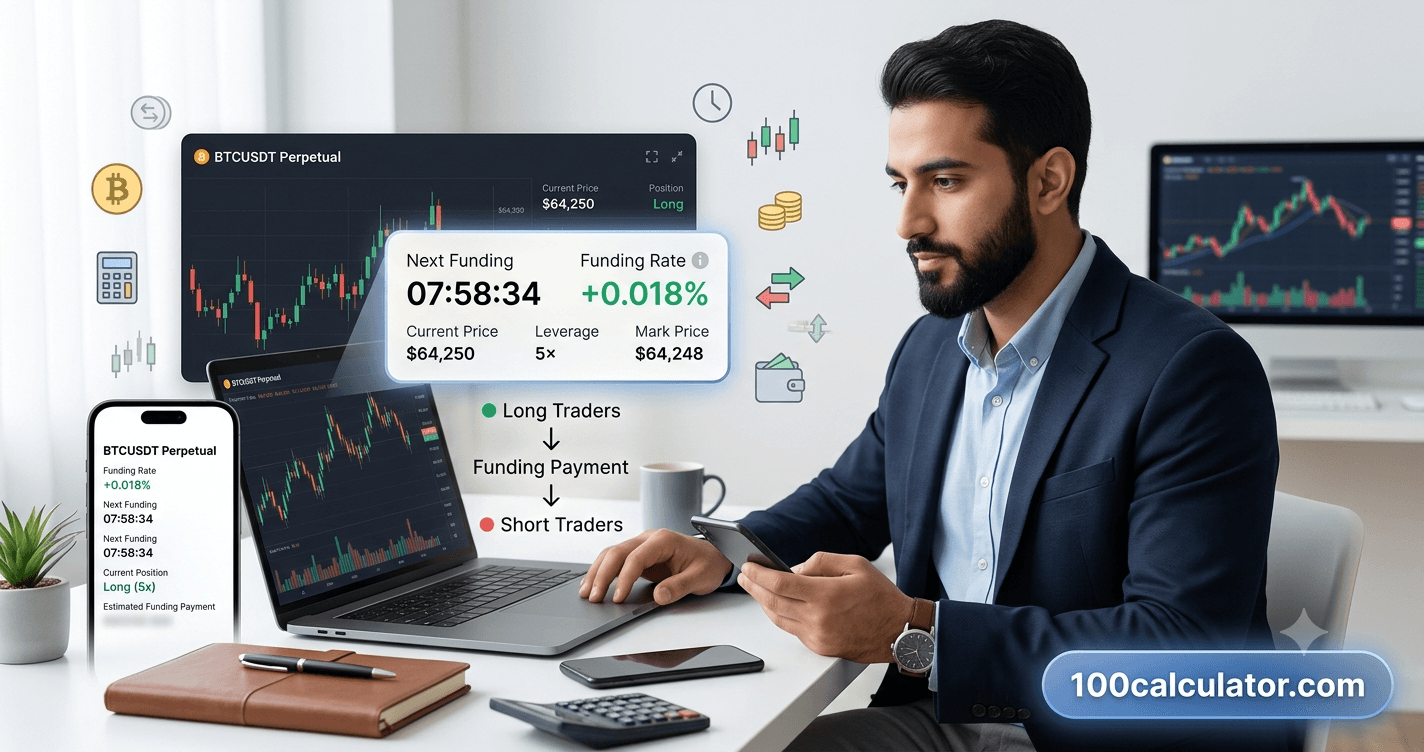
If you've ever opened a perpetual futures position and noticed a small charge or credit hit your account every few hours, you've already met the funding rate. It works quietly in the background of nearly every crypto derivatives platform, and it can add up to real money if you hold a position for more than a day or two.
The funding rate is a small, recurring payment exchanged directly between traders holding long positions and traders holding short positions in a perpetual futures contract. It isn't a fee collected by the exchange — it's a peer-to-peer payment that keeps the contract's price closely tied to the actual spot price of the asset. When the rate is positive, long traders pay short traders. When it's negative, short traders pay long traders. The payment usually happens every eight hours, though the exact schedule depends on the exchange.
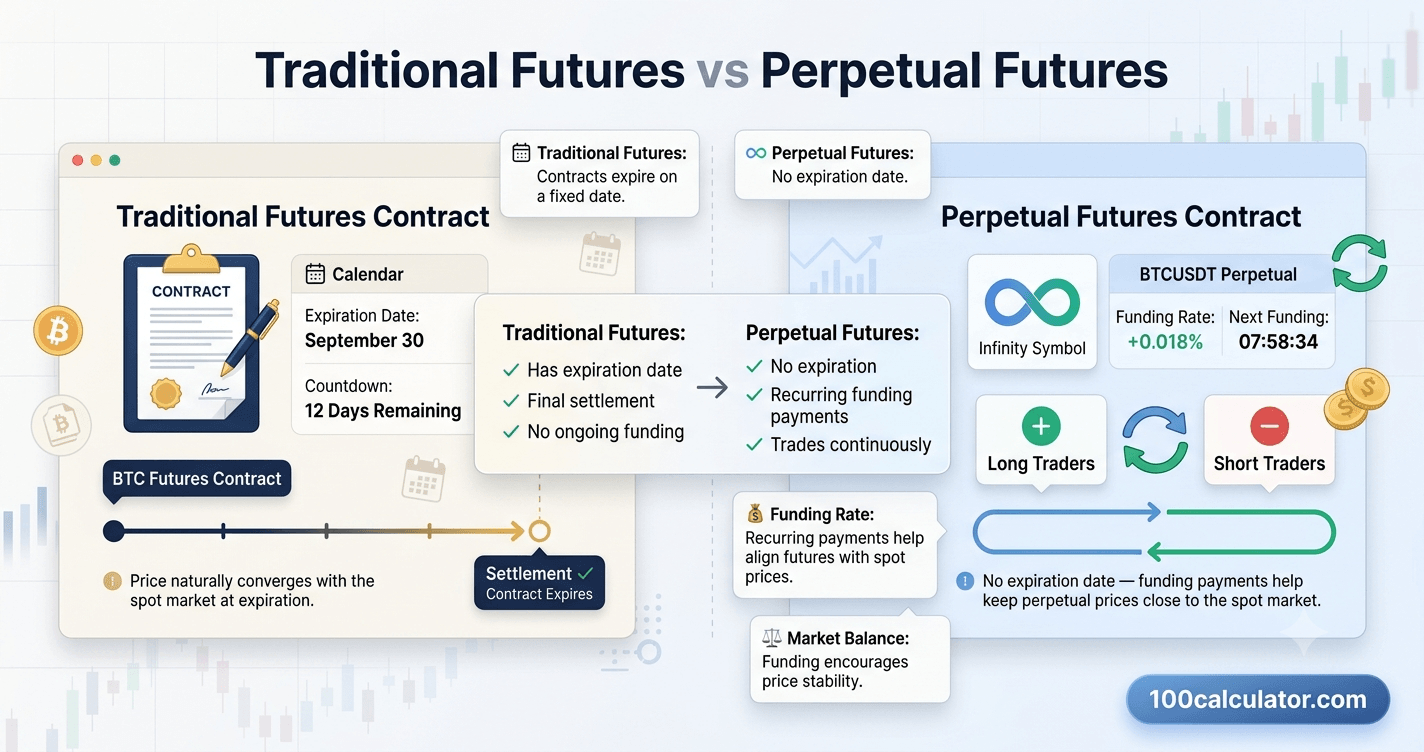
Funding rates exist because perpetual futures never expire. A traditional futures contract naturally converges with the spot price as its expiration date approaches. A perpetual contract has no such deadline, so exchanges built the funding rate as a substitute — a recurring cost that makes it expensive to hold the crowded side of the market and rewarding to hold the other side.
This guide walks through how the funding rate works, how it's calculated, and how to figure out what it will cost you on a specific position. If you want the exact number before you open a trade, 100 Calculator's Crypto Futures Funding Fee Calculator does the math for you in seconds.
Understanding Perpetual Futures Contracts
Before the funding rate makes sense, it helps to understand the contract it belongs to: the perpetual future, usually just called a "perp."
A futures contract is an agreement to buy or sell an asset at a set price on a set future date. Traditional futures, the kind used for oil, wheat, or stock indexes, expire. When the expiration date arrives, the contract settles and its price converges with the spot price of the underlying asset, simply because there's no time left for the two prices to disagree.
Perpetual futures work differently. As the name suggests, they never expire. A trader can open a long or short position and hold it indefinitely, as long as they keep enough margin in their account to cover potential losses. This design is a big reason perpetual contracts became so popular in crypto trading: no monthly rollover, no expiration date to track, and no forced exit.
What Makes Perpetual Contracts Different From Traditional Futures
The core difference comes down to one thing: expiration. Traditional futures have it, perpetuals don't. That single design choice changes how each contract behaves day to day.
| Feature | Traditional Futures | Perpetual Futures |
|---|---|---|
| Expiration date | Fixed, set in advance | None |
| Price convergence with spot | Happens automatically at expiry | Relies on the funding rate |
| Rollover required | Yes, to keep exposure open | No |
| Common use in crypto trading | Less common | Very common |
Why Perpetual Contracts Need a Balancing Mechanism
Without an expiration date, nothing forces the perpetual contract's price to match the spot price. If traders get overly bullish, buying pressure could push the perpetual price well above the real spot price, with nothing pulling it back.
Exchanges solve this with the funding rate. It's a recurring, built-in cost that makes it progressively more expensive to hold the crowded side of the trade, which naturally encourages trading activity that pushes prices back toward spot.
What Is a Funding Rate?
Now that you know why perpetual contracts need a balancing mechanism, here's the mechanism itself, in plain terms.
The Simple Definition
A funding rate is a small, periodic percentage applied to your position's value, paid directly between traders holding opposite sides of a perpetual futures contract. If you're long and the rate is positive, you pay. If you're short under that same positive rate, you receive. The exchange doesn't keep this payment; it simply facilitates the transfer between the two sides.
The rate is usually expressed as a small percentage, something like 0.01% or -0.02%, and it resets on a fixed schedule, most often every eight hours. A number that looks tiny at first glance can add up meaningfully if you hold a leveraged position for days or weeks, which is exactly why it's worth understanding before you open a trade.
- Paid directly between traders, not to the exchange
- Only applies while your position is open at the funding timestamp
- Calculated on your full position value, not just your margin
- Resets on a fixed schedule, most commonly every 8 hours
- Can be positive (longs pay) or negative (shorts pay)
Funding Rate vs. Trading Fees
It's easy to lump the funding rate in with regular trading fees, but the two work very differently.
| Aspect | Trading Fee | Funding Rate |
|---|---|---|
| Who receives it | The exchange | The trader on the other side of your trade |
| When it's charged | At order execution | At each funding interval, only while a position is open |
| Can it be avoided | No, charged on every trade | Yes, by closing before the funding timestamp |
| Direction | Always a cost | Can be a cost or a payment to you |
A trading fee is a one-time cost charged by the exchange every time you open or close a position. The funding rate only applies while your position stays open through a funding timestamp, and depending on which side you're on, it can either cost you money or pay you money.
How the Funding Rate Is Calculated
Exchanges don't pick the funding rate out of thin air. It's built from two components that update continuously based on market activity.
The Two Building Blocks: Interest Rate and Premium Index
The interest rate is a small, relatively stable base rate meant to reflect the general cost of holding one currency versus another. It rarely moves much and tends to sit at a very small fraction of a percent per funding interval.
The premium index is the part that actually moves. It measures the gap between the perpetual contract's price and the spot price, averaged over the funding interval to smooth out short-term noise. When the perpetual trades above spot, the premium index is positive. When it trades below spot, the premium index is negative.
Funding rate formula
Funding Rate = Interest Rate + Premium Index
Interest Rate — a small, relatively fixed base rate set by the exchange
Premium Index — the average gap between the perpetual price and the spot price over the funding interval
Most exchanges also apply a clamp, or cap, to this formula so a sudden spike in the premium index can't push the funding rate to an extreme level in a single interval. The exact caps and averaging methods differ by platform, which is one reason the same trade can carry a slightly different rate depending on where you're trading.
Example Calculation
Say Ethereum's perpetual contract is trading at $3,015 while the spot price sits at $3,000. That's a premium of $15, or 0.5%, over spot. If the exchange smooths that gap into an average premium index of 0.03% for this interval, and its interest rate is fixed at 0.01%, the funding rate works out to:
0.01% + 0.03% = 0.04%
Because the rate is positive, long traders pay short traders 0.04% of their position's value at the next funding timestamp. The exact inputs and clamps differ from platform to platform, but the underlying logic is the same everywhere: the further the perpetual price drifts from spot, the larger the premium index, and the larger the funding rate becomes in response.
Positive vs Negative Funding Rates
The sign of the funding rate, positive or negative, tells you which side of the market is currently paying the other.
What a Positive Rate Tells You
A positive funding rate means the perpetual contract is trading above the spot price. Demand for long positions is outpacing demand for short positions, so longs pay shorts. This usually shows up during bullish stretches, when more traders are opening leveraged long positions than short ones.
What a Negative Rate Tells You
A negative funding rate flips the direction. The perpetual is trading below spot, short positions are more crowded, and shorts pay longs instead. This tends to appear during sharp sell-offs or periods of bearish sentiment, when traders are piling into short positions.
| Signal | Positive Funding Rate | Negative Funding Rate |
|---|---|---|
| Perpetual price vs. spot | Trading above spot | Trading below spot |
| Who pays | Longs pay shorts | Shorts pay longs |
| Common during | Bullish, crowded long positioning | Bearish, crowded short positioning |
Reading Funding Rate as a Sentiment Gauge
Because the funding rate reacts directly to how crowded one side of the market is, many traders treat it as a rough sentiment indicator. A rate that stays unusually high and positive for an extended stretch often signals that longs are heavily leveraged and the trade has become one-sided, which can make the market more vulnerable to a sharp reversal if those positions start unwinding. The same logic applies in reverse for deeply negative rates.
How Often Funding Payments Happen
Funding isn't charged continuously. It's applied at fixed checkpoints throughout the day.
The Standard 8-Hour Cycle
Most major exchanges settle funding every eight hours, which works out to three times a day at fixed points on the clock, commonly around 00:00, 08:00, and 16:00 UTC. Binance, for example, recalculates and settles its futures funding every eight hours. Some platforms use a different rhythm: Coinbase applies funding hourly, and a few other platforms settle on four-hour or twelve-hour windows instead.
What Happens If You Close Right Before Funding Time
Funding only applies to positions that are open at the exact moment the funding timestamp hits. If you close your position even a minute before that checkpoint, you won't pay or receive funding for that interval. This is why some short-term traders time their entries and exits around the funding schedule, especially when the rate looks unusually high.
Who Pays the Funding Rate: Longs or Shorts?
This comes down entirely to the sign of the rate and which side of the trade you're on.
| Your Position | Funding Rate Is Positive | Funding Rate Is Negative |
|---|---|---|
| Long | You pay | You receive |
| Short | You receive | You pay |
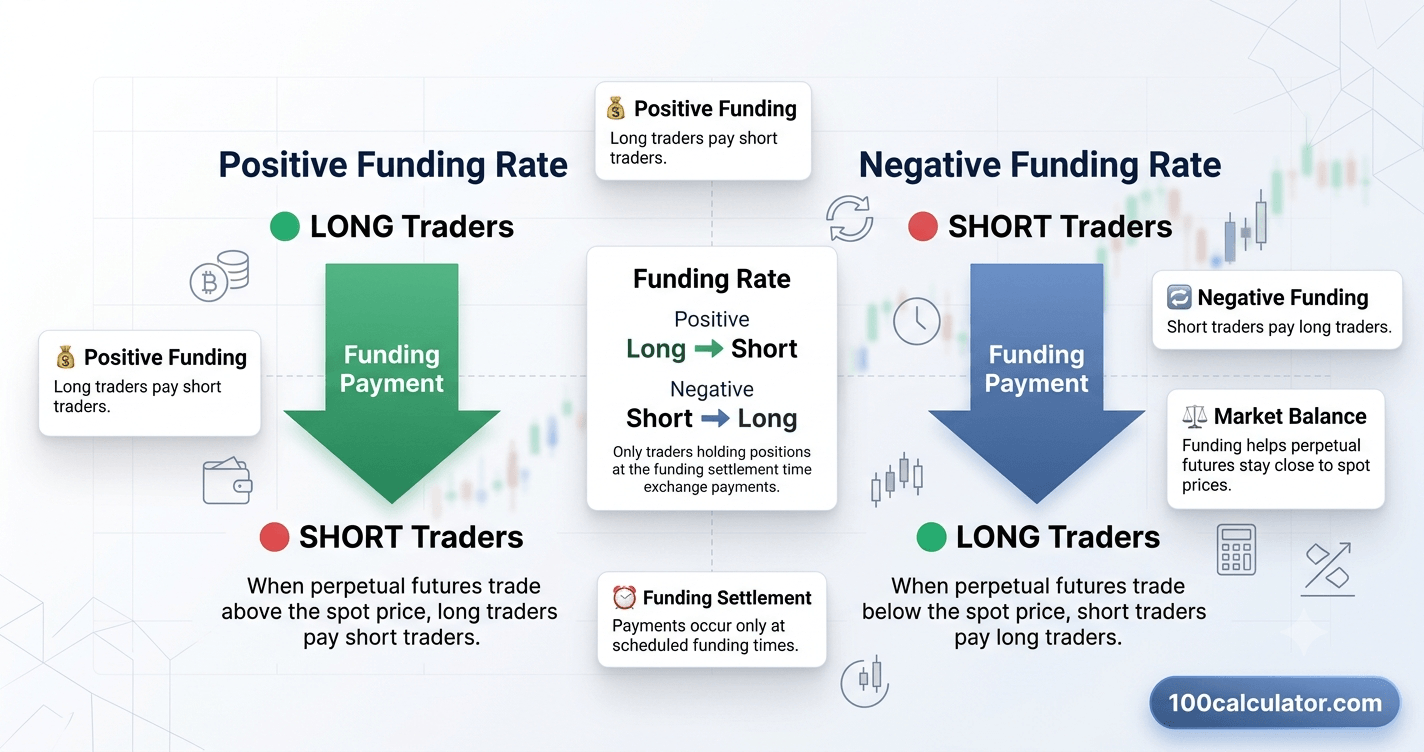
If you're long and the rate is positive, funding is deducted from your account balance at each interval. If you're short under that same positive rate, that same amount is credited to you. The two sides always net out: whatever longs pay, shorts receive, and vice versa. The exchange is only the middleman passing the payment from one side to the other.
It's worth remembering this direction can flip between one funding interval and the next if market sentiment shifts, so being short doesn't guarantee you'll keep collecting funding indefinitely, and being long doesn't guarantee you'll keep paying it.
How to Calculate Your Own Funding Fee
Once you know the funding rate for your position, working out the actual dollar cost is simple arithmetic.
The Funding Fee Formula
Funding fee formula
Funding Fee = Position Value × Funding Rate
Position Value — the full notional value of your position (mark price × position size), not just the margin you deposited
Funding Rate — the rate published by the exchange for that interval, expressed as a decimal
This detail about notional value trips up a lot of new traders. Funding is charged on your entire position size, not on the smaller amount of margin sitting in your account. That means leverage magnifies your funding cost in the same way it magnifies your potential profit or loss.
Worked Example With Real Numbers
Say you open a long position worth $15,000 in notional value. That figure could come from a smaller amount of margin multiplied up by leverage. The funding rate for the current interval is +0.02%.
Funding Fee = $15,000 × 0.0002 = $3.00
You'd pay $3.00 at this single funding interval. That might look small, but if the rate held steady at 0.02% across all three daily intervals, every day, for a month, the position would rack up roughly $270 in funding costs alone, separate from any trading fees or price movement. Real rates rarely stay perfectly constant, so treat that monthly figure as an illustration of how quickly a small rate compounds, not a prediction.
Using 100 Calculator's Funding Fee Calculator
Doing this math by hand for every position gets tedious fast, especially once you're comparing different position sizes, rates, or holding periods.
Free Online Tool
Skip the manual math
100 Calculator's Crypto Futures Funding Fee Calculator handles this calculation for you. Enter your position size, the current funding rate, and how long you plan to hold the position, and it estimates your total funding cost or income across multiple intervals, so you know the real cost of holding before you commit to a trade.
If you're also managing leverage and want to see how funding interacts with your margin requirements, the Crypto Liquidation Price Calculator and Crypto Position Size Calculator are natural companions to this one. Our guide on how liquidation price is calculated in crypto futures covers that connection in more depth.
Funding Rate Trading Strategies
Once you understand how funding works, a few trading strategies build directly on top of it.
Cash and Carry (Delta-Neutral) Positions
Some traders try to collect funding payments without taking a directional bet on price at all. The classic approach, often called a cash-and-carry trade or funding rate arbitrage, involves holding two offsetting positions at the same time: buying the asset on the spot market while simultaneously opening a short position of equal size on the perpetual contract.
Because the spot position and the short perpetual position move in opposite directions, gains on one side offset losses on the other no matter which way the price moves. What's left over is the funding payment collected from the short leg, whenever the rate is positive. Traders call this being delta-neutral, since the net exposure to price direction stays close to zero.
This strategy isn't risk-free. It depends on the funding rate staying positive long enough to outweigh trading fees on both legs, and it carries its own risks: a sudden funding reversal, a widening gap between spot and perpetual prices, or a liquidation on the leveraged perpetual leg if margin isn't managed carefully. 100 Calculator's APY ↔ APR Crypto Yield Calculator can help you translate a periodic funding rate into an annualized figure, which makes it easier to compare against other potential uses of your capital. Our guide on APY vs APR in crypto walks through that distinction in more detail.
Timing Entries Around Funding
Shorter-term traders sometimes time position entries and exits around the funding schedule itself. If a rate is unusually high and about to be charged, a trader might close a long position minutes before the funding timestamp and reopen it right after, avoiding that one payment. This kind of timing can save money on an individual trade, but it also means paying extra trading fees to close and reopen, and giving up any price exposure during that gap. For most casual traders, it's a marginal tactic rather than a core strategy.
Common Funding Rate Mistakes to Avoid
A handful of habits quietly cost traders money when it comes to funding. Here's what to watch for:
- Ignoring funding on long-held positions. A rate that looks negligible per interval can add up to a meaningful cost over weeks of holding a leveraged trade.
- Calculating funding on margin instead of position value. Funding applies to your full notional position size, not the smaller amount of margin you put down.
- Assuming the rate will stay the same. Funding resets every interval and can flip direction as sentiment shifts, sometimes within a single day.
- Chasing an extremely high rate as a "free" strategy. A rate that looks too good to be true is usually a sign the market is one-sided and could reverse sharply.
- Forgetting funding when comparing exchanges. The same position can cost noticeably different amounts on different platforms because premium calculations and intervals aren't identical.
- Not checking funding before opening a swing trade. If you plan to hold a position for days, the cumulative funding cost deserves the same attention as the trading fee. Pairing your funding estimate with 100 Calculator's Crypto Profit & Exchange Fee Calculator gives you the fuller picture, including exchange fees.
Position sizing plays into most of these mistakes too. Our guide on how to size crypto positions based on risk tolerance is a useful next read if you're still working out how large a leveraged position should realistically be.
Related Calculators
Put what you just read into practice, try these free tools instantly, no sign-up required.
Crypto Position Size Calculator
Calculate the right crypto position size for your risk level.
Crypto Liquidation Price Calculator
Find the price at which your leveraged crypto position liquidates.
Crypto Futures Funding Fee Calculator
Estimate funding fees paid or earned on crypto futures positions.
APY ↔ APR Crypto Yield Calculator
Convert between APY and APR to compare real crypto yields.
Impermanent Loss Calculator
Estimate impermanent loss when providing liquidity to a pool.
How Funding Rates Compare Across Exchanges
The funding rate mechanism is universal across perpetual futures platforms, but the specific numbers rarely match exactly from one exchange to another.
Funding Interval Differences
Most major centralized exchanges, including Binance and Bybit, settle funding every eight hours. A handful of platforms use a different cadence: some settle hourly, and others use four-hour or twelve-hour windows. A shorter interval means the rate adjusts to market conditions faster, which can matter if you're running a short-term strategy built around funding.
Rate Caps and Formulas Differ Too
Exchanges also differ in how they calculate the interest rate component, how they average the premium index, and what upper and lower limits, or clamps, they apply to prevent the rate from spiking too far in a single interval. Because of these differences, the same position, on the same asset, at the same moment, can carry a noticeably different funding rate depending on which exchange you're trading on.
| Factor | What Varies |
|---|---|
| Funding interval | Every hour, every 4 hours, every 8 hours, or every 12 hours depending on the platform |
| Interest rate assumption | Set independently by each exchange, and can differ by trading pair |
| Premium averaging method | Some use a simple average, others weight recent minutes more heavily |
| Rate caps | Upper and lower limits vary and may adjust during high volatility |
Before opening a position, it's worth checking the specific exchange's funding page rather than assuming every platform behaves identically. A rate that looks acceptable on one exchange might be considerably higher, or lower, on another for the exact same trade. For a closer look at how these costs stack up over longer holding periods, see our guide on how funding fees affect long-term futures positions.
Trading disclaimer: This article is for general educational purposes only and isn't financial advice. Perpetual futures trading involves leverage and carries a high risk of loss, including the potential to lose more than your initial margin. Funding rates, formulas, and schedules vary by exchange and can change at any time. Always confirm the current funding rate, interval, and formula directly on your exchange before opening a position, and consider speaking with a licensed financial professional if you're unsure whether derivatives trading fits your financial situation.
Sources & References
This guide draws on how major crypto derivatives platforms and established industry education resources publicly explain the funding rate mechanism:
More From Crypto Calculator Guides
Still building your knowledge of crypto derivatives and risk management? These related guides dig deeper into the topics covered above.
Frequently Asked Questions
What is a funding rate in crypto futures trading?
A funding rate is a small, recurring payment exchanged directly between traders holding long and short positions in a perpetual futures contract. It isn't a fee collected by the exchange. Instead, it acts as a balancing mechanism that keeps the perpetual contract's price closely tied to the spot price of the underlying asset. The rate can be positive or negative, and it typically resets every eight hours, though the exact schedule depends on the exchange.
How is the funding rate calculated?
Most exchanges calculate the funding rate by adding two components: an interest rate, which is a small, relatively fixed base rate, and a premium index, which measures the gap between the perpetual contract's price and the spot price over the funding interval. The formula is usually written as Funding Rate = Interest Rate + Premium Index. Many platforms also apply caps, or clamps, to prevent the rate from swinging to an extreme level during a single interval.
How often is funding paid on perpetual futures?
Most major exchanges, including Binance and Bybit, settle funding every eight hours, which works out to three payments a day at set times, commonly around 00:00, 08:00, and 16:00 UTC. Some platforms use a different schedule. Coinbase, for example, applies funding hourly, and a few other platforms use four-hour or twelve-hour windows instead. It's worth checking your specific exchange's funding page, since the interval affects how often costs add up.
Do you pay funding fees if you trade spot crypto?
No. Funding rates only apply to perpetual futures contracts, not to spot trading. When you buy or sell crypto on the spot market, you own the actual asset outright, and there's no ongoing contract that needs a mechanism to stay aligned with the spot price, because it is the spot price. Funding only becomes relevant once you open a leveraged long or short position on a perpetual futures contract.
What does a positive funding rate mean?
A positive funding rate means the perpetual contract is trading above the spot price, which usually signals that more traders are opening long positions than short positions. Under a positive rate, traders holding long positions pay traders holding short positions at each funding interval. This tends to happen during bullish periods, when demand for long, leveraged exposure outweighs demand for short exposure.
What does a negative funding rate mean?
A negative funding rate means the perpetual contract is trading below the spot price, which typically points to heavier short positioning in the market. Under a negative rate, traders holding short positions pay traders holding long positions at each funding interval. This pattern often shows up during sharp sell-offs or periods of bearish sentiment, when more traders are betting on further price declines.
Can you avoid paying funding fees?
You can avoid a specific funding payment by closing your position before the funding timestamp, since funding only applies to positions that are open at that exact moment. You can also end up on the receiving side instead of the paying side, depending on whether you're long or short relative to the current rate's direction. Over time, though, active perpetual futures traders generally can't avoid funding altogether if they hold positions through funding intervals.
Why do perpetual futures contracts need a funding rate?
Traditional futures contracts have an expiration date, and their price naturally converges with the spot price as that date approaches. Perpetual futures never expire, so there's nothing forcing their price to stay close to spot without some other mechanism. The funding rate fills that role: it makes it progressively more expensive to hold the crowded side of the market, which encourages trading activity that pulls the perpetual price back toward spot.
Is a high funding rate a bad sign?
A very high, sustained funding rate isn't necessarily bad, but it is a signal worth paying attention to. It usually means one side of the market, often longs during a rally, has become heavily crowded and leveraged. That kind of one-sided positioning can make the market more vulnerable to a sharp reversal if those positions start unwinding, though the funding rate itself doesn't predict when or if that will happen.
Does the funding rate affect your liquidation price?
Funding payments are debited or credited to your account balance, which can nudge your available margin up or down slightly over time. Since your liquidation price is based partly on your remaining margin relative to your position size, a large accumulated funding cost can bring your liquidation price closer to the current market price. It's a secondary effect compared to price movement itself, but it's worth tracking on positions held for multiple days.
How much money can funding fees actually cost you?
The cost depends on your position's full notional value, the size of the rate, and how many funding intervals you hold through. For example, a $15,000 position paying a 0.02% rate would cost $3 at a single interval, but that adds up across three intervals a day if the rate holds steady. Over weeks of holding a large, leveraged position, funding can become a meaningful part of your total trading costs.
Is funding calculated on my margin or my full position size?
Funding is calculated on your position's full notional value, meaning the mark price multiplied by your position size, not just the margin you deposited to open the trade. This is an important detail for leveraged traders, since leverage increases your notional exposure without increasing your margin by the same amount, which means funding costs scale with your leverage.
What's the difference between funding rate and a trading fee?
A trading fee is charged by the exchange every time you open or close a position, and the exchange keeps that fee. The funding rate is different: it's a payment exchanged directly between traders on opposite sides of a perpetual contract, it only applies while a position stays open through a funding timestamp, and depending on your position, it can either cost you money or pay you money.
Do all crypto exchanges use the same funding rate?
No. While the underlying mechanism is similar everywhere, exchanges calculate their interest rate assumptions, average their premium index, and set their rate caps differently. Funding intervals also vary, with most major platforms using an eight-hour cycle while some use hourly, four-hour, or twelve-hour schedules instead. The same position can carry a different funding rate on different exchanges at the exact same moment.
Can the funding rate predict which way the price will move?
Not reliably. The funding rate reflects how crowded one side of the market currently is, which makes it a useful sentiment gauge, but it isn't a price forecast. An extremely high positive rate can suggest a crowded long trade that's vulnerable to a reversal, but it doesn't tell you when that reversal might happen, or whether it will happen at all.
What is funding rate arbitrage?
Funding rate arbitrage, also called a cash-and-carry trade, is a strategy where a trader holds an equal and opposite position in the spot market and the perpetual futures market at the same time, such as buying spot while shorting the perpetual. Because the two positions offset each other's exposure to price movement, the trader is left collecting the funding payments from the short leg whenever the rate is positive, without taking a directional bet on price.
How do I calculate my exact funding fee before opening a trade?
Multiply your position's full notional value by the current funding rate shown on your exchange, expressed as a decimal. For a faster estimate, especially across multiple intervals or holding periods, 100 Calculator's Crypto Futures Funding Fee Calculator lets you enter your position size, funding rate, and holding period to see the total estimated cost or income before you commit to a trade.
What happens if I close my position right before the funding time?
If you close your position before the exact funding timestamp, you won't pay or receive funding for that interval, since funding only applies to positions that are open at that specific moment. Some short-term traders use this timing deliberately when a rate looks unusually high, though closing and reopening a position means paying additional trading fees and briefly stepping away from any price exposure.
About 100 Calculator
100 Calculator is a free hub of online calculators and educational guides covering crypto, trading, forex, finance, health, education, and more. Every tool is built to be fast, accurate, and genuinely free, with no account or signup required.
We built this guide, and tools like the Crypto Futures Funding Fee Calculator referenced throughout it, to make derivatives trading concepts a little easier to understand before you put real capital behind them. Head back to the 100 Calculator homepage to explore the full library of tools, or learn more about the team behind them on our About Us page.