What Is Impermanent Loss in Crypto Liquidity Pools?
A beginner-friendly walkthrough of why liquidity providers can end up with less value than if they'd simply held their tokens, the math behind it, and how to check your own exposure before you deposit.
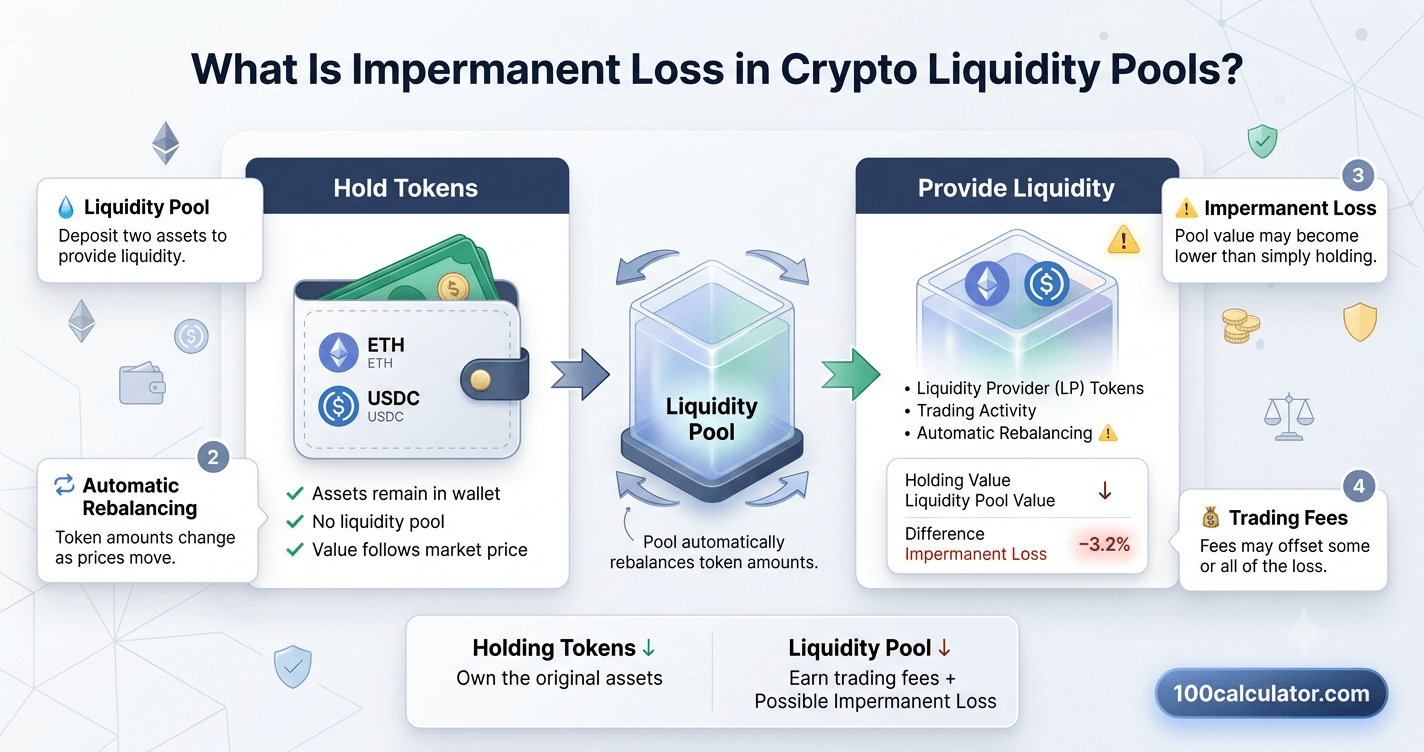
If you've looked into earning yield by depositing crypto into a decentralized exchange, you've probably run into a warning about impermanent loss. It sounds abstract at first, but the idea itself is fairly simple once you see it happen with real numbers.
Impermanent loss is the difference in value between holding two tokens in your wallet and depositing those same tokens into a liquidity pool, once their prices move apart from where they started. It happens because automated market makers automatically rebalance the tokens in a pool every time someone trades, which usually leaves liquidity providers holding more of whichever token dropped in price and less of whichever token rose. The loss is called "impermanent" because it can shrink back to zero if prices return to where they started, but it becomes permanent the moment you withdraw while prices are still apart.
This guide walks through how liquidity pools actually work, why impermanent loss happens, the exact formula behind it, and a full worked example using real numbers. We'll also cover how trading fees can offset it, how Uniswap's concentrated liquidity changes the risk, and practical ways to reduce your exposure. If you'd rather skip the math and just see your own numbers, 100 Calculator's Impermanent Loss Calculator does the calculation for you the moment you enter a price change.
First, let's look at what's actually happening inside a liquidity pool, since that's what makes the rest of this guide make sense.
How Liquidity Pools and AMMs Work
Before impermanent loss makes sense, it helps to understand what a liquidity pool is actually doing behind the scenes. Once you see how trades get priced, the rest of this guide falls into place quickly.
What Is a Liquidity Pool?
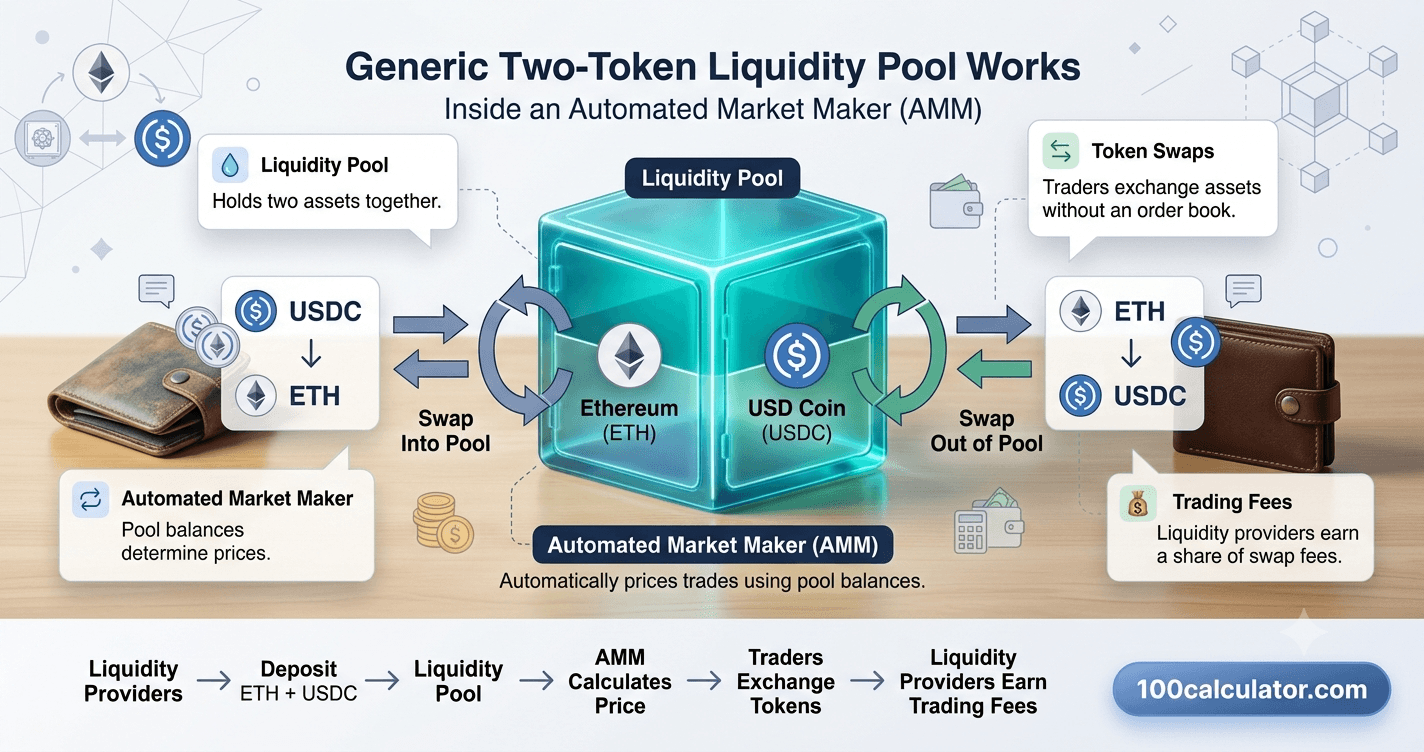
A liquidity pool is a shared pot of two tokens, locked into a smart contract, that traders can swap against directly instead of waiting for a matching buyer or seller. Anyone can become a liquidity provider, or LP, by depositing an equal value of both tokens, in return for a share of the trading fees every swap generates.
This is different from a traditional order book exchange, where your trade is matched against another person's order. In a liquidity pool, you're trading against the pool itself, and the pool's underlying formula decides the price.
What Is an Automated Market Maker?
An automated market maker, or AMM, is the software that prices trades inside a liquidity pool without a human market maker or order book. Instead of matching buyers and sellers, an AMM uses a mathematical formula to set the exchange rate between the two tokens based on how much of each one currently sits in the pool.
Uniswap, one of the most widely used decentralized exchanges, popularized this model, and most major AMMs across Ethereum and other blockchains still follow the same basic design today.
The Constant Product Formula (x × y = k)
The most common AMM design uses what's called the constant product formula, usually written as x × y = k. Here, x and y are the quantities of the two tokens in the pool, and k is a value the pool always maintains after every trade.
If a trader buys ETH from an ETH/USDC pool, they add USDC and remove ETH. To keep x × y equal to the same k, the pool automatically raises the price of the remaining ETH. This same mechanism, working in reverse, is exactly what eventually produces impermanent loss for liquidity providers.
What Is Impermanent Loss?
With the mechanics of a liquidity pool in mind, we can define impermanent loss precisely instead of just describing the feeling of it.
Impermanent loss is the gap between two outcomes: what your tokens would be worth if you had simply held them in your wallet, and what your share of the pool is actually worth after prices moved. It's measured in percentage terms, and it exists whether the price of your tokens went up or down, because it depends on the ratio between the two prices changing, not the direction.
Why It's Called "Impermanent"
The loss is called impermanent because it isn't locked in until you withdraw your liquidity. If the prices of both tokens return to the same ratio they were at when you deposited, the loss disappears completely, and you keep every fee you earned along the way.
The catch is that plenty of liquidity providers never see prices fully revert, especially in fast-moving crypto markets. If you withdraw while the ratio is still different from your entry point, the loss becomes real and permanent at that moment.
Impermanent Loss vs. Simply Holding
It helps to think of impermanent loss as an opportunity cost rather than a direct loss of funds. You don't wake up with fewer tokens out of nowhere. Instead, the pool's rebalancing leaves you holding a different mix of the two tokens than if you'd just held the original amounts, and that different mix is usually worth a little less at the new price.
Why Impermanent Loss Happens
Impermanent loss doesn't happen because of a hidden fee or an exchange glitch. It happens because of arbitrage, and arbitrage is actually what keeps a pool's price in line with the rest of the market.
How Arbitrage Traders Rebalance the Pool
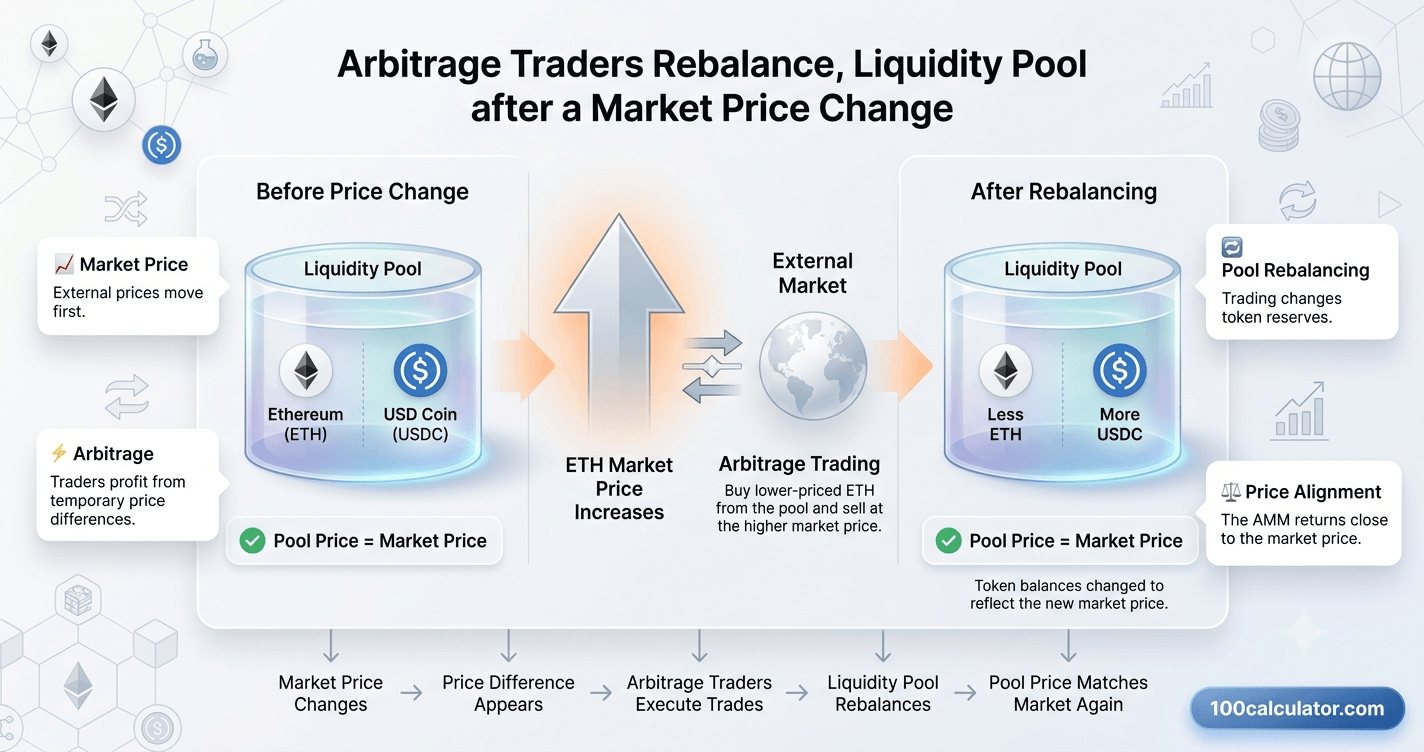
Here's the sequence: say ETH is trading at $2,000 on every exchange, including inside an ETH/USDC pool. Now the price of ETH rises to $2,200 everywhere else, but the pool's price hasn't moved yet, since nobody has traded there recently. Arbitrage traders notice the pool is now selling ETH too cheaply, so they buy ETH from the pool with USDC until the pool's price matches the external market again.
Every one of those arbitrage trades removes ETH from the pool and adds USDC, which is exactly the rebalancing that produces impermanent loss for the liquidity providers on the other side of those trades. The bigger the price move, the more arbitrage trading happens, and the larger the resulting impermanent loss.
The Impermanent Loss Formula
Impermanent loss follows a specific, well-established formula that only depends on how much the price ratio between your two tokens has changed, not on the size of your deposit or which specific tokens you're holding.
Impermanent Loss Formula
IL = [2 × √r ÷ (1 + r)] − 1
r is the price ratio: the new price of one token divided by its price when you deposited it.
IL is impermanent loss, shown as a negative percentage compared to simply holding both tokens.
A price ratio of 2 means one token has doubled in value relative to the other; a price ratio of 0.5 means it's worth half as much. Either way, plugging that ratio into the formula tells you how far your pool position has drifted from what holding would have given you.
Impermanent Loss at Different Price Changes
Because the formula only cares about the ratio, not the direction, a token doubling in price and a token halving in price produce the exact same percentage of impermanent loss. The table below shows how the loss scales as the price ratio moves further from 1.
| Price Change | Price Ratio | Impermanent Loss |
|---|---|---|
| +25% | 1.25x | 0.6% |
| +50% | 1.50x | 2.0% |
| +100% (2x) | 2.00x | 5.7% |
| +200% (3x) | 3.00x | 13.4% |
| +400% (5x) | 5.00x | 25.5% |
| +900% (10x) | 10.00x | 42.5% |
Notice how the loss accelerates as the price gap widens. A modest 25% move barely registers, but a token that ten-folds in price relative to its pair produces a loss north of 40%, even though you personally never sold anything.
Free Online Tool
Skip the manual math
100 Calculator's Impermanent Loss Calculator runs this exact formula for you. Enter your entry price and a hypothetical new price, and it estimates your impermanent loss instantly, with no account required.
A Step-by-Step Impermanent Loss Example
Numbers are easier to follow with a concrete scenario, so let's walk through one from start to finish.
Setting Up the Example
Say you deposit 1 ETH and 2,000 USDC into an ETH/USDC pool, at a time when ETH is trading at $2,000. Your total deposit is worth $4,000, split evenly between the two tokens, which is how standard liquidity pools generally require deposits to be structured.
Calculating the Result
A few weeks later, ETH's price doubles to $4,000 everywhere, including inside the pool, once arbitrage traders rebalance it. Because the pool has to keep the product of its two token quantities constant, your share of the pool no longer holds 1 ETH and 2,000 USDC. Instead, it holds roughly 0.71 ETH and 2,828 USDC.
| Scenario | ETH Held | USDC Held | Total Value |
|---|---|---|---|
| Just holding | 1.00 | 2,000 | $6,000 |
| In the liquidity pool | 0.71 | 2,828 | $5,657 |
The difference between $6,000 and $5,657 is $343, or about 5.7% of the value you'd have had by simply holding, which matches exactly what the formula predicts for a price that has doubled.
Impermanent Loss vs. Trading Fees
Impermanent loss is only half of the picture. Every trade that happens in a pool pays a small fee, usually somewhere between 0.01% and 1% of the trade depending on the pool, and that fee is split among the current liquidity providers. Your actual return as an LP is your fee income minus your impermanent loss, not the loss on its own.
When Fees Outweigh Impermanent Loss
High-volume, relatively stable pools, like major stablecoin pairs or the most actively traded pairs on a large exchange, tend to generate enough fee income to comfortably outweigh typical impermanent loss. This is why professional market makers are willing to provide liquidity even though impermanent loss is a known, unavoidable feature of the design.
Low-volume pools or newly launched, highly volatile tokens are the opposite case. If barely any trading happens, there isn't enough fee income to offset even a moderate price swing, and providing liquidity there is closer to taking on price risk for free. Before depositing into any pool, it's worth checking 100 Calculator's APY ↔ APR Crypto Yield Calculator to see what your fee income actually annualizes to, so you can compare it against the kind of impermanent loss shown in the table above. If you want to see your full return after both fees and any exchange costs, the Crypto Profit & Exchange Fee Calculator is another useful check.
Impermanent Loss and Concentrated Liquidity (Uniswap V3)
Older AMM designs, often called constant product or Uniswap V2-style pools, spread your liquidity evenly across every possible price, from zero to infinity. Most of that liquidity sits unused, since prices rarely visit the extreme ends of that range.
Narrow Ranges Increase Risk and Reward
Uniswap V3 introduced concentrated liquidity, which lets you choose a specific price range to provide liquidity in, instead of the entire curve. Depositing the same dollar amount into a narrow range earns a much larger share of the fees generated inside that range, since your capital isn't spread thin across prices that will probably never trade.
The trade-off is that concentrated positions experience impermanent loss faster. Because your liquidity is concentrated instead of spread out, the same price move causes a bigger shift in your token ratio, and once the price moves outside your chosen range entirely, your position stops earning fees and effectively becomes a single-asset holding until the price comes back. Choosing a narrow range is a genuine trade-off between higher fee income and faster, larger impermanent loss, not a way to avoid impermanent loss altogether.
Common Mistakes Liquidity Providers Make
Even experienced traders sometimes misjudge impermanent loss. These are the mistakes that come up most often.
- Ignoring impermanent loss entirely. Some new liquidity providers only look at the advertised APY and never check what a 30% or 50% price swing would do to their position.
- Choosing pools with brand-new or highly speculative tokens. These pairs often see the largest, fastest price swings, and therefore the largest impermanent loss, especially if one token's price collapses.
- Picking an overly narrow price range without monitoring it. A narrow Uniswap V3 range can maximize fees while the price stays inside it, but it needs regular attention once the price approaches either edge.
- Forgetting gas and transaction costs. Entering and exiting a pool costs gas on Ethereum, and moving in and out frequently to "time" impermanent loss can quietly eat your returns. 100 Calculator's Ethereum Gas Fee to USD Calculator can help you see what those costs add up to.
- Not tracking the real cost basis of the position. Because your token amounts shift as the pool rebalances, your effective cost basis changes too. 100 Calculator's Crypto Average Cost Basis Calculator can help you keep this straight, and it matters more than most people expect once tax season comes around.
Ways to Reduce Impermanent Loss
Impermanent loss can't be eliminated completely as long as prices move, but there are practical ways to reduce your exposure to it.
Choose Stablecoin or Correlated Pairs
Pools made up of two stablecoins, like USDC/USDT, experience very little impermanent loss because both tokens are designed to stay near the same dollar value. The same logic applies, to a lesser degree, to pairs of tokens that tend to move together, such as two tokens tied to the same blockchain ecosystem. The less their price ratio drifts, the less impermanent loss you'll see.
Pick Your Range and Fee Tier Carefully
If you're using a concentrated liquidity AMM, a wider price range reduces how quickly impermanent loss builds up, at the cost of lower fee income per dollar deposited. Matching your range to how volatile you expect the pair to be, rather than always chasing the narrowest range, tends to produce a steadier result over time. 100 Calculator's Crypto Position Size Calculator can also help you decide how much of your portfolio makes sense to commit to any single pool in the first place.
Track Your Position Regularly
Impermanent loss isn't a set-and-forget number. Checking it periodically, alongside the fees you've earned, tells you whether a position is still worth holding or whether it's time to withdraw. Our guide on how to reduce impermanent loss when providing liquidity goes deeper into specific strategies, including how some liquidity providers hedge their exposure.
Before providing liquidity to any pool, it helps to run through a short checklist:
- Is trading volume high enough to generate meaningful fee income?
- How correlated are the two tokens' prices historically?
- What price range am I comfortable with if I'm using concentrated liquidity?
- Have I checked the impermanent loss at a 2x and a 5x price move for this pair?
- Have I factored in gas costs for entering and eventually exiting the pool?
Related Calculators
Put what you just read into practice, try these free tools instantly, no sign-up required.
Crypto Position Size Calculator
Calculate the right crypto position size for your risk level.
Crypto Liquidation Price Calculator
Find the price at which your leveraged crypto position liquidates.
Crypto Futures Funding Fee Calculator
Estimate funding fees paid or earned on crypto futures positions.
APY ↔ APR Crypto Yield Calculator
Convert between APY and APR to compare real crypto yields.
Impermanent Loss Calculator
Estimate impermanent loss when providing liquidity to a pool.
Impermanent Loss Myths vs. Facts
A few misconceptions about impermanent loss come up constantly. Here's what's actually true.
| Myth | Fact |
|---|---|
| Impermanent loss only happens when a price goes down. | It happens whenever the price ratio changes in either direction; a token doubling produces the same loss as a token being cut in half. |
| Stablecoin pools have zero impermanent loss. | They have very little as long as both tokens hold their peg, but a depegging event can still create real impermanent loss. |
| Concentrated liquidity on Uniswap V3 reduces impermanent loss. | It concentrates your capital for higher fee income, but that same concentration usually makes impermanent loss build up faster. |
| Impermanent loss means you've lost real money. | It's an opportunity cost measured against holding, not a direct loss of principal; you can still profit in dollar terms while experiencing it. |
| Impermanent loss is a bug or a scam. | It's a predictable, well-documented feature of how constant product AMMs price trades, not a flaw or a hidden fee. |
Sources & References
The concepts and formulas in this guide are based on publicly available documentation from established platforms in the DeFi space.
Investment risk disclaimer: This article is for general educational purposes only and isn't financial or investment advice. Providing liquidity to a DeFi pool carries real financial risk, including impermanent loss, smart contract risk, and the possibility of losing some or all of your principal. Cryptocurrency markets are highly volatile, and DeFi protocols carry additional technical risks beyond traditional investments. Always research a protocol thoroughly and consider speaking with a licensed financial advisor before providing liquidity or investing in cryptocurrency.
More From Our Crypto Calculator Guide
Still building your understanding of DeFi risk and crypto calculators? These related guides dig deeper into the topics covered above.
Frequently Asked Questions
What is impermanent loss in simple terms?
Impermanent loss is the difference between what your tokens would be worth if you simply held them in your wallet, and what your share of a liquidity pool is worth after the price ratio between those tokens changes. It happens because the pool automatically rebalances your holdings every time someone trades against it, leaving you with more of the token that fell in price and less of the token that rose.
Why is it called "impermanent" loss?
The loss is called impermanent because it isn't locked in while your funds stay in the pool. If prices return to the same ratio they were at when you deposited, the loss shrinks back to zero and you keep every trading fee you earned along the way. It only becomes permanent the moment you withdraw while the price ratio is still different from when you started.
What causes impermanent loss in a liquidity pool?
Impermanent loss comes from arbitrage trading. When a token's price changes on outside exchanges but hasn't updated inside the pool yet, arbitrage traders buy or sell against the pool until its price matches the broader market again. Every one of those trades shifts the pool's token balance, and that shift is what creates impermanent loss for liquidity providers.
What is the formula for calculating impermanent loss?
The standard formula is IL = [2 × √r ÷ (1 + r)] − 1, where r is the price ratio: the new price of one token divided by its price when you deposited. Plugging in a price ratio of 2, for a token that has doubled, gives an impermanent loss of about 5.7% compared to simply holding.
How much impermanent loss should I expect for a 2x price change?
A price change of 2x, meaning one token doubles relative to the other, produces an impermanent loss of about 5.7% compared to holding. This number comes directly from the standard impermanent loss formula and applies whether the token doubled or was cut in half, since the formula only measures the size of the ratio change, not its direction.
Does impermanent loss mean I'm losing actual money?
Not necessarily. Impermanent loss is an opportunity cost measured against a specific alternative: simply holding your tokens instead of depositing them. If both tokens in your pair rose in price, you can still end up with more dollars than you started with, even while technically experiencing impermanent loss relative to what holding would have earned.
Can impermanent loss be avoided completely?
Not as long as the prices of your two tokens can move independently of each other. It can be reduced significantly by choosing stablecoin pairs or correlated assets, and it can be offset by trading fees, but it can't be eliminated entirely in any pool where the token ratio is free to change.
Do stablecoin pools have impermanent loss?
Stablecoin pools, like USDC/USDT, have very little impermanent loss under normal conditions because both tokens are designed to stay close to the same value. The exception is a depegging event, where one stablecoin temporarily or permanently loses its peg to the dollar, which can create meaningful impermanent loss until the peg is restored.
Does Uniswap V3's concentrated liquidity increase or reduce impermanent loss?
Concentrated liquidity generally increases how quickly impermanent loss builds up for a given price move, compared to spreading liquidity across the entire price curve. It lets you earn more fees per dollar deposited within your chosen range, but that same concentration makes your position more sensitive to price changes, which is a trade-off rather than a way to avoid impermanent loss.
How do trading fees offset impermanent loss?
Every swap that happens in a pool pays a small fee, which is split among the liquidity providers active at that time. In pools with enough trading volume, the fees earned over weeks or months can exceed the impermanent loss from price changes, making the position profitable overall even though impermanent loss technically still occurred.
Is impermanent loss the same as slippage?
No. Slippage is the difference between the price a trader expects and the price they actually get on a single trade, and it's a cost paid by traders. Impermanent loss is a separate concept that affects liquidity providers over time, based on how the price ratio of their deposited tokens changes compared to when they added liquidity.
What's a good way to calculate impermanent loss before providing liquidity?
The quickest way is to use a dedicated tool rather than doing the math by hand every time. 100 Calculator's Impermanent Loss Calculator lets you enter your expected price change and see the estimated loss instantly, which makes it easier to compare that number against the fee income a pool is likely to generate.
Does impermanent loss apply to yield farming and staking too?
Impermanent loss specifically applies to two-sided liquidity pools used by automated market makers, since it depends on a pool rebalancing a pair of tokens. Simple single-asset staking, where you lock up one token without pairing it against another, doesn't involve impermanent loss, though it carries its own separate risks like slashing or protocol risk.
How can I check the impermanent loss on a position I already opened?
You'll need your original deposit amounts and prices, plus the current prices of both tokens. Many DeFi dashboards and block explorers display this automatically for connected wallets, or you can estimate it manually using the price ratio between your entry point and today by plugging both into an impermanent loss calculator.
About 100 Calculator
100 Calculator is a free hub of online calculators and educational guides covering health, finance, trading, crypto, education, and more. Every tool is built to be fast, accurate, and genuinely free, with no account or signup required.
We built this guide, along with tools like the Impermanent Loss Calculator referenced throughout it, to make DeFi concepts a little easier to understand before you put real money into a liquidity pool. Head back to the 100 Calculator homepage to explore the full library of tools, or learn more about the team behind them on our About Us page.