How to Size Crypto Positions Based on Risk Tolerance
A practical, beginner-friendly walkthrough of the formula traders use to size crypto positions, so a single trade never risks more of your account than you actually meant it to.
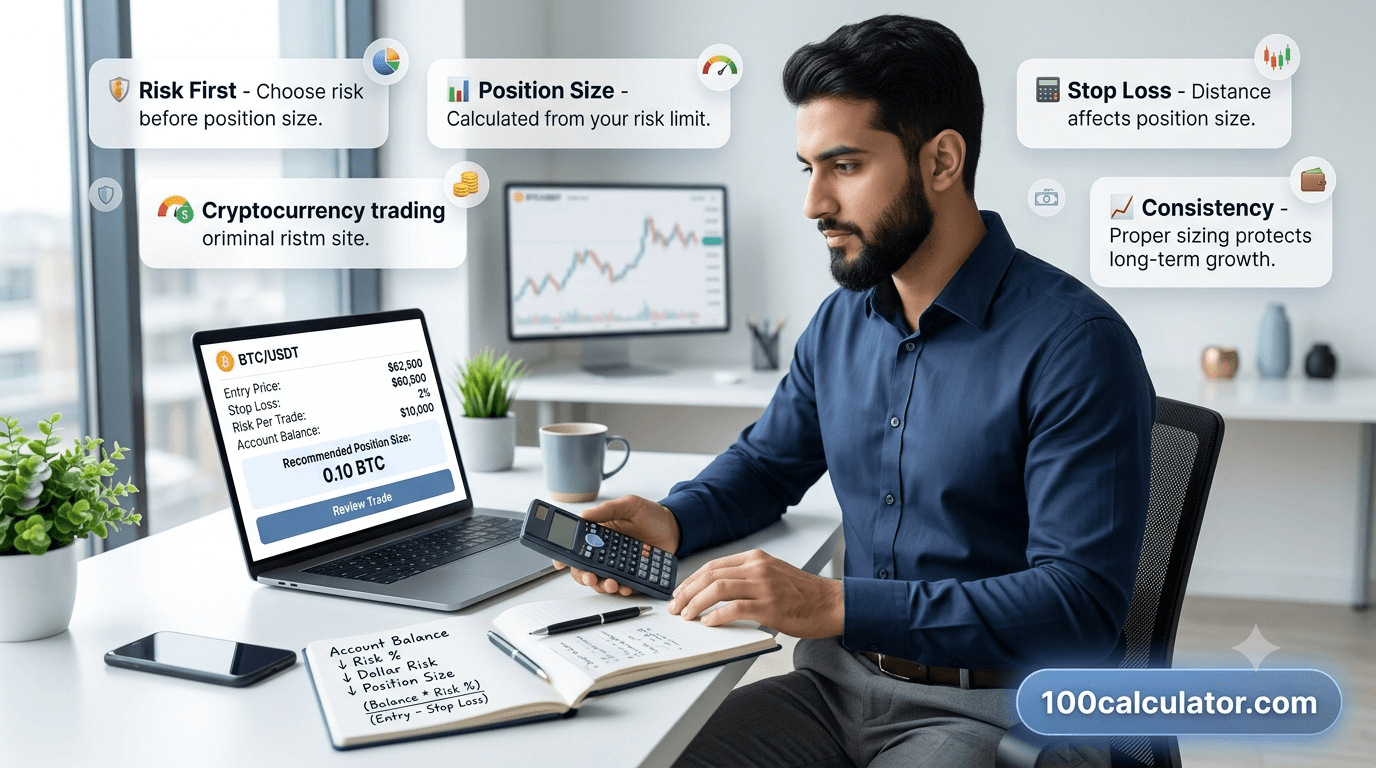
Most crypto losses don't come from picking the wrong coin. They come from betting too much on a single trade, then watching an ordinary price swing turn into a real hit to the whole account. Position sizing is what fixes that.
Position sizing is the process of deciding how much money to put into a single trade, based on your account balance, how much you're willing to risk if the trade goes wrong, and how far your stop-loss sits from your entry price. Instead of guessing an amount or sizing a trade around how confident you feel, you calculate it, so no single trade can seriously damage your account even when it doesn't work out.
This matters more in crypto than in most markets. Prices swing harder, leverage is only a few taps away on most exchanges, and it's easy to size a position around conviction instead of what you can actually afford to lose. Risk tolerance, not confidence, is what should set that number.
In this guide, we'll walk through the exact formula traders use to size crypto positions, how leverage changes the math, how to adjust for a coin's volatility, and the mistakes that quietly wreck otherwise solid strategies. If you'd rather skip the manual math, 100 Calculator's Crypto Position Size Calculator does it for you the moment you enter your numbers. First, let's break down what position sizing actually means.
What Is Crypto Position Sizing?
Position sizing answers one specific question: how much of your account should go into this particular trade? It's separate from picking which coin to buy or when to buy it. Two traders can agree completely on a trade setup and still end up with very different outcomes, simply because one sized the position sensibly and the other didn't.
The core idea is straightforward. Before you open a trade, you decide how much you're willing to lose if it doesn't work out, then work backward to figure out how large the position itself can be. That's different from most beginners' instinct, which is to decide how much money to put in first and hope for the best.
Position Sizing vs. Portfolio Allocation
It's easy to mix up position sizing with portfolio allocation, but they answer different questions. Portfolio allocation is the big-picture decision: what share of your overall savings or investments sits in crypto versus stocks, cash, or anything else. Position sizing is a smaller, per-trade decision: within the money you've already set aside for crypto trading, how much goes into any single trade.
You can get one right and still get the other wrong. Someone with a conservative 5% portfolio allocation to crypto can still oversize individual trades within that 5%, risking a large chunk of it on one position. Position sizing is what protects you at the trade level, even after the bigger allocation decision has already been made.
Why Risk Tolerance Should Set Your Position Size
The U.S. Securities and Exchange Commission's investor education site describes risk tolerance as a combination of two things: how much of an investment someone could stand to lose, and how willing they are to accept that possibility for a shot at higher returns. (SEC) Position sizing is simply that idea turned into a repeatable number instead of a feeling.
Without a clear risk tolerance guiding your position size, it's tempting to size trades based on how sure you feel about them. High conviction starts to look like a green light for a bigger position, and a string of wins can make risk feel smaller than it actually is. Tying position size to a fixed percentage of your account, instead of your mood about a particular trade, removes that guesswork.
Risk Tolerance vs. Risk Capacity
That definition bundles two ideas together: willingness and ability. In practice, many financial educators find it useful to separate them into two distinct questions.
Risk tolerance is the psychological side: how comfortable you actually are watching a position lose value without making an emotional decision. Risk capacity is the financial side: how much you can genuinely afford to lose without it affecting your rent, savings, or day-to-day life.
The lower of the two should set your position size. Someone might feel emotionally fine watching a large position swing wildly, but if that account is also their emergency fund, their risk capacity is low even though their risk tolerance feels high. Crypto's volatility makes this gap worth checking honestly before you settle on a risk percentage.
A quick recap of what proper position sizing actually gives you:
- A fixed, repeatable way to decide how much to risk on every trade
- Protection against any single trade seriously damaging your account
- A buffer against emotional decisions during high-conviction trades
- A consistent framework you can apply across every coin you trade
- A clearer sense of how leverage is actually affecting your risk
The Crypto Position Sizing Formula
Once you know your risk tolerance, sizing a position comes down to one formula. It looks intimidating written out, but it's just three numbers you already have once you've planned a trade.
Position Size Formula
Position Size ($) = (Account Balance × Risk % per Trade) ÷ Stop-Loss Distance (%)
Account Balance — your total trading capital, or the amount set aside for this strategy.
Risk % per Trade — the share of your account you're willing to lose on this trade, commonly 0.5%–2%.
Stop-Loss Distance (%) — how far your stop-loss sits from your entry price, as a percentage.
Breaking Down Each Variable
Each part of the formula answers a specific question:
- Account balance is the total trading capital you're working with, or the portion of it you've set aside for this strategy.
- Risk percentage per trade is the share of that balance you're willing to lose if this specific trade hits your stop-loss. Most traders keep this between 0.5% and 2%.
- Stop-loss distance is how far your stop-loss sits from your entry price, expressed as a percentage move, not a dollar amount.
Multiplying your account balance by your risk percentage gives you a dollar figure, your maximum acceptable loss on this one trade. Dividing that dollar figure by your stop-loss distance tells you exactly how large a position can absorb that stop-loss without exceeding your risk limit.
Step-by-Step: Calculating Your Position Size
Here's how to put the formula to work before you open a trade:
- Decide your account balance. Use your full trading account, or a set portion of it if you split capital across different strategies.
- Pick a risk percentage. Choose a percentage that matches your risk tolerance, usually somewhere between 0.5% and 2% of your account.
- Set your entry and stop-loss price. Decide where you're getting in and where you'll exit if the trade goes against you, based on chart structure, not a round number.
- Calculate your stop-loss distance. Work out the percentage difference between your entry price and your stop-loss price.
- Run the formula. Multiply your account balance by your risk percentage, then divide by your stop-loss distance to get your position size.
Worked Example With Real Numbers
Say you have a $10,000 account and you've decided to risk 1% per trade, which is $100. You're looking at a coin trading at $50, and based on recent support levels, your stop-loss sits at $47.50, a 5% distance from your entry.
Position Size = $100 ÷ 0.05 = $2,000. You'd open a $2,000 position, not the full $10,000. If the price drops to your stop-loss and you sell, you lose $100, exactly 1% of your account, no matter how tempting the setup looked going in.
Notice how much stop-loss distance changes the outcome. A tighter stop lets you open a larger position for the same dollar risk, while a wider stop, often necessary on more volatile coins, shrinks the position size accordingly:
| Stop-Loss Distance | Dollar Risk (1%) | Resulting Position Size |
|---|---|---|
| 2% | $100 | $5,000 |
| 5% | $100 | $2,000 |
| 10% | $100 | $1,000 |
| 20% | $100 | $500 |
This is also where a Crypto Position Size Calculator earns its keep. Once you've decided your account balance, risk percentage, entry, and stop-loss, it runs this exact math instantly, so you're not doing division mid-trade while the price keeps moving.
Free Online Tool
Skip the manual math
100 Calculator's Crypto Position Size Calculator runs right in your browser. Enter your account balance, risk percentage, entry, and stop-loss, and it calculates your position size instantly, with no account required.
Matching Risk Percentage to Your Risk Tolerance
The formula only works once you've picked a risk percentage, and that number should come from your risk tolerance, not from what feels exciting. Here's how that typically breaks down:
Conservative
0.5–1%
Capital preservation first
A sensible starting point for beginners, smaller accounts, or anyone who wants a long runway of trades before a rough patch meaningfully affects their balance.
Moderate
1–2%
The most common approach
A balance many traders settle on once they have a tested strategy and a track record of actually sticking to their stop-losses.
Aggressive
2–3%+
Higher swings, higher pressure
Only appropriate with a proven edge, disciplined exits, and capital you can genuinely afford to see drop sharply during a rough stretch.
Why 1–2% Is the Most Common Recommendation
The math behind small risk percentages is more persuasive than it first sounds. Losses and gains aren't symmetrical: a 10% loss only needs a roughly 11% gain to recover, but a 50% loss needs a full 100% gain just to get back to even. Position sizing that keeps individual losses small is what keeps recovery realistic.
Here's what that looks like over a stretch of losing trades, purely as a hypothetical to illustrate the math, not a prediction of what will happen. Ten losing trades in a row at 1% risk each bring an account down by roughly 9.6%, needing about a 10.6% gain to recover. The same ten losses at 5% risk each bring the account down by around 40%, needing a much steeper 67% gain just to break even.
That gap is why so many traders settle on 1–2%. It's not about being timid, it's about making sure a losing streak, which happens to every strategy eventually, stays recoverable. If you want to see exactly how a specific drawdown translates into the gain needed to recover it, 100 Calculator's Drawdown Recovery Calculator runs the numbers for you.
How Leverage Changes the Position Sizing Math
Leverage is where crypto position sizing most often goes wrong. It's not that the formula changes, it's that leverage makes it easy to lose track of what "position size" actually means.
Position Size vs. Margin Required
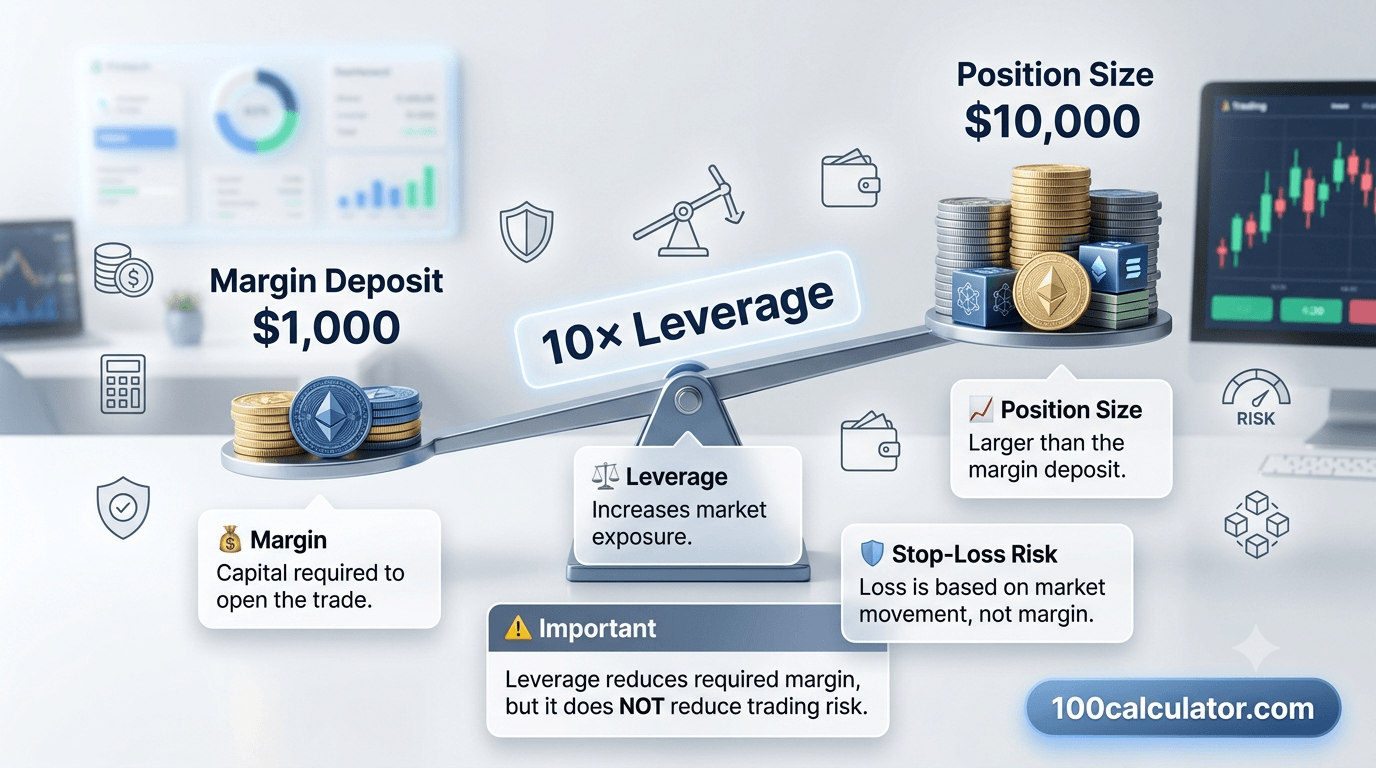
Your position size is the full value of the trade you're controlling, sometimes called notional exposure. Margin is the amount of your own money required to open that position when you're using leverage. The two aren't the same number, and mixing them up is one of the most common ways traders end up oversized without realizing it.
Take that same $2,000 position from the earlier example. Here's what margin looks like at different leverage levels, while the position size, and the risk if it hits your stop-loss, stays exactly the same:
| Leverage | Margin Required | Position Size (Risk Exposure) |
|---|---|---|
| 1x (no leverage) | $2,000 | $2,000 |
| 5x | $400 | $2,000 |
| 10x | $200 | $2,000 |
| 20x | $100 | $2,000 |
Stop-Loss vs. Liquidation Price
A stop-loss is a price you set yourself, meant to close the trade before losses grow too large. A liquidation price is set by the exchange, and it triggers automatically once your margin can no longer cover your losses. They're not interchangeable, and confusing the two is a fast way to lose far more than intended.
Properly sized positions are built so your own stop-loss triggers comfortably before the exchange's liquidation price, not right up against it. That gives you control over the exit instead of leaving it to the exchange. Our guide on how liquidation price is calculated in crypto futures walks through that calculation in more detail, and 100 Calculator's Crypto Liquidation Price Calculator shows you exactly where that line sits for a given leverage level.
Leverage also isn't free to hold. Perpetual futures positions typically involve periodic funding payments between long and short traders, which our guide on what a funding rate is in crypto futures trading explains in full, and which can add up on positions held for a while, something our piece on how funding fees affect long-term futures positions breaks down further. 100 Calculator's Crypto Futures Funding Fee Calculator can estimate that cost before you open a leveraged position.
Adjusting Position Size for Crypto's Volatility
Not every coin moves the same amount in a day. Bitcoin, the most established crypto asset, still swings more than most traditional markets, and smaller altcoins routinely move further and faster than Bitcoin does. Treating every coin the same way in your position sizing ignores that difference.
Why Bitcoin and Altcoins Need Different Position Sizes
A tight, close stop-loss on a highly volatile altcoin is more likely to get triggered by ordinary price noise rather than an actual reversal of the trend. That usually means a wider stop-loss makes sense on more volatile coins, and since the formula divides your dollar risk by stop-loss distance, a wider stop naturally produces a smaller position size for the same amount of risk.
In practice, this means running the formula separately for each trade instead of reusing the same position size across every coin. A $2,000 position might be entirely reasonable on a relatively stable large-cap coin and oversized on a small, thinly traded altcoin with the same dollar amount at stake but a much wider realistic stop-loss.
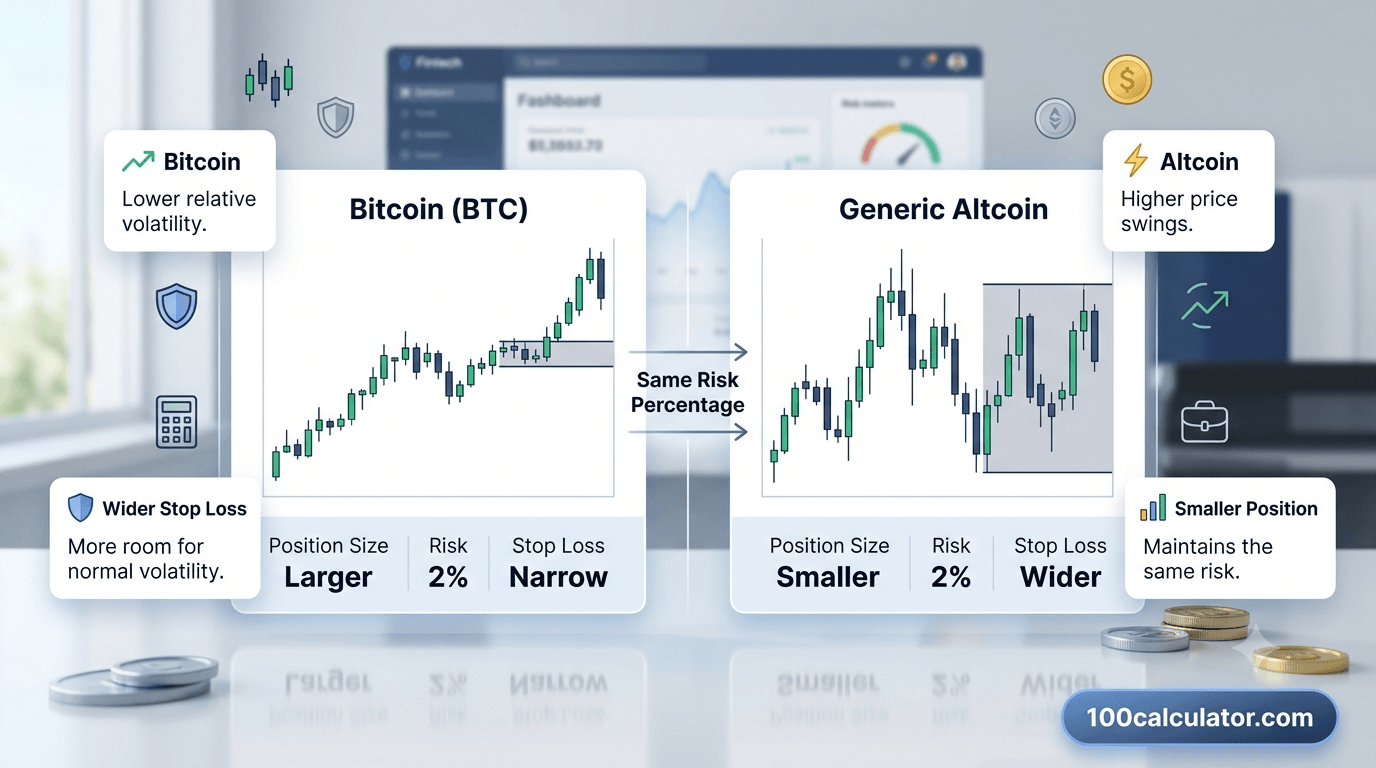
A useful habit is checking a coin's recent price swings before setting your stop-loss, rather than defaulting to a stop distance that worked on a completely different asset. The stop-loss should reflect how that specific coin actually moves, and the position size should follow from there.
Common Position Sizing Mistakes to Avoid
Even traders who know the formula sometimes skip it under pressure. Here's what tends to go wrong:
- Sizing trades on conviction instead of the formula. A setup that "feels like a sure thing" is exactly when it's tempting to break your own rules, and exactly when a formula-based limit matters most.
- Using the same dollar amount for every trade. A flat dollar position size ignores stop-loss distance entirely, so it ends up risking wildly different percentages of your account from one trade to the next.
- Confusing margin with position size. Having enough margin available to open a large leveraged position doesn't mean that position matches your actual risk tolerance.
- Increasing size to win back a previous loss. Revenge trading with a larger position size turns one loss into the possibility of a much bigger one.
- Skipping the stop-loss and sizing by feel. Without a defined stop-loss distance, there's no accurate way to calculate a position size that matches your intended risk.
- Ignoring how correlated your open positions are. Several "different" altcoin positions that all move with Bitcoin can behave like one large position during a sharp move, not several smaller, independent ones.
If you're also working out where to set your exit relative to your entry, our guide to position sizing rules every crypto trader should know covers a few additional guardrails worth building into your routine, and 100 Calculator's Risk Reward Ratio Calculator can help you check whether a trade's potential reward justifies the risk before you size it at all.
Position Sizing Across Your Whole Portfolio
Sizing a single position correctly doesn't automatically mean your overall exposure is under control. It's possible to size every individual trade perfectly and still end up with far more total risk on the table than intended, simply by having too many positions open at once.
Correlation Risk Between Coins
Diversification works by spreading risk across assets that don't all move the same way at the same time. Investor education from the SEC frames it plainly: spreading money across different holdings is meant to protect against a decline in any single one dragging the whole portfolio down with it. (SEC)
Crypto complicates this, because many altcoins tend to move in the same direction as Bitcoin, especially during sharp market-wide moves. Holding five different altcoin positions can look diversified on paper while behaving like one large, concentrated bet if all five rise and fall together. Real diversification means checking how closely your positions actually move with each other, not just counting how many different coin names you hold.
Setting a Maximum Total Exposure
Alongside a risk percentage per trade, it helps to set a cap on total risk across every open position combined, often somewhere around 5–10% of the account at once. If you're risking 1% per trade, that generally works out to five to ten positions open at the same time before you've hit your limit.
This cap matters most during broad market drops, when correlated coins can all hit their stop-losses within a short window. A per-trade limit alone doesn't protect against that scenario, but a total exposure cap does.
Related Calculators
Put what you just read into practice, try these free tools instantly, no sign-up required.
Crypto Position Size Calculator
Calculate the right crypto position size for your risk level.
Crypto Liquidation Price Calculator
Find the price at which your leveraged crypto position liquidates.
Crypto Futures Funding Fee Calculator
Estimate funding fees paid or earned on crypto futures positions.
APY ↔ APR Crypto Yield Calculator
Convert between APY and APR to compare real crypto yields.
Impermanent Loss Calculator
Estimate impermanent loss when providing liquidity to a pool.
Building a Position Sizing Routine That Sticks
Knowing the formula and actually using it every time are two different things, especially when a trade looks exciting. A few habits make it much easier to stay consistent.
- Decide your risk percentage before you're looking at a specific trade. Choosing it in the moment makes it far too easy to stretch the number to fit whatever setup you're excited about.
- Set your stop-loss before you calculate position size, not after. The formula needs that number to work, and picking a stop-loss after sizing the position tends to bend the stop-loss to fit a position you already wanted.
- Run the same formula every time, no exceptions. High-conviction trades are exactly where skipping the calculation causes the most damage.
- Recalculate for every trade, not once for your whole strategy. Stop-loss distance changes from trade to trade, so your position size should too.
- Review your risk percentage periodically, not your position size in the moment. As your account grows or your experience with a strategy builds, it's reasonable to revisit whether your risk percentage still fits, but that's a planned review, not a mid-trade decision.
Once these habits are in place, plugging your numbers into 100 Calculator's Crypto Position Size Calculator turns the whole process into a few seconds of typing instead of mental math under pressure.
Risk disclaimer: This article is for general educational purposes only and isn't financial or investment advice. Cryptocurrency trading, especially with leverage, carries a high risk of loss and isn't suitable for everyone. Position sizing and risk management techniques can help manage that risk, but they can't eliminate it. Always trade with money you can afford to lose, and consider speaking with a licensed financial advisor before making trading decisions.
Sources & References
More From Crypto Calculator Guide
Still building out your crypto risk management toolkit? These related guides dig deeper into leverage, liquidation, and yield topics touched on above.
Frequently Asked Questions
What is position sizing in crypto trading?
Position sizing is the process of deciding how much money to put into a single trade. Instead of guessing or investing a random amount, you calculate the position based on your account balance, how much you're willing to risk on that trade, and how far your stop-loss sits from your entry price. The goal is simple: no single trade, even a losing one, should do serious damage to your overall account.
How do I calculate crypto position size based on risk tolerance?
Start by deciding what percentage of your account you're willing to lose on one trade, commonly between 0.5% and 2%. Multiply that percentage by your account balance to get your dollar risk. Then divide that dollar risk by your stop-loss distance, expressed as a percentage. The result is your position size in dollars. A free crypto position size calculator can do this math instantly once you enter these numbers.
What percentage of my account should I risk per trade?
Most trading education points to somewhere between 0.5% and 2% of your account per trade, with 1% being one of the most commonly cited starting points. Conservative traders, beginners, and smaller accounts often stay closer to 0.5–1%. More experienced traders with a tested strategy sometimes move toward 2%. Going much beyond that increases how quickly a losing streak can shrink your account.
Is a 1% risk per trade rule too conservative for crypto?
Not really. Crypto's volatility usually means your stop-loss distances are wider than in less volatile markets, which already increases how much price movement your position can absorb. Risking 1% per trade with a wide stop can still mean meaningful exposure to price swings. Conservative risk percentages exist specifically because crypto assets can move sharply in short periods.
How does leverage affect position size?
Leverage doesn't change how you calculate position size, it changes how much margin, your own money, is required to open that position. Your position size should still be based on your account balance, risk percentage, and stop-loss distance, exactly like an unleveraged trade. Leverage simply lets you commit less of your own capital to reach that same position size, which is why it's easy to overuse.
What's the difference between position size and margin?
Position size is the total value of the trade you're controlling, sometimes called notional exposure. Margin is the amount of your own capital you put up to open that position when using leverage. A $2,000 position at 10x leverage only requires $200 of margin, but your profit, loss, and risk are still based on the full $2,000 position size, not the smaller margin amount.
What's the difference between a stop-loss and a liquidation price?
A stop-loss is a price you set yourself, designed to close your trade before losses get too large. A liquidation price is set by the exchange and triggers automatically when your margin can no longer cover your losses. Properly sized positions are built so your own stop-loss triggers well before the exchange's liquidation price, giving you control over the exit instead of the exchange.
Should I use the same position size for every coin?
Not necessarily. More volatile coins tend to need wider stop-losses to avoid getting closed out by normal price noise, and a wider stop-loss produces a smaller position size for the same dollar risk. Using one flat position size across very different coins can mean taking on more risk than intended on the more volatile ones.
How many crypto positions should I hold open at once?
There's no single correct number, but many traders cap their total risk across all open positions at once, often somewhere around 5–10% of their account. If you risk 1% per trade, that might mean five to ten positions open at the same time. The right number depends on your risk tolerance, how correlated your positions are, and how closely you can monitor them.
What's a safe position size for a beginner?
Beginners are usually better off starting on the conservative end, risking around 0.5–1% of their account per trade while they build experience with stop-loss placement and market behavior. Smaller position sizes mean smaller mistakes while you're still learning, and they give you more trades' worth of room before a rough stretch meaningfully affects your account balance.
Does proper position sizing guarantee I won't lose money?
No. Position sizing controls how much a single loss can cost you, not whether you'll have one. You can size every trade perfectly and still lose money on a given trade or over a rough stretch. What position sizing does is keep any one loss, or even a string of losses, from being large enough to seriously damage your overall account.
Can I size a position without setting a stop-loss first?
Not accurately. The position sizing formula needs a stop-loss distance to work, since that's what determines how much price movement your position can absorb before you hit your risk limit. Without a defined stop-loss, there's no way to calculate a position size that matches your intended risk, which is why setting your exit point comes before sizing the trade.
Do spot and futures trading use the same position sizing formula?
The core formula is the same for both: dollar risk divided by stop-loss distance. The main difference is that futures trading often involves leverage, which affects how much margin you need but not the underlying position size or risk calculation. Spot trading, without leverage, simply means your margin and your position size are the same number.
Should I recalculate my position size for every trade?
Yes. Stop-loss distance changes from trade to trade, even on the same coin, since it depends on where support and resistance levels sit for that specific setup. Reusing a position size from a previous trade, rather than recalculating it, means your actual risk percentage drifts away from your intended one without you noticing. Running the formula fresh each time keeps every trade's risk consistent, even when the stop-loss distance varies.
What happens if I consistently oversize my positions?
Oversized positions turn ordinary, expected losses into ones that damage your account. A string of normal losing trades, something every trading strategy has, can wipe out a large share of your capital if each position risks too much. Consistently oversizing also makes it harder to stick to a strategy, since bigger swings in account value tend to trigger emotional decisions.
About 100 Calculator
100 Calculator is a free hub of online calculators and educational guides covering health, finance, trading, crypto, education, and more. Every tool is built to be fast, accurate, and genuinely free, with no account or signup required.
We built this guide, and tools like the Crypto Position Size Calculator referenced throughout it, to make everyday trading questions a little easier to answer. Head back to the 100 Calculator homepage to explore the full library of tools, or learn more about the team behind them on our About Us page.