How Funding Fees Affect Long-Term Futures Positions
A plain-English look at how the funding rate on perpetual futures adds up over weeks and months, how to estimate the real cost of holding a leveraged position, and how to plan around it before it quietly eats into your return.
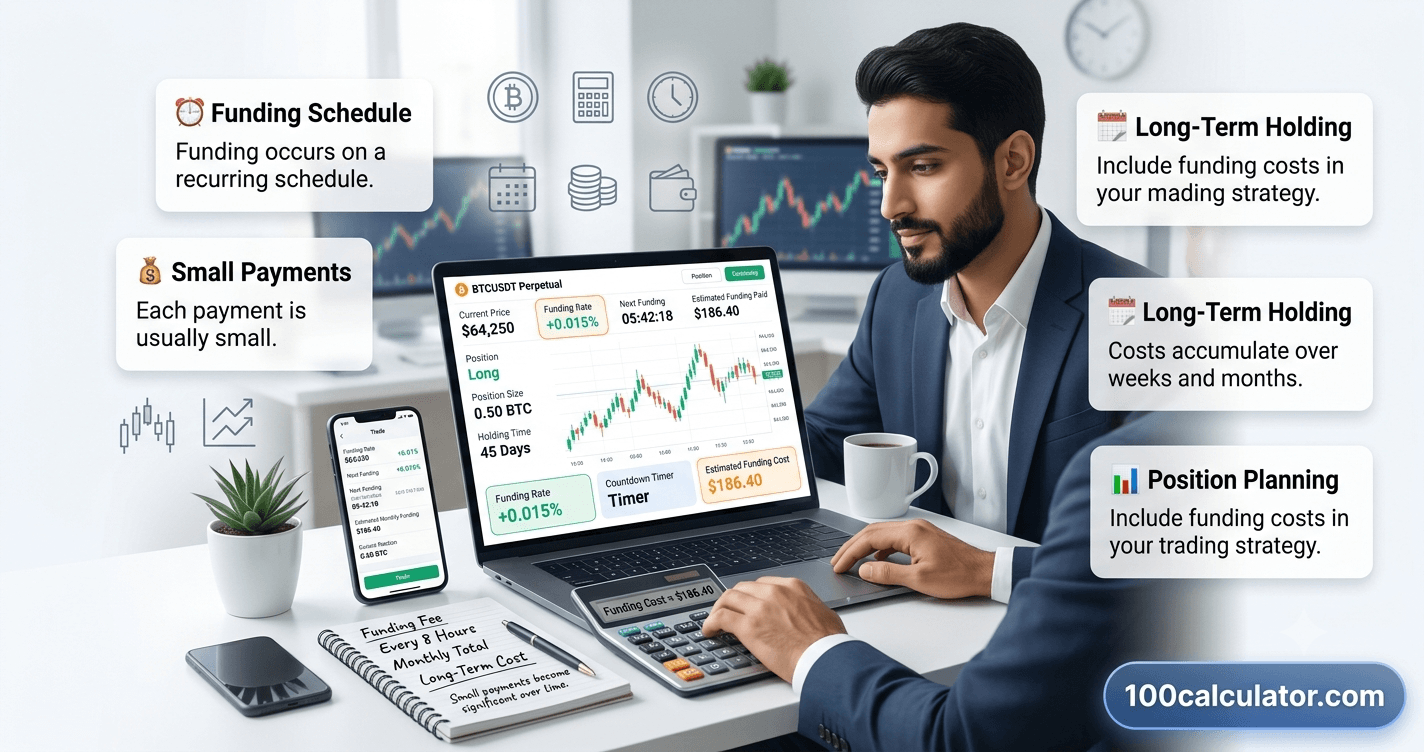
Open a long position on a perpetual futures contract, watch the price move in your favor for a few weeks, and close it out — only to find your actual return is smaller than the price chart suggested it should be. Funding fees are usually the reason. They're small, they're automatic, and on any single day they barely register.
A funding fee, also called a funding rate payment, is a recurring charge exchanged directly between long and short traders on a perpetual futures contract, typically every eight hours, to keep the contract's price in line with the spot market. Depending on which side of the market is more crowded, you either pay this fee or collect it. The rate itself is often a small fraction of a percent per payment — which sounds negligible until you multiply it by three payments a day, every day, for as long as the position stays open.
This guide breaks down exactly how funding fees add up on a long-term hold, how to estimate the real cost before you open a position, and how experienced traders manage that cost instead of getting surprised by it. If you'd rather skip the manual math, 100 Calculator's Crypto Futures Funding Fee Calculator estimates your total funding cost based on your position size, the rate, and how long you plan to hold.
What Is a Funding Fee, in Plain Terms?
If you're already comfortable with how funding rates work, feel free to jump ahead to how the cost adds up over time. For everyone else, here's the short version.
Perpetual futures contracts never expire. That's what makes them different from traditional futures, which settle on a fixed date and naturally converge toward the spot price as that date approaches. Without an expiration date, a perpetual contract has no built-in mechanism to keep its price tied to the actual market price of the asset, so exchanges add one artificially: the funding rate.
Every funding interval — commonly every eight hours, though some platforms use four-hour or twelve-hour cycles — the exchange compares the perpetual contract's price to the underlying spot price. (Coinbase) If the contract is trading above spot, meaning more traders want to be long, long positions pay a fee to short positions. If it's trading below spot, the payment flows the other way: shorts pay longs.
This part surprises a lot of new traders: the exchange doesn't keep this payment. It's a transfer between traders on opposite sides of the same contract. The exchange only facilitates it.
For the full breakdown of the formula, the premium index, and the interest rate component, see our guide on what a funding rate is in crypto futures trading. The rest of this article focuses on what that mechanism means once you're holding a position for weeks or months instead of hours.
Why Funding Fees Matter More the Longer You Hold
A single funding payment is almost always small. On a $10,000 position with a 0.01% funding rate, one payment is exactly $1. Nobody closes a winning trade early because of a single dollar.
The problem isn't any one payment — it's the number of them. Perpetual contracts are built to be held indefinitely, and traders often do hold them for weeks or months at a stretch, especially when using them to express a longer-term view on price direction. Every one of those payments happens whether you're watching or not, three times a day on an exchange that uses an eight-hour cycle.
Here's the part that catches people off guard: funding fees don't compound the way savings account interest does. Each payment is a flat percentage of your position's notional value, not a percentage of some growing balance. What actually happens is simpler, and just as costly — the charges add up, payment after payment, for as long as the position and the rate both stay roughly where they are.
There's a second effect worth knowing about, though. Funding is usually deducted straight from your account's available margin, not from the position itself. If you're on the paying side of a sustained funding rate, your equity slowly shrinks while your position size stays the same. That means your effective leverage on the trade quietly increases over time, which can move your liquidation price closer to the market even if the asset's price hasn't moved against you at all.
That combination — a cost that accumulates with time, plus a slow increase in effective leverage — is why funding fees deserve more attention on a three-month hold than they do on a three-hour one.
How to Calculate the Real Cost of a Long-Term Position
The Simple Formula
The math behind a single funding payment is straightforward:
The Formula
Funding Payment = Notional Value × Funding Rate Total Funding Cost ≈ Notional Value × Funding Rate × Number of Payments
Notional value is your position size, not your margin. A $2,000 margin deposit controlling $20,000 of exposure at 10x leverage is charged funding on the full $20,000, not the $2,000 you put down.
Number of payments depends on the exchange's funding interval and how long you hold. An eight-hour cycle produces three payments a day.
The tricky part isn't the arithmetic. It's that the funding rate itself doesn't stay fixed — it moves with market sentiment, sometimes several times a day. Any estimate you calculate is only as good as the rate you plug in, which is why it's worth treating the result as a reasonable planning figure rather than a guarantee.
A Worked Example Over 7, 30, 90, and 365 Days
Say you open a $10,000 long position on a perpetual futures contract and the funding rate holds steady at 0.01% per eight-hour interval — a fairly typical baseline level. Here's how the cost builds as the hold gets longer:
| Holding Period | Funding Payments | Estimated Total Cost | Cost as % of Position |
|---|---|---|---|
| 7 days | 21 | $21 | 0.21% |
| 30 days | 90 | $90 | 0.90% |
| 90 days | 270 | $270 | 2.70% |
| 180 days | 540 | $540 | 5.40% |
| 365 days | 1,095 | $1,095 | 10.95% |
At a glance, none of those numbers looks dramatic — until you compare the one-week figure to the one-year figure. The rate never changed in this example. Only the number of payments did. That's the entire lesson of funding fees on a long-term position: time is the multiplier, not the rate.
Free Online Tool
Skip the manual math
100 Calculator's Crypto Futures Funding Fee Calculator runs the same calculation shown above using your own position size, rate, and holding period, so you get an estimate in seconds instead of redoing the math every time the rate changes.
Since funding is easiest to compare once it's annualized, 100 Calculator's APY ↔ APR Crypto Yield Calculator can help you convert a periodic rate into a yearly figure, which is useful when weighing a holding cost against a yield-bearing alternative.
Leverage, Position Size, and Funding Exposure
Funding is charged on notional value, which means leverage changes your exposure to it even when your account balance doesn't change.
Picture two traders who each deposit $1,000 in margin. The first trades without leverage, opening a $1,000 position. The second uses 10x leverage to open a $10,000 position with that same $1,000. If the funding rate is 0.01% per interval, the first trader pays $0.10 per payment. The second pays $1.00 — ten times more, from the same amount of capital, purely because of leverage.
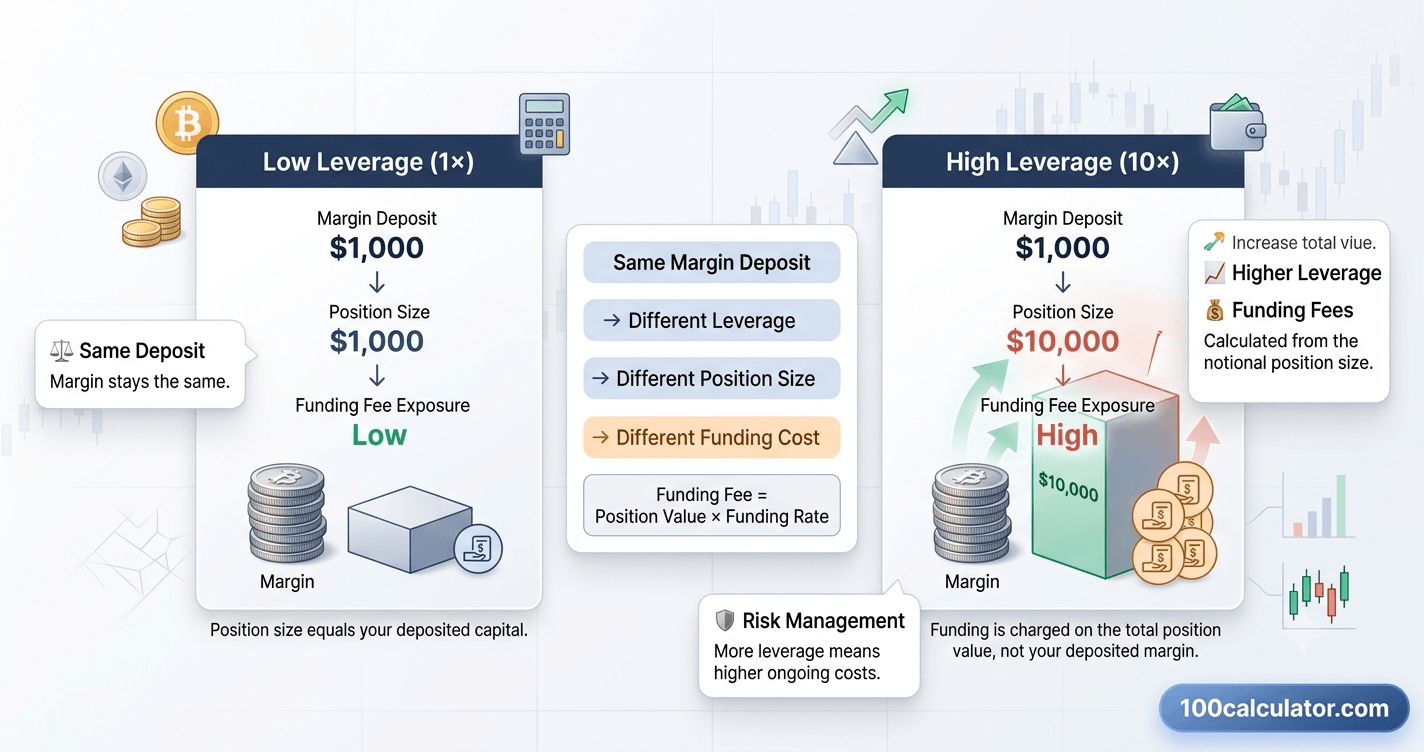
This is one of the more overlooked costs of high leverage in perpetual futures. Traders often focus on how leverage magnifies price risk and forget that it magnifies funding cost by the same multiple, every single interval the position stays open.
Position sizing is where this really shows up. A trader who scales into a large position gradually, or who runs several smaller positions instead of one large one, is often making a funding-cost decision as much as a risk decision — total notional exposure determines total funding paid, regardless of how it's split up. If you're not sure how leverage and account size should shape your position size, 100 Calculator's Crypto Position Size Calculator can help you work backward from how much you're willing to risk. It's also worth reviewing the position size mistakes every trader should avoid, since sizing errors tend to compound funding exposure right alongside price risk.
Positive vs. Negative Funding: Who's Paying Whom
Funding rates aren't always something you pay. Depending on which direction you're positioned and what the broader market is doing, you can end up collecting funding instead.
A positive funding rate means the perpetual contract is trading above the spot price, usually because more traders want to be long than short. In that case, long positions pay, and short positions collect. A negative funding rate flips it: the contract is trading below spot, short positions pay, and long positions collect.
For a long-term holder, this matters in two ways. First, if you're on the collecting side, funding effectively works in your favor for as long as the rate holds — it slowly adds to your account instead of draining it. Second, funding rates are widely watched as a rough sentiment gauge. A rate that stays unusually high and positive for an extended stretch often signals a market that's heavily leveraged and long, which some traders read as a sign of a crowded trade rather than a reason to celebrate free income.
None of this is predictable in advance. Funding rates shift with market sentiment, sometimes flipping direction within the same day. A long-term holder shouldn't plan around collecting funding indefinitely, any more than they should assume they'll always be paying it.
Funding Cost Scenarios by Market Condition
Funding rates don't sit still. They move with how crowded the long or short side of the market gets, and during periods of heavy speculation, they can run well above the baseline levels used in the table above. Here's roughly how three different market conditions translate into an annualized cost, assuming the rate held steady the whole time — which it rarely does, but it's a useful way to compare regimes.
Calm Market
~0.005% / 8h
Roughly 5.5% annualized
Typical of a market with fairly balanced long and short interest. Neither side is paying much of a premium to hold its position.
Typical Market
~0.01% / 8h
Roughly 11% annualized
A common baseline in ordinary trading conditions, close to the built-in interest rate component many exchanges use as a floor.
Overheated Market
~0.05% / 8h
Roughly 55%+ annualized
Seen when one side of the market gets crowded, often during strong rallies or sell-offs. Rates can spike even higher for short bursts during extreme volatility.
None of these figures are a prediction of what any specific contract will do. They're a way to see how much the rate itself matters, independent of how long you hold. A position held through a calm stretch and the same position held through an overheated one can end up with very different funding costs, even with identical size and duration.
How to Reduce or Offset Funding Costs
Funding fees aren't avoidable if you want to hold a leveraged perpetual position, but there are a few practical ways to manage how much they cost you.
- Compare exchanges before opening a large position. Funding rates for the same contract can differ meaningfully between platforms, since each exchange derives its own premium index from its own order book.
- Annualize the rate before entering a long-term hold. A rate that looks trivial per interval can look very different once you run the math from the table above.
- Consider hedging with a spot position when it fits your strategy. Holding spot alongside an offsetting perpetual position — sometimes called a cash-and-carry or delta-neutral setup — can let a trader collect funding instead of paying it, though this isn't a beginner strategy and requires watching both legs of the trade closely.
- Trim position size instead of closing out entirely. Since funding scales directly with notional value, reducing a position cuts the funding cost by the same proportion, without necessarily abandoning the underlying view on price.
- Recheck the rate periodically, not just on day one. A rate that was negligible when you opened the position can shift substantially weeks later.
Track total holding costs the same way you'd track a trading fee. 100 Calculator's Crypto Profit & Exchange Fee Calculator can help you see funding alongside trading fees, so your profit estimate reflects both.
Common Mistakes Long-Term Holders Make With Funding Fees
- Only checking the rate once, at entry. Funding rates move. A rate that looked cheap on day one can drift substantially by week three, especially during a strong trend.
- Confusing funding fees with trading fees. The maker or taker fee you pay to open or close a position is a one-time cost. Funding is a recurring cost that applies for as long as the position stays open, and the two shouldn't be lumped together when estimating total cost.
- Ignoring funding when comparing similar trades across exchanges. Two exchanges can offer the same contract with meaningfully different funding rates and intervals, since each one derives its rate from its own order book and index calculation. (Kraken)
- Assuming a small per-interval rate isn't worth annualizing. A 0.01% rate looks tiny in isolation. Multiplied out to a year, it isn't.
- Forgetting that funding is drawn from account equity, not from the position. Over a long hold, a sustained funding drain can quietly increase effective leverage on a position that hasn't actually gotten any bigger. A slow, steady drain like this behaves a lot like the situation covered in our guide on why large drawdowns are so hard to recover from — the earlier it's caught, the easier it is to correct.
Funding Fees vs. Other Costs of Holding a Position
Funding fees are just one line item in the total cost of holding a leveraged position. It helps to see how they compare to the other costs traders often overlook.
| Cost Type | When It's Charged | How It Behaves Over a Long Hold |
|---|---|---|
| Funding fee | Every funding interval (commonly 8 hours) | Recurring; scales with notional value and time held |
| Trading (maker/taker) fee | Only when opening or closing | One-time per trade; doesn't grow with holding period |
| Traditional futures roll cost | At contract expiration, if rolling to a new month | Periodic but infrequent; tied to the futures curve, not a fixed schedule |
| Margin or borrowing interest | Ongoing, on borrowed funds in margin trading | Recurring; similar in spirit to funding but calculated differently |
Funding fees deserve special attention on long-term positions because they're the only cost on this list that's both recurring and directly tied to how long you hold. A trading fee is fixed no matter how long the position stays open, but funding keeps accumulating for every day it does. Getting this full picture right matters for your bottom line — see our guide on common crypto profit calculation mistakes to avoid for other costs that often get left out of a quick profit estimate.
Related Calculators
Put what you just read into practice, try these free tools instantly, no sign-up required.
Crypto Position Size Calculator
Calculate the right crypto position size for your risk level.
Crypto Liquidation Price Calculator
Find the price at which your leveraged crypto position liquidates.
Crypto Futures Funding Fee Calculator
Estimate funding fees paid or earned on crypto futures positions.
APY ↔ APR Crypto Yield Calculator
Convert between APY and APR to compare real crypto yields.
Impermanent Loss Calculator
Estimate impermanent loss when providing liquidity to a pool.
Building Funding Costs Into Your Trading Plan
A few habits turn funding fees into a planned cost instead of a surprise one.
- Estimate the total funding cost before opening a long-term position, not after. Use the current rate, your intended holding period, and your position's notional value to get a ballpark figure.
- Build that estimate into your target profit. If a trade needs to move a certain amount to be worthwhile, expected funding cost should be part of that threshold, not an afterthought subtracted from the result.
- Set a reminder to recheck the rate periodically, especially on positions you plan to hold for more than a few weeks.
- Weigh funding costs against your reward target using the same discipline you'd apply to any other cost. 100 Calculator's Risk Reward Ratio Calculator can help you see whether a trade's potential upside still justifies the setup once funding is factored in.
- Decide in advance how much sustained funding cost would change your mind about holding the position, rather than deciding in the moment.
None of this requires predicting where funding rates will go. It just means treating funding the way you'd treat any other recurring cost of doing business — worth estimating, worth tracking, and worth revisiting as conditions change.
Risk disclaimer: This article is for general educational purposes only and isn't financial or investment advice. Perpetual futures trading involves substantial risk, including the potential loss of your entire position, and funding rates can change quickly and unpredictably. Leverage magnifies both gains and losses. Availability of these products varies by jurisdiction and platform. Always do your own research and consider speaking with a licensed financial professional before trading derivatives.
More From Our Crypto Calculator Guide
Still building your knowledge of crypto derivatives, leverage, and yield? These related guides dig deeper into the topics covered above.
Frequently Asked Questions
What is a funding fee in crypto futures?
A funding fee is a recurring payment exchanged directly between long and short traders on a perpetual futures contract, typically every eight hours. It's used to keep the contract's price close to the spot market price, and the exchange facilitates the payment without collecting it.
How often are funding fees charged?
Most exchanges charge funding every eight hours, which works out to three payments a day. Some platforms use four-hour or twelve-hour cycles instead, so it's worth checking the specific schedule for the exchange and contract you're trading.
Do funding fees only apply to leveraged positions?
Funding applies to any open perpetual futures position, leveraged or not, because it's calculated on the position's notional value. Leverage doesn't create the fee, but it does increase your notional exposure for a given amount of margin, which increases how much funding you pay or receive.
Can funding fees work in your favor?
Yes. When the funding rate is negative, short positions pay and long positions collect. When it's positive, the reverse happens. Whether you pay or collect depends on which side of the market you're on and which way the rate is currently running.
How do I calculate the total funding cost of a long-term position?
Multiply your position's notional value by the funding rate per interval, then multiply that by the number of funding intervals over your intended holding period. 100 Calculator's Crypto Futures Funding Fee Calculator runs this calculation automatically based on the numbers you enter.
Does a funding fee calculator account for rates that change over time?
A funding fee calculator typically projects cost using the rate you enter, which is most useful for estimating cost at the current rate or testing a few different scenarios. Since real funding rates shift with market conditions, treat the result as a planning estimate rather than a guaranteed figure, and recheck it periodically.
What's the difference between a funding fee and a trading fee?
A trading fee, sometimes called a maker or taker fee, is charged once, when you open or close a position. A funding fee is charged repeatedly for as long as the position stays open. Over a short trade, the trading fee usually matters more; over a long hold, funding usually adds up to more.
Why do funding rates spike during volatile markets?
Funding rates rise when one side of the market gets crowded relative to the other. During a strong rally, more traders open leveraged longs, pushing the perpetual price above spot and driving funding higher. The same dynamic happens in reverse during sharp sell-offs, when shorts can become the crowded side.
Can you avoid funding fees entirely?
Not if you're holding an open perpetual futures position, since funding is a core part of how those contracts work. Trading spot instead of futures avoids funding entirely, though it also means giving up leverage and the ability to easily short the asset.
Is a high funding rate a warning sign?
A sustained, unusually high funding rate often indicates that one side of the market has become crowded with leveraged positions, which some traders treat as a caution flag rather than a reason to chase the trend. It's a useful sentiment signal, but it isn't, on its own, a reliable timing tool.
Do funding fees compound like interest?
Not exactly. Each funding payment is a flat percentage of your position's notional value, not a percentage of a growing balance, so the cost accumulates in a straight line rather than compounding. That said, since funding is usually deducted from your account margin rather than your position size, a sustained funding drain can quietly increase your effective leverage over time.
How does leverage affect funding exposure?
Funding is calculated on your position's notional value, which leverage increases without requiring more margin. A trader using 10x leverage pays funding on ten times the notional value of an unleveraged trader with the same account size, even though both put down the same margin.
Should I close a long-term position just because of funding costs?
That depends on the size of the funding cost relative to your expected return. A small, steady funding cost that's already factored into your target profit usually isn't a reason to exit on its own. A funding rate that's spiked sharply and stayed there is worth re-evaluating alongside the rest of your original reasons for holding the position.
Do all crypto exchanges charge funding at the same interval?
No. Eight-hour funding intervals are the most common, but some exchanges use four-hour or twelve-hour cycles, and the exact rate formula, including the interest rate component and any caps, can vary by platform. It's worth checking the specific contract's documentation before assuming a schedule.
About 100 Calculator
100 Calculator is a free hub of online calculators and educational guides covering health, finance, trading, crypto, education, and more. Every tool is built to be fast, accurate, and genuinely free, with no account or signup required.
We built this guide, and tools like the Crypto Futures Funding Fee Calculator referenced throughout it, to make crypto derivatives a little easier to understand before you put real money behind a position. Head back to the 100 Calculator homepage to explore the full library of tools, or learn more about the team behind them on our About Us page.