Position Size Mistakes Every Trader Should Avoid
A clear look at the position sizing mistakes that quietly wreck trading accounts, and the formula, worked examples, and free calculator that fix them for good.
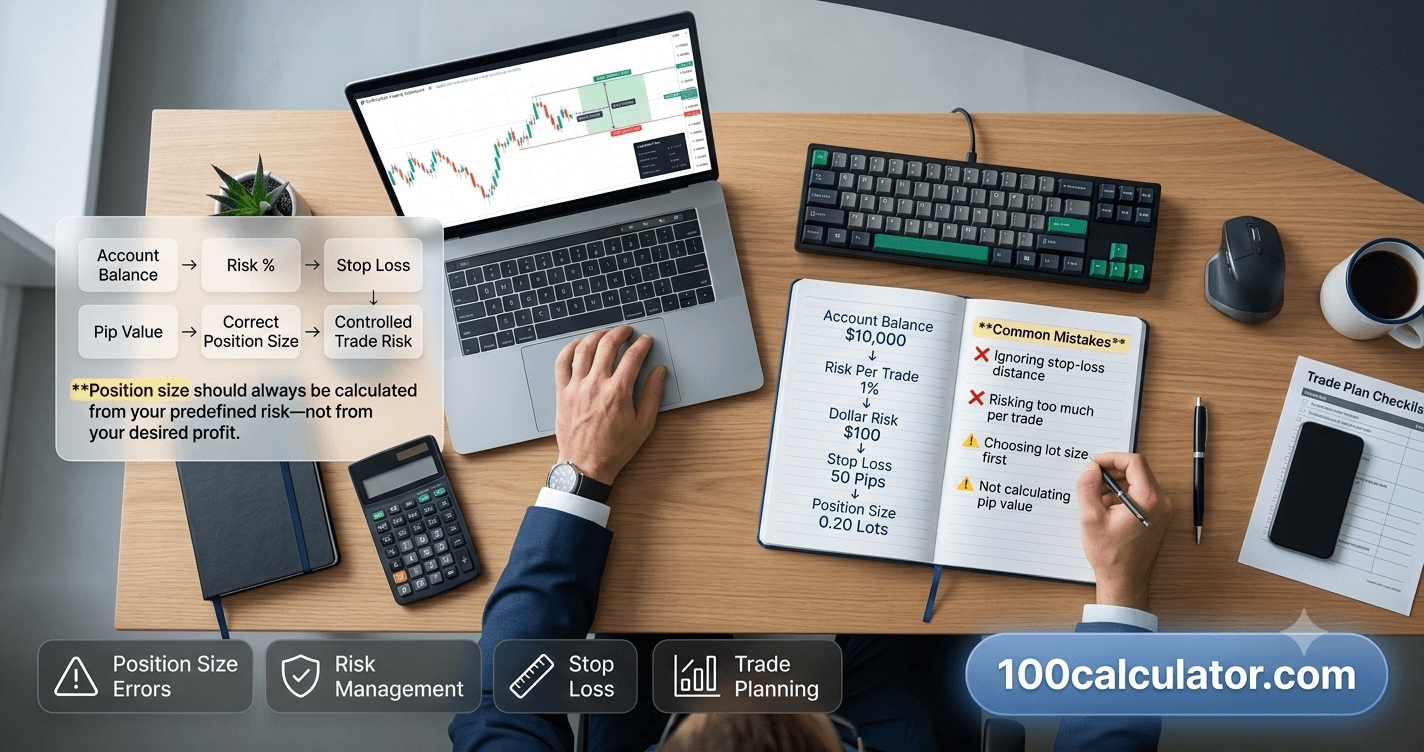
Most trading losses don't come from a bad idea. They come from a good idea traded with the wrong position size. A trader can have a perfectly reasonable setup and still wipe out weeks of gains in a handful of trades, simply because each position was too large for the account behind it.
Position sizing is the process of deciding how many shares, lots, or contracts to trade, based on your account balance, your risk percentage, and the distance to your stop-loss, not on how much margin you have available or how confident you feel about a setup. Get it wrong consistently, and even a genuinely good strategy can drain an account. Get it right, and a string of losing trades barely puts a dent in your progress.
This guide walks through eight position sizing mistakes that show up again and again among retail traders, in forex, stocks, and crypto alike, along with a practical fix for each one. We'll also cover the formula itself, so it stops feeling like a black box, plus worked examples and a free Position Size Calculator you can use to size every trade correctly from here on.
If you haven't calculated position size before, our companion guide on how to calculate position size for safer trading covers the basics in more depth. This article focuses specifically on where that process tends to break down.
What Is Position Sizing (and Why It's Not the Same as Margin)?
Before getting into the mistakes themselves, it helps to be precise about what position sizing actually means, since a lot of the confusion around it comes from mixing it up with related terms like margin and lot size.
Position sizing is the calculation that tells you how many units, shares, or contracts to trade on a given position, based on your account balance, the percentage of that balance you're willing to risk, and how far your stop-loss sits from your entry price. It's a number that comes out of a formula, not a gut feeling about how a trade "should" go.
The Position Sizing Formula, Explained
Position Size Formula
Position Size = (Account Balance × Risk % per Trade) ÷ (Stop-Loss Distance × Pip, Tick, or Point Value)
Account Balance: your total trading capital right now
Risk % per Trade: the share of your account you're willing to lose on this one trade, often 1–2%
Stop-Loss Distance: how far your stop sits from your entry, in pips, ticks, or price points
Pip, Tick, or Point Value: what that distance is worth in dollars for the instrument you're trading
Every variable in this formula comes from a decision you make before you enter the trade, which is exactly the point. Your account balance is simply what's in the account right now. Your risk percentage is how much of that balance you're comfortable losing if the stop-loss gets hit. Your stop-loss distance is how far, in pips, ticks, or price points, your stop sits from your planned entry. And your pip, tick, or point value tells you what that distance is actually worth in dollars for whatever you're trading.
Plug those four numbers in, and the formula tells you exactly how large your position should be. Nothing about the calculation cares how confident you feel or how much money happens to be sitting in your account beyond that risk percentage.
Position Size vs. Margin vs. Lot Size
These three terms get used almost interchangeably by traders, and that habit causes real problems.
- Position size is the total size of the trade itself, expressed in units, shares, contracts, or lots. It determines your profit or loss per point of price movement.
- Lot size is how position size is expressed in forex specifically. A standard lot is 100,000 units of the base currency, a mini lot is 10,000 units, and a micro lot is 1,000 units.
- Margin is the amount of your own capital your broker requires as collateral to open and hold that position, based on your leverage. It has nothing to do with how much you're risking; it only reflects how much capital the position ties up.
This mix-up matters because a trader can have plenty of margin available to open a large position that's still far too risky for their account. Having the margin for a trade and having a properly sized trade are two completely different questions, and this guide is really about the second one.
Why Position Sizing Mistakes Cause More Damage Than Bad Trade Ideas
It's tempting to think a losing trade is a failure of analysis: wrong direction, bad timing, or a setup that didn't play out. Sometimes that's true. But plenty of blown accounts come from trades that were reasonable ideas, sized far too aggressively for the account they were traded in.
Capital Preservation Comes First
Professional risk management starts from a simple premise: you can't make money in the markets if you don't have any capital left to trade with. Protecting what you have takes priority over squeezing extra profit out of any single trade, because a large enough loss doesn't just cost you money, it costs you the ability to keep trading at all while you recover. Position sizing is simply the practical tool that puts capital preservation into practice, trade by trade.
What the Data Says About Retail Trading Losses
Retail trading has a genuinely difficult track record, and it's worth being upfront about that rather than glossing over it. Regulators in the European Union require CFD and forex brokers to publish what percentage of their retail client accounts lose money, and that data shows a large majority, typically somewhere between 74% and 89%, losing money on these products. (ESMA) That doesn't mean trading is impossible to do well, but it does mean the odds favor traders who manage risk deliberately over those who don't. Poor position sizing shows up constantly alongside overleveraging and a lack of a clear exit plan as reasons cited for these losses.
None of the eight mistakes below are exotic. They're ordinary habits that feel harmless in the moment and only add up to real damage once you look at them over dozens of trades.
Mistake 1: Risking Too Much on a Single Trade
This is the mistake sitting underneath most of the others on this list. Risking too much per trade doesn't always look reckless in the moment; a trader might risk 5% or 10% on a setup that looks unusually strong. The math behind consecutive losses is what makes the real danger clear.
The Math Behind Consecutive Losses
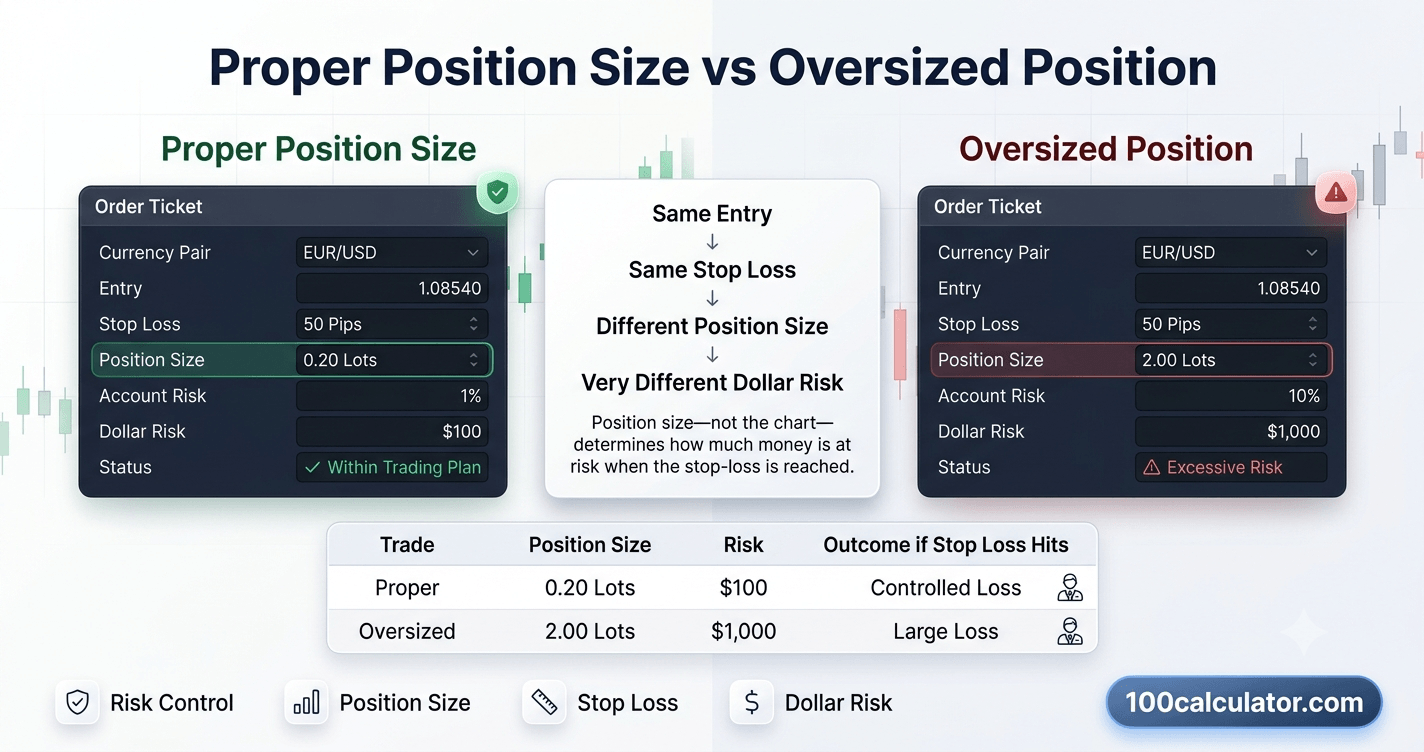
The chart above shows something every trader eventually learns the hard way: risk percentage doesn't scale in a straight line. At 1% risk per trade, ten losses in a row still leave about 90% of the account intact. At 10% risk per trade, the same ten losses leave roughly 35%, and getting back to even from there takes nearly tripling what's left, not just recovering the 65% that was lost. This is a simplified illustration, not a prediction of how any specific strategy will perform, but the relationship between risk percentage and drawdown severity holds regardless of the market or system involved.
How Much Should You Actually Risk Per Trade?
Most experienced risk managers land somewhere between 1% and 2% of account equity per trade, and rarely go beyond that even on their highest-conviction setups. This isn't an arbitrary number. It's roughly the level where a realistic losing streak, five, eight, even ten trades in a row, still leaves enough capital and enough psychological composure to keep executing your strategy without panic.
Mistake 2: Sizing Trades by Feel Instead of a Formula
A lot of traders round to a lot size or share count that "feels right" for the setup in front of them, rather than running the numbers. It's faster in the moment, and it's exactly how wrong position sizing sneaks into an otherwise disciplined process.
Why Round-Number Sizing Backfires
Say you decide to risk 1% on every trade, but in practice you tend to trade "1 standard lot" or "100 shares" out of habit. A 20-pip stop and an 80-pip stop should produce very different position sizes to keep the dollar risk the same, but sizing by feel usually produces roughly the same size regardless of the stop distance. The result is that your actual risk swings wildly from trade to trade, even though your intended risk percentage never changed on paper.
The Quick Fix
Treat the position sizing formula as a mandatory step, the same way you'd never skip checking your entry price. Run the calculation every time your stop-loss distance changes, which is every single trade. A position size calculator turns this into a five-second step instead of mental math you're tempted to shortcut.
Mistake 3: Ignoring Stop-Loss Distance When Setting Size
Stop-loss distance is one of the four inputs in the position sizing formula, but plenty of traders work backward: they decide on a position size first, like "I trade 1 lot," and only place a stop wherever seems reasonable afterward. That's the formula running in reverse, and it quietly breaks the whole point of position sizing.
A Forex Example
Say you have a $10,000 account and you're risking 1% per trade, or $100. Your stop-loss sits 50 pips from your entry on EUR/USD, where a standard lot (100,000 units) is worth roughly $10 per pip when your account is in USD, though this varies slightly by pair and broker, so it's worth confirming the exact figure with a Pip Value Calculator rather than assuming. Dividing $100 by (50 pips × $10) gives a position size of 0.2 standard lots, or 2 mini lots. If you'd rather think in lot size directly, the Forex Lot Size Calculator converts between units, mini lots, and standard lots automatically.
A Stock Example
Now say you have a $20,000 account and you're risking 1.5% per trade, or $300. You plan to buy at $50 per share with a stop at $47, a $3 risk per share. Dividing $300 by $3 gives a position size of 100 shares, a $5,000 position, even though only $300 of it is actually at risk if the stop is hit.
A Crypto Example
With a $5,000 account risking 1% per trade, or $50, and a Bitcoin entry at $60,000 with a stop at $58,800, that's a $1,200 risk per coin. Dividing $50 by $1,200 gives a position size of about 0.0417 BTC. Because crypto stops are often wider in dollar terms, the resulting position size is usually smaller relative to account size than a forex or stock trade with the same risk percentage.
In every example above, the stop-loss distance came first, based on where the trade setup was actually invalidated, and the position size was calculated from that. None of these examples started with "how many units do I want to trade."
Mistake 4: Increasing Size After a Losing Streak
This is the pattern most traders recognize immediately once it's described: a trade loses, frustration sets in, and the next trade gets sized bigger to "win it back" quickly. It's one of the fastest ways to turn an ordinary losing streak into a genuinely damaging one.
Why This Feels Logical But Isn't
Increasing size after a loss feels like taking control back, but mathematically it does the opposite. A losing streak is exactly when a strategy might be having a rough patch, and that's the worst possible moment to increase risk per trade. If you're already dealing with a meaningful account drawdown, our guide on why large drawdowns are so hard to recover from breaks down exactly why bigger losses need disproportionately bigger gains just to get back to even.
The Quick Fix
Set a hard rule before you're in the middle of a losing streak, not during one. A common version is stopping for the day after two or three consecutive losses, or after hitting a set daily loss limit. Keep your position size the same, or smaller, following a loss rather than larger. If you want to understand exactly how much a string of losses would take to recover from, the Drawdown Recovery Calculator makes the math concrete instead of abstract.
Mistake 5: Confusing Position Size With Available Margin
"I have the margin for it" is not the same statement as "this position is sized correctly," but a lot of traders treat them as interchangeable, especially once an account grows and margin stops feeling like a constraint.
What 0.01 Lot Size Actually Means
In forex, 0.01 lot is called a micro lot, equal to 1,000 units of the base currency. That's one-tenth of a mini lot (0.1, or 10,000 units) and one-hundredth of a standard lot (1.0, or 100,000 units). Trading in micro lots means each pip of movement is worth a small, precise amount, often around $0.10 on major USD pairs, which makes them useful for beginners and for fine-tuning position size on smaller accounts.
The Quick Fix
Calculate position size from your risk percentage and stop-loss distance first, every time. Only afterward check whether your margin and leverage actually allow you to open that size. Margin should confirm a trade is possible, not decide how large it should be.
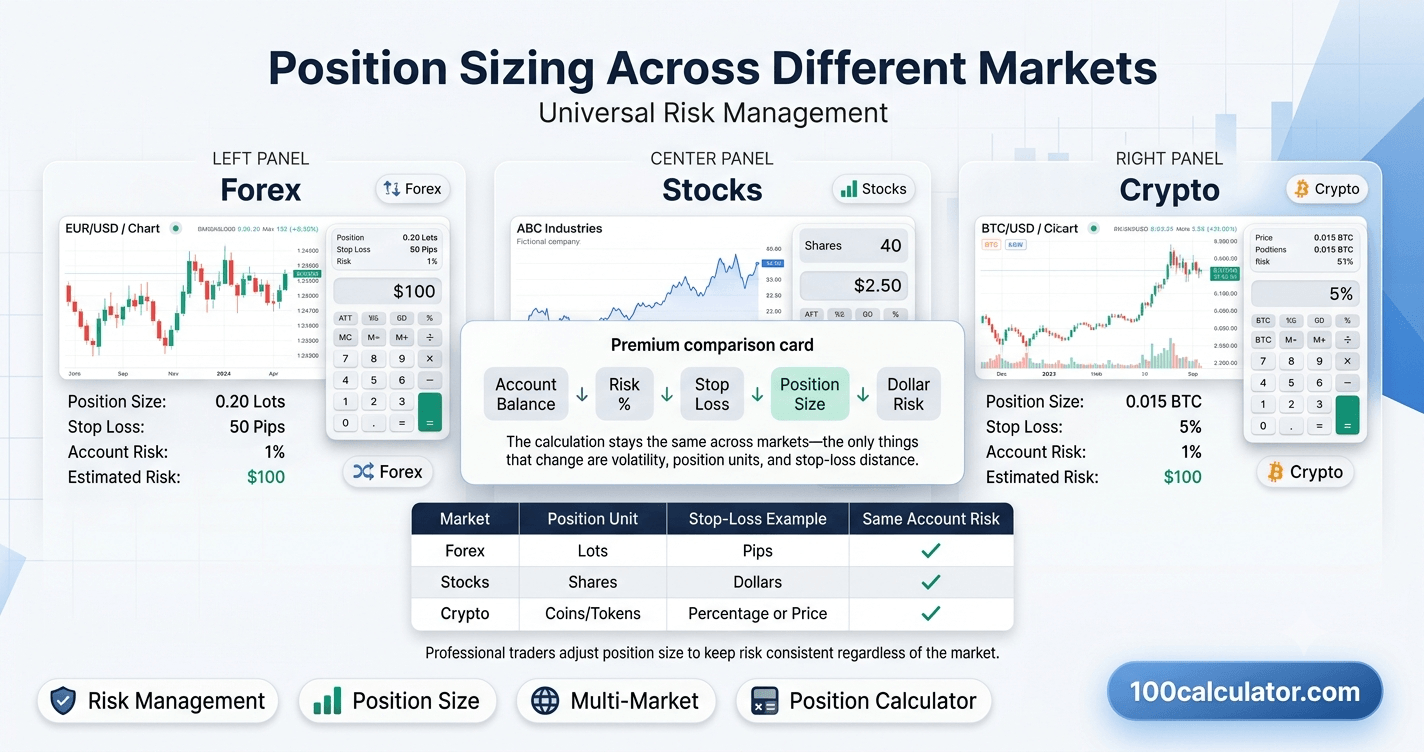
Mistake 6: Using the Same Sizing Rules Across Forex, Stocks, and Crypto
Forex pairs, individual stocks, and cryptocurrencies don't move the same way day to day, so a sizing habit that works fine in one market can be badly miscalibrated in another.
Why Crypto Usually Needs Smaller Position Sizes
Cryptocurrencies typically swing through a wider price range in a single day than most forex pairs or blue-chip stocks. A stop-loss placed at a reasonable distance for that volatility is often much wider in percentage terms, which means hitting the same 1% risk target usually results in a noticeably smaller position size than the same dollar risk would produce on a calmer instrument.
The Quick Fix
Recalculate position size for every market and every instrument you trade, rather than reusing a size that worked somewhere else. If you split your time between forex and crypto, our guide to calculating pip value for any currency pair and the Crypto Position Size Calculator cover the market-specific details that the general formula leaves out.
Mistake 7: Overusing Leverage Because It's Available
High leverage is often marketed as a feature, letting you control a much larger position with a small amount of capital. That's true, and it's also exactly why it's easy to let available leverage decide your position size instead of your risk percentage.
Leverage Changes Your Margin, Not Your Risk
Leverage lowers how much of your own capital you need to set aside as margin to open a given position size. It doesn't change how much you should be willing to lose on that trade. The common mistake is using the largest position your available leverage and margin allow, rather than the position size your risk percentage and stop-loss distance actually call for. Two traders can use identical leverage and end up with completely different risk levels, depending on which one sized their trade from their risk rule instead of their margin balance.
The Quick Fix
Calculate your position size from your risk percentage first, exactly as described earlier in this guide, then check that your margin and leverage support opening it. Use leverage for capital efficiency, freeing up the rest of your account, rather than treating it as a reason to trade bigger. The Forex Margin Calculator is useful for checking exactly how much margin a given position size will require before you open it.
Mistake 8: Trading Without a Written Risk-Per-Trade Rule
Plenty of traders can tell you, in the abstract, that they risk "around 1 or 2%" per trade. Far fewer have that rule written down anywhere, with a specific number and a specific maximum daily or weekly loss attached to it.
Why "I'll Decide Later" Falls Apart Under Pressure
A risk rule that only exists in your head tends to bend exactly when it matters most, in the middle of a strong emotional reaction like fear, frustration, or the fear of missing out on a move that's already happening. Written rules are harder to quietly renegotiate with yourself in the moment than a vague intention is.
The Quick Fix
Write down your risk percentage per trade, your maximum daily loss, and your rule for what happens after a losing streak, somewhere you'll actually see it before every session. Treat it the same way you'd treat any other non-negotiable part of your process, not a suggestion you'll follow when convenient.
Related Calculators
Put what you just read into practice, try these free tools instantly, no sign-up required.
Pip Value Calculator
Calculate the value of a pip for any currency pair and lot size.
Position Size Calculator
Determine the right position size based on your risk tolerance.
Risk Reward Ratio Calculator
Compare potential risk against reward before entering a trade.
Drawdown Recovery Calculator
Calculate the gain needed to recover from a trading drawdown.
Trading Compound Interest Calculator
Project compounded returns on your trading account balance.
The 8 Position Sizing Mistakes at a Glance
Here's a quick recap of everything above, in case you just want the summary:
| Mistake | Why It Hurts You | Quick Fix |
|---|---|---|
| Risking too much per trade | A handful of losses can erase months of gains | Cap risk at 1–2% of account per trade |
| Sizing by feel, not a formula | Actual risk swings wildly trade to trade | Always calculate size from risk % and stop distance |
| Ignoring stop-loss distance | Same size used for very different setups | Set your stop first, then size from it |
| Sizing up after a losing streak | Turns a normal drawdown into a severe one | Keep size the same or smaller after losses |
| Confusing size with margin | "I can afford it" isn't the same as "it's sized correctly" | Size from risk % first, check margin second |
| Same rules across markets | Crypto's volatility needs different sizing than forex | Recalculate for every instrument you trade |
| Overusing available leverage | Bigger position, same account, bigger swings | Use leverage for efficiency, not bigger risk |
| No written risk-per-trade rule | Rules get bent under pressure | Write your risk % and max loss down in advance |
How to Build a Position Sizing Strategy That Actually Works
Knowing the mistakes is one thing. Building a repeatable process that avoids them is what actually changes your results.
Step-by-Step: Calculating Your Position Size
- Decide your risk percentage for this trade, commonly 1% to 2% of your account balance.
- Multiply your account balance by that percentage to get your dollar risk amount.
- Set your stop-loss based on the chart, not on how much you want to risk, and measure the distance from your entry.
- Find the pip, tick, or point value for whatever instrument you're trading.
- Divide your dollar risk amount by (stop-loss distance × pip, tick, or point value) to get your position size.
Using a Position Size Calculator to Save Time
Running this formula by hand for every single trade is exactly the kind of step that gets skipped under time pressure, which is how "sizing by feel" creeps back in.
Free Online Tool
Skip the manual math entirely
100 Calculator's Position Size Calculator runs this exact formula for you. Enter your account balance, risk percentage, and stop-loss distance, and it returns the position size instantly, whether you're trading forex lots, shares, or contracts.
Once position size feels automatic, it's worth pairing it with a target that reflects a solid risk-to-reward ratio, since sizing controls how much you lose, while your risk-reward ratio has a lot to do with how much you can gain relative to that same risk. The Risk Reward Ratio Calculator is a quick way to compare setups side by side before you commit to one.
Reviewing and Adjusting Your Risk Over Time
Position sizing isn't a "set it once" decision. A short review habit keeps it working as your account and your track record change:
- Track your win rate and average risk-to-reward ratio over at least 20–30 trades before changing your risk percentage
- Lower your risk percentage after a rough stretch, instead of trying to trade your way out of it
- Recalculate your typical position size whenever your account balance changes meaningfully
- Log position size, risk percentage, and outcome for every trade, so patterns are easy to spot later
Trading and investment risk disclaimer: This article is for general educational purposes only and isn't financial or investment advice. Trading forex, stocks, and cryptocurrencies involves substantial risk of loss and isn't suitable for every investor. The examples in this guide are hypothetical and don't guarantee any particular result. Always consider your own financial situation and risk tolerance, and speak with a licensed financial professional before making trading decisions.
Sources & References
This guide draws on publicly available regulatory guidance on trading risk, margin, and leverage:
More From Our Trading Guide
Position sizing connects to almost everything else in trading risk management. These related guides dig deeper into the topics that come up throughout this article.
Frequently Asked Questions
What is the best position sizing strategy for beginners?
For most beginners, the most reliable approach is risking a fixed, small percentage of your account on every trade, commonly 1% to 2%, and calculating the exact position size from that percentage, your stop-loss distance, and the value of a pip, point, or share move. This keeps any single loss small enough that a losing streak doesn't meaningfully damage your account, which matters more early on than finding the perfect entry strategy. A position size calculator makes this quick to apply consistently, trade after trade.
What is the ideal position size for a single trade?
There's no single ideal position size that works for every trader, because it depends on your account balance, how far your stop-loss is from your entry, and how much you're willing to risk. What matters is the process: decide your risk percentage first, often 1–2% of your account, then let your stop-loss distance and the instrument's pip or point value determine the exact number of shares, lots, or contracts. The size that results is "ideal" for that specific trade, not a fixed number you reuse everywhere.
What does 0.01 lot size mean?
In forex, 0.01 lot is called a micro lot, equal to 1,000 units of the base currency. A standard lot is 100,000 units (1.0), and a mini lot is 10,000 units (0.1). Trading 0.01 lots means each pip of movement is worth a very small amount, often around $0.10 on major USD pairs, which makes micro lots useful for beginners or for very precise position sizing on smaller accounts.
Is position size the same as margin?
No. Position size is the total size of your trade, the number of units, shares, or contracts, and it determines how much you gain or lose per price movement. Margin is the amount of your own capital a broker requires you to set aside as collateral to open and hold that position, based on your leverage. You can have enough margin available to open a large position that's still far too risky for your account, which is exactly why sizing by risk percentage matters more than sizing by available margin.
How do you calculate position size for stocks, forex, crypto, and futures?
The core formula stays the same across markets: divide your risk amount, account balance times risk percentage, by your per-unit risk, which is entry price minus stop-loss price, or stop-loss distance times pip or tick value. For stocks, that per-unit risk is in dollars per share. For forex, it's pips times pip value per lot. For crypto, it's the price distance to your stop in the coin's quote currency. For futures, you'll use the contract's specific tick or point value instead, since that varies significantly by contract.
Why do so many traders lose money even with a good strategy?
Regulators in the European Union require CFD and forex brokers to disclose what share of their client accounts lose money, and those disclosures typically show that a large majority of retail accounts, often somewhere between 70% and 90%, lose money over time. Poor position sizing is consistently cited as a major factor behind this: a trader can have a genuinely workable strategy and still blow up an account if a handful of oversized losses erase months of small, steady gains. Sizing every trade correctly is one of the few variables a trader fully controls, no matter how the market behaves.
Is trading gambling if you don't size your positions properly?
Trading isn't inherently gambling, but trading without any position sizing or risk management starts to resemble it, since outcomes become dominated by chance rather than a repeatable process. The key difference is control: a disciplined trader controls how much they risk on every trade regardless of the outcome, while a gambler typically has no consistent risk framework at all. Proper position sizing is one of the clearest ways to keep trading a skill-based activity rather than a series of unmanaged bets.
What's the single biggest position sizing mistake new traders make?
The most common mistake is sizing a trade based on how much money is available or how confident the setup feels, rather than calculating size from a fixed risk percentage and the stop-loss distance. This usually shows up as risking a much larger share of the account than intended, especially on trades that feel "obvious." Fixing this one habit, always sizing from your risk percentage first, resolves most of the other position sizing mistakes covered in this guide almost automatically.
How can I avoid revenge trading after a losing streak?
Set a hard rule in advance, such as stopping for the day after two or three consecutive losses or a set percentage drawdown, and write it down before you're in the middle of a losing streak. Revenge trading happens because emotions push traders to increase size to win back losses quickly, which almost always makes things worse. Keeping your position size the same, or even smaller, after a loss removes the temptation to chase losses with an oversized trade.
How do I avoid sizing a trade out of FOMO?
Decide your position size using your risk percentage and stop-loss distance before you feel the urge to enter, not while you're watching a price move away from you. FOMO typically pushes traders to skip their normal sizing process and enter larger, or with a wider stop, just to participate in a move that's already happening. If you find yourself increasing size specifically because a trade already moved without you, that's usually a sign to stick with your normal size or skip the trade entirely.
Does leverage change how I should size my positions?
Leverage changes how much margin you need to open a position, but it shouldn't change how much you're willing to risk. High leverage lets you open a larger position with less capital tied up as margin, which is exactly why it's easy to accidentally oversize a trade when leverage is available. Your position size should still come from your risk percentage and stop-loss distance first; leverage is simply the mechanism that lets you open that size with less margin, not a reason to size bigger.
Can a position size calculator really improve my trading results?
A position size calculator won't improve your entries or predict the market, but it removes the manual math and rounding errors that often lead to oversized trades. By entering your account balance, risk percentage, and stop-loss distance, you get a consistent, repeatable position size every time, which is one of the most reliable ways to protect your account while you work on the rest of your trading process. Consistency in sizing is often what separates traders who survive long enough to improve from those who don't.
About 100 Calculator
100 Calculator is a free hub of online calculators and educational guides covering health, finance, trading, crypto, education, and more. Every tool is built to be fast, accurate, and genuinely free, with no account or signup required.
We built this guide, and tools like the Position Size Calculator referenced throughout it, to make everyday trading questions a little easier to answer. Head back to the 100 Calculator homepage to explore the full library of tools, or learn more about the team behind them on our About Us page.