How Compounding Returns Work in Active Trading
A clear look at how reinvesting profits actually grows a trading account, what the compound return formula really says, and why popular shortcuts like the 8-4-3 rule don't translate cleanly from long-term investing to active trading.
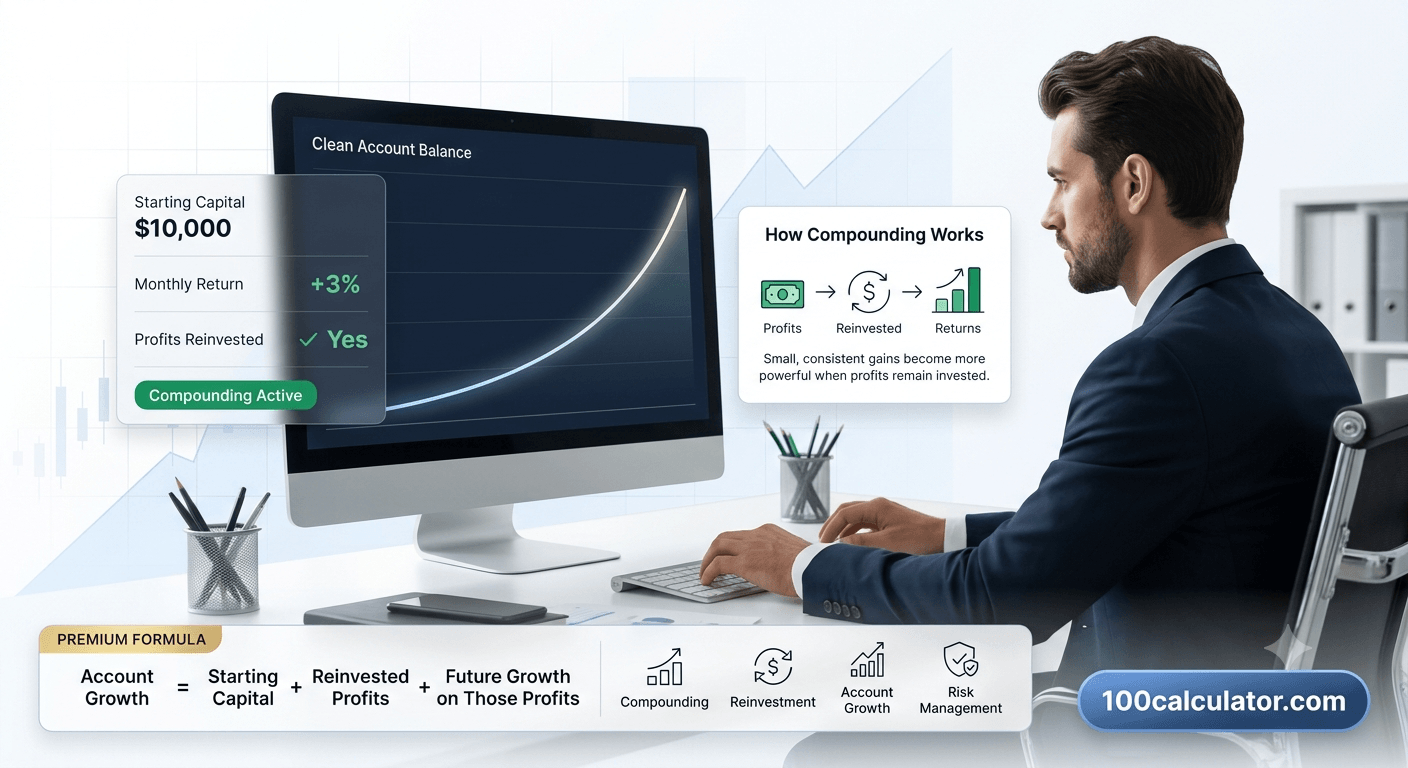
Compounding in active trading works the same way it does anywhere else money grows: every gain you reinvest becomes part of the base your next gain is calculated from. Leave your profits in the account instead of pulling them out, and your position sizes — and your dollar profits — get a little bigger with each winning stretch, even if your percentage return per trade never changes.
Compounding in trading is the process of reinvesting profits so future gains are calculated on your original capital plus everything you've already earned, rather than on the starting balance alone. A trading compound interest calculator applies this same math to your own numbers, showing how a starting balance grows under different return and reinvestment assumptions.
The catch is that a trading account isn't a savings account with a fixed rate. Returns swing between winning and losing stretches, so the smooth, ever-upward curve in textbook examples only shows up once you also manage the losing periods well. This guide covers how compounding behaves in a real trading account, where shortcuts like the 8-4-3 rule break down for traders, and how Buffett, the misattributed Einstein quote, and Islamic finance fit into the picture.
What Compounding Means in Trading
Before getting into trading-specific examples, it helps to separate two ideas that get mixed up constantly: simple interest and compound interest.
Simple Interest vs. Compound Interest, in Plain Terms
Simple interest only ever applies to your original amount. Put $10,000 into something paying 5% a year, and simple interest pays $500 every single year, forever, because the calculation always uses that same original $10,000.
Compound interest applies to your original amount plus everything you've already earned. Year one still earns $500. Year two calculates 5% on $10,500, not $10,000, because last year's gain is now part of the base. The gap between the two methods is small at first and widens every period after that. It's the same mechanic the SEC's investor education tools use to illustrate compounding for savings and retirement accounts.
Why a Trading Account Doesn't Compound Like a Savings Account
A savings account pays a fairly predictable rate. An active trading account doesn't. Some months you might be up 8%, some months flat, and some months you give part of it back. The compounding mechanism itself is identical — your account balance still becomes the base for the next period's calculation — but the rate feeding into that formula is inconsistent, and unlike a bank's interest rate, it can turn negative.
That difference is exactly why this guide spends as much time on realistic expectations and drawdowns as it does on the formula itself. A compounding projection is only as good as the return assumption you feed into it.
The Compound Return Formula in Trading
The math behind compounding hasn't changed in centuries. What changes is what you plug into it.
Compound Return Formula
FV = P × (1 + r)ⁿ
FV — the account value after compounding
P — your starting capital (principal)
r — your average return per period, as a decimal
n — the number of periods (trades, months, or years) you compound over
For a savings account, r is a fixed interest rate and n is usually years. For an active trading account, r is your average return per trade, week, or month, and n is however many of those periods you're projecting forward. Because trading returns aren't fixed, most traders use an average return pulled from their own track record rather than a rate someone else promised them.
Why Trading Doesn't Compound at a Fixed Rate
Plug a steady 3% monthly return into the formula and it projects a smooth curve stretching out for years. Real trading results don't arrive that neatly — some months beat the average, some fall short, some are negative. The formula still applies to each period; r should just reflect your realistic average, ideally pulled from your own trade history rather than an optimistic guess.
Geometric Returns vs. Average Returns: A Common Mix-Up
Here's a mistake that trips up a lot of traders: averaging your percentage returns the simple way overstates what compounding actually delivers. Up 50% one month and down 50% the next, your simple average is 0%, but your account is actually down 25%, since a 50% loss needs a 100% gain just to break even. Compounding always follows this "geometric" path, not the simple average — exactly why big losses hurt far more than big wins help.
A Step-by-Step Example of Compounding a Trading Account
Numbers make this easier to see than formulas alone. Here's a simple, hypothetical example — not a return projection or a promise of what any strategy will actually produce, just a clean illustration of what reinvesting versus withdrawing profit does to an account over time.
Say a trader starts with $10,000 and averages a steady 2% gain per month (a number chosen because it's easy to follow, not because it's a typical or guaranteed trading return). One version of this trader reinvests every dollar of profit. Another withdraws the monthly gain and keeps the account balance flat.
| Month | Reinvesting Every Gain | Withdrawing Gains Monthly |
|---|---|---|
| 0 | $10,000 | $10,000 |
| 12 | $12,682 | $12,400 |
| 24 | $16,084 | $14,800 |
| 36 | $20,399 | $17,200 |
| 48 | $25,871 | $19,600 |
| 60 | $32,810 | $22,000 |
Notice how close the two columns stay for the first year or two, and how much they diverge by year five. That gap — small at first, then suddenly not small — doesn't appear on a specific date. It builds gradually, then becomes obvious once enough periods have passed for the reinvested gains to matter more than the original starting capital.
The 8-4-3 Rule of Compounding (and the 7-5-3-1 Version)
If you've spent any time reading about compounding, you've probably run into the "8-4-3 rule." It's popular in long-term mutual fund and retirement investing content, and it's worth understanding mainly so you know where it applies and where it doesn't.
Where the 8-4-3 Rule Comes From
The 8-4-3 rule is a teaching example, not a law of finance. It illustrates how a long-term, regularly funded investment — the kind of thing a monthly investment plan is built for — can roughly double three times over 15 years: once in the first 8 years, again after 4 more years, and once more after 3 more years. The doubling periods shrink because regular contributions plus reinvested returns compound faster once the account has a meaningful base. Different sources assume slightly different return rates when illustrating it, a good sign it's a simplified example rather than a precise formula.
Applied to active trading, it doesn't translate cleanly. It assumes a steady annual return and a fixed monthly contribution, which describes a retirement account far better than one built from individual trades. The underlying lesson — patience and consistent reinvestment pay off disproportionately over time — is still relevant to trading. The specific 8-4-3 timeline just isn't.
What About the "7-5-3-1" Version?
The 7-5-3-1 rule is a real, separate concept, though it's broader than compounding alone. It's a systematic investment plan framework: stay invested at least 7 years so compounding has time to work, spread contributions across roughly 5 fund categories, expect 3 emotional phases of doubt along the way (usually described as disappointment, irritation, and panic), and step up your contribution once a year, often by around 10 to 12%. Only the "7" is really about compounding directly — the rest is investing discipline, which matters for traders too, just not in a way that maps onto a single numeric rule.
For a more skeptical, trading-specific look at how realistic these kinds of compounding timelines are once you account for real trading conditions, our companion piece on whether you can realistically compound gains while trading goes deeper into that question.
Why Compounding Is Harder in Active Trading Than Long-Term Investing
Long-term investing examples usually assume a return that only moves in one direction on average. Active trading doesn't get that assumption for free, which is exactly why drawdowns deserve more attention than most compounding explanations give them.
Drawdowns Break the Compounding Curve
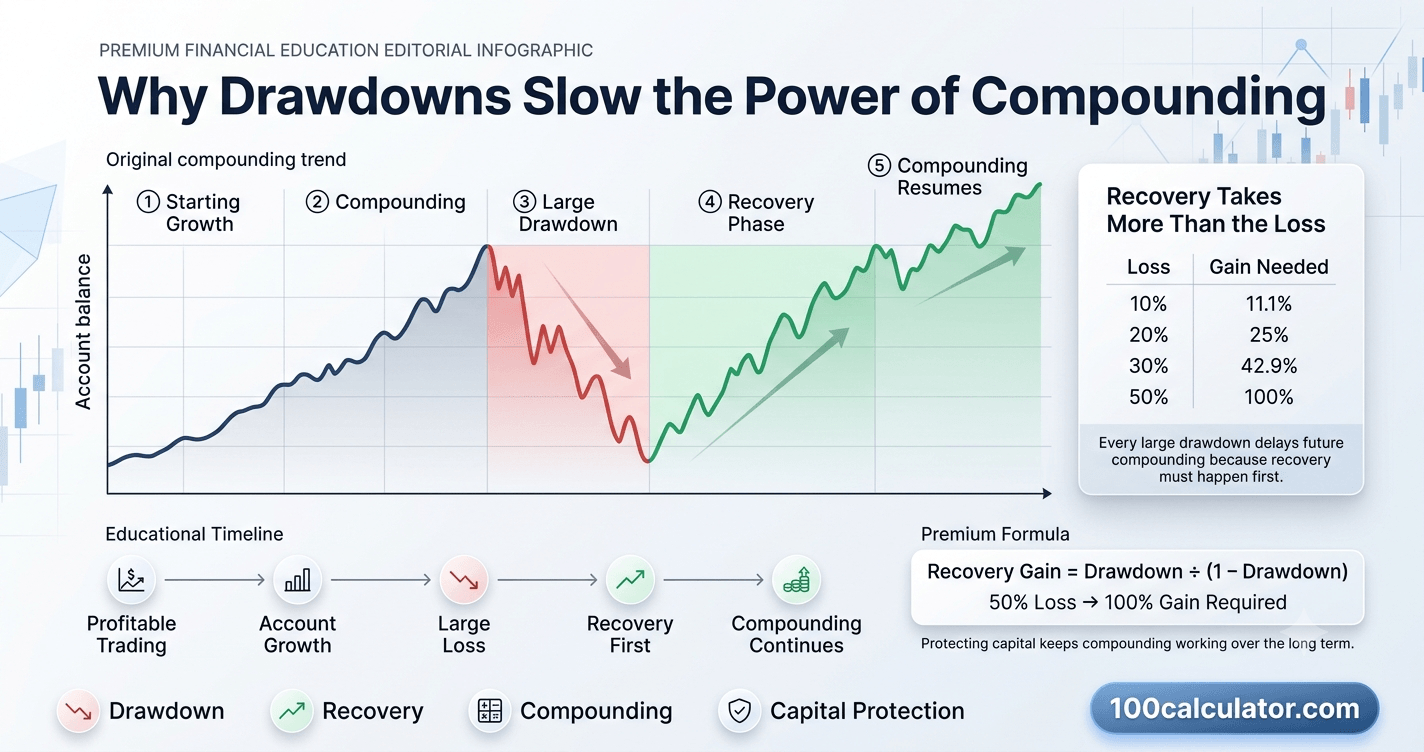
This is the main reason a string of great months can be undone by one bad one. Our Drawdown Recovery Calculator runs these numbers for your own account, and our guides on how much return you need to recover from a drawdown and why large drawdowns are so hard to recover from both dig deeper into why this matters so much for compounding specifically.
Consistency Beats Big Wins
Because losses compound against you just as much as gains compound for you, a trader netting a modest, steady 2% a month will often out-compound one who nets 10% some months and loses 8% on others — even though the second trader's average sounds more impressive. Compounding rewards an account that avoids deep dips almost as much as one that grows quickly.
What Buffett, Einstein, and the "8-8-8 Rule" Really Say About Compounding
A handful of names and quotes come up constantly around compounding. Some hold up. Some don't. It's worth knowing the difference before you repeat any of them.
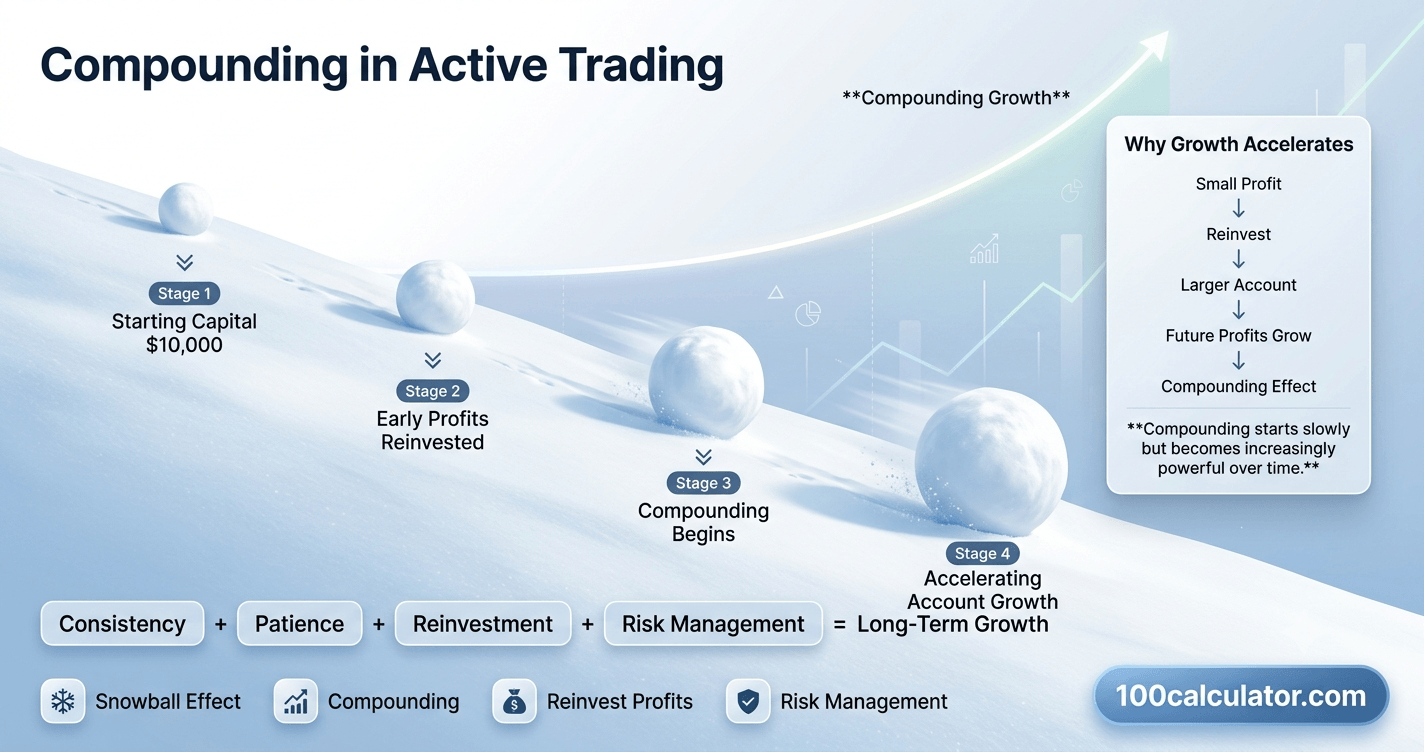
The Buffett "Snowball" Idea
Warren Buffett has talked about compounding for decades, most memorably in his authorized biography, titled The Snowball. His own description: "The important thing is finding wet snow and a really long hill." The snowball picks up more snow as it rolls, and given enough hill — enough time — a small starting amount can turn into something enormous. For traders, the practical takeaway isn't the metaphor itself; it's that Buffett's own wealth is largely a story of decades of reinvestment, not a handful of spectacular years.
Did Einstein Really Call It the Eighth Wonder of the World?
Almost certainly not. The line "compound interest is the eighth wonder of the world" is one of the most repeated quotes in personal finance, and researchers who specialize in tracing quotes back to their source, including Quote Investigator, have found no record of Einstein ever writing or saying it. The earliest known appearances trace back to financial advertising and commentary decades after his death in 1955, not to anything in his own papers. The sentiment about compounding's power is accurate. The attribution to Einstein isn't.
The "8-8-8 Rule" You May Have Seen Online
This one isn't about compounding at all, even though it sometimes gets grouped with these other "rules" because of the similar numeric name. The 8-8-8 rule is a work-life balance idea — 8 hours of sleep, 8 hours of work, 8 hours for everything else — loosely inspired by Buffett's described habits and interview comments, not a financial formula and not something he's on record naming himself.
Daily, Monthly, or Per-Trade Compounding: Which Wins?
This question usually comes from general savings-account content, but it's worth answering properly, then translating it into terms that actually apply to trading.
More frequent compounding does produce a slightly higher return at the same stated annual rate, because gains get added back to the base more often. Here's what that looks like on a 24% nominal annual rate, compounded at different frequencies:
| Compounding Frequency | Effective Annual Yield |
|---|---|
| Annual | 24.00% |
| Monthly | 26.82% |
| Daily | 27.11% |
The jump from annual to monthly compounding is meaningful. The jump from monthly to daily is much smaller, and daily versus continuous compounding is close enough to make no practical difference.
Why Most Active Traders Effectively Compound Per Trade
Banks compound on a calendar schedule because interest accrues whether or not you do anything. Trading doesn't work that way. Your account only compounds when a trade closes and you decide to leave the resulting balance in place rather than withdrawing it. In practice, that means most active traders are compounding per trade or per closed position, not per day or per month, and the frequency that matters most is how often you actually reinvest, not a fixed calendar interval.
If you want to model your own account this way, our Daily Compound Interest Calculator is useful for the general savings-style comparison above, while a Trading Compound Interest Calculator is built specifically around per-trade or per-period reinvestment assumptions instead of a fixed calendar rate.
How to Build a Realistic Trading Compounding Strategy
Knowing the math is one thing. Actually compounding a trading account well comes down to a handful of practical habits.
Decide How Much You'll Reinvest Before You Need the Money
Few traders reinvest every single dollar of profit, and that's fine. Deciding your reinvestment percentage in advance — say, reinvesting 70% of profits and setting aside 30% — keeps the decision from being made emotionally after a particularly good or bad month.
Keep Position Sizing Consistent as the Account Grows
A bigger balance should mean proportionally sized positions, not permission to take bigger risks per trade. Our Position Size Calculator and guide on how to calculate position size for safer trading both help keep risk proportional rather than letting a growing balance quietly raise how much you risk per trade.
Keep your risk-to-reward expectations realistic as the account compounds, too. Our guide on how risk-reward ratio impacts long-term trading success and the Risk Reward Ratio Calculator both help confirm your strategy's math actually supports compounding over time.
Before you commit to a compounding plan, it helps to have a short checklist:
- A trade history long enough to calculate a real average return, not a guess
- A written reinvestment percentage you'll stick to regardless of how last month went
- A maximum risk-per-trade rule that doesn't change just because your balance grew
- A plan for what happens after a losing month, decided before it happens
Free Online Tool
See your own numbers before you commit to a plan
100 Calculator's Trading Compound Interest Calculator lets you enter your starting balance, an assumed return per period, and how many periods you're projecting, so you can compare reinvestment scenarios side by side instead of guessing.
Compounding Across Forex, Stocks, and Crypto Trading
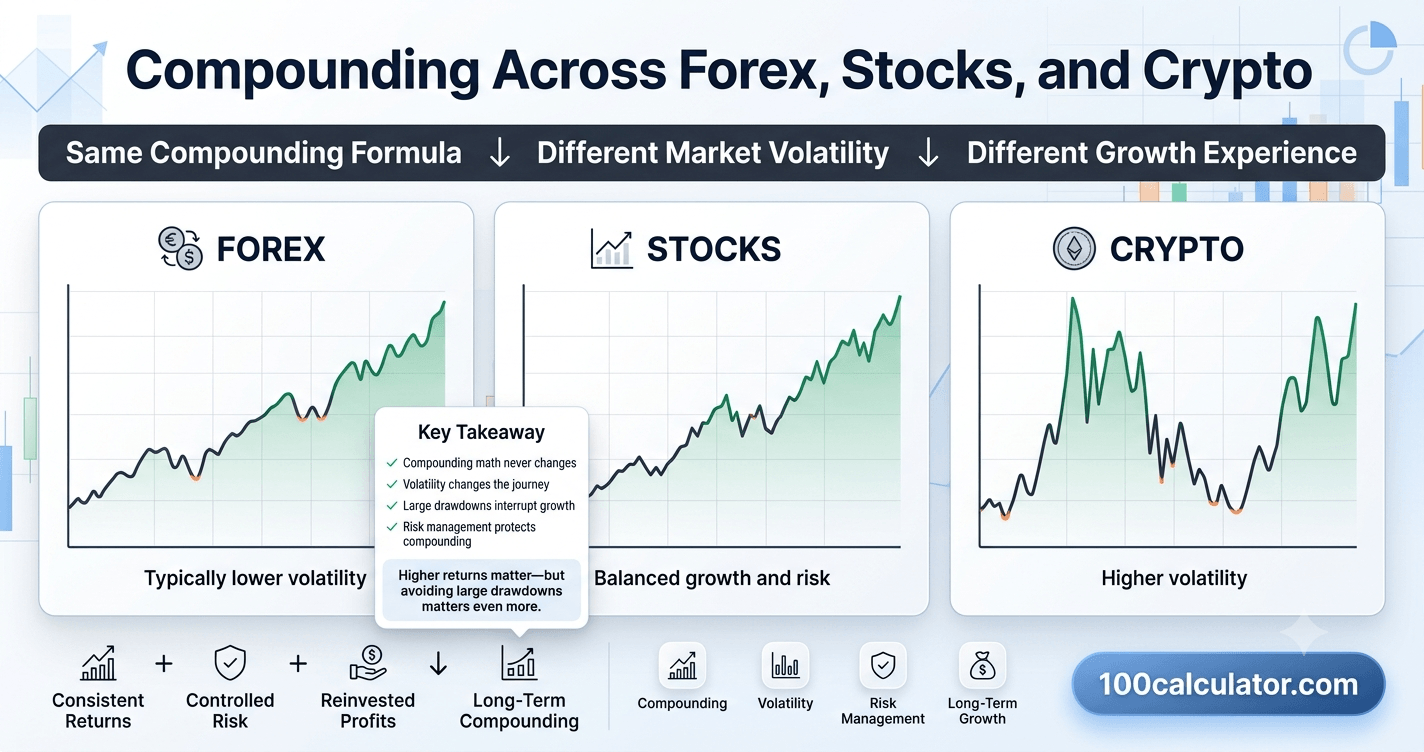
The compounding math itself doesn't change between markets. What changes is the return pattern, the fees, and a few market-specific details worth knowing.
Forex Account Compounding
Forex accounts often compound through lot size adjustments — as your balance grows, you trade slightly larger lots while keeping your risk percentage the same. Our Forex Compounding Calculator models this directly, and since pip value scales with lot size, our Pip Value Calculator pairs well with it. Overnight swap fees are worth tracking too — our guide on why pip value matters for managing trading risk covers how these small, recurring costs work against compounding if ignored.
Stock Trading Compounding
Stock traders compound in two overlapping ways: reinvesting realized trading gains, and, for longer holds, reinvesting dividends. The math is identical to the general formula above either way — what typically differs is the return pattern, since active stock trading tends to produce more frequent, smaller wins and losses compared with a buy-and-hold dividend strategy.
Crypto Trading Compounding
Crypto compounding faces two extra variables: sharply higher volatility, which magnifies the drawdown math above, and exchange fees, which eat into the return you're compounding if you aren't tracking them. Our Crypto Profit & Exchange Fee Calculator accounts for fees directly, which matters more here than elsewhere since frequent trading racks up fee costs quickly.
Common Mistakes That Quietly Break Compounding
A few habits show up again and again in accounts that never quite compound the way the math suggests they should.
- Confusing average return with compounded return. As covered earlier, a simple average overstates real growth once losses are in the mix.
- Increasing position size right after a winning streak. This is one of the fastest ways to turn a normal drawdown into an account-ending one. Our guide on position size mistakes every trader should avoid covers this pattern in detail.
- Withdrawing inconsistently. Pulling out profit at random breaks the compounding base unpredictably, making it hard to know what your account is actually on track to do.
- Borrowing a rule built for something else. The 8-4-3 rule was built for long-term, regularly funded investing, not short-term active trading. Applying its exact timeline to a trading account sets expectations the math was never designed to support.
- Ignoring fees and taxes in the return you're compounding. A return figure that ignores trading costs and taxes isn't the number that's actually compounding in your account.
Related Calculators
Put what you just read into practice, try these free tools instantly, no sign-up required.
Pip Value Calculator
Calculate the value of a pip for any currency pair and lot size.
Position Size Calculator
Determine the right position size based on your risk tolerance.
Risk Reward Ratio Calculator
Compare potential risk against reward before entering a trade.
Drawdown Recovery Calculator
Calculate the gain needed to recover from a trading drawdown.
Trading Compound Interest Calculator
Project compounded returns on your trading account balance.
Is Compounding in Trading Considered Halal?
This question comes up often enough that it deserves a clear, factual answer, without pretending to issue a religious ruling.
Why Interest-Based Compounding Raises Concerns
Mainstream Islamic scholarship holds that riba — interest — is prohibited, based on multiple Quranic verses, and most scholars treat compound interest as an even more serious form of riba, since it charges interest on interest already earned. This applies to conventional bank interest, interest-bearing loans, and similar guaranteed, interest-based returns, regardless of how small the rate is.
What About Trading Profits and Reinvestment?
Reinvesting profit itself isn't the issue; the source of that profit is. Islamic finance ties permissible returns to real economic activity and shared risk — profit from legitimate trade or risk-sharing structures such as Mudarabah and Musharakah — rather than a guaranteed return on money simply for lending it. Reinvesting profits earned this way doesn't carry the same riba concern that interest does. Certain practices raise separate concerns beyond interest, though, particularly leveraged positions with overnight interest-based swap fees, or styles some scholars consider too close to pure speculation.
Shariah-Compliant Alternatives and Screening
This is also why broad market benchmarks aren't automatically halal. The standard S&P 500 includes conventional banks and insurers earning interest-based income, plus companies carrying more debt than Shariah screening allows. S&P Dow Jones Indices publishes a separate, screened S&P 500 Shariah index for this reason, and several Shariah-compliant funds apply similar screening.
Trading risk disclaimer: This article is for general educational purposes only and isn't financial or investment advice. Trading involves substantial risk of loss, past performance and hypothetical examples don't guarantee future results, and compounding works against you during losing periods just as it works for you during winning ones. Consider your own risk tolerance and, if needed, speak with a licensed financial professional before making trading or investment decisions.
Sources & References
- U.S. Securities and Exchange Commission — Investor.gov Compound Interest Calculator
- Consumer Financial Protection Bureau — Regulation DD, Payment of Interest (Truth in Savings Act)
- S&P Dow Jones Indices — How Indexing Impacts Shariah-Compliant Investing
- Quote Investigator — Origin Research on "The Eighth Wonder of the World Is Compound Interest"
More From Our Trading Guide
Compounding connects to almost everything else in trading risk management. These related guides dig deeper into the pieces that make compounding actually work in practice.
Frequently Asked Questions
How does compounding actually work in active trading?
Compounding in trading means leaving your profits in your account so they add to your position size on future trades, instead of withdrawing them. Each time your account grows, the same percentage gain applies to a larger base, so your dollar profit grows even if your percentage return stays constant. Over many trades, this reinvestment effect adds up substantially, provided your returns stay reasonably consistent and losses don't keep erasing prior gains.
What is the 8-4-3 rule of compounding?
The 8-4-3 rule is a popular illustration, common in long-term SIP and mutual fund investing content, showing how a steady, reinvested investment can double roughly three times over 15 years: once in the first 8 years, again after 4 more years, and a third time after 3 more years. It's a simplified teaching example, not a guaranteed formula, and it applies most naturally to long-term investing with regular contributions rather than short-term active trading.
Is the "7-5-3-1 rule" a real compounding principle?
Yes, though it's broader than compounding alone. It's a popular SIP investing framework suggesting you stay invested at least 7 years so compounding has time to work, spread money across roughly 5 fund categories, expect 3 emotional phases of doubt along the way, and step up your contribution once a year, often by around 10 to 12%. Only the "7" ties directly to compounding; the rest is about investing discipline.
What did Warren Buffett actually say about compounding?
In his authorized biography, Buffett described his approach this way: "The important thing is finding wet snow and a really long hill." He's used the snowball image often to explain compounding: a small snowball picks up more snow as it rolls, and given enough "hill," or time, it turns into something enormous. Traders usually take from this that patience and letting gains sit matter more than any single spectacular trade.
What is the "8-8-8 rule" people mention with Warren Buffett?
This isn't actually about compounding or trading. It's a work-life balance idea that circulates on social media: 8 hours of sleep, 8 hours of work, and 8 hours for personal life. It's inspired by Buffett's own described habits and interviews, not an official rule he coined or a financial formula. If you saw it while researching trading compounding, it's simply a different, unrelated concept that shares a similar numeric naming pattern.
Is daily compounding better than monthly compounding?
Mathematically, yes, slightly. Compounding daily produces a marginally higher effective return than monthly compounding at the same stated annual rate, because gains get added to your balance more often. In practice, the difference is small for typical rates and account sizes. For active trading specifically, what matters far more than compounding frequency is how consistently you generate positive returns and how well you manage losing trades.
Is it legal for an account to compound interest daily?
In the United States, yes. Federal rules under the Truth in Savings Act allow banks and financial institutions to compound interest annually, monthly, daily, or on almost any other schedule they choose, as long as they clearly disclose the compounding frequency and the resulting annual percentage yield to the account holder. Rules can differ in other countries, so it's worth checking local regulations if this matters for your situation. This isn't legal advice.
Is compounding or earning interest considered halal in Islam?
Mainstream Islamic scholarship holds that interest, or riba, is prohibited, and most scholars view compound interest as an even more serious form of it, since it charges interest on interest already earned. This applies to conventional bank interest and interest-bearing loans. Profits from legitimate trade, business ownership, or shared-risk structures are treated differently, since Islamic finance ties permissible returns to real economic activity rather than a guaranteed return on money. A qualified scholar can advise on specific products.
Why do some investors consider the S&P 500 not fully Shariah-compliant?
The standard S&P 500 includes companies from sectors Islamic finance screening typically excludes, like conventional banks and insurers that earn interest-based income, plus businesses tied to alcohol, gambling, or similar industries. Many constituents also carry more debt relative to their size than Shariah screening allows. Screened alternatives exist, including a dedicated S&P 500 Shariah index and various Shariah-compliant funds that remove the non-compliant names.
What is the "golden rule" of compounding?
There's no single official "golden rule," but the idea people usually mean is this: give compounding as much time as possible and disturb it as little as possible. That means starting early, reinvesting gains instead of withdrawing them, and avoiding large losses that force you to rebuild your base from scratch. In trading terms, protecting your capital from big drawdowns matters just as much as generating gains in the first place.
Is there a real limit to how much compounding can grow an account?
Mathematically, no; the formula keeps producing larger numbers the longer it runs. In the real world, growth is limited by how long you can sustain a positive average return, how much capital you can risk per trade, liquidity at larger position sizes, taxes and fees, and the simple fact that no trader wins every period. Those practical limits matter more than the math itself.
Is compounding really the key to building wealth?
It's one important piece, not the only one. Compounding rewards time, consistency, and reinvestment, but it can't fix a strategy that loses money on average, and it won't manage the emotional side of watching an account shrink during a losing streak. Most people who build real wealth combine compounding with realistic return expectations, disciplined risk management, and enough time for the process to work.
How do I actually start compounding my trading profits?
Decide in advance what portion of profits you'll reinvest versus withdraw, since few traders reinvest every dollar. Keep position sizing consistent with your account rules as the balance grows, rather than letting a bigger balance tempt you into bigger risks. Track results over enough trades to know your real average return, and use a trading compound interest calculator to see how different reinvestment habits affect your account over time.
Is a 70/30 portfolio better than a 60/40 portfolio for compounding growth?
Neither is universally better. A 70/30 stock-to-bond split typically compounds faster on average than 60/40 because stocks have historically outperformed bonds over long periods, but it also carries more short-term volatility and larger potential drawdowns. The right split depends on your time horizon, how much volatility you can tolerate, and your goals, which is a personal decision worth discussing with a financial professional rather than a one-size-fits-all answer.
About 100 Calculator
100 Calculator is a free hub of online calculators and educational guides covering health, finance, trading, crypto, education, and more. Every tool is built to be fast, accurate, and genuinely free, with no account or signup required.
We built this guide, and tools like the Trading Compound Interest Calculator referenced throughout it, to make trading math easier to understand before you rely on it. Head back to the 100 Calculator homepage to explore the full library of tools, or learn more about the team behind them on our About Us page.