How Risk Reward Ratio Impacts Long-Term Trading Success
A practical, no-jargon look at what risk-reward ratio actually means, how to calculate it for any trade, and why the ratio you choose today quietly shapes your results months and years down the road.
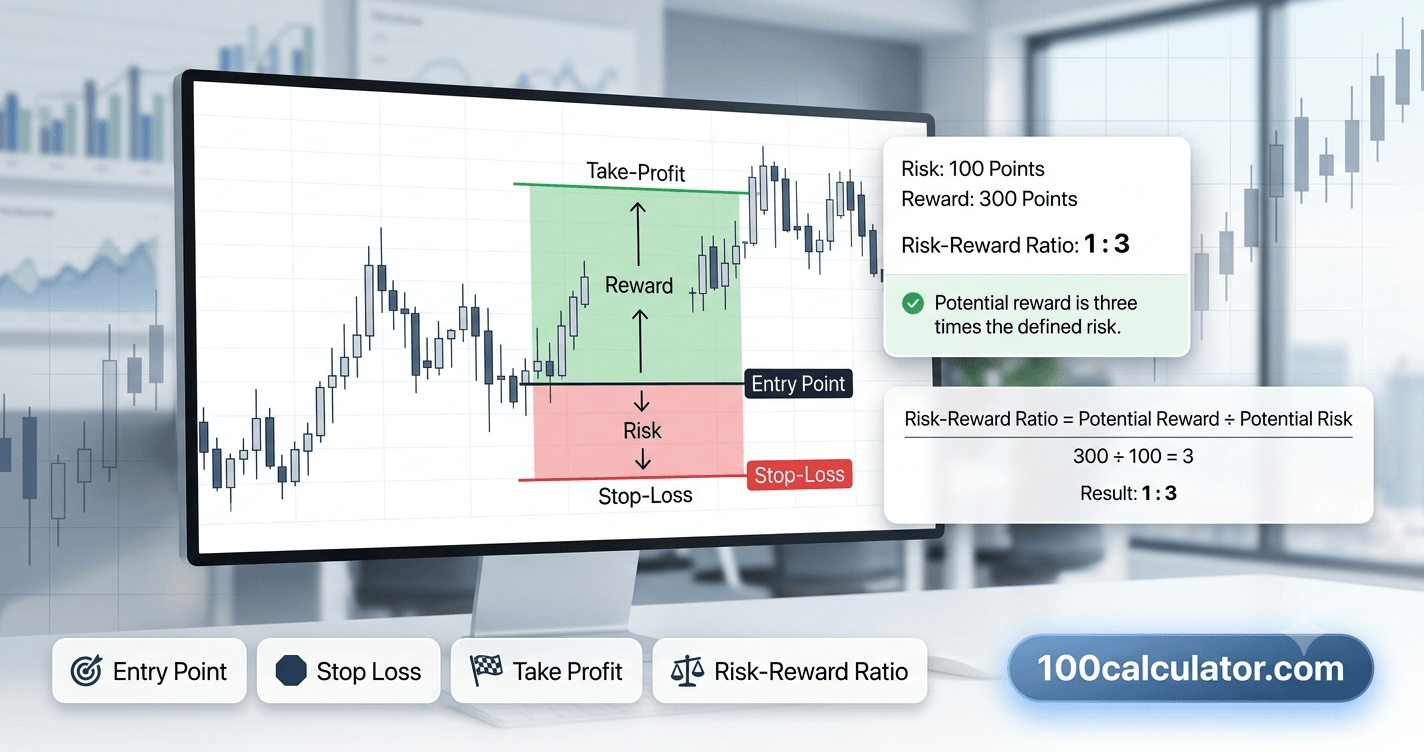
Two traders can take the exact same setup, at the exact same price, and still end up with completely different results a year later. The difference usually isn't luck. It comes down to what happens on the losing trades, and more specifically, how much each trader risked compared to how much they stood to gain.
Risk-reward ratio compares how much you're risking on a trade to how much you could realistically gain from it, usually written as risk:reward, like 1:2 or 1:3. A 1:3 ratio means you're risking $1 to potentially make $3. Get this ratio wrong on a regular basis, and even a strategy with a decent win rate can slowly drain an account. Get it right, and you can lose more trades than you win and still come out ahead.
This guide walks through exactly how risk-reward ratio works, how to calculate it for any trade, what a "good" ratio actually looks like, and why it matters so much more over hundreds of trades than it ever does on a single one. If you'd rather skip the manual math, 100 Calculator's Risk Reward Ratio Calculator works it out instantly. But understanding the logic behind the numbers is what actually makes the ratio useful, so let's start with the basics.
What Is Risk-Reward Ratio?
Risk-reward ratio, sometimes called reward-to-risk ratio, compares what you're putting on the line against what you could earn if a trade goes your way. It doesn't predict whether a trade will win. It simply tells you whether the potential payoff justifies the risk before you place the order.
Risk-Reward Ratio Meaning in Trading
The ratio is almost always written with risk first: a 1:2 ratio means you're risking 1 unit to potentially gain 2, a 1:3 ratio means risking 1 to potentially gain 3, and so on. The bigger the second number, the more reward you're aiming for relative to what you're risking. This applies the same way whether you're trading forex, stocks, futures, or crypto, since the underlying math never changes, only the units do.
Key Terms: Entry, Stop-Loss, and Take-Profit
Three price points define every risk-reward calculation:
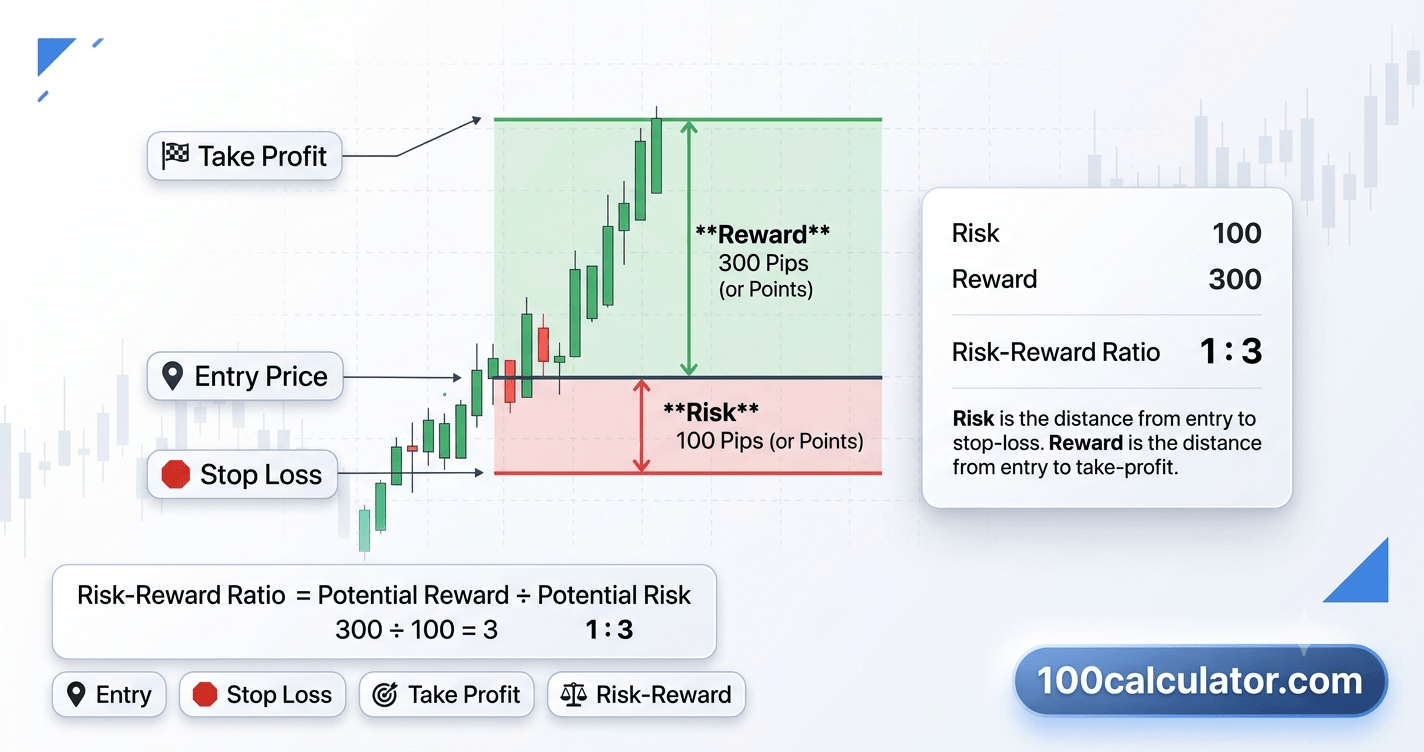
- Entry price — the price at which you open the trade.
- Stop-loss — the price where you'll exit if the trade goes against you. The distance from entry to stop-loss defines your risk.
- Take-profit — the price where you'll exit if the trade goes your way. The distance from entry to take-profit defines your reward.
Once you know these three numbers for any trade, you already have everything you need to work out its risk-reward ratio, which is exactly what the next section covers.
How to Calculate Risk-Reward Ratio
Calculating risk-reward ratio only takes three numbers and one division. Here's the formula, followed by a worked example you can copy for your own trades.
The Risk-Reward Ratio Formula
Risk-Reward Ratio Formula
Risk-Reward Ratio = (Entry − Stop-Loss) : (Take-Profit − Entry)
Risk is the distance between your entry price and your stop-loss.
Reward is the distance between your entry price and your take-profit.
Divide reward by risk to express the relationship as a single ratio, like 1:2.5 or 1:3.
Step-by-Step Example Calculation
Say you're buying a stock at $50. You place your stop-loss at $48 and your take-profit at $56. Your risk is $50 − $48 = $2. Your reward is $56 − $50 = $6. Dividing reward by risk gives 6 ÷ 2 = 3, so your risk-reward ratio is 1:3. You're risking $2 to potentially make $6.
The same steps work for a short trade — you'd just flip the direction, measuring risk as the distance up to your stop and reward as the distance down to your target. And they work in any unit: dollars, pips, or percentage moves, as long as you use the same unit for both sides of the calculation.
Free Online Tool
Skip the manual math
100 Calculator's Risk Reward Ratio Calculator works out your ratio instantly from your entry, stop-loss, and take-profit prices, so you can check a setup in seconds before you place the trade.
Risk-Reward Ratio Examples in Forex, Stocks, and Crypto
The formula never changes, but seeing it applied across different markets makes it easier to use on your own trades, whatever you trade.
Forex Risk-Reward Ratio Example
Say you buy EUR/USD at 1.0850, set a stop-loss at 1.0820, and a take-profit at 1.0940. Your risk is 30 pips and your reward is 90 pips, for a 1:3 ratio. Working in pips instead of price is standard in forex, which is why knowing what each pip is worth matters just as much as the ratio itself — our guide to calculating pip value covers that piece in detail.
Stock Trading Risk-Reward Example
Using the earlier example, buying at $50 with a $48 stop-loss and a $56 take-profit gives a $2 risk and a $6 reward, again a 1:3 ratio. Stock traders usually think in whole dollars or percentage moves rather than pips, but the calculation is identical.
Crypto Trading Risk-Reward Example
Say you buy Bitcoin at $60,000, with a stop-loss at $58,800 and a take-profit at $63,600. Your risk is $1,200 and your reward is $3,600, once again a 1:3 ratio. Crypto's higher volatility often means wider stops in dollar terms, so many crypto traders track risk as a percentage of entry price instead of a flat dollar figure, to keep comparisons consistent across coins.
| Market | Entry | Risk | Reward | Ratio |
|---|---|---|---|---|
| Forex (EUR/USD) | 1.0850 | 30 pips | 90 pips | 1:3 |
| Stocks | $50.00 | $2.00 | $6.00 | 1:3 |
| Crypto (BTC) | $60,000 | $1,200 | $3,600 | 1:3 |
What Is a Good Risk-Reward Ratio for Trading?
Most trading educators suggest a minimum of 1:2, meaning your potential reward is at least twice your risk, with many preferring 1:3 or higher for swing and position trades. A higher ratio gives you more room to be wrong on individual trades and still finish profitable overall, which is the whole point of thinking about risk and reward together in the first place.
1:2 vs. 1:3 Risk-Reward Ratio
The jump from 1:2 to 1:3 might look small, but it changes how much room you have for error. At 1:2, you need to win roughly 1 out of every 3 trades just to break even. At 1:3, that drops to 1 out of every 4. Our guide on what risk-reward ratio beginner traders should use breaks this down further if you're just getting started.
Is a Risk-Reward Ratio of 1.67 Good?
A 1.67 ratio, or 1:1.67, means your potential reward is about 67% larger than your risk. It sits below the 1:2 minimum many traders aim for, but it isn't automatically bad. At this ratio you'd need to win more than roughly 37% of your trades to break even, so it can work perfectly well if your strategy has a tested win rate comfortably above that.
| Risk-Reward Ratio | Breakeven Win Rate | What It Means |
|---|---|---|
| 1:1 | 50% | You need to win half your trades just to break even |
| 1:1.67 | ≈37.5% | A little over 1 in 3 wins keeps you flat |
| 1:2 | ≈33.3% | You can lose about 2 out of 3 trades and still break even |
| 1:3 | 25% | You can lose 3 out of 4 trades and still break even |
| 1:5 | ≈16.7% | Very few wins are needed, but qualifying setups are rarer |
The math behind this table is simple: Breakeven Win Rate = Risk ÷ (Risk + Reward). At a 1:3 ratio, that's 1 ÷ (1 + 3) = 25%. It's worth remembering that a very high ratio isn't automatically better — setups offering 1:5 or more are naturally rarer, and holding out only for those means passing on a lot of otherwise valid trades. The right ratio is the one your tested win rate can comfortably support.
Risk-Reward Ratio vs. Win Rate: Why Both Matter
It's tempting to chase the highest possible risk-reward ratio, but the ratio alone never tells the whole story. What actually determines whether a strategy makes money is the combination of risk-reward ratio and win rate, known as trading expectancy.
The Trading Expectancy Formula
Trading Expectancy Formula
Expectancy = (Win Rate × Average Win) − (Loss Rate × Average Loss)
Win Rate is the percentage of trades that hit your take-profit.
Average Win / Average Loss reflect your typical reward and risk per trade.
A positive number means the strategy makes money on average, over enough trades.
For example, a strategy with a 40% win rate, a 1:3 risk-reward ratio, and $100 risked per trade has an expectancy of (0.40 × $300) − (0.60 × $100) = $120 − $60 = $60 per trade, on average. That same 40% win rate at a 1:1 ratio would produce (0.40 × $100) − (0.60 × $100) = −$20 per trade — a losing strategy with the identical win rate, purely because the ratio changed.
Is Risk-Reward Ratio More Important Than Win Rate?
Neither one matters much without the other. A great risk-reward ratio can't save a strategy with a very low win rate, and a high win rate can't save you if your losses are far bigger than your wins. Long-term trading success comes from finding a combination of the two that produces a positive expectancy, then applying it consistently.
| Myth | What's Actually True |
|---|---|
| A higher ratio always means a better strategy | A very high ratio paired with an unrealistically low win rate can still lose money over time |
| You need to win most of your trades to profit | With a strong risk-reward ratio, you can lose more trades than you win and still profit |
| Risk-reward ratio guarantees an outcome | It only describes a planned setup — slippage and gaps can still affect the actual result |
How Risk-Reward Ratio Impacts Long-Term Trading Success
Risk-reward ratio matters on any single trade, but its real impact only becomes obvious once you zoom out to dozens or hundreds of trades. Small differences in ratio compound into very different account outcomes, which is exactly why professional traders talk about it so often.
The Compounding Effect of Consistent Risk-Reward
A trader risking a fixed 1% of their account per trade, with a strong risk-reward ratio and a modest win rate, builds an account very differently than a trader risking the same 1% at a weaker ratio, even if both trade the same number of times. Over enough trades, that difference stops looking small and starts looking like the entire outcome. Our guide on how compounding returns work in active trading explores this same idea from the growth side of the equation.
A 100-Trade Simulation: Good vs. Poor Risk-Reward
Here's a simplified illustration, assuming a fixed risk of 1R (one "risk unit") per trade across 100 trades, at different combinations of win rate and risk-reward ratio:
| Scenario | Win Rate | Risk-Reward Ratio | Net Result |
|---|---|---|---|
| Weak ratio, average win rate | 45% | 1:1 | −10R (loss) |
| Modest ratio, average win rate | 40% | 1:1.5 | 0R (flat) |
| Strong ratio, below-average win rate | 35% | 1:3 | +40R (profit) |
| Strong ratio, average win rate | 45% | 1:3 | +80R (profit) |
Notice that the third scenario wins fewer trades than the first, yet still finishes 90R ahead of it, purely because of the risk-reward ratio behind each win. This is the core reason risk-reward ratio impacts long-term trading success more than almost any other single number: it decides how forgiving your strategy is when the losing trades inevitably show up.
Why So Many Traders Lose Money
If a strong risk-reward ratio can make a strategy this forgiving, it's fair to ask why so many traders still struggle. The answer has more to do with discipline than strategy.
What the Research Actually Shows
Multiple independent studies on active, short-term traders — including large-scale research covering day traders in Brazil and Taiwan, along with reviews from U.S. regulators — have consistently found that a large majority end up losing money over time, with figures in various studies ranging from roughly 70% up to 97% depending on the market and how long a trader keeps going. The U.S. Securities and Exchange Commission has noted directly that day traders typically suffer serious financial losses in their first months of trading, and many never reach profitability at all. The exact percentage varies by study, but the direction of the finding is remarkably consistent across markets and decades.
Common Reasons Traders Fail Despite Good Setups
Poor risk-reward discipline is consistently one of the biggest reasons behind these numbers. Traders move their stop-loss when a trade goes against them, close winners early out of fear, risk far too much on single positions, or abandon their own rules the moment a losing streak starts. Large, badly managed drawdowns often follow, and recovering from them is harder than it looks — our guide on why large drawdowns are so hard to recover from explains exactly why the math works against you once a losing streak gets deep enough. If you want to see what it would actually take to climb back, 100 Calculator's Drawdown Recovery Calculator shows the required return for any size of loss.
Risk-Reward Ratio by Trading Style
There's no single "correct" risk-reward ratio across all of trading. The right target depends heavily on your timeframe and how frequently you trade.
Risk-Reward Ratio for Scalping
Scalping usually involves tighter risk-reward ratios, often close to 1:1 or slightly above, since trades are held for seconds to minutes and aim for small, frequent price moves. Scalpers typically lean on a high win rate to make the math work, rather than chasing large individual rewards.
Risk-Reward Ratio for Day Trading
Day trading sits in the middle, often somewhere between 1:1.5 and 1:3, since trades are held for minutes to hours within a single session and have more room to run than a scalp, but still need to close out before the day ends.
Risk-Reward Ratio for Swing Trading
Swing and position trading, held over days, weeks, or longer, generally support wider risk-reward ratios, often 1:2 to 1:5 or more, since wider stops and targets give trades more room to capture a larger price move.
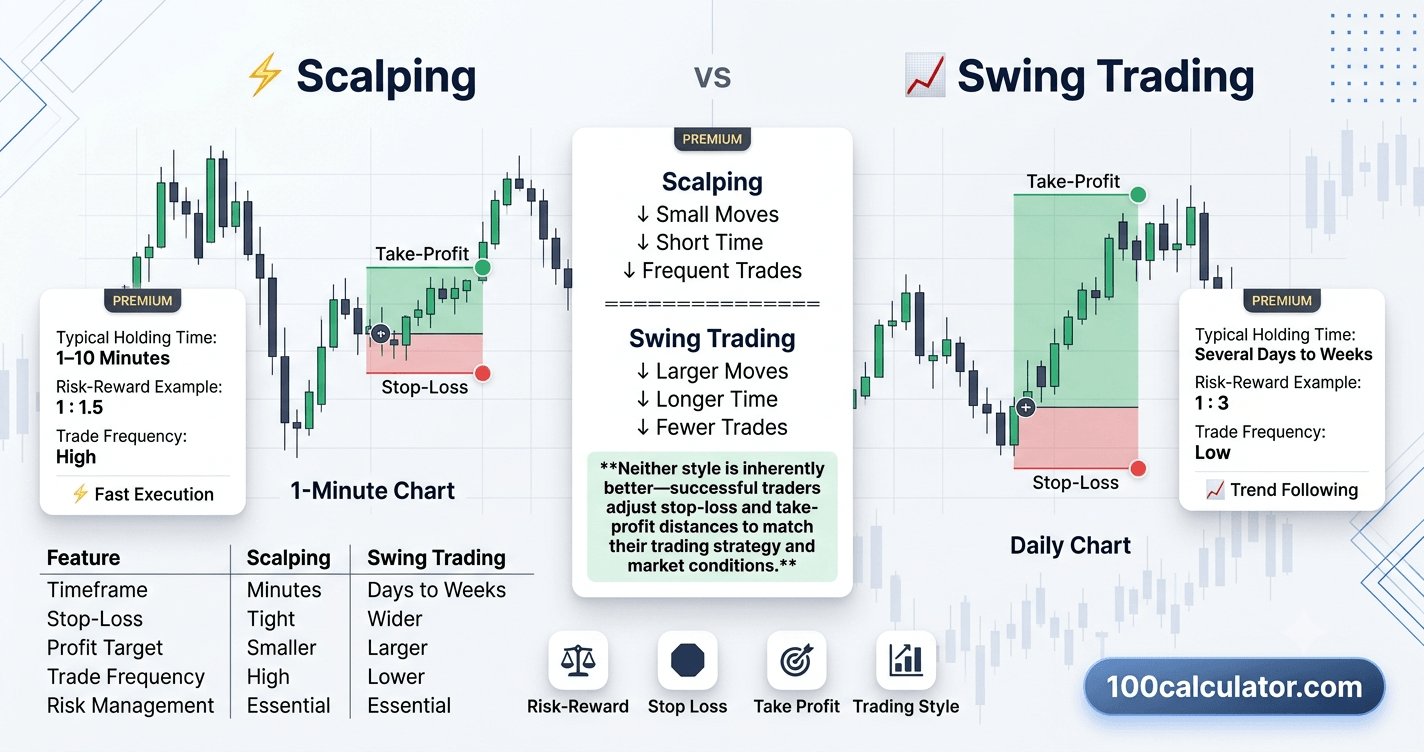
| Trading Style | Typical Ratio | Typical Holding Time |
|---|---|---|
| Scalping | 1:1 to 1:1.5 | Seconds to minutes |
| Day trading | 1:1.5 to 1:3 | Minutes to hours |
| Swing trading | 1:2 to 1:5 | Days to weeks |
| Position trading | 1:3 to 1:10+ | Weeks to months or longer |
Common Risk-Reward Ratio Mistakes to Avoid
Even traders who understand the math above can still undo it in practice. Here's what quietly throws off a well-planned risk-reward ratio:
- Moving the stop-loss further away mid-trade. This quietly turns a planned 1:3 ratio into something far worse, often close to 1:1 or negative, right when the trade is already going wrong.
- Closing winning trades too early. Taking profit at half your target out of nerves shrinks your reward and can turn a 1:3 setup into an effective 1:1.5 in practice.
- Ignoring risk-reward ratio because a setup "feels right." Confidence in a trade doesn't change the math — a 1:0.5 ratio still needs an unusually high win rate to be worthwhile.
- Chasing an unrealistically high ratio. Holding out for 1:10 on every setup means passing on far more valid trades than you actually take.
- Sizing positions incorrectly around the ratio. A good ratio doesn't help much if position size is off — our guide on position size mistakes every trader should avoid covers the sizing side of this in more depth.
- Forgetting that spreads, fees, and slippage eat into both sides of the ratio, especially in fast-moving markets like forex and crypto.
How to Improve Your Risk-Reward Ratio
Improving your ratio usually comes down to tightening risk without cutting it too close, and giving reward more room to grow. A few practical habits make the biggest difference:
- Set your stop-loss based on chart structure, like a recent swing low or high, rather than a random dollar amount
- Use trailing stops to let winning trades run further instead of closing at a fixed target every time
- Skip setups where the realistic target is barely bigger than your stop distance
- Scale out of positions in parts — bank some profit while letting the rest aim for a bigger target
- Review closed trades weekly to spot winners you exited too early, since this is one of the fastest patterns to fix
Related Calculators
Put what you just read into practice, try these free tools instantly, no sign-up required.
Pip Value Calculator
Calculate the value of a pip for any currency pair and lot size.
Position Size Calculator
Determine the right position size based on your risk tolerance.
Risk Reward Ratio Calculator
Compare potential risk against reward before entering a trade.
Drawdown Recovery Calculator
Calculate the gain needed to recover from a trading drawdown.
Trading Compound Interest Calculator
Project compounded returns on your trading account balance.
Building a Risk Management Plan Around Risk-Reward Ratio
Risk-reward ratio works best as part of a full risk management plan, not as a rule you apply on its own. Two pieces complete the picture: how much you risk per trade, and how you size each position to match that risk.
The 1% to 2% Risk-Per-Trade Rule
Risking 1% to 2% of your account per trade is one of the most widely used guidelines in trading risk management. It's small enough that a losing streak of 10 or even 20 trades in a row won't wipe out your account, but large enough to build meaningful gains when paired with a solid risk-reward ratio. Many experienced traders treat 2% as an upper limit rather than a target to hit on every single trade.
Position Sizing and Risk-Reward Work Together
Your risk-reward ratio tells you the shape of a trade. Position sizing tells you how much of your account that trade is allowed to affect. Get the ratio right but size the position too large, and a single loss can still do serious damage. Our guide on how to calculate position size for safer trading walks through this step by step, and 100 Calculator's Position Size Calculator turns your account size, risk percentage, and stop-loss distance into an exact position size in seconds.
Using a Risk-Reward Ratio Calculator to Save Time
Doing this math by hand for every trade adds up, especially if you're checking multiple setups a day. A dedicated calculator removes the friction entirely.
What a Risk-Reward Ratio Calculator Does
100 Calculator's Risk Reward Ratio Calculator takes your entry, stop-loss, and take-profit prices and returns your ratio instantly, with no signup or account required. It's built to double-check a setup in the few seconds before you place a trade, which matters most when the market is moving and you don't have time to do the division by hand.
Once you've settled on a ratio and position size you're comfortable with, thinking about the bigger picture is worth doing too — our guide on whether you can realistically compound gains while trading looks at how consistent risk-reward discipline plays out over months and years, not just individual trades.
Trading and investment risk disclaimer: This article is for general educational purposes only and isn't a substitute for personalized financial or investment advice. Trading forex, stocks, and cryptocurrency carries a high level of risk and may not be suitable for every investor. The simulations and examples in this guide are hypothetical and don't guarantee future results. Always consider your own financial situation and risk tolerance, and consult a licensed financial professional before making trading decisions.
Sources & References
- U.S. Securities and Exchange Commission — Day Trading: Your Dollars at Risk
- North American Securities Administrators Association (NASAA) — State Securities Regulators Highlight Problems With Day Trading
- U.S. Securities and Exchange Commission, Investor.gov — Day Trading
More From Our Trading Guides
Want to go deeper on trading risk and position management? These related guides build on the concepts covered above.
Frequently Asked Questions
What does risk-reward ratio mean in trading?
Risk-reward ratio compares how much you're risking on a trade to how much you stand to gain if it works out. It's usually written as risk:reward, like 1:2 or 1:3, where the first number is your potential loss and the second is your potential profit. A 1:3 ratio means you're risking $1 to potentially make $3. Traders use this ratio to judge whether a trade is worth taking before they ever enter it, regardless of how confident they feel about the setup.
How do you calculate risk-reward ratio?
Subtract your stop-loss price from your entry price to find your risk, then subtract your entry price from your take-profit price to find your reward. Divide the reward by the risk to get your ratio. For example, if you enter a trade at $50, set a stop-loss at $48, and a take-profit at $56, your risk is $2 and your reward is $6, giving you a 1:3 risk-reward ratio.
What is a good risk-reward ratio for trading?
Most trading educators recommend a minimum of 1:2, meaning your potential reward is at least twice your risk, with many preferring 1:3 or higher. A higher ratio gives you more room to be wrong about some trades and still finish profitable overall. That said, the "right" ratio also depends on your win rate and trading style, which is why risk-reward should never be judged completely on its own.
Is a risk-reward ratio of 1.67 good?
A 1.67 risk-reward ratio, closer to 1:1.67, means your potential reward is about 67% larger than your risk. It's better than a 1:1 ratio, but it sits below the 1:2 minimum many traders aim for. Whether it's good enough depends on your win rate — at 1.67, you'd need to win more than roughly 37% of your trades just to break even, so it can work fine if your strategy has a solid, tested win rate above that.
Is risk-reward ratio more important than win rate?
Neither one matters much without the other. A great risk-reward ratio can't save a strategy with a very low win rate, and a high win rate can't save you if your losses are far bigger than your wins. What actually determines profitability is trading expectancy, which combines both numbers together. Long-term trading success comes from finding a combination of win rate and risk-reward ratio that produces a positive expectancy, then applying it consistently.
How does risk-reward ratio affect long-term trading success?
Risk-reward ratio determines how much room you have for error over hundreds of trades. A trader using a 1:3 ratio can be wrong more than half the time and still come out ahead, while a trader using a 1:1 ratio needs to win more than half of every trade just to stay flat. Over a large number of trades, small differences in risk-reward ratio compound into very different account outcomes, which is exactly why it matters more the longer you trade.
Why do so many traders lose money, even with a solid strategy?
Most losing trading accounts aren't caused by bad ideas — they're caused by inconsistent execution. Traders move their stop-loss when a trade goes against them, cut winning trades short out of fear, risk too much on single positions, or abandon their risk-reward rules the moment a losing streak starts. Multiple independent studies on day traders have found that the large majority end up losing money over time, and poor risk management is consistently one of the biggest reasons why.
What is the risk-reward ratio for scalping?
Scalping usually involves tighter risk-reward ratios, often close to 1:1 or slightly above, since trades are held for seconds or minutes and aim for small, frequent price moves. Scalpers typically rely on a high win rate to make this work, rather than large individual rewards. This is very different from swing trading, where wider stops and targets usually support higher risk-reward ratios like 1:3 or more.
Is risking 2% per trade a good guideline?
Yes, risking 1% to 2% of your account per trade is one of the most widely used guidelines in trading risk management. It's small enough that a losing streak of 10 or even 20 trades in a row won't wipe out your account, but large enough to build meaningful gains when combined with a solid risk-reward ratio. Many professional traders treat 2% as an upper limit rather than a target to hit on every trade.
How can I improve my risk-reward ratio?
Focus on tightening your stop-loss placement without cutting it so close that normal price movement stops you out, and let winning trades run further using trailing stops instead of closing them early. It also helps to wait for setups where the distance to a realistic target is naturally larger than the distance to your stop, rather than forcing a trade that doesn't offer that room. Reviewing your past trades to see where you exited winners too early is one of the fastest ways to spot an easy fix.
What does a 2.3 risk-reward ratio mean?
A 2.3 risk-reward ratio means your potential reward is 2.3 times the size of your risk, so you stand to make $2.30 for every $1 you're risking. It's a solid ratio that sits comfortably above the commonly recommended 1:2 minimum. At this ratio, you only need to win a little over 30% of your trades to break even, which gives you a meaningful cushion for losing trades.
Is a lower risk-reward ratio ever the better choice?
Yes, if it comes with a high enough win rate to make up for it. Some strategies, like certain scalping or mean-reversion approaches, intentionally use lower risk-reward ratios because they win a much higher percentage of the time. The ratio itself isn't good or bad in isolation; what matters is whether the combination of your win rate and risk-reward ratio produces a positive expectancy over a large number of trades.
Is there a "7% rule" for risk-reward ratio?
Not specifically. The well-known "7% rule" in trading actually comes from investor William O'Neil's CAN SLIM method, which recommends selling a stock if it falls 7% to 8% below your purchase price, regardless of the reason. That's a stop-loss guideline for limiting losses on individual stock positions, not a risk-reward ratio rule. It can still work alongside risk-reward thinking, since a disciplined stop-loss is exactly what the "risk" side of your ratio depends on.
About 100 Calculator
100 Calculator is a free hub of online calculators and educational guides covering health, finance, trading, crypto, education, and more. Every tool is built to be fast, accurate, and genuinely free, with no account or signup required.
We built this guide, and tools like the Risk Reward Ratio Calculator referenced throughout it, to make trading math easier to work through before you place a trade. Head back to the 100 Calculator homepage to explore the full library of tools, or learn more about the team behind them on our About Us page.