Can You Realistically Compound Gains While Trading?
A plain-English look at whether reinvesting trading profits actually compounds the way a savings account does, what a realistic growth curve looks like, and where most compounding plans quietly fall apart.
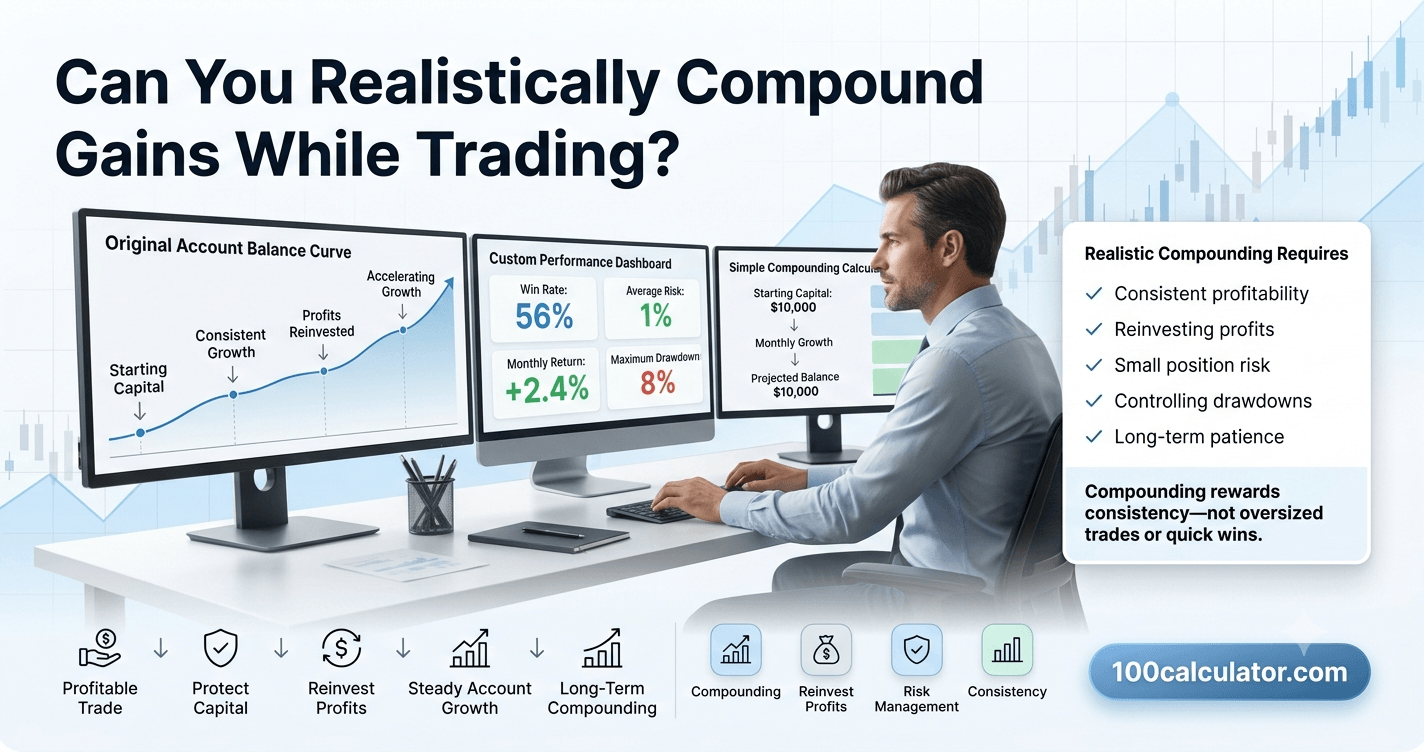
Compounding is one of the most talked-about ideas in trading, and one of the most misunderstood. The short answer: compounding is completely real. If you reinvest your trading profits instead of withdrawing them, your account balance grows, and future gains get calculated on that larger balance — exactly how compound interest works in a savings account. What trips people up is assuming trading returns behave like a fixed interest rate. They don't. A savings account might pay a steady rate no matter what happens in the world. A trading account's return depends on whether you actually win more than you lose, month after month, after costs — and that's a much harder bar to clear consistently.
This guide walks through how compounding actually works, what a realistic reinvestment curve looks like, why most day traders never get far enough to benefit from it, and how compounding differs across stocks, forex, and crypto. Along the way, you can use 100 Calculator's free Trading Compound Interest Calculator to turn the math into something you can test with your own numbers instead of taking anyone's word for it.
What "Compounding Gains" Actually Means
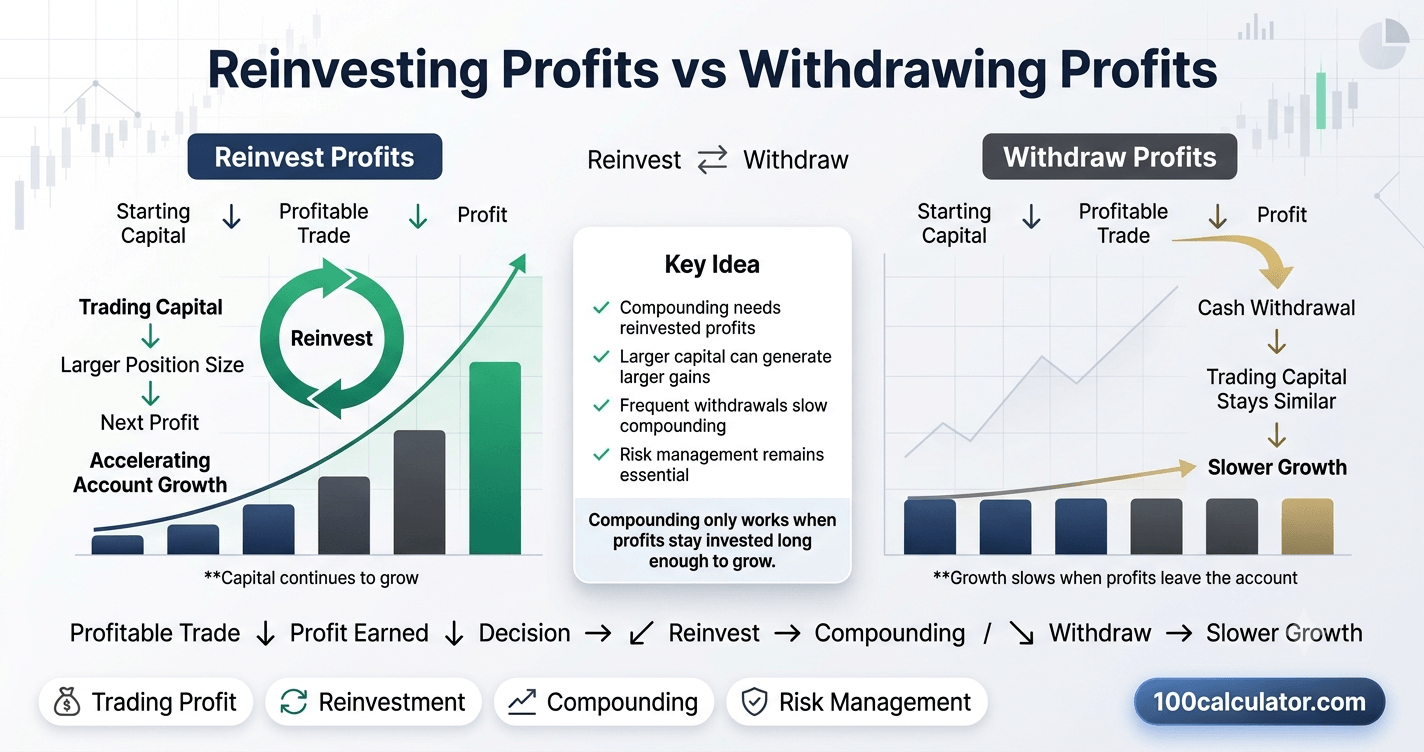
Compounding your trading gains means leaving your profits inside your trading account instead of pulling them out. The next time you place a trade, you're trading with a slightly bigger pot of capital than before, so a winning trade of the same percentage size produces a slightly bigger dollar gain than it did last time.
Compare that to the more common alternative: withdrawing profit as soon as you make it. If you start with $10,000 and pull out every dollar you earn, your trading capital stays at $10,000 forever. You might be building savings somewhere else, but your trading account itself never grows, and neither does the size of your future gains.
This is the same principle behind any compound interest calculator: money that stays invested earns a return, and that return then earns its own return. The difference in trading is that the "return" isn't a guaranteed rate — it's the net result of your wins and losses. That distinction is the reason compounding gets complicated once you move from a savings account to an active trading account, and it's what the rest of this guide is really about.
How Compound Interest Works, in Plain Terms
Before applying compounding to trading, it helps to see the plain math behind it. Compound growth follows this formula:
Compound Growth Formula
A = P × (1 + r)ⁿ
A = the final balance after compounding
P = your starting principal, or starting capital
r = the rate of return per period
n = the number of periods
Say you start with $1,000 and earn 10% per period, and you reinvest every time. After one period you have $1,100. That $1,100 earns 10% next, not the original $1,000, so period two ends at $1,210 instead of $1,200. By period three, you're at $1,331. That extra $10, then $31, looks small over three periods, but it compounds faster the longer it runs, because you're always earning a return on your previous returns, not just your original capital.
This is the entire idea behind a trading compound interest calculator: it lets you plug in a starting balance, an expected rate of return, and a number of periods, and instantly see what reinvesting would produce, without doing the exponent math by hand.
Free Online Tool
Test your own numbers
100 Calculator's Trading Compound Interest Calculator lets you enter your starting capital, an expected return per period, and how many periods you plan to trade, then see the projected growth instantly, with no signup required.
Investing vs. Trading: Why Compounding Behaves Differently
Compounding works the same mathematically whether you're a long-term investor or an active trader. What changes is how predictable the rate of return actually is.
A long-term investor holding a diversified stock portfolio is compounding over a small number of long periods — years, not days. Dividends can be reinvested automatically, adding a steady, periodic boost, and there's more time for a bad year to be offset by several good ones. An active trader is compounding over far more periods, sometimes dozens of trades a week, and each period's return can swing sharply positive or sharply negative.
That difference matters more than most people expect, because gains and losses aren't symmetrical. If your account drops 50%, you don't need a 50% gain to get back to even — you need a 100% gain, because you're now growing from a smaller base.
| Account Loss | Gain Needed to Break Even |
|---|---|
| 10% | 11.1% |
| 20% | 25% |
| 25% | 33.3% |
| 50% | 100% |
| 75% | 300% |
| 90% | 900% |
This is why a string of small, disciplined wins tends to compound better over time than one big win followed by one big loss, even when the average return looks identical on paper. If drawdowns are a weak spot in your own trading, our guide to recovering from a drawdown and the Drawdown Recovery Calculator break this down further.
Do Stocks Compound Daily, Monthly, or Annually?
Stock prices themselves don't compound on a fixed schedule the way a savings account does. A share price simply reflects what buyers and sellers agree it's worth at that moment, and it can move for reasons that have nothing to do with compounding. What actually compounds is your decision to reinvest.
For long-term investors, that usually happens a few times a year: quarterly dividends get reinvested (sometimes called a DRIP, or dividend reinvestment plan), or new contributions are added on a regular schedule. For an active trader, "compounding frequency" really just means how often a position is closed and the proceeds left to ride versus withdrawn. Close and reinvest daily, and the effective compounding period is daily. Reassess monthly, and it's monthly.
| Frequency | What It Means | Common Example |
|---|---|---|
| Daily | Gains or losses are added back to the balance every trading day | Active or swing trading with daily reinvestment |
| Monthly | Gains are tallied and reinvested once a month | Many retail trading and forex accounts |
| Annually | Gains are reinvested once a year | Long-term index fund or retirement investing |
A daily compound interest calculator and a monthly one will show different numbers for the same annual return, because compounding more often means each smaller gain starts earning its own return sooner. You can compare the two using 100 Calculator's Daily Compound Interest Calculator. In practice, for a trading account, the bigger question isn't daily versus monthly — it's whether the return per period is reliably positive at all, which is what the next two sections dig into.
Is Compounding Realistic in Day Trading?
Mathematically, yes: if a day trader wins consistently and reinvests every dollar, the balance compounds exactly like any other example in this guide. Practically, it's rare, and the reason isn't the math — it's everything standing between a single trade and a repeatable, positive average return.
Day trading multiplies the number of "periods" you're compounding over, sometimes to dozens of trades a day, and every one of those periods carries its own transaction cost. (FINRA) FINRA's required day-trading risk disclosure statement illustrates this with a simple example: if a trade costs $16 and a trader executes an average of 29 transactions a day, that trader would need to generate more than $111,000 in profit a year just to cover commissions.
That's before counting spreads, slippage, taxes, or the cost of managing several open positions at once. A compounding curve assumes each period nets a positive return after all of that. Skip the cost side of the math, and a strategy that looks profitable on paper can be a net loser in practice, with nothing left over to compound at all.
Why Most Day Traders Never Get to Compound
You can't compound gains you don't have, and the data on day trading is sobering. Independent studies, spanning different markets and time periods, consistently find that most day traders lose money rather than compound it.
| Source | Key Finding |
|---|---|
| FINRA day-trading risk disclosure | Day trading can produce rapid, substantial losses and is generally unsuitable for traders with limited capital or experience |
| NASAA industry investigation | At least 70% of sampled day traders lost money; only about 11.5% traded profitably |
| SEBI, India (2022–23 fiscal year) | More than 70% of individual intraday equity traders ended the year with a net loss |
| Academic study of Brazilian futures day traders | Only about 3% of traders who persisted for 300+ days were consistently profitable |
(NASAA) Industry estimates also suggest that around 80% of day traders stop within their first two years, often after a string of losses depletes the capital they started with.
The traders who lose money tend to share a few habits: trading far more often than their edge supports, increasing size after a losing trade to "win it back," and treating trading capital the same as spending money. Every one of those habits interrupts compounding before it can start, because compounding needs a growing balance to build on, not a shrinking one.
A Realistic Example: Reinvesting $10,000 in Gains
Numbers make this easier to picture than percentages alone. Here's a simplified, hypothetical example: a trader starts with $10,000 and, purely for illustration, nets an average gain of 5% a month, every single month, for a year. If every dollar of profit is reinvested, the account grows like this:
By month twelve, the reinvested account sits at roughly $17,959 — an increase of nearly $8,000 from compounding alone. Compare that to a trader who withdraws each month's profit instead: their trading capital stays flat at $10,000 the entire year, and the $6,000 in total profit (12 months × $500) sits separately, growing only by simple addition, not compounding.
That gap between $7,959 and $6,000 is the entire point of compounding. It's also worth being direct about the catch: a consistent, positive 5% every single month isn't realistic for most traders. Real trading results mix losing months in with winning ones, and a single bad month can undo several good ones. This example exists to show how the math behaves, not to suggest what any specific strategy will return. Try plugging in your own, more conservative numbers with the Trading Compound Interest Calculator to see a realistic range for your own trading.
Compounding in Forex, Stocks, and Crypto Trading
Compounding follows the same math in every market. What changes are the costs, the volatility, and the tools traders typically use to manage both.
Compounding in Forex Trading
Forex accounts often compound through position sizing rather than a fixed number of shares. As an account balance grows, a properly sized position, measured in lots, grows with it, so the same percentage move produces a larger dollar gain, similar to reinvesting stock trading profits.
Leverage complicates this. It can accelerate compounding on winning streaks, but it accelerates losses just as fast, which is why the loss-and-recovery math from earlier in this guide applies especially hard to leveraged forex accounts. Holding positions overnight can also add swap or rollover costs that quietly work against a compounding curve if they aren't accounted for; our guide to overnight rollover fees covers this in more detail.
For a closer look at what realistic forex compounding tends to look like month over month, see How Forex Compounding Grows a Trading Account and Realistic Monthly Returns for Compounding Forex Accounts, or run your own numbers through the Forex Compounding Calculator.
Compounding in Stock Trading
Stock traders compound in two main ways: reinvesting dividends automatically through a DRIP, and reinvesting realized trading gains into new positions. Long-term, buy-and-hold investors tend to have an easier time compounding simply because they're exposed to fewer, longer periods, which smooths out the effect of any single bad week or month.
Long-term investors often point to dividend-paying blue-chip stocks to illustrate this: for well-known dividend payers, decades of reinvested dividends typically add up to a meaningfully larger share of total return than price appreciation alone. That's the same reinvestment principle behind everything in this guide, just stretched across a much longer timeline than active trading usually allows. Active stock traders, including swing traders, face the same cost and consistency challenges outlined earlier for day trading, just with more time between trades to manage risk.
Compounding in Crypto Trading
Crypto adds another layer: extreme volatility, which cuts both ways. A strategy that compounds impressively during a bull run can give back months of gains in a single sharp drawdown, which is exactly why the recovery math from earlier matters even more in crypto than in most other markets.
It's also worth separating two different ideas that both get called "crypto compounding." Active crypto trading compounds the same way stock or forex trading does, through reinvested trading profit. Staking or yield-generating crypto products compound more like a savings account, with a stated APY, though APY and APR aren't quite the same thing, and mixing them up can make a yield look better than it is. Our guides on APY vs. APR in crypto and how compounding frequency changes your crypto yield walk through the difference, and the APY ↔ APR Crypto Yield Calculator can convert between the two.
Mistakes That Break Your Compounding Curve
A compounding plan rarely fails because the math was wrong. It usually fails because one of these habits got in the way:
- Increasing position size sharply after a winning streak, instead of following a consistent sizing rule
- Trading without a stop-loss or a defined maximum loss per trade
- Withdrawing money inconsistently, so there's no clear record of what's actually been reinvested
- Mixing trading capital with money needed for rent, bills, or emergencies
- Widening stops or "averaging down" on a losing trade instead of accepting the loss
- Judging a strategy's edge from one good week instead of a large enough sample of trades
- Ignoring commissions, spreads, and taxes when calculating real returns
Position sizing mistakes in particular tend to be the quiet killer of compounding curves. Our guide to position size mistakes covers the most common versions of this in more depth, and the Position Size Calculator can help size trades consistently as an account balance changes.
Building a Realistic Compound Trading Approach
None of this means compounding is impossible in trading. It means it needs a plan, not just an intention to "let profits ride." A few practices make it realistic:

- Separate trading capital from living expenses. Only trade with money you can afford to see fluctuate, so a losing month doesn't force a withdrawal at the worst possible time.
- Set a position-sizing rule before you need one. Decide how much of the account to risk per trade, and keep that rule the same whether on a winning streak or a losing one.
- Pick a reinvestment rule, not an all-or-nothing habit. Some traders reinvest a fixed percentage of profits, say 50%, and set the rest aside, which still compounds the trading account while building a cash cushion.
- Judge performance over enough trades to mean something. A handful of trades tells you almost nothing about a real edge. Look for a large enough sample, ideally spanning different market conditions, before trusting the number.
- Know your maximum acceptable drawdown in advance. Deciding this after a bad week, rather than before one, tends to produce worse decisions. Our guide to risk-reward ratios for beginners is a good place to start if this isn't defined yet.
- Reassess on a schedule, not after every trade. Weekly or monthly reviews tend to produce steadier decisions than reacting to each individual win or loss.
Run 100 Calculator's Trading Compound Interest Calculator with a conservative, realistic rate of return, not an optimistic one, and treat it as a planning tool rather than a promise. For a look at how compounding typically plays out in active trading specifically, see How Compounding Returns Work in Active Trading.
What Buffett and Einstein Actually Said About Compounding
Two names come up constantly in conversations about compounding, and both are worth a closer look, because the popular version of each story isn't quite accurate.
Warren Buffett has talked about compounding for decades using a snowball analogy, most famously recounted in Alice Schroeder's biography, "The Snowball." (CNBC) Buffett has described building wealth as being like packing a snowball with wet snow at the top of a very long hill, where the length of the hill — time — matters as much as the size of the snowball you start with. The metaphor is really about patience and time horizon, which lines up with everything covered earlier in this guide: compounding rewards consistency over a long stretch far more than it rewards one spectacular trade.
Buffett is also refreshingly open about his mistakes, which is a useful reminder that even skilled, long-term investors don't compound in a straight line. (CNBC) He's called his 1993 purchase of Dexter Shoe Company, paid for with Berkshire Hathaway stock rather than cash, one of the worst deals of his career, in his own shareholder letters. If a mistake like that can happen to Buffett, it's reasonable to expect that any trader's compounding curve will include a few rough patches too.
Albert Einstein's supposed quote calling compound interest "the eighth wonder of the world" is a different story: quote researchers, including Quote Investigator, have found no evidence Einstein ever said it. (Quote Investigator) The phrase's earliest known appearance in print dates to the early 1980s, nearly three decades after Einstein died in 1955, with no record of it in his letters, papers, or interviews. The math behind the phrase is accurate even if the attribution isn't — compound growth genuinely is dramatic over long periods, whoever first pointed it out.
Related Calculators
Put what you just read into practice, try these free tools instantly, no sign-up required.
Pip Value Calculator
Calculate the value of a pip for any currency pair and lot size.
Position Size Calculator
Determine the right position size based on your risk tolerance.
Risk Reward Ratio Calculator
Compare potential risk against reward before entering a trade.
Drawdown Recovery Calculator
Calculate the gain needed to recover from a trading drawdown.
Trading Compound Interest Calculator
Project compounded returns on your trading account balance.
Is Compounding Through Trading Considered Halal?
This question comes up often enough to be worth a direct, general answer, though it's genuinely a religious question best answered by a qualified Islamic finance scholar for a specific situation, not a calculator website.
In broad terms, Islamic finance principles generally prohibit riba, or interest, along with excessive gharar, or uncertainty that resembles gambling. That distinction matters for compounding specifically: compounding through a fixed-rate, interest-bearing account is treated differently by most scholars than compounding through profit earned on legitimate trade in real assets, where returns aren't fixed or guaranteed in advance.
Many Sharia-compliant investing approaches screen individual stocks against criteria like debt levels relative to assets and how much revenue comes from non-permissible business activities, and those screening results can change over time as a company's financials change. Because of that, this guide won't make a blanket call on whether any specific stock, fund, or index is or isn't compliant. If this matters for your trading, a knowledgeable Islamic finance advisor or a reputable Sharia-screening service is a better source than a general article like this one.
Investment risk disclaimer: This article is for general educational purposes only and isn't financial, investment, or trading advice. Trading and investing involve risk, including the potential loss of your entire principal, and past performance never guarantees future results. Compounding examples in this guide are simplified illustrations of how the math works, not predictions or promises of any specific return. Always consider your own financial situation and risk tolerance, and speak with a licensed financial advisor before making trading or investment decisions.
Sources & References
More From Our Trading Guide
Compounding is easier to sustain once the fundamentals around it, like position sizing, risk-reward, and drawdown recovery, are dialed in. These related guides dig deeper into each one.
Frequently Asked Questions
Can you really compound gains while trading?
Yes, the math is real: if you reinvest your trading profits instead of withdrawing them, your account balance grows, and future gains are calculated on that larger balance, the same way compound interest works in a savings account. The catch is that trading returns aren't fixed or guaranteed like a savings rate, so compounding only works if you can sustain a positive average return, after costs, over enough trades or months to matter.
Do stocks compound daily, monthly, or annually?
Stock prices don't compound on a fixed schedule; they simply move based on supply and demand each day. What compounds is your reinvestment behavior: dividends are typically reinvested a few times a year, active traders effectively compound as often as they close and reinvest a position, and long-term investors usually think in annual terms. The frequency matters less than whether the reinvested return is actually positive.
What's a realistic amount of money to make day trading?
There isn't one number that applies to everyone, and most studies show the realistic outcome for most day traders is a loss, not a profit. Regulators and academic studies consistently find that a large majority of day traders lose money, and only a small percentage are consistently profitable over multiple years, so it's worth treating income projections from day trading with real skepticism.
Is it true that most day traders lose money?
Yes, this is one of the more consistent findings in trading research. Depending on the study, the market, and the time period, figures range from roughly 70% to as high as 97% of day traders losing money, with sources including securities regulators like NASAA and SEBI, and academic research on day traders in markets like Brazil.
Can you make $200 a day day trading?
It's mathematically possible on any given day, but it isn't a reliable income target. A $200 daily target implies a specific, consistent win rate and position size that most traders can't sustain across losing days, transaction costs, and normal market volatility, which is part of why the majority of day traders lose money rather than hit steady daily targets.
Can I start day trading with $100?
You can open some accounts with $100, but most professionals and regulators consider that level of capital too small to trade safely or realistically compound. Transaction costs alone can eat a large share of a $100 account's potential gains, and pattern day trading rules in some markets set minimum equity requirements well above that amount, so $100 is better suited to learning and practice than to real compounding.
How much can a trader realistically grow a $1,000 account?
It depends entirely on the strategy, risk management, and consistency involved, and there's no guaranteed or typical figure, since most traders starting with $1,000 lose money rather than grow it. A more useful approach is testing a range of conservative return assumptions in a trading compound interest calculator, rather than anchoring to a specific dollar target.
Why do so many traders quit?
Industry estimates suggest around 80% of day traders stop within their first couple of years, usually after a string of losses depletes their starting capital. Common contributors include trading too frequently, increasing position size after losses to "win it back," and underestimating how much commissions, spreads, and taxes cut into real returns.
Is day trading considered gambling?
Day trading and gambling aren't identical, but they share some features: both involve quick decisions under uncertainty, and both can become genuinely addictive for some people. Day trading does involve analyzing real market information rather than pure chance, but the high failure rates and impulsive behavior seen in many day traders look similar to gambling patterns in practice.
Can trading realistically become a full-time job?
For a small number of disciplined, well-capitalized traders, yes, but it's the exception rather than the norm. Full-time trading usually requires enough capital that realistic returns can cover living expenses, strict risk management, and a proven, consistent edge tested over a long track record, which is a higher bar than most part-time or new traders have crossed.
Did Einstein really call compound interest the eighth wonder of the world?
No, there's no verified evidence he ever said this. Quote researchers, including Quote Investigator, have traced the phrase's earliest known appearance to the early 1980s, decades after Einstein's death in 1955, with no record of it in his letters, papers, or interviews. The underlying idea, that compound growth is dramatic over long periods, is accurate regardless of who first said it.
Is compounding gains through trading considered halal?
It depends on the specific structure involved, and it's a religious question best answered by a qualified Islamic finance scholar rather than a general guide. Broadly, Islamic finance principles distinguish between fixed, interest-based returns, which are generally not permissible, and profit earned through legitimate trade in real assets, which can be permissible subject to screening criteria that vary by scholar and can change over time.
What's the difference between "compound trading" and simply reinvesting profits?
In most everyday use, they mean the same thing: leaving trading profits in your account so future gains are calculated on a larger balance instead of withdrawing profit after every win. Some traders use "compound trading" more specifically to describe a defined reinvestment rule, like reinvesting a fixed percentage of each month's profit, rather than an all-or-nothing approach.
About 100 Calculator
100 Calculator is a free hub of online calculators and educational guides covering health, finance, trading, crypto, education, and more. Every tool is built to be fast, accurate, and genuinely free, with no account or signup required.
We built this guide, and tools like the Trading Compound Interest Calculator referenced throughout it, to make trading math easier to test before you rely on it. Head back to the 100 Calculator homepage to explore the full library of tools, or learn more about the team behind them on our About Us page.