Realistic Monthly Returns for Compounding Forex Accounts
A clear, math-based look at what monthly returns are actually achievable when you compound a forex account, why "double your account every month" claims don't hold up, and how to plan around numbers you can genuinely sustain.
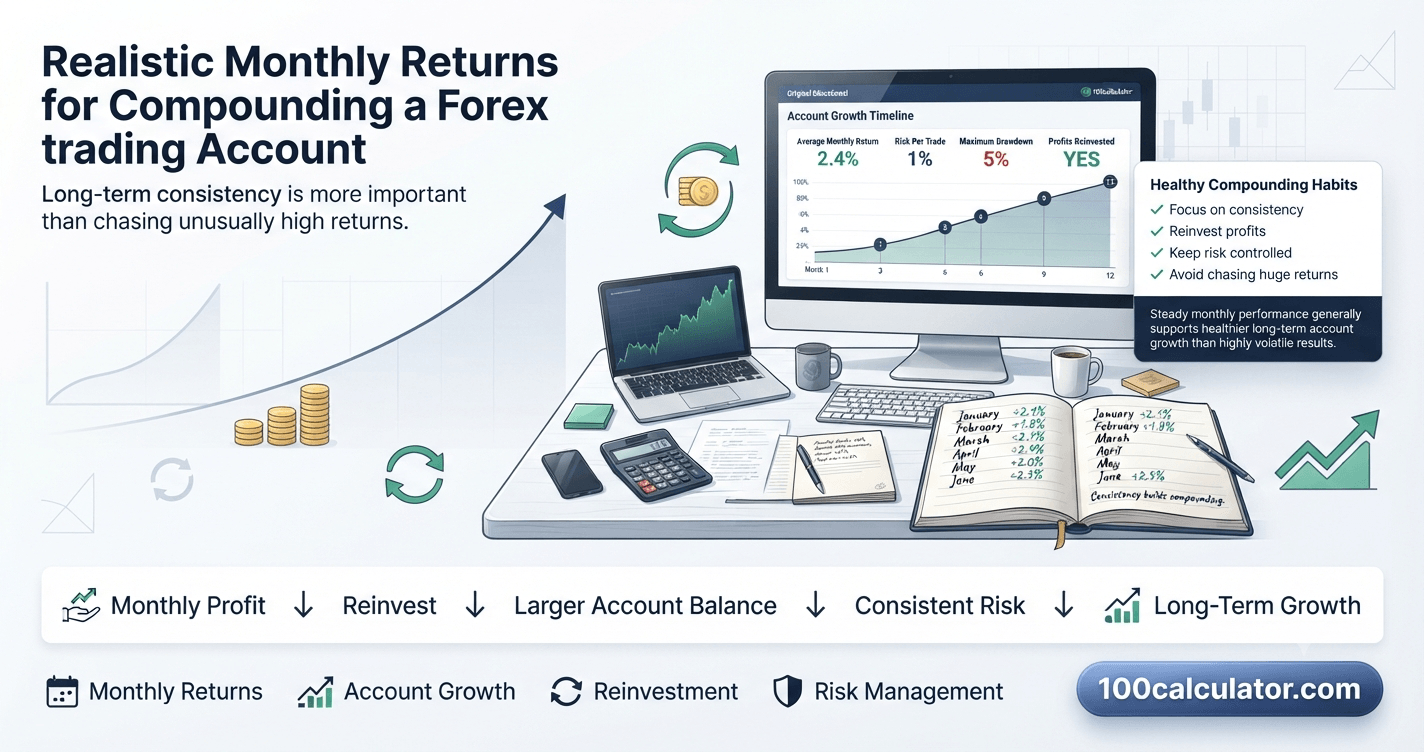
Search "forex compounding" and you'll run into two very different worlds. In one, someone claims they turned $500 into $50,000 in a few months. In the other, professional traders talk about being satisfied with a few percent a month, year after year. Only one of those worlds holds up once you actually run the numbers.
A realistic monthly return for a compounding forex account typically falls between 1% and 6%, depending on strategy, risk tolerance, and account size. Returns that consistently exceed 10% a month are extremely rare, and claims of doubling an account every few weeks almost always involve enormous risk, cherry-picked results, or outright fraud.
That range might look small next to what some trading ads promise, but compounding is patient math, not a shortcut. A steady 2% a month, reinvested consistently, still turns $1,000 into about $1,268 after a year and roughly $2,040 after three years — without a single lucky month required.
This guide walks through how compounding actually works in a forex account, what monthly returns are genuinely achievable, why drawdowns hurt more than they look, and how to build a plan around numbers you can sustain. If you want to run your own numbers as you read, 100 Calculator's Forex Compounding Calculator does the month-by-month math for you.
Understanding Compounding in a Forex Account
Before getting into what counts as "realistic," it helps to be clear on what compounding actually means inside a trading account, since it works a little differently than it does in a savings account. If you'd like the deeper mechanics behind this, our guide on how forex compounding grows a trading account is a good companion to this one.
What Compounding Actually Means
Compounding means your gains start generating their own gains. If a $1,000 account grows 5% in a month, you don't just have $1,050 sitting there — if you leave it in the account, next month's 5% return applies to $1,050, not the original $1,000. Each month's return is calculated on a slightly larger base than the one before it.
Over a handful of months, this barely matters. Over a year or more, it starts to matter quite a bit, which is exactly why compounding is treated as a long-term strategy rather than a quick-money technique.
Compounding vs. Simple Growth
Simple growth adds the same dollar amount every period. Compounding adds a percentage of a growing balance, so the dollar amount itself increases over time even if the percentage return stays exactly the same.
Say you earn 5% a month on a $1,000 account. With simple growth — withdrawing the profit every month and starting fresh at $1,000 — you'd make $50 a month, or $600 after 12 months. With full compounding, that same 5% a month grows the account to about $1,796 after 12 months: a $796 gain, nearly a third more than simple growth, purely from letting profits stay invested.
Why Forex Compounding Isn't Like a Savings Account
A savings account compounds a fixed, guaranteed interest rate. A forex account compounds a return that changes every month, can be negative, and depends entirely on your own trading decisions. That difference matters in a few practical ways:
- A savings account's compounding curve only ever goes up.
- A forex account's compounding curve can go up, sideways, or down, and a single bad month can undo several good ones.
- The "rate" in a forex account isn't set by a bank — it's the result of your strategy, your risk management, and how the market behaved that month.
This is also why realistic forex return expectations need to build in some cushion for losing months, rather than assuming every month looks like the best one.
Why Realistic Targets Matter More Than Big Wins
It's tempting to search for the highest monthly return you can find and treat it as a goal. In practice, the size of the target you chase has a lot to do with whether you keep your account at all.
The Problem With "Double Your Account" Claims
A 10% monthly return compounded for a year turns $1,000 into roughly $3,138. Compounded for three years, that same 10% a month turns $1,000 into more than $30,900. Numbers like that are exactly why "10% a month" claims spread so easily online — the math looks incredible on a spreadsheet.
The problem is sustaining it. A monthly return that high usually requires very large position sizes relative to the account, very high leverage, or both — and both of those also increase how much a single bad month can take away. Strategies chasing this kind of return rarely survive more than a handful of months before a large loss erases the gains that came before it.
What Broker and Regulator Disclosures Show
This isn't just theory. In the European Union, brokers offering forex and CFD trading to retail clients must publish, directly on their websites, the share of client accounts that lost money over the reporting period — and those figures commonly land somewhere in the 70s to high-80s percent range. (ESMA) In the United States, forex dealers must give retail customers a risk disclosure that includes the percentage of the dealer's accounts that were profitable versus not profitable each quarter. (NFA)
None of this means trading forex well is impossible — plenty of disciplined traders are consistently profitable. It does mean any return target should be built around what a realistic minority actually sustains, not what a promotional screenshot implies is normal.
What's a Realistic Monthly Return for Retail Forex Traders?
"Realistic" isn't one single number — it depends on strategy, risk tolerance, and how much of the account you're willing to put at risk on any one trade. It helps to think in terms of a few general profiles instead of chasing a single target.
Conservative
1–3% / month
Capital preservation first
Smaller risk per trade, fewer trades, and a focus on protecting the account over chasing speed.
Moderate
3–6% / month
A common target for disciplined traders
Reflects a tested strategy, consistent risk management, and a track record across more than a few months.
Aggressive
6–10%+ / month
Rarely sustainable long-term
Usually requires larger risk per trade or higher leverage, which raises the odds of a large drawdown.
These ranges aren't a formula or a guarantee — they're a general way to frame expectations, based on how trading education commonly categorizes retail results. A trader with a genuine, tested edge and strict risk management might land in the moderate range consistently. A trader chasing the aggressive range for long periods is usually taking on risk that eventually catches up with the account.
How Account Size Changes What's Realistic
Percentage targets get harder to sustain as an account grows, for a very practical reason: position sizing and liquidity. A $1,000 account chasing 5% a month needs to make $50 — often achievable with a handful of well-timed trades. A $500,000 account chasing that same 5% needs to make $25,000 a month, which usually requires larger positions, more trades, or both, and both introduce more slippage and more chances for a single mistake to cost more.
This is one reason experienced fund managers tend to target and report comparatively modest annual returns relative to what many retail traders assume is normal — a large pool of capital simply can't move in and out of positions as nimbly as a small one can.
The Compounding Math, Explained
The concept of compounding is simple once you see the formula and a worked example side by side.
The Compound Growth Formula
This is the same formula behind 100 Calculator's Forex Compounding Calculator, and behind every projection in this guide.
The Formula
Final Balance = Starting Balance × (1 + Monthly Return) ^ Number of Months
Starting Balance — the amount in the account at month zero
Monthly Return — your average return per month, written as a decimal (5% = 0.05)
Number of Months — how many months you compound for
Worked Example: $1,000 at Different Monthly Rates
Here's how a $1,000 account grows at three different monthly rates, assuming every dollar of profit stays in the account:
| Monthly Return | After 3 Months | After 6 Months | After 12 Months |
|---|---|---|---|
| 2% | $1,061.21 | $1,126.16 | $1,268.24 |
| 5% | $1,157.63 | $1,340.10 | $1,795.86 |
| 10% | $1,331.00 | $1,771.56 | $3,138.43 |
Notice how much the gap widens over time. At 3 months, the difference between 2% and 10% a month is a few hundred dollars. At 12 months, it's nearly $1,900. That gap is exactly why monthly return assumptions matter so much for long-term projections — small differences early on turn into large differences later.
Free Online Tool
Run your own compounding numbers
100 Calculator's Forex Compounding Calculator projects how your account grows month by month at any starting balance and return rate, so you can compare scenarios before committing real capital.
Visualizing the Compounding Curve
Numbers in a table tell the story, but a chart makes the shape of compounding easier to see at a glance. The chart below tracks a $1,000 account over 12 months at 2%, 5%, and 10% monthly returns.
This curve is the whole argument for realistic targets in one picture. A monthly return that looks only slightly more aggressive on paper — 5% instead of 2%, or 10% instead of 5% — produces a dramatically different curve by month 12, because compounding rewards, and punishes, small differences repeatedly, not just once.
Why Drawdowns Hurt Compounding More Than They Look
Compounding works in both directions. The same math that makes consistent gains grow faster also makes losses more expensive to recover from, and that asymmetry is one of the most overlooked parts of building a realistic plan.
The Math of Loss Recovery
A loss and the gain needed to undo it are never the same percentage, because the loss shrinks the balance you're calculating the recovery gain from. Losing 10% only requires an 11.1% gain to get back to even. Losing 50% requires a 100% gain — the account has to double just to return to where it started.
| Account Loss | Gain Needed to Break Even |
|---|---|
| 10% | 11.1% |
| 20% | 25.0% |
| 30% | 42.9% |
| 40% | 66.7% |
| 50% | 100.0% |
| 70% | 233.3% |
This is exactly why 100 Calculator built a dedicated Drawdown Recovery Calculator — the relationship between losses and required gains isn't obvious until you see it laid out, and it changes how most traders think about risk per trade.
How One Bad Month Can Erase Months of Gains
Say a trader compounds a $1,000 account at 5% a month for six straight months, reaching roughly $1,340. A single 30% loss in month seven drops that balance to about $938 — lower than where the account started. Six months of consistent, disciplined gains, undone by one month of oversized risk.
This is why a realistic monthly target always has to be paired with a realistic loss limit. A plan that can produce 5% in a good month but also lose 30% in a bad one isn't really averaging 5% a month at all — it's taking on far more risk than the average return suggests. Losing a large position quickly can also trigger a margin call; our guide on what happens when you get a margin call in forex walks through exactly how that plays out.
Position Sizing and Leverage: The Real Ceiling on Returns
If drawdown math explains why big losses are so costly, position sizing and leverage explain where those big losses usually come from.
Leverage Magnifies Both Gains and Losses
Leverage lets you control a larger position than your account balance would otherwise allow, which is exactly why it can produce outsized monthly returns — and outsized monthly losses. Regulators restrict retail leverage for this reason: the NFA caps leverage at 50:1 on major currency pairs for U.S. retail accounts, while ESMA limits it to 30:1 for retail clients trading major pairs in the European Union.
Higher leverage isn't automatically reckless, but it does mean smaller price moves have a bigger impact on your balance in both directions. A realistic monthly target should assume the leverage you actually plan to use, not the maximum your broker allows. Our guide on how margin and leverage work together in forex breaks this relationship down in more detail, and 100 Calculator's Forex Margin Calculator shows exactly how much margin a position requires at a given leverage.
The Risk-Per-Trade Rule and Its Effect on Growth
Many experienced traders risk somewhere between 0.5% and 2% of their account balance on any single trade, specifically so a string of losses doesn't create a drawdown deep enough to threaten the whole account. That same rule caps how fast the account can realistically grow, because your position size — and therefore your potential profit — is tied directly to that risk limit.
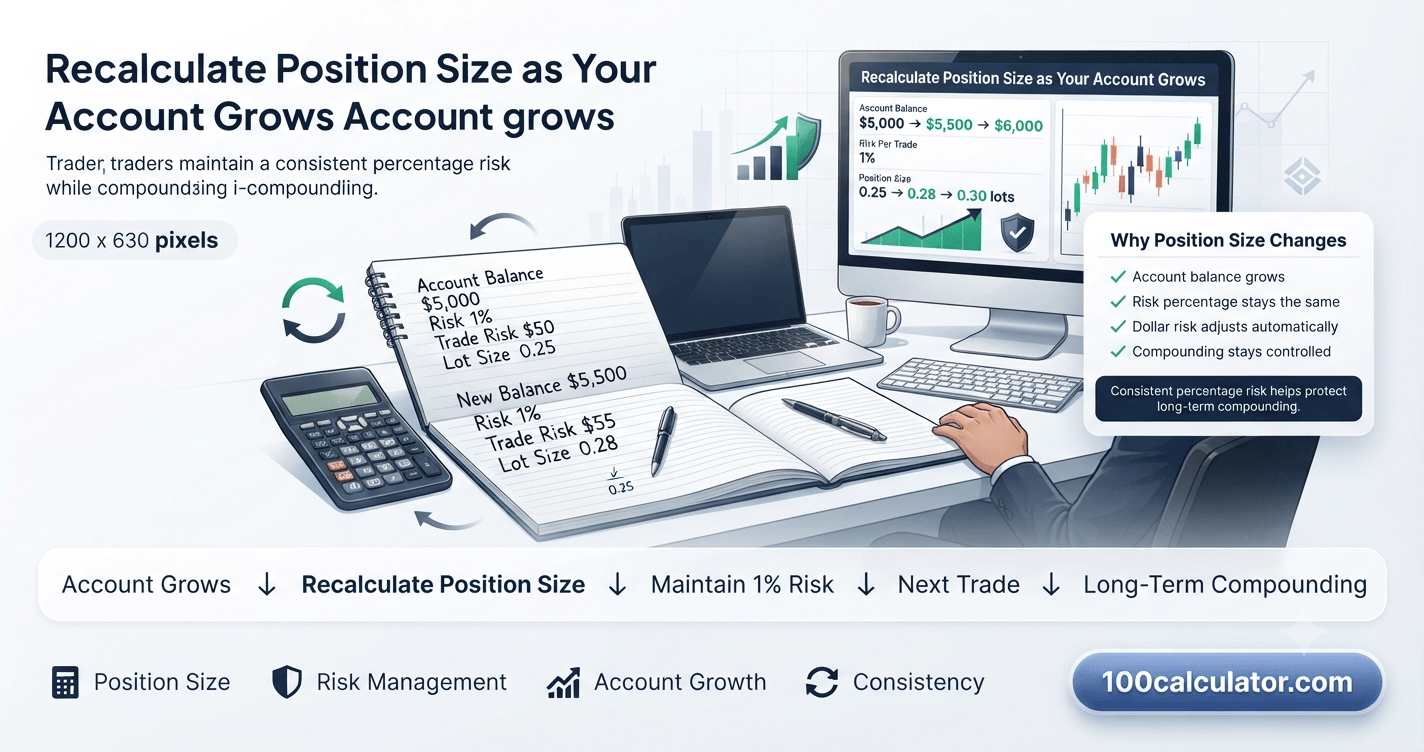
Recalculating position size as the balance changes is part of what makes compounding work correctly. A $1,000 account risking 1% per trade risks $10; once that account grows to $1,500, 1% is $15. 100 Calculator's Position Size Calculator and Forex Lot Size Calculator handle that recalculation automatically, so the math doesn't have to be redone by hand every time the balance changes.
Position size also depends on how lot size and pip value interact for the currency pair you're trading. Our guides on how to choose the right forex lot size for your account and how lot size and pip value work together in forex cover this in more depth, and 100 Calculator's Pip Value Calculator shows exactly what a pip is worth in your account currency before you enter a trade.
Reinvesting vs. Withdrawing Profits: How Each Changes Growth
Compounding assumes profits stay in the account, but that's a choice, not a requirement. How you handle monthly profit changes your growth curve significantly.
Full Reinvestment
Leaving every dollar of profit in the account maximizes the compounding effect, which is why all the growth examples earlier in this guide assume full reinvestment. The tradeoff is that your risk exposure grows right along with your balance — a 1% risk-per-trade rule on a $1,000 account risks $10, but that same rule on a $5,000 account risks $50. Full reinvestment usually suits smaller accounts still building toward a specific balance target, where maximizing growth matters more than protecting an already-large amount of capital.
Partial Withdrawal Strategies
Some traders withdraw profits above a set threshold each month — for example, keeping the account at a fixed size and withdrawing anything earned beyond that — which slows compounding but locks in gains and keeps the account's risk exposure from growing indefinitely. Others withdraw a fixed share of profit, such as half, and reinvest the rest, blending growth with some cash taken off the table.
There's no universally correct choice here; it depends on whether the goal is growing the account as large as possible or generating usable income from it. 100 Calculator's Trading Compound Interest Calculator lets you model both approaches side by side, including regular withdrawals, so you can see the long-term difference before deciding.
Related Calculators
Put what you just read into practice, try these free tools instantly, no sign-up required.
Forex Compounding Calculator
Project compounded growth of your forex trading account.
Forex Swap & Rollover Calculator
Calculate overnight swap and rollover fees on forex positions.
Forex Lot Size Calculator
Find the ideal lot size based on your account and risk.
Forex Margin Calculator
Calculate the margin required to open a forex position.
Pip Value Calculator
Calculate the value of a pip for any currency pair and lot size.
Common Compounding Mistakes to Avoid
Most blown-up compounding plans don't fail because of one catastrophic trade. They fail because of a handful of small, repeated habits that quietly work against the math.
- Chasing an outsized target. A monthly goal built around your best month ever isn't a target — it's a best case.
- Sizing up after a winning streak. Confidence, not a plan, is often what's driving the largest position size of the month.
- Ignoring trading costs. Spread, commission, and swap or rollover charges are small per trade but add up across a month. See our guides on how forex swap is actually calculated and how overnight rollover fees affect forex trades.
- Trading without a fixed risk rule. Without one, every month's result depends on luck as much as skill.
- Revenge trading after a loss. Increasing size or frequency to "win it back" quickly is one of the most common ways a manageable drawdown turns into a large one.
- Benchmarking against other people's best months instead of tracking a personal average over time.
- Forgetting to resize positions. Trading the same lot size regardless of balance either under-risks a growing account or over-risks a shrinking one.
Building a Realistic Compounding Plan
Once you understand the math and the common failure points, building an actual plan comes down to a short list of concrete steps.
- Review your strategy's real historical performance — or paper-trade it for a few months — before assuming any specific monthly return.
- Set a target range, not a single number. "2% to 5% a month" is a plan; "5% a month, every month" is a wish.
- Define a fixed risk-per-trade percentage and write it down somewhere you'll actually see it before placing trades.
- Recalculate position size every time your balance changes meaningfully, rather than trading the same lot size regardless of account growth.
- Decide your reinvestment and withdrawal policy before you start, not after a particularly good or bad month makes the decision emotional.
- Track monthly results, not just individual trades, so you can see your real average return and real worst month side by side.
- Review performance quarterly and adjust your target range based on actual data rather than how the last few weeks felt.
Using a Forex Compounding Calculator to Model Your Growth
Every table and chart in this guide was built using the same math a compounding calculator uses. Running your own numbers takes the guesswork out of planning.
100 Calculator's Forex Compounding Calculator projects your account balance forward month by month at any starting balance, return rate, and time horizon — the fastest way to sanity-check a target range before trading real money. A few other tools on the site cover the specific pieces of the plan discussed in this guide:
- Position Size Calculator — recalculates how large a position to take, based on your balance and risk-per-trade percentage
- Forex Lot Size Calculator — converts a dollar risk amount into the right lot size for a given currency pair
- Pip Value Calculator — shows exactly what a pip is worth in your account currency before you enter a trade
- Forex Margin Calculator — checks how much margin a position requires at your chosen leverage
- Drawdown Recovery Calculator — shows exactly how much gain a given loss will require to break even
- Forex Swap Calculator — estimates overnight swap or rollover costs for positions held longer than a day
There's no calculator that can guarantee a specific monthly return — that part is still up to your strategy and discipline. What these tools can do is remove the guesswork from the math, so the target you're compounding toward is based on real numbers instead of hope.
Investment risk disclaimer: This article is for general educational purposes only and isn't financial or investment advice. Forex trading involves substantial risk of loss, including the potential loss of your entire investment, and isn't suitable for every investor. The monthly return ranges, examples, and calculations in this guide illustrate how compounding math works — they aren't predictions or guarantees of what any strategy will achieve. Past results and hypothetical examples don't indicate future performance. Consider your own financial situation and risk tolerance, and consult a licensed financial professional before trading with real capital.
Sources & References
This guide explains general compounding math and widely documented retail trading risk. For official guidance on forex regulation and risk in your region, these resources are a reasonable starting point:
- U.S. Commodity Futures Trading Commission (CFTC) — retail forex regulation and risk disclosure requirements
- National Futures Association (NFA) — investor education and forex dealer due-diligence resources
- European Securities and Markets Authority (ESMA) — retail leverage limits and CFD risk-warning requirements
More From Our Forex Guide
Want to go deeper on the pieces that make a compounding plan work? These related guides cover the mechanics referenced throughout this article.
Frequently Asked Questions
What is a realistic monthly return for a compounding forex account?
A realistic monthly return for most retail traders falls between 1% and 6%, depending on strategy, risk tolerance, and account size. Many disciplined traders with a tested strategy land in the 3% to 6% range consistently. Returns above 10% a month are extremely rare to sustain over the long run, and any strategy or signal service promising much more than that should be treated with real skepticism until it's backed by verified, audited results over at least a year.
How does compounding work in a forex trading account?
Compounding means each month's percentage return is calculated on your current balance, not your original starting balance. If you leave your profits in the account instead of withdrawing them, next month's return applies to a slightly larger amount, so the account grows faster over time than it would with the same percentage applied to a fixed starting balance every month.
Is a 10% monthly return in forex realistic?
A 10% monthly return is possible in an individual month, but sustaining it consistently is extremely difficult and rare. Compounded over a year, 10% a month turns $1,000 into more than $3,100; over three years, that same rate turns $1,000 into more than $30,000, which is why the claim is so common in marketing. In practice, strategies aiming for returns that high usually carry proportionally larger risk, and most don't survive more than a handful of months before a large loss erases the gains.
Can you really compound gains consistently while trading forex?
Yes, but "consistently" usually means a modest, repeatable monthly range rather than the exact same number every month. Real compounding in a trading account looks like a mix of winning and losing months that average out to a positive return over time, managed with a fixed risk-per-trade rule so losing months stay small enough for the winning months to outweigh them.
Why do so many forex traders fail to compound their accounts successfully?
The most common reasons are chasing unrealistic monthly targets, increasing position size emotionally after a win streak, trading without a fixed risk-per-trade rule, and revenge trading after a loss. Any one of these can turn a single bad month into a drawdown large enough to erase months of previous gains, which breaks the compounding effect the account was building.
How much can a $1,000 forex account grow in a year with compounding?
It depends entirely on the monthly return. At a conservative 2% a month, $1,000 grows to about $1,268 after a year. At a moderate 5% a month, it grows to about $1,796. At an aggressive, and hard to sustain, 10% a month, it would reach about $3,138. These figures assume every month is profitable and all profit stays in the account, which real trading rarely does.
Does leverage help or hurt compounding returns?
Leverage can do both. It lets a smaller account control a larger position, which can increase monthly returns, but it increases losses by the same proportion. Regulators cap retail forex leverage for this reason: the NFA limits it to 50:1 on major pairs in the U.S., and ESMA limits it to 30:1 in the EU. Higher leverage should match your actual risk tolerance, not just the maximum your broker allows.
How do drawdowns affect a compounding forex account?
Drawdowns affect compounding more than they first appear to, because the percentage gain needed to recover a loss is always larger than the loss itself. A 20% loss needs a 25% gain to break even, and a 50% loss needs a 100% gain. Large drawdowns can erase months of steady compounding in a single bad month, which is why limiting drawdown size matters as much as chasing return.
Should I reinvest all my forex trading profits?
Full reinvestment maximizes compounding growth, which makes sense for smaller accounts still working toward a target balance. As an account grows, some traders shift to withdrawing part of their profit each month, which slows growth but locks in gains and keeps risk exposure from increasing indefinitely. The right approach depends on whether the goal is maximum growth or generating usable income.
What's the difference between compounding and simple growth in trading?
Simple growth adds the same dollar amount each period, usually because profits are withdrawn rather than reinvested. Compounding applies each period's percentage return to a growing balance, so the dollar amount increases over time even at the same percentage return. Over many months, compounding produces meaningfully more growth than simple growth at the identical return rate.
How does position size affect how much I can realistically compound?
Position size, combined with your risk-per-trade percentage, determines how much you can gain or lose on any single trade. A fixed risk-per-trade rule, commonly 0.5% to 2% of the account, caps how fast the account can grow, because your profit potential is tied directly to that risk limit. Recalculating position size as the balance changes keeps that risk percentage consistent as the account compounds.
What monthly return should a beginner forex trader target?
Beginners are usually better off targeting the lower end of the realistic range, often 1% to 3% a month, while they're still building consistency and refining risk management. Chasing a higher target before a strategy has a proven track record tends to lead to oversized positions and larger-than-planned losses, which is a common reason new accounts don't survive their first year.
Do swap and rollover fees affect compounding returns?
Yes. Swap and rollover fees apply to positions held open overnight and are charged or credited based on the interest rate difference between the two currencies in a pair. These costs are usually small per trade but add up across a month, especially for strategies that hold positions for several days, so they should be included when calculating your real average monthly return.
How long does it take to double a forex account through compounding?
It depends on the monthly return. At 2% a month, doubling takes about 35 months, just under three years. At 5% a month, it takes about 14 months. At 10% a month, it takes roughly 7 months — but sustaining 10% a month for that long is extremely rare in practice, which is why the more conservative timelines are the more realistic ones to plan around.
What's the safest way to grow a small forex account through compounding?
The safest approach combines a modest monthly target, often 1% to 3%, a fixed risk-per-trade rule of 1% or less, full reinvestment while the account is still small, and consistent monthly tracking so you know your real average return rather than relying on memory of your best months. Growing slowly with a plan you can actually sustain tends to outlast strategies built around a single aggressive target.
About 100 Calculator
100 Calculator is a free hub of online calculators and educational guides covering health, finance, trading, forex, crypto, education, and more. Every tool is built to be fast, accurate, and genuinely free, with no account or signup required.
We built this guide, and tools like the Forex Compounding Calculator referenced throughout it, to make trading math easier to understand before real money is on the line. Head back to the 100 Calculator homepage to explore the full library of tools, or learn more about the team behind them on our About Us page.