What Is Forex Swap and How Is It Actually Calculated?
A beginner-friendly breakdown of what forex swap actually is, why it exists, the exact formula brokers use to calculate it, and what it means for your open positions overnight.
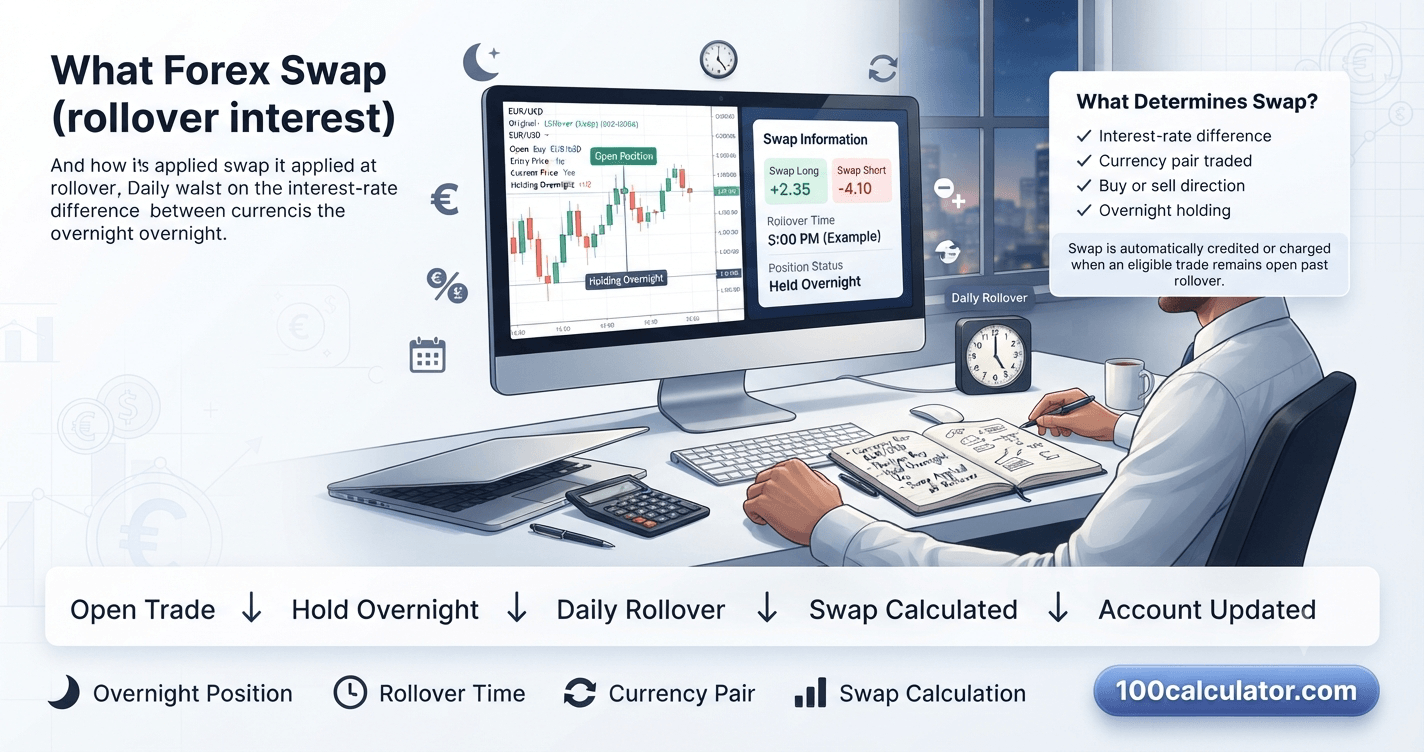
Open a forex position and hold it past your broker's daily cutoff, and something happens to your account balance that has nothing to do with where the price moved. That's swap, and it catches plenty of new traders off guard the first time they spot it on a statement.
A forex swap, also called a rollover, is the interest a trader earns or pays for holding a currency position open overnight. It comes from the interest rate gap between the two currencies in the pair you're trading, plus a small markup most brokers add for handling the transaction. Hold a position past the daily rollover time, usually around 5 p.m. New York time, and a swap gets applied automatically: credited to your account or deducted from it, depending on your position and which currency pays more interest.
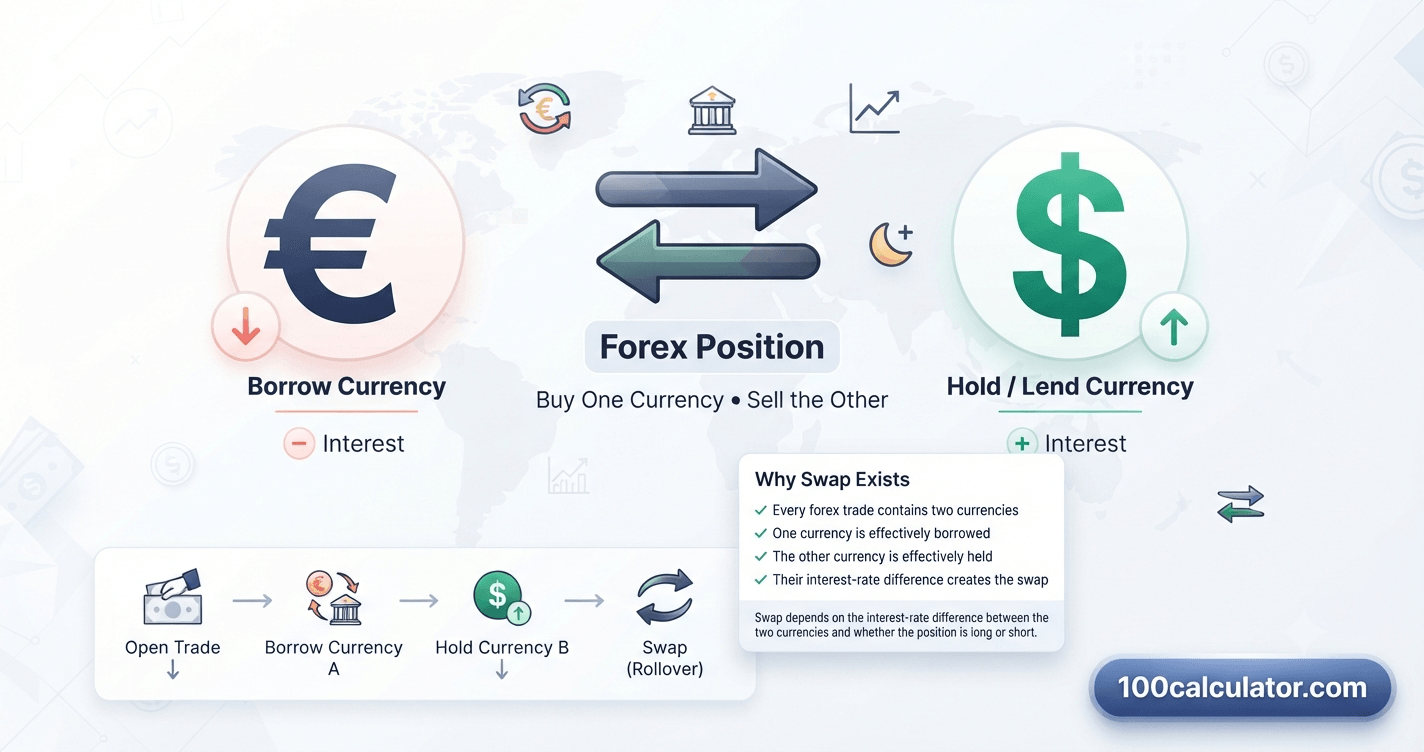
This isn't a fee your broker invented out of nowhere. It comes from something real about how currency trading works: buy one currency and sell another, and you're effectively borrowing the currency you sold while holding the one you bought. Borrowing costs interest. Holding, in effect, lending, earns it. Swap is simply the net of the two.
This guide walks through exactly how forex swap gets calculated, why some brokers charge triple swap on Wednesdays, what a swap-free account actually changes, and how to check the swap rate on any pair before you open a trade. If you'd rather see the number directly, 100 Calculator's Forex Swap & Rollover Calculator does the math for you in seconds.
What Is a Forex Swap?
Forex swap goes by a few different names depending on the broker and platform you use: swap, rollover, overnight fee, financing charge. They all point to the same mechanic, so once you understand one, you understand all of them.
Key Terms You'll See on Your Statement
A handful of terms come up constantly once you start looking at swap rates, and knowing them makes the rest of this guide much easier to follow.
- Base currency and quote currency. In EUR/USD, EUR is the base currency and USD is the quote currency. You're always buying one and selling the other.
- Long and short. Going long means buying the base currency. Going short means selling it. Swap rates almost always differ depending on which side you're on.
- Swap long and swap short. Most brokers list two separate swap values for every pair, one for long positions and one for short positions, because the interest rate differential works in opposite directions depending on which currency you're buying.
- Pip and point. A pip is the smallest standard price move for a currency pair, usually the fourth decimal place. Many brokers now quote an extra decimal, called a point, so 10 points equal 1 pip.
- Value date. The date a trade is officially considered settled. Rollover pushes this date forward by one day every time a position stays open overnight.
Forex Swap vs. Rollover: Are They the Same Thing?
In everyday trading conversation, yes. Technically, "rollover" describes the process of extending a position to a new value date, and "swap" describes the interest amount that results from it. MetaTrader platforms label the line item "Swap." Some other platforms, including several US-based brokers, label it "Rollover" or "Financing" instead. Whatever it's called on your statement, it works the same way underneath.
Why Forex Swap Exists: The Interest Rate Differential
Swap isn't a fee your broker invented to squeeze a little extra revenue out of overnight traders. It comes from something real: every time you open a forex position, you're borrowing one currency to buy another.
Say you buy EUR/USD. You're effectively borrowing US dollars and using them to buy euros. Borrowing money isn't free, and holding money that someone else could have lent out usually earns interest. Your account gets charged interest on the dollars you borrowed and credited interest on the euros you're holding. Swap is simply the net of those two numbers.
Every Currency Pair Has Two Interest Rates
Each currency in a pair is tied to an interest rate set by that country's central bank, sometimes called the overnight rate or the benchmark rate. The Federal Reserve sets a rate for the US dollar, the European Central Bank sets one for the euro, the Bank of Japan sets one for the yen, and so on for every currency you can trade.
When the two rates in a pair sit close together, swap tends to be small. When they're far apart, like a low-yield currency paired against a much higher-yield one, swap tends to be larger in both directions.
Common Misconception: Swap Isn't a Random Broker Fee
It's easy to assume swap is just another cost brokers tack on, similar to a commission. In reality, most of the swap value comes directly from the interest rate differential between the two currencies. Brokers typically add a small markup on top, sometimes just a few tenths of a point, to cover their own cost of running the position. That markup is the part that's genuinely broker-specific. The bulk of the number reflects real interest rates set by central banks, not an arbitrary charge.
How Forex Swap Is Actually Calculated
You don't need to calculate raw interest rates yourself. Brokers do that work behind the scenes and publish a swap rate, in points, for every pair and direction in their contract specifications. From there, the calculation traders actually use is straightforward.
Swap Formula
Swap = (Pip Value × Swap Rate × Number of Nights) ÷ 10
Pip Value: The account-currency value of a single pip move for your position size.
Swap Rate: The number of points your broker credits or charges per lot, shown in the contract specifications.
Number of Nights: How many nights the position stays open, including any extra nights charged on the triple swap day.
Step-by-Step Example
Let's walk through a simple example using hypothetical numbers so you can see how the pieces fit together.
Suppose you sell (go short) 1 standard lot of EUR/USD, which is 100,000 units. For a pair quoted against the US dollar, 1 standard lot has a pip value of about $10, since each 0.0001 move in the exchange rate equals $10 on a position that size. If pip value is a new concept, our beginner's guide on pip value explained breaks it down further, and 100 Calculator's Pip Value Calculator can work it out for your exact position size.
Now suppose your broker's platform shows a swap rate of -3.2 points for a short EUR/USD position. Plugging that into the formula:
Swap = (10 × -3.2 × 1) ÷ 10 = -3.2
That means you'd pay about $3.20 for each night you hold the position. Hold it for three ordinary nights, and the total swap cost comes to roughly $9.60, before accounting for any triple-swap night. Our guide on how lot size and pip value work together shows how these numbers scale once you change your position size.
Where the Interest Rate Differential Comes From
Behind the scenes, brokers base their swap rates on overnight lending rates from the interbank market, the same rates banks use to borrow and lend currency to each other. These are adjusted based on central bank policy and market conditions, then passed through to your trading platform, usually with a small markup added. You don't need to track interbank rates yourself. Checking your broker's published swap rate before you trade tells you everything you need to know for that pair.
Positive Swap vs Negative Swap
Every open forex position falls into one of two categories overnight: it either earns swap or pays it, and the direction depends entirely on which currency you're holding and which one you're effectively borrowing against.
| Swap Type | What It Means | When It Happens |
|---|---|---|
| Positive swap | Your account is credited overnight | The currency you bought pays more interest than the one you sold |
| Negative swap | Your account is charged overnight | The currency you bought pays less interest than the one you sold |
When You Earn Swap (Positive Carry)
You earn a positive swap when the currency you bought has a higher interest rate than the currency you sold. Your account is credited a small amount for every night the position stays open.
When You Pay Swap (Negative Carry)
You pay a negative swap when the currency you bought has a lower interest rate than the currency you sold. In this case, the interest you owe on the borrowed currency outweighs what you earn on the currency you're holding, and the difference is deducted from your account.
The Carry Trade Strategy
Some traders build a strategy specifically around collecting positive swap, known as carry trading. The approach is simple in concept: buy a currency with a relatively high interest rate, sell one with a relatively low interest rate, and hold the position for an extended period to accumulate the daily credit. AUD/JPY has long been used as a textbook example in trading education, since the Australian dollar has historically carried a higher interest rate than the Japanese yen, though the actual relationship between any two currencies shifts as central banks adjust policy over time.
If you're modeling how a carry trade might grow over months rather than days, 100 Calculator's Forex Compounding Calculator and our guide on how forex compounding grows a trading account can help you see the bigger picture.
Triple Swap Days: Why Wednesday Hits Different
If you've ever noticed a swap charge roughly three times bigger than usual, there's a specific, predictable reason for it, and it has nothing to do with your broker trying to catch you off guard.
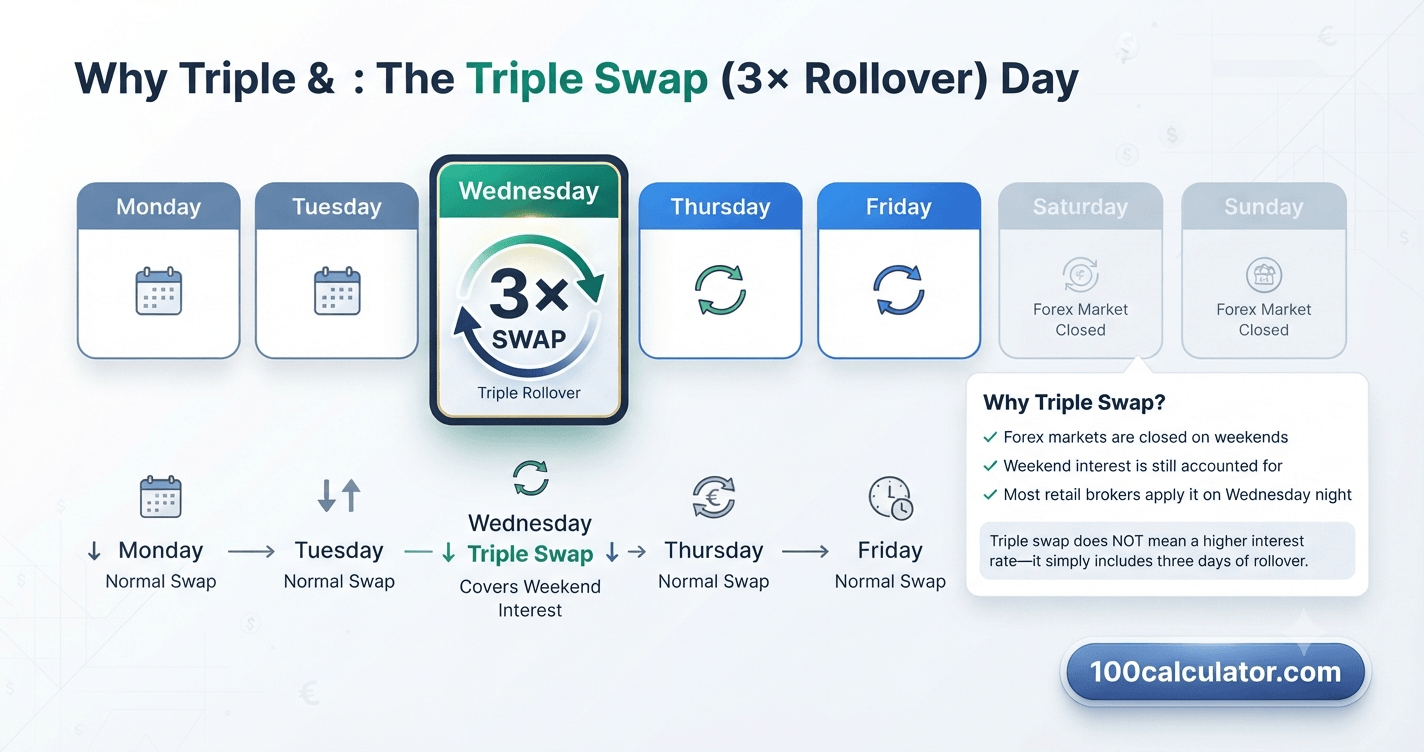
Currency trades in the spot market are conventionally set to settle two business days after they're opened, a standard often referred to as T+2. Retail forex brokers avoid ever actually settling trades by continuously rolling positions forward one day at a time, but the two-day settlement convention still shapes how swap is charged through the week. (Federal Register)
Banks are closed on Saturdays and Sundays, so a position opened on Wednesday would settle on Friday under the T+2 rule, while a position opened on Thursday wouldn't settle until the following Monday. To account for the extra weekend days of bank interest, most brokers apply three times the normal swap on Wednesday nights instead of trying to split it across the two closed days when no trading happens.
| Night Position Is Held | Nights of Interest Charged |
|---|---|
| Monday night | 1 night |
| Tuesday night | 1 night |
| Wednesday night | 3 nights (covers the weekend) |
| Thursday night | 1 night |
| Friday through Sunday | No separate charge; already covered by Wednesday's 3-night swap |
Swap-Free (Islamic) Forex Accounts
Charging or receiving interest conflicts with Islamic finance principles, which prohibit riba, or interest, on borrowed or lent money. Since a standard forex swap is fundamentally an interest payment, brokers created a workaround: the swap-free, or Islamic, account.
How Brokers Replace Swap on These Accounts
A swap-free account doesn't calculate or apply the standard interest-based swap on eligible instruments. That doesn't mean holding a position overnight is free, though. Brokers still need to cover their own cost of running the position, so they typically use one of a few alternatives instead:
- A fixed administration fee charged after a certain number of days, rather than every night
- A slightly wider spread on eligible pairs to make up the difference
- A flat holding fee that isn't structured as interest
The specific approach, and which instruments qualify, varies by broker, so it's worth reading the account terms carefully rather than assuming "swap-free" means "cost-free." Most regulated brokers that offer swap-free accounts make them available to any trader who requests one, not only traders who need Sharia compliance, though eligibility rules still vary.
What Affects Your Swap Rate
Swap rates aren't static, and they don't look the same across brokers, even for the exact same currency pair. A handful of factors drive the differences.
| Factor | How It Affects Swap |
|---|---|
| Central bank interest rates | A wider gap between the two currencies' rates generally means a larger swap in both directions |
| Position direction | The same pair almost always has different swap long and swap short values |
| Position size (lot size) | Swap is calculated per lot, so larger positions accumulate proportionally more |
| Broker markup | Each broker adds its own margin on top of the raw interest rate differential |
| Account currency | Swap is usually converted into your account's base currency, which can add a small conversion effect |
| Currency pair type | Major pairs tend to have tighter, more predictable swap rates than exotic pairs |
Lot size has one of the most direct effects, since swap scales with position size the same way pip value does. 100 Calculator's Forex Lot Size Calculator can help you see how adjusting your position size changes both your risk and your swap exposure, and our guide on choosing the right forex lot size walks through position sizing in more detail. If you're still getting comfortable with the different contract sizes, standard vs mini vs micro lots is a useful companion read.
How to Check Swap Rates Before You Trade
Checking the swap rate on a pair takes less time than placing the trade itself, and it's one of the easiest habits to build if you plan on holding positions overnight.
- Open the symbol's contract specifications on your trading platform. Most platforms list swap long and swap short values directly next to each instrument.
- Check your broker's website. Nearly every regulated broker publishes a swap rate table that's updated regularly.
- Confirm which day carries the triple swap. This is usually Wednesday, but it's worth confirming rather than assuming.
- Estimate the total for your planned holding period. Multiply the nightly swap by how many nights you expect to hold the position.
- Use a swap calculator to skip the manual math entirely. Enter your currency pair, position size, and direction, and it does the calculation for you.
Free Online Tool
Skip the manual math
100 Calculator's Forex Swap & Rollover Calculator estimates your overnight cost or credit based on your currency pair, position size, and holding period, right in your browser, with no account required.
Swap vs Other Forex Trading Costs
Swap is just one of several costs that come with forex trading, and it's easy to confuse it with the others if you're new to reading a trading statement.
| Cost | When It's Charged | Can It Work in Your Favor? |
|---|---|---|
| Spread | Every time you open a trade | No, it's always a cost |
| Commission | Per trade, on some account types | No, it's always a cost |
| Swap / rollover | Only if a position stays open past rollover | Yes, it can be a credit or a charge |
| Margin usage | Not a direct fee, but ties up account capital | Not a cost, but limits open positions |
Margin itself isn't a direct cost the way spread or swap is, but it determines how much of your capital gets tied up in a position, which affects how many trades you can hold at once. Our guide on how margin and leverage work together in forex explains the relationship, and 100 Calculator's Forex Margin Calculator can help you check how much margin a specific position requires before you open it. If a leveraged position moves against you, understanding what happens during a margin call matters just as much as tracking swap.
Common Mistakes Traders Make With Swap
Even experienced traders slip up on a few swap-related details. Here's what to watch for:
- Assuming swap works the same on every pair. Some pairs consistently favor one direction; others flip depending on current interest rate policy.
- Forgetting about the Wednesday triple charge. A position that looks cheap to hold Monday through Thursday can cost noticeably more if it crosses a Wednesday rollover.
- Chasing positive swap without considering price risk. A currency pair's daily price movement usually dwarfs the swap it pays or charges.
- Not checking swap before opening a long-term position. It's much harder to factor in after the fact than before you trade.
- Confusing swap with spread or commission. These are three separate costs that show up differently on your statement.
- Assuming a swap-free account has no overnight cost at all. It removes the interest-based swap specifically, not every possible fee.
Our guide on how overnight rollover fees affect forex trades looks at a few of these mistakes in more depth, especially for traders running swing or position trades.
Related Calculators
Put what you just read into practice, try these free tools instantly, no sign-up required.
Forex Compounding Calculator
Project compounded growth of your forex trading account.
Forex Swap & Rollover Calculator
Calculate overnight swap and rollover fees on forex positions.
Forex Lot Size Calculator
Find the ideal lot size based on your account and risk.
Forex Margin Calculator
Calculate the margin required to open a forex position.
Pip Value Calculator
Calculate the value of a pip for any currency pair and lot size.
Strategies to Manage Swap Costs
None of this means you need to avoid overnight positions altogether. A few habits make swap easier to manage, whichever side of it you tend to be on.
Closing Before Rollover
If your strategy doesn't need multi-day holds, closing every position before your broker's daily rollover time removes swap from the equation completely. This is the standard approach for most day traders.
Choosing Pairs With Favorable Swap
If you're planning to hold a position for an extended period anyway, checking the swap rate for both directions on a few candidate pairs before you commit can turn what would otherwise be a pure cost into a small tailwind. Just remember that swap should support a trade idea you already believe in, not replace one.
Matching Swap to Your Trading Style
How much swap matters to you depends heavily on your holding period. A scalper who's in and out within minutes will rarely think about it. A swing trader holding for several days will notice it on their statement. A position trader or carry trader holding for weeks or months needs to treat it as a real part of the overall return, alongside price movement, spread, and any commission paid along the way.
If you're holding positions long enough for swap and compounding to matter together, our guide on realistic monthly returns for compounding forex accounts is a useful next read, and 100 Calculator's Position Size Calculator can help make sure your position size still matches your risk tolerance over a longer hold.
Risk disclaimer: Forex and CFD trading involves significant risk and isn't suitable for every investor. Swap rates, spreads, and other trading costs vary by broker and change with market conditions, so always confirm current rates directly with your broker before trading. Nothing in this article is financial advice; consider speaking with a licensed financial professional before making trading decisions.
More From Our Forex Guide
Still building your understanding of forex costs, position sizing, and trading mechanics? These related guides dig deeper into the topics covered above.
Frequently Asked Questions
What is a forex swap in simple terms?
A forex swap, also called a rollover, is the interest you either earn or pay for holding a currency position open past your broker's daily cutoff, usually around 5 p.m. New York time. It comes from the interest rate difference between the two currencies in the pair you're trading, plus a small markup most brokers add. If the currency you bought pays more interest than the one you sold, you typically earn swap. If it's the other way around, you pay it.
Is forex swap the same thing as rollover?
Yes, in retail forex trading, "swap" and "rollover" are generally used to mean the same thing: the interest charged or credited for holding a position overnight. Some brokers use "rollover" to describe the mechanical process of extending the position to a new value date, and "swap" to describe the resulting interest amount, but in everyday trading conversation, the two terms are interchangeable.
How is forex swap actually calculated?
Most retail platforms calculate swap using a formula like swap equals pip value multiplied by the swap rate in points and the number of nights, divided by 10. Your broker publishes the swap rate for each pair and direction in its contract specifications, so you rarely need to calculate the raw interest rate differential yourself. The underlying rate reflects the gap between the two currencies' interest rates, adjusted by the broker's own markup.
Why do some brokers charge triple swap on Wednesdays?
Currency trades typically settle two business days after they're opened. Since banks are closed on weekends, a position opened on Wednesday would normally settle on Friday, but a position opened on Thursday wouldn't settle until the following Monday. To account for the two extra bank days of weekend interest, most brokers charge three times the normal swap on Wednesday nights instead of spreading it across Saturday and Sunday, when no trading happens.
What's the difference between a positive swap and a negative swap?
A positive swap means your account is credited overnight, which happens when the currency you bought pays a higher interest rate than the currency you sold. A negative swap means you're charged overnight, which happens when the currency you bought pays a lower interest rate than the one you sold. The same currency pair can be positive in one direction and negative in the other.
Can I avoid paying swap fees entirely?
You can avoid swap by closing every position before your broker's daily rollover time, which is a common approach for day traders who don't hold trades overnight. If you need to hold positions longer but want to avoid interest-based charges specifically, a swap-free (Islamic) account removes the swap calculation, though brokers typically apply a different fee, like a wider spread or admin charge, in its place.
What is a swap-free or Islamic forex account?
A swap-free account, also called an Islamic account, removes the overnight interest charge or credit that standard forex accounts apply, since charging or receiving interest conflicts with Islamic finance principles. Instead of a swap, brokers commonly apply a fixed administration fee after a set number of days, a slightly wider spread, or other adjustments. These accounts are typically available to any trader on request, not only Muslim traders, though eligibility and terms vary by broker.
Do all currency pairs have the same swap rate?
No. Swap rates differ for every currency pair and depend on the interest rate policies of each country's central bank, current market conditions, and the specific broker's markup. Pairs involving currencies with a large interest rate gap, like a low-yield currency against a high-yield one, tend to have larger swap values in either direction than pairs where both currencies have similar interest rates.
Does swap apply if I only day trade and never hold overnight?
No. Swap only applies to positions that are still open at your broker's daily rollover cutoff, typically around 5 p.m. New York time. If you close every trade before that time, no swap is calculated or applied to your account, regardless of how many trades you make during the day.
What is the carry trade strategy?
A carry trade is a strategy where a trader buys a currency with a higher interest rate while selling one with a lower interest rate, aiming to collect the positive swap over time in addition to any gains from price movement. It's a longer-term approach that depends on interest rate differentials staying favorable, and it carries real risk, since exchange rate moves can easily outweigh the swap earned.
How do I check the swap rate for a currency pair before trading?
Most trading platforms list swap long and swap short values for every instrument in the contract specifications or symbol properties window. You can also check your broker's website, which usually publishes a swap rate table, or use a dedicated tool like 100 Calculator's Forex Swap & Rollover Calculator to estimate the cost or credit for a specific position size and holding period.
Does lot size affect how much swap I pay or earn?
Yes. Swap is calculated per lot, so a larger position accumulates proportionally more swap than a smaller one, whether that swap is positive or negative. Trading 0.10 lots instead of 1.00 standard lot, for example, generally reduces the swap amount to roughly a tenth, assuming the swap rate and number of nights stay the same.
Is forex swap the same as a trading commission?
No. A commission is a fixed fee your broker charges for executing a trade, regardless of how long you hold the position. Swap is an ongoing interest charge or credit that only applies when a position stays open past the daily rollover time, and it can either cost you money or add to your account, depending on the direction of your trade and the currencies involved.
What time does forex rollover happen?
Most brokers apply rollover around 5 p.m. Eastern Time (New York time), which lines up with the close of the New York trading session and the start of a new trading day in the forex market. The exact cutoff can vary slightly by broker, so it's worth checking your specific platform's trading hours or contract specifications if precise timing matters for your strategy.
Can swap rates change from day to day?
Yes. Swap rates aren't fixed. They move with central bank interest rate decisions, shifts in market liquidity, and changes to a broker's own markup, so a pair that pays a positive swap today could pay less, or even flip to negative, in the future. If you're holding a position specifically to collect swap, it's worth checking the current rate regularly rather than assuming it stays the same.
Is a positive swap guaranteed profit?
No. A positive swap adds a small credit to your account each night you hold a qualifying position, but it's usually tiny compared to how much the currency pair's price can move. A single adverse price swing can easily wipe out weeks of accumulated positive swap, so it should be treated as a minor factor in a trading plan, not a reliable source of profit on its own.
About 100 Calculator
100 Calculator is a free hub of online calculators and educational guides covering health, finance, trading, forex, crypto, education, and more. Every tool is built to be fast, accurate, and genuinely free, with no account or signup required.
We built this guide, and tools like the Forex Swap & Rollover Calculator referenced throughout it, to make everyday trading questions a little easier to work through. Head back to the 100 Calculator homepage to explore the full library of tools, or learn more about the team behind them on our About Us page.