How to Choose the Right Forex Lot Size for Your Account
A practical, beginner-friendly walkthrough of the formula professional traders use to size every position, so your lot size always matches how much you actually meant to risk.
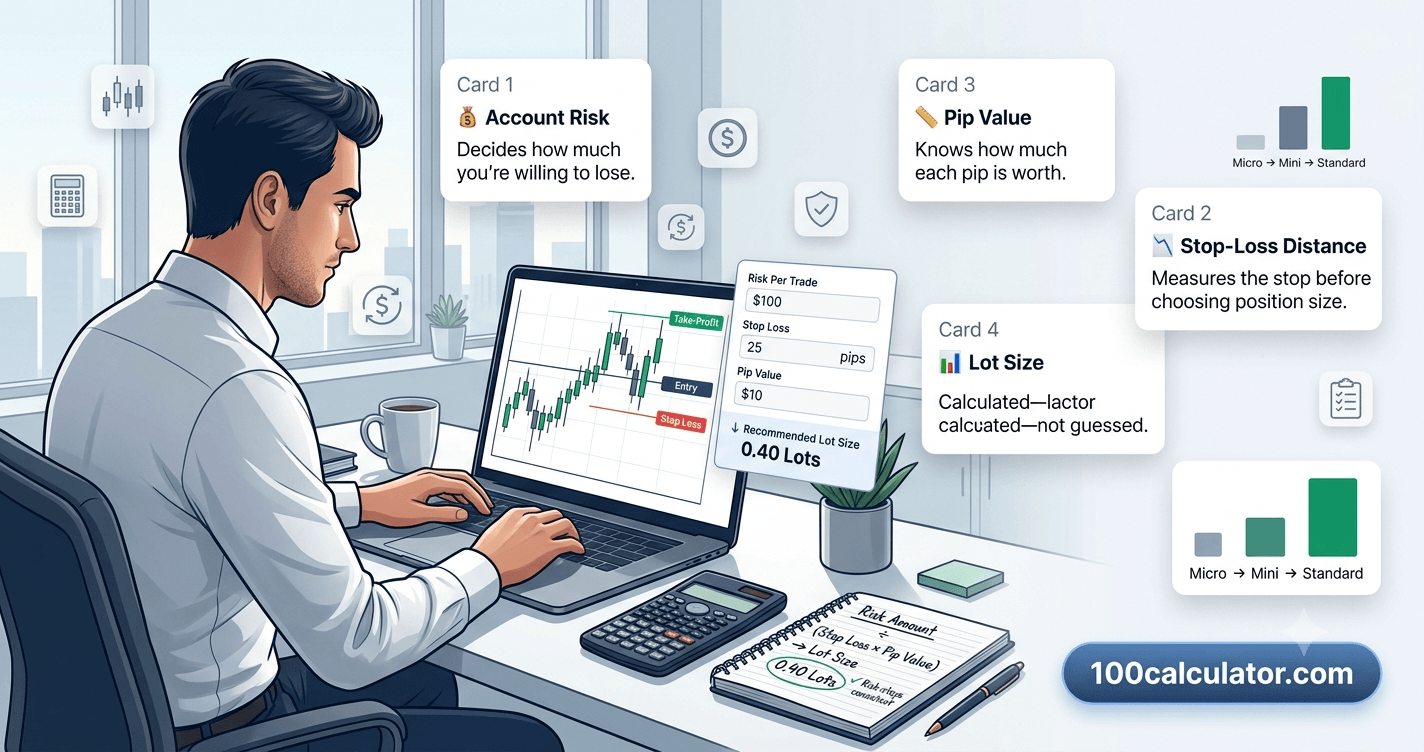
Forex lot size is the number of currency units you're buying or selling in a single trade, and it's the biggest lever you control over how much that trade can cost you. Pick a lot size that's too big for your account, and a completely normal price swing can wipe out weeks of gains in minutes. Pick one that's too small, and you're barely moving the needle even when you're right about the trade.
Lot size is set correctly when it makes your dollar risk match a number you already decided on, not whatever felt right in the moment. The formula is simple: divide the amount you're willing to risk by your stop-loss distance in pips, then divide that by the pip value of the lot type you're trading. Match the result to a standard, mini, micro, or nano lot, and your position size will always reflect exactly what you meant to risk.
This guide walks through what lot size actually means, the exact formula behind it, and how account size, leverage, and currency pair all change the number you land on. We'll work through real dollar-amount examples, cover the mistakes that trip up most new traders, and show how a Forex Lot Size Calculator can run this math for you in seconds once you understand what it's doing behind the scenes.
What Is Lot Size in Forex Trading?
A lot is a standardized contract size used to measure how much of a currency pair you're trading. Instead of quoting trades in raw currency units, brokers group them into lots, so "1 lot" means something consistent no matter which pair you're trading. The convention originated in interbank trading, where banks moved large blocks of currency to settle trade and manage exposure, and retail brokers later adopted the same structure for individual traders.
Lot size matters because it's the single biggest factor in how much money moves with every pip. Two traders can enter the exact same setup, at the exact same price, with the exact same stop-loss, and still end up with completely different outcomes purely because they chose different lot sizes.
Standard, Mini, Micro, and Nano Lots Explained
Forex lots come in four common sizes. Each one is a fraction of the size before it, which is what makes the market accessible to accounts of very different sizes.
| Lot Type | Units of Base Currency | Approx. Pip Value* | Typically Suits |
|---|---|---|---|
| Standard lot | 100,000 | $10.00 | Larger, experienced accounts |
| Mini lot | 10,000 | $1.00 | Small-to-mid accounts |
| Micro lot | 1,000 | $0.10 | Beginners, smaller accounts |
| Nano lot | 100 | $0.01 | Testing strategies with minimal exposure |
*Pip values shown are for major currency pairs quoted against the US dollar, such as EUR/USD or GBP/USD. Pip value changes for other pairs, which we'll cover later in this guide.
Nano lots aren't offered by every broker, so if you're working with an especially small account, it's worth confirming which lot sizes your broker actually supports before assuming nano lots are available.
Lot Size vs. Position Size: What's the Difference?
Traders often use "lot size" and "position size" interchangeably, but they describe slightly different things. Lot size is the unit you're measuring in (standard, mini, micro, or nano). Position size is the total exposure that results from it, meaning the lot size multiplied by the contract size, expressed in actual currency units or dollar value.
Why Lot Size Is the Most Important Decision You Make Per Trade
It's tempting to spend most of your prep time on entry timing, chart patterns, or indicators, and treat lot size as an afterthought. In practice, lot size decides whether a losing trade is a minor, expected cost of doing business or a genuine setback to your account.
Lot Size Controls Your Risk, Not Your Strategy
A good entry strategy still loses sometimes. That's normal, and no amount of skill removes losing trades from trading entirely. What lot size controls is how much any single loss, or string of losses, actually costs you. A string of losses at a sensible lot size is a normal drawdown. The same string of losses at an oversized lot size can turn into damage that takes far longer to recover from, which is exactly why large drawdowns are so hard to recover from.
The Most Common Lot Size Mistake New Traders Make
The single most common mistake is picking a lot size that feels right instead of one that's calculated. Traders often start with whatever lot size their platform defaults to, copy a size they saw someone else use, or simply trade the same lot size on every position regardless of the stop-loss distance. All three approaches disconnect lot size from actual risk, which means your real dollar exposure changes from trade to trade without you fully realizing it.
The Lot Size Formula Every Trader Should Know
Choosing the right lot size isn't guesswork once you know the formula. It comes down to three numbers you already control or can measure before you ever place the trade.
The Position Sizing Formula
Lot Size Formula
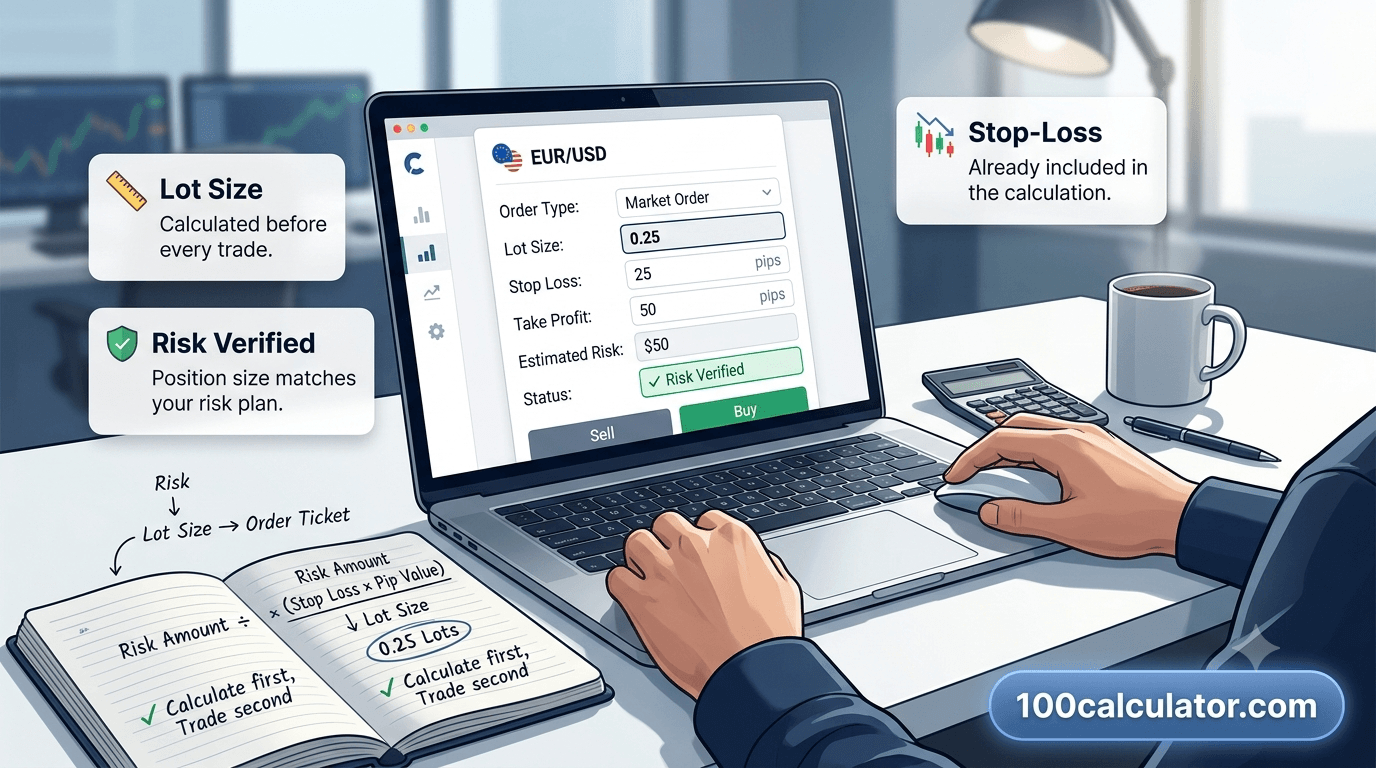
Lot Size = Risk Amount ÷ (Stop-Loss in Pips × Pip Value per Lot)
Risk Amount — the dollar amount you're willing to lose if your stop-loss is hit, commonly 1% to 2% of your account balance
Stop-Loss in Pips — the distance between your entry price and your stop-loss, measured in pips
Pip Value per Lot — how much one pip is worth for the lot type and currency pair you're trading
Understanding Pip Value in the Formula
Pip value is the one variable in this formula that isn't fixed. It depends on your lot size and, for many pairs, on the current exchange rate too. For currency pairs quoted with the US dollar as the second currency, like EUR/USD, GBP/USD, or AUD/USD, pip value per standard lot is a flat $10, no matter where the exchange rate sits. For other pairs, it shifts, which we'll unpack later in this guide. Our beginner's guide to pip value and Pip Value Calculator cover this in more depth if you want the full breakdown before moving on.
How to Calculate Your Lot Size Step by Step
Here's the formula broken into a repeatable process you can run before every trade:
- Decide your risk amount. Multiply your account balance by the percentage you're willing to risk on this one trade, commonly 1% to 2%.
- Set your stop-loss distance first. Base it on chart structure, like the distance to a recent swing high or low, not on a round number that feels comfortable.
- Find the pip value for one standard lot of the pair you're trading, either from memory for USD-quoted majors or from a pip value calculator for everything else.
- Divide your risk amount by your stop-loss distance in pips multiplied by the pip value you just found.
- Round down to your broker's smallest lot increment, usually 0.01 lots, so you never round your way into risking slightly more than planned.
Worked Examples: Lot Size in Real Trades
Formulas make more sense with real numbers attached. Here are three examples that walk through different accounts, stop-loss distances, and currency pairs.
Example 1: A $500 Account Trading EUR/USD
Risking 1% of a $500 account means risking $5 on this trade. The stop-loss, based on chart structure, sits 25 pips away. Since EUR/USD is a USD-quoted pair, pip value per standard lot is a flat $10.
| Variable | Value |
|---|---|
| Risk amount | $5 (1% of $500) |
| Stop-loss distance | 25 pips |
| Pip value (standard lot) | $10 |
| Calculation | $5 ÷ (25 × $10) = 0.02 lots |
A lot size of 0.02 is two micro lots. Even though it's a small number, it's precisely sized so that hitting the stop-loss costs exactly $5, not more and not less.
Example 2: Adjusting Lot Size for a Wider Stop-Loss
Now picture a $10,000 account, still risking 1% ($100) on EUR/USD. Chart structure sometimes calls for a tighter stop, and sometimes a wider one. Here's how the same risk amount plays out at two different stop-loss distances.
| Stop-Loss Distance | Calculation | Lot Size |
|---|---|---|
| 40 pips | $100 ÷ (40 × $10) | 0.25 lots |
| 80 pips | $100 ÷ (80 × $10) | 0.12 lots (rounded down from 0.125) |
Notice that doubling the stop-loss distance roughly halves the lot size, for the exact same dollar risk. This is the relationship worth remembering: a wider stop-loss doesn't mean more risk by itself, as long as you scale the lot size down to match it.
Example 3: A Cross-Currency Pair Like GBP/JPY
JPY pairs and cross pairs work a little differently because pip value shifts with the exchange rate. Assume GBP/JPY is trading at a level where each pip on a standard lot works out to about $6.50. That figure moves as the exchange rate moves, so it's always worth confirming the current number with a pip value calculator rather than assuming it stays fixed like it does on EUR/USD.
| Variable | Value |
|---|---|
| Account balance | $10,000 |
| Risk amount | $100 (1%) |
| Stop-loss distance | 50 pips |
| Pip value (standard lot, illustrative) | $6.50 |
| Calculation | $100 ÷ (50 × $6.50) = 0.30 lots |
Same risk percentage, same account, but a noticeably different lot size than the EUR/USD example, purely because the pip value is different. This is exactly why our guide on how lot size and pip value work together is worth reading before you trade JPY pairs regularly.
Using a Forex Lot Size Calculator (The Fast Way)
Once you understand the formula, running it by hand before every single trade gets tedious, and tedious math is exactly where mistakes creep in, especially on JPY pairs or crosses where pip value isn't a round number.
What to Enter Into the Calculator
A lot size calculator typically asks for four things:
- Your account balance
- Your risk percentage or a fixed dollar risk amount
- Your stop-loss distance in pips
- The currency pair you're trading
Why a Calculator Beats Manual Math Under Pressure
Markets move quickly, and doing arithmetic while a setup is forming is exactly when small mistakes happen, like transposing digits or forgetting that a JPY pair needs a different pip value than the USD-quoted pairs you're used to. A calculator removes that risk and lets you spend your attention on whether the trade setup itself is actually a good one.
Free Online Tool
Skip the manual math
100 Calculator's Forex Lot Size Calculator runs the exact formula from this guide. Enter your account balance, risk percentage, stop-loss in pips, and currency pair, and it returns the lot size instantly, with no account or signup required.
How Your Account Size Should Shape Your Lot Size
Account size doesn't set your lot size directly, the formula still does that, but it does shape which lot types you'll realistically be using most often.
Small Accounts (Under $1,000)
Micro and nano lots are usually the practical choice here. Even with a full standard lot's worth of stop- loss distance, a single micro lot keeps each pip movement small relative to the account, which gives you room to use a sensible stop-loss without the account being unable to support it.
Medium Accounts ($1,000–$10,000)
This range typically mixes micro and mini lots, occasionally stretching into a fraction of a standard lot depending on the stop-loss distance and pair. This is also a common range where traders start paying closer attention to how compounding grows a trading account over time, since consistent, appropriately sized risk is what makes compounding possible in the first place.
Larger Accounts (Above $10,000)
Standard lots become genuinely usable here without turning a single trade into an outsized share of the account. That said, the formula still runs the show. A larger account doesn't mean you should risk more than 1% to 2% per trade just because you can afford the position size, it just means that percentage translates into a bigger raw number.
| Account Size | Typical Lot Range | Why |
|---|---|---|
| Under $500 | Nano to micro (0.01–0.05 lots) | Keeps each pip small relative to balance |
| $500–$5,000 | Micro to mini (0.02–0.20 lots) | Room for a sensible stop without overrisk |
| $5,000–$25,000 | Mini to standard (0.10–1.00 lots) | Standard lots become usable without excess |
| Above $25,000 | Standard lots and multiples | Formula still sets the number, not size alone |
These ranges are starting points, not rules. Your actual lot size for any single trade still comes from the formula, using your real stop-loss distance and real risk percentage for that trade.
How Leverage and Margin Affect Your Lot Size Choice
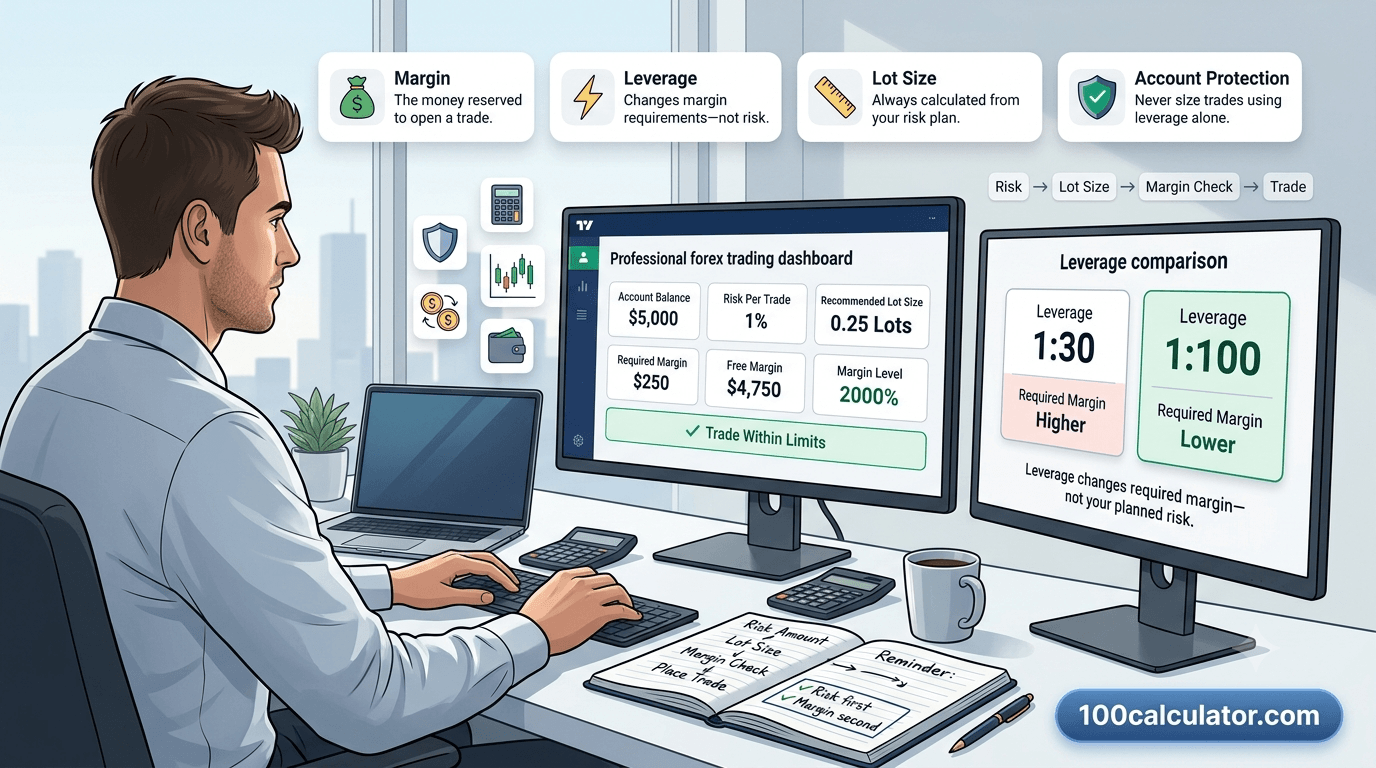
Leverage and lot size get confused often, but they answer two different questions. Lot size answers "how much am I risking." Leverage answers "how much margin does my broker require to hold this position open."
Leverage Is Available Capacity, Not a Target
Higher leverage means a smaller portion of your account is tied up as margin for a given lot size, which frees up capital, but it doesn't change how much you should risk on the trade. In the United States, the Commodity Futures Trading Commission authorizes the National Futures Association to set leverage limits for retail forex accounts, typically up to 50:1 on major currency pairs and lower on minor pairs. (CFTC) Regulators in the UK and EU generally cap retail leverage lower, and brokers operating outside these frameworks may offer considerably higher leverage with correspondingly less oversight. Wherever you trade, treating the maximum available leverage as a target rather than a ceiling is how a well-calculated lot size turns into an oversized one. Our guide on how margin and leverage work together in forex and the Forex Margin Calculator both go deeper into this relationship.
Margin Call Risk From Oversized Lots
A lot size larger than your risk math supports doesn't just risk more money if your stop-loss is hit, it also ties up more margin while the trade is open. That combination can push an account toward a margin call well before price even reaches your stop-loss, particularly during a volatile move. Retail forex trading carries real risk regardless of how carefully you size a position, and it's possible to lose more than you expect if a trade moves sharply against you. (CFTC) Our guide on what happens when you get a margin call in forex walks through exactly how that unfolds.
Lot Size and Risk Management Work Together
Lot size isn't a one-time decision you make and forget. It's part of an ongoing risk-management habit that should adjust as your account, your stop-loss distances, and even your trading pairs change.
The 1% to 2% Risk Rule
Many traders cap their risk on any single trade at 1% to 2% of their account balance. It's a widely used convention rather than a regulatory requirement, and it exists because it lets you absorb a normal string of losing trades without meaningfully damaging your account. Pairing this with a sensible risk-reward ratio matters too. Our guide on how risk-reward ratio impacts long-term trading success explains why capped risk and a healthy reward target work best together, not in isolation.
Adjusting Lot Size as Your Account Grows or Shrinks
A risk percentage-based formula automatically scales with your account. As your balance grows, the same 1% translates into a larger dollar amount and a larger lot size. As it shrinks, following a drawdown, the lot size shrinks with it too, which is part of what makes this approach self-correcting. If you're recovering from a rough stretch, our guide on how much return you need to recover from a drawdown and the Drawdown Recovery Calculator can help you see exactly what's needed to get back to even.
Common Lot Size Mistakes to Avoid
A few habits quietly undo good lot-size math. Here's what to watch for:
- Using the same lot size on every trade, regardless of how far the stop-loss sits, which means your real dollar risk changes from trade to trade without you noticing.
- Copying another trader's lot size without matching their account size, risk tolerance, or stop-loss distance.
- Increasing lot size to "win back" a loss, sometimes called revenge trading, which is one of the fastest ways to turn a normal losing trade into a damaging one. Our guide on position size mistakes every trader should avoid covers this pattern in more detail.
- Ignoring how leverage changes required margin, which can leave less room than expected before a margin call during a volatile move.
- Rounding lot size up instead of down, which quietly increases risk above what was actually planned.
- Forgetting that JPY pairs and cross pairs have different pip values than the flat $10-per-pip convention that applies to major USD-quoted pairs.
Why Lot Size Behaves Differently Across Currency Pairs
The lot size itself, in units, never changes. A standard lot is always 100,000 units of the base currency, no matter which pair you're trading. What changes is the pip value attached to that lot, and that's what makes the same lot size represent very different dollar risk depending on the pair.
Why Pip Value Changes by Currency Pair
Currency pairs generally fall into three groups for pip value purposes. Pairs quoted with the US dollar as the second currency, like EUR/USD or GBP/USD, have a flat $10 pip value per standard lot, regardless of the exchange rate. Pairs where the dollar is the base currency, like USD/CAD or USD/CHF, have a pip value that shifts with the exchange rate. Cross pairs that don't involve the dollar at all, like EUR/GBP or GBP/JPY, require converting through the exchange rate as well, making them the most involved to calculate by hand.
JPY Pairs and Lot Size Adjustments
Japanese yen pairs are quoted to two decimal places instead of four, so a pip is 0.01 instead of 0.0001. That single difference changes the pip value math enough that assuming a JPY pair behaves like EUR/USD is one of the more common calculation errors new traders make. Our guide on how lot size and pip value work together in forex breaks this down further, and a pip value calculator handles the conversion automatically so you don't have to keep the current exchange rate in your head.
Related Calculators
Put what you just read into practice, try these free tools instantly, no sign-up required.
Forex Compounding Calculator
Project compounded growth of your forex trading account.
Forex Swap & Rollover Calculator
Calculate overnight swap and rollover fees on forex positions.
Forex Lot Size Calculator
Find the ideal lot size based on your account and risk.
Forex Margin Calculator
Calculate the margin required to open a forex position.
Pip Value Calculator
Calculate the value of a pip for any currency pair and lot size.
Building a Lot Size Routine You Can Trust
The most reliable lot size process is the one you actually follow before every single trade, not just the ones where you remember to.
- Decide your risk percentage before you open your platform, not while a setup is already forming and adrenaline is running.
- Set your stop-loss first, lot size second. The stop-loss belongs to your chart analysis. The lot size belongs to your risk math. Keep the two decisions separate.
- Recalculate every trade. Don't reuse yesterday's lot size just because it's familiar, since your stop-loss distance and account balance rarely stay identical trade to trade.
- Review your risk math weekly against your current account balance, especially after a winning or losing stretch that's shifted your balance meaningfully.
- Double-check with a calculator, particularly on JPY pairs or crosses, rather than trusting mental math done quickly.
Once this becomes routine, sizing a position stops being a source of stress and becomes just another quick step before you place a trade. If you're holding positions overnight as part of your strategy, it's also worth understanding how forex swap is actually calculated, since overnight fees add another small cost that compounds alongside your position size over time. When you're ready to size your next trade, 100 Calculator's Forex Lot Size Calculator runs everything covered in this guide in seconds, so you can spend your attention on the trade itself.
Risk disclaimer: This article is for general educational purposes only and isn't personalized financial or investment advice. Forex trading involves substantial risk, including the potential loss of your entire deposit, and leverage can magnify both gains and losses. Figures and examples in this guide are illustrative and won't match every broker, account, or market condition exactly. Always confirm contract specifications and margin requirements with your own broker, and consider speaking with a licensed financial professional before trading with real capital.
Sources & References
This guide references publicly available regulatory information on retail forex trading in the United States. For more on how leverage is regulated, see the U.S. Commodity Futures Trading Commission's overview of Foreign Currency Trading and its investor advisory, Eight Things You Should Know Before Trading Forex. Leverage limits vary by country and broker, so always confirm the current rules that apply to your own account.
More From Our Forex Guide
Still building your knowledge of forex fundamentals? These related guides dig deeper into the topics covered above.
Frequently Asked Questions
What is lot size in forex trading?
Lot size is the number of currency units you're buying or selling in a single trade. A standard lot equals 100,000 units of the base currency, a mini lot equals 10,000 units, a micro lot equals 1,000 units, and a nano lot equals 100 units. The lot size you choose directly determines how much each pip movement is worth in dollars, which is why it's the main lever you have over how much a single trade can gain or lose.
What is the difference between a standard, mini, micro, and nano lot?
The difference is simply scale. A standard lot is 100,000 units, a mini lot is 10,000 units (one-tenth the size), a micro lot is 1,000 units (one-hundredth), and a nano lot is 100 units (one-thousandth). Smaller lot types make each pip worth less money, which lets traders with smaller accounts control risk more precisely. Nano lots are offered by only a limited number of brokers.
How do I calculate the right lot size for my account?
Decide how much money you're willing to risk on the trade, usually 1% to 2% of your account balance. Then divide that risk amount by your stop-loss distance in pips multiplied by the pip value of the lot type you're considering. The result tells you how many lots to trade so that hitting your stop-loss costs exactly the amount you planned to risk, not more.
What is the formula for forex position sizing?
The formula is Lot Size = Risk Amount ÷ (Stop-Loss in Pips × Pip Value per Lot). Risk Amount is the dollar figure you're willing to lose, Stop-Loss in Pips is the distance between your entry and your stop, and Pip Value per Lot is how much one pip is worth for the lot type and currency pair you're trading. A Forex Lot Size Calculator runs this formula for you automatically.
How much is one pip worth in a standard lot?
For currency pairs quoted with the US dollar as the second currency, like EUR/USD, GBP/USD, and AUD/USD, one pip on a standard lot is worth exactly $10, regardless of the current exchange rate. For pairs where the dollar is the base currency, or for cross pairs like EUR/GBP or GBP/JPY, pip value shifts with the exchange rate, so it's worth checking a pip value calculator for the current figure.
What lot size should I use with a small account, like $500?
With a $500 account risking 1% per trade ($5), most stop-loss distances work out to somewhere between 0.01 and 0.05 lots, which falls in the micro and low mini lot range. The exact number still depends on your stop-loss distance and the pair you're trading, so it's worth running your specific numbers through the formula rather than assuming a fixed size.
What lot size should I use with a $10,000 account?
At 1% risk ($100) and a typical stop-loss of 30 to 50 pips on a major USD-quoted pair, the math usually lands between 0.20 and 0.35 standard lots. Wider stops or higher-pip-value pairs bring that number down, while tighter stops allow a larger lot size for the same dollar risk. The formula, not the account size alone, sets the final number.
Does leverage decide my lot size?
No. Leverage determines how much margin your broker requires to open a position, not how much you should risk. Your lot size should come from your risk amount, stop-loss distance, and pip value. Using all the leverage available to you as a target, rather than a limit, is one of the fastest ways to open a position far larger than your account can safely support.
What happens if I choose too large a lot size?
An oversized lot size means your stop-loss, if hit, costs far more than you intended to risk. It can also push your account close to a margin call well before the trade even reaches your stop, since larger positions require more margin to maintain. Both outcomes come from the same root cause: picking a lot size that doesn't match your account and risk plan.
How does my stop-loss distance affect lot size?
Stop-loss distance and lot size move in opposite directions for the same dollar risk. A wider stop-loss means each pip matters less to your total risk, so you can use a larger lot size. A tighter stop-loss means each pip matters more, so the same dollar risk only supports a smaller lot size.
Does lot size change for different currency pairs?
The lot size itself, in units, stays the same (a standard lot is always 100,000 units). What changes is the pip value for that lot, since pip value depends on which currencies are involved and the current exchange rate. That's why the same lot size can represent very different dollar risk on EUR/USD versus GBP/JPY.
What is the 1% risk rule in forex trading?
The 1% rule is a common risk-management convention where traders cap the amount they're willing to lose on any single trade at 1% of their account balance. Some traders use up to 2%, especially on smaller accounts, but going much higher increases how quickly a losing streak can damage the account. It's a guideline many traders follow, not a regulatory requirement.
Can I trade forex without doing lot size math myself?
Yes. A Forex Lot Size Calculator does the arithmetic for you. Enter your account balance, the percentage you want to risk, your stop-loss in pips, and your currency pair, and it returns the lot size instantly. Understanding the formula still helps you sanity-check the result and catch mistakes, like a mistyped stop-loss distance.
How is pip value calculated for JPY pairs?
JPY pairs are quoted to two decimal places instead of four, so a pip is 0.01 instead of 0.0001. For a pair like USD/JPY, pip value in dollars depends on the current exchange rate, since the pip is measured in Japanese yen and needs converting back to dollars. This is different enough from standard USD-quoted pairs that it's worth double-checking with a pip value calculator before sizing a trade.
Is a forex lot size calculator accurate?
Yes, assuming the numbers you enter are accurate. A lot size calculator applies the same formula covered in this guide, so its output is only as reliable as your account balance, risk percentage, stop-loss distance, and pip value inputs. It removes arithmetic errors, but it can't correct a stop-loss distance or risk percentage that wasn't well thought out to begin with.
How often should I recalculate my lot size?
Recalculate every time you place a trade, since your stop-loss distance and often your account balance change from one trade to the next. Reusing the same lot size across different setups is one of the most common ways traders end up risking far more, or far less, than they intended on a given trade.
About 100 Calculator
100 Calculator is a free hub of online calculators and educational guides covering health, finance, trading, crypto, education, and more. Every tool is built to be fast, accurate, and genuinely free, with no account or signup required.
We built this guide, and tools like the Forex Lot Size Calculator referenced throughout it, to make position sizing and risk management easier to understand before you risk real money. Head back to the 100 Calculator homepage to explore the full library of tools, or learn more about the team behind them on our About Us page.