How Margin and Leverage Work Together in Forex
A beginner-friendly breakdown of how margin and leverage actually connect, how to calculate the margin a trade requires, and what happens to your account when a leveraged position moves against you.
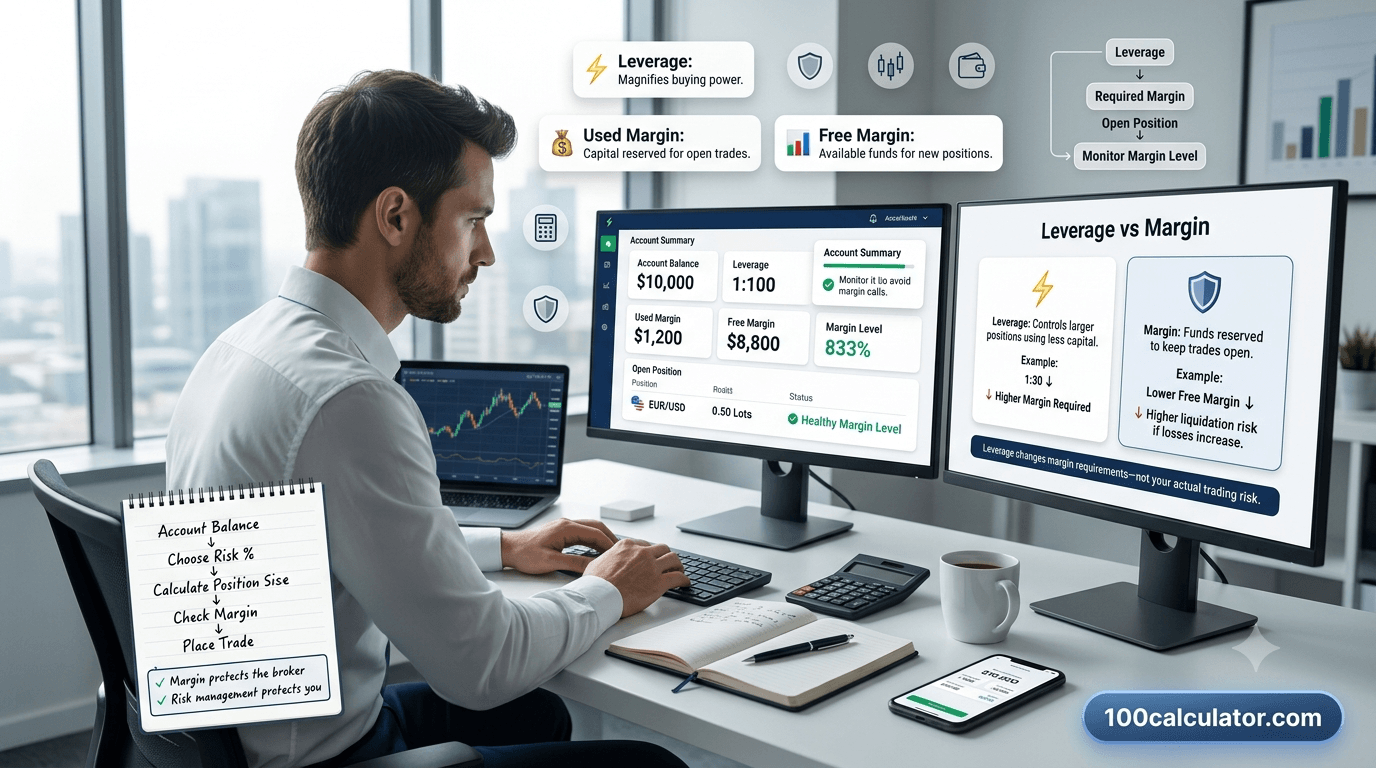
Margin and leverage are the two numbers that decide how large a forex position you can open with the money in your account, and how much a small price move can help or hurt you. Margin is the amount of money your broker sets aside from your account to open a trade, while leverage is the ratio that shows how much bigger your position is compared to that margin. A 1:100 leverage ratio, for example, means every dollar of margin controls $100 worth of currency.
Understanding how these two numbers work together matters more than most beginners realize. Trade with too little margin relative to your position size, and a normal market swing can trigger a margin call or close your trade automatically. Use leverage without understanding it, and a position that looked small on paper can move your account balance far more than expected.
This guide walks through how margin and leverage connect, how to calculate the margin a trade actually requires, what leverage limits look like around the world, and what happens if a trade moves against you. Along the way, you'll see worked examples with real numbers, plus how a Forex Margin Calculator can do this math for you in seconds.
What Are Margin and Leverage in Forex Trading?
Margin and leverage show up on every forex platform, but the two words get mixed up constantly, partly because they describe the same relationship from opposite directions. Getting the definitions straight is the foundation for everything else in this guide.
What Is Margin in Forex Trading?
Margin is the amount of money your broker temporarily sets aside from your account balance to open and maintain a trade. It isn't a fee, and you don't lose it just by placing a trade — it works more like a security deposit. As long as your trade stays open, that portion of your balance is "used" and unavailable for opening new positions. Once you close the trade, the margin is released back into your account, adjusted for whatever profit or loss the trade produced.
What Is Leverage in Forex Trading?
Leverage is the ratio between the size of your position and the margin your broker requires to open it. It's usually written as a ratio like 1:50 or 1:200, meaning $1 of margin controls $50 or $200 worth of currency. Brokers offer leverage because most currency pairs move in small increments, often less than 1% in a single day, so trading without any leverage would put meaningful position sizes out of reach for most retail accounts.
How Margin and Leverage Are Connected
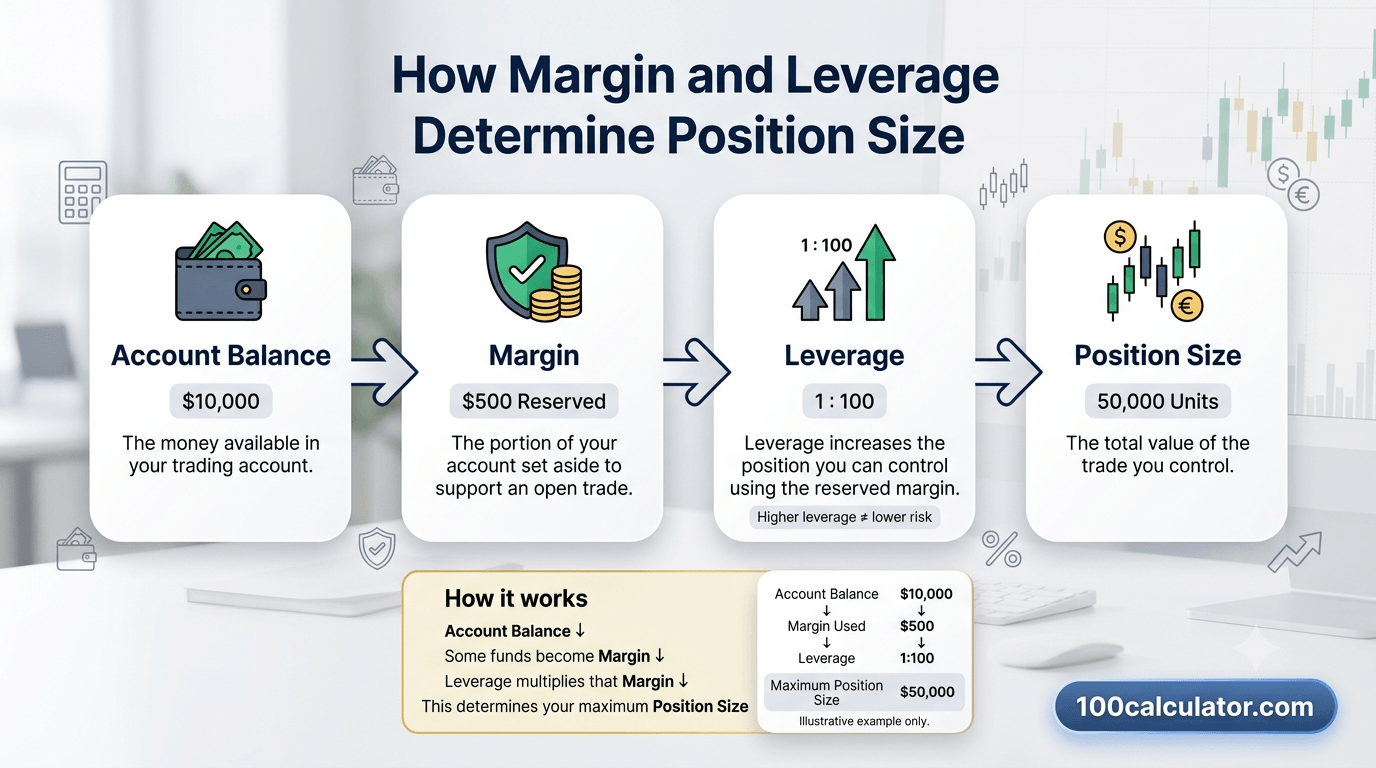
Margin and leverage are two sides of the same equation. Once you know your position size and your leverage ratio, your required margin is fixed — there's no separate decision to make. Raise the leverage ratio, and the margin requirement for the same position drops. Lower it, and the margin requirement rises. This is why the two terms are always discussed together: neither one means much without the other.
| Margin | Leverage | |
|---|---|---|
| What it is | The money set aside to open a trade | The ratio between position size and margin |
| How it's shown | A dollar or currency amount | A ratio, like 1:50 or 1:100 |
| Who sets it | Your broker's margin requirement | Offered by your broker, sometimes capped by regulators |
| What it changes | How much of your balance is tied up | How large a position your margin can control |
Why Forex Brokers Offer Leverage in the First Place
Leverage exists because currency price moves are usually small. A currency pair might move half a percent in a day during normal conditions. Without leverage, a trader would need a very large amount of capital for that kind of move to be worth trading, which would put forex trading out of reach for most retail accounts.
Trading Bigger Positions With Less Capital
Leverage lets you open a position worth far more than the cash sitting in your account. A trader with $2,000 and 1:100 leverage can control a position worth up to $200,000, though using the full amount available is rarely a good idea, which we'll cover later. This is the entire appeal of leverage: it makes meaningful position sizes accessible with a realistic amount of starting capital.
How Brokers Set Margin Requirements
Brokers calculate margin requirements based on the leverage they offer for a specific account type and currency pair. Major, highly liquid pairs like EUR/USD typically come with the highest available leverage, since they're less prone to sudden, extreme price gaps. More volatile or less liquid pairs, along with other instruments like gold, indices, or individual stocks, usually carry lower leverage limits and therefore higher margin requirements for the same position size.
How to Calculate Required Margin (Step by Step)
Once you understand the relationship between margin and leverage, calculating the exact margin a trade requires is straightforward arithmetic.
The Margin Formula
Margin Formula
Required Margin = (Position Size × Opening Price) ÷ Leverage
Position Size — the number of units of the base currency you're trading (100,000 units for one standard lot)
Opening Price — the current exchange rate of the currency pair
Leverage — the ratio your broker offers for that pair, written as a single number (1:100 becomes 100 in the formula)
Worked Example: Calculating Margin for a Trade
Say you want to buy 0.5 standard lots (50,000 units) of EUR/USD at a price of 1.1000, and your broker offers 1:100 leverage on this pair.
- Position value = 50,000 × 1.1000 = $55,000
- Required margin = $55,000 ÷ 100 = $550
That $550 is what your broker sets aside from your account balance the moment you open the trade. The rest of your balance stays free, available for other trades or to absorb losses on this one.
| Leverage Ratio | Margin Required | Position Value Controlled |
|---|---|---|
| 1:10 | $11,000 | $110,000 |
| 1:20 | $5,500 | $110,000 |
| 1:30 | $3,667 | $110,000 |
| 1:50 | $2,200 | $110,000 |
| 1:100 | $1,100 | $110,000 |
| 1:200 | $550 | $110,000 |
| 1:500 | $220 | $110,000 |
Using a Forex Margin Calculator
Free Online Tool
Skip the manual math
Doing this calculation by hand works fine for one trade, but it gets tedious once you're comparing pairs, lot sizes, or leverage options before placing an order. 100 Calculator's Forex Margin Calculator handles the conversion for you — enter your currency pair, position size, and leverage, and it returns the margin your broker would require in seconds.
Common Leverage Ratios and How They're Regulated
Leverage ratios aren't arbitrary. In most of the world, they're capped by financial regulators who oversee how brokers can offer leverage to retail traders.
Common Leverage Ratios Explained
You'll typically see leverage offered somewhere between 1:10 and 1:500, though the exact number depends heavily on your broker's regulatory jurisdiction and the instrument you're trading.
- Low leverage (1:5 to 1:20): Requires more margin per position; common for riskier instruments, or chosen voluntarily by cautious traders.
- Moderate leverage (1:30 to 1:50): The typical ceiling for major currency pairs at brokers regulated in the US, EU, UK, and Australia.
- High leverage (1:100 to 1:500 or more): Common at brokers regulated outside these regions, where retail leverage limits are looser or don't exist.
Leverage Limits by Region
In the United States, the Commodity Futures Trading Commission and the National Futures Association cap retail forex leverage at 50:1 for major currency pairs and 20:1 for minor pairs. Brokers regulated in the European Union follow tiered leverage limits set by the European Securities and Markets Authority, which cap major currency pairs at 30:1 and minor pairs or gold at 20:1, scaling down further for other instruments, alongside a mandatory margin close-out rule. The UK's Financial Conduct Authority and Australia's regulator apply closely aligned limits.
| Region / Regulator | Major Pairs | Minor Pairs / Gold |
|---|---|---|
| United States (CFTC / NFA) | 50:1 | 20:1 |
| European Union (ESMA) | 30:1 | 20:1 |
| United Kingdom (FCA) | 30:1 | 20:1 |
| Australia (ASIC) | 30:1 | 20:1 |
| Many offshore brokers | Up to 500:1 or higher | Varies by broker |
Used Margin, Free Margin, and Margin Level Explained
Once you have more than one trade open, three related numbers on your trading platform start to matter: used margin, free margin, and margin level.
Used Margin
Used margin is the total amount of your account balance currently tied up across all your open positions. If you have three trades open, each requiring $500 of margin, your used margin is $1,500 combined.
Free Margin
Free margin is what's left over: your account equity minus used margin. It's the amount available to open new trades or to absorb further losses on your existing ones without triggering a margin call.
Margin Level and Why It Matters
Margin Level Formula
Margin Level (%) = (Equity ÷ Used Margin) × 100
Equity — your account balance plus or minus any unrealized profit or loss on open trades
Used Margin — the total margin currently locked across all open positions
Result — shown as a percentage; most platforms display this number in real time
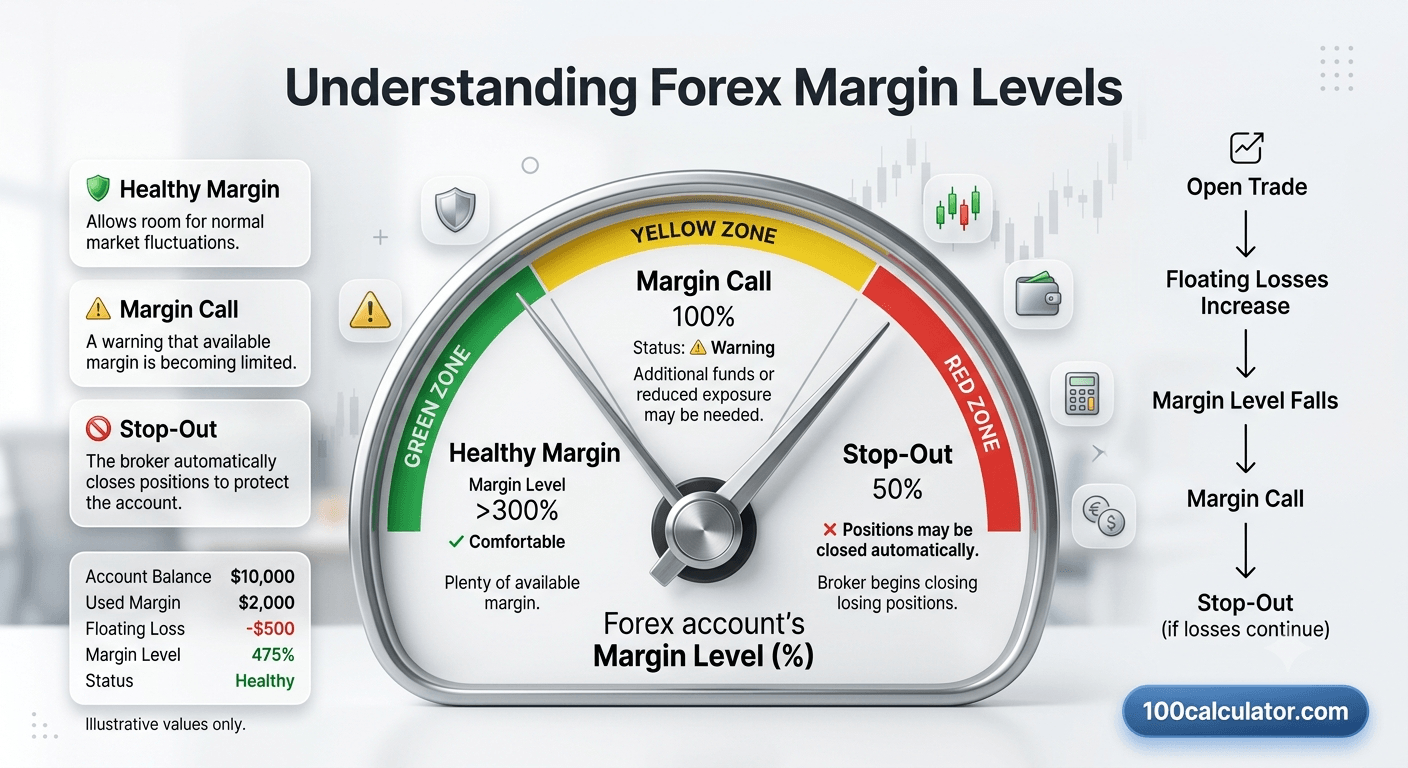
A margin level of 500% or higher is generally considered comfortable. As losses accumulate and equity falls relative to used margin, that percentage drops, and once it reaches your broker's margin call threshold, you'll get a warning.
Margin Calls and Stop-Outs: What Happens When a Trade Goes Wrong
Margin calls and stop-outs are the safety mechanisms that stop a losing trade from draining more of your account than your broker allows.
What Triggers a Margin Call
A margin call happens when your margin level drops to a threshold your broker has set, often somewhere around 100%. At that point, your broker notifies you, usually through the platform itself rather than an actual phone call, that you need to add funds or reduce your open positions.
What Happens at Stop-Out
If you don't respond to a margin call and losses keep growing, your account reaches the stop-out level. This is different from a margin call because it's automatic: the platform begins closing your open positions, typically starting with the largest loss, without waiting for your input. The goal is to stop your account from going negative, not to punish you.
Typical Margin Call and Stop-Out Levels
These thresholds vary by broker, so it's worth checking your own broker's trading conditions rather than assuming a universal number. That said, a margin call around 100% and a stop-out somewhere between 20% and 50% of used margin are common setups. Brokers regulated under the UK and EU's tiered leverage rules are required to close out retail positions once funds fall to 50% of the margin needed to maintain them.
How Leverage Amplifies Both Profits and Losses
This is the part of leverage that trips up most beginners: leverage doesn't just make bigger wins possible, it makes bigger losses just as possible, using the exact same math.
Example: Same Trade, Two Leverage Levels
Imagine two traders, each starting with a $10,000 account. Trader A opens a position with no leverage, committing the full $10,000 as margin to control $10,000 worth of currency. Trader B uses 1:50 leverage, also committing $10,000 as margin, but that margin now controls a position worth $500,000. If the price then moves by 1%, the outcome for each trader looks very different.
| Trader A (1:1, no leverage) | Trader B (1:50 leverage) | |
|---|---|---|
| Margin committed | $10,000 | $10,000 |
| Position size controlled | $10,000 | $500,000 |
| Price moves +1% | +$100 (1% account gain) | +$5,000 (50% account gain) |
| Price moves -1% | -$100 (1% account loss) | -$5,000 (50% account loss) |
Both traders risked the same dollar amount of margin. The only thing that changed was leverage, and it changed the outcome of the exact same 1% price move from a rounding error to half the account.
Why Higher Leverage Isn't "More Skill"
It's tempting to see high leverage as something only advanced traders use, but leverage is a risk setting, not a skill level. A trader using 1:500 leverage isn't necessarily more experienced than one using 1:10 — they are simply exposing their account to a much larger swing per dollar of margin. Matching your leverage to your risk tolerance and strategy matters more than reaching for the highest number your broker allows.
Lot Size, Position Size, and Their Effect on Margin
Margin doesn't exist in isolation. It's a direct function of how large a position you're trying to open, which in forex is measured in lots.
Standard, Mini, and Micro Lots
A standard lot is 100,000 units of the base currency. A mini lot is 10,000 units, one-tenth the size, and a micro lot is 1,000 units, one-hundredth the size. Smaller lot sizes exist specifically so traders with smaller accounts can control position sizes, and therefore margin requirements, that actually fit their capital. Our guide on standard vs. mini vs. micro lots breaks down when each size makes sense.
How Position Size Changes Your Margin Requirement
Margin scales directly with position size at a fixed leverage ratio. Trading one mini lot instead of one standard lot cuts your required margin to a tenth of the amount, since you're controlling a tenth of the currency. Position size is the main lever most traders actually control day to day — leverage is usually fixed by your account type, but position size is a decision you make on every single trade. For help choosing a starting point, see our guide on choosing the right forex lot size for your account, and 100 Calculator's Forex Lot Size Calculator can help you translate a risk amount into an exact lot size.
Lot size also determines your pip value, which works alongside margin to define your total risk on a trade. Our guide to pip value and our piece on how lot size and pip value work together cover that side of the equation in more detail, and 100 Calculator's Pip Value Calculator can do the math for a specific pair and lot size.
Margin Requirements Can Change: What Beginners Should Know
The margin a trade requires isn't always fixed once you've checked it. A handful of situations can cause your broker to change margin requirements, sometimes with very little notice.
Why Brokers Raise Margin Requirements Before Big Events
Ahead of major economic releases, such as central bank rate decisions or employment reports, brokers sometimes temporarily raise margin requirements. This reduces the leverage available for a short window, which limits how much a sudden, sharp price move can affect trader accounts and, in turn, the broker's own risk exposure.
Weekend and Holiday Margin Changes
Trading liquidity drops sharply over weekends and market holidays, since most major trading centers are closed. Some brokers raise margin requirements or reduce maximum leverage heading into these low-liquidity windows, since thinner markets can produce larger, faster price gaps once trading resumes.
Common Margin and Leverage Mistakes to Avoid
Even traders who understand the formulas can run into trouble through a handful of habits that quietly increase risk. Here's what to watch for:
- Using the maximum leverage available "because it's there." Just because your broker offers 1:500 doesn't mean it matches your account size or risk tolerance.
- Treating free margin as a budget. Free margin isn't money to spend on more trades — it's your buffer against normal price fluctuation on the trades you already have open.
- Ignoring margin level until a margin call arrives. Checking your margin level only when you're already in trouble leaves little room to react calmly.
- Opening several trades on correlated pairs. Multiple positions on currency pairs that tend to move together can multiply your risk more than it first appears, even if each trade's margin looks small on its own.
- Assuming margin requirements never change. As covered above, they can shift around news events, weekends, and holidays.
- Not knowing your broker's stop-out level. This number determines how much of your account survives a bad trade, and it's worth knowing before you need it, not after.
Related Calculators
Put what you just read into practice, try these free tools instantly, no sign-up required.
Forex Compounding Calculator
Project compounded growth of your forex trading account.
Forex Swap & Rollover Calculator
Calculate overnight swap and rollover fees on forex positions.
Forex Lot Size Calculator
Find the ideal lot size based on your account and risk.
Forex Margin Calculator
Calculate the margin required to open a forex position.
Pip Value Calculator
Calculate the value of a pip for any currency pair and lot size.
Best Practices for Managing Margin and Leverage Safely
None of this means leverage is something to avoid entirely — it's a normal, useful part of forex trading when it's managed deliberately.
Risk Management Habits That Help
- Calculate required margin before placing a trade, not after
- Keep enough free margin as a buffer, rather than using most of your balance on open positions
- Use a stop-loss on every trade so a single position has a defined maximum loss
- Check your margin level periodically, especially during volatile sessions
- Review your broker's specific margin call and stop-out levels so there are no surprises
Choosing Leverage That Matches Your Strategy
Different trading styles naturally call for different amounts of leverage. Longer-term position traders, who hold trades for days or weeks and need room for price to fluctuate, typically use lower leverage than short-term day traders, who hold trades for minutes or hours and manage risk through tighter stop-losses instead. Neither approach is automatically safer — what matters is that your leverage, position size, and stop-loss placement are all working together, not against each other. 100 Calculator's Risk Reward Ratio Calculator and Position Size Calculator can help you plan a trade around a risk amount you're actually comfortable with, rather than backing into one after the fact.
If you hold positions overnight, it's also worth understanding how forex swap charges are calculated, since that's a separate cost from margin that still affects a leveraged account over time. And if you're comparing how a leveraged account might grow, our guide on how forex compounding grows a trading account is a natural next read.
Sources & References
This guide draws on rules and guidance published by financial regulators that oversee forex and CFD trading for retail clients:
- National Futures Association — Forex Transactions: Regulatory Guide
- U.S. Commodity Futures Trading Commission — Retail Forex Rule Fact Sheet
- European Securities and Markets Authority — Product Intervention Measures on CFDs
- Financial Conduct Authority — PS19/18: Restricting CFD Products Sold to Retail Clients
Leverage limits, margin close-out rules, and broker requirements can change, so always confirm current figures directly with your broker or the relevant regulator before trading.
Trading disclaimer: This article is for general educational purposes only and isn't financial or investment advice. Forex trading involves substantial risk of loss and isn't suitable for every investor. Leverage can magnify both gains and losses, and depending on your broker's policies, you could lose more than your initial deposit. Always consider your financial situation and risk tolerance, and consult a licensed financial advisor before trading with leverage.
More From Our Forex Guides
Want to go deeper on the mechanics behind a leveraged forex account? These related guides build on the concepts covered above.
Frequently Asked Questions
What is the difference between margin and leverage in forex?
Margin is the money your broker sets aside from your account to open and hold a trade. Leverage is the ratio that describes how much bigger your position is compared to that margin. If your broker offers 1:50 leverage, you can control a position 50 times larger than the margin you put down. They describe the same relationship from two different angles: margin is the deposit, and leverage is the multiplier.
How do I calculate margin in forex trading?
Divide the total value of your position by your leverage ratio. One standard lot of EUR/USD at 1.1000 is worth $110,000. At 1:100 leverage, required margin is $110,000 divided by 100, which equals $1,100. A Forex Margin Calculator does this instantly once you enter your lot size, currency pair, and leverage, so you don't have to do the conversion by hand.
What is a good leverage ratio for beginners?
Many trading educators suggest beginners start with lower leverage, such as 1:10 to 1:20, even if their broker allows more. Lower leverage means a smaller position for the same margin, which gives the price more room to move before you're at risk of a margin call. The right ratio depends on your account size, risk tolerance, and strategy, so treat any specific number as a starting point rather than a rule.
What happens when you get a margin call in forex?
A margin call is a warning from your broker that your account equity has dropped close to the amount needed to keep your open trades running. It's usually a notification, not an automatic action, and it gives you a chance to add funds or close some positions. If you ignore it and losses continue, your account can reach the stop-out level, where the broker starts closing trades automatically.
What is the difference between a margin call and a stop-out?
A margin call is a warning, while a stop-out is an action. The margin call tells you your margin level has fallen to a set threshold, often around 100%. If you don't respond and losses continue, the stop-out level, commonly somewhere between 20% and 50% of used margin depending on the broker, triggers automatic closing of your positions to stop further losses.
How much margin do I need to trade one standard lot?
It depends on the currency pair's price and your leverage. One standard lot is 100,000 units of the base currency. At a price of 1.1000 and 1:100 leverage, you'd need about $1,100. At 1:30 leverage, the same trade needs roughly $3,667. A Forex Margin Calculator can give you the exact figure for your specific pair, price, and leverage.
Can you lose more money than you deposit with leverage?
It depends on your broker and where they're regulated. Many regulated brokers, particularly in the EU, UK, and Australia, are required to offer negative balance protection, meaning you can't lose more than what's in your account. Brokers without this protection can, in rare fast-moving markets, leave you owing more than your deposit, so it's worth checking your broker's policy before trading with leverage.
What is free margin in forex?
Free margin is the portion of your account equity that isn't tied up in open trades. It's calculated as equity minus used margin, and it's the amount available to open new positions or absorb losses on the ones you already have. When free margin runs low, your account has less cushion before a margin call.
What is margin level and how is it calculated?
Margin level is a percentage that shows how healthy your account is relative to your open trades. The formula is equity divided by used margin, multiplied by 100. A margin level of 500% or higher is generally considered comfortable, while a level approaching 100% usually triggers a margin call, and a level near your broker's stop-out threshold triggers automatic position closing.
Why do forex brokers limit leverage in some countries?
Regulators such as the CFTC and NFA in the United States, and the FCA in the UK under ESMA-aligned rules, cap retail leverage to reduce how much money new traders can lose quickly. High leverage magnifies both gains and losses, and regulators found that unrestricted leverage was contributing to significant, fast losses for inexperienced retail traders.
Is higher leverage more profitable?
Not by itself. Leverage doesn't change your percentage return on a price move — it changes how much capital you need to put down and how much that move affects your account balance. Higher leverage means the same price move produces a bigger swing in your account equity in both directions, which is why it's better understood as a risk setting than a profit strategy.
What is used margin?
Used margin is the total amount of your account balance currently locked up to support your open positions. If you have several trades open at once, used margin is the sum of the margin required for each one. It's separate from free margin, which is what remains available for new trades.
Does leverage cost money to use?
Leverage itself doesn't come with a direct fee, but positions held open overnight may involve a swap or rollover charge, which is a separate cost tied to holding a leveraged position past the daily cutoff. Our guide on overnight rollover fees breaks down exactly how that charge is calculated.
Why did my margin requirement suddenly increase?
Brokers sometimes raise margin requirements temporarily around major news events, low-liquidity periods like weekends and holidays, or times of unusually high volatility. This is a risk-management step on the broker's side, not something you did wrong, and it usually reverts once conditions settle down.
What's the safest leverage ratio for a small trading account?
There's no single safest number, but many small accounts benefit from using only a fraction of the maximum leverage available, keeping position sizes small enough that a normal price swing doesn't threaten a large share of the account. Combining lower leverage with a stop-loss on every trade is a common way to manage this risk.
Do all forex brokers offer the same leverage?
No. Maximum leverage varies significantly by broker and by where that broker is regulated. A broker regulated in the US typically offers up to 1:50 on major pairs, while brokers regulated in the EU, UK, or Australia are usually capped around 1:30 for majors. Offshore brokers outside these regions sometimes advertise much higher ratios, though higher availability doesn't mean higher leverage is a good idea to actually use.
What's the difference between position size and margin?
Position size is how much of an asset you're actually buying or selling, such as one standard lot of EUR/USD. Margin is the portion of your account the broker sets aside as a good-faith deposit to open that position. A bigger position size requires more margin at any given leverage ratio, which is why lot size and margin are so closely linked.
About 100 Calculator
100 Calculator is a free hub of online calculators and educational guides covering health, finance, trading, crypto, education, and more. Every tool is built to be fast, accurate, and genuinely free, with no account or signup required.
We built this guide, and tools like the Forex Margin Calculator referenced throughout it, to make the mechanics of leveraged trading easier to understand before you put real money on the line. Head back to the 100 Calculator homepage to explore the full library of tools, or learn more about the team behind them on our About Us page.