How Lot Size and Pip Value Work Together in Forex
A practical, beginner-friendly walkthrough of how lot size and pip value connect — with the formulas, comparison tables, and worked examples you need to size every forex trade using real numbers instead of guesswork.
If you've started looking into forex trading, you've probably run into two terms that show up in nearly every discussion of risk: lot size and pip value. They sound like separate ideas, but they're really two halves of the same calculation, and once you see how they connect, the rest of position sizing starts to make a lot more sense.
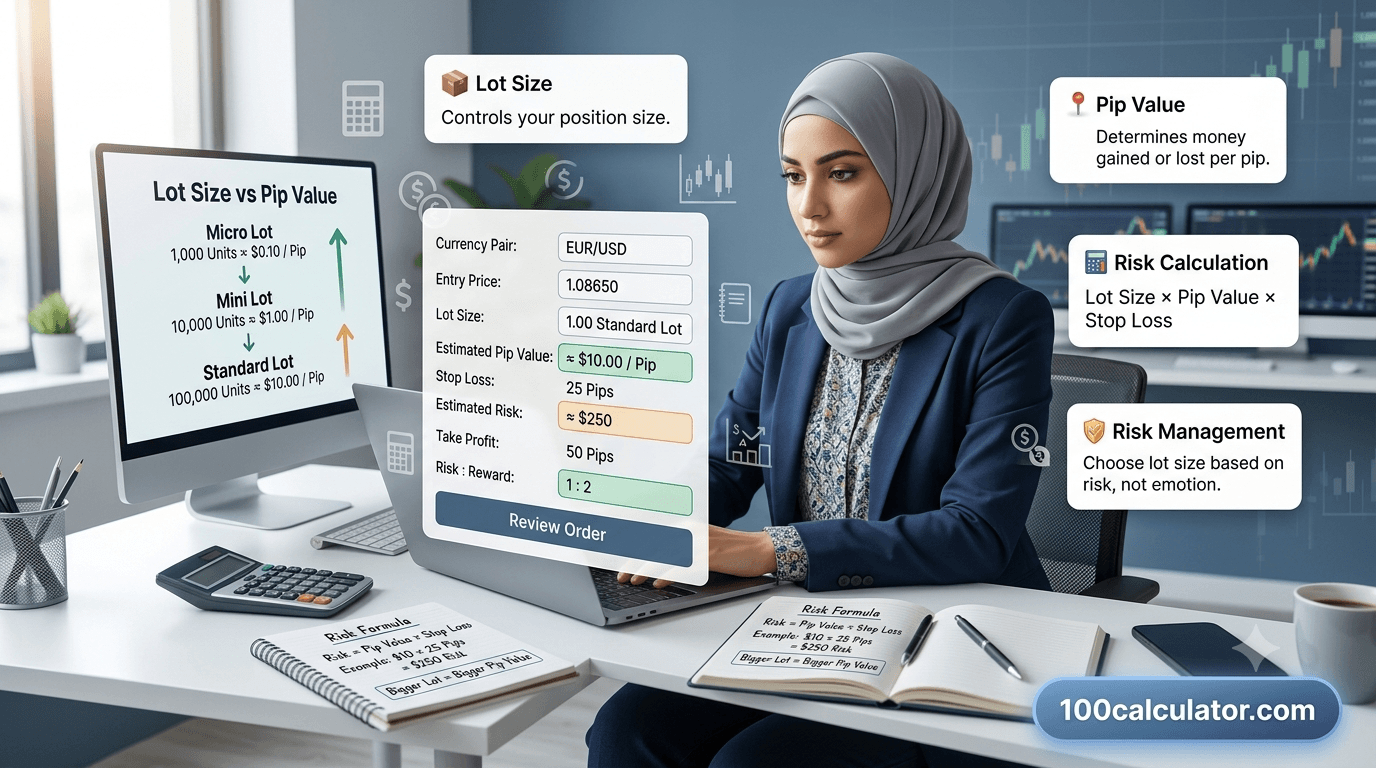
Pip value is the amount of money a single pip of price movement is worth on a trade, and it's calculated directly from your lot size — the bigger the lot, the bigger the pip value, in exact proportion. Trade a full standard lot of EUR/USD, and each pip is worth about $10. Trade a micro lot of the same pair, and that same pip is only worth about ten cents. Same market move, completely different amount of money, purely because of lot size.
This guide walks through exactly how the two connect, with the formulas, a lot-size comparison table, and worked examples using real numbers. By the end, you'll be able to work out pip value for any lot size and currency pair by hand, or skip the arithmetic with 100 Calculator's free Pip Value Calculator and Forex Lot Size Calculator.
What Is a Pip and Pip Value?
Before lot size and pip value can make sense together, it helps to get comfortable with each one on its own, starting with the pip.
How a Pip Is Measured in a Price Quote
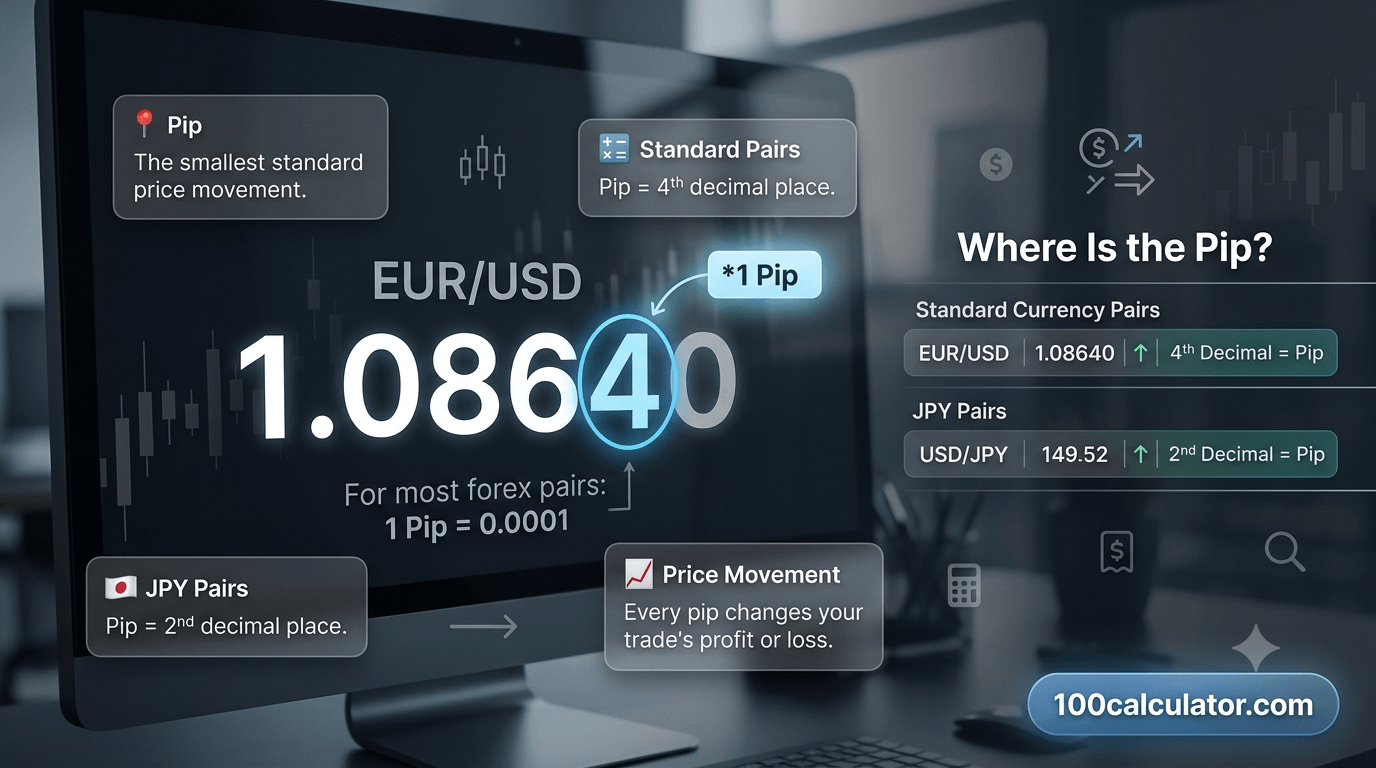
A pip, short for "percentage in point," is the standard unit traders use to measure how much a currency pair's price has moved. For most pairs, a pip is the fourth decimal place in the exchange rate, so if EUR/USD moves from 1.0850 to 1.0851, that's a one-pip move. Pairs that include the Japanese yen are the main exception: because yen pairs are quoted with only two decimal places, one pip there equals 0.01 instead of 0.0001. We'll come back to why that matters later in this guide.
Why Pip Value Isn't a Fixed Number
Pip value is a different thing entirely. It's the actual dollar amount, or the amount in whatever currency your account is funded in, that one pip of movement is worth on your specific trade. Pip value changes depending on the currency pair, the current exchange rate, and — most importantly for this guide — how much of that pair you're trading. Our companion piece on what pip value means for forex traders covers this idea in more depth if you want the full background first.
That last part, how much you're trading, is where lot size comes in, and it's the single biggest factor in pip value. Two traders can watch the exact same one-pip move on the exact same pair and have completely different amounts of money riding on it, purely because they're trading different lot sizes.
What Is Lot Size in Forex Trading?
Lot size is simply the number of currency units you're buying or selling in a trade. Currencies aren't traded one unit at a time, since a single-dollar price movement would be meaningless — instead, forex brokers standardize trade sizes into "lots" so that a normal pip movement translates into a normal amount of money.
Standard, Mini, Micro, and Nano Lots
Most retail brokers offer four lot sizes, each one-tenth of the size before it:
| Lot Type | Units of Base Currency | Typical Broker Notation |
|---|---|---|
| Standard Lot | 100,000 | 1.00 lot |
| Mini Lot | 10,000 | 0.10 lot |
| Micro Lot | 1,000 | 0.01 lot |
| Nano Lot | 100 | 0.001 lot |
Not every broker offers nano lots, and a few only go down to micro lots as their smallest size. Most trading platforms also let you enter fractional lot sizes, like 0.25 or 0.33 lots, rather than forcing you to trade in whole lot increments. Our guide on standard vs. mini vs. micro lots goes deeper into how brokers typically offer each size.
How Lot Size Relates to Your Market Exposure
Lot size is really a measure of exposure. Trading one standard lot of EUR/USD means you're controlling 100,000 euros worth of exposure to that currency pair, even though your actual cash outlay, thanks to leverage, is much smaller. That gap between exposure and cash outlay is exactly why lot size deserves careful thought rather than a guess. Our guide to choosing the right forex lot size for your account walks through that decision in more detail.
How Lot Size Determines Pip Value
The Direct Relationship Between the Two
Lot size and pip value move in direct proportion to each other. Since pip value is calculated from the number of units you're trading, doubling your lot size doubles your pip value, and trading one-tenth the lot size cuts pip value to one-tenth as well. There's no curve, no diminishing return, and no special case: it's a straight, linear relationship.
Seeing It in Numbers
This is why the exact same 50-pip stop-loss can mean wildly different things depending on lot size. On a standard lot of EUR/USD, a 50-pip stop represents about $500 of risk. On a micro lot of the same pair, that identical 50-pip stop only represents about $5 of risk, a hundred times smaller, because the lot size is a hundred times smaller. The pips didn't change. The pair didn't change. Only the lot size changed, and pip value scaled right along with it.
This is also exactly why lot size, not the number of pips you risk, is usually the lever traders adjust when they want to control how much a trade can cost them. Our guide on why pip value matters for managing trading risk looks at this from the risk-management side in more detail.
Pip Value by Lot Size: Quick Comparison
Before getting into the formula, it helps to see the actual numbers side by side. The table below shows approximate pip values for each lot size on EUR/USD, where the U.S. dollar is the quote currency and no conversion step is needed, alongside USD/JPY, which does need one.
| Lot Type | Units | Pip Value (EUR/USD) | Pip Value (USD/JPY, rate ≈ 150.00) |
|---|---|---|---|
| Standard Lot | 100,000 | $10.00 | ≈ $6.67 |
| Mini Lot | 10,000 | $1.00 | ≈ $0.67 |
| Micro Lot | 1,000 | $0.10 | ≈ $0.07 |
| Nano Lot | 100 | $0.01 | ≈ $0.007 |
How to Calculate Pip Value for Any Currency Pair
The comparison table above covers two common pairs, but the same formula works for any currency pair, at any lot size, on any given day.
The Basic Pip Value Formula
When the pair you're trading is quoted directly in your account's currency, the formula is straightforward:
Pip Value Formula
Pip Value = Pip Size × Lot Size (in units) If the quote currency isn't your account currency: Pip Value = (Pip Size × Lot Size) ÷ Exchange Rate
Pip Size: 0.0001 for most pairs, or 0.01 for pairs that include the Japanese yen
Lot Size: the number of currency units in your trade, such as 100,000 for one standard lot
Exchange Rate: the current rate for the pair, only needed when converting the result into your account currency
Adjusting When the Pair Isn't Quoted in Your Account Currency
For a pair like EUR/USD, GBP/USD, or AUD/USD, the U.S. dollar is already the quote currency, so a USD-funded account can use the basic formula with no extra step. For a pair like USD/JPY, where the yen is the quote currency, you calculate pip value in yen first, then divide by the USD/JPY exchange rate to convert it back into dollars. Cross pairs that don't involve your account currency at all, such as EUR/GBP for a USD-funded account, need one more conversion step through a related pair. Our guide on calculating pip value for any currency pair walks through that extra conversion in more detail.
Step-by-Step Example
Let's calculate pip value for one standard lot of GBP/USD, where the U.S. dollar is the quote currency:
- Identify the pip size. GBP/USD isn't a yen pair, so the pip size is 0.0001.
- Identify the lot size in units. One standard lot equals 100,000 units.
- Multiply the two together. 0.0001 × 100,000 = $10.
- Skip the conversion step. Since GBP/USD is already quoted in U.S. dollars, that $10 figure is your final pip value — no division needed.
Now compare that with one standard lot of USD/JPY, using an example exchange rate of 150.00:
- Identify the pip size. USD/JPY is a yen pair, so the pip size is 0.01.
- Identify the lot size in units. One standard lot equals 100,000 units.
- Multiply the two together. 0.01 × 100,000 = 1,000 yen.
- Convert to your account currency. 1,000 ÷ 150.00 ≈ $6.67 per pip.
Free Online Tool
Would rather skip the manual math?
100 Calculator's Pip Value Calculator runs this exact formula for you, including the currency conversion step. Enter the pair, your lot size, and the current exchange rate, and it returns your pip value instantly, with no account required.
Using Lot Size and Pip Value for Position Sizing
So far, we've calculated pip value by starting with a lot size and working forward. Position sizing flips that process around: you start with how much you're willing to risk, then work backward to find the right lot size.
The Position Sizing Formula
Position Sizing Formula
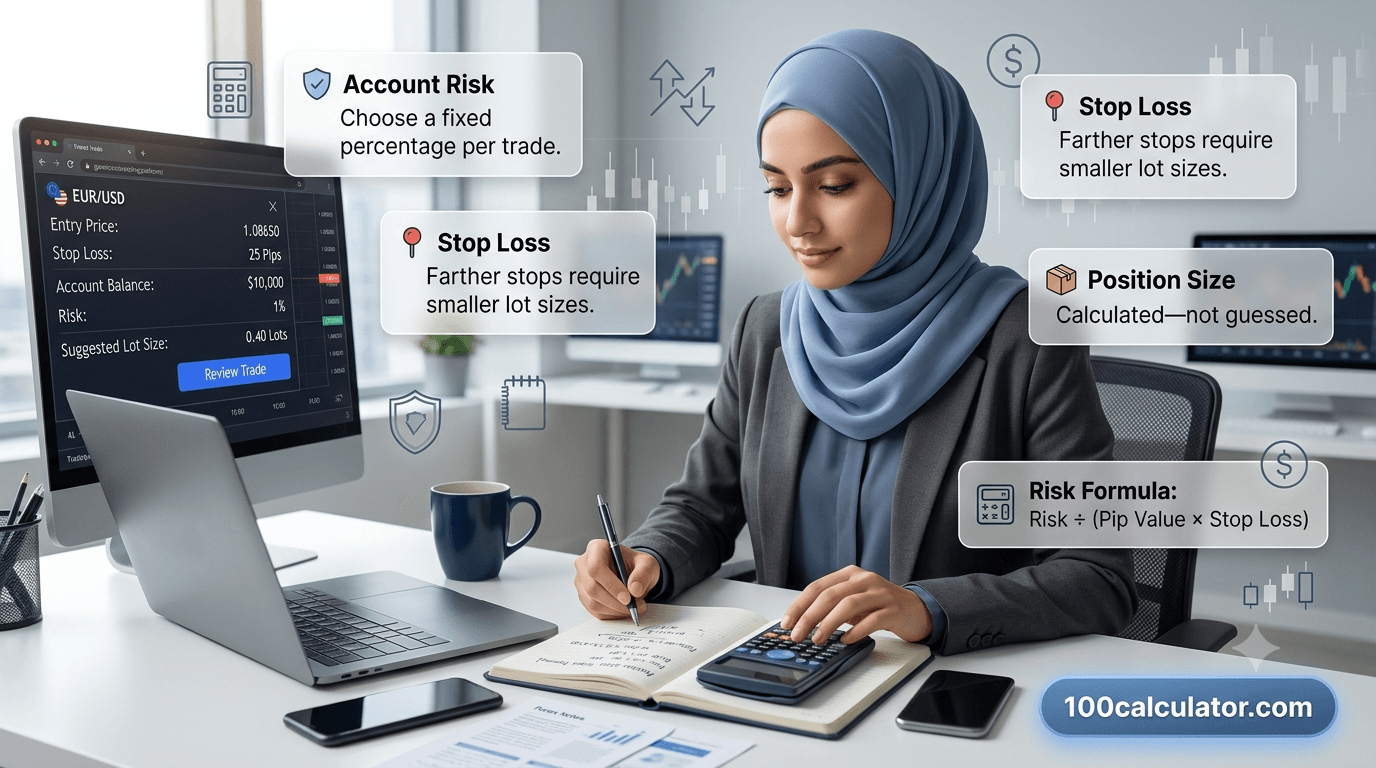
Lot Size = Account Risk ($) ÷ (Stop-Loss Distance in Pips × Pip Value per Pip for 1 Standard Lot)
Account Risk: the dollar amount you're willing to lose on this specific trade, often set as a percentage of your account balance
Stop-Loss Distance: the number of pips between your entry price and your stop-loss order
Pip Value per Standard Lot: the pip value you calculated in the previous section, for one full standard lot of the pair you're trading
Why This Protects Your Account
This formula puts your risk tolerance in the driver's seat instead of your lot size. Rather than picking a lot size out of habit and hoping the resulting risk feels reasonable, you decide the dollar amount you're comfortable losing first, and the math tells you exactly which lot size keeps you inside that limit. For a closer look at applying this in practice, see our guide on calculating position size for safer trading.
A consistent risk-per-trade rule is what this formula is built to support:
- A dollar loss you decided on ahead of time, instead of one you discover after the trade closes
- A lot size that automatically shrinks when your stop-loss distance is wider, and grows when it's tighter
- Consistent risk from trade to trade, even across different currency pairs with different pip values
- A account balance that can absorb a losing streak without a single trade doing outsized damage
Worked Examples: Lot Size and Pip Value in Action
Formulas make more sense with real numbers attached to them. Here are two complete examples, from account size all the way to a final lot size.
Example 1: Micro Lot Trade on EUR/USD
A trader has a $500 account and wants to risk 2% on a single EUR/USD trade, using a 25-pip stop-loss.
- Account risk: 2% of $500 = $10
- Stop-loss distance: 25 pips
- Pip value per standard lot (EUR/USD): $10
- Lot size = $10 ÷ (25 × $10) = $10 ÷ $250 = 0.04 lots
A 0.04 lot position equals 4,000 units, or four micro lots. At that size, pip value works out to about $0.40 per pip, so a full 25-pip stop-loss costs almost exactly the $10 the trader planned to risk.
Example 2: A Larger Account on GBP/USD
A trader has a $20,000 account and wants to risk 1% on a GBP/USD trade, using a 60-pip stop-loss.
- Account risk: 1% of $20,000 = $200
- Stop-loss distance: 60 pips
- Pip value per standard lot (GBP/USD): $10
- Lot size = $200 ÷ (60 × $10) = $200 ÷ $600 ≈ 0.33 lots
A 0.33 lot position sits between a mini and a third of a standard lot. Pip value at that size works out to about $3.30 per pip, so the full 60-pip stop-loss costs roughly $198, close to the $200 the trader budgeted, with the small gap coming from rounding the lot size to a practical two decimal places. For more on comparing the risk you're taking against the reward you're targeting once your lot size is set, see our guide on how risk-reward ratio impacts long-term trading success.
Currency Pairs That Change the Math
The formula itself never changes, but a few types of currency pairs affect the numbers that go into it.
JPY Pairs and the Extra Decimal
Pairs that include the Japanese yen, like USD/JPY, EUR/JPY, or GBP/JPY, are quoted to two decimal places instead of four. That means one pip equals 0.01 rather than 0.0001. If you forget to swap the pip size when switching from a pair like EUR/USD to one like USD/JPY, your pip value calculation will be off by a factor of 100, which is a large enough error to throw off your entire position size.
Cross Pairs and Indirect Conversion
A cross pair is any pair that doesn't include your account's currency at all, such as EUR/GBP or AUD/JPY for a USD-funded account. Since neither currency in the pair is U.S. dollars, converting pip value back into dollars takes an extra step: you calculate pip value in the pair's own quote currency first, then convert that figure using the exchange rate between the quote currency and your account currency. This is exactly the kind of calculation where doing the math by hand gets tedious fast, and where a pip value calculator saves the most time.
Common Mistakes With Lot Size and Pip Value
A handful of small errors account for most of the confusion traders run into with this part of risk management.
- Trading a full standard lot on a small account. A $10 pip value can turn a routine 30-pip move into a loss that eats a large share of a small account in a single trade.
- Picking a lot size before setting a stop-loss. Position size should come from your stop-loss distance and risk tolerance, not the other way around.
- Assuming pip value is identical across every pair. JPY pairs and cross pairs both need their own calculation, not a copy of the EUR/USD number.
- Confusing lot size with the number of trades open. Two open trades of 0.05 lots each is not the same thing as one trade of 0.10 lots, even though the total exposure happens to match.
- Not recalculating position size after a losing streak. A shrinking account balance means the same lot size represents a larger percentage risk than it did before, even if the dollar amount looks unchanged.
Our guide on position size mistakes every trader should avoid covers several more of these in detail, alongside practical ways to catch them before they cost you money.
Related Calculators
Put what you just read into practice, try these free tools instantly, no sign-up required.
Forex Compounding Calculator
Project compounded growth of your forex trading account.
Forex Swap & Rollover Calculator
Calculate overnight swap and rollover fees on forex positions.
Forex Lot Size Calculator
Find the ideal lot size based on your account and risk.
Forex Margin Calculator
Calculate the margin required to open a forex position.
Pip Value Calculator
Calculate the value of a pip for any currency pair and lot size.
How Leverage and Margin Connect to Lot Size
Lot size and pip value explain what a trade is worth per pip. Leverage and margin explain how much of your own money you need to open that trade in the first place, and the two ideas get mixed up often enough to be worth untangling.
What Margin Actually Reserves
Margin is the portion of your account balance your broker sets aside as collateral while a leveraged position is open. Leverage determines how much margin a given lot size requires, but it doesn't change pip value itself. Two traders using the same lot size on the same pair have identical pip value, even if one is trading with 10:1 leverage and the other with 50:1 — the difference shows up in how much margin each of them had to set aside, not in what each pip is worth. Our guide on how margin and leverage work together in forex breaks this relationship down in more detail, including what happens during a margin call.
Leverage Limits by Regulator
How much leverage you're allowed to use depends heavily on where your broker is regulated, which indirectly shapes how large a lot size you can reasonably support with a given account balance.
| Region / Regulator | Major Currency Pairs | Minor / Other Pairs |
|---|---|---|
| United States (NFA / CFTC) | 50:1 | 20:1 |
| European Union (ESMA) | 30:1 | 20:1 or lower |
| United Kingdom (FCA) | 30:1 | 20:1 or lower |
| Other jurisdictions | Varies by regulator and broker | Varies by regulator and broker |
In the United States, the National Futures Association sets retail forex leverage at 50:1 for major currency pairs and 20:1 for minor pairs, under authority granted by the CFTC. That translates to a 2% margin requirement on majors, meaning a $2,000 deposit can support a standard lot's worth of exposure. Brokers regulated elsewhere may allow higher leverage, but higher leverage only reduces the margin required to open a given lot size — it never changes what that lot size's pip value actually is.
Tools That Do the Math for You
Once you understand the formulas above, using a calculator to apply them is faster and less error-prone than doing it by hand for every single trade. 100 Calculator offers a few free tools built specifically for this:
- Pip Value Calculator — enter a pair, lot size, and exchange rate to get an exact pip value in your account currency
- Forex Lot Size Calculator — work out the right lot size from your account balance and risk tolerance
- Position Size Calculator — combine account risk and stop-loss distance into a full position-sizing recommendation
- Forex Margin Calculator — check how much margin a given lot size requires under your broker's leverage
- Risk Reward Ratio Calculator — check your planned trade's risk-reward ratio once your lot size is set
None of these require an account or a spreadsheet, and each one is built to be used before you place a trade, not after.
Risk disclaimer: This article is for general educational purposes only and isn't personalized trading or investment advice. Forex trading uses leverage and carries a high level of risk, including the possible loss of more than your initial deposit depending on your broker's terms. Pip value and position-sizing formulas are tools for managing risk, not guarantees of a particular outcome. Always confirm exact contract sizes, pip values, and margin rules with your own broker, and consider your risk tolerance carefully before trading with leverage.
More From Our Forex Guide
Still building your understanding of forex mechanics? These related guides dig deeper into the topics covered above.
Frequently Asked Questions
What is pip value in forex trading?
Pip value is the dollar, or account-currency, amount that one pip of price movement is worth on your specific trade. It depends on the currency pair, the exchange rate, and, most importantly, your lot size. A bigger lot size means a bigger pip value, since you're controlling more currency units per pip of movement.
What is lot size in forex trading?
Lot size is the number of currency units you're buying or selling in a trade. A standard lot is 100,000 units of the base currency, a mini lot is 10,000 units, a micro lot is 1,000 units, and a nano lot is 100 units. Most retail platforms also let you trade in fractions of a standard lot, like 0.10 or 0.01 lots.
How does lot size affect pip value?
Lot size and pip value move in direct proportion to each other. Since pip value is calculated from the number of units you're trading, doubling your lot size doubles your pip value, and trading one-tenth the lot size cuts pip value to one-tenth as well. This is why the same 50-pip stop-loss can mean a $500 risk on a standard lot but only a $5 risk on a micro lot.
How much is a pip worth on a standard lot?
On most USD-quoted pairs, one pip on a standard lot of 100,000 units is worth approximately $10. That figure comes from multiplying the pip size, 0.0001 for most pairs, by the number of units in a standard lot, then adjusting for the exchange rate if the pair isn't quoted directly in your account currency.
How much is a pip worth on a mini or micro lot?
Using the same math, a pip on a mini lot of 10,000 units is worth about $1 on most USD-quoted pairs, and a pip on a micro lot of 1,000 units is worth about $0.10. A nano lot of 100 units, where a broker offers it, works out to roughly $0.01 per pip.
How do you calculate pip value for any lot size?
Multiply the pip size for the pair, 0.0001 for most pairs or 0.01 for JPY pairs, by the number of units in your lot size. If the pair isn't quoted in your account's currency, divide the result by the current exchange rate to convert it. 100 Calculator's Pip Value Calculator runs this formula automatically for any pair and lot size.
Does pip value change for pairs with the Japanese yen?
Yes. JPY pairs are quoted to two decimal places instead of four, so one pip equals 0.01 instead of 0.0001. Because of that extra zero, the same lot size produces a different pip value on a JPY pair than it does on a pair like EUR/USD, even though the underlying formula is identical.
How are lot size and pip value used together for position sizing?
Position sizing works backward from how much you're willing to risk. You decide your dollar risk, often a percentage of your account, divide it by your stop-loss distance in pips, and the result tells you the maximum pip value you can afford, which then tells you the lot size to trade.
What happens if I choose the wrong lot size for my account?
An oversized lot size relative to your account balance means each pip of normal price movement represents a larger share of your equity than intended, which can lead to much larger losses, or even a margin call, from what looked like a routine trade. This is one of the most common ways new traders exceed their intended risk without meaning to.
Is a bigger lot size always riskier?
Not by itself. A standard lot isn't automatically dangerous, and a micro lot isn't automatically safe. What matters is lot size relative to your account balance and your stop-loss distance. A standard lot on a $50,000 account with a tight stop can carry less real risk than a poorly sized micro lot on a $200 account.
How does leverage relate to lot size and pip value?
Leverage determines how much margin you need to open a given lot size, but it doesn't change pip value itself. Two traders using the same lot size on the same pair have identical pip value, even with different leverage ratios. The difference shows up in how much margin each trader had to set aside, not in what each pip is worth.
Can I trade forex without understanding pip value?
You can place a trade without knowing your exact pip value, but you won't have a reliable way to control your risk. Since your stop-loss distance in pips only translates into an actual dollar amount once you know pip value, skipping this step usually means guessing at how much you can really lose on a trade.
Do lot size and pip value work the same way for every currency pair?
The underlying formula is the same for every pair, but the resulting numbers shift depending on the quote currency and the current exchange rate. Pairs quoted directly in your account currency are the simplest to calculate, while cross pairs and JPY pairs need an extra conversion step.
What's the fastest way to calculate pip value without doing the math by hand?
A dedicated pip value calculator is the fastest option, since it applies the formula automatically using the exchange rate you enter. 100 Calculator's free Pip Value Calculator and Forex Lot Size Calculator both handle this instantly, without needing an account or a spreadsheet.
How much is a 100-pip move worth on different lot sizes?
On a standard lot of a USD-quoted pair like EUR/USD, a 100-pip move is worth roughly $1,000, which is 100 pips multiplied by about $10 per pip. The same 100-pip move would be worth about $100 on a mini lot, or $10 on a micro lot, since pip value scales directly with lot size.
Should beginners start with a smaller lot size?
Many trading educators suggest beginners start with micro or nano lots, since the smaller pip value gives more room to practice risk management and get comfortable with a platform without a single mistake meaningfully hurting the account. Lot size can be scaled up gradually as comfort and account size grow.
About 100 Calculator
100 Calculator is a free hub of online calculators and educational guides covering health, finance, trading, crypto, education, and more. Every tool is built to be fast, accurate, and genuinely free, with no account or signup required.
We built this guide, and tools like the Pip Value Calculator referenced throughout it, to make forex math easier to work through before you risk real money on a trade. Head back to the 100 Calculator homepage to explore the full library of tools, or learn more about the team behind them on our About Us page.