How to Calculate Pip Value for Any Currency Pair
A clear walkthrough of the pip value formula, with worked examples for major pairs, JPY pairs, and gold (XAUUSD), so you always know exactly what a single pip is worth before you open a trade.
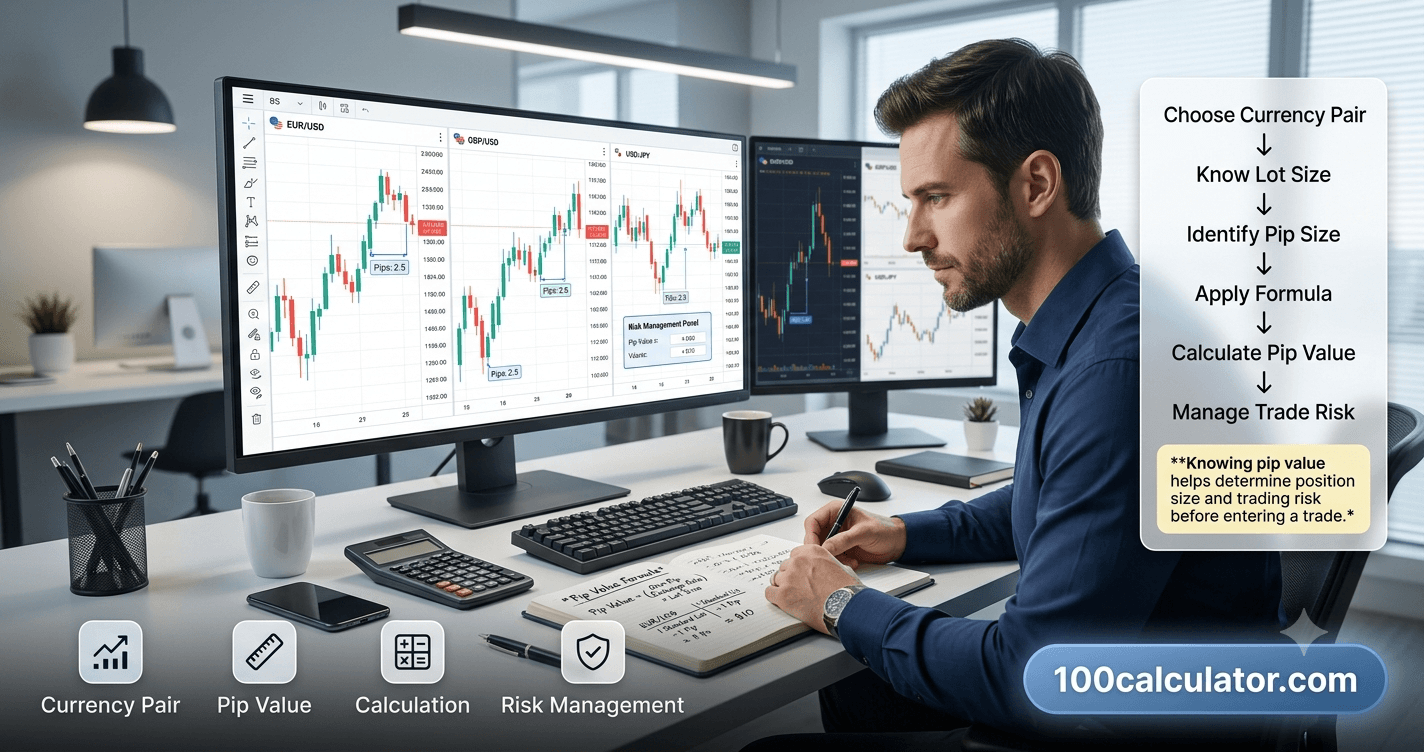
Every forex trade comes down to one basic question: if the price moves, how much money actually changes hands? A pip tells you how far the price moved. Pip value tells you what that movement is worth in real currency. Without knowing both, you're really just guessing at your risk every time you open a trade.
Pip value is the dollar amount a single pip movement is worth on a specific trade, and it depends on three things: the currency pair, your lot size, and your account currency. On a standard lot of EUR/USD, one pip is worth about $10. On a micro lot of the same pair, it's closer to ten cents. Same pair, same pip, completely different money on the line.
This guide walks through the pip value formula step by step, with worked examples for major pairs, JPY pairs, and gold (XAUUSD), which uses different conventions entirely. You'll also see how pip value connects directly to position sizing and risk management, and where traders most often trip up when they calculate it by hand. If you'd rather skip the math, 100 Calculator's Pip Value Calculator does this instantly, but understanding how the number is built makes it much easier to trust, and use, the result.
First, let's define exactly what a pip is, since that's the building block everything else in this guide depends on.
What Is a Pip in Forex Trading?
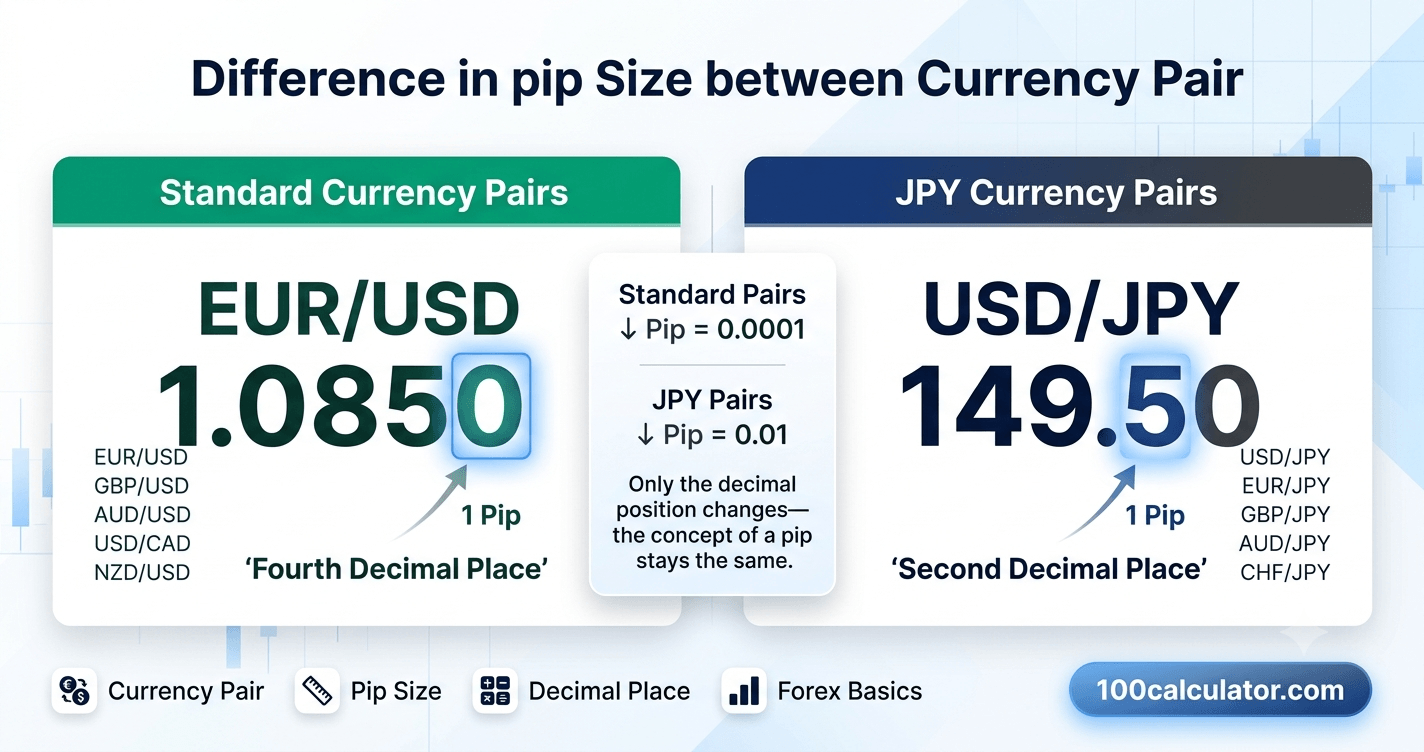
A pip, short for "percentage in point," is the standard unit traders use to measure price movement in a currency pair. For most pairs, that's the fourth decimal place. If EUR/USD moves from 1.0850 to 1.0851, that's a one-pip move.
The idea behind a fixed, standardized unit is simple: it gives every trader a common way to talk about price movement, no matter which pair they're trading or how big their position is. "The price moved 15 pips" means something specific, the same way "the temperature dropped five degrees" does.
Pips vs. Pipettes
Many brokers now quote prices to a fifth decimal place instead of four, showing something like 1.08503 instead of 1.0850. That extra digit is called a pipette, or fractional pip, worth one-tenth of a full pip. Pipettes give slightly more precise pricing, but the pip itself is still the main unit traders use when talking about profit, loss, and risk.
You might also hear the word "tick" used interchangeably with pip. Technically, a tick is the smallest possible price increment a platform allows, which on most modern forex platforms works out to one pipette, a tenth of a pip, rather than a full pip.
Why JPY Pairs Are Different
Pairs that include the Japanese yen, like USD/JPY, EUR/JPY, and GBP/JPY, use a different pip size: the second decimal place instead of the fourth. If USD/JPY moves from 149.50 to 149.51, that's one pip, not one-hundredth of a pip.
This isn't arbitrary. The yen has a much lower unit value than currencies like the US dollar or euro, so JPY pairs are quoted with fewer decimal places to keep the price display manageable. It does mean you can't apply the same pip size across every pair. Always check whether you're trading a JPY pair before you calculate pip value, since using the wrong pip size throws the whole number off.
The Pip Value Formula, Explained Simply
Once you know the pip size for your pair, calculating pip value comes down to one formula.
Formula
Pip Value = Pip Size × Lot Size (units of the base currency)
Pip Size: 0.0001 for most pairs, 0.01 for JPY pairs
Lot Size: Units of the base currency you're trading, 100,000 for a standard lot
Result: The pip value in the pair's quote currency, which may still need converting to your account currency
This gives you the pip value in the pair's quote currency, the second currency listed in the pair. If that happens to match your account currency, you're done. If it doesn't, there's one more step: convert that figure into your account currency using the current exchange rate between the quote currency and your account currency.
Why Pip Value Changes With the Exchange Rate
Here's the part that trips people up. For pairs where your account currency is the quote currency, like EUR/USD for a USD account, pip value stays essentially fixed at the same round numbers no matter where the price sits. But for pairs where your account currency is the base currency, like USD/JPY, pip value shifts slightly every time the exchange rate moves, because you're dividing by a number that's constantly changing.
Neither version is more "correct." They're just different mechanics depending on which side of the pair your account currency sits on, and it's exactly why a calculator that uses a current exchange rate is more reliable than a number you memorized last month.
How to Calculate Pip Value Step by Step
Here's the full process, broken into steps you can follow for any pair.
- Identify the pip size. 0.0001 for most pairs, 0.01 for JPY pairs.
- Identify your lot size in units. Standard = 100,000, mini = 10,000, micro = 1,000.
- Multiply pip size by lot size. This gives you the pip value in the quote currency.
- Check your account currency against the quote currency. If they match, you're finished.
- If they don't match, convert. Divide or multiply by the current exchange rate between the quote currency and your account currency.
Worked Example: EUR/USD
Say you're trading a standard lot (100,000 units) of EUR/USD, and your account is funded in US dollars.
Pip size: 0.0001
Lot size: 100,000
Pip value = 0.0001 × 100,000 = $10.00
Since USD is the quote currency in EUR/USD, and your account is also in USD, there's no conversion step. One pip is worth $10 on a standard lot, full stop. This same shortcut applies to any major pair where USD is the quote currency, including GBP/USD, AUD/USD, and NZD/USD, so calculating pips in GBP/USD, for example, works out to the same $10 per pip on a standard lot.
Worked Example: USD/JPY
Now say you're trading a standard lot of USD/JPY, with the pair at an example rate of 150.00.
Pip size: 0.01 (JPY pair)
Lot size: 100,000
Pip value in JPY = 0.01 × 100,000 = 1,000 JPY
Here, USD is the base currency and JPY is the quote currency, so there's a conversion step. Divide the JPY figure by the exchange rate to get the value in USD:
1,000 ÷ 150.00 ≈ $6.67 per pip
Notice this number isn't as round as the EUR/USD figure, and it drifts slightly as USD/JPY's exchange rate moves. That's the exchange-rate effect described above, not a mistake in the math.
Pip Value by Lot Size: Standard, Mini, Micro, and Nano
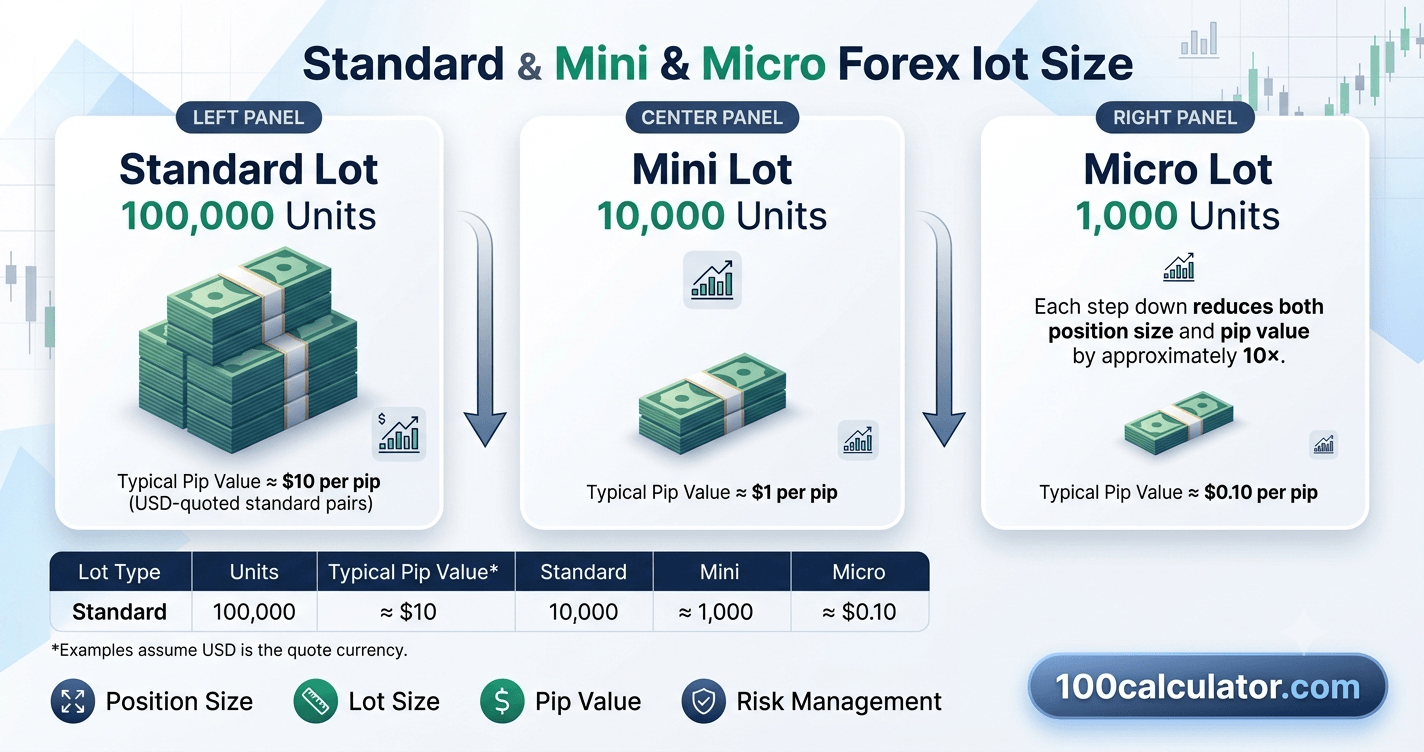
Lot size is the single biggest factor in how much a pip is worth, since pip value scales directly with position size. Here's what each lot size means, and what a pip is worth on each one for USD-quoted major pairs like EUR/USD, GBP/USD, AUD/USD, and NZD/USD.
| Lot Type | Units of Base Currency | Approx. Pip Value (USD) |
|---|---|---|
| Standard Lot (1.00) | 100,000 | $10.00 |
| Mini Lot (0.10) | 10,000 | $1.00 |
| Micro Lot (0.01) | 1,000 | $0.10 |
| Nano Lot (0.001) | 100 | $0.01 |
These figures apply to pairs where USD is the quote currency. For pairs where USD is the base currency, like USD/JPY or USD/CAD, expect the exact number to drift slightly with the exchange rate, as shown in the USD/JPY example above.
Choosing a Lot Size That Matches Your Risk Tolerance
Most retail brokers let you trade in increments as small as 0.01 lots, which is exactly why micro lots have become the default starting point for newer traders. A ten-cent pip value means a string of losing trades costs you dollars, not hundreds of dollars, while you're still learning how a strategy performs in live conditions.
There's no universally "right" lot size. It depends on your account balance and how much of it you're comfortable risking on a single trade. If you're not sure where to start, 100 Calculator's Forex Lot Size Calculator can help you work backward from your risk tolerance to an appropriate lot size, and our guide on standard vs. mini vs. micro lots breaks down the tradeoffs in more depth.
How to Calculate Pip Value for Gold (XAUUSD)
Gold doesn't play by the same rules as standard currency pairs, and that trips up a lot of traders who assume the forex pip formula carries over exactly. It doesn't, not entirely.
Why Gold Pips Work Differently
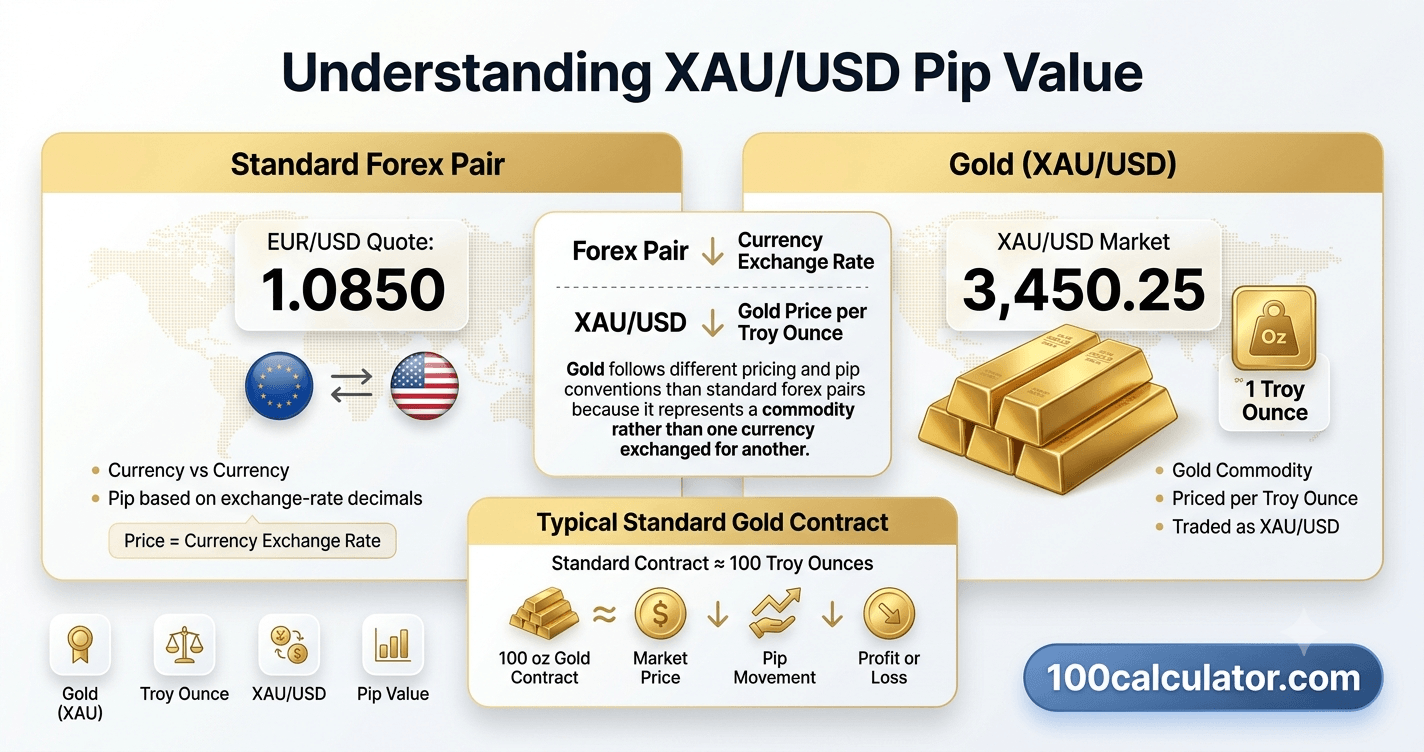
XAUUSD is quoted in US dollars per troy ounce, not as an exchange rate between two currencies, so there's no single industry standard for what counts as "one pip" the way there is for EUR/USD. Some brokers treat a $0.01 price move as one pip. Others use $0.10. A few use the word "point" instead of "pip" entirely, and define it differently again.
This isn't a minor detail. It changes your pip value by a factor of ten depending on which convention your broker uses, so the first step with gold is always checking your broker's contract specifications, not assuming.
XAUUSD Pip Value Formula and Example
The lot sizing convention for gold generally mirrors forex: a standard lot is commonly 100 ounces, a mini lot 10 ounces, and a micro lot 1 ounce, though this can vary by broker too.
Formula (Gold / XAUUSD)
Pip Value = Pip Definition ($0.01 or $0.10, broker dependent) × Contract Size (ounces)
Pip Definition: Varies by broker, commonly $0.01 or $0.10 per ounce
Contract Size: Ounces of gold per lot, 100 oz is a common standard lot
For this example, let's say gold is trading at $2,350.00 per ounce, and your broker uses a standard 100-ounce lot.
If your broker defines 1 pip as a $0.01 move: Pip value = $0.01 × 100 oz = $1.00 per pip
If your broker defines 1 pip as a $0.10 move: Pip value = $0.10 × 100 oz = $10.00 per pip
That tenfold gap is exactly why "how many pips is $1 on gold" doesn't have one universal answer. On the $0.01 convention, $1 profit is roughly one pip on a standard lot. On the $0.10 convention, $1 profit is roughly a tenth of a pip.
Gold Pip Value by Lot Size
| Lot Size | Ounces | If 1 Pip = $0.01 | If 1 Pip = $0.10 |
|---|---|---|---|
| Standard (1.00) | 100 oz | $1.00 | $10.00 |
| Mini (0.10) | 10 oz | $0.10 | $1.00 |
| Micro (0.01) | 1 oz | $0.01 | $0.10 |
Because of this variability, a dedicated XAUUSD pip calculator, or a general pip value calculator where you can enter your broker's exact contract size, is genuinely more useful for gold than it is for major currency pairs. It removes the guesswork instead of assuming a convention that might not match your broker.
Using a Pip Value Calculator vs. Calculating by Hand
Doing the math by hand is a genuinely useful skill, mainly because it helps you understand what's actually happening to your money when a trade moves. But once you understand the mechanics, there's not much reason to keep recalculating it manually every time you open a position.
What a Pip Value Calculator Does For You
A pip value calculator automates the process above:
- Applies the correct pip size automatically, including JPY pairs and gold
- Adjusts for your exact lot size, down to micro and nano positions
- Converts to your account currency using a current exchange rate
- Gives you an instant number you can plug straight into a position size calculation
Free Online Tool
Skip the manual math
100 Calculator's Pip Value Calculator handles the formula, the lot size conversion, and the currency conversion for you. Select your pair, enter your lot size, and get an instant, accurate pip value with no signup required.
When Manual Calculation Still Matters
Even with a calculator handy, it's worth understanding the math for a couple of reasons. First, it helps you sanity-check a number that looks off, whether that's a calculator error, a stale rate, or you selecting the wrong lot size by mistake. Second, if you ever trade a less common pair your broker's calculator doesn't list, you'll be able to work out the pip value yourself using the same formula covered earlier in this guide.
Why Pip Value Matters for Risk and Position Sizing
Pip value isn't just a number for calculating profit. It's the foundation of responsible position sizing, since your stop-loss distance multiplied by your pip value tells you exactly how much a losing trade will cost before you ever place it.
Connecting Pip Value to Stop-Loss Risk
Say you're risking a 40-pip stop-loss. On a standard lot of a USD-quoted pair, at roughly $10 per pip, that's a $400 risk on a single trade. On a micro lot, the same 40-pip stop only risks about $4. Same strategy, same stop distance, completely different amount of money on the line, purely because of lot size.
This is exactly why traders size positions around a fixed percentage of their account, rather than picking a lot size out of habit. A common approach is deciding how much of your account you're willing to risk on one trade, often 1-2%, and then working backward to the lot size that keeps your stop-loss distance within that budget. 100 Calculator's Position Size Calculator does this calculation directly, and our guide on how to calculate position size for safer trading walks through the reasoning in more depth.
A Simple Risk Calculation Example
On a $5,000 account, risking 2% per trade means you're willing to lose $100 on a losing trade. If your stop-loss is 50 pips away and you're trading a USD-quoted pair, divide $100 by 50 pips to get a maximum pip value of $2 per pip. That points you toward a position size of about 0.20 lots, roughly double the size of a standard mini lot.
Getting this backward, sizing your position first and checking the risk after, is one of the more common ways traders end up with bigger losses than they intended. Pip value is what connects the two numbers, so it's worth calculating before you enter a trade, not after. The (CFTC) notes that most retail forex customers end up losing money once fees and financing charges are factored in, which is exactly why disciplined position sizing matters more than any single winning trade. If a losing streak does happen, 100 Calculator's Drawdown Recovery Calculator shows exactly how much you'd need to gain back to recover, which is usually more than people expect.
How Many Pips Do You Need to Hit a Profit Target?
This is one of the most common questions new traders ask, and the honest answer is: it depends entirely on your lot size. The same profit target needs wildly different pip counts depending on how big your position is.
Pips Needed for $100, $500, and Beyond
| Profit Target | Standard Lot (~$10/pip) | Mini Lot (~$1/pip) | Micro Lot (~$0.10/pip) |
|---|---|---|---|
| $100 | 10 pips | 100 pips | 1,000 pips |
| $500 | 50 pips | 500 pips | 5,000 pips |
| $1,000 | 100 pips | 1,000 pips | 10,000 pips |
The math is straightforward once you know your pip value: divide your target dollar amount by your pip value per lot. A $500 target on a mini lot needs 500 pips of favorable movement; the same $500 target on a standard lot needs just 50.
Is a Daily Pip Target Realistic?
It's tempting to set a goal like "30 pips a day" or "100 pips a day," but a fixed pip target ignores lot size entirely, and chasing one is a common way traders end up overtrading on quiet days or taking on too much risk to hit a number on volatile ones. Some days genuinely offer 100 or more pips of movement on a major pair. Others offer a fraction of that, and no amount of effort changes what the market is doing.
A more useful way to judge performance is your risk-adjusted return: how much you made relative to how much you risked, tracked over weeks or months rather than any single session. Pairing that with a sensible risk-reward ratio, using a tool like 100 Calculator's Risk Reward Ratio Calculator, tells you a lot more about whether your strategy is actually working than a daily pip count ever will. Once you're hitting profit targets consistently, our guide on how forex compounding grows a trading account shows how small, steady gains add up over time.
Related Calculators
Put what you just read into practice, try these free tools instantly, no sign-up required.
Pip Value Calculator
Calculate the value of a pip for any currency pair and lot size.
Position Size Calculator
Determine the right position size based on your risk tolerance.
Risk Reward Ratio Calculator
Compare potential risk against reward before entering a trade.
Drawdown Recovery Calculator
Calculate the gain needed to recover from a trading drawdown.
Trading Compound Interest Calculator
Project compounded returns on your trading account balance.
Common Pip Value Mistakes to Avoid
A handful of small errors account for most pip value miscalculations. Here's what to watch for:
- Using the wrong pip size for JPY pairs. Applying 0.0001 to a yen pair instead of 0.01 throws your entire calculation off by a factor of 100.
- Forgetting the currency conversion step. If your account currency doesn't match the pair's quote currency, skipping the conversion gives you a number in the wrong currency entirely, not just a slightly inaccurate one.
- Assuming gold follows standard forex pip conventions. As covered above, gold's pip size and contract size both vary by broker, so carrying over the standard forex formula without checking specifics can be off by 10x.
- Sizing a position before checking the resulting dollar risk. Picking a lot size out of habit, then discovering afterward that your stop-loss risks far more than intended, is one of the most avoidable mistakes in trading.
- Using a stale exchange rate for cross-currency conversions. Pip value for pairs requiring conversion shifts with the market, so a rate from yesterday, or even an hour ago in a fast-moving session, can meaningfully skew the number.
- Not accounting for margin and leverage separately. Pip value tells you profit or loss per pip; it doesn't tell you whether you have enough margin to hold the position. 100 Calculator's Forex Margin Calculator covers that side of the equation.
- Confusing pips with percentage of account. As covered in the FAQ below, 100 pips doesn't correspond to any fixed percentage of your balance; that relationship depends entirely on your position size relative to your account.
Most of these come down to the same root cause: treating pip value as a fixed number you memorize once, rather than something that depends on the specific pair, lot size, and account currency in front of you on that trade.
Risk disclaimer: This article is for general educational purposes only and isn't financial or investment advice. Forex and gold (XAUUSD) trading involve leverage and carry a significant risk of loss, and past performance or hypothetical examples don't guarantee future results. Always confirm contract specifications with your own broker and consider your risk tolerance, or speak with a licensed financial professional, before trading.
More From Our Trading & Forex Guides
Want to go deeper on risk, lot sizing, or how pip value fits into a bigger trading plan? These related guides build on what's covered above.
Frequently Asked Questions
What is a pip calculator?
A pip calculator is a free tool that works out how much a single pip movement is worth in real money, based on the currency pair you're trading, your lot size, and your account currency. Instead of manually applying the pip value formula every time you open a trade, you plug in your details and get an instant figure, which makes it much easier to size trades and set stop-losses correctly.
How do I calculate my pip value?
Multiply the pip size, 0.0001 for most pairs or 0.01 for JPY pairs, by your lot size in units of the base currency. If the quote currency matches your account currency, that's your answer. If it doesn't, convert the result using the current exchange rate between the quote currency and your account currency. A pip value calculator does this conversion automatically.
How much is 1 pip in forex in USD?
It depends on your lot size. On a standard lot (100,000 units) of a USD-quoted pair like EUR/USD or GBP/USD, 1 pip is worth about $10. On a mini lot (10,000 units), it's about $1. On a micro lot (1,000 units), it's about $0.10. For pairs where USD is the base currency, like USD/JPY, the exact value shifts slightly with the exchange rate.
Is 10 pips really equal to $1?
Only on a micro lot (0.01 lots) of a USD-quoted major pair, where each pip is worth roughly $0.10, so 10 pips comes to about $1. On a standard lot, 10 pips is closer to $100, and on a mini lot it's closer to $10. The lot size you're trading changes the answer completely.
How much is 100 pips in forex, in dollars?
On a standard lot of a USD-quoted pair, 100 pips is roughly $1,000. On a mini lot, it's about $100. On a micro lot, it's about $10. Multiply your pip value per lot by 100 to get the total for any position size.
How many pips do I need to make $100?
On a standard lot (pip value around $10), you'd need about 10 pips. On a mini lot (around $1 per pip), you'd need about 100 pips. On a micro lot (around $0.10 per pip), you'd need about 1,000 pips. The same math scales for a $500 target; just multiply the pip counts above by five.
What is 1 pip in XAUUSD (gold)?
It depends on your broker. Many platforms treat a $0.01 move in gold's price as 1 pip, while others use $0.10. On a standard 100-ounce lot, a $0.01 pip is worth about $1, and a $0.10 pip is worth about $10. Check your broker's contract specifications, since gold doesn't follow a single industry-wide pip standard the way major forex pairs do.
How much is 100 pips on gold in dollars?
Using the $0.01-pip convention on a standard lot, 100 pips works out to roughly $100. Using the $0.10-pip convention, the same 100 pips would be closer to $1,000. That tenfold difference is exactly why it's worth confirming how your broker defines a gold pip before you calculate potential profit or loss.
Why use a XAUUSD pip calculator instead of doing it by hand?
Gold's pip value depends on your broker's specific contract size and pip definition, both of which vary more than they do for standard currency pairs. A dedicated XAUUSD pip calculator, or one where you can enter your broker's exact contract specs, removes the guesswork and gives you an accurate figure without having to double-check conventions every time you trade.
How much is a 0.01 lot size worth per pip?
A 0.01 lot is a micro lot, equal to 1,000 units of the base currency. On a USD-quoted major pair, that works out to roughly $0.10 per pip. It's the smallest position size most retail brokers offer, which makes it a popular starting point for beginners who want to keep risk low while they practice.
Is 100 pips the same as 1% of my account?
Not necessarily. Pips measure price movement, not a percentage of your account, so the two only line up by coincidence. Whether 100 pips equals 1% of your balance depends entirely on your account size and position size. A $1,000 move on a $100,000 account is 1%, but that same $1,000 move on a $10,000 account is 10%.
Is 30 to 100 pips a day a realistic trading goal?
Some days deliver that much movement and some don't, so treating a fixed pip count as a daily target can encourage overtrading. A more reliable way to judge performance is your risk-adjusted return: how much you made relative to how much you risked, tracked over weeks or months rather than any single day.
What is the 3-5-7 rule in trading?
It's a popular risk-management guideline: risk no more than 3% of your account on a single trade, keep total exposure across all open trades under 5%, and aim for winning trades that net at least 7% relative to what you risked. It isn't an official regulation, just a widely shared heuristic for keeping position sizes sane.
Do all brokers calculate pip values the same way?
The core forex pip value formula is standard, but contract sizes, minimum lot increments, and how a pair's pip is defined, especially for metals like gold, can vary by broker. Always check your broker's contract specifications, and use a pip calculator configured for your specific account type and currency to get a number you can rely on.
About 100 Calculator
100 Calculator is a free hub of online calculators and educational guides covering health, finance, trading, crypto, education, and more. Every tool is built to be fast, accurate, and genuinely free, with no account or signup required.
We built this guide, and tools like the Pip Value Calculator referenced throughout it, to make everyday trading math easier to work through. Head back to the 100 Calculator homepage to explore the full library of tools, or learn more about the team behind them on our About Us page.