Standard vs Mini vs Micro Lots in Forex Trading
A plain-English breakdown of forex lot sizes — what standard, mini, micro, and nano lots actually mean, how each one changes your pip value and risk, and how to pick the right size for your account instead of guessing.
Open a forex trading platform for the first time and the order ticket asks you to pick a "lot size" before it asks almost anything else. If you've never seen that word used this way before, it's easy to freeze right there.
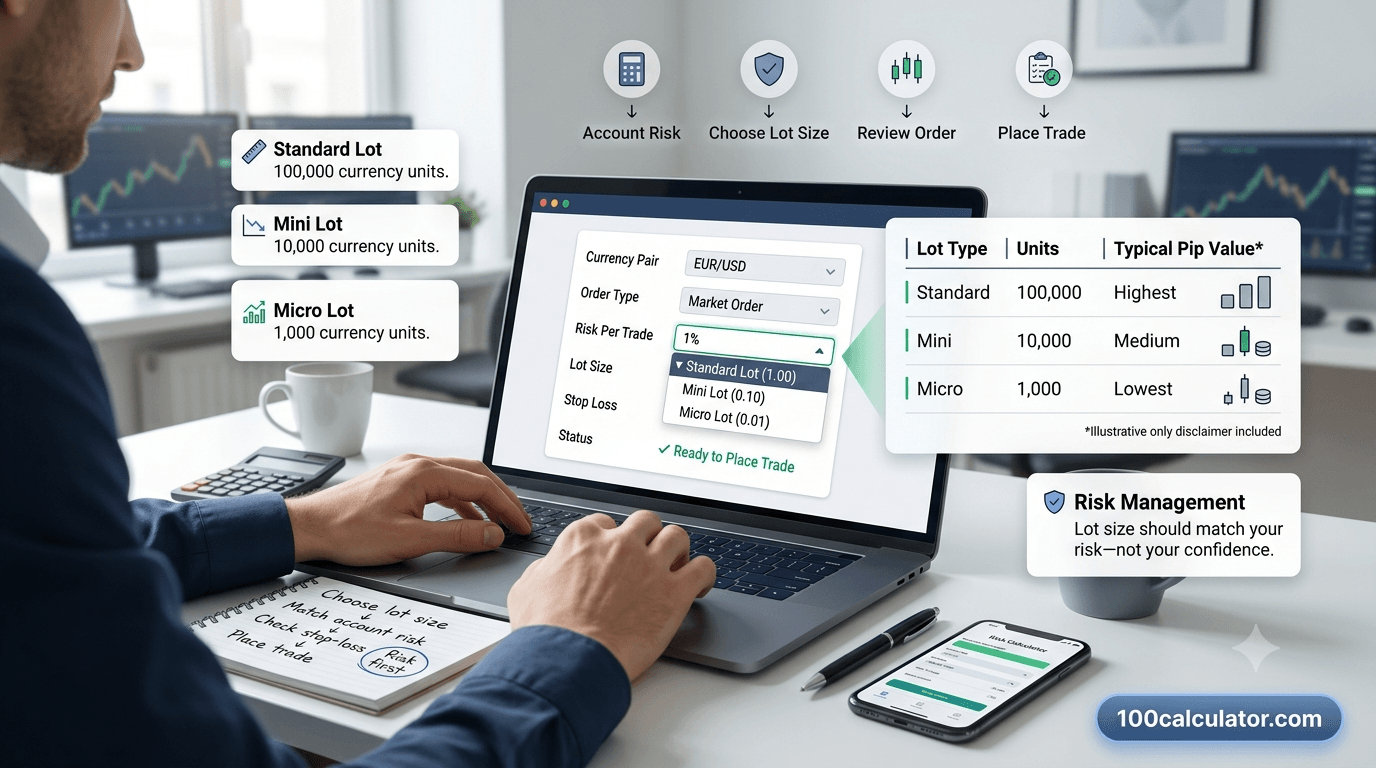
A lot in forex trading is a fixed unit of currency you buy or sell — a standard lot is 100,000 units, a mini lot is 10,000, a micro lot is 1,000, and a nano lot is 100. Picking the right one is really a decision about how much you want a single pip of price movement to affect your account, not a decision about broker features.
That distinction matters more than it sounds. Two traders can watch the exact same EUR/USD chart, place the exact same trade at the exact same price, and still end up with completely different risk, because one used a standard lot and the other used a micro lot. The chart didn't change. The lot size did.
This guide walks through what each lot size actually means, how lot size connects to pip value and margin, and how to work out a size that fits your account instead of guessing. If you'd rather skip the math, 100 Calculator's Forex Lot Size Calculator does the conversion the moment you enter your account size and risk tolerance.
What Is a Lot in Forex Trading?
In forex, currencies aren't traded one unit at a time the way a single share of stock might be. Instead, trades are grouped into standardized batches called lots, so every trader and every broker is talking about the same size of trade when they say "one lot."
A lot is simply the number of units of the base currency in a trade. In a EUR/USD trade, the base currency is the euro, so one standard lot means you're buying or selling 100,000 euros. The unit size doesn't change based on the currency pair — only how much that unit is worth in your account's currency changes.
Forex brokers settled on four common lot sizes, from largest to smallest:
- Standard lot: 100,000 units
- Mini lot: 10,000 units
- Micro lot: 1,000 units
- Nano lot: 100 units
Each size down is exactly one-tenth of the one above it. A mini lot is 10 percent of a standard lot, a micro lot is 10 percent of a mini lot, and so on. That neat 10x relationship is what makes lot size math predictable once you understand one size — the same logic just gets divided by 10, three times over.
Why Forex Uses Lots Instead of Individual Units
Some platforms do let you enter an exact unit amount, like "buy 47,300 units of EUR/USD." But quoting trades in lots gives traders a shared shorthand: "I'm long two mini lots on GBP/USD" tells another trader your exact exposure without either of you doing conversion math out loud. It's the same reason eggs are sold by the dozen instead of one at a time — the grouping makes trading, and talking about trades, faster.
Why Lot Size Is the Most Important Number in Your Trade
New traders tend to spend most of their attention on entry price and which direction to trade. Lot size often gets picked last, almost as an afterthought. That's backwards, because lot size is what turns a price movement into an actual amount of money gained or lost.
Here's the part that trips people up: the market doesn't know or care what lot size you picked. A 20-pip move on EUR/USD is a 20-pip move whether you're trading a nano lot or ten standard lots. What changes is what that move is worth to you. On a micro lot, 20 pips might mean $2. On a standard lot, the same 20-pip move means $200.
That's why two traders can be "right" about the exact same trade — same pair, same entry, same exit — and still walk away with wildly different outcomes. The one trading too large a lot size for their account can turn a normal, everyday price swing into a margin call. The one trading a size that matches their account usually just sees a manageable dip and moves on to the next trade.
Choosing a lot size is really choosing how much of your account you're willing to put behind one pip of movement, which is why it deserves the same care as your stop-loss and your broader position-sizing strategy.
Standard Lots Explained
A standard lot is 100,000 units of the base currency, and it's the original, default lot size forex brokers were built around. When someone says "I traded one lot" without specifying mini or micro, they usually mean a standard lot.
On most U.S.-dollar-quoted pairs, one standard lot moves roughly $10 for every pip the price shifts. That's a meaningful amount attached to a single pip, which is exactly why standard lots suit traders with larger accounts and more experience — the same account management principles apply, but the dollar amounts at stake are bigger in both directions.
Who Actually Trades Standard Lots
Standard lots are common among funded traders, proprietary trading firms, and retail traders who've built up account balances large enough that a $10-per-pip swing is a small, manageable slice of their capital — typically accounts in the tens of thousands of dollars or more, depending on how tightly a trader manages risk.
Nothing stops a smaller account from trading standard lots. It's just considerably riskier, since a normal 30- or 40-pip move against you could mean a $300–$400 loss on a single trade. For most beginners, that's a bigger swing than their account, or their nerves, are built to handle.
Mini Lots Explained
A mini lot is 10,000 units of the base currency, one tenth the size of a standard lot. On most USD-quoted pairs, a mini lot moves about $1 per pip, giving traders a noticeably gentler ride than a standard lot while still producing meaningful gains on a good trade.
Mini lots tend to be the size traders move to once they've outgrown micro lots but aren't ready for the swings a standard lot creates. A string of 20-pip moves means $20 swings instead of $200 ones — enough to feel real, but rarely enough to wipe out a small account in one bad trade.
Many retail brokers set mini lots as their default suggested size for intermediate accounts, since it sits in a comfortable middle ground: large enough to matter, small enough to forgive a mistake or two while a trader is still refining a strategy.
Micro Lots Explained
A micro lot is 1,000 units of the base currency, one tenth of a mini lot. Pip value drops to roughly $0.10 per pip on most USD-quoted pairs, small enough that even a rough day in the market barely dents a small account.
This is the size almost every beginner should start with, and for good reason. A micro lot lets you place real trades, with real money and real emotions attached, without the outsized consequences of a bigger position while you're still learning to read the market and manage a stop-loss.
It's also the size most demo-to-live transitions use, since the psychological jump from paper trading to real money is smoother when the dollar amounts at stake are still modest. A 50-pip loss on a micro lot is $5, annoying but not account-threatening, which means a new trader can absorb a string of learning-curve mistakes without their confidence, or their capital, taking a serious hit.
Nano Lots: The Smallest Option
A nano lot is 100 units of the base currency, one tenth of a micro lot again, and about as small as forex trading gets. Pip value shrinks to roughly $0.01 per pip on most USD-quoted pairs, meaning even a genuinely bad trade barely registers on an account statement.
Not every broker offers nano lots, since the trade sizes are small enough that some platforms don't bother supporting them. Where they are available, nano lots are mostly used by brand-new traders testing a live account for the first time, or by anyone testing a new strategy with real execution conditions — real spreads, real slippage, real order fills — without risking anything that actually matters.
Because the numbers are so small, nano lots aren't really meant to be a long-term trading size. They're a stepping stone: a way to get comfortable with a live platform before scaling up to micro or mini lots.
Standard vs Mini vs Micro vs Nano at a Glance
Once you can see all four sizes side by side, the pattern is easy to remember: each size is exactly 10 times smaller than the one before it, and pip value scales down right along with it.
| Lot Type | Units of Base Currency | Approx. Pip Value (USD pairs) | Commonly Used By |
|---|---|---|---|
| Standard Lot | 100,000 | ~$10.00 per pip | Experienced traders, larger accounts |
| Mini Lot | 10,000 | ~$1.00 per pip | Traders scaling up from micro lots |
| Micro Lot | 1,000 | ~$0.10 per pip | Beginners and smaller accounts |
| Nano Lot | 100 | ~$0.01 per pip | Brand-new live accounts, strategy testing |
How Lot Size Determines Pip Value
Pip value and lot size are locked together by a simple relationship: pip value is just lot size multiplied by the size of one pip.
For most currency pairs, one pip equals 0.0001 of the quoted price. Yen pairs are the exception, where one pip equals 0.01, since the yen doesn't use the same number of decimal places as most other currencies. Multiply the pip size by however many units you're trading, and you get pip value in the quote currency.
Formula
Lot Size (units) — the number of units of the base currency in your trade: 100,000 for a standard lot, 10,000 for a mini lot, and so on.
Pip Size — the smallest standard price movement for that pair, almost always 0.0001, except for yen pairs at 0.01.
A Quick Pip Value Example
Say you're trading one standard lot of EUR/USD, worth 100,000 units. Multiply 100,000 by 0.0001, and you get $10 — every pip EUR/USD moves is worth $10 to you at that size.
Drop down to a micro lot, 1,000 units of the same pair, and the math is 1,000 × 0.0001 = $0.10 per pip. Same pair, same pip movement, one-hundredth of the dollar impact, purely because of the lot size.
This is also why pip value isn't identical across every currency pair, even at the same lot size. If the U.S. dollar isn't the quote currency, pip value comes out in a different currency first and needs converting back to your account currency at the current exchange rate, which is exactly the extra step a Pip Value Calculator or a combined Forex Lot Size Calculator takes care of automatically.
Choosing the Right Lot Size for Your Account
Rather than picking a lot size first and hoping it fits, most experienced traders work backward from how much of their account they're willing to risk on a single trade. That approach gives you a lot size that matches your account and your stop-loss, instead of a size that simply feels familiar.
The 1–2% Risk Guideline
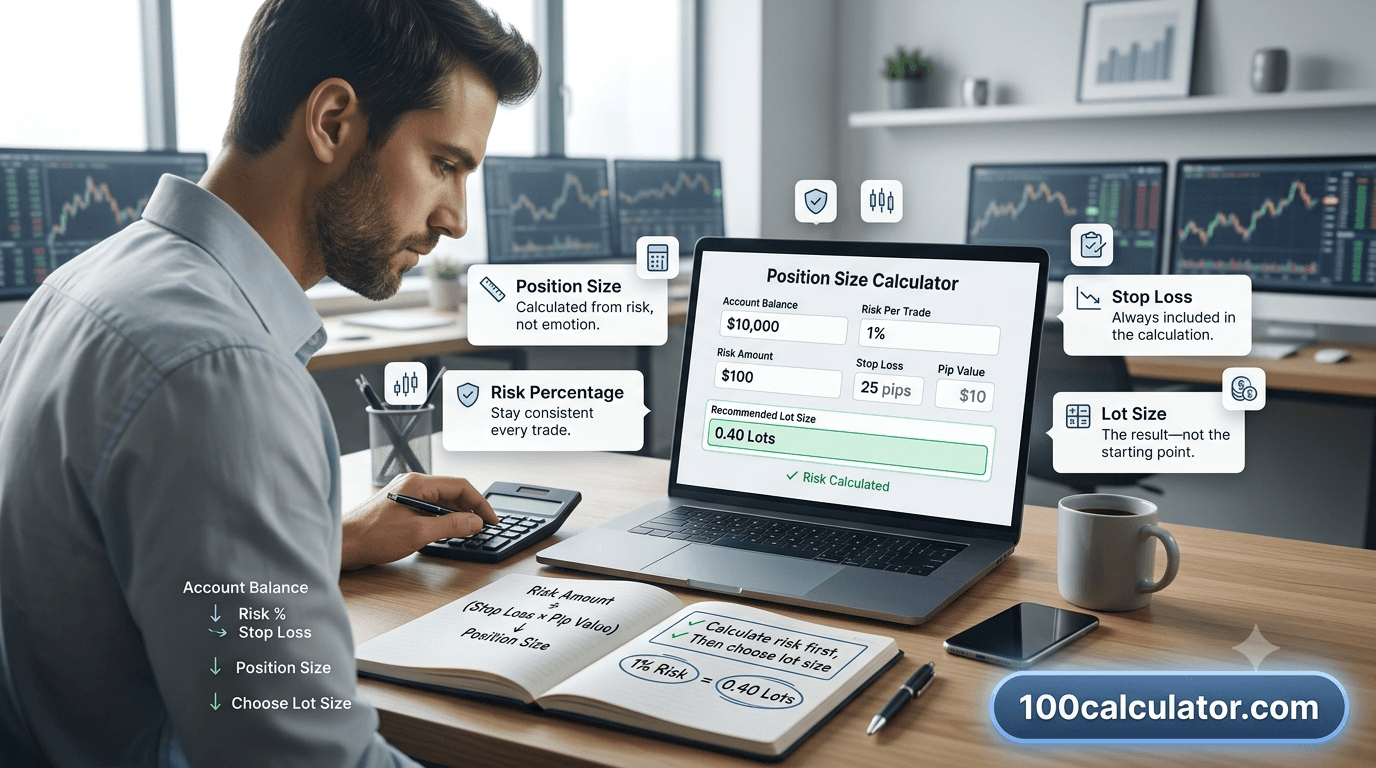
A widely used guideline among traders is to risk no more than 1–2% of an account balance on any single trade. On a $1,000 account, that's $10–$20 at risk per trade; on a $10,000 account, it's $100–$200. This isn't a rule enforced by any exchange — it's a risk management habit that gives a trading strategy room to survive a losing streak instead of being wiped out by one.
Working Out Lot Size From Your Risk
Once you know your risk amount and your stop-loss distance in pips, the lot size math becomes straightforward:
- Decide how much you're willing to risk on the trade — for example, 1% of a $2,000 account is $20.
- Set your stop-loss and measure the distance in pips — for example, 25 pips from your entry.
- Divide your risk amount by the pip distance to find your maximum pip value: $20 ÷ 25 pips = $0.80 per pip.
- Match that pip value to a lot size using the pip-value table above. Since one micro lot is worth about $0.10 per pip, $0.80 per pip lines up with roughly 8 micro lots, or 0.08 standard lots.
Doing this by hand for every trade gets tedious fast, which is exactly the calculation 100 Calculator's Forex Lot Size Calculator automates: enter your account size, risk percentage, and stop-loss distance, and it returns the lot size that matches.
Matching Lot Size to Account Size, Roughly
As a general starting point, many beginners find nano and micro lots comfortable on accounts under a few thousand dollars, mini lots reasonable once an account reaches the low-to-mid five figures, and standard lots appropriate mainly for larger, more established accounts. These are starting points, not hard rules — your own risk tolerance and stop-loss habits matter just as much as your account balance.
Lot Size, Leverage, and Margin: How They Connect
Lot size determines how many units you control. Leverage determines how much of your own money you need to put up to control them. The two work together, and mixing them up is one of the most common sources of confusion for new traders.
Margin is the portion of your account a broker sets aside to open and hold a position, and it's calculated directly from your lot size and your leverage ratio. A bigger lot size needs more margin at the same leverage; more leverage lowers the margin needed for the same lot size. Neither one changes how much a pip is worth — that's still governed purely by lot size, as covered above.
Leverage Limits Around the World
Leverage limits vary by where a broker is regulated, and it's worth knowing the general shape of these rules even if you never plan to use much leverage. In the United States, the Commodity Futures Trading Commission and the National Futures Association cap retail forex leverage at 50:1 on major currency pairs and 20:1 on minor and exotic pairs. In the European Union and United Kingdom, regulators including ESMA and the FCA cap retail leverage at 30:1 on major pairs, with lower limits on riskier instruments. Brokers operating outside these frameworks sometimes advertise leverage of 200:1, 500:1, or higher, which increases how large a position you can open with a small deposit but does nothing to reduce the actual risk per pip tied to your lot size.
U.S. regulators also require forex brokers to close offsetting positions on a first-in, first-out basis, rather than letting traders hold opposing long and short positions in the same pair at the same time (NFA) — a rule worth knowing if you've read about "hedging" strategies used on other platforms.
Why Higher Leverage Isn't the Same as Lower Risk
It's tempting to treat high leverage as a way to trade "for free," since it lets a small account open a large position. But leverage only reduces the margin required — it doesn't reduce or increase the actual dollar risk per pip, which is set entirely by lot size. A trader using 500:1 leverage to open a full standard lot takes on exactly the same $10-per-pip risk as a trader using 10:1 leverage on the same standard lot. High leverage just means less of the trader's own capital is tied up as margin while that same risk sits on the table. If anything, easy access to high leverage tends to encourage larger lot sizes than an account can really absorb, which is where a lot of new trading accounts run into trouble.
For a deeper look at how margin requirements are calculated and what happens if an account can't cover them, see our guides on how margin and leverage work together in forex and what happens when you get a margin call. You can also check your own numbers with 100 Calculator's Forex Margin Calculator.
Common Lot Size Mistakes to Avoid
A handful of avoidable habits account for most of the lot-size-related losses new traders run into. Here's what to watch for:
- Sizing up too fast after a win. A couple of profitable trades can make a bigger lot size feel earned. Losing streaks don't care how confident you're feeling, and a string of normal losing trades at an oversized lot can undo weeks of gains in days.
- Using the same lot size on every pair. A 20-pip stop-loss means something very different on a low-volatility major pair than on a fast-moving exotic pair. Lot size should adjust to a pair's typical movement, not stay fixed out of habit.
- Ignoring leverage until a margin call happens. High leverage doesn't create risk by itself, but it does make it easy to open a lot size an account can't actually absorb if a trade goes against you.
- Confusing lot size with position size. Lot size is the unit of measurement; position size is how many of those units you're actually trading. Two mini lots and twenty micro lots are the same position size, expressed with different units.
- Rounding a calculated lot size up "to keep it simple." Rounding 0.34 lots up to 0.5 might feel tidier, but it also raises risk by close to 50% above what the calculation said was appropriate.
- Skipping the math because a broker's default size feels normal. Many platforms default new accounts to a specific lot size regardless of account balance. That default has nothing to do with an individual account's size or risk tolerance.
Avoiding these mistakes is less about learning more forex theory and more about resisting the urge to skip the position-sizing step because it feels like extra friction before placing a trade. Our guide on position size mistakes every trader should avoid goes deeper into several of these patterns.
Using a Forex Lot Size Calculator
Everything covered so far — lot size, pip value, risk percentage, stop-loss distance — feeds into one calculation. Doing it by hand works fine occasionally, but it's easy to make a small arithmetic slip when you're repeating it before every single trade, especially under the time pressure of a moving market.
Free Online Tool
Skip the manual math
100 Calculator's Forex Lot Size Calculator takes your account balance, risk percentage, and stop-loss distance in pips, then returns the lot size — standard, mini, micro, or a fractional combination — that matches the risk you chose to take. It also handles pip value conversion across currency pairs, so you're not stuck assuming every pair behaves like a USD-quoted major.
A calculator doesn't replace understanding what a lot size actually is — everything covered in the sections above still applies, and it's worth knowing what a tool is doing behind the scenes rather than treating it as a black box. What it does remove is the repetitive arithmetic, so the time you'd spend recalculating lot size by hand can go toward reading the chart instead.
Related Calculators
Put what you just read into practice, try these free tools instantly, no sign-up required.
Forex Compounding Calculator
Project compounded growth of your forex trading account.
Forex Swap & Rollover Calculator
Calculate overnight swap and rollover fees on forex positions.
Forex Lot Size Calculator
Find the ideal lot size based on your account and risk.
Forex Margin Calculator
Calculate the margin required to open a forex position.
Pip Value Calculator
Calculate the value of a pip for any currency pair and lot size.
Building a Position-Sizing Routine That Sticks
Getting lot size right once is easy. Doing it consistently, trade after trade, is what actually protects an account long-term. A short routine makes that consistency automatic instead of something you have to remember to do.
- Decide your risk percentage before you open a chart. Pick 1% or 2%, or whatever fits your account, as a standing rule rather than a decision made trade by trade.
- Set your stop-loss based on the chart, not on the lot size you want to trade. The stop-loss should reflect where your trade idea is actually wrong, not be squeezed in to justify a bigger position.
- Calculate lot size last, using your risk amount and stop-loss distance together, rather than picking a lot size you're comfortable with and hoping the risk works out.
- Round down, not up, whenever your calculated lot size falls between two clean numbers.
- Recalculate every time your account balance changes meaningfully, since a lot size that made sense at a smaller balance may be too conservative, or too aggressive, once the account has grown or shrunk.
None of these steps take more than a minute once they're habits. The goal isn't to slow down your trading; it's to make sure the size of every trade is a decision, not a guess.
Risk disclaimer: This article is for general educational purposes only and isn't financial or investment advice. Forex trading involves substantial risk, including the potential to lose more than your initial deposit when leverage is involved, and isn't suitable for every investor. Lot size and pip value figures in this guide are approximations for illustration — always confirm exact figures with your own broker. Consider practicing with a demo account and speaking with a licensed financial professional before trading with real money.
More From Our Forex Guide
Want to go deeper on any of the ideas covered above? These related guides from the same Forex Guide series dig into swaps, margin, leverage, and pip value in more detail.
Frequently Asked Questions
What is a lot in forex trading?
A lot is a standardized unit of currency used to measure the size of a forex trade. A standard lot equals 100,000 units of the base currency, a mini lot equals 10,000 units, a micro lot equals 1,000 units, and a nano lot equals 100 units. Brokers use lots so every trader is describing trade size the same way, instead of quoting raw unit amounts that vary trade to trade.
What is the difference between a standard lot, mini lot, and micro lot?
The difference is the number of units each one represents, and each size is exactly ten times smaller than the one above it. A standard lot is 100,000 units, a mini lot is 10,000 units, and a micro lot is 1,000 units. Pip value scales down the same way, at roughly $10, $1, and $0.10 per pip on most USD-quoted pairs.
How many units are in a standard lot?
A standard lot equals 100,000 units of the base currency. On a USD-quoted pair like EUR/USD, that works out to roughly $10 per pip of price movement.
How many units are in a mini lot?
A mini lot equals 10,000 units of the base currency, which is one-tenth the size of a standard lot. On most USD-quoted pairs, that comes out to roughly $1 per pip of price movement.
How many units are in a micro lot?
A micro lot equals 1,000 units of the base currency, one-tenth the size of a mini lot. On most USD-quoted pairs, a micro lot moves about $0.10 per pip, which is why it's the size most beginners start with.
What is a nano lot in forex?
A nano lot is the smallest standard lot size, equal to 100 units of the base currency. Pip value drops to roughly $0.01 on most USD-quoted pairs. Not every broker offers nano lots, since some platforms only support trade sizes down to micro lots.
How much is a pip worth on a micro lot?
On most currency pairs quoted in U.S. dollars, one pip on a micro lot is worth about $0.10. Yen pairs and pairs where the dollar isn't the quote currency calculate slightly differently, which is why a pip value calculator is useful for confirming the exact figure.
What lot size should a beginner use in forex trading?
Most beginners start with micro lots, since the roughly $0.10-per-pip risk is small enough to absorb a string of learning-curve mistakes without doing serious damage to the account. Some traders start even smaller, with nano lots if their broker offers them, before moving up to micro and then mini lots as experience grows.
How do I calculate the right lot size for my forex account?
Decide what percentage of your account you're willing to risk on a single trade, commonly 1 to 2 percent, then divide that dollar amount by your stop-loss distance in pips. The result is your maximum pip value, which you can match to a lot size using a pip value reference table or a lot size calculator.
Can I trade forex without using a full standard lot?
Yes. Nearly every retail forex broker supports mini, micro, and often nano lots, and most platforms also allow fractional lot sizes such as 0.1 or 0.01 lots. A full standard lot is simply the largest standard unit, not a requirement for placing a trade.
How does leverage affect the lot size I can trade?
Leverage changes how much margin your broker requires to open a lot size, not the actual risk per pip tied to that lot size. Higher leverage lets a smaller account open a larger position with less margin set aside, but the dollar risk per pip stays the same as it would at any other leverage ratio.
What happens if I choose a lot size that's too big for my account?
A lot size that's too large relative to your account balance means normal, everyday price swings can trigger outsized losses or even a margin call, where your broker automatically closes positions because your account can no longer support them. Sizing trades from a fixed risk percentage, rather than a lot size that simply feels comfortable, helps avoid this.
Do all forex brokers offer micro and nano lots?
Most retail forex brokers support micro lots, since they're the standard entry point for smaller accounts. Nano lots are offered less consistently, so it's worth checking a specific broker's trade size options before assuming nano lots will be available.
Is a smaller lot size always safer in forex trading?
A smaller lot size reduces the dollar risk per pip, but it doesn't automatically make a trade safer if the underlying strategy, stop-loss placement, or risk percentage is still poorly planned. Lot size is one part of risk management, not the whole picture.
How is lot size different from position size?
Lot size is the standardized unit of measurement, such as standard, mini, micro, or nano. Position size is the total amount of currency you're actually trading, expressed in whichever lot size you choose. Two mini lots and twenty micro lots represent the same position size, just described in different units.
What's the easiest way to figure out my lot size before placing a trade?
The fastest way is to use a dedicated lot size calculator, entering your account balance, risk percentage, and stop-loss distance in pips. It applies the same math covered in this guide automatically, which removes the chance of an arithmetic mistake right before you place a trade.
About 100 Calculator
100 Calculator is a free hub of online calculators and educational guides covering finance, trading, forex, crypto, health, education, and more. Every tool is built to be fast, accurate, and genuinely free, with no account or signup required.
We built this guide, and tools like the Forex Lot Size Calculator referenced throughout it, to make everyday trading questions a little easier to work through. Head back to the 100 Calculator homepage to explore the full library of tools, or learn more about the team behind them on our About Us page.