How Forex Compounding Grows a Trading Account
A clear, math-first look at how reinvesting your trading profits, instead of pulling them out, changes the way a forex account grows, with the formula, worked examples, and honest expectations about what's actually realistic.
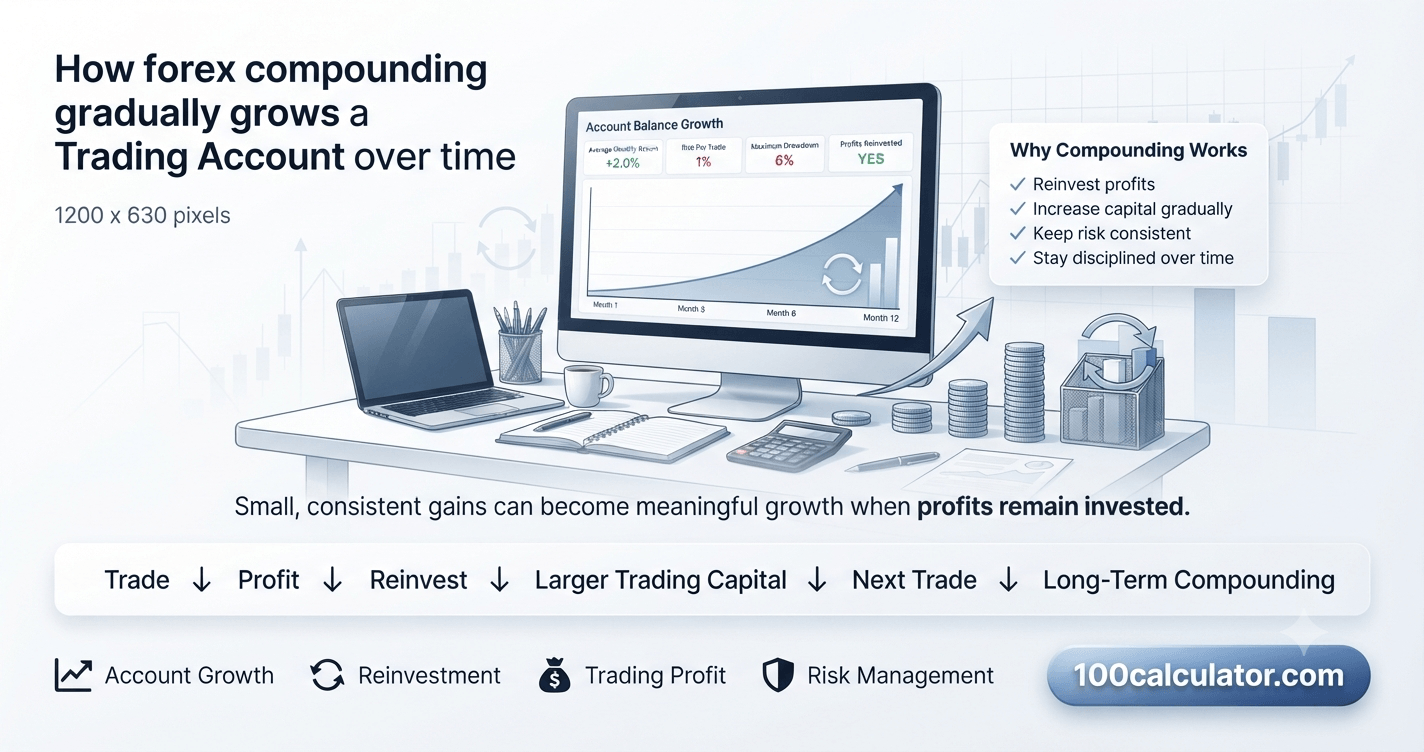
Two traders can start with the exact same $1,000 account, earn the exact same average return every month, and still end up with very different balances a year later. The difference usually comes down to one habit: whether they reinvest their profits or pull them out.
Forex compounding is the practice of leaving your trading profits in your account instead of withdrawing them, so your position sizes, and your future gains, are calculated on a growing balance instead of a fixed one. Because each new gain is based on a slightly larger account than the one before it, a compounding account tends to grow at an accelerating rate over time, even if the percentage return per trade or per month never changes.
This is the same basic idea behind compound interest in a savings account, applied to an actively traded forex account instead. The math is identical. What's different is that a trading account's monthly "return" isn't fixed or guaranteed the way a bank's interest rate is. It depends on your strategy, your risk management, and market conditions that shift from one month to the next.
100 Calculator's Forex Compounding Calculator can run these numbers for you in seconds, but it helps to understand what's happening underneath the calculation first. This guide walks through the formula, shows what compounding actually looks like with real numbers, and explains what a realistic compounding rate looks like compared to the kind of claims that should make you skeptical.
What Is Forex Compounding?
In a forex trading account, compounding means increasing your position size as your account balance grows, so that the same percentage return produces a larger dollar gain over time. If you start with $1,000 and make 2% on a trade, you gain $20. If your balance has grown to $1,500 by the time you make your next 2% gain, you now gain $30, not because you did anything differently, but because you're trading a larger account.
This only works if you actually leave the profit in the account. Withdraw it, and your balance, and your position size, stays flat no matter how many winning trades you string together.
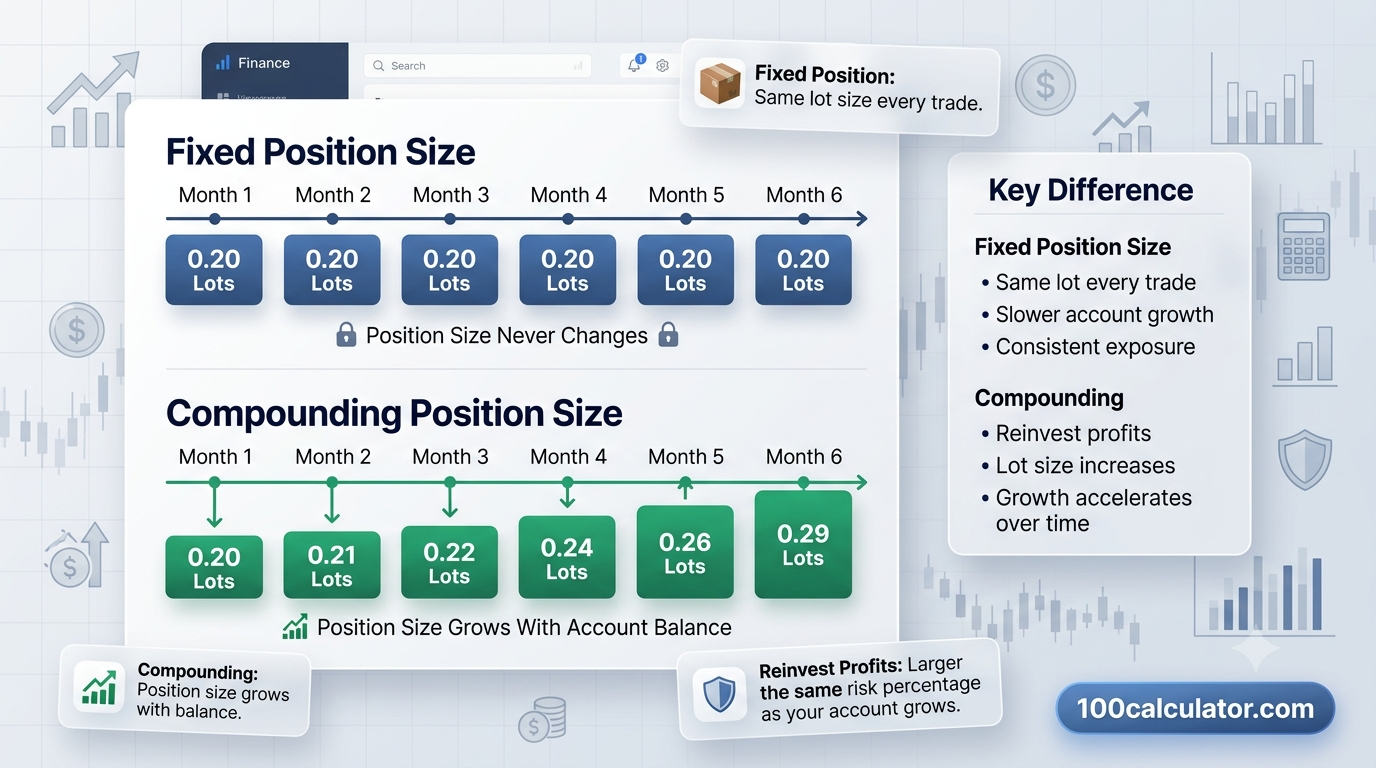
Compounding vs Fixed Position Sizing
Fixed position sizing is the opposite approach. A trader using fixed sizing might always risk $20 per trade, or always trade the same lot size, no matter how much the account has grown or shrunk. This keeps risk very predictable, and it's a genuinely reasonable choice for some traders, especially beginners still building consistency. But it also means the account grows in a straight line instead of a curve: $20 always turns into roughly $20 more, never $30 or $40, even after months of gains.
Key Terms to Know Before You Start
A few terms come up constantly in any discussion of compounding, so it helps to have clear definitions before going further.
| Term | What It Means |
|---|---|
| Principal | Your starting account balance before any gains are added |
| Compounding period | How often you recalculate your position size based on the new balance, such as per trade, weekly, or monthly |
| Rate of return | The percentage gain or loss for a given period, relative to the balance at the start of that period |
| Position size | The number of lots or units you trade, which determines how much a given pip movement is worth in dollars |
| Drawdown | The percentage an account has fallen from its most recent high point |
The Forex Compounding Formula Explained
The formula behind forex compounding is the same one used for compound interest anywhere else in finance:
The Compounding Formula
FV = P × (1 + r) ^ n
FV = Future value, your ending balance
P = Principal, your starting balance
r = Rate of return per compounding period, written as a decimal (2% = 0.02)
n = Number of compounding periods
A Simple Example With Real Numbers
Say you start with $1,000 and manage to average a steady 2% return each month, reinvesting everything. Using the formula, FV = 1,000 × (1.02)^12, your account would grow to roughly $1,268 after a year, not from a single big win, but from twelve ordinary 2% months stacked on top of each other.
Push that same 2% monthly average out to two years, or 24 months, and the balance grows to about $1,608. Notice the growth isn't a straight line: the gain in year two is larger than the gain in year one, because every new gain is calculated on a bigger balance than the one before it.
Why Compounding Matters for a Trading Account
Two traders with identical win rates can end up in very different places after a year, depending on one decision: what they do with their profits.
Reinvesting Profits vs Withdrawing Them
Every time you withdraw profit from a trading account, you reset part of the compounding effect. That's not necessarily a mistake. Plenty of traders withdraw a portion of their gains every month to cover living expenses, pay taxes, or simply bank the win, and that's a completely reasonable choice. But it's worth being clear-eyed about the trade-off: money you withdraw stops working for you inside the account, and future gains are calculated only on what's left behind.
A common middle ground is a partial compounding, or profit split, approach: reinvest most of each period's gain, and withdraw a smaller, fixed portion. This keeps some of the compounding benefit while still letting you use a portion of your profits along the way.
Small, Consistent Gains Add Up Faster Than You'd Think
It's easy to underestimate how much a small, repeatable edge is worth once it compounds. A trader averaging just 2% a month doesn't sound dramatic, but reinvested consistently, that account roughly doubles in under three years. A quick shortcut called the Rule of 72 estimates this: divide 72 by your monthly rate to estimate how many months it takes to double (72 ÷ 2 ≈ 36 months). It's the same underlying math behind how compound interest grows your money over time in a savings account, just applied to trading gains instead of a bank's interest rate. For a closer look at how this plays out across different trading styles, see our guide on how compounding returns work in active trading.
A compounding approach generally gives you:
- A trading account that grows at an accelerating rate instead of a flat one
- Position sizes that scale automatically with account performance, so a bigger balance means bigger, not just repeated, gains
- Less pressure to swing for oversized wins, since consistency does more of the work
- A clearer, more realistic long-term growth curve you can actually plan around
How to Compound a Forex Account Step by Step
Compounding a live trading account isn't complicated, but it does take a specific, repeatable process. Here's a simple version to start from:
- Start with an amount you can genuinely afford to trade. Compounding works on any size account, but it can't turn an unrealistic starting balance into meaningful income overnight. Treat your starting balance as risk capital, not money earmarked for bills.
- Decide on a consistent risk percentage per trade, commonly somewhere around 1% to 2% of the account balance, rather than a fixed dollar amount. This is what actually connects your position size to your balance. Our Position Size Calculator, Pip Value Calculator, and Forex Lot Size Calculator can help you translate a risk percentage into an actual lot size for a given stop-loss distance.
- Recalculate your position size at a fixed interval, whether that's after every closed trade, once a week, or once a month, rather than adjusting it impulsively after a big win or loss. We'll cover the trade-offs between these intervals later in this guide.
- Leave the calculated profit in the account rather than withdrawing it, at least for the portion of gains you're planning to compound.
- Track your balance and your risk-adjusted position size over time, so you can see whether your process is actually working the way the math says it should. 100 Calculator's Forex Compounding Calculator can project this forward for a given starting balance, rate, and time frame.
Compounding vs Simple Growth: A Side-by-Side Comparison
The easiest way to see what compounding actually buys you is to compare it directly against simple growth: the same 2% monthly return, but calculated only on your original $1,000 balance instead of your current one.
| Month | Compound Growth | Simple Growth |
|---|---|---|
| 1 | $1,020.00 | $1,020.00 |
| 3 | $1,061.21 | $1,060.00 |
| 6 | $1,126.16 | $1,120.00 |
| 12 | $1,268.24 | $1,240.00 |
| 24 | $1,608.44 | $1,480.00 |
In month one, the two methods are identical, because there's no accumulated gain yet for compounding to build on. By month 24, compounding has pulled ahead by about $128, roughly 8.7% more than the simple approach ended up with, using the exact same monthly return the entire time.
Realistic Monthly Return Expectations
The compounding formula doesn't care what rate you plug into it. It will just as happily calculate the results of an unrealistic monthly return as a realistic one. That's exactly why this section is worth reading carefully.
Why Big Claims Don't Hold Up Mathematically
Advertisements and trading "gurus" sometimes claim monthly returns of 20%, 30%, or more, presented as consistently achievable. Run that number through the same compounding formula and the problem becomes obvious fast. A steady 20% a month, fully compounded, would turn $1,000 into about $8,916 in a single year. Stretch that same steady rate to two years and it becomes roughly $79,497. At five years, it's over $56 million from a single $1,000 starting deposit.
If a strategy could genuinely deliver a steady 20% a month sustained for years, the trader running it would become one of the wealthiest people alive within a decade. In practice, the opposite is far more common. The U.S. Commodity Futures Trading Commission reports that based on quarterly profitability data from registered U.S. forex dealers, roughly two out of three retail forex accounts finish a given quarter at a loss, not the runaway, guaranteed gains that aggressive return claims imply.
What Experienced Traders Actually Target
There's no single official "correct" number, and returns vary a lot by strategy, market conditions, and risk tolerance. That said, many experienced traders and trading educators treat a monthly return in the low single digits, often cited as somewhere in the 1% to 4% range, as a more sustainable target than double-digit monthly numbers, specifically because it's a rate that can survive losing months without requiring outsized risk. Regulators such as the CFTC require forex dealers to give customers clear risk disclosures, precisely because retail forex trading carries a high risk of loss, and no return, modest or aggressive, is ever guaranteed. Our companion guide on realistic monthly returns for compounding forex accounts goes deeper into setting a target that fits your own strategy, rather than borrowing someone else's number.
How Compounding Frequency Affects Growth
In a savings account, compounding frequency (daily, monthly, annually) mostly just changes how often interest gets added, and more frequent compounding produces slightly more growth. In a forex trading account, the idea is similar, but the trade-offs are bigger, because you're recalculating position size, not risk-free interest.
| Frequency | How It Works | Trade-off |
|---|---|---|
| Per trade | Position size recalculated after every closed trade | Fastest compounding during a winning streak, but also the fastest way to compound losses during a losing streak |
| Weekly | Position size recalculated once a week | Smooths out single-trade swings while still responding to short-term performance |
| Monthly | Position size recalculated once a month | The steadiest and easiest to plan around, but the slowest to reflect a strong month's gains |
There's no universally "best" frequency. Traders with a proven, low-volatility edge sometimes compound per trade to maximize growth. Most beginners are better served by weekly or monthly recompounding, since it limits how quickly a rough patch can shrink position sizes, and in turn, future gains. 100 Calculator's Trading Compound Interest Calculator lets you compare projections at different compounding frequencies side by side before picking one.
Common Mistakes That Derail Forex Compounding
Compounding is simple in theory, but a handful of habits consistently throw it off in practice.
- Increasing risk after a winning streak. A few good months can tempt traders into risking a much larger percentage per trade, which turns a working compounding plan into a much riskier bet.
- Panic-sizing after a loss. Cutting position size drastically after a single bad trade, rather than following a consistent plan, makes it harder to recover through normal compounding.
- Withdrawing profits inconsistently. Pulling out gains during a good month and leaving losses to compound during a bad one skews the math against you over time.
- Ignoring trading costs. Spreads, commissions, and swap or rollover fees quietly reduce your real rate of return every period, so the number you plug into a compounding calculator should reflect net gains, not gross ones. Our guide on how overnight rollover fees affect forex trades and 100 Calculator's Forex Swap & Rollover Calculator can help you see the real cost of holding positions overnight.
- Compounding an unproven strategy. Compounding accelerates whatever your underlying strategy produces, including a losing edge. It's worth confirming a strategy is genuinely profitable on a fixed size first, before compounding amplifies the results either way.
Related Calculators
Put what you just read into practice, try these free tools instantly, no sign-up required.
Forex Compounding Calculator
Project compounded growth of your forex trading account.
Forex Swap & Rollover Calculator
Calculate overnight swap and rollover fees on forex positions.
Forex Lot Size Calculator
Find the ideal lot size based on your account and risk.
Forex Margin Calculator
Calculate the margin required to open a forex position.
Pip Value Calculator
Calculate the value of a pip for any currency pair and lot size.
The Real Impact of Drawdowns on a Compounding Account
Compounding cuts both ways. The same math that accelerates gains also accelerates losses, which is why managing drawdowns matters just as much as chasing returns.
| Account Loss | Gain Needed to Recover |
|---|---|
| 10% | 11.1% |
| 20% | 25.0% |
| 30% | 42.9% |
| 40% | 66.7% |
| 50% | 100.0% |
| 75% | 300.0% |
The relationship isn't symmetrical. A 10% loss only needs an 11.1% gain to recover, which barely registers. But a 50% loss needs a full 100% gain just to get back to even, and a 75% loss needs the account to quadruple. This is exactly why avoiding large drawdowns protects your compounding curve more effectively than trying to make up for a big loss with an even bigger win. Pairing a sensible risk-per-trade percentage with a healthy risk-reward ratio is one of the more reliable ways to keep drawdowns small enough that compounding can keep working in your favor. Our Drawdown Recovery Calculator and our guide on how much return you need to recover from a drawdown go deeper into this math if you want to run your own numbers.
Building a Compounding Plan You Can Actually Stick To
The most effective compounding plan is the one you'll actually follow for months, not the one that looks best in a spreadsheet after a single lucky week.
- Pick a risk percentage and a compounding frequency, then write them down. A plan you can look back at is much easier to stick to than one you're reinventing every week.
- Review your results monthly, not daily. Daily swings are mostly noise. Monthly patterns tell you whether the plan is actually working.
- Separate trading capital from money you can't afford to lose. Compounding should never be applied to funds you need for near-term expenses.
- Decide your withdrawal policy in advance, whether that's full reinvestment, a fixed percentage withdrawal, or milestone-based withdrawals, such as once the account doubles.
- Revisit your plan after major wins and major losses, not to abandon it, but to confirm it's still appropriate for your current balance and risk tolerance.
Free Online Tool
See your own numbers before you trade them
100 Calculator's Forex Compounding Calculator lets you enter a starting balance, a monthly return, and a time frame to see exactly how your account would grow under different compounding assumptions, with no signup required. Pair it with the Position Size Calculator to translate your target risk percentage into an actual lot size for your next trade.
Risk disclaimer: This article is for general educational purposes only and isn't personalized financial or trading advice. Forex trading involves leverage and carries a high level of risk, including the possible loss of more than your original deposit. Past performance, including any example returns shown in this guide, is not indicative of future results. Always consider your own financial situation and risk tolerance, and consult a licensed financial professional before making trading decisions.
Sources & References
This guide relies on publicly available information from official regulators that oversee retail forex trading in the United States. Their sites are a good next step if you want to read the underlying risk disclosure requirements yourself.
More From Our Forex Guide
Compounding is just one piece of a bigger picture. These related guides dig into the other mechanics that shape how a forex account actually performs.
Frequently Asked Questions
What is forex compounding?
Forex compounding is reinvesting your trading profits back into your account instead of withdrawing them, so future position sizes and gains are calculated on a growing balance. Because each gain builds on a slightly larger balance than the one before it, a compounding account tends to grow at an accelerating rate over time, even if your percentage return per trade or per month stays exactly the same.
How does compounding work in forex trading?
It works by recalculating your position size based on your current account balance rather than your original deposit. If your balance grows, a fixed percentage risk translates into a slightly larger position, which produces a slightly larger dollar gain on the next winning trade. Left alone over many trades or months, this creates a curve that bends upward faster than simple, non-reinvested growth.
What is a realistic monthly return in forex trading?
There's no single agreed-upon number, since it depends heavily on strategy and risk tolerance, but many experienced traders and educators treat something in the 1% to 4% monthly range as a more sustainable target than double-digit monthly claims. Modest, repeatable returns are generally easier to sustain through losing months than aggressive targets that require outsized risk on every trade.
Is a 20% monthly return realistic in forex trading?
Not as a sustained, ongoing rate. Run 20% a month through the compounding formula and $1,000 becomes roughly $8,900 in a year and more than $56 million after five years, a result no publicly known trading strategy has ever sustained. Claims of consistent 20%-or-higher monthly returns are widely treated as a red flag in the trading community rather than a sign of skill.
How often should I compound my forex account?
It depends on your strategy and comfort with volatility. Recalculating position size after every trade compounds the fastest but also amplifies losing streaks the fastest. Weekly or monthly recompounding grows more slowly but smooths out single-trade swings, which is usually the more comfortable starting point for newer traders.
What's the difference between compounding and simple growth in trading?
Simple growth calculates your gain on your original starting balance every period, so a fixed dollar amount is added each time. Compounding calculates your gain on your current balance, which includes previously reinvested profits, so the dollar amount added grows over time even though the percentage return stays the same.
Can compounding also compound my losses?
Yes. The same mechanism that accelerates gains during a winning streak accelerates losses during a losing one, since position size is still based on your, now smaller, balance. This is exactly why risk management and consistent position sizing matter just as much as, if not more than, the return you're chasing.
How much do I need to gain back after a 50% drawdown?
A 50% loss requires a 100% gain just to return to your starting balance, since you're now trying to recover the loss from a much smaller base. This is why avoiding large drawdowns in the first place protects your compounding progress far more effectively than trying to trade your way back afterward.
Should I withdraw my trading profits or keep compounding?
There's no universally right answer. Fully reinvesting maximizes long-term growth, while withdrawing some profit each period lets you use your gains along the way, at the cost of slower compounding. A common middle ground is reinvesting most of your profit and withdrawing a smaller, fixed portion.
What is the formula for compounding a forex account?
The standard compound growth formula is FV = P × (1 + r) ^ n, where FV is your ending balance, P is your starting balance, r is your rate of return per period as a decimal, and n is the number of periods. It's the same formula used for compound interest anywhere else in finance.
Does compounding work with a small starting balance?
Yes, the math works the same way regardless of account size. A smaller account will produce smaller dollar gains at the same percentage return, but the percentage growth curve is identical. The main limitation with a very small account is that minimum lot sizes can make precise position sizing harder, which is worth checking with your broker.
How long does it take to double a forex account through compounding?
It depends entirely on your monthly return. Using the Rule of 72, a rough shortcut for estimating doubling time, a steady 2% monthly return doubles an account in about 35 months, while a steady 5% monthly return would double it in about 14 months. These are illustrative estimates, not promises, since real trading returns vary month to month.
Is forex compounding guaranteed to work?
No. Compounding is a mathematical process that amplifies whatever return your trading strategy actually produces, whether that return is positive or negative. It doesn't create profit on its own and can't protect against a losing strategy or a string of losing months. It only changes how gains and losses build on top of each other over time.
What's the safest way to start compounding a forex account?
Most trading educators recommend starting with a modest, consistent risk percentage per trade, often cited around 1% to 2% of the account balance, recompounding on a fixed schedule like weekly or monthly rather than after every trade, and testing the approach on a demo account before applying it to real capital.
Can I use a spreadsheet instead of a compounding calculator?
Yes, the compounding formula is simple enough to build in any spreadsheet using an exponent function. A dedicated tool like 100 Calculator's Forex Compounding Calculator is mainly a convenience, letting you test different starting balances, rates, and time frames instantly without setting up formulas yourself.
About 100 Calculator
100 Calculator is a free hub of online calculators and educational guides covering health, finance, trading, crypto, education, and more. Every tool is built to be fast, accurate, and genuinely free, with no account or signup required.
We built this guide, and tools like the Forex Compounding Calculator referenced throughout it, to make the math behind trading decisions easier to understand and verify for yourself. Head back to the 100 Calculator homepage to explore the full library of tools, or learn more about the team behind them on our About Us page.