Pip Value Explained: A Beginner's Guide for Forex Traders
What one pip is actually worth in your account currency, how to calculate it by hand for any pair and lot size, and how a pip value calculator turns that math into a single click.
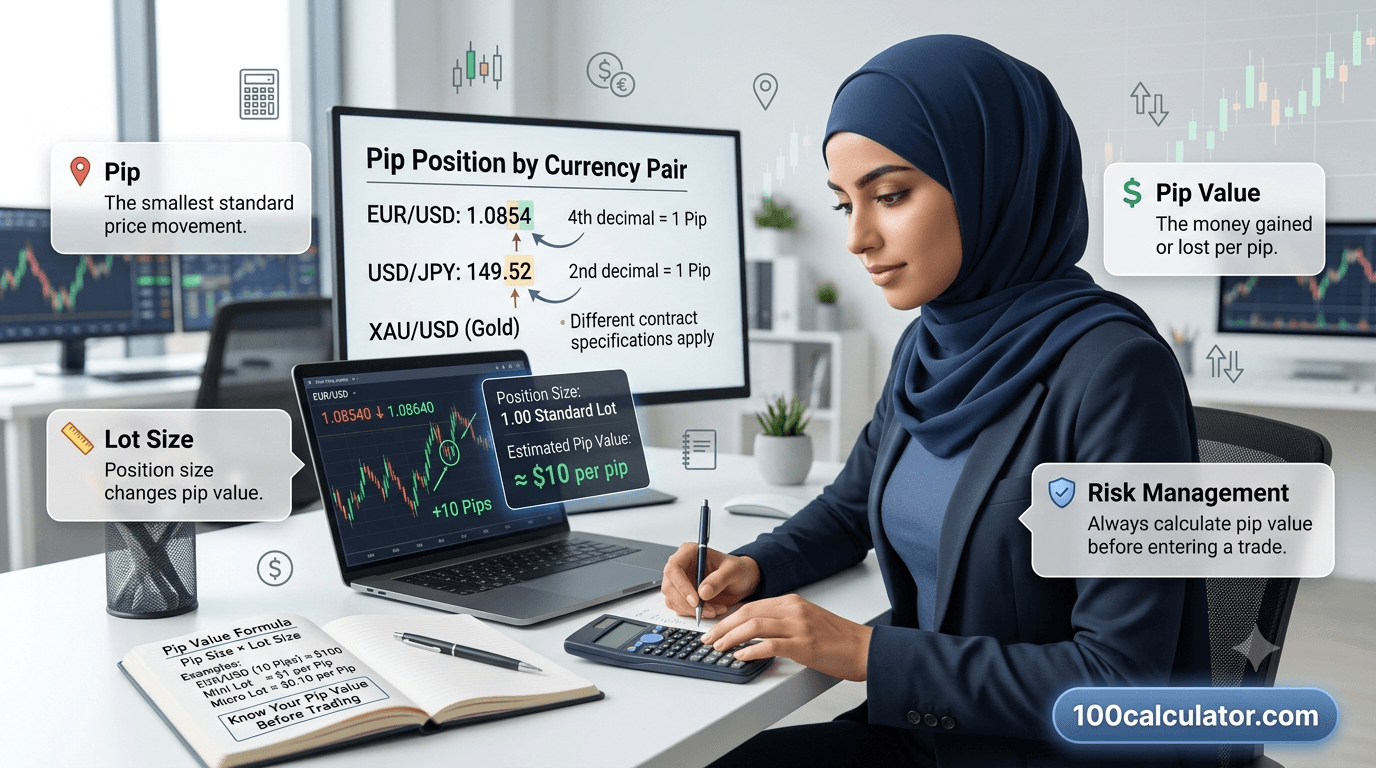
Open a forex chart for the first time and the first thing that trips people up usually isn't the direction of the trade — it's the price itself. EUR/USD moves from 1.0850 to 1.0851, and somehow that tiny shift is supposed to translate into real money gained or lost. That shift is called a pip, and knowing exactly what one pip is worth is the difference between a trade that matches your risk tolerance and one that quietly puts more of your account on the line than you meant to risk.
Pip value is the amount of money, in your account's currency, that a single pip of price movement is worth for a given trade size. It depends on the currency pair you're trading, how many units you're buying or selling, and sometimes the current exchange rate itself. Once you know a pair's pip value, you can work out exactly how much a trade will gain or lose for every pip the price moves, before you ever click buy or sell.
This guide walks through what a pip actually is, how to calculate its value by hand for any currency pair, and how a pip value calculator turns that same math into a single, instant result. We'll also connect pip value directly to position sizing and stop-loss placement, since that's really the whole point of understanding it in the first place.
Understanding Pip Value: What a Pip Really Is
The forex market is enormous — global daily trading volume reached $7.5 trillion in April 2022, according to the Bank for International Settlements' Triennial Survey. But every one of those trades, from the smallest retail order to the largest institutional block, still comes down to the same basic unit of price movement: the pip.
Every forex quote pairs two currencies, like EUR/USD or GBP/JPY. The first currency listed is the base currency, and the second is the quote currency. The number in the quote tells you how much of the quote currency it takes to buy one unit of the base currency. When EUR/USD trades at 1.0850, one euro is worth 1.0850 US dollars.
A pip is the smallest standard unit of price movement most currency pairs use. For most pairs, that's the fourth decimal place — 0.0001. For pairs involving the Japanese yen, it's the second decimal place — 0.01, since yen pairs are quoted with fewer decimal places to begin with. If GBP/USD moves from 1.2700 to 1.2701, that's a one-pip move. If USD/JPY moves from 150.00 to 150.01, that's also a one-pip move, just at a different decimal position.
Where the Word "Pip" Comes From
The term traces back to "percentage in point," a phrase that described the smallest measurable price change in a currency pair long before modern trading platforms existed. Traders shortened it to "pip" over time, and the name stuck even as trading moved from phone calls and paper tickets to electronic screens. Some traders also treat "pip" as short for "point in price," which describes the same idea from a slightly different angle. Either explanation lands in the same place: a pip is simply the standard increment traders use to talk about price movement.
Pips vs. Pipettes: The Fractional Pip
Most retail platforms today show one extra decimal place beyond the standard pip — a fifth decimal for most pairs, or a third decimal for yen pairs. That extra digit is called a pipette, or fractional pip, and it's worth one-tenth of a full pip.
In GBP/USD at 1.27341, the "4" in the fourth decimal place is the pip, and the trailing "1" is the pipette. Pipettes give brokers a more precise way to quote spreads and prices, but most pip value calculations, position sizing formulas, and everyday trading conversations still round to the whole pip, which is exactly how this guide uses the term from here on.
Why Pip Value Matters for Every Trade You Place
It's tempting to treat pip value as a background detail — something a calculator handles so you don't have to think about it. In practice, it's one of the more useful numbers in your entire trading plan, because it connects price movement directly to your account balance.
Understanding pip value pays off in a few concrete ways:
- Lets you size a position so a stop-loss matches a specific dollar amount you're willing to risk
- Makes it easier to compare risk across different currency pairs before choosing one
- Removes the guesswork when a trade moves against you mid-session
- Helps you catch an obviously wrong calculator result before it affects a real trade
Pip Value and Risk Management
Every stop-loss you set is really a statement about pip value, whether you've calculated it directly or not. A 30-pip stop-loss on a position where each pip is worth $10 puts $300 at risk. The same 30-pip stop-loss on a position where each pip is worth $1 puts only $30 at risk. The distance in pips didn't change — the dollar risk did, entirely because of trade size. Knowing pip value before you enter a trade is what lets you choose a stop-loss distance and a position size that together match how much you're actually willing to lose.
Pip Value and Position Sizing
Position sizing is the process of deciding how many units, mini lots, or standard lots to trade so that a stop-loss represents a specific, chosen dollar amount rather than whatever the market happens to hand you. That calculation runs directly through pip value: once you know what one pip is worth at a given trade size, you can scale the trade size up or down until the stop-loss distance lines up with your risk tolerance. We walk through this calculation directly in a later section, and 100 Calculator's Position Size Calculator can handle the math instantly once you know your numbers.
How to Calculate Pip Value Step by Step
For most currency pairs, pip value follows a straightforward relationship between three things: the pip size, the exchange rate, and the trade size.
The Standard Pip Value Formula
Pip Value Formula
Pip Value = (Pip Size ÷ Exchange Rate) × Trade Size
Pip Size — 0.0001 for most pairs, or 0.01 for pairs quoted in Japanese yen
Exchange Rate — the pair's current quote rate, only needed when converting to your account currency
Trade Size — the number of units of the base currency you're trading
There's a helpful shortcut for pairs quoted in your own account currency. If you trade with a USD account and the pair quotes in USD — EUR/USD, GBP/USD, AUD/USD — the exchange rate cancels out of the formula entirely, and pip value simply becomes pip size × trade size. That's why EUR/USD and GBP/USD both work out to a flat $10 per pip on a standard lot, no matter where the price currently sits.
Calculating Pip Value for JPY Pairs
Yen pairs work a little differently, both because of that 0.01 pip size and because the quote currency (JPY) usually isn't your account currency. The formula still applies, but you calculate pip value in yen first, then convert it to your account currency using the current exchange rate.
For USD/JPY at an example rate of 150.00, a standard lot works out to 0.01 × 100,000 = 1,000 yen per pip. Converting that to US dollars means dividing by the exchange rate: 1,000 ÷ 150.00 ≈ $6.67 per pip. Notice that this number moves whenever the exchange rate does — unlike EUR/USD or GBP/USD, pip value on yen pairs isn't fixed.
Adjusting for Your Account Currency
The formula gets one more layer when neither currency in the pair matches your account currency — say, a EUR/GBP position held in a USD account. In that case, you calculate pip value in the quote currency first (GBP, in this example), then convert that amount into US dollars using the current GBP/USD rate. It's the same two-step process as the JPY example above, just with an extra conversion at the end. This is exactly the kind of calculation where a pip value calculator earns its keep, since it applies the right conversion automatically based on the pair and account currency you select.
Pip Value by Lot Size: Standard, Mini, and Micro Lots
Trade size in forex is usually described in lots rather than raw units, and lot size scales pip value directly. Here's how the standard sizes compare, using a pair like EUR/USD or GBP/USD where pip value doesn't depend on the exchange rate.
| Lot Type | Units of Base Currency | Pip Value per Pip |
|---|---|---|
| Standard Lot | 100,000 | $10.00 |
| Mini Lot | 10,000 | $1.00 |
| Micro Lot | 1,000 | $0.10 |
| Nano Lot | 100 | $0.01 |
Most retail brokers offer standard, mini, and micro lots, though not every broker supports nano lots. The relationship stays proportional throughout: half a standard lot (0.5 lots, or 50,000 units) is worth $5 per pip, and 2.5 standard lots is worth $25 per pip. Once you know the pip value for one lot size on a pair, scaling to any other size is simple multiplication. If you're still deciding what lot size fits your account, our guide on choosing the right forex lot size walks through that decision in more depth, and the Forex Lot Size Calculator can suggest a size based on your account balance and risk preference.
Worked Examples: Calculating Pip Value for Popular Currency Pairs
Formulas make more sense with numbers attached. The exchange rates below are round example figures chosen for teaching purposes, not live market data — always check current pricing with your broker before applying any of this to a real trade.
EUR/USD Example
Say you open a 0.5 standard lot (50,000 units) position on EUR/USD. Since USD is the quote currency and matches a USD account, pip value is simply 0.0001 × 50,000 = $5.00 per pip. If the trade moves 20 pips in your favor, that's a $100 gain; 20 pips against you is a $100 loss.
USD/JPY Example
Say you open a 1 standard lot (100,000 units) position on USD/JPY at an example rate of 150.00. Pip value in yen is 0.01 × 100,000 = 1,000 yen. Converting to USD: 1,000 ÷ 150.00 ≈ $6.67 per pip. A 30-pip stop-loss on this position risks roughly $200, compared with the flat $300 a EUR/USD position of the same size would risk at a $10-per-pip rate.
GBP/USD Example
Say you open a 0.2 standard lot (20,000 units) position on GBP/USD. Pip value is 0.0001 × 20,000 = $2.00 per pip. A 40-pip stop-loss represents $80 of risk — useful to know before deciding whether that stop distance actually fits your account size and your risk-reward ratio for the setup.
Using a Pip Value Calculator Instead of Manual Math
Manual calculation is worth understanding, but almost nobody does it by hand once they're actually placing trades. A pip value calculator runs the same formula instantly and removes the risk of a rounding mistake or a missed conversion step.
Free Online Tool
Skip the manual math entirely
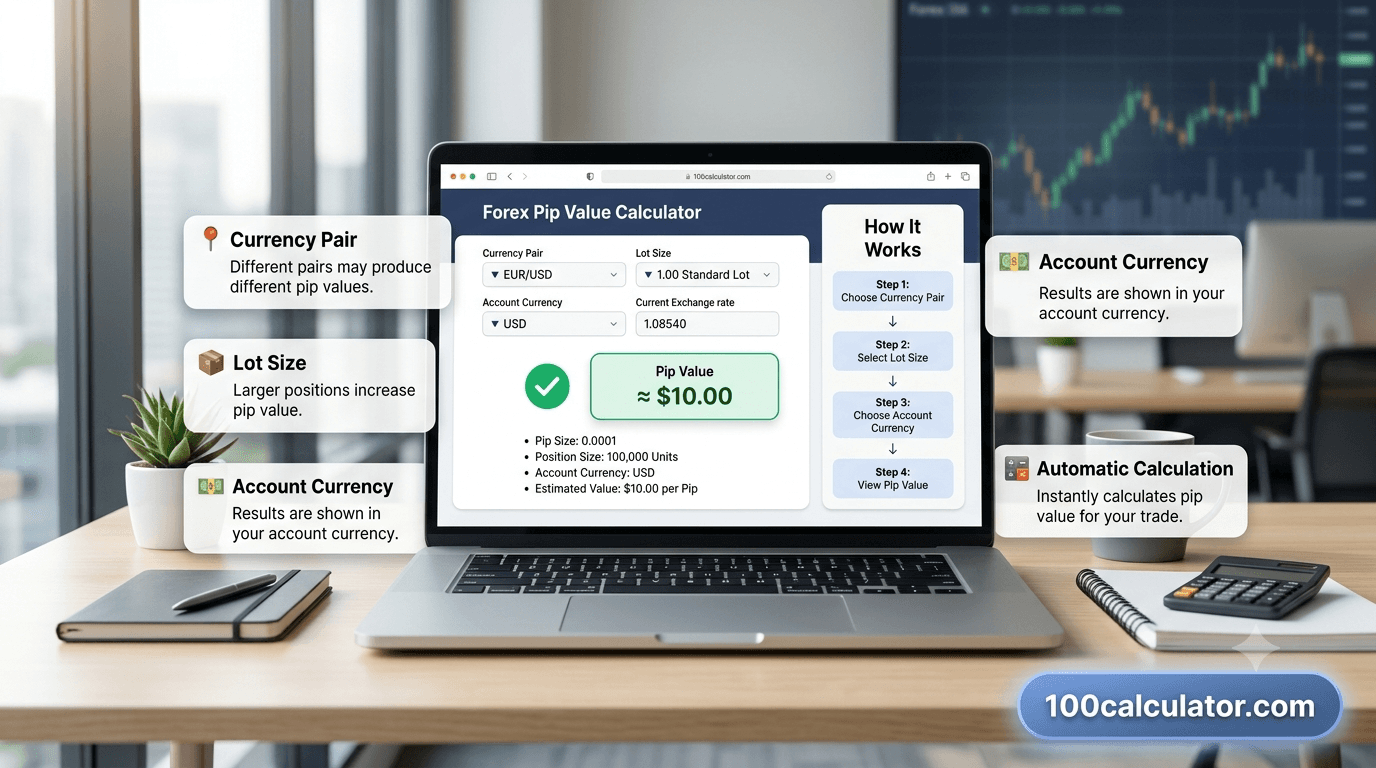
100 Calculator's Pip Value Calculator runs right in your browser. Select your currency pair, trade size, and account currency, and it returns the exact pip value instantly, with no account or signup required.
What to Enter Into a Pip Value Calculator
- The currency pair you're trading, like EUR/USD or USD/JPY
- Your trade size, in lots or raw units of the base currency
- The currency your trading account is funded in
- The current exchange rate, if your calculator doesn't pull it in automatically
Why It's Still Worth Learning the Manual Formula
A calculator is faster, but understanding the formula behind it means you can sanity-check the output. If a result ever looks obviously wrong — say, $100 per pip on what should be a micro lot — knowing roughly what the number should be helps you catch a typo in the lot size or currency pair field before it affects a real trade.
| Approach | Speed | Error Risk | Best For |
|---|---|---|---|
| Manual formula | Slower | Higher — rounding or a missed conversion | Learning how the mechanics work |
| Pip value calculator | Instant | Low | Everyday trading decisions |
Connecting Pip Value to Stop-Loss and Position Sizing
Pip value becomes genuinely practical once you use it to work backward from a risk amount to an actual position size, rather than picking a trade size first and hoping the risk works out.
Working Backward From Your Risk Amount
Position Size Formula
Position Size (in lots) = Risk Amount ÷ (Stop-Loss Distance in Pips × Pip Value per Lot)
Risk Amount — the dollar amount you've decided you're willing to lose on this trade
Stop-Loss Distance — how many pips away your stop-loss sits from your entry price
Pip Value per Lot — the pip value for one standard lot on the pair you're trading
For example, say you want to risk $100 on a EUR/USD trade with a 50-pip stop-loss. Pip value on a standard lot is $10, so the calculation is 100 ÷ (50 × 10) = 0.2 standard lots — the equivalent of 20,000 units, or two mini lots. Open that exact position size, and hitting your stop-loss costs exactly $100, no more and no less.
This is the same logic 100 Calculator's Position Size Calculator runs automatically: enter your account size, risk percentage, and stop-loss distance, and it returns the position size that keeps your risk exactly where you want it. Pairing that with the Risk Reward Ratio Calculator also helps you check whether a setup's potential reward justifies the risk before you place it.
Related Calculators
Put what you just read into practice, try these free tools instantly, no sign-up required.
Forex Compounding Calculator
Project compounded growth of your forex trading account.
Forex Swap & Rollover Calculator
Calculate overnight swap and rollover fees on forex positions.
Forex Lot Size Calculator
Find the ideal lot size based on your account and risk.
Forex Margin Calculator
Calculate the margin required to open a forex position.
Pip Value Calculator
Calculate the value of a pip for any currency pair and lot size.
Common Pip Value Mistakes to Avoid
A few small habits can throw off pip value calculations even when the underlying formula is correct. Here's what to watch for:
- Confusing pip value with the spread. The spread is a cost baked into the price you trade at; pip value is about how much a pip of movement is worth once you're in the trade. They're related but not the same thing.
- Forgetting that JPY pairs use a different pip size. Applying the 0.0001 pip size to a yen pair instead of 0.01 throws the entire calculation off by a factor of 100.
- Assuming pip value is the same across every account currency. Pip value is always expressed in your account's currency, so the same trade can produce a different number depending on whether your account is funded in USD, EUR, or GBP.
- Mixing up lot size units. Entering "1" when you mean 1 micro lot instead of 1 standard lot changes the trade size by a factor of 100 — always double-check whether a field expects lots or raw units.
- Not recalculating after adjusting trade size. Pip value scales with trade size, so a position you resized halfway through planning needs a fresh calculation, not the old number carried over.
- Ignoring small broker-specific rounding. Slightly different exchange rate feeds or rounding conventions can shift pip value by a fraction of a cent between brokers — rarely significant, but worth knowing about if your numbers don't match exactly.
Pip Value on Cross-Currency Pairs
Cross-currency pairs — those that don't include the US dollar at all, like EUR/GBP, AUD/JPY, or EUR/CHF — often need an extra conversion step, since neither currency in the pair may match your account currency.
Take EUR/GBP held in a USD account as an example. You first calculate pip value in the quote currency, GBP: 0.0001 × trade size in units. Then you convert that GBP figure into US dollars using the current GBP/USD exchange rate. It's the same process used for JPY pairs earlier in this guide, just applied to a pair where neither side is your account currency to begin with.
Cross-currency pairs are exactly where a pip value calculator saves the most time, since it applies the correct conversion automatically rather than asking you to look up a second exchange rate by hand. If leverage and margin requirements on these pairs are still unclear, our guide on how margin and leverage work together in forex covers that side of the equation in more depth, and the Forex Margin Calculator can confirm exactly how much margin a given position requires.
Quick Reference: Pip Value Cheat Sheet by Pair Type
Here's a scannable summary of everything covered so far, organized by the type of currency pair you're trading.
| Pair Type | Example Pairs | Pip Size | Pip Value (Standard Lot) |
|---|---|---|---|
| USD-quoted majors | EUR/USD, GBP/USD, AUD/USD | 0.0001 | $10.00, fixed |
| JPY pairs | USD/JPY, GBP/JPY | 0.01 | Varies with exchange rate, roughly $6–$9 |
| Cross pairs (no USD) | EUR/GBP, EUR/CHF | 0.0001 | Requires conversion via quote currency |
| JPY cross pairs | EUR/JPY, AUD/JPY | 0.01 | Requires conversion via quote currency |
When in doubt, the fastest way to confirm any figure in this table for your exact trade size is to run it through the Pip Value Calculator directly — it applies the right formula and conversion automatically, so you don't have to remember which row of this table applies.
Trading disclaimer: This article is for general educational purposes only and isn't financial or investment advice. Forex trading involves substantial risk, including the potential to lose more than your original deposit when trading with leverage, and past performance never guarantees future results. The example rates and calculations in this guide are illustrative, not live market data — always check current pricing with your broker before applying any of these numbers to a real trade. Consider your own financial situation and, if needed, speak with a licensed financial professional before trading foreign exchange.
More From Our Forex Guides
Still building your forex fundamentals? These related guides dig deeper into the lot sizes, margin, swaps, and account mechanics that connect directly to pip value.
Frequently Asked Questions
What is a pip in forex trading?
A pip is the standard unit traders use to measure price movement in a currency pair. For most pairs, it's the fourth decimal place (0.0001); for pairs involving the Japanese yen, it's the second decimal place (0.01). If EUR/USD moves from 1.0850 to 1.0851, that's a one-pip move. Pips give traders a consistent way to talk about price changes and calculate potential gains or losses, regardless of which currency pair they're trading.
How do you calculate pip value?
Pip value equals the pip size divided by the exchange rate, multiplied by your trade size in units. For pairs quoted in your account currency, like EUR/USD in a USD account, the exchange rate cancels out and pip value is simply pip size × trade size. For pairs quoted in a different currency, like USD/JPY, you calculate pip value in that currency first, then convert it to your account currency using the current exchange rate.
What is the pip value for EUR/USD?
For a USD-based account, EUR/USD pip value stays fixed regardless of the current price: $10 per pip on a standard lot (100,000 units), $1 per pip on a mini lot (10,000 units), and $0.10 per pip on a micro lot (1,000 units). This stays constant because USD is the quote currency and already matches the account currency, so no conversion step is needed.
Why is pip value calculated differently for JPY pairs?
Yen pairs use a pip size of 0.01 instead of 0.0001, since JPY pairs are quoted with fewer decimal places to begin with. On top of that, the quote currency (JPY) usually doesn't match a trader's account currency, so pip value has to be converted using the current exchange rate. That's also why pip value on yen pairs, unlike EUR/USD or GBP/USD, actually shifts as the exchange rate moves.
What is the difference between a pip and a pipette?
A pip is the standard unit of price movement — the fourth decimal place for most pairs, or the second for JPY pairs. A pipette, or fractional pip, is one-tenth of a full pip, shown as an extra decimal place on many modern trading platforms. Pipettes give slightly more precise pricing, but most pip value calculations, position sizing formulas, and everyday trading discussions still round to the whole pip.
How does lot size affect pip value?
Pip value scales directly with lot size, since a lot simply describes how many units of the base currency you're trading. A standard lot (100,000 units) has ten times the pip value of a mini lot (10,000 units), which in turn has ten times the pip value of a micro lot (1,000 units). Trading half a standard lot gives you exactly half the pip value of a full standard lot, and so on.
What is the pip value for a standard lot, mini lot, and micro lot?
On a USD-quoted pair like EUR/USD or GBP/USD, a standard lot (100,000 units) is worth $10 per pip, a mini lot (10,000 units) is worth $1 per pip, and a micro lot (1,000 units) is worth $0.10 per pip. Some brokers also offer nano lots (100 units), worth $0.01 per pip. These figures shift for pairs where the quote currency isn't USD.
Does pip value change based on my account currency?
Yes. Pip value is always expressed in your account's currency, so the same trade can have a different pip value depending on whether your account is funded in USD, EUR, GBP, or another currency. When the pair's quote currency matches your account currency, the calculation is simple. When it doesn't, an extra conversion step applies — exactly what a pip value calculator handles automatically.
How do I use a pip value calculator?
Most pip value calculators ask for the currency pair you're trading, your trade size in lots or units, and your account's currency. Some also let you enter or confirm the current exchange rate, though many pull this automatically. Once you submit those details, the calculator applies the correct formula and conversion for that specific pair, returning the exact pip value for your position.
How is pip value connected to position sizing?
Position sizing uses pip value to translate a stop-loss distance into an actual dollar amount at risk. Once you know what one pip is worth for a given trade size, you can adjust that trade size up or down until your stop-loss distance represents the exact dollar risk you've decided is acceptable, rather than an amount the market happens to determine for you.
How do I calculate position size from my risk amount and stop-loss?
Divide your risk amount by the product of your stop-loss distance in pips and the pip value per lot. For example, risking $100 with a 50-pip stop-loss on EUR/USD, where pip value is $10 per standard lot, gives you 100 ÷ (50 × 10) = 0.2 standard lots. That position size keeps your risk at exactly $100 if the stop-loss is hit.
Is pip value the same across every forex broker?
The underlying math is the same everywhere, but small differences can appear based on how a broker rounds figures, which exchange rate feed it uses for conversions, and whether it offers fractional lot sizes. These differences are usually tiny — often fractions of a cent per pip — but it's worth double-checking pip value directly with your own broker before relying on it for exact position sizing.
What is pip value for cross-currency pairs that don't include the US dollar?
Cross-currency pairs, like EUR/GBP or AUD/JPY, often require two conversion steps instead of one, since neither currency in the pair may match your account currency. You calculate pip value in the quote currency first, then convert that figure into your account currency using the current exchange rate between the two. This is one of the situations where a pip value calculator saves the most time.
Why do some trading platforms show a fifth decimal place?
That extra digit represents a pipette, or fractional pip, and it gives brokers a more precise way to quote spreads and prices. For most pairs, this shows up as a fifth decimal place; for JPY pairs, it's a third decimal place. It doesn't change how pip value is calculated for practical trading purposes — most traders and calculators still work primarily with the whole pip.
Do indices, commodities, or crypto have "pips" too?
Some platforms use the term "pip" loosely for other markets, but the concept doesn't translate directly outside forex. Indices and commodities typically measure price movement in points, while cryptocurrency price changes are usually tracked in whole currency units or percentages instead. If you trade these markets alongside forex, it's worth confirming exactly how your platform defines a "point" or "tick" for each one, since the value per unit of movement can look very different from a forex pip.
About 100 Calculator
100 Calculator is a free hub of online calculators and educational guides covering health, finance, trading, crypto, education, and more. Every tool is built to be fast, accurate, and genuinely free, with no account or signup required.
We built this guide, and the Pip Value Calculator referenced throughout it, to make forex math easier to understand and faster to apply before you place a trade. Head back to the 100 Calculator homepage to explore the full library of tools, or learn more about the team behind them on our About Us page.