How Overnight Rollover Fees Affect Forex Trades
A clear, beginner-friendly breakdown of how forex rollover and swap fees actually work, why some trades earn a credit instead of a charge, and how to estimate your own overnight costs before you open a position.
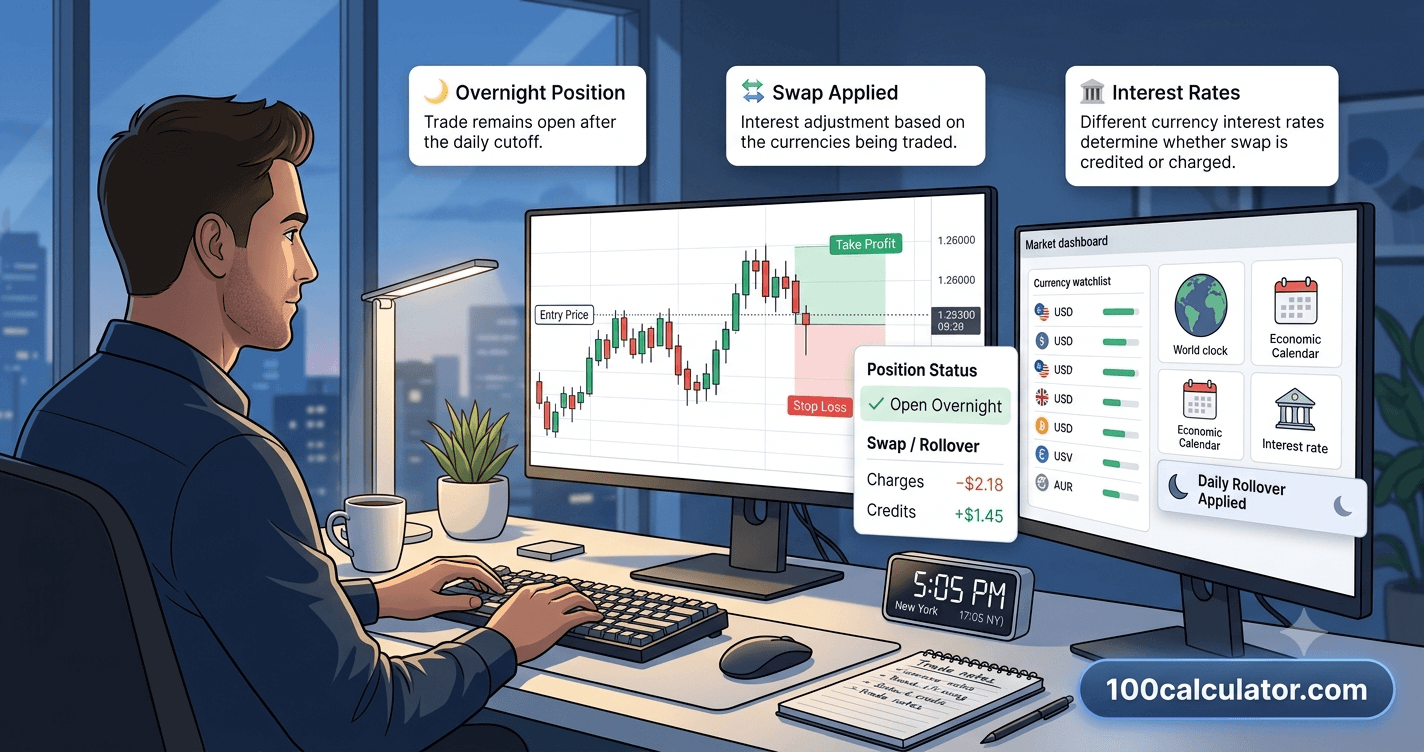
If you've ever left a forex trade open overnight and noticed your balance move slightly without you doing anything, that was a rollover fee at work. Also called a swap fee, it's a small interest-based charge or credit applied whenever a position stays open past your broker's daily cutoff, usually around 5 p.m. New York time.
A rollover fee is the interest adjustment applied when you hold a forex position open past your broker's daily cutoff, and it can either cost you money or add a small credit depending on your trade direction and the currencies involved. Every currency pair involves borrowing one currency to fund another, and since currencies carry different interest rates, holding a position overnight settles that difference automatically.
None of this is complicated once you see the mechanics, but it catches plenty of traders off guard, especially anyone holding positions for more than a day. A single overnight charge is usually small, but it adds up fast for swing trades and anyone leaning on a carry trade strategy.
This guide walks through how rollover fees are calculated, why some trades earn a credit instead of a charge, what "triple swap Wednesday" actually means, and how to check your own broker's rates before they show up as a surprise. We'll also look at how 100 Calculator's Forex Swap & Rollover Calculator estimates your overnight costs in seconds, so you're never left guessing.
What Is a Rollover Fee in Forex Trading?
A rollover fee is the interest adjustment your broker applies whenever a forex position stays open past the end of the trading day. It's part of how the currency market is structured, not an arbitrary broker charge.
Every forex trade is really a trade between two currencies, and each one carries its own interest rate, set by its country's central bank. When you buy one currency and sell another, you're effectively borrowing the currency you sold to fund the one you bought. Rollover is the interest that gets settled on that arrangement each night the position stays open. For a closer look at the exact mechanics brokers use, our companion guide on what forex swap is and how it's calculated breaks the process down step by step.
| Term | What It Means |
|---|---|
| Rollover / Swap | Interest charge or credit for holding a position overnight |
| Value Date | The date a trade is scheduled to settle |
| Long Position | Buying the base currency in a pair |
| Short Position | Selling the base currency in a pair |
| Triple Swap Day | The day three nights of rollover are charged at once, commonly Wednesday |
| Swap-Free Account | An account structure that removes the standard interest-based rollover charge |
Rollover Fee vs Swap Fee: Are They the Same Thing?
Yes. "Rollover" and "swap" describe the same charge, and traders use the two terms interchangeably. Some platforms label the line item "rollover," others call it "swap," and a few use "overnight financing fee." All three point to the same thing on your account statement.
Why Forex Trades Even Have an "Overnight" Cost
Spot forex trades are built to settle two business days after you open them, a convention known as T+2. Close your trade before the daily cutoff, and that settlement date never needs adjusting, so no rollover applies. Hold the position past the cutoff, though, and the settlement date rolls forward by a day, which is exactly what triggers the interest adjustment.
How Overnight Positions Actually Trigger a Rollover Charge
Rollover isn't something your broker decides to charge on a whim. It follows directly from how currency settlement works in the spot market.
Spot Settlement and the T+2 Rule
"T+2" simply means a trade's actual currency exchange settles two business days after the trade date. This is standard across the spot forex market, not something any individual broker invented. As long as you close your position before the platform's rollover cutoff, you're never charged interest, because you never actually carry the position into a new settlement cycle.
What Happens at the Daily Rollover Cutoff
Most brokers set their daily cutoff around 5 p.m. New York time (10 p.m. GMT), the point where the New York session ends and a new trading day begins on their servers. Why that specific time? It roughly matches the close of the New York session and the early hours of trading picking back up in the Asia-Pacific region, which is the closest thing the 24-hour forex market has to a natural "end of day." Any position still open at that moment gets rolled to the next value date, and the swap fee or credit for that night is applied automatically. You don't need to do anything to trigger it, and most platforms list the exact cutoff time in their trading conditions or symbol specifications.
How Rollover Fees Are Calculated
Rollover math looks intimidating from the outside, but the practical version is simple: your broker publishes a swap rate for each currency pair, usually shown in your account currency per standard lot per night, and you just multiply.
The Basic Rollover Formula
Here's the formula behind almost every swap calculation you'll come across:
Rollover Cost Formula
Total Rollover Cost = Swap Rate (per lot, per night) × Lot Size × Nights Held
Swap Rate = the per-night charge or credit your broker publishes for that pair and direction
Lot Size = the number of standard lots in your position
Nights Held = how many rollover cutoffs the trade stays open through
Behind that published rate sits the actual interest rate differential between the two currencies, adjusted by your broker's own markup, but you never need to work that part out by hand. Your trading platform already bakes it into the rate it shows you. If you want to see how pip value factors into a similar per-lot calculation, our beginner's guide to pip value covers that side of the math.
Worked Example: Calculating a Real Rollover Cost
Say your broker quotes a long EUR/USD swap rate of -6.50 USD per standard lot per night. This is a hypothetical rate used only to illustrate the formula, not a live market rate. If you hold 2 standard lots open for 3 nights, your rollover cost works out to:
6.50 × 2 × 3 = 39 USD
That amount gets deducted from your account automatically. If the same trade carried a positive swap rate instead, say +1.20 USD per lot per night, the math works the same way in your favor: 1.20 × 2 × 3 = 7.20 USD credited to your account. Since lot size is one of only three variables in this formula, choosing your position size carefully is one of the simplest ways to control your rollover exposure.
Long vs Short: Why Trade Direction Changes the Fee
Every currency pair actually has two swap rates: one for going long (buying the base currency) and one for going short (selling it). That's because you're borrowing a different currency depending on which direction you trade, and each currency carries its own interest rate.
If the currency you're buying has a lower interest rate than the one you're selling, you'll typically pay to hold that position overnight. Reverse the trade, and the roles reverse too.
| Direction | Typical Swap Outcome | Why |
|---|---|---|
| Long (buying the higher-rate currency) | Often a credit | You're funding the position with the lower-rate currency |
| Short (selling the higher-rate currency) | Often a charge | You're borrowing the higher-rate currency to sell it |
Actual direction and size vary by broker, currency pair, and current interest rates, so treat this as a pattern to understand rather than a fixed rule for every pair.
When You Might Actually Earn a Positive Swap
Carry traders build entire strategies around this idea. By going long on a currency with a relatively higher interest rate against one with a lower rate, they aim to collect a small credit every night the trade stays open, on top of any gains from the exchange rate itself. Our guide on how forex compounding grows a trading account looks at a related idea: how small, repeated gains build on each other over time. 100 Calculator's Forex Compounding Calculator can help you model that growth with your own numbers.
Carry trading has real upside, but real trade-offs too:
- Upside: a steady credit each night the position stays open, in the trade's favor.
- Downside: a single sharp move in the exchange rate can erase weeks of collected swap in minutes, and a central bank rate change can flip the swap direction entirely without warning.
Triple Swap Day: Why Wednesday Charges Three Days at Once
Because of the T+2 settlement rule, a position held open on Wednesday would technically settle over the weekend, when banks don't operate. Rather than leave that gap unresolved, most brokers apply three full days of rollover on Wednesday night at once, covering Thursday, Friday, and the weekend in a single charge or credit.
This convention is common across the industry, though the exact day can vary by broker and by instrument, so it's worth checking your own platform's symbol specifications rather than assuming Wednesday every time. If you're planning to hold a position through the middle of the week, factoring in triple swap ahead of time avoids an unpleasant surprise on your statement.
What Makes Rollover Rates Different Across Currency Pairs
Not every pair carries the same swap rate, and the gap between pairs can be significant.
Interest Rate Differentials, in Plain English
Every currency pair's swap rate starts with the gap between the two countries' interest rates. A pair combining a currency with a notably higher rate against one with a much lower rate tends to carry a bigger rollover gap between its long and short rates. Pairs where both currencies sit closer together usually carry a smaller gap. In practice, this is why pairs combining a historically low-interest currency with a historically higher-interest one tend to show noticeably wider swap gaps than pairs where both currencies sit closer together. Since central bank rates change over time, swap rates shift with them, so a rate you saw months ago isn't guaranteed to still apply. Checking current rates directly, rather than relying on what a pair "used to" do, is the only reliable approach.
Broker Markups and Why Rates Vary Between Brokers
Brokers add their own markup on top of the underlying interest rate differential, which is part of how they cover the cost of offering the service. That's exactly why two brokers can quote different swap rates for the same currency pair on the same day. If overnight costs matter to your strategy, comparing swap rates across a couple of brokers before choosing one is worth the extra few minutes.
How to Check Your Broker's Swap Rates
You don't need to guess your rollover costs. Every regulated broker publishes its swap rates, usually right inside the trading platform.
Finding Swap Rates in MT4 and MT5
- Open the Market Watch window in your trading platform.
- Right-click the currency pair you want to check and select "Symbols" or "Specification."
- Look for the "Swap Long" and "Swap Short" fields, usually shown in points or directly in your account currency.
- Check the "Swap Rollover" field too. It tells you which day of the week carries the triple charge for that specific instrument.
If your broker uses its own custom platform instead of MT4 or MT5, the same information is usually listed under "trading conditions," "contract specifications," or directly on the currency pair's info page.
Swap-Free (Islamic) Forex Accounts Explained
Some traders can't hold interest-bearing positions for religious reasons, since charging or receiving interest conflicts with Islamic finance principles. To accommodate this, many brokers offer swap-free accounts, sometimes labeled "Islamic accounts."
These accounts replace the standard swap charge or credit with either no fee at all for a limited number of days, or a flat administrative fee that isn't tied to interest rates. It's worth reading a broker's specific swap-free terms carefully, since "swap-free" doesn't always mean every overnight cost disappears entirely, especially for positions held open for many weeks at a time.
Practical Ways to Reduce or Avoid Rollover Costs
You don't have to eliminate rollover to trade profitably, but a few habits keep it from quietly eating into your results.
- Close day trades before your broker's daily rollover cutoff if overnight cost isn't part of your plan.
- Compare swap rates across a few brokers before opening a longer-term position, since rates for the same pair can differ.
- Favor currency pairs with a smaller rate gap if regular overnight holding is part of your plan.
- Ask about a swap-free account if religious or strategic reasons make interest-based fees a concern.
- Factor in triple swap Wednesday specifically when deciding whether to hold a position through midweek.
- Check your position size alongside your swap exposure, since a larger position multiplies both the potential cost and the potential credit.
- Keep a simple log of your rollover costs alongside your other trading costs, so you can see the real impact on a strategy over time.
Running the numbers before you commit takes a fraction of the time it takes to be surprised by them later. 100 Calculator's Forex Swap & Rollover Calculator estimates the exact cost of holding a position for a set number of nights in seconds.
Rollover Fees vs Spreads and Commissions: How the Costs Compare
Rollover is just one of three main costs that come with forex trading. Here's how it stacks up against the other two.
| Cost | What It Is | When It's Charged | How to Reduce It |
|---|---|---|---|
| Spread | The gap between the buy and sell price | The moment you open a trade | Trade pairs with tighter spreads; avoid major news spikes |
| Commission | A flat or per-lot fee some brokers charge | On trade open, close, or both | Compare broker fee schedules |
| Rollover / Swap | Interest adjustment for holding overnight | At each daily rollover cutoff | Close before cutoff, choose lower-swap pairs, or use a swap-free account |
For short-term day traders who close everything before the cutoff, rollover rarely matters. For swing and position traders who hold for days or weeks, it can add up to more than the spread and commission combined, which is exactly why checking swap rates in advance is worth the habit.
Related Calculators
Put what you just read into practice, try these free tools instantly, no sign-up required.
Forex Compounding Calculator
Project compounded growth of your forex trading account.
Forex Swap & Rollover Calculator
Calculate overnight swap and rollover fees on forex positions.
Forex Lot Size Calculator
Find the ideal lot size based on your account and risk.
Forex Margin Calculator
Calculate the margin required to open a forex position.
Pip Value Calculator
Calculate the value of a pip for any currency pair and lot size.
Common Rollover Mistakes and Misconceptions
Even experienced traders slip up on a few rollover details. Here's what to watch for:
- Assuming every broker charges the same rate for the same pair. They don't; markups vary from one broker to the next.
- Forgetting that swap can work in your favor. A long position isn't automatically a cost; it depends on the currency pair and direction.
- Ignoring rollover when planning a swing trade. Even a small nightly charge compounds over a multi-week hold.
- Assuming a swap-free account means zero overnight cost forever. Many brokers apply a flat fee after a certain number of days.
- Forgetting triple swap Wednesday when estimating the cost of a midweek hold.
- Overlooking rollover entirely when backtesting a strategy. A strategy that looks profitable on price movement alone can look very different once realistic swap costs are added in.
Myths vs Facts About Overnight Fees
Myth: Rollover fees are the same
everywhere.
Fact: Rates depend on the broker, the
currency pair, and current interest rates, so they shift
constantly.
Myth: You always pay a swap fee for
holding overnight.
Fact: Depending on direction and currency
pair, you can just as easily receive a small credit.
Myth: Rollover only matters for
professional traders.
Fact: Anyone holding a position past the
daily cutoff is affected, regardless of experience level.
Using a Forex Swap & Rollover Calculator to Plan Your Trades
Doing rollover math by hand works fine for a single trade, but it gets tedious once you're comparing multiple pairs, lot sizes, or holding periods. That's exactly the gap 100 Calculator's Forex Swap & Rollover Calculator is built to close.
Free Online Tool
Know your overnight cost before you hold the trade
Enter your currency pair, lot size, trade direction, and the number of nights you plan to hold, and 100 Calculator's Forex Swap & Rollover Calculator estimates your total rollover cost instantly, no account or spreadsheet required.
Pairing it with 100 Calculator's Forex Margin Calculator and Forex Lot Size Calculator gives you a fuller picture before you open a position: how much margin it ties up, how it fits into your margin and leverage, and what it will cost you to hold overnight. If you're actively trading several pairs at once, running the numbers on all three takes less time than watching one price candle close. The core habit worth taking away from all of this: know your swap rate and your holding period before you open the trade, not after.
Trading risk disclaimer: This article is for general educational purposes only and isn't financial or investment advice. Forex trading carries a high level of risk, including the potential loss of your entire investment, and swap rates, spreads, and trading conditions vary by broker and change over time. Always review your own broker's specific trading conditions and consult a licensed financial professional before making trading decisions.
More From Our Forex Guide
Still building your understanding of forex costs and trade mechanics? These related guides dig deeper into the topics covered above.
Frequently Asked Questions
What is a rollover fee in forex trading?
A rollover fee, also called a swap fee, is the interest-based charge or credit applied when you hold a forex position open past your broker's daily cutoff, usually around 5 p.m. New York time. It reflects the interest rate difference between the two currencies in your pair, adjusted by your broker's markup, and can either cost you money or add a small credit depending on your trade direction.
Why do forex trades have overnight fees at all?
Forex trades settle two business days after you open them, a convention known as T+2. Closing a position before the daily cutoff avoids any adjustment, but holding it past that point pushes the settlement date forward by another day, which triggers an interest adjustment. Rollover is simply the cost or credit of extending that settlement date one more night.
How is a forex swap fee calculated?
Your broker publishes a swap rate for each currency pair and direction, usually shown per standard lot per night. To estimate your total cost, multiply that rate by your lot size and the number of nights you hold the position. A Forex Swap & Rollover Calculator does this multiplication for you automatically.
What's the difference between a positive and negative swap?
A negative swap means you pay a small fee each night you hold the position, while a positive swap means you receive a small credit instead. Which one applies depends on your trade direction and the interest rate difference between the two currencies in the pair.
Why is Wednesday called triple swap day?
Because of the T+2 settlement rule, a position held open on Wednesday would otherwise settle over the weekend, when banks don't operate. To account for that gap, most brokers charge three days of rollover at once on Wednesday night instead of spreading it across the weekend. The exact day can vary by broker, so it's worth checking your own platform.
Do all currency pairs charge the same rollover fee?
No. Rollover rates depend on the interest rate gap between the two currencies in a pair, plus each broker's own markup. Pairs with a bigger interest rate difference typically carry bigger swap rates, and the same pair can have different rates from one broker to another.
What is a swap-free forex account?
A swap-free account, sometimes called an Islamic account, removes the standard interest-based rollover charge to accommodate traders who can't hold interest-bearing positions for religious reasons. Many brokers replace it with either no fee for a limited number of days or a flat administrative charge instead, so it's worth reading the specific terms rather than assuming every overnight cost disappears completely.
Can you avoid paying rollover fees completely?
The most reliable way is to close every position before your broker's daily rollover cutoff, since fees only apply to trades still open at that point. If you plan to hold positions overnight regularly, comparing swap rates across brokers or asking about a swap-free account are the next best options.
Is rollover the same thing as a carry trade?
Not exactly. Rollover is the mechanism, the actual interest charge or credit applied nightly. A carry trade is a strategy that deliberately uses that mechanism, going long on a higher-interest currency against a lower-interest one specifically to collect the positive swap over time, on top of any price movement.
How do I check my broker's swap rates?
In MT4 or MT5, right-click a currency pair in the Market Watch window and open its "Specification" or "Symbols" details, where you'll find the swap long and swap short rates along with which day gets the triple charge. Other platforms usually list the same information under "trading conditions" or "contract specifications."
Does lot size affect how much rollover I pay?
Yes. Rollover is calculated per standard lot, so a 2-lot position costs roughly twice as much in swap fees as a 1-lot position held for the same number of nights, all else being equal. Larger positions amplify both the potential cost and, in a positive-swap trade, the potential credit.
What time does forex rollover actually happen?
Most brokers apply rollover around 5 p.m. New York time (10 p.m. GMT), which marks the end of the New York session and the start of a new trading day on their servers. The exact time can vary slightly by broker, so it's worth confirming in your platform's trading conditions.
Do rollover fees apply if I close my trade the same day?
No. Rollover only applies to positions still open when your broker's daily cutoff passes. If you open and close a trade entirely within the same trading day, before that cutoff, no swap charge or credit applies to it at all.
How does a Forex Swap & Rollover Calculator actually help?
It replaces manual multiplication with a quick estimate. Enter your currency pair, direction, lot size, and planned holding period, and the calculator shows your expected rollover cost or credit before you ever open the trade, which makes it much easier to compare strategies or currency pairs.
Are rollover fees the same across every broker?
No. Brokers add their own markup on top of the underlying interest rate differential, so two brokers can quote noticeably different swap rates for the exact same currency pair on the same day. Comparing rates matters most if you regularly hold positions overnight.
Can rollover fees turn a winning trade into a loss?
It's possible, especially for trades held open for many weeks with a negative swap rate. The fee itself is usually small per night, but it compounds the longer a position stays open, which is exactly why swing and position traders should factor it into their overall cost calculations rather than focusing on the spread alone.
Sources & References
This guide reflects publicly available information on how retail forex markets and overnight financing work, including educational materials from industry regulators.
About 100 Calculator
100 Calculator is a free hub of online calculators and educational guides covering health, finance, trading, crypto, education, and more. Every tool is built to be fast, accurate, and genuinely free, with no account or signup required.
We built this guide, along with tools like the Forex Swap & Rollover Calculator referenced throughout it, to make everyday trading questions easier to work through. Head back to the 100 Calculator homepage to explore the full library of tools, or learn more about the team behind them on our About Us page.