What Happens When You Get a Margin Call in Forex?
A plain-English walkthrough of what actually happens to your account when a margin call hits, why brokers send them, and the exact steps you can take to protect your open trades before it's too late.
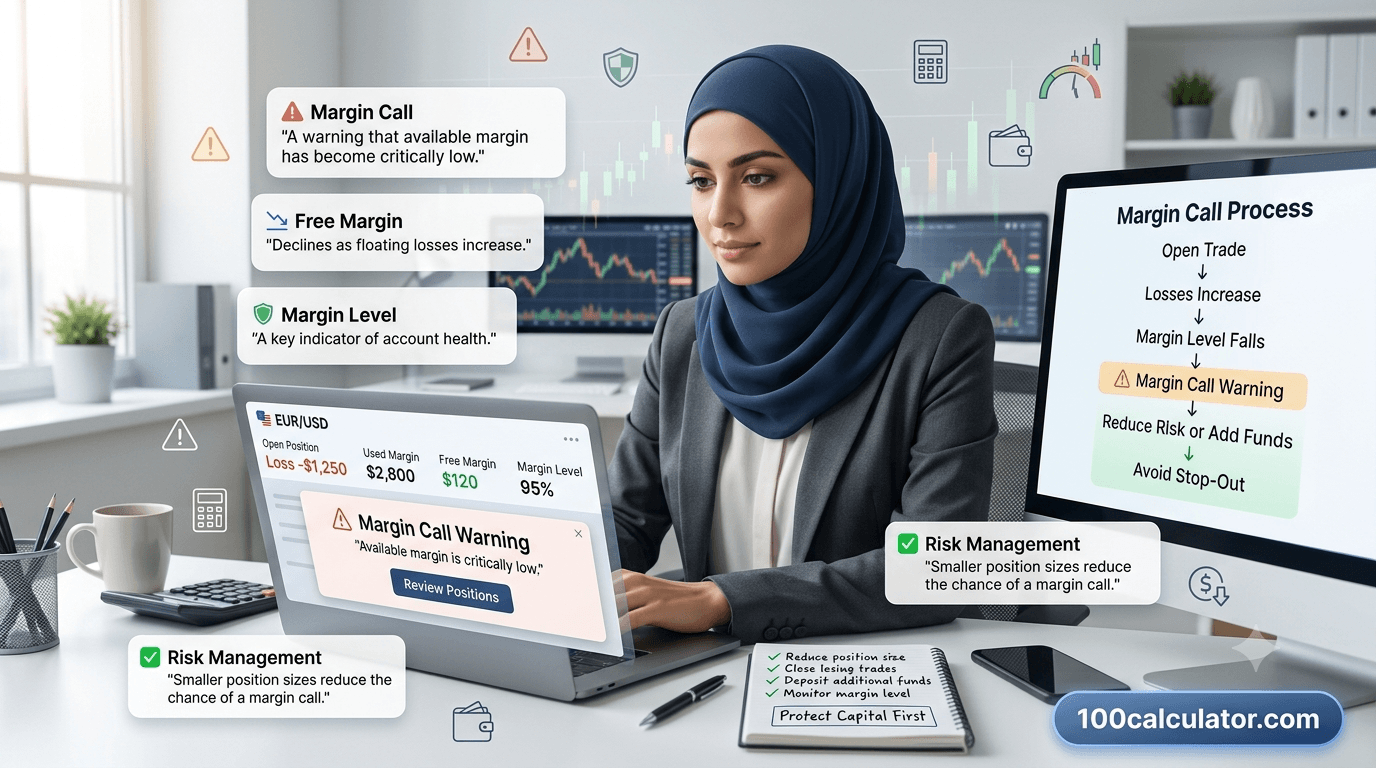
Nobody opens a forex position hoping to see the words "margin call." But if you trade with leverage for long enough, it's a moment most traders eventually run into. Understanding it ahead of time is what turns a stressful lesson into a manageable one.
A margin call happens when your account's equity drops too close to the margin you have locked up in open trades. Your broker warns you to add funds or close positions, and if your margin level falls further, the broker can start closing trades automatically to stop the losses from growing. It isn't a penalty, and it isn't personal. It's a built-in safety mechanism that protects both you and the broker from losses spiraling out of control.
This guide walks through exactly what triggers a margin call, what happens step by step once you get one, and how it's different from a stop-out. We'll work through a real numbers example, cover the habits that keep your margin level in a safe range, and show how a forex margin calculator can flag the danger zone before you ever place a risky trade.
Understanding Margin and Leverage in Forex
Margin calls only make sense once you understand the two ideas behind them: margin and leverage. They're related, but they're not the same thing, and mixing them up is usually where the confusion starts.
What Is Margin?
Margin is the portion of your account balance your broker sets aside as collateral while you have a trade open. It isn't a fee, and you don't lose it just by opening a position. It stays locked up, or "used," for as long as the trade is open, and it's released back to your free margin once you close it.
Think of it like a security deposit on an apartment. You're not spending that money; it's held to cover potential damage, and you get it back afterward, minus anything owed. Margin works the same way for your broker.
What Is Leverage?
Leverage is what lets a small amount of margin control a much larger position. With 50:1 leverage, for example, $200 of margin can control a $10,000 position. That's what makes forex trading capital-efficient, and it's also exactly why margin calls can happen faster than new traders expect.
Leverage doesn't change how much a currency pair moves. It changes how much that movement affects your account. A small price swing on a heavily leveraged position can shift your equity by a much larger percentage than the same swing would on an unleveraged one. Our guide on how margin and leverage work together in forex breaks this relationship down in more detail.
Key Margin Terms to Know
A handful of terms come up constantly once you start watching your margin level. Here's what each one actually means:
| Term | What It Means |
|---|---|
| Balance | The amount in your account before counting any open trades |
| Equity | Your balance adjusted for the current floating profit or loss on open trades |
| Used Margin | The amount set aside as collateral for your open positions |
| Free Margin | The money still available to open new trades or absorb losses |
| Margin Level | Equity divided by used margin, shown as a percentage; the number that determines margin call risk |
What Is a Margin Call?
The Simple Definition
A margin call is a warning from your broker that your margin level has dropped to, or close to, the minimum threshold needed to keep your current trades open. It usually shows up as a notification, an email, or a red indicator directly on your trading platform.
At that point, you have two realistic options: add more funds to raise your equity, or close some positions to free up used margin. Doing nothing is technically a third option, but it's the one most likely to end with the broker making the decision for you.
Margin Call vs. Stop-Out: What's the Difference?
These two terms get used interchangeably, but they describe two different stages of the same problem.
A margin call gives you a chance to act. A stop-out means that chance has passed. We'll walk through exactly how that second stage plays out later in this guide.
Why Do Margin Calls Happen?
A margin call is really just math catching up with a losing position. Once you know the common causes, you can usually see one coming long before your broker has to tell you.
Common Triggers
- The market moves against your position. This is the most direct cause. A losing trade reduces your equity in real time.
- You're using too much leverage for your account size. Higher leverage means smaller price moves have a bigger impact on your margin level.
- You have several trades open at once. Each open position uses margin, so multiple trades can drain your free margin even if none of them is losing badly on its own.
- You're not using stop-loss orders. Without one, a losing trade can keep running until your margin level forces the issue.
- A high-impact news event causes a sudden price spike. Volatility around economic data or central bank announcements can move prices further and faster than normal.
How Leverage Increases the Risk
Overnight and weekend gaps are a particular risk here. Currency markets react to news around the clock, and a position that looked fine when you went to bed can open the next session already deep in the red. Rollover and swap charges on positions held overnight can also quietly chip away at your equity over time; our guide on how overnight rollover fees affect forex trades covers this in more detail.
The (CFTC and NASAA) have long cautioned that off-exchange retail forex trading carries substantial risk, and leverage is a big part of why. It isn't a reason to avoid forex trading altogether, but it's a good reason to size positions with margin calls in mind from the start.
How to Calculate Your Margin Level
Your margin level is the single number that determines how close you are to a margin call. It's worth understanding the formula, even if you'll usually just glance at the number your platform shows you.
The Margin Level Formula
Margin Level Formula
Margin Level (%) = (Equity ÷ Used Margin) × 100
Equity is your account balance plus or minus any floating profit or loss on open trades.
Used Margin is the total amount currently locked up as collateral for your open positions.
Step-by-Step Example
Say you deposit $1,000 and open a trade that uses $200 of margin. If that trade is currently down $50, your equity is $950 ($1,000 minus $50), and your used margin is still $200.
Margin Level = ($950 ÷ $200) × 100 = 475%
A margin level of 475% is comfortably safe for most brokers. What matters is how quickly that percentage can drop as a trade moves further against you, which is exactly what the example in the next section walks through. If you'd rather skip the manual math, 100 Calculator's Forex Margin Calculator and Pip Value Calculator can work out these numbers for you before you place a trade. Our guide to pip value is a useful companion read if you want to understand how each of those numbers is calculated.
What Happens Step by Step When You Get a Margin Call
Once your margin level hits your broker's threshold, the process usually unfolds in a predictable order.
Step 1: The Warning Notification
You'll get an alert, typically an on-platform banner, a push notification, or an email, telling you that your margin level has reached the margin call threshold. At this stage, none of your trades have been closed yet. It's purely a warning.
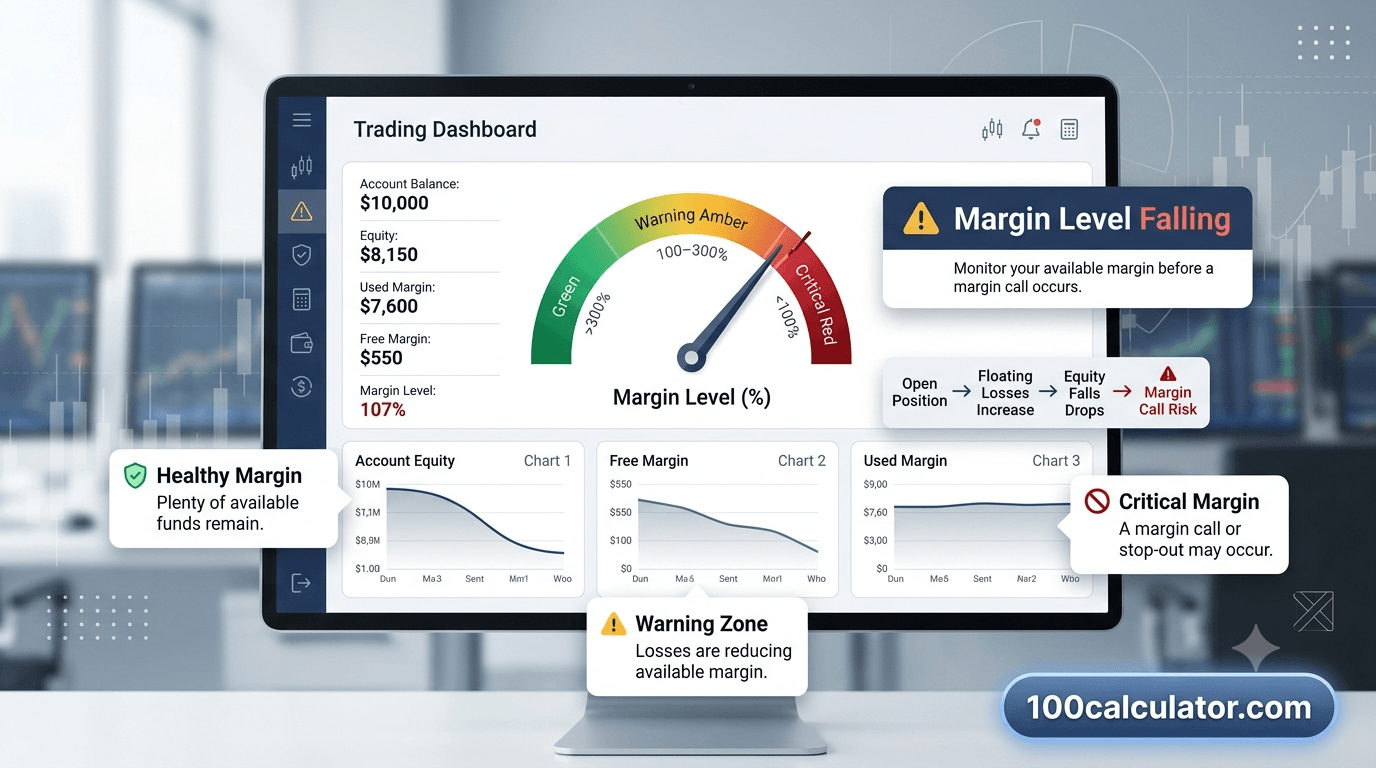
Step 2: Your Options at That Point
- Deposit additional funds. This raises your equity and, in turn, your margin level.
- Close one or more losing positions. This frees up used margin and immediately improves your margin level.
- Reduce position size on an open trade. Partially closing a position lowers used margin without exiting the trade entirely.
- Do nothing and hope the market turns. This is always an option, but it's the riskiest one, since it leaves the decision in the market's hands.
Step 3: What Happens If You Do Nothing
If your margin level keeps falling past the margin call threshold, it will eventually reach your broker's stop-out level. At that point, the broker's system automatically closes positions, usually starting with the largest loser, until your margin level climbs back above the stop-out line.
This isn't your broker being aggressive. According to (NFA) guidance for retail traders, you remain responsible for meeting margin calls and for any deficiency that goes beyond your margin deposit, so automatic closeout exists largely to protect you from a much larger loss, not just the broker.
A Real-World Margin Call Example
Numbers make this click faster than definitions do. Here's how a margin call actually plays out for a trader we'll call Jordan.
Jordan deposits $1,200 and opens a leveraged EUR/USD position at 9:00 a.m. that uses $500 in margin, an opening margin level of 240%. No stop-loss is set. Through the day, a surprise interest rate comment pushes the pair steadily against the position:
| Time | Floating P/L | Equity | Used Margin | Margin Level |
|---|---|---|---|---|
| 9:00 a.m. | $0 | $1,200 | $500 | 240% |
| 10:00 a.m. | −$150 | $1,050 | $500 | 210% |
| 11:00 a.m. | −$350 | $850 | $500 | 170% |
| 12:00 p.m. | −$550 | $650 | $500 | 130% |
| 1:00 p.m. | −$700 | $500 | $500 | 100% — margin call |
| 2:00 p.m. | −$840 | $360 | $500 | 72% |
| 3:00 p.m. | −$970 | $230 | $500 | 46% — stop-out |
By 1:00 p.m., Jordan gets the margin call warning but doesn't act on it. Two hours later, the account has fallen into stop-out territory, and the broker closes the remaining position automatically, locking in most of the original deposit as a loss. A stop-loss order or a smaller position size at the start of the day could have changed this outcome entirely.
How to Avoid a Margin Call
Most margin calls trace back to a handful of avoidable habits. None of these require giving up on leverage entirely, just using it more deliberately.
Right-Size Your Positions
Position size, not leverage alone, is usually the real culprit behind a margin call. A smaller position leaves more equity in reserve relative to the margin it uses. Our guide to choosing the right forex lot size walks through how to match position size to your account balance, and 100 Calculator's Forex Lot Size Calculator can do the math for you.
Use Stop-Loss Orders
A stop-loss closes your trade automatically once it hits a price you've decided is your limit, well before your margin level gets anywhere close to a call. It won't protect you from every gap or slippage event, but it removes the "will I notice in time" risk from most ordinary losing trades.
Keep a Margin Buffer
Using every dollar of available margin on open trades leaves no room for normal price fluctuation. Many experienced traders keep a meaningful cushion of free margin in reserve specifically so a temporary dip doesn't turn into a forced closeout.
Avoid Overleveraging
Just because your broker offers high leverage doesn't mean you need to use all of it on every trade. Choosing a lower effective leverage than the maximum available gives ordinary volatility more room to happen without threatening your margin level.

Free Online Tool
Check your margin before you trade
100 Calculator's Forex Margin Calculator shows exactly how much margin a position will use based on your lot size, leverage, and currency pair, so you can size trades with your margin level in mind from the start. Pair it with the Position Size Calculator to set a position size based on how much you're willing to risk.
A quick checklist to keep handy before you trade:
- Check the margin a trade will use before you open it
- Set a stop-loss on every position
- Leave a comfortable buffer of free margin unused
- Avoid opening several correlated positions at once
- Know your specific broker's margin call and stop-out levels
What to Do If You're Close to a Margin Call Right Now
If your margin level is dropping fast, a clear head matters more than a fast reaction.
- Check your open positions first. Identify which trade is losing the most and driving the drop.
- Decide between closing and funding, not both at once. Adding funds to a position you haven't reassessed often just delays the same problem.
- Close the weakest position first. This frees up the most used margin for the least overall change to your strategy.
- Check whether your account has negative balance protection. This varies by broker and by where you're regulated, so it's worth knowing in advance rather than during a crisis.
Common Margin Call Mistakes to Avoid
Even experienced traders fall into a few of these patterns. Watching for them is half the battle.
- Ignoring the first warning. A margin call is your cue to act, not a message to dismiss and check back on later.
- Adding funds without fixing the position size. Topping up your account without reducing exposure often just postpones the same outcome.
- Assuming every broker uses the same numbers. Margin call and stop-out levels vary, sometimes significantly, from one broker to the next.
- Trading with money you can't afford to lose. This turns an ordinary margin call into a genuine financial problem instead of a trading lesson.
- Turning off account notifications. Missing the early warning removes your best chance to respond before a stop-out happens.
Margin Requirements Across Brokers and Account Types
Regulators don't mandate one universal margin call or stop-out level, and the exact numbers vary by broker and jurisdiction. Under (FCA) rules for UK-regulated CFD and forex providers, firms are required to close a retail client's position once their funds fall to 50% of the margin needed to maintain it. Plenty of brokers elsewhere follow a similar structure voluntarily, though the specific numbers still differ.
| Setup Style | Margin Call Level | Stop-Out Level | What It Means |
|---|---|---|---|
| Common retail setup | Around 100% | Around 50% | Warning once equity roughly matches used margin; forced closure once equity covers half of it |
| Tighter setup | Around 80% | Around 50% | The warning arrives a little earlier |
| Looser setup | Around 100% | Around 20% | The broker allows equity to fall further before stepping in |
Account type can matter too. Standard accounts, professional accounts, and Islamic (swap-free) accounts sometimes carry different margin terms at the same broker. If you're unsure which numbers apply to you, your broker's margin policy page or account agreement will have the exact figures. Understanding how standard, mini, and micro lots differ is also worth a read, since lot size directly affects how much margin any given trade uses.
Building a Long-Term Risk Management Routine
Avoiding one margin call is useful. Building habits that keep you out of that territory consistently is what actually protects your account over time.
- Risk a small, consistent share of your account per trade. Many traders and trading educators cap this around 1–2% of account balance, so no single loss can do serious damage on its own.
- Know your risk-reward ratio before entering a trade. Our guide to risk-reward ratio explains why this matters more than win rate alone, and 100 Calculator's Risk Reward Ratio Calculator can check the math for you.
- Keep a simple trading journal. Logging position size, leverage used, and outcome makes patterns, including the ones leading to margin calls, much easier to spot.
- Review your account weekly, not just after a loss. Catching a margin level trending downward early gives you far more options than noticing it during a crisis.
- Scale position size gradually as your account grows. Resist the urge to immediately trade larger after a winning streak; consistency matters more than any single result.
Related Calculators
Put what you just read into practice, try these free tools instantly, no sign-up required.
Forex Compounding Calculator
Project compounded growth of your forex trading account.
Forex Swap & Rollover Calculator
Calculate overnight swap and rollover fees on forex positions.
Forex Lot Size Calculator
Find the ideal lot size based on your account and risk.
Forex Margin Calculator
Calculate the margin required to open a forex position.
Pip Value Calculator
Calculate the value of a pip for any currency pair and lot size.
When to Reassess Your Trading Strategy
One margin call can happen to anyone, even with careful planning, since markets are unpredictable by nature. A pattern of repeated margin calls is a different signal entirely, and it usually points to position sizing or strategy rather than bad luck.
If you've had more than one or two margin calls in a short stretch, it's worth stepping back and reviewing your win rate, your average risk-reward ratio, and how much leverage you're actually using compared to what you intended. If a series of losses has already eaten into your account, our guide on recovering from a drawdown explains why the return needed to break even climbs faster than most traders expect, and 100 Calculator's Drawdown Recovery Calculator can show you that math directly.
Testing adjustments on a demo account before returning to live trading is a reasonable middle step, and for larger or more persistent losses, a conversation with a licensed financial professional is worth considering alongside anything you read here.
Trading risk disclaimer: This article is for general educational purposes only and isn't financial or investment advice. Forex trading involves substantial risk, including the potential loss of more than your initial deposit in some circumstances, and it isn't suitable for everyone. Margin requirements, stop-out levels, and negative balance protection policies vary by broker and jurisdiction, so always confirm the specific terms with your own broker and consult a licensed financial professional before trading with leverage.
Sources & References
More From Our Forex Guide
Still building your understanding of margin, leverage, and everyday forex trading mechanics? These related guides dig deeper into the topics covered above.
Frequently Asked Questions
What is a margin call in forex trading?
A margin call is a warning from your broker that your account's margin level has dropped too close to the minimum required to keep your trades open. It means your equity is getting close to the amount of margin locked up in open positions, and you need to add funds or close trades before the broker starts closing them for you.
What triggers a margin call?
A margin call is triggered when losses on open trades shrink your equity enough that your margin level falls to your broker's specific margin call threshold, often somewhere around 100%. Common causes include holding too many positions, trading with too much leverage, or not using stop-loss orders during a volatile move.
What's the difference between a margin call and a stop-out?
A margin call is a warning; a stop-out is an action. The margin call tells you your margin level is getting low, while the stop-out level is a lower threshold where the broker starts automatically closing your open positions, usually starting with the biggest loser, to stop your account from going further negative.
How is margin level calculated?
Margin level is your account equity divided by your used margin, multiplied by 100. For example, if your equity is $950 and you have $200 of margin locked up in open trades, your margin level is 475%, which is comfortably in safe territory for most brokers.
Can I lose more than my account balance in a margin call?
It depends on your broker and where they're regulated. Some brokers and jurisdictions offer negative balance protection, which caps your losses at your deposited funds. Others don't, which means a fast-moving market could theoretically push your balance below zero. Check your broker's specific policy before trading with leverage.
How do I avoid a margin call?
Keep your position sizes small relative to your account balance, use stop-loss orders on every trade, and avoid using your full available margin at once. Checking a forex margin calculator before you open a trade is a quick way to see how much margin a position actually requires before you commit to it.
What happens if I ignore a margin call?
If you ignore a margin call and your equity keeps falling, your margin level will eventually reach your broker's stop-out level. At that point, the broker automatically closes one or more of your open positions, starting with the largest loss, to bring your margin level back above the stop-out threshold.
Is a margin call the same as getting liquidated?
Not exactly. A margin call is the warning stage, while liquidation, often called a stop-out, is what happens if the margin level keeps dropping after the warning. Liquidation is the broker forcibly closing your positions, while a margin call is simply notifying you that action is needed.
What margin level do most brokers use for margin calls?
This varies by broker. A common setup pairs a margin call around 100% with a stop-out around 50%, but plenty of brokers use different numbers, such as 80% or 20% for the stop-out level. Always check your specific broker's margin policy rather than assuming a standard number applies to you.
Can a margin call happen overnight?
Yes. Currency prices can move significantly outside your normal trading hours because of economic news, central bank announcements, or events in other time zones. If a position moves sharply against you overnight, your margin level can drop enough to trigger a margin call before you're even awake to react.
Does higher leverage increase margin call risk?
Yes. Higher leverage means you're controlling a larger position with the same amount of margin, so price moves have a bigger impact on your equity relative to your used margin. A small adverse move that would barely affect a low-leverage account can push a highly leveraged account toward a margin call much faster.
What should I do immediately after a margin call?
Stop and assess before reacting. Look at which positions are losing the most, decide whether to close some of them or add funds, and avoid impulsively adding money just to keep a losing trade open longer. Use the moment to review whether your position sizing was too aggressive in the first place.
Can I add funds during a margin call to save my position?
In most cases, yes. Depositing additional funds raises your equity and your margin level, which can pull you out of margin call territory. That said, adding funds without addressing why the position moved against you in the first place often just delays the same problem rather than solving it.
Do all forex brokers use the same margin call rules?
No. Margin call levels, stop-out levels, and negative balance protection policies all vary from broker to broker and often depend on the regulatory framework the broker operates under. It's worth reading your broker's specific margin policy document rather than assuming it matches what you've read elsewhere.
How can a forex margin calculator help prevent margin calls?
A forex margin calculator shows you exactly how much margin a trade will use before you open it, based on your position size, leverage, and currency pair. Checking this ahead of time helps you avoid accidentally using too much of your available margin on a single trade.
What's a safe margin level to maintain while trading?
There's no single "safe" number that applies to everyone, but many traders aim to keep their margin level comfortably above 200% to 300% as a buffer against normal price swings. The right cushion depends on your strategy, how many positions you hold at once, and how volatile the pairs you trade tend to be.
About 100 Calculator
100 Calculator is a free hub of online calculators and educational guides covering health, finance, trading, crypto, education, and more. Every tool is built to be fast, accurate, and genuinely free, with no account or signup required.
We built this guide, along with tools like the Forex Margin Calculator referenced throughout it, to make trading concepts easier to understand before you put real money on the line. Head back to the 100 Calculator homepage to explore the full library of tools, or learn more about the team behind them on our About Us page.