How Compound Interest Grows Your Money Over Time
A clear, no-jargon walkthrough of how compound interest actually works — the formula, real worked examples, the Rule of 72, and what happens when you give your money enough time to grow on its own.

A dollar sitting in an account doesn't just wait around to become two dollars. Once it starts earning interest, that interest starts earning its own interest — and that one detail is the entire reason ordinary, unremarkable savings habits can turn into real money over time.
Compound interest is interest calculated on both your original principal and on the interest that principal has already earned, so your balance grows by a slightly larger amount every period instead of the same flat amount each time. Simple interest, by comparison, only ever pays you based on your starting balance. The gap between the two looks tiny after one year. After twenty or thirty years, it isn't.
If you'd rather see the effect on your own numbers right away, 100 Calculator's Premium Compound Interest Calculator will run the math instantly for any starting amount, rate, and time frame you enter.
In this guide, we'll go through the compound interest formula step by step, work through real examples with real numbers, look at how compounding frequency changes your results, and cover shortcuts like the Rule of 72 — plus what Warren Buffett has actually said about compounding, and how all of it connects to retirement planning.
What Is Compound Interest?
Compound interest is interest you earn on your interest. Every savings account, index fund, and retirement account that reinvests its earnings works this way by default, but it's easy to use the term for years without ever quite picturing what's happening underneath it.
Picture a simple case. You put $1,000 in an account paying 5% interest once a year. After year one, you have $1,050. If that account only paid simple interest, you'd earn another flat $50 in year two, no matter how long you kept the money there. With compound interest, though, year two's 5% applies to the whole $1,050 — not just your original $1,000 — so you earn $52.50 instead. That $2.50 difference looks trivial on its own. Run the same account for 30 years, and the gap between simple and compound interest turns into tens of thousands of dollars, purely because each year's interest becomes part of the balance that earns the next year's interest.
Compound Interest vs. Simple Interest
The two work differently enough that it's worth seeing them side by side:
| Feature | Simple Interest | Compound Interest |
|---|---|---|
| Calculated on | Only the original principal | Principal plus all interest earned so far |
| Growth pattern | Linear — the same amount added each period | Exponential — the amount added grows every period |
| Common uses | Some personal loans, auto loans, bonds | Savings accounts, most investments, credit card debt |
| Effect of extra time | Grows at the same steady rate regardless | Accelerates the longer it runs |
Our guide on simple interest vs. compound interest breaks this comparison down in more detail if you're choosing between two specific accounts or loans.
Key Terms You'll See in This Guide
- Principal: the amount you start with, before any interest is added
- Interest rate: the percentage your money grows by, usually stated as an annual rate
- Compounding frequency: how often interest is calculated and added — annually, monthly, daily, and so on
- Time: how long the money stays invested, almost always measured in years
Those four ideas are literally the four inputs in the compound interest formula, which we'll walk through next.
The Compound Interest Formula Explained
Once you understand what compound interest means in practice, the formula is just a way of writing that idea down so you can calculate it for any starting amount, rate, or time period. The standard compound interest formula looks like this:
Breaking Down Each Part of the Formula
| Symbol | Meaning |
|---|---|
| A | The final amount, after interest |
| P | The principal — your starting amount |
| r | The annual interest rate, written as a decimal (5% becomes 0.05) |
| n | Number of times interest compounds per year |
| t | Number of years the money is invested |
So if you come across a compound interest formula example with solution somewhere else, all it's really doing is dropping specific numbers into those five slots and solving for A.
A Compound Interest Formula Example With Solution
Let's work through an actual example step by step so the formula stops feeling abstract.
Say you invest $2,000 (P) at a 5% annual interest rate (r = 0.05), compounded once a year (n = 1), for 6 years (t = 6):
- A = 2,000 × (1 + 0.05/1)1×6
- A = 2,000 × (1.05)6
- A = $2,680.19
You'd earn $680.19 in interest over six years — more than the flat $600 you'd earn from simple interest at the same rate, because each year's interest gets added to the balance that earns the next year's interest.
Now compound that same $2,000 quarterly instead of annually (n = 4):
- A = 2,000 × (1 + 0.05/4)4×6
- A = $2,694.70
Compounding more often nudges the total up by about $14.51 in this example — a modest bump here, but one that becomes meaningful at larger balances and longer time frames, which we'll look at a little later on. For now, if you want to skip the arithmetic entirely, plugging your own numbers into the Premium Compound Interest Calculator gets you the same result instantly.
Why Compound Interest Grows Your Money Faster Over Time
The Snowball Effect
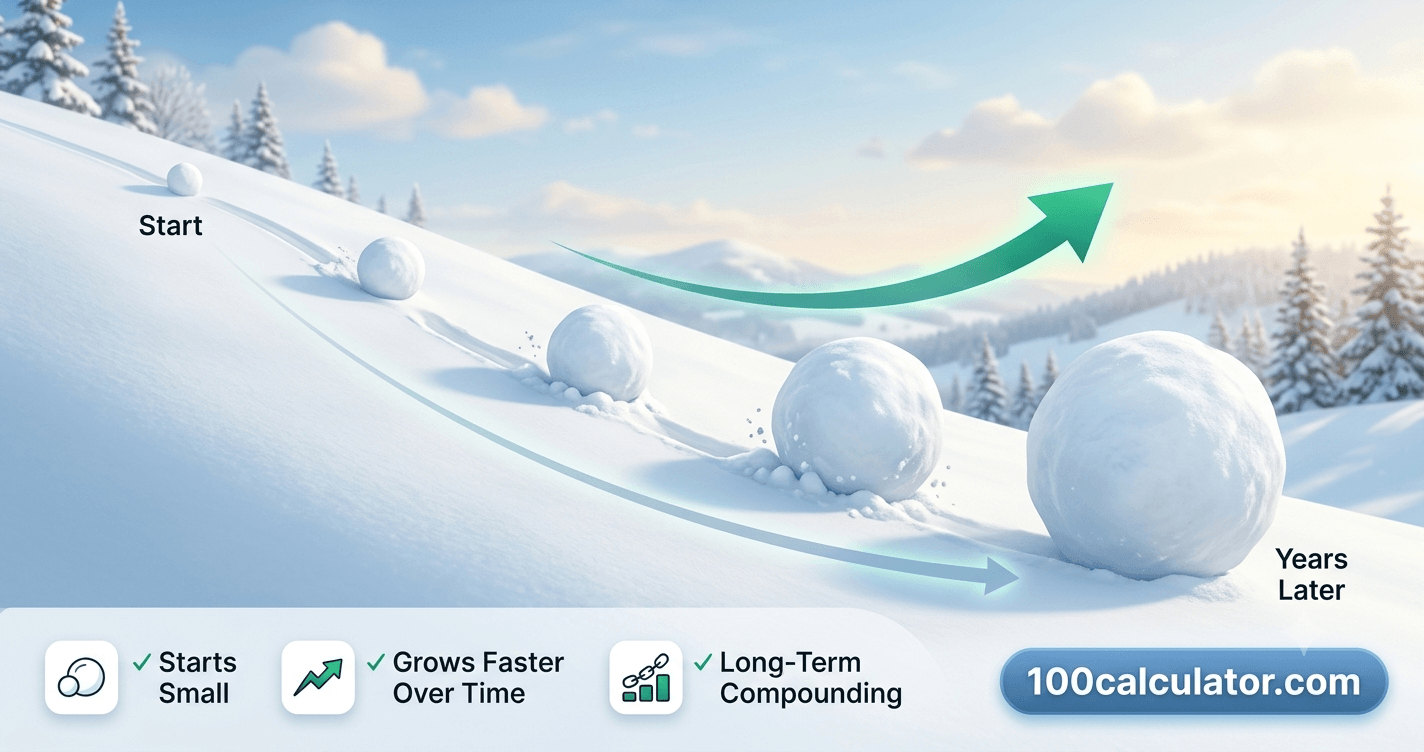
Compound interest is often compared to a snowball rolling down a hill. At the top, the snowball is small and picks up snow slowly. But as it grows, it has more surface area to collect more snow, so it speeds up. By the bottom of the hill, it's picking up more snow in a single second than it did during its first ten seconds combined.
Your money behaves the same way. In the early years, the interest you earn is small because your balance is still small. But as that interest gets added back in and starts earning its own interest, growth accelerates — not steadily, but exponentially. This is why compound interest is usually drawn as a curve that looks almost flat at first and then bends sharply upward.
Why Starting Early Beats Starting Big
Because compounding accelerates over time, the number of years your money stays invested usually matters more than how much you started with. A modest amount invested in your twenties often outgrows a much larger amount invested in your forties, simply because it has more compounding cycles to work through. The next section shows exactly how large that gap can get.
Real Compound Interest Examples
Formulas are easier to trust once you've seen them play out with real numbers. Here are two of the clearest compound interest examples for understanding why time and consistency matter so much.
Example 1 — Starting at 25 vs. Starting at 35
Investor A starts at age 25, investing $300 a month for 10 years, then stops adding new money entirely and simply leaves the account alone until age 65, earning a steady 7% average annual return compounded monthly.
Investor B waits until age 35 to start, then invests that same $300 a month continuously for 30 years, all the way to age 65, at the same 7% return.
| Detail | Investor A | Investor B |
|---|---|---|
| Started investing at age | 25 | 35 |
| Years of active contributions | 10 | 30 |
| Total contributed | $36,000 | $108,000 |
| Balance at age 65 | $421,453 | $365,991 |
Investor A put in exactly one-third of what Investor B contributed, and stopped adding new money twenty years earlier — yet ends up with more money at 65. The only real difference between them is when the money started compounding, not how much of it there was.
Example 2 — What Compounding Alone Adds
You don't need contributions at all for compounding to matter. Consider a single $10,000 deposit left untouched for 30 years, comparing simple interest to compound interest at the same 7% annual rate:
- Simple interest total after 30 years: $31,000
- Compound interest total after 30 years: $76,122.55
That's a difference of more than $45,000 on the exact same starting amount and the exact same rate — the only variable is whether the interest itself gets to earn interest. The chart below plots both scenarios year by year, so you can see how flat the difference stays early on and how sharply it separates later.
Dividend-paying investments follow a similar pattern when dividends are automatically reinvested rather than taken as cash. As one illustration, financial data trackers have calculated that a $1,000 investment in Coca-Cola stock made three decades ago would be worth roughly $9,000 today, with more than half of that total coming from reinvested dividends rather than the stock's price growth alone — a reminder that compounding applies to dividend reinvestment just as much as it does to a plain savings account.
How Compounding Frequency Changes Your Growth
The "n" in the compound interest formula — how often interest compounds — also affects your final total, though usually by less than people expect. Take $10,000 invested at 6% annually for 20 years, and compare what happens at different compounding frequencies:
| Compounding Frequency | Balance After 20 Years |
|---|---|
| Annually | $32,071.35 |
| Semiannually | $32,620.38 |
| Quarterly | $32,906.63 |
| Monthly | $33,102.04 |
| Daily | $33,197.90 |
Moving from annual to daily compounding adds about $1,126.55 over 20 years on this $10,000 balance — a real difference, but a small one compared with the effect of the interest rate itself or how long the money stays invested.
Does Compounding Frequency Really Matter That Much?
Compounding frequency is worth knowing, especially when comparing two accounts with the same stated interest rate, since the one that compounds more often will technically pay slightly more. But it's a secondary factor. If you're deciding between starting to invest now at a lower rate or waiting a few years for a slightly better one, the earlier start almost always wins, because time affects your total far more than compounding frequency does. Our guides on how daily compounding differs from monthly or yearly and why daily compounding can boost your savings growth go into more detail, and 100 Calculator's Daily Compound Interest Calculator runs the numbers for any balance and rate you enter.
The Rule of 72 (and Other Quick Ways to Estimate Compounding)
How the Rule of 72 Works
The Rule of 72 is a mental shortcut for estimating how many years it takes an investment to double at a given annual interest rate, without running the full formula. Divide 72 by the interest rate (as a whole number, not a decimal), and the result is roughly the number of years to double your money.
| Annual Rate | Rule of 72 Estimate | Actual Years to Double |
|---|---|---|
| 4% | 18.0 years | 17.67 years |
| 6% | 12.0 years | 11.90 years |
| 8% | 9.0 years | 9.01 years |
| 9% | 8.0 years | 8.04 years |
| 12% | 6.0 years | 6.12 years |
As the table shows, the Rule of 72 is remarkably accurate for rates between roughly 6% and 10%, which is exactly the range most long-term stock market returns fall into. So yes — the Rule of 72 genuinely is a compounding shortcut, not just a loose approximation people use casually.
The Rule of 69 for Continuous Compounding
Less commonly used, but worth knowing: the Rule of 69 (sometimes written as the Rule of 69.3) works the same way as the Rule of 72, but it's built for continuous compounding rather than the periodic annual, monthly, or daily compounding most real accounts actually use. Divide 69.3 by your rate to estimate doubling time — at a 15% continuously compounded rate, for example, that's roughly 4.6 years. It shows up occasionally in academic finance and some real estate return calculations, but for everyday savings and investment accounts, the Rule of 72 remains the more practical version.
The 8-4-3 Rule: A Popular Way to Visualize Compounding
You may have come across the 8-4-3 rule, especially in the context of regular monthly investing. It's a popular illustration — not a strict formula — for how compounding accelerates in phases when you invest a fixed amount every month at an assumed steady return, commonly modeled around 12% annually. The idea: your first meaningful stretch of growth takes about 8 years, a comparable jump takes only 4 more years after that, and the jump after that takes just 3 more years, because the same growth rate is now being applied to a much larger balance.
Here's what that looks like with $500 invested monthly at a 12% annual return, compounded monthly:
- After 8 years: about $79,964 in the account, from $48,000 contributed
- Years 9–12 add roughly $79,567 more — nearly matching the growth of the first 8 years, in half the time
- Years 13–15 add about $90,259 more — surpassing the first 8 years' growth in just 3 years
The 8-4-3 rule assumes a constant rate of return, which real investments never quite deliver, so treat it as a teaching tool rather than a forecast. The underlying lesson still holds up mathematically: the later years of consistent investing tend to contribute far more growth than the early years, which is exactly why stopping early is the most expensive mistake an investor can make.
What Warren Buffett Says About Compound Interest
Buffett's 90/10 Rule
Warren Buffett, chairman of Berkshire Hathaway, has talked about the power of long-term compounding for decades, and his advice consistently comes back to one theme: keep it simple, keep costs low, and give your money time.
The clearest example is what's become known as Buffett's 90/10 rule. (Berkshire Hathaway) In a letter to Berkshire Hathaway shareholders, Buffett described the instructions he'd left for a trust to benefit his wife after his death: put 90% of the cash into a very low-cost S&P 500 index fund, and the remaining 10% into short-term government bonds. His reasoning was straightforward — over long periods, most professional fund managers don't outperform a low-cost index fund after fees, so a simple, diversified, low-cost approach held for decades tends to beat a more complicated one.
The 90/10 rule isn't really about picking a single winning stock. It's about giving compounding as much room as possible to work by keeping fees low and staying invested, rather than trying to time the market or chase individual winners.
The "Eighth Wonder of the World" Quote
You'll frequently see compound interest described as the "eighth wonder of the world," usually attributed to Albert Einstein. It's a popular line in finance writing, but quote researchers who've traced its origin have found no verified record of Einstein ever saying it — the phrase appears to trace back to bank advertising copy from the 1920s, long before it started getting attached to Einstein's name. Whoever said it first, the underlying point holds up mathematically: money that compounds over long stretches of time grows in a way that looks almost unbelievable compared with money that doesn't.
Related Calculators
Put what you just read into practice, try these free tools instantly, no sign-up required.
Premium Compound Interest Calculator
Calculate compound interest growth on your investments over time.
Premium Simple Interest Calculator
Quickly calculate simple interest earned or owed on a principal.
Daily Compound Interest Calculator
See how daily compounding interest grows your savings over time.
FIRE Financial Independence Calculator
Plan your path to financial independence and early retirement.
4 Percent Rule Calculator
Estimate safe retirement withdrawals using the 4% rule.
Common Mistakes That Slow Down Compound Growth
Even with the math on your side, a few habits can quietly undercut how much compounding actually does for you. Here's what to watch for:
- Waiting to start. Every year you delay is a year of compounding you can't get back, even if you invest more later to try to catch up.
- Withdrawing early. Pulling money out — even temporarily — interrupts the compounding process and can cost far more than the amount you withdrew.
- Ignoring fees. A 1–2% annual fee doesn't sound like much, but compounded against your returns over decades, it can quietly eat a significant share of your total growth.
- Not reinvesting interest or dividends. If you take your returns out in cash instead of leaving them invested, you're only earning simple interest on your original amount, no matter what the account is technically capable of.
- Chasing short-term wins. Frequently moving money in search of the next best rate or hot stock interrupts the steady compounding that comes from simply staying invested.
Our related guide on compound interest mistakes that cost you money walks through each of these in more depth, with examples of what they actually cost over time.
How to Put Compound Interest to Work for You
- Start with whatever amount you have. The exact dollar amount matters far less than the number of years it has to compound.
- Automate your contributions. Setting up automatic transfers removes the decision-making from the equation and keeps your compounding consistent.
- Reinvest your returns. Whether it's interest, dividends, or capital gains, leaving your returns invested is what actually makes them compound.
- Compare accounts by more than the headline rate. A slightly higher rate with more frequent compounding, or lower fees, can outperform a flashier number over time.
- Model your own numbers. Run your actual starting amount, rate, and time frame through 100 Calculator's Premium Compound Interest Calculator to see your specific results instead of relying on generic examples.
- Leave it alone. Once your money is compounding, the single best thing you can usually do is not interrupt it.
Compound Interest and Retirement Planning
Connecting Compounding to the FIRE Movement and the 4% Rule
Retirement planning is really just compound interest applied to a specific goal and a specific deadline. Two ideas come up constantly in that conversation: the FIRE movement and the 4% rule.
The FIRE movement — Financial Independence, Retire Early — is built almost entirely around compound growth: save and invest aggressively while you're working, let compounding do the heavy lifting for as many years as possible, and reach a portfolio large enough to support your expenses without a paycheck. Our guides on what the FIRE movement is and how it works and how to calculate your FIRE number for retirement cover the mechanics in more depth, and the FIRE Financial Independence Calculator can help you estimate your own target.
The 4% rule offers a rough framework for the other side of that question: how much yearly income a given portfolio can reasonably support. As one illustration, generating $3,000 a month — $36,000 a year — using a 4% withdrawal rate would call for a portfolio of roughly $900,000. Whether a specific number like $2 million is "enough" to retire at 70, or at any age, depends on far more than portfolio size alone: your expected expenses, other income sources like Social Security, health care costs, and how long you expect to need that income all factor in. That's exactly the kind of calculation worth running with your own numbers rather than a one-size rule of thumb. Our 4 Percent Rule Calculator, along with our articles on how the 4 percent rule works for retirement planning and whether the 4 percent rule is still safe for retirees today, walk through those assumptions in more detail.
Financial disclaimer: This article is for general educational purposes only and isn't personalized financial, investment, or tax advice. Interest rates, investment returns, and account terms vary by provider and change over time, and past performance never guarantees future results. Always confirm current rates and terms with your financial institution, and consider speaking with a licensed financial advisor before making significant investment or retirement decisions.
More From Our Finance Guides
Still building your understanding of interest, compounding, and retirement planning? These related guides dig deeper into the topics covered above.
Frequently Asked Questions
What is compound interest?
Compound interest is interest calculated on both your original principal and on the interest that principal has already earned. Instead of earning the same flat amount every period like simple interest, your balance grows a little faster with each cycle, since previous interest becomes part of the amount that earns the next round of interest. Over short periods the difference is minor; over years or decades, it becomes the main driver of investment growth.
What is the compound interest formula?
The compound interest formula is A = P(1 + r/n)nt, where A is the final amount, P is your starting principal, r is the annual interest rate as a decimal, n is how many times per year interest compounds, and t is the number of years invested. Plugging your own numbers into this formula tells you exactly how a given balance will grow under a given rate and time frame.
How does compound interest help your money grow over time?
Compound interest helps your money grow faster over time because every period's interest gets added to your balance, so the next period's interest is calculated on a larger amount. Early on, this effect is small and easy to overlook. But because the growth compounds on itself, the curve bends upward more sharply the longer the money stays invested, which is why the biggest gains in a long-term investment often happen in its final years rather than its first ones.
Why is compound interest important?
Compound interest is important because it's the mechanism behind almost all long-term wealth building, from basic savings accounts to retirement portfolios. Understanding it helps you see why starting to invest early matters more than starting with a large amount, why fees quietly cost more than they appear to, and why leaving your returns invested rather than cashing them out changes your long-term results dramatically.
What is the Rule of 72, and is it really about compounding?
Yes — the Rule of 72 is a genuine compounding shortcut, not just a loose approximation. Divide 72 by an investment's annual interest rate to estimate how many years it will take to double in value. At 8% annual growth, for example, 72 ÷ 8 = 9 years, which lines up closely with the actual mathematical answer of about 9.01 years. It's most accurate for rates between roughly 6% and 10%, which covers most long-term stock market and retirement account returns.
Is there a Rule of 69 too?
Yes. The Rule of 69, sometimes called the Rule of 69.3, works the same way as the Rule of 72 but is designed for continuous compounding rather than the periodic compounding most bank and investment accounts actually use. Divide 69.3 by the annual rate to estimate doubling time. It shows up more in academic finance and certain real estate return calculations than in everyday personal finance, where the Rule of 72 remains the more practical shortcut.
What is the 8-4-3 rule of compounding?
The 8-4-3 rule is a popular way to illustrate how consistent monthly investing accelerates over time, commonly modeled at an assumed 12% annual return. It suggests your investment reaches a first major growth milestone in about 8 years, a comparable milestone 4 years after that, and another one just 3 years after that, since each stage applies the same growth rate to a larger balance. It's an illustrative teaching tool based on an assumed constant return, not a guaranteed formula, since real investment returns fluctuate year to year.
What does Warren Buffett say about compound interest?
Warren Buffett has emphasized long-term, low-cost, patient investing for decades as the practical way to let compounding work. His best-known specific example is called the 90/10 rule: in a letter to Berkshire Hathaway shareholders, he explained that he'd instructed a trustee to invest 90% of a cash inheritance for his wife in a low-cost S&P 500 index fund and the remaining 10% in short-term government bonds, reasoning that a simple, low-fee, diversified approach held over a long period tends to outperform more complicated strategies.
Is 1% per month the same as 12% per annum?
No, and this is a common source of confusion. If you earn 1% every month and that interest compounds, you actually end up with about 12.68% growth over a full year, not a flat 12%, because each month's 1% is calculated on a slightly larger balance than the month before. A flat, non-compounding 12% per year and a compounding 1% per month sound similar but produce different results, with the compounding monthly version coming out ahead.
What is the "golden rule" of compounding?
There's no single official definition, but the phrase usually points to the same core idea covered throughout this guide: start as early as possible and give your money as much time as possible to compound. Time has a bigger effect on your final total than almost any other factor you can control, including how much money you start with.
How much would I need to invest to generate $3,000 a month in retirement?
Using the commonly cited 4% withdrawal rule as a rough guide, generating $3,000 a month, or $36,000 a year, would call for a portfolio of about $900,000 ($36,000 ÷ 0.04). This is a simplified illustration, not a personalized target — your actual number depends on your expected expenses, other income like Social Security, taxes, and inflation. Our 4 Percent Rule Calculator can help you model your own numbers.
Is $2 million enough to retire at 70?
It depends heavily on your circumstances, so there's no single yes-or-no answer. Using the 4% rule as a rough guide, a $2 million portfolio could support roughly $80,000 a year before other income sources like Social Security. Whether that's enough depends on your expected living expenses, health care costs, where you live, debt, and how long you expect retirement to last. It's worth running your specific numbers rather than relying on a round figure that works for everyone.
What's the difference between rules like 70/20/10, 50/30/20, and 75/15/10?
These are budgeting frameworks for splitting your income, not compounding formulas, and you'll see several variations online. The 50/30/20 rule allocates 50% to needs, 30% to wants, and 20% to savings; the 70/20/10 rule typically allocates 70% to everyday expenses, 20% to savings and investing, and 10% to debt repayment or giving; and the 75/15/10 rule allocates 75% to expenses, 15% to long-term investing, and 10% to short-term savings. None is objectively "better" — the right one depends on your income, cost of living, and goals. What matters more than the framework you pick is consistently investing a portion of your income long enough for compounding to take effect.
What about the 3-6-9 rule or the "8-8-8 rule"? Are those about compound interest?
Not directly. The 3-6-9 rule is typically used for sizing an emergency fund, aiming for 3, 6, or 9 months of expenses in savings, rather than describing investment growth. The "8-8-8 rule," which splits a day into 8 hours of sleep, 8 hours of work, and 8 hours of personal time, is a time-management idea that circulates online loosely associated with Warren Buffett's habits, but it isn't a verified quote from him and has nothing to do with compounding math. Both are useful ideas in their own right, just not compound interest rules.
Sources & References
This guide draws on publicly available resources from the U.S. Securities and Exchange Commission and Warren Buffett's own shareholder letters to Berkshire Hathaway:
- U.S. Securities and Exchange Commission, Investor.gov — Compound Interest Calculator
- U.S. Securities and Exchange Commission, Investor.gov — Compound Interest (glossary definition)
- Berkshire Hathaway Inc. — Shareholder Letters, source for Warren Buffett's 90/10 rule
About 100 Calculator
100 Calculator is a free hub of online calculators and educational guides covering health, finance, trading, crypto, education, and more. Every tool is built to be fast, accurate, and genuinely free, with no account or signup required.
We built this guide, and tools like the Premium Compound Interest Calculator referenced throughout it, to make everyday money questions a little easier to answer. Head back to the 100 Calculator homepage to explore the full library of tools, or learn more about the team behind them on our About Us page.